replace disc SUBARU FORESTER 2004 Service Repair Manual
[x] Cancel search | Manufacturer: SUBARU, Model Year: 2004, Model line: FORESTER, Model: SUBARU FORESTER 2004Pages: 2870, PDF Size: 38.67 MB
Page 765 of 2870
PM-28
PERIODIC MAINTENANCE SERVICE
Front & Rear Differential Oil
17.Front & Rear Differential Oil
A: REPLACEMENT
1. FRONT DIFFERENTIAL (MT MODEL)
For MT model, manual transmission oil works as
differential oil to lubricate differential. Refer to
“Transmission Oil”.
2. FRONT DIFFERENTIAL (AT MODEL)
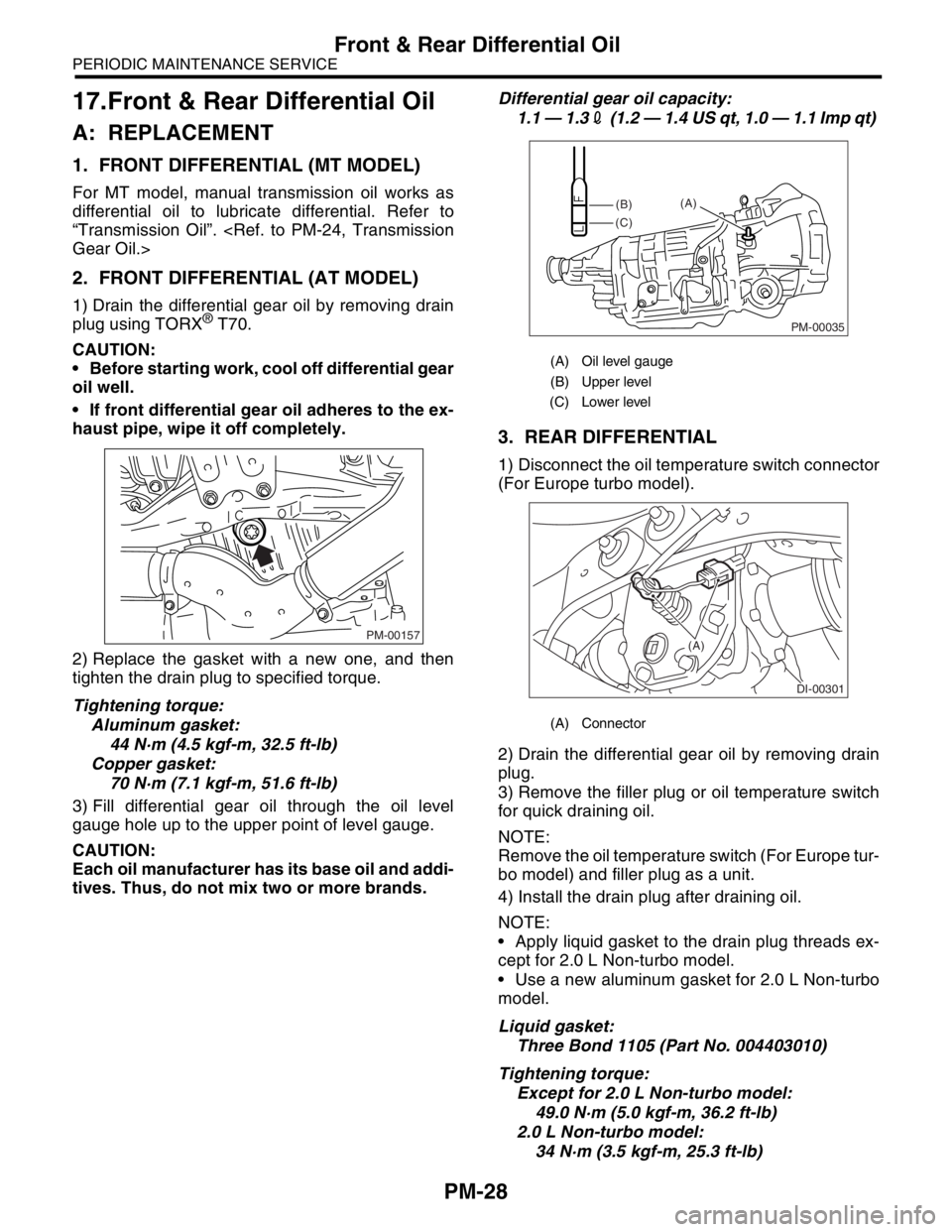
1) Drain the differential gear oil by removing drain
plug using TORX® T70.
CAUTION:
Before starting work, cool off differential gear
oil well.
If front differential gear oil adheres to the ex-
haust pipe, wipe it off completely.
2) Replace the gasket with a new one, and then
tighten the drain plug to specified torque.
Tightening torque:
Aluminum gasket:
44 N·m (4.5 kgf-m, 32.5 ft-lb)
Copper gasket:
70 N·m (7.1 kgf-m, 51.6 ft-lb)
3) Fill differential gear oil through the oil level
gauge hole up to the upper point of level gauge.
CAUTION:
Each oil manufacturer has its base oil and addi-
tives. Thus, do not mix two or more brands.Differential gear oil capacity:
1.1 — 1.32 (1.2 — 1.4 US qt, 1.0 — 1.1 Imp qt)
3. REAR DIFFERENTIAL
1) Disconnect the oil temperature switch connector
(For Europe turbo model).
2) Drain the differential gear oil by removing drain
plug.
3) Remove the filler plug or oil temperature switch
for quick draining oil.
NOTE:
Remove the oil temperature switch (For Europe tur-
bo model) and filler plug as a unit.
4) Install the drain plug after draining oil.
NOTE:
Apply liquid gasket to the drain plug threads ex-
cept for 2.0 L Non-turbo model.
Use a new aluminum gasket for 2.0 L Non-turbo
model.
Liquid gasket:
Three Bond 1105 (Part No. 004403010)
Tightening torque:
Except for 2.0 L Non-turbo model:
49.0 N·m (5.0 kgf-m, 36.2 ft-lb)
2.0 L Non-turbo model:
34 N·m (3.5 kgf-m, 25.3 ft-lb)
PM-00157
(A) Oil level gauge
(B) Upper level
(C) Lower level
(A) Connector
PM-00035
(B)
(C)(A)
DI-00301
(A)
Page 770 of 2870
PM-33
PERIODIC MAINTENANCE SERVICE
Disc Brake Pads and Discs
20.Disc Brake Pads and Discs
A: INSPECTION
1. DISC BRAKE PAD AND DISC
1) Lift-up the vehicle. Then remove the wheels.
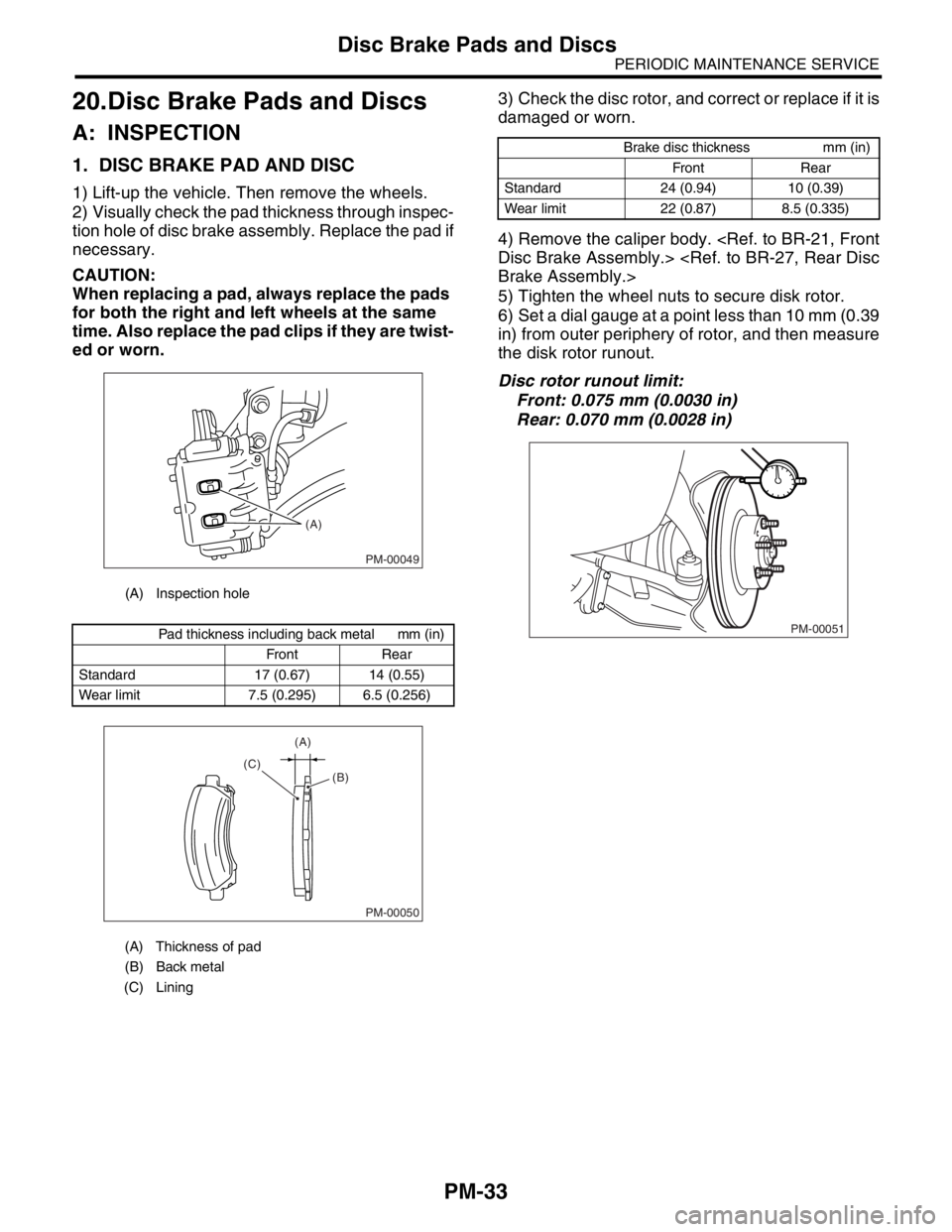
2) Visually check the pad thickness through inspec-
tion hole of disc brake assembly. Replace the pad if
necessary.
CAUTION:
When replacing a pad, always replace the pads
for both the right and left wheels at the same
time. Also replace the pad clips if they are twist-
ed or worn.3) Check the disc rotor, and correct or replace if it is
damaged or worn.
4) Remove the caliper body.
5) Tighten the wheel nuts to secure disk rotor.
6) Set a dial gauge at a point less than 10 mm (0.39
in) from outer periphery of rotor, and then measure
the disk rotor runout.
Disc rotor runout limit:
Front: 0.075 mm (0.0030 in)
Rear: 0.070 mm (0.0028 in)
(A) Inspection hole
Pad thickness including back metal mm (in)
Front Rear
Standard 17 (0.67) 14 (0.55)
Wear limit 7.5 (0.295) 6.5 (0.256)
(A) Thickness of pad
(B) Back metal
(C) Lining
PM-00049
(A)
PM-00050
(A)
(C)
(B)
Brake disc thickness mm (in)
Front Rear
Standard 24 (0.94) 10 (0.39)
Wear limit 22 (0.87) 8.5 (0.335)
PM-00051
Page 771 of 2870
PM-34
PERIODIC MAINTENANCE SERVICE
Brake Linings and Drums
21.Brake Linings and Drums
A: INSPECTION
1. REAR DRUM BRAKE
1) Remove the brake drum, and check that there is
no fluid leakage from wheel cylinder.
If there is fluid leakage from wheel cylinder, inspect
the wheel cylinder, and then repair or replace it.
2) Inspect the brake shoes for damage or deformi-
ties and check brake linings for wear.
CAUTION:
Always replace both leading and trailing
brake shoes for the right and left wheels at the
same time.
When either the right and left brake assembly
is replaced, always replace the leading shoe
and trailing shoe of the other.
Thickness of lining (except back metal)
Standard value: 4.1 mm (0.161 in)
Service limit: 1.5 mm (0.059 in)
3) Check the brake drum for wear, dents or other
damage.
If the inside surface of brake drum is streaked, cor-
rect the surface with emery cloth (#200 or more). If
it is unevenly worn, tapered or the outside surface
of brake drum is damaged, correct or replace it.
Brake drum inner diameter
Standard value: 228.6 mm (9.000 in)
Service limit: 230.6 mm (9.079 in)If deformation or wear of back plate, shoe, etc. is
noticeable, replace the affected parts.
2. PARKING BRAKE (REAR DISC BRAKE)
Inspect the brake linings and the disk rotor inside of
both sides of the rear brake at the same time by re-
moving the disk rotor.
1) Inspect the brake shoes for damage or deforma-
tion and check brake linings for wear.
CAUTION:
Always replace both primary and secondary
brake shoes for the right and left wheels at the
same time.
Brake lining thickness (excluding back metal)
Standard value: 3.2 mm (0.126 in)
Wear limit: 1.5 mm (0.059 in)
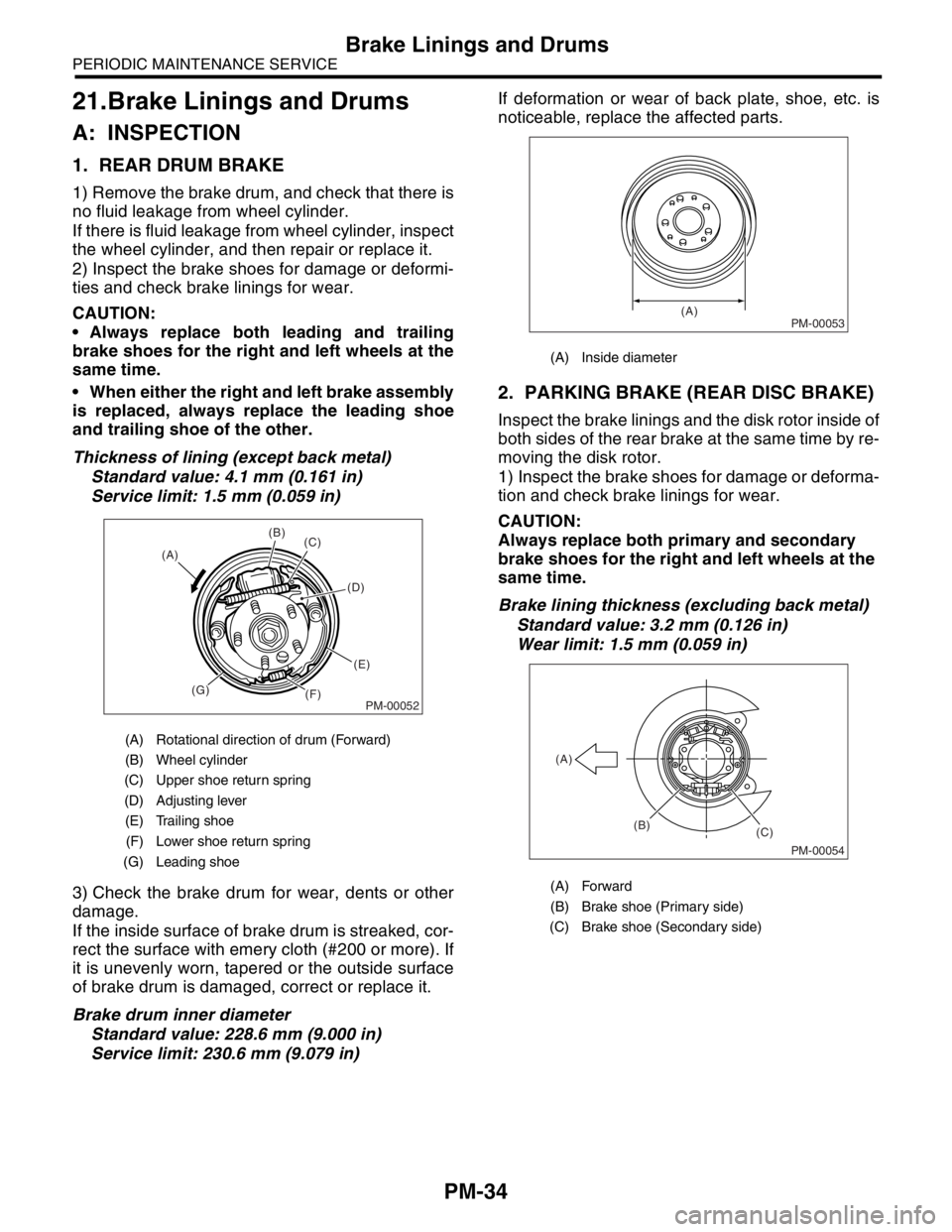
(A) Rotational direction of drum (Forward)
(B) Wheel cylinder
(C) Upper shoe return spring
(D) Adjusting lever
(E) Trailing shoe
(F) Lower shoe return spring
(G) Leading shoe
PM-00052
(B)
(C)
(D)
(E)
(F) (G) (A)
(A) Inside diameter
(A) Forward
(B) Brake shoe (Primary side)
(C) Brake shoe (Secondary side)
PM-00053(A)
PM-00054
(B)
(C) (A)
Page 772 of 2870
PM-35
PERIODIC MAINTENANCE SERVICE
Brake Linings and Drums
2) Check the disk rotor for wear, dents or other
damage. If the inside surface of disk rotor is
streaked, correct the surface with emery cloth
(#200 or more). If it is unevenly worn or tapered,
correct or replace it.
Brake drum inside diameter
Standard value: 170 mm (6.69 in)
Wear limit: 171 mm (6.73 in)
3) If the deformation or wear of back plate, shoe,
etc. is noticeable, replace them.
4) When the shoe return spring tension is exces-
sively weakened, replace it.B: ADJUSTMENT
1. REAR DRUM BRAKE
The main brake is adjusted automatically, and so
there is no need to adjust it.
2. PARKING BRAKE (REAR DISC BRAKE)
For rear disc brake, adjust the parking brake after
bleeding air.
1) Remove the rear cover (rubber) installed at back
plate.
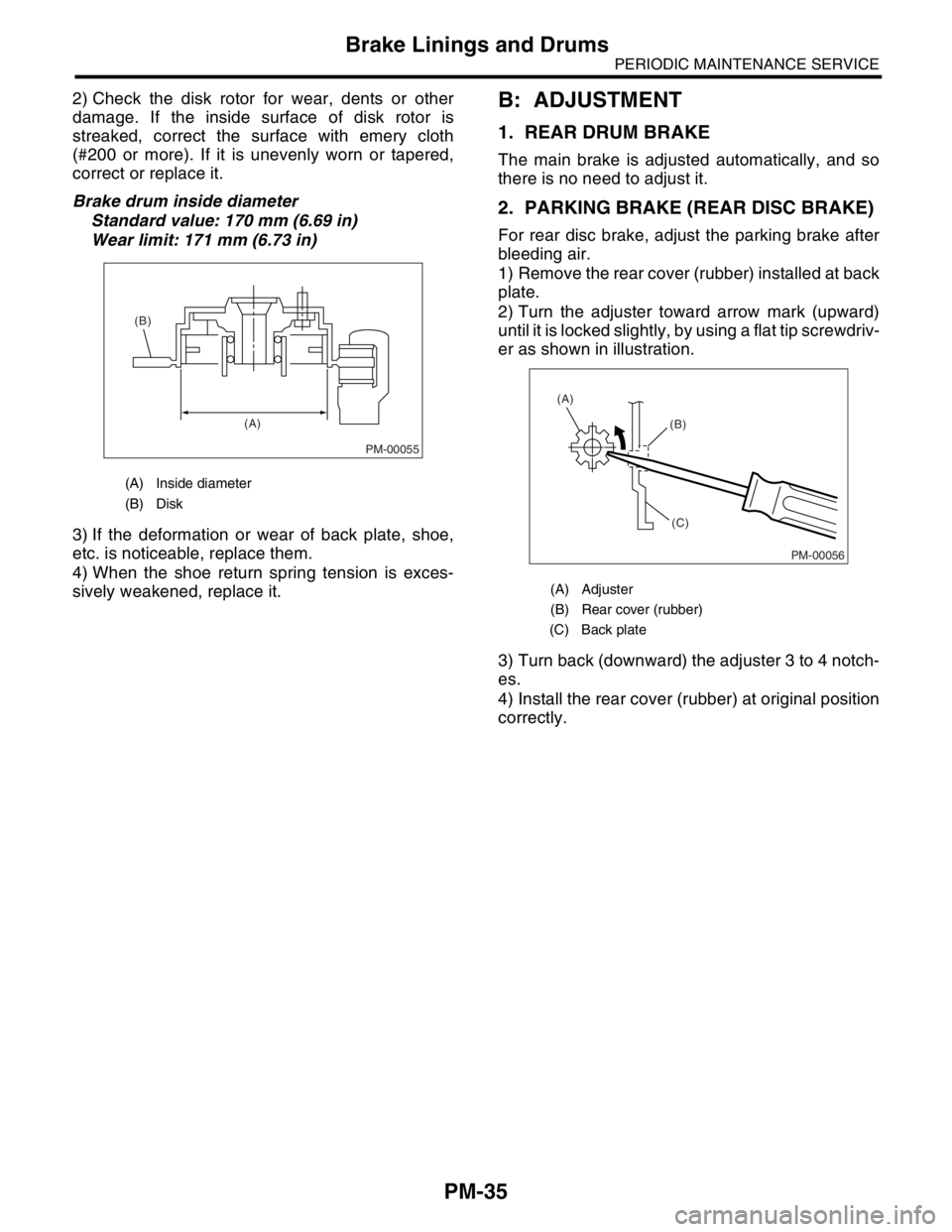
2) Turn the adjuster toward arrow mark (upward)
until it is locked slightly, by using a flat tip screwdriv-
er as shown in illustration.
3) Turn back (downward) the adjuster 3 to 4 notch-
es.
4) Install the rear cover (rubber) at original position
correctly.
(A) Inside diameter
(B) Disk
PM-00055
(A) (B)
(A) Adjuster
(B) Rear cover (rubber)
(C) Back plate
PM-00056
(B)
(C) (A)
Page 773 of 2870
PM-36
PERIODIC MAINTENANCE SERVICE
Suspension
22.Suspension
A: INSPECTION
1. SUSPENSION BALL JOINT
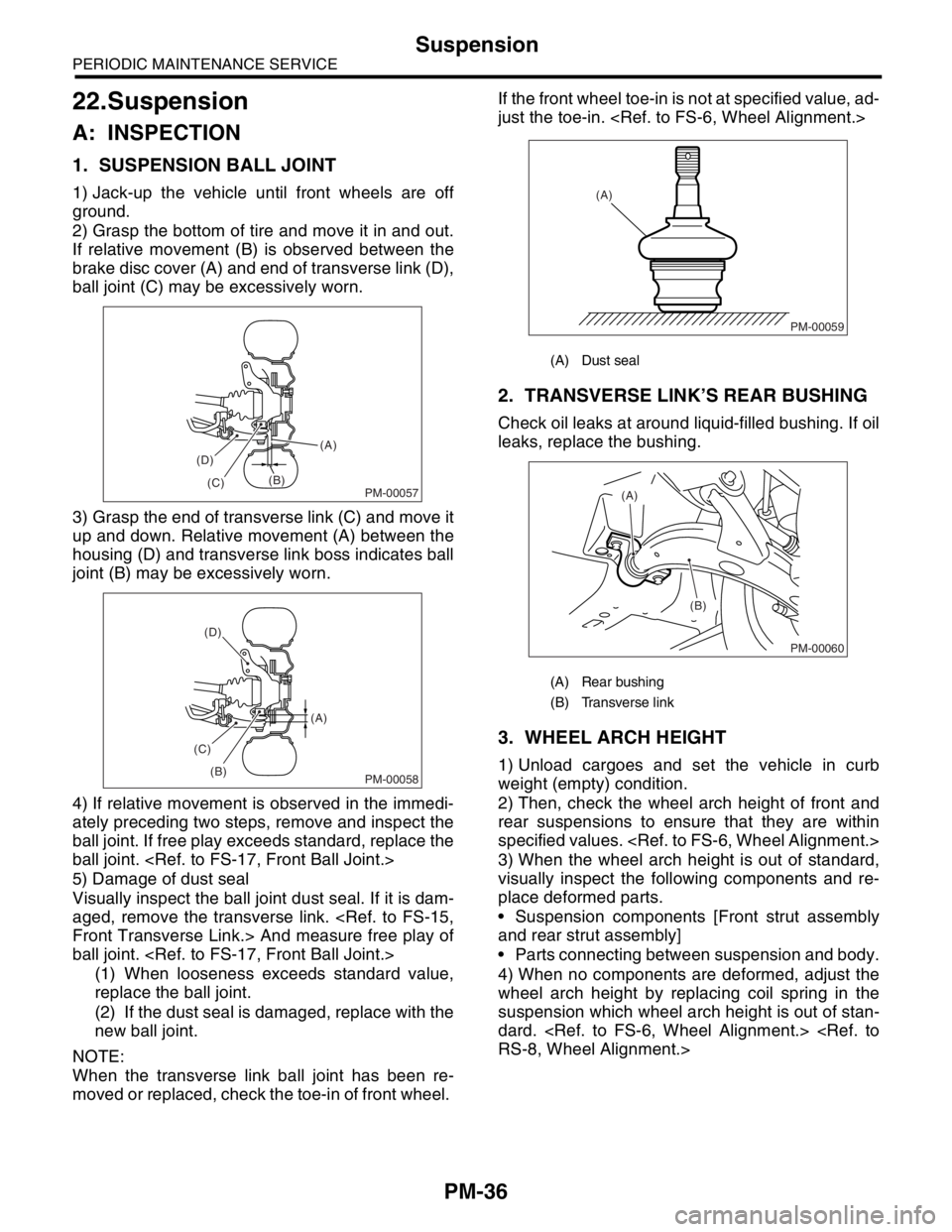
1) Jack-up the vehicle until front wheels are off
ground.
2) Grasp the bottom of tire and move it in and out.
If relative movement (B) is observed between the
brake disc cover (A) and end of transverse link (D),
ball joint (C) may be excessively worn.
3) Grasp the end of transverse link (C) and move it
up and down. Relative movement (A) between the
housing (D) and transverse link boss indicates ball
joint (B) may be excessively worn.
4) If relative movement is observed in the immedi-
ately preceding two steps, remove and inspect the
ball joint. If free play exceeds standard, replace the
ball joint.
5) Damage of dust seal
Visually inspect the ball joint dust seal. If it is dam-
aged, remove the transverse link.
ball joint.
(1) When looseness exceeds standard value,
replace the ball joint.
(2) If the dust seal is damaged, replace with the
new ball joint.
NOTE:
When the transverse link ball joint has been re-
moved or replaced, check the toe-in of front wheel. If the front wheel toe-in is not at specified value, ad-
just the toe-in.
2. TRANSVERSE LINK’S REAR BUSHING
Check oil leaks at around liquid-filled bushing. If oil
leaks, replace the bushing.
3. WHEEL ARCH HEIGHT
1) Unload cargoes and set the vehicle in curb
weight (empty) condition.
2) Then, check the wheel arch height of front and
rear suspensions to ensure that they are within
specified values.
3) When the wheel arch height is out of standard,
visually inspect the following components and re-
place deformed parts.
Suspension components [Front strut assembly
and rear strut assembly]
Parts connecting between suspension and body.
4) When no components are deformed, adjust the
wheel arch height by replacing coil spring in the
suspension which wheel arch height is out of stan-
dard.
PM-00057
(A)
(B)
(C) (D)
PM-00058
(A)
(B) (C)(D)
(A) Dust seal
(A) Rear bushing
(B) Transverse link
PM-00059
(A)
PM-00060
(A)
(B)
Page 794 of 2870
FU(H4SO)-12
FUEL INJECTION (FUEL SYSTEM)
General Description
C: CAUTION
Wear working clothing, including a cap, protec-
tive goggles, and protective shoes during opera-
tion.
Remove contamination including dirt and corro-
sion before removal, installation or disassembly.
Keep the disassembled parts in order and pro-
tect them from dust or dirt.
Before removal, installation or disassembly, be
sure to clarify the failure. Avoid unnecessary re-
moval, installation, disassembly, and replacement. Be careful not to burn yourself, because each
part on the vehicle is hot after running.
Be sure to tighten fasteners including bolts and
nuts to the specified torque.
Place shop jacks or rigid racks at the specified
points.
Before disconnecting electrical connectors of
sensors or units, be sure to disconnect negative
terminal from battery.
Place “NO FIRE” signs near the working area.
Be careful not to spill fuel on the floor.
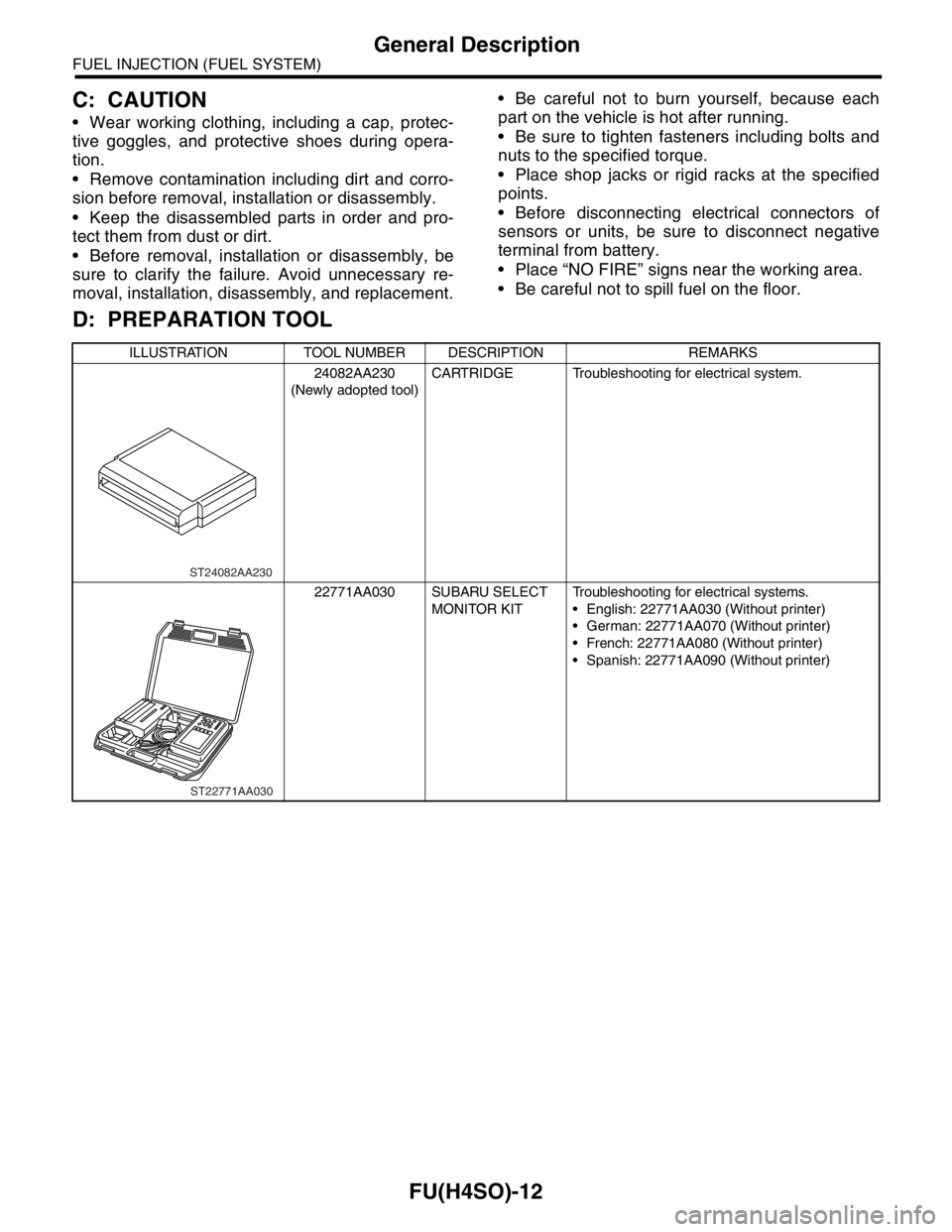
D: PREPARATION TOOL
ILLUSTRATION TOOL NUMBER DESCRIPTION REMARKS
24082AA230
(Newly adopted tool)CARTRIDGE Troubleshooting for electrical system.
22771AA030 SUBARU SELECT
MONITOR KITTroubleshooting for electrical systems.
English: 22771AA030 (Without printer)
German: 22771AA070 (Without printer)
French: 22771AA080 (Without printer)
Spanish: 22771AA090 (Without printer)
ST24082AA230
ST22771AA030
Page 795 of 2870
FU(H4SO)-13
FUEL INJECTION (FUEL SYSTEM)
Throttle Body
2. Throttle Body
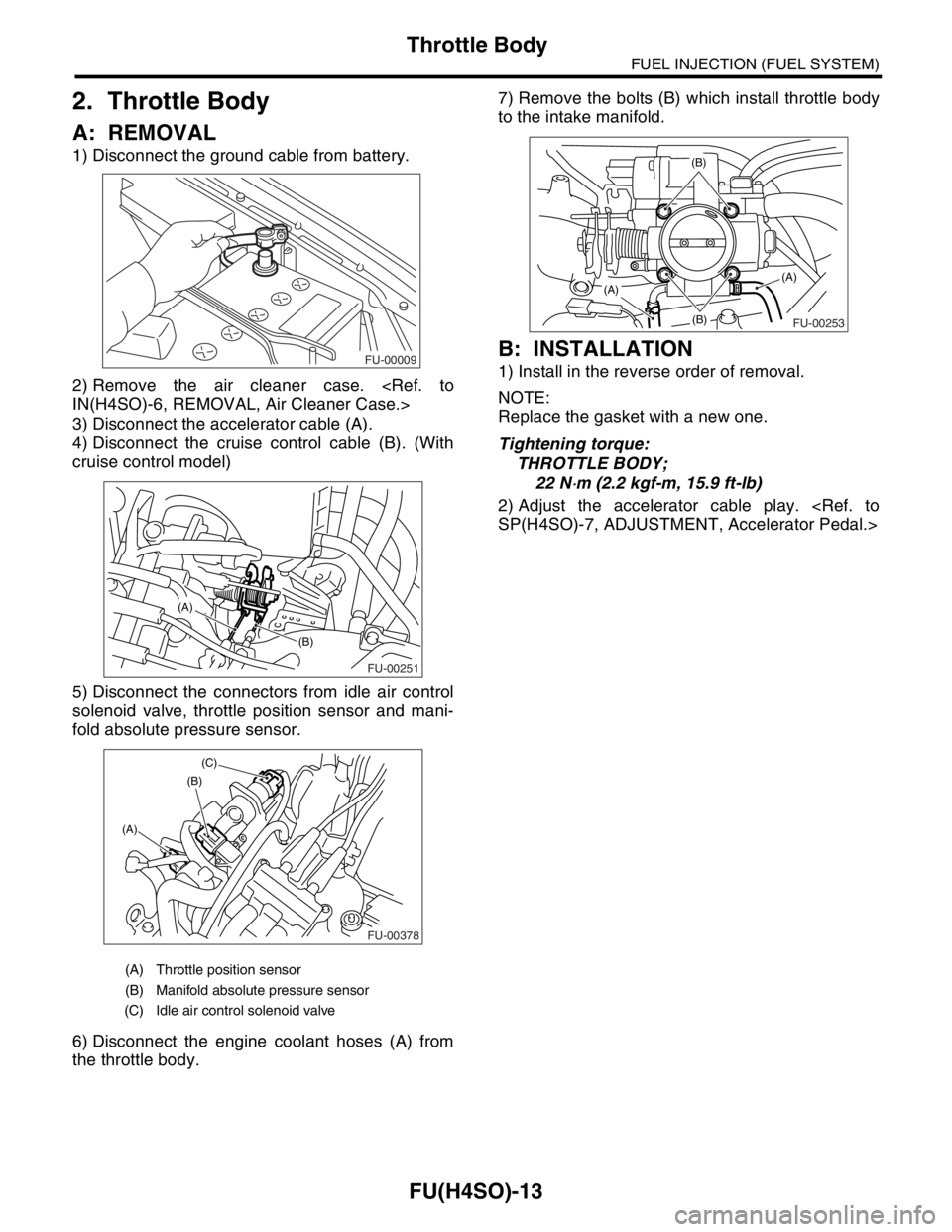
A: REMOVAL
1) Disconnect the ground cable from battery.
2) Remove the air cleaner case.
3) Disconnect the accelerator cable (A).
4) Disconnect the cruise control cable (B). (With
cruise control model)
5) Disconnect the connectors from idle air control
solenoid valve, throttle position sensor and mani-
fold absolute pressure sensor.
6) Disconnect the engine coolant hoses (A) from
the throttle body.7) Remove the bolts (B) which install throttle body
to the intake manifold.
B: INSTALLATION
1) Install in the reverse order of removal.
NOTE:
Replace the gasket with a new one.
Tightening torque:
THROTTLE BODY;
22 N
⋅m (2.2 kgf-m, 15.9 ft-lb)
2) Adjust the accelerator cable play.
(A) Throttle position sensor
(B) Manifold absolute pressure sensor
(C) Idle air control solenoid valve
FU-00009
FU-00251
(B)
(A)
FU-00378
(B)
(A)(C)
FU-00253
(B)
(B)
(A)(A)
Page 798 of 2870
FU(H4SO)-16
FUEL INJECTION (FUEL SYSTEM)
Intake Manifold
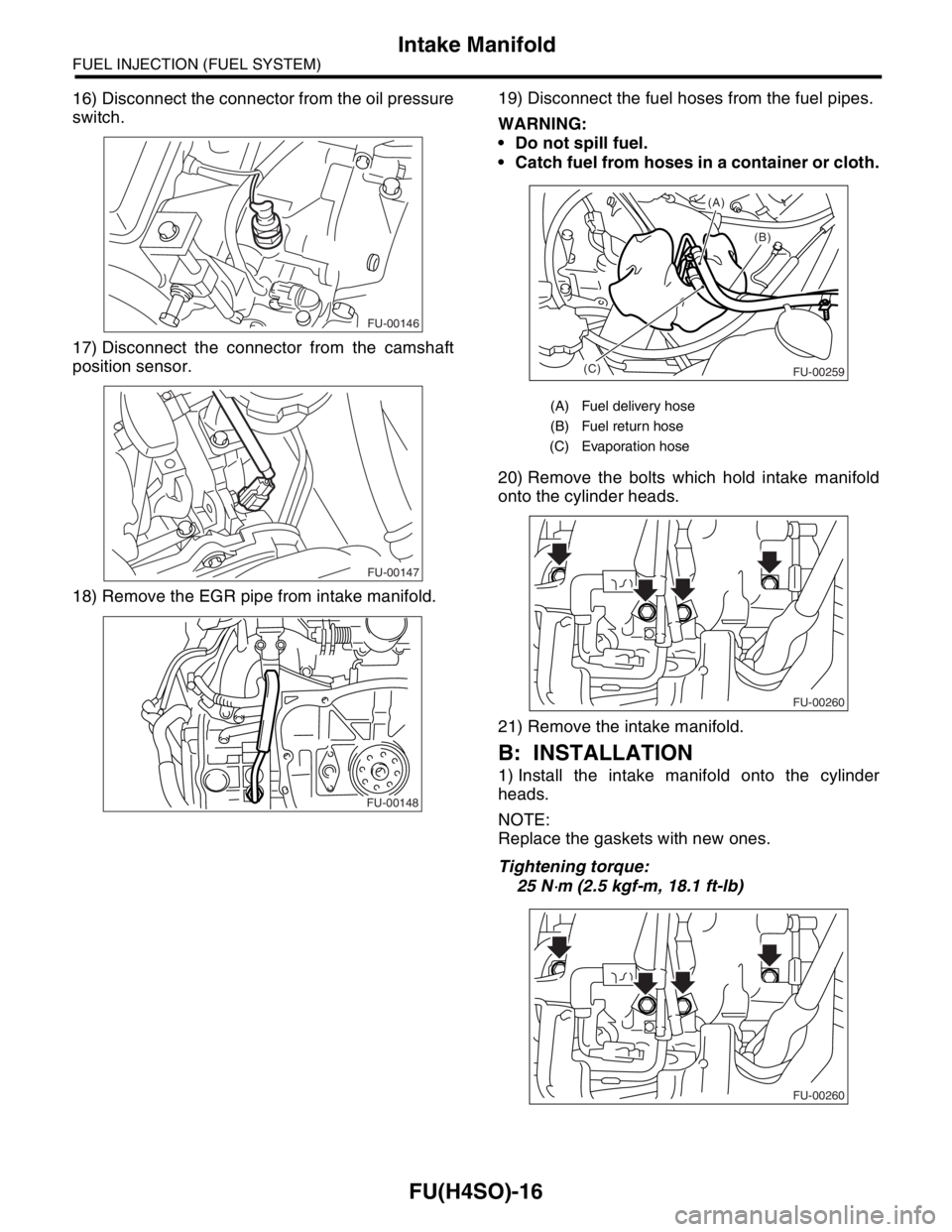
16) Disconnect the connector from the oil pressure
switch.
17) Disconnect the connector from the camshaft
position sensor.
18) Remove the EGR pipe from intake manifold.19) Disconnect the fuel hoses from the fuel pipes.
WARNING:
Do not spill fuel.
Catch fuel from hoses in a container or cloth.
20) Remove the bolts which hold intake manifold
onto the cylinder heads.
21) Remove the intake manifold.
B: INSTALLATION
1) Install the intake manifold onto the cylinder
heads.
NOTE:
Replace the gaskets with new ones.
Tightening torque:
25 N
⋅m (2.5 kgf-m, 18.1 ft-lb)
FU-00146
FU-00147
FU-00148
(A) Fuel delivery hose
(B) Fuel return hose
(C) Evaporation hose
(B) (A)
(C)
FU-00259
FU-00260
FU-00260
Page 813 of 2870
FU(H4SO)-31
FUEL INJECTION (FUEL SYSTEM)
Manifold Absolute Pressure Sensor
9. Manifold Absolute Pressure
Sensor
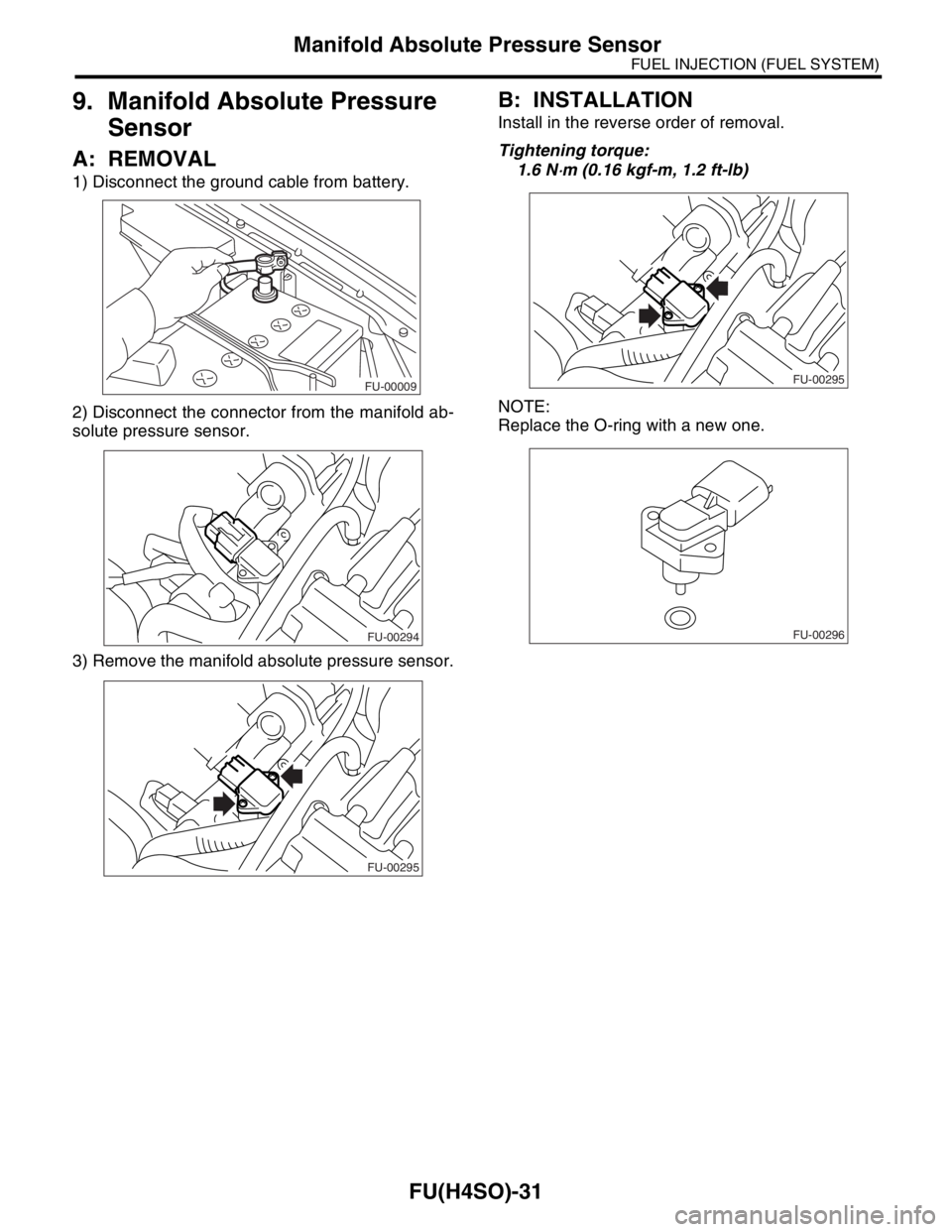
A: REMOVAL
1) Disconnect the ground cable from battery.
2) Disconnect the connector from the manifold ab-
solute pressure sensor.
3) Remove the manifold absolute pressure sensor.
B: INSTALLATION
Install in the reverse order of removal.
Tightening torque:
1.6 N
⋅m (0.16 kgf-m, 1.2 ft-lb)
NOTE:
Replace the O-ring with a new one.
FU-00009
FU-00294
FU-00295
FU-00295
FU-00296
Page 842 of 2870
FU(H4SO)-60
FUEL INJECTION (FUEL SYSTEM)
Fuel Filter
25.Fuel Filter
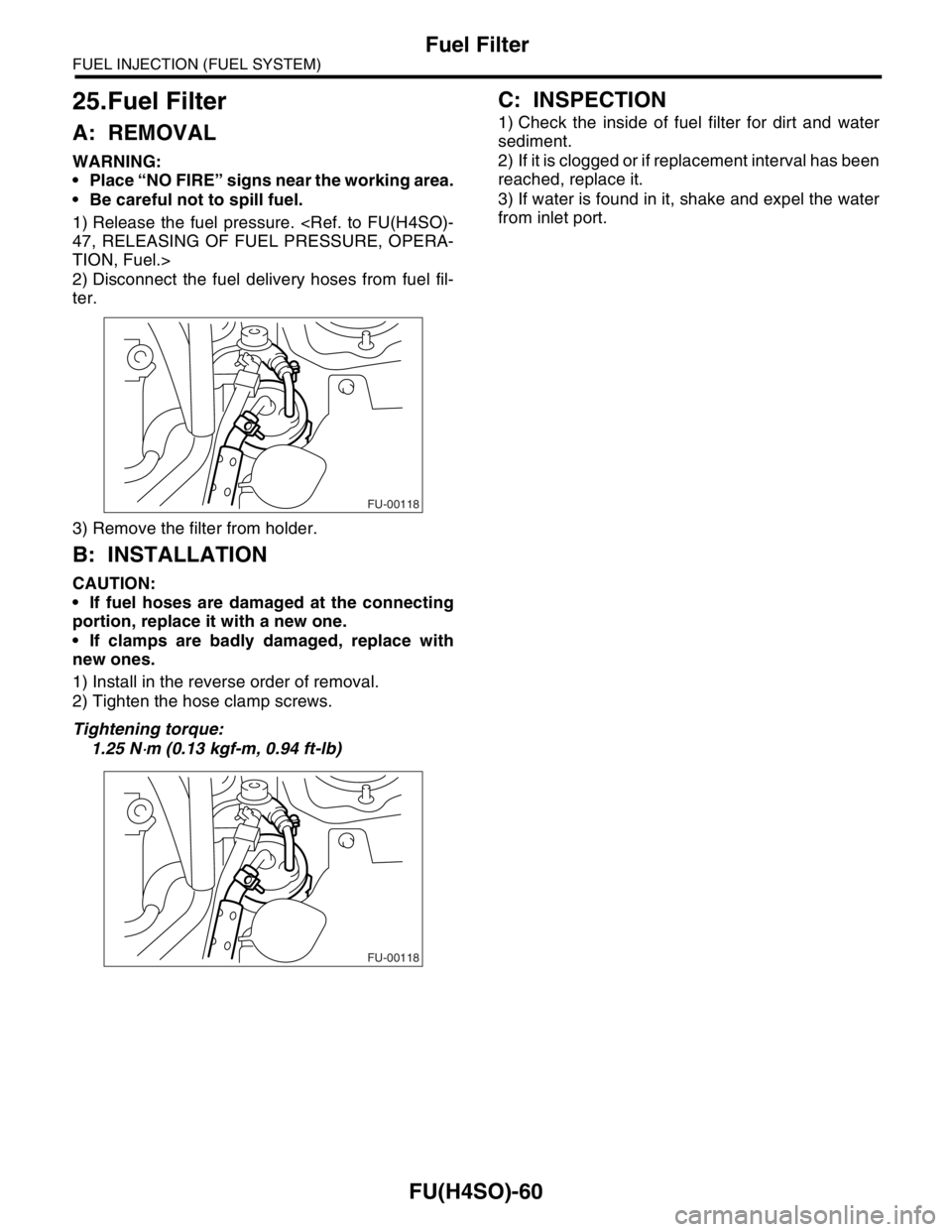
A: REMOVAL
WARNING:
Place “NO FIRE” signs near the working area.
Be careful not to spill fuel.
1) Release the fuel pressure.
TION, Fuel.>
2) Disconnect the fuel delivery hoses from fuel fil-
ter.
3) Remove the filter from holder.
B: INSTALLATION
CAUTION:
If fuel hoses are damaged at the connecting
portion, replace it with a new one.
If clamps are badly damaged, replace with
new ones.
1) Install in the reverse order of removal.
2) Tighten the hose clamp screws.
Tightening torque:
1.25 N
⋅m (0.13 kgf-m, 0.94 ft-lb)
C: INSPECTION
1) Check the inside of fuel filter for dirt and water
sediment.
2) If it is clogged or if replacement interval has been
reached, replace it.
3) If water is found in it, shake and expel the water
from inlet port.
FU-00118
FU-00118