height SUBARU FORESTER 2004 Service Owner's Manual
[x] Cancel search | Manufacturer: SUBARU, Model Year: 2004, Model line: FORESTER, Model: SUBARU FORESTER 2004Pages: 2870, PDF Size: 38.67 MB
Page 1531 of 2870
ME(H4DOTC)-73
MECHANICAL
Camshaft
C: INSPECTION
1) Measure the bend, and repair or replace if nec-
essary.
Limit:
0.020 mm (0.0008 in)
2) Check the journal for damage and wear. Re-
place if faulty.
3) Measure the outside diameter of camshaft jour-
nal. If the journal diameter is not as specified,
check the oil clearance.
4) Measurement of the camshaft journal oil clear-
ance:
(1) Clean the bearing caps and camshaft jour-
nals.
(2) Place the camshafts on cylinder head.
(Without installing the valve rocker.)
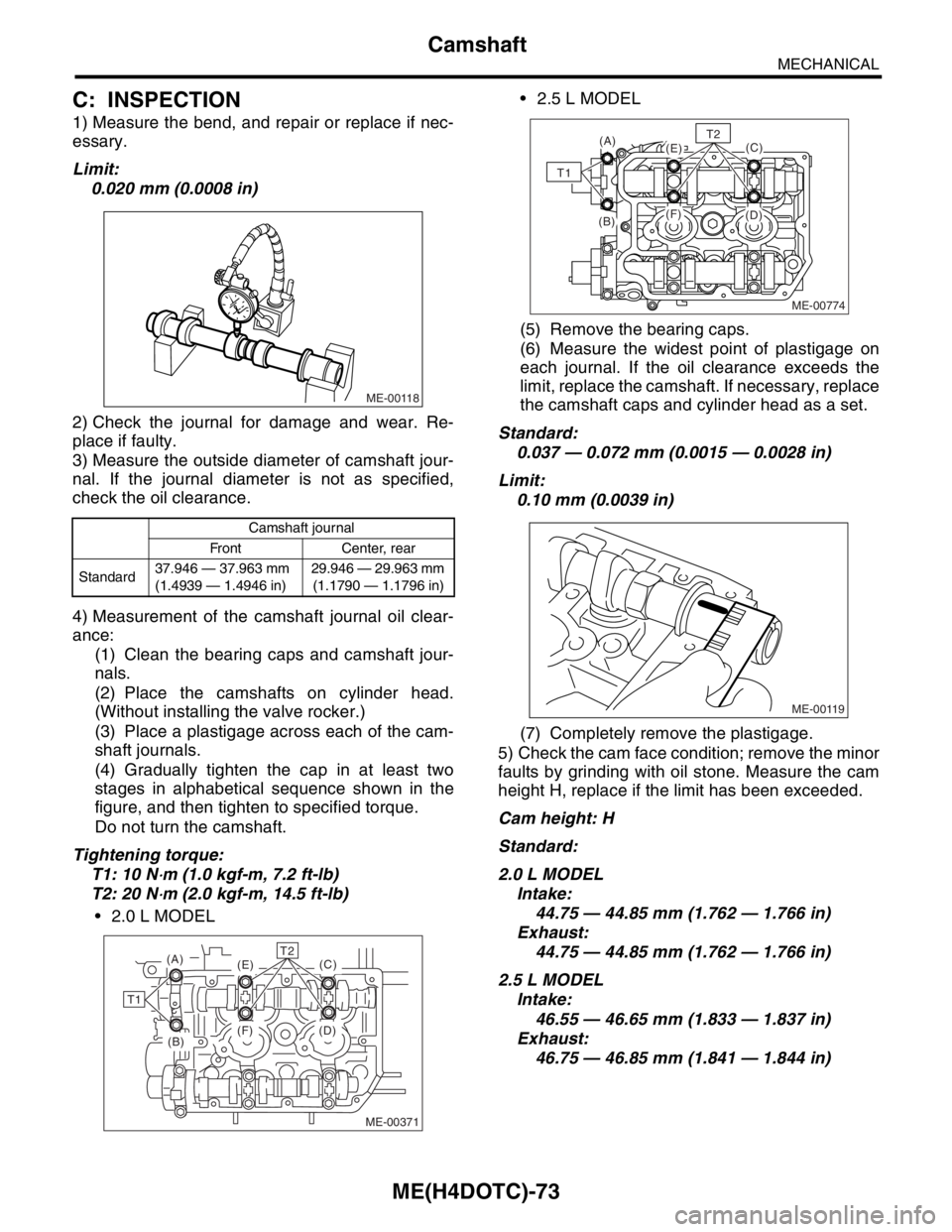
(3) Place a plastigage across each of the cam-
shaft journals.
(4) Gradually tighten the cap in at least two
stages in alphabetical sequence shown in the
figure, and then tighten to specified torque.
Do not turn the camshaft.
Tightening torque:
T1: 10 N
⋅m (1.0 kgf-m, 7.2 ft-lb)
T2: 20 N
⋅m (2.0 kgf-m, 14.5 ft-lb)
2.0 L MODEL 2.5 L MODEL
(5) Remove the bearing caps.
(6) Measure the widest point of plastigage on
each journal. If the oil clearance exceeds the
limit, replace the camshaft. If necessary, replace
the camshaft caps and cylinder head as a set.
Standard:
0.037 — 0.072 mm (0.0015 — 0.0028 in)
Limit:
0.10 mm (0.0039 in)
(7) Completely remove the plastigage.
5) Check the cam face condition; remove the minor
faults by grinding with oil stone. Measure the cam
height H, replace if the limit has been exceeded.
Cam height: H
Standard:
2.0 L MODEL
Intake:
44.75 — 44.85 mm (1.762 — 1.766 in)
Exhaust:
44.75 — 44.85 mm (1.762 — 1.766 in)
2.5 L MODEL
Intake:
46.55 — 46.65 mm (1.833 — 1.837 in)
Exhaust:
46.75 — 46.85 mm (1.841 — 1.844 in)
Camshaft journal
Front Center, rear
Standard37.946 — 37.963 mm
(1.4939 — 1.4946 in)29.946 — 29.963 mm
(1.1790 — 1.1796 in)
ME-00118
ME-00371
(F) (D)(C)
T1
T2(A)(E)
(B)
ME-00774
(A)(E)
(F)(B)(D)
(C)T2
T1
ME-00119
Page 1536 of 2870
ME(H4DOTC)-78
MECHANICAL
Cylinder Head Assembly
1) Installation of valve spring and valve.
(1) Coat the stem of each valve with engine oil
and insert the valve into valve guide.
NOTE:
When inserting the valve into valve guide, use spe-
cial care not to damage the oil seal lip.
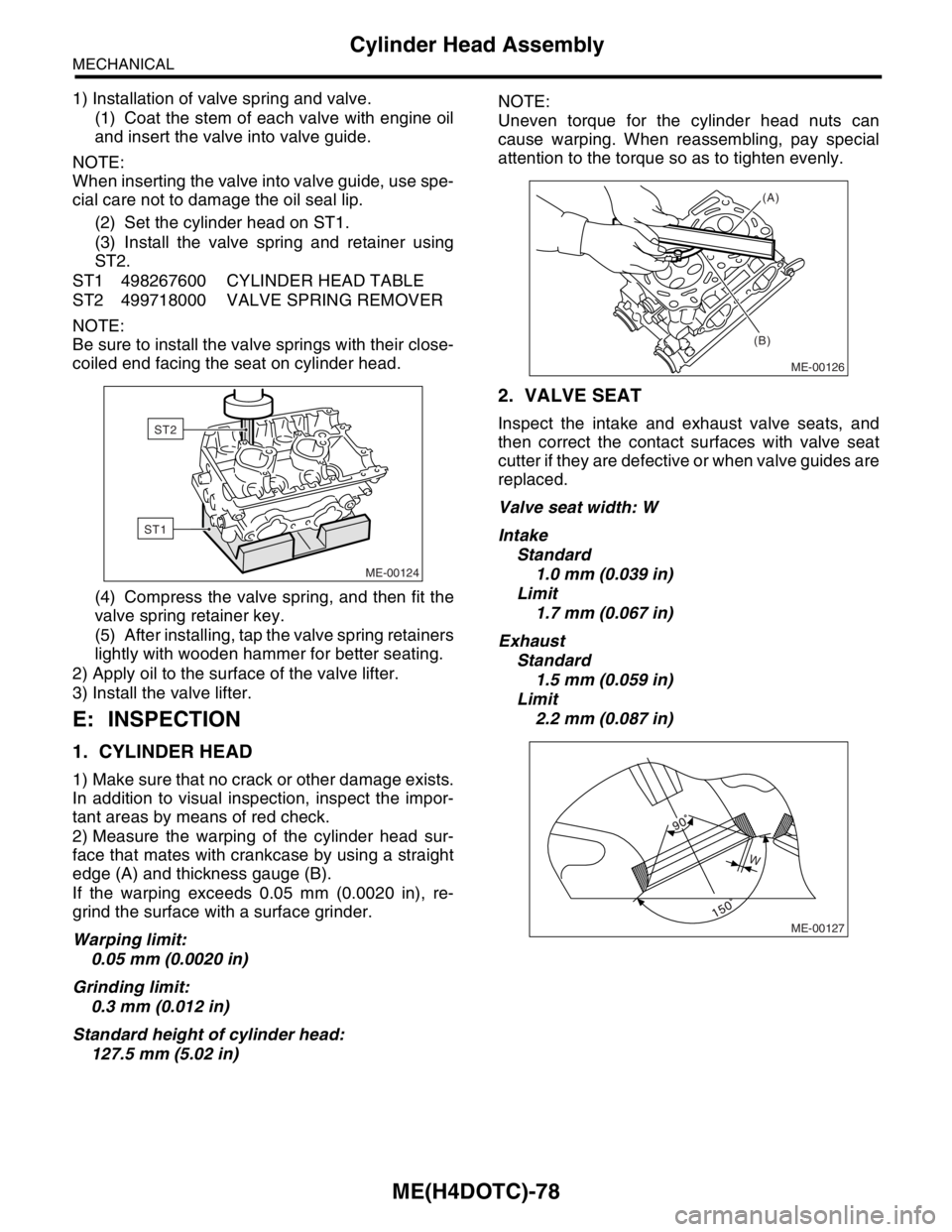
(2) Set the cylinder head on ST1.
(3) Install the valve spring and retainer using
ST2.
ST1 498267600 CYLINDER HEAD TABLE
ST2 499718000 VALVE SPRING REMOVER
NOTE:
Be sure to install the valve springs with their close-
coiled end facing the seat on cylinder head.
(4) Compress the valve spring, and then fit the
valve spring retainer key.
(5) After installing, tap the valve spring retainers
lightly with wooden hammer for better seating.
2) Apply oil to the surface of the valve lifter.
3) Install the valve lifter.
E: INSPECTION
1. CYLINDER HEAD
1) Make sure that no crack or other damage exists.
In addition to visual inspection, inspect the impor-
tant areas by means of red check.
2) Measure the warping of the cylinder head sur-
face that mates with crankcase by using a straight
edge (A) and thickness gauge (B).
If the warping exceeds 0.05 mm (0.0020 in), re-
grind the surface with a surface grinder.
Warping limit:
0.05 mm (0.0020 in)
Grinding limit:
0.3 mm (0.012 in)
Standard height of cylinder head:
127.5 mm (5.02 in)NOTE:
Uneven torque for the cylinder head nuts can
cause warping. When reassembling, pay special
attention to the torque so as to tighten evenly.
2. VALVE SEAT
Inspect the intake and exhaust valve seats, and
then correct the contact surfaces with valve seat
cutter if they are defective or when valve guides are
replaced.
Valve seat width: W
Intake
Standard
1.0 mm (0.039 in)
Limit
1.7 mm (0.067 in)
Exhaust
Standard
1.5 mm (0.059 in)
Limit
2.2 mm (0.087 in)
ME-00124
ST1
ST2
ME-00126
(A)
(B)
ME-00127
W
Page 1538 of 2870

ME(H4DOTC)-80
MECHANICAL
Cylinder Head Assembly
(9) Recheck the contact condition between
valve and valve seat after replacing the valve
guide.
4. INTAKE AND EXHAUST VALVE
1) Inspect the flange and stem of valve, and re-
place if damaged, worn, or deformed, or if “H” is
less than the specified limit.
H:
Intake (A)
Standard
1.2 mm (0.047 in)
Limit
0.8 mm (0.031 in)
Exhaust (B)
Standard
1.5 mm (0.059 in)
Limit
0.8 mm (0.031 in)
Valve overall length:
Intake (A)
104.4 mm (4.110 in)
Exhaust (B)
104.65 mm (4.120 in)2) Put a small amount of grinding compound on the
seat surface and lap the valve and seat surface. In-
stall a new valve oil seal after lapping.
NOTE:
Replace intake valve oil seal with a new one if the
valve and seat are lapped.
Differentiate intake valve and exhaust valve by
overall length.
5. VALVE SPRINGS
1) Check the valve springs for damage, free length,
and tension. Replace the valve spring if it is not
within specifications presented in the table.
2) To measure the squareness of valve spring,
stand the spring on a surface plate and measure its
deflection at the top using a try square.
2.0 L model
2.5 L model
ME-00758
H
H
(B) (A)
Valve spring
Free length 44.67 mm (1.759 in)
Tension/spring
heightSet206 — 236 N
(21.0 — 24.1 kgf, 46.3 — 53.1 lb)
/36.0 mm (1.417 in)
Lift485 — 537 N (49.5 — 54.8 kgf, 109
— 121 lb) /26.6 mm (1.041 in)
Squareness 2.5°, 2.0 mm (0.079 in)
Valve spring
Free length 47.32 mm (1.863 in)
Tension/spring
heightSet205 — 235 N
(20.9 — 24.0 kgf, 46.1 — 52.8 lb)
/36.0 mm (1.417 in)
Lift426 — 490 N (43.4 — 50.0 kgf, 95.8
— 110 lb) /26.5 mm (1.04 in)
Squareness 2.5°, 2.1 mm (0.083 in)
ME-00132
Page 1565 of 2870
ME(H4DOTC)-105
MECHANICAL
Cylinder Block
D: ASSEMBLY
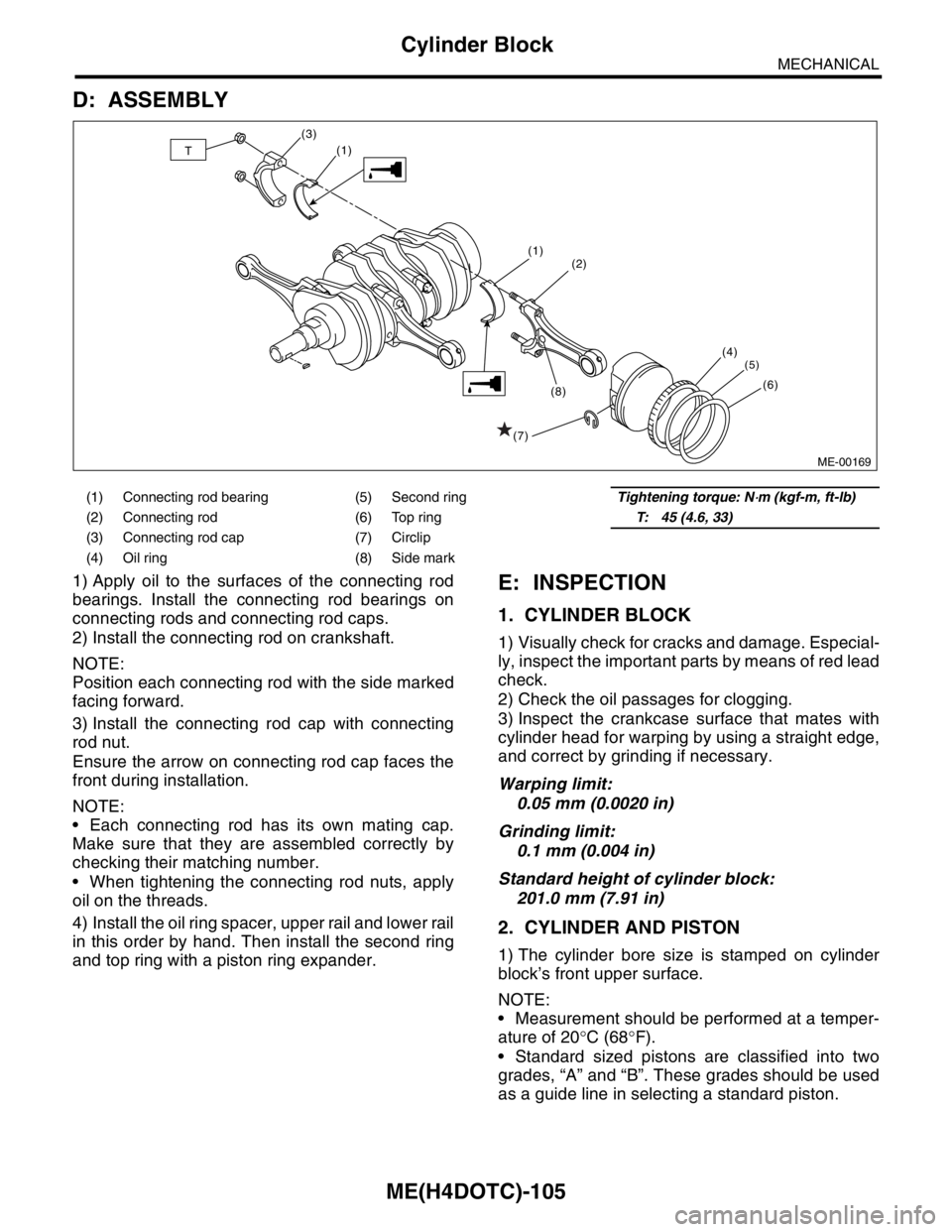
1) Apply oil to the surfaces of the connecting rod
bearings. Install the connecting rod bearings on
connecting rods and connecting rod caps.
2) Install the connecting rod on crankshaft.
NOTE:
Position each connecting rod with the side marked
facing forward.
3) Install the connecting rod cap with connecting
rod nut.
Ensure the arrow on connecting rod cap faces the
front during installation.
NOTE:
Each connecting rod has its own mating cap.
Make sure that they are assembled correctly by
checking their matching number.
When tightening the connecting rod nuts, apply
oil on the threads.
4) Install the oil ring spacer, upper rail and lower rail
in this order by hand. Then install the second ring
and top ring with a piston ring expander.E: INSPECTION
1. CYLINDER BLOCK
1) Visually check for cracks and damage. Especial-
ly, inspect the important parts by means of red lead
check.
2) Check the oil passages for clogging.
3) Inspect the crankcase surface that mates with
cylinder head for warping by using a straight edge,
and correct by grinding if necessary.
Warping limit:
0.05 mm (0.0020 in)
Grinding limit:
0.1 mm (0.004 in)
Standard height of cylinder block:
201.0 mm (7.91 in)
2. CYLINDER AND PISTON
1) The cylinder bore size is stamped on cylinder
block’s front upper surface.
NOTE:
Measurement should be performed at a temper-
ature of 20°C (68°F).
Standard sized pistons are classified into two
grades, “A” and “B”. These grades should be used
as a guide line in selecting a standard piston.
(1) Connecting rod bearing (5) Second ringTightening torque: N⋅m (kgf-m, ft-lb)
(2) Connecting rod (6) Top ringT: 45 (4.6, 33)
(3) Connecting rod cap (7) Circlip
(4) Oil ring (8) Side mark
ME-00169
(2)
(4)
(5)
(6)
(1)
(1)
(7)(8) (3)T
Page 1566 of 2870
ME(H4DOTC)-106
MECHANICAL
Cylinder Block
2.0 L MODEL
Standard diameter:
A: 92.005 — 92.015 mm (3.6222 — 3.6226 in)
B: 91.995 — 92.005 mm (3.6218 — 3.6222 in)
2.5 L MODEL
Standard diameter:
A: 99.505 — 99.515 mm (3.9175 — 3.9179 in)
B: 99.495 — 99.505 mm (3.9171 — 3.9175 in)
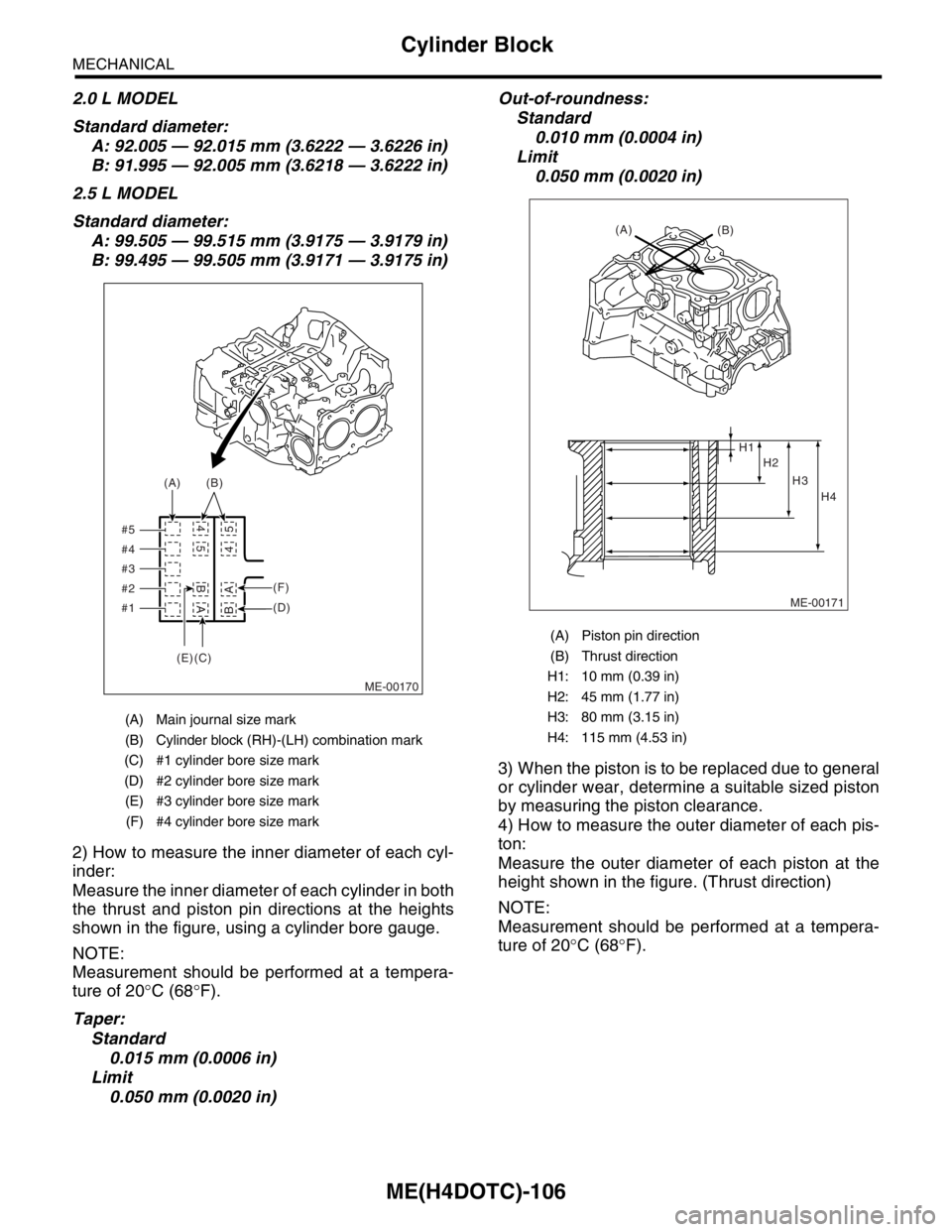
2) How to measure the inner diameter of each cyl-
inder:
Measure the inner diameter of each cylinder in both
the thrust and piston pin directions at the heights
shown in the figure, using a cylinder bore gauge.
NOTE:
Measurement should be performed at a tempera-
ture of 20°C (68°F).
Taper:
Standard
0.015 mm (0.0006 in)
Limit
0.050 mm (0.0020 in)Out-of-roundness:
Standard
0.010 mm (0.0004 in)
Limit
0.050 mm (0.0020 in)
3) When the piston is to be replaced due to general
or cylinder wear, determine a suitable sized piston
by measuring the piston clearance.
4) How to measure the outer diameter of each pis-
ton:
Measure the outer diameter of each piston at the
height shown in the figure. (Thrust direction)
NOTE:
Measurement should be performed at a tempera-
ture of 20°C (68°F).
(A) Main journal size mark
(B) Cylinder block (RH)-(LH) combination mark
(C) #1 cylinder bore size mark
(D) #2 cylinder bore size mark
(E) #3 cylinder bore size mark
(F) #4 cylinder bore size mark
ME-00170 #5
#4
#3
#2
#1(A)(B)
(F)
(D)
A BA B
5 45 4
(C) (E)
(A) Piston pin direction
(B) Thrust direction
H1: 10 mm (0.39 in)
H2: 45 mm (1.77 in)
H3: 80 mm (3.15 in)
H4: 115 mm (4.53 in)
ME-00171
(A)
(B)
H2 H1
H3
H4
Page 2337 of 2870

4AT-25
AUTOMATIC TRANSMISSION
General Description
499787700 WRENCH Used for removing and installing drive pinion lock
nut.
499787500 ADAPTER Used for removing and installing drive pinion lock
nut.
398643600 GAUGE Used for measuring total end play, extension end
play and drive pinion height.
498627100 SEAT Used for holding low clutch piston retainer spring
when installing snap ring. ILLUSTRATION TOOL NUMBER DESCRIPTION REMARKS
ST-499787700
ST-499787500
ST-398643600
ST-498627100
Page 2419 of 2870
4AT-105
AUTOMATIC TRANSMISSION
Oil Pump Housing
35.Oil Pump Housing
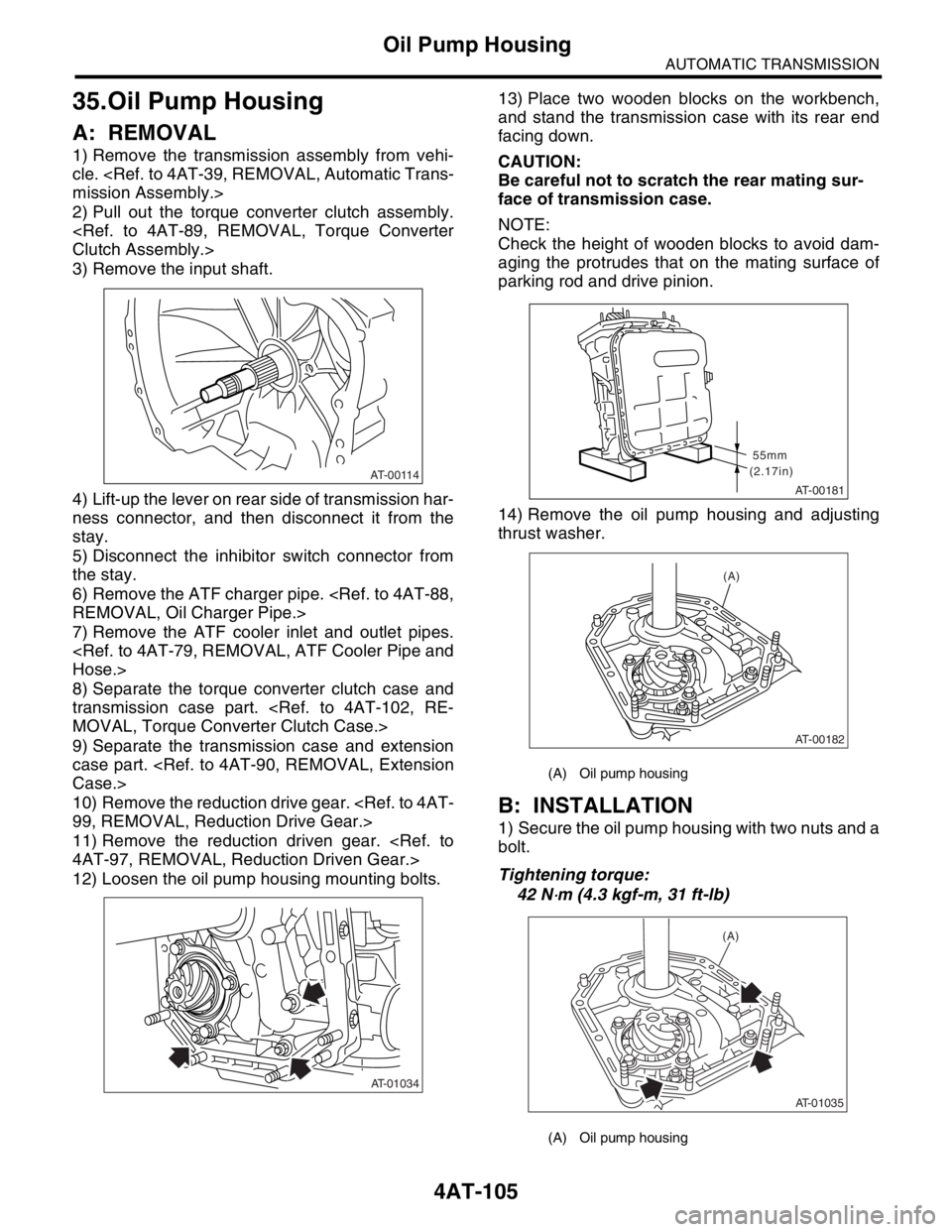
A: REMOVAL
1) Remove the transmission assembly from vehi-
cle.
2) Pull out the torque converter clutch assembly.
3) Remove the input shaft.
4) Lift-up the lever on rear side of transmission har-
ness connector, and then disconnect it from the
stay.
5) Disconnect the inhibitor switch connector from
the stay.
6) Remove the ATF charger pipe.
7) Remove the ATF cooler inlet and outlet pipes.
8) Separate the torque converter clutch case and
transmission case part.
9) Separate the transmission case and extension
case part.
10) Remove the reduction drive gear.
11) Remove the reduction driven gear.
12) Loosen the oil pump housing mounting bolts.13) Place two wooden blocks on the workbench,
and stand the transmission case with its rear end
facing down.
CAUTION:
Be careful not to scratch the rear mating sur-
face of transmission case.
NOTE:
Check the height of wooden blocks to avoid dam-
aging the protrudes that on the mating surface of
parking rod and drive pinion.
14) Remove the oil pump housing and adjusting
thrust washer.
B: INSTALLATION
1) Secure the oil pump housing with two nuts and a
bolt.
Tightening torque:
42 N
⋅m (4.3 kgf-m, 31 ft-lb)
AT-00114
AT-01034
(A) Oil pump housing
(A) Oil pump housing
AT-00181
(2.17in)55mm
AT-00182
(A)
AT-01035
(A)
Page 2423 of 2870
4AT-109
AUTOMATIC TRANSMISSION
Oil Pump Housing
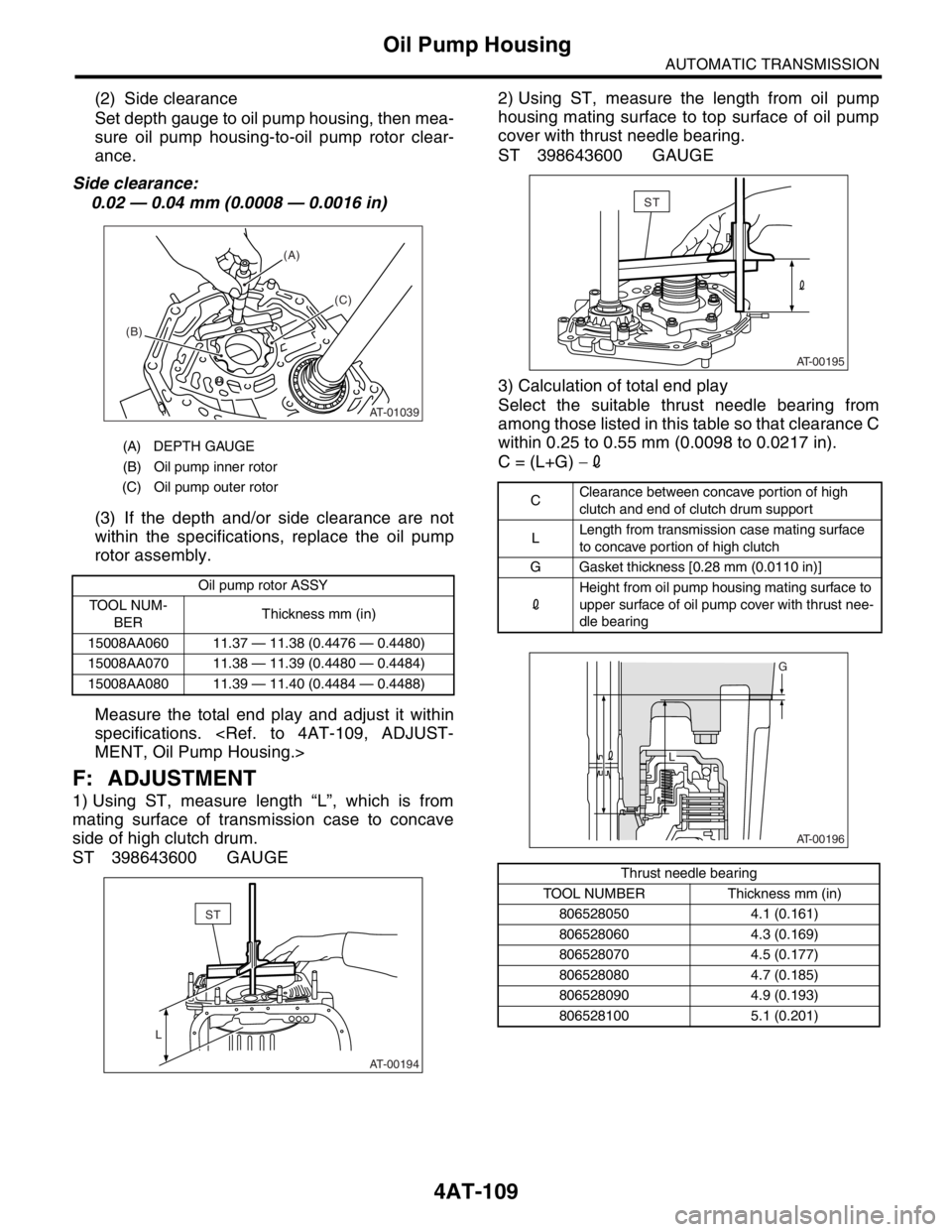
(2) Side clearance
Set depth gauge to oil pump housing, then mea-
sure oil pump housing-to-oil pump rotor clear-
ance.
Side clearance:
0.02 — 0.04 mm (0.0008 — 0.0016 in)
(3) If the depth and/or side clearance are not
within the specifications, replace the oil pump
rotor assembly.
Measure the total end play and adjust it within
specifications.
F: ADJUSTMENT
1) Using ST, measure length “L”, which is from
mating surface of transmission case to concave
side of high clutch drum.
ST 398643600 GAUGE2) Using ST, measure the length from oil pump
housing mating surface to top surface of oil pump
cover with thrust needle bearing.
ST 398643600 GAUGE
3) Calculation of total end play
Select the suitable thrust needle bearing from
among those listed in this table so that clearance C
within 0.25 to 0.55 mm (0.0098 to 0.0217 in).
C = (L+G) −2
(A) DEPTH GAUGE
(B) Oil pump inner rotor
(C) Oil pump outer rotor
Oil pump rotor ASSY
TOOL NUM-
BERThickness mm (in)
15008AA060 11.37 — 11.38 (0.4476 — 0.4480)
15008AA070 11.38 — 11.39 (0.4480 — 0.4484)
15008AA080 11.39 — 11.40 (0.4484 — 0.4488)
AT-01039
(A)
(B)
(C)
AT-00194
L
ST
CClearance between concave portion of high
clutch and end of clutch drum support
LLength from transmission case mating surface
to concave portion of high clutch
G Gasket thickness [0.28 mm (0.0110 in)]
2Height from oil pump housing mating surface to
upper surface of oil pump cover with thrust nee-
dle bearing
Thrust needle bearing
TOOL NUMBER Thickness mm (in)
806528050 4.1 (0.161)
806528060 4.3 (0.169)
806528070 4.5 (0.177)
806528080 4.7 (0.185)
806528090 4.9 (0.193)
806528100 5.1 (0.201)
AT-00195
ST
AT-00196
G
L
Page 2429 of 2870
4AT-115
AUTOMATIC TRANSMISSION
Drive Pinion Shaft Assembly
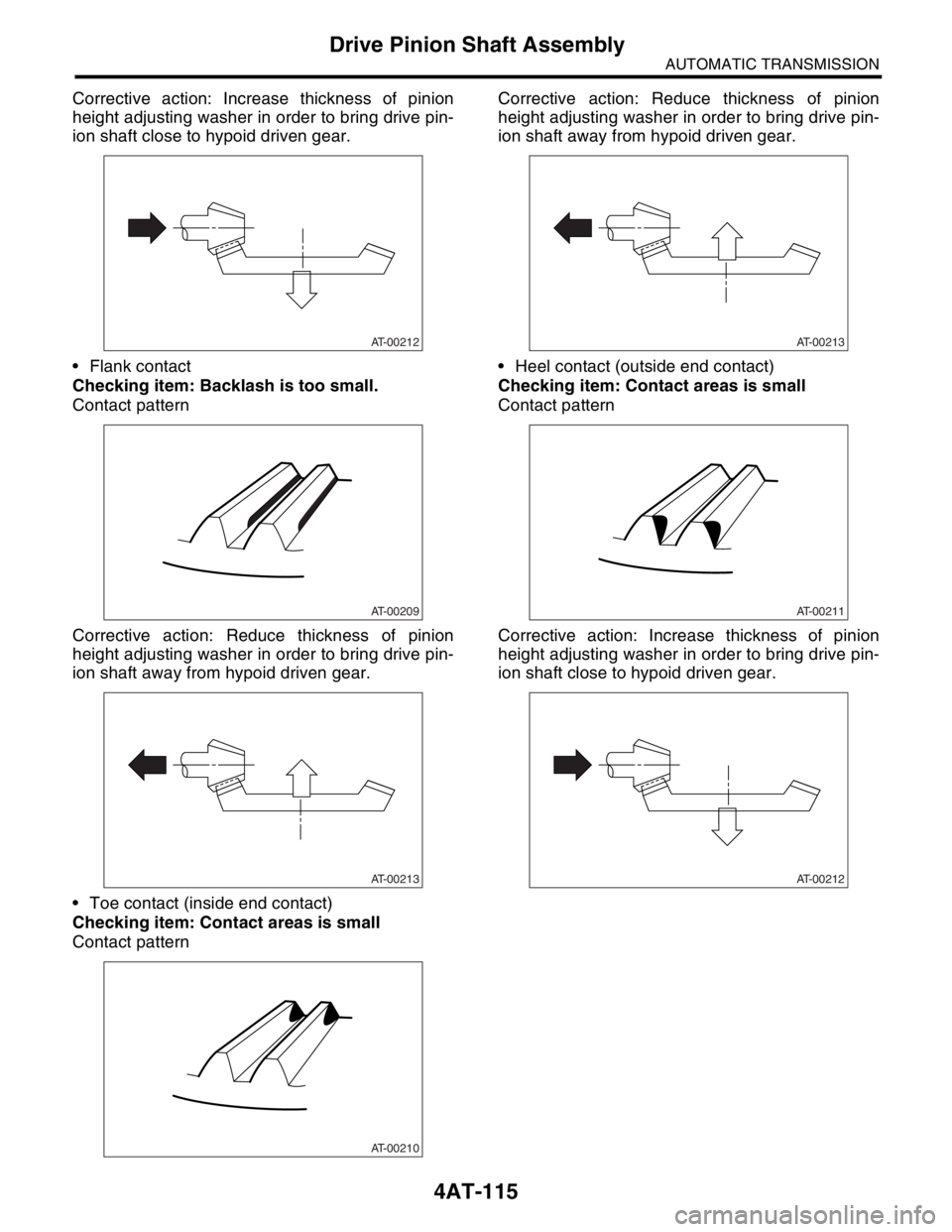
Corrective action: Increase thickness of pinion
height adjusting washer in order to bring drive pin-
ion shaft close to hypoid driven gear.
Flank contact
Checking item: Backlash is too small.
Contact pattern
Corrective action: Reduce thickness of pinion
height adjusting washer in order to bring drive pin-
ion shaft away from hypoid driven gear.
Toe contact (inside end contact)
Checking item: Contact areas is small
Contact patternCorrective action: Reduce thickness of pinion
height adjusting washer in order to bring drive pin-
ion shaft away from hypoid driven gear.
Heel contact (outside end contact)
Checking item: Contact areas is small
Contact pattern
Corrective action: Increase thickness of pinion
height adjusting washer in order to bring drive pin-
ion shaft close to hypoid driven gear.
AT-00212
AT-00209
AT-00213
AT-00210
AT-00213
AT-00211
AT-00212
Page 2440 of 2870
4AT-126
AUTOMATIC TRANSMISSION
AT Main Case
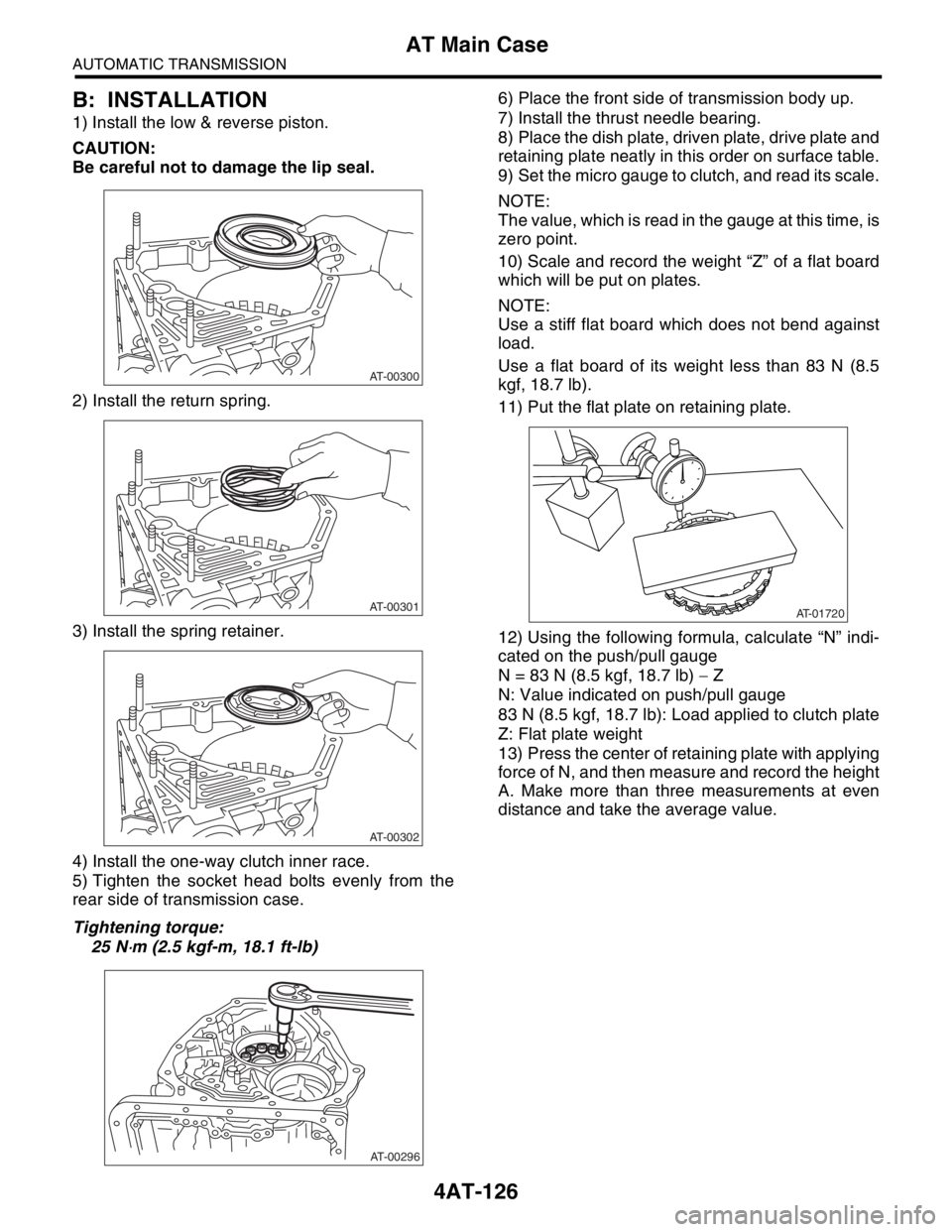
B: INSTALLATION
1) Install the low & reverse piston.
CAUTION:
Be careful not to damage the lip seal.
2) Install the return spring.
3) Install the spring retainer.
4) Install the one-way clutch inner race.
5) Tighten the socket head bolts evenly from the
rear side of transmission case.
Tightening torque:
25 N
⋅m (2.5 kgf-m, 18.1 ft-lb)6) Place the front side of transmission body up.
7) Install the thrust needle bearing.
8) Place the dish plate, driven plate, drive plate and
retaining plate neatly in this order on surface table.
9) Set the micro gauge to clutch, and read its scale.
NOTE:
The value, which is read in the gauge at this time, is
zero point.
10) Scale and record the weight “Z” of a flat board
which will be put on plates.
NOTE:
Use a stiff flat board which does not bend against
load.
Use a flat board of its weight less than 83 N (8.5
kgf, 18.7 lb).
11) Put the flat plate on retaining plate.
12) Using the following formula, calculate “N” indi-
cated on the push/pull gauge
N = 83 N (8.5 kgf, 18.7 lb) − Z
N: Value indicated on push/pull gauge
83 N (8.5 kgf, 18.7 lb): Load applied to clutch plate
Z: Flat plate weight
13) Press the center of retaining plate with applying
force of N, and then measure and record the height
A. Make more than three measurements at even
distance and take the average value.
AT-00300
AT-00301
AT-00302
AT-00296
AT-01720