stop start SUBARU FORESTER 2004 Service Owner's Guide
[x] Cancel search | Manufacturer: SUBARU, Model Year: 2004, Model line: FORESTER, Model: SUBARU FORESTER 2004Pages: 2870, PDF Size: 38.67 MB
Page 2056 of 2870
![SUBARU FORESTER 2004 Service Owners Guide EN(H4DOTC 2.5)-32
ENGINE (DIAGNOSTIC)
Subaru Select Monitor
7. LED OPERATION MODE FOR ENGINE
1) On the «Main Menu» display screen, select the {Each System Check} and press the [YES] key.
2) On the Â](/img/17/57426/w960_57426-2055.png "SUBARU FORESTER 2004 Service Owners Guide EN(H4DOTC 2.5)-32
ENGINE (DIAGNOSTIC)
Subaru Select Monitor
7. LED OPERATION MODE FOR ENGINE
1) On the «Main Menu» display screen, select the {Each System Check} and press the [YES] key.
2) On the Â")
EN(H4DOTC 2.5)-32
ENGINE (DIAGNOSTIC)
Subaru Select Monitor
7. LED OPERATION MODE FOR ENGINE
1) On the «Main Menu» display screen, select the {Each System Check} and press the [YES] key.
2) On the «System Selection Menu» display screen, select the {Engine} and press the [YES] key.
3) Press the [YES] key after the information of engine type was displayed.
4) On the «Engine Diagnosis» screen, select the {Current Data Display/Save}, and then press the [YES] key.
5) On the «Data Display» screen, select the {Data & LED Display} and press the [YES] key.
6) Using the scroll key, move the display screen up or down until the desired data is shown.
A list of the support data is shown in the following table.
Description Display Message LED “ON” requirements
Ignition switch signal Ignition Switch ON or OFF When ignition switch is ON.
Test Mode Signal Test Mode Signal ON or OFF When test mode connector is connected.
Neutral position switch signal Neutral Position Switch ON or OFF When neutral position signal is entered.
Air conditioning switch signal A/C Switch ON or OFF When air conditioning switch is ON.
Air conditioning relay signal A/C Compressor Signal ON or OFF When air conditioning relay is in function.
Radiator main fan relay signal Radiator Fan Relay #1 ON or OFF When radiator main fan relay is in function.
Knocking signal Knocking Signal ON or OFF When knocking signal is input.
Radiator sub fan relay signal Radiator Fan Relay #2 ON or OFF When radiator sub fan relay is in function.
Rear oxygen sensor rich signalRear O
2 Rich Signal
ON or OFFWhen rear oxygen sensor mixture ratio is
rich.
Starter switch signal Starter Switch Signal ON or OFF When starter switch signal is entered.
Idle switch signal Idle Switch Signal ON or OFF When idle switch signal is entered.
Crankshaft position sensor signal Crankshaft Position Signal ON or OFFWhen crankshaft position sensor signal is
input.
Camshaft position sensor signal Camshaft Position Signal ON or OFFWhen camshaft position sensor signal is
entered.
Power steering switch signal P/S Switch ON or OFF When power steering switch is entered.
Rear defogger switch signal Rear Defogger Switch ON or OFF When rear defogger switch is ON.
Blower fan switch signal Blower Fan Switch ON or OFF When blower fan switch is ON.
Small light switch signal Light Switch ON or OFF When small light switch is ON.
Tumble generated valve actuator
signalTGV Output ON or OFF When TGV actuator signal is entered.
Tumble generated valve drive sig-
nalTGV DriveClose or
OpenWhen TGV moves and valve opens.
Handle switch signal Handle SWLow Input
or High
InputIlluminates in Low Input.
AT/MT identification terminal AT Vehicle ID Signal ON or OFF ON (AT model).
Wiper switch signal Wiper Switch ON or OFF When wiper switch is turned to ON.
A/C mid pressure switch signal A/C Mid Pressure Switch ON or OFFWhen A/C mid pressure switch is turned to
ON.
AT coordinate retard angle
demandRetard Signal from AT ON or OFF When AT retard angle signal is exists.
AT coordinate fuel cut demand Fuel Cut Signal from AT ON or OFFWhen AT coordinate fuel cut demand signal
is exists.
AT coordinate permission signal Torque Permission Signal ON or OFFWhen AT coordinate permission signal is
exists.
VDC not torque down out put Ban of Torque Down ON or OFFWhen VDC not torque down output signal is
exists.
VDC torque down demand Request Torque Down VDC ON or OFFWhen VDC torque down demand signal is
exists.
ETC motor relay signal ETC Motor Relay ON or OFFWhen electronic throttle control relay is in
function.
Clutch switch signal Clutch Switch ON or OFF When clutch switch is ON.
Stop switch signal Stop Light Switch ON or OFF When stop light switch is ON.
Page 2060 of 2870

EN(H4DOTC 2.5)-36
ENGINE (DIAGNOSTIC)
Inspection Mode
P0852 Neutral Switch Input Circuit High —
P1086 Tumble Generated Valve Position Sensor 2 Circuit Low —
P1087 Tumble Generated Valve Position Sensor 2 Circuit High —
P1088 Tumble Generated Valve Position Sensor 1 Circuit Low —
P1089 Tumble Generated Valve Position Sensor 1 Circuit High —
P1091 Tumble Generated Valve System 1 (Valve Close) —
P1093 Tumble Generated Valve System 2 (Valve Close) —
P1094 Tumble Generated Valve Signal 1 Circuit Malfunction (Open) —
P1095 Tumble Generated Valve Signal 1 Circuit Malfunction (Short) —
P1096 Tumble Generated Valve Signal 2 Circuit Malfunction (Open) —
P1097 Tumble Generated Valve Signal 2 Circuit Malfunction (Short) —
P1110 Atmospheric Pressure Sensor Circuit Malfunction (Low Input) —
P1111 Atmospheric Pressure Sensor Circuit Malfunction (High Input) —
P1160 Return Spring Failure—
P1518 Starter Switch Circuit Low Input —
P1544 High exhaust temperature detected —
P1560 Back-Up Voltage Circuit Malfunction —
P1570 ANTENNA—
P1571 Reference Code Incompatibility —
P1572 IMM Circuit Failure (Except Antenna Circuit) —
P1574 Key Communication Failure —
P1576 EGI Control Module EEPROM —
P1577 IMM Control Module EEPROM —
P2088 OCV Solenoid Valve Signal A Circuit Open (Bank 1) —
P2089 OCV Solenoid Valve Signal A Circuit Short (Bank 1) —
P2092 OCV Solenoid Valve Signal A Circuit Open (Bank 2) —
P2093 OCV Solenoid Valve Signal A Circuit Short (Bank 2) —
P2101 Throttle Actuator Control Motor Circuit Range/Performance —
P2102 Throttle Actuator Control Motor Circuit Low —
P2103 Throttle Actuator Control Motor Circuit High —
P2109 Throttle/Pedal Position Sensor A Minimum Stop Performance —
P2122 Throttle/Pedal Position Sensor/Switch “D” Circuit Low Input —
P2123 Throttle/Pedal Position Sensor/Switch “D” Circuit High Input —
P2127 Throttle/Pedal Position Sensor/Switch “E” Circuit Low Input —
P2128 Throttle/Pedal Position Sensor/Switch “E” Circuit High Input —
P2135 Throttle/Pedal Position Sensor/Switch “A”/“B” Voltage Rationality —
P2138 Throttle/Pedal Position Sensor/Switch “D”/“E” Voltage Rationality —DTC Item On condition
Page 2344 of 2870

4AT-32
AUTOMATIC TRANSMISSION
Road Test
4. Road Test
A: INSPECTION
1. GENERAL PRECAUTION
Road tests should be conducted to properly diag-
nose the condition of the automatic transmission.
NOTE:
When performing the test, do not exceed posted
speed limit.
2. D RANGE SHIFT FUNCTION
Check shifting between 1st ←→ 2nd ←→ 3rd ←→
4th while driving on normal city streets.
3. D RANGE SHIFT SHOCK
Check the shock level when shifting up during nor-
mal driving.
4. KICK-DOWN FUNCTION
Check kick-down for each gear. Also check the
kick-down shock level.
5. ENGINE BRAKE OPERATION
Check the 3rd gear engine brake when shifting
down from D ←→ 3rd range while driving in 4th
gear of D range [50 — 60 km/h (31 — 37 MPH)].
Check the 2nd gear engine brake when shifting
between 3rd ←→ 2nd range while driving in the 3rd
range of 3rd gear [40 — 50 km/h (25 — 31 MPH)].
Check the 1st gear engine brake when shifting
between 2nd ←→ 1st range while driving in the 2nd
range of 2nd gear [20 — 30 km/h (12 — 19 MPH)].
6. LOCK-UP FUNCTION
Check that rpm does not change sharply when
the axle pedal is lightly depressed when driving on
flat roads at 60 km/h (37 MPH).
Check slip lock-up with following procedure.
Subaru Select Monitor is needed for checking (EC,
EK model).
Before start checking, check that the DTC is not ex-
isted using Subaru Select Monitor. When the DTC
is existed, perform the collective action with DTC
and check that the DTC is not existed again, and
then start the checking.
1) The check performed on flat and straight road or
free roller.
NOTE:
Slip lock-up does not operate when the vehicle is
lifted up, because of not occurring surface resis-
tance.
Also checking on the free roller, check with de-
pressing foot brake lightly to make the checking
easier, because the surface resistance will be defi-
cient2) Connect the Subaru Select Monitor.
3) Check ATF temperature using Subaru Select
Monitor.
NOTE:
ATF temperature is between 50 — 100°C (122
— 212°F).
When the temperature is low, warm-up the ATF
by running the vehicle or etc.
4) Start the engine, and make the lock-up duty be
able to read on data display of Subaru Select Mon-
itor.
5) 35 — 40 Drive the vehicle at a constant speed of
35 — 40 km/h (22 — 25 MPH).
6) Read the lock-up duty while vehicle is running.
Standard value:
25 — 45%
NOTE:
On the free roller, the value sometimes lowers.
Slip lock-up control is not operating when the
lock-up duty is less than 5%, or when the lock-up
duty goes down immediately after starts rise. On
these cases, improper ATF or deterioration of ATF
may be the cause. Check the amount of ATF or re-
place them, and then recheck it.
7. P RANGE OPERATION
Stop the vehicle on an uphill grade of 5% or more
and shift to “P” range. Check that the vehicle does
not move when the parking brake is released.
8. NOISE AND VIBRATION
Check for unusual sounds and vibration while driv-
ing and during shifting.
9. CLIMBING CONTROL FUNCTION
Check that the gear remains in 3rd when going
up a grade.
Check that the gear remains in 3rd when apply-
ing the brakes while going down a grade.
10.TRANSFER CLUTCH
Check tight corner braking when the vehicle started
with steering fully turned.
11.OIL LEAKS
After the driving test, inspect for oil leaks.
Page 2347 of 2870

4AT-35
AUTOMATIC TRANSMISSION
Time Lag Test
6. Time Lag Test
A: INSPECTION
NOTE:
If the select lever is shifted while the engine is
idling, there will be a certain time elapse or lag be-
fore the shock can be felt. This is used for checking
the condition of the low clutch, reverse clutch, low &
reverse brake and one-way clutch.
Perform the test at normal operation fluid tem-
perature 70 — 80°C (158 — 176°F).
Be sure to allow a one minute interval between
tests.
Perform measurement for three times and take
the average value.
1) Fully apply the parking brake.
2) Start the engine.
Check the idling speed (A/C OFF).
3) Shift the select lever from “N” to “D” range.
Using a stop watch, measure the time it takes from
shifting the lever until the shock is felt.
Time lag: Less than 1.2 seconds
If “N” → “D” time lag is longer than specified:
Line pressure too low
Low clutch worn
One-way clutch not operating properly
D-ring worn
4) In the same manner, measure the time lag for
“N” → “R”.
Time lag: Less than 1.5 seconds
If “N” → “R” time lag is longer than specified:
Line pressure too low
Reverse clutch worn
Low & reverse brake worn
D-ring worn
Page 2355 of 2870
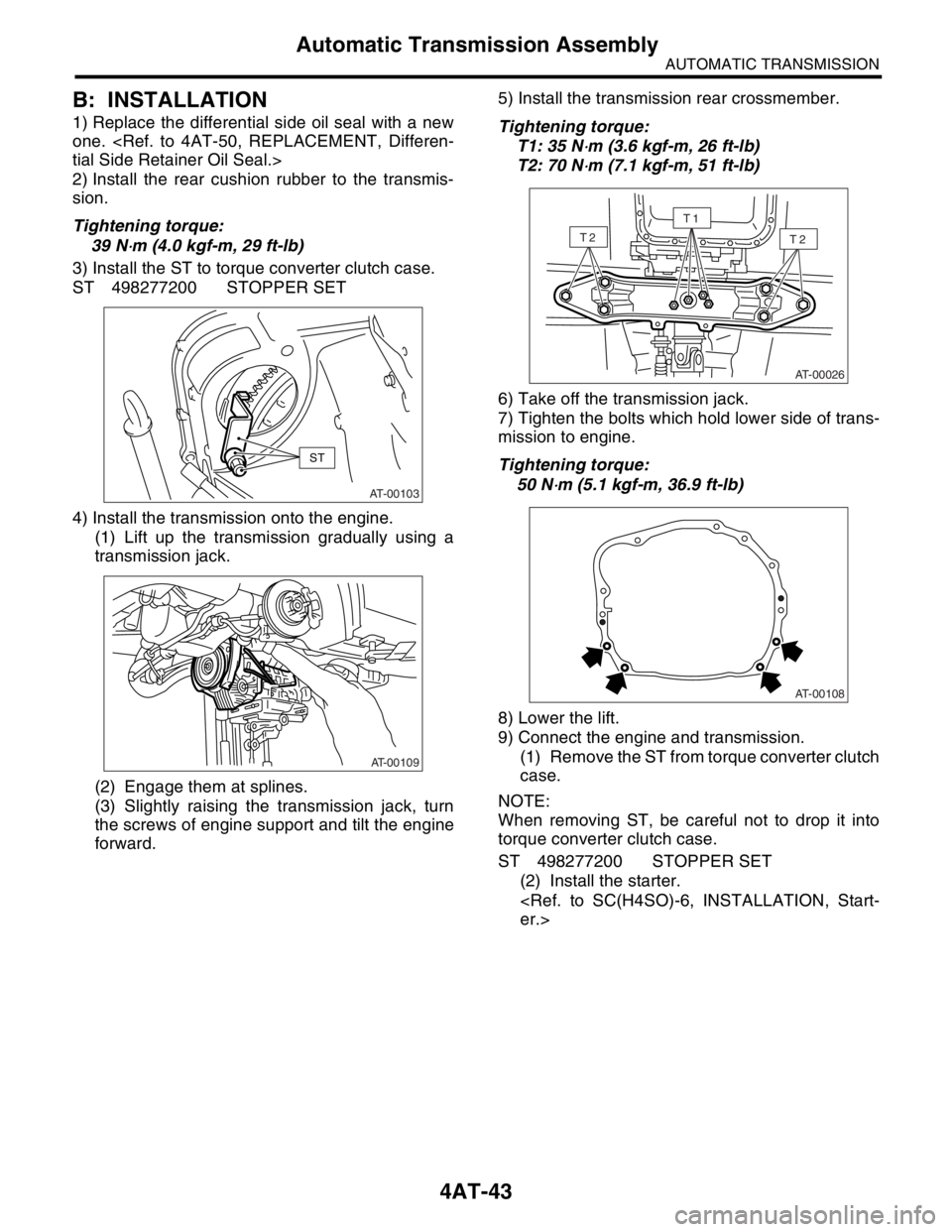
4AT-43
AUTOMATIC TRANSMISSION
Automatic Transmission Assembly
B: INSTALLATION
1) Replace the differential side oil seal with a new
one.
2) Install the rear cushion rubber to the transmis-
sion.
Tightening torque:
39 N
⋅m (4.0 kgf-m, 29 ft-lb)
3) Install the ST to torque converter clutch case.
ST 498277200 STOPPER SET
4) Install the transmission onto the engine.
(1) Lift up the transmission gradually using a
transmission jack.
(2) Engage them at splines.
(3) Slightly raising the transmission jack, turn
the screws of engine support and tilt the engine
forward.5) Install the transmission rear crossmember.
Tightening torque:
T1: 35 N
⋅m (3.6 kgf-m, 26 ft-lb)
T2: 70 N
⋅m (7.1 kgf-m, 51 ft-lb)
6) Take off the transmission jack.
7) Tighten the bolts which hold lower side of trans-
mission to engine.
Tightening torque:
50 N
⋅m (5.1 kgf-m, 36.9 ft-lb)
8) Lower the lift.
9) Connect the engine and transmission.
(1) Remove the ST from torque converter clutch
case.
NOTE:
When removing ST, be careful not to drop it into
torque converter clutch case.
ST 498277200 STOPPER SET
(2) Install the starter.
ST
AT-00109
AT-00026
T2T2
T1
AT-00108
Page 2479 of 2870

4AT(H4SO)-20
AUTOMATIC TRANSMISSION (DIAGNOSTIC)
Read Diagnostic Trouble Code (DTC)
7. Read Diagnostic Trouble Code (DTC)
A: OPERATION
1. WITHOUT SUBARU SELECT MONITOR
Step Check Yes No
1 PERFORM READ DTC.
1) Warm-up the engine.
2) Turn the ignition switch to OFF.
3) Turn the ignition switch to ON.
4) Start the engine.
5) Drive the vehicle at speeds greater than 20
km/h (12 MPH).
6) Stop the vehicle.
7) The brake pedal depressed and move
select lever to 1 range.
8) Turn the ignition switch to OFF.
9) Turn the ignition switch to ON.
10)Move the select lever “2” range.
11)Move the select lever “1” range.
12)Move the select lever “2” range.
13)Move the select lever “3” range.
14)Move the select lever “D” range.Does the POWER indicator
light blink at 4 Hz intervals?
NOTE: Blinks every 0.125 (1/8)
seconds (until the ignition
switch is turned OFF).Go to step 2.Repair the power
supply and ground
circuit.
CHECK POWER
SUPPLY AND
GROUND LINE,
INSPECTION,
Power Indicator
Light Display.>
2 CHECK POWER INDICATOR LIGHT.Does the POWER indicator
light blink at 2 Hz intervals?
NOTE: Blinks every 0.25 (1/4)
seconds (until ignition switch is
turned to OFF).The AT system is
normal.Go to step 3.
3 CHECK POWER INDICATOR LIGHT.Is the DTC outputted by the
blink of POWER indicator
light?Inspect the prob-
lem correspond-
ing with DTC.
N
OTE:
Record all DTCs.Go to step 4.
4 CHECK POWER INDICATOR LIGHT.Does the POWER indicator
light remain illuminated?Repair the
POWER indicator
light circuit
INSPECTION,
Power Indicator
Light Display.>, or
Inspect inhibitor
switch, wiring,
TCM, etc.Calling up the DTC
again.
Page 2528 of 2870

4AT(H4SO)-69
AUTOMATIC TRANSMISSION (DIAGNOSTIC)
Diagnostic Procedure with Diagnostic Trouble Code (DTC)
5 CHECK OUTPUT SIGNAL EMITTED FROM
TCM.
1) Connect all connectors.
2) Start the engine and warm-up the transmis-
sion until ATF temperature is above 80°C
(176°F).
N
OTE:
If ambient temperature is below 0°C (32°F),
drive the vehicle until ATF reaches its operating
temperature.
3) Turn the ignition switch to ON (engine
OFF).
4) Move the select lever to “N” range.
5) Throttle fully closed.
6) Measure the voltage between TCM con-
nector and chassis ground.
Connector & terminal
(B54) No. 9 (+) — Chassis ground (
−):Is the voltage 1.5 — 5.0 V? Go to step 6.Go to step 9.
6 CHECK OUTPUT SIGNAL EMITTED FROM
TCM.
1) Throttle fully open and hold it.
2) Measure the voltage between TCM con-
nector and chassis ground.
Connector & terminal
(B54) No. 9 (+) — Chassis ground (
−):Is the voltage less than 1 V? Even if the
POWER indicator
light was blinking,
the circuit has
returned to a nor-
mal condition at
this time. A tempo-
rary poor contact
of the connector or
harness may be
the cause. Repair
the harness or
connector in trans-
mission.Go to step 9.
7 CHECK OUTPUT SIGNAL EMITTED FROM
TCM USING SUBARU SELECT MONITOR.
1) Connect the connectors to TCM and trans-
mission.
2) Connect the Subaru Select Monitor to data
link connector.
3) Start the engine and turn Subaru Select
Monitor switch to ON.
4) Warm-up the transmission until ATF tem-
perature is above 80°C (176°F).
N
OTE:
If ambient temperature is below 0°C (32°F),
drive the vehicle until ATF reaches its operating
temperature.
5) Stop the engine and turn ignition switch to
ON (engine OFF).
6) Move the select lever to “N” range.
7) Throttle is fully closed.
Line pressure duty solenoid is indicated in
“%”.
8) Read the data of line pressure duty sole-
noid using Subaru Select Monitor.Is the value 100%? Go to step 8.Go to step 9. Step Check Yes No
Page 2531 of 2870

4AT(H4SO)-72
AUTOMATIC TRANSMISSION (DIAGNOSTIC)
Diagnostic Procedure with Diagnostic Trouble Code (DTC)
5 CHECK OUTPUT SIGNAL EMITTED FROM
TCM.
1) Connect all connectors.
2) Start the engine and warm-up the transmis-
sion until ATF temperature is above 80°C
(176°F).
N
OTE:
If ambient temperature is below 0°C (32°F),
drive the vehicle until ATF reaches its operating
temperature.
3) Turn the ignition switch to ON (engine
OFF).
4) Move the select lever to “N” range.
5) Throttle fully closed.
6) Measure the voltage between TCM con-
nector and chassis ground.
Connector & terminal
(B54) No. 18 (+) — Chassis ground (
−):Is the voltage 1.5 — 5.0 V? Go to step 6.Go to step 9.
6 CHECK OUTPUT SIGNAL EMITTED FROM
TCM.
1) Throttle fully open and hold it.
2) Measure the voltage between TCM con-
nector and chassis ground.
Connector & terminal
(B54) No. 18 (+) — Chassis ground (
−):Is the voltage less than 1 V? Even if the
POWER indicator
light was blinking,
the circuit has
returned to a nor-
mal condition at
this time. A tempo-
rary poor contact
of the connector or
harness may be
the cause. Repair
the harness or
connector in TCM
and transmission.Go to step 9.
7 CHECK OUTPUT SIGNAL EMITTED FROM
TCM USING SUBARU SELECT MONITOR.
1) Connect all connectors.
2) Connect the Subaru Select Monitor to data
link connector.
3) Start the engine and turn Subaru Select
Monitor switch to ON.
4) Warm-up the transmission until ATF tem-
perature is above 80°C (176°F).
NOTE:
If ambient temperature is below 0°C (32°F),
drive the vehicle until ATF reaches its operating
temperature.
5) Stop the engine and turn ignition switch to
ON (engine OFF).
6) Move the select lever to “N” range.
7) Throttle is fully closed.
2-4 brake duty solenoid is indicated in “%”.
8) Read the data of 2-4 brake duty solenoid
using Subaru Select Monitor.Is the value 100%? Go to step 8.Go to step 9. Step Check Yes No
Page 2646 of 2870

4AT(H4DOTC)-70
AUTOMATIC TRANSMISSION (DIAGNOSTIC)
Diagnostic Procedure with Diagnostic Trouble Code (DTC)
4 PREPARE SUBARU SELECT MONITOR.Do you have a Subaru Select
Monitor?Go to step 7.Go to step 5.
5 CHECK OUTPUT SIGNAL FROM TCM.
1) Connect all connectors.
2) Start the engine and warm-up the engine
until ATF temperature is above 80°C (176°F).
N
OTE:
If ambient temperature is below 0°C (32°F),
drive the vehicle until ATF reaches its operating
temperature.
3) Turn the ignition switch to ON (engine
OFF).
4) Shift the select lever to “R” range.
5) Close the throttle fully.
6) Measure the voltage between TCM con-
nector and chassis ground.
Connector & terminal
(B56) No. 20 (+) — Chassis ground (
−):Is the voltage 5.0 — 7.0 V? Go to step 6.Go to step 9.
6 CHECK OUTPUT SIGNAL FROM TCM.
1) Open the throttle fully.
2) Measure the voltage between TCM con-
nector and chassis ground.
Connector & terminal
(B56) No. 20 (+) — Chassis ground (
−):Is the voltage 3.0 — 5.0 V? Even if the POWER
indicator light was
blinking, the circuit
has returned to a
normal condition at
this time. A tempo-
rary poor contact of
the connector or
harness may be the
cause. Repair the
harness or connec-
tor in transmission.Go to step 9.
7 CHECK OUTPUT SIGNAL FROM TCM US-
ING SUBARU SELECT MONITOR.
1) Connect the connectors to TCM and trans-
mission.
2) Connect the Subaru Select Monitor to data
link connector.
3) Start the engine and turn Subaru Select
Monitor switch to ON.
4) Warm-up the transmission until ATF tem-
perature is above 80°C (176°F).
NOTE:
If ambient temperature is below 0°C (32°F),
drive the vehicle until ATF reaches its operating
temperature.
5) Stop the engine and turn ignition switch to
ON (engine OFF).
6) Shift the select lever to “R” range.
7) Read the data of line pressure linear sole-
noid using Subaru Select Monitor.
Line pressure linear solenoid is indicated in
“%”.
8) Throttle is fully closed.Is the value 45 — 50%? Go to step 8.Go to step 9. Step Check Yes No
Page 2650 of 2870

4AT(H4DOTC)-74
AUTOMATIC TRANSMISSION (DIAGNOSTIC)
Diagnostic Procedure with Diagnostic Trouble Code (DTC)
7 CHECK OUTPUT SIGNAL FROM TCM US-
ING SUBARU SELECT MONITOR.
1) Connect the connectors to TCM and trans-
mission.
2) Connect the Subaru Select Monitor to data
link connector.
3) Start the engine and turn Subaru Select
Monitor switch to ON.
4) Warm-up the transmission until ATF tem-
perature is above 80°C (176°F).
N
OTE:
If ambient temperature is below 0°C (32°F),
drive the vehicle until ATF reaches its operating
temperature.
5) Stop the engine and turn ignition switch to
ON (engine OFF).
6) Shift the select lever to “P” or “N” range.
7) Read the data of low clutch duty solenoid
using Subaru Select Monitor.
Low clutch duty solenoid is indicated in “%”.Is the value 100%? Go to step 8.Go to step 9.
8 CHECK OUTPUT SIGNAL FROM TCM US-
ING SUBARU SELECT MONITOR.
1) Turn the ignition switch to ON (engine
OFF).
2) Shift the select lever to “D” range.
3) Read the data of low clutch duty solenoid.Is the value 0%? Even if the POWER
indicator light was
blinking, the circuit
has returned to a
normal condition at
this time. A tempo-
rary poor contact of
the connector or
harness may be the
cause. Repair the
harness or connec-
tor in transmission.Go to step 9.
9 CHECK POOR CONTACT.Is there poor contact in low
clutch duty solenoid circuit?Repair the poor
contactReplace the TCM.
trol Module
(TCM).>
10 CHECK LOW CLUTCH DUTY SOLENOID (IN
TRANSMISSION).
1) Remove the transmission connector from
bracket.
2) Drain the ATF.
CAUTION:
Do not drain the ATF until it cools down.
3) Remove the oil pan, and disconnect con-
nector from low clutch duty solenoid.
4) Measure the resistance between low clutch
duty solenoid connector and transmission
ground.
Connector & terminal
(AT12) No. 2 — Transmission ground:Is the resistance 2.0 — 4.5 Ω? Go to step 11.Replace the con-
trol valve body.
Body.>
11 CHECK HARNESS CONNECTOR BETWEEN
TRANSMISSION AND LOW CLUTCH DUTY
SOLENOID.
Measure the resistance of harness between
low clutch duty solenoid and transmission con-
nector.
Connector & terminal
(T4) No. 4 — (AT12) No. 2:Is the resistance less than 1
Ω?Go to step 12.Repair the open
circuit in harness
between low clutch
duty solenoid and
transmission con-
nector. Step Check Yes No