meter SUBARU FORESTER 2004 Service Workshop Manual
[x] Cancel search | Manufacturer: SUBARU, Model Year: 2004, Model line: FORESTER, Model: SUBARU FORESTER 2004Pages: 2870, PDF Size: 38.67 MB
Page 623 of 2870
CC(H4DOTC 2.5)-11
CRUISE CONTROL SYSTEM (DIAGNOSTIC)
Diagnostic Procedure with Symptom
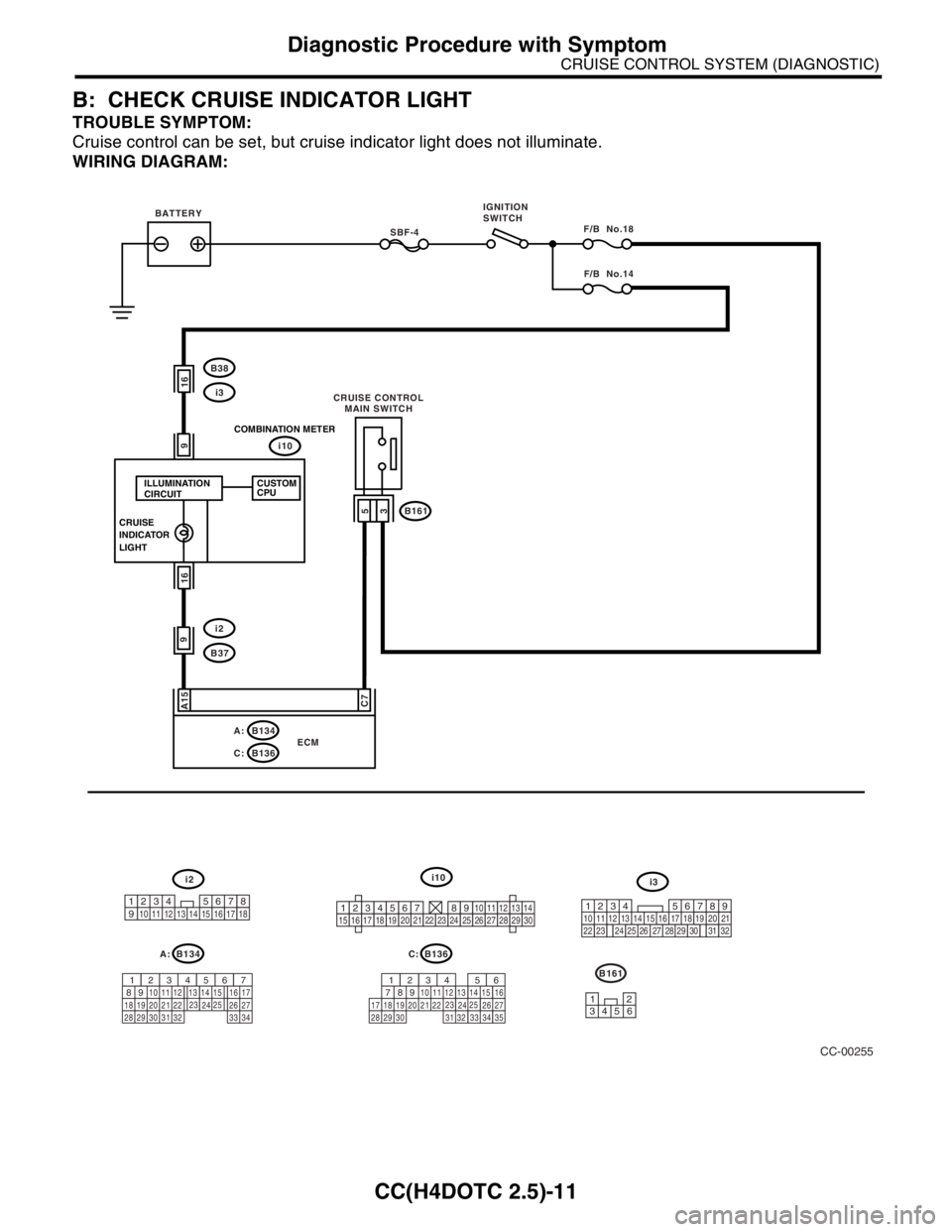
B: CHECK CRUISE INDICATOR LIGHT
TROUBLE SYMPTOM:
Cruise control can be set, but cruise indicator light does not illuminate.
WIRING DIAGRAM:
CC-00255
i10i3
123456789101112131415161718192021222324252627282930
B134
9
30 29 28 323120 19 18 222110 121114
24
34 3327 2617 16123456713
2315
258
B136
9
30 29 28 323120 19 18 22211012
1114
24
34 3327
261612345613
2315
25871735
C: A:
B161
219
32
1234
5610 11 12 13 14 15716
23 3019 20
22 26 27 28 29817
24 3118
25
COMBINATION METERSBF-4F/B No.18
B38
i3F/B No.14
16
BATTERYIGNITION
SWITCH
CRUISE CONTROL
MAIN SWITCH
ILLUMINATION
CIRCUIT
A15
C716
i2
B37
5
3B161
9 9i10
B134
A:
B136
C:ECM CRUISE
INDICATOR
LIGHTCUSTOM
CPU
12
3456
i2
123 8
910411 12 13 14 15 165671718
Page 624 of 2870

CC(H4DOTC 2.5)-12
CRUISE CONTROL SYSTEM (DIAGNOSTIC)
Diagnostic Procedure with Symptom
Step Check Yes No
1 CHECK CRUISE INDICATOR LIGHT CIR-
CUIT.
1) Turn the ignition switch to OFF.
2) Disconnect the combination meter harness
connector.
3) Turn the ignition switch to ON.
4) Measure the voltage between harness con-
nector terminal and chassis ground.
Connector & terminal
(i10) No. 9 (+) — Chassis ground (
−):Is the voltage more than 10 V? Go to step 2. Check the fuse
No. 14 (in fuse &
relay box).
Check the har-
ness for open or
short between
combination meter
and fuse & relay
box.
2 CHECK CRUISE INDICATOR LIGHT CIR-
CUIT.
1) Turn the ignition switch to OFF.
2) Disconnect the ECM harness connector.
3) Measure the resistance between ECM har-
ness connector terminal and combination
meter harness connector terminal.
Connector & terminal
(B134) No. 15 — (i10) No. 16:Is the resistance less than 10
Ω?Go to step 3.Repair the har-
ness.
3 CHECK CRUISE INDICATOR LIGHT CIR-
CUIT.
Ground the ECM harness connector terminal
with a suitable wire.
Connector & terminal
(B134) No. 15 — Chassis ground:Does the cruise indicator light
illuminate?Check the poor
contact of ECM
connector.Replace the meter
main assembly.
Page 652 of 2870
IM-10
IMMOBILIZER (DIAGNOSTIC)
Diagnostics Chart for Immobilizer Warning Light
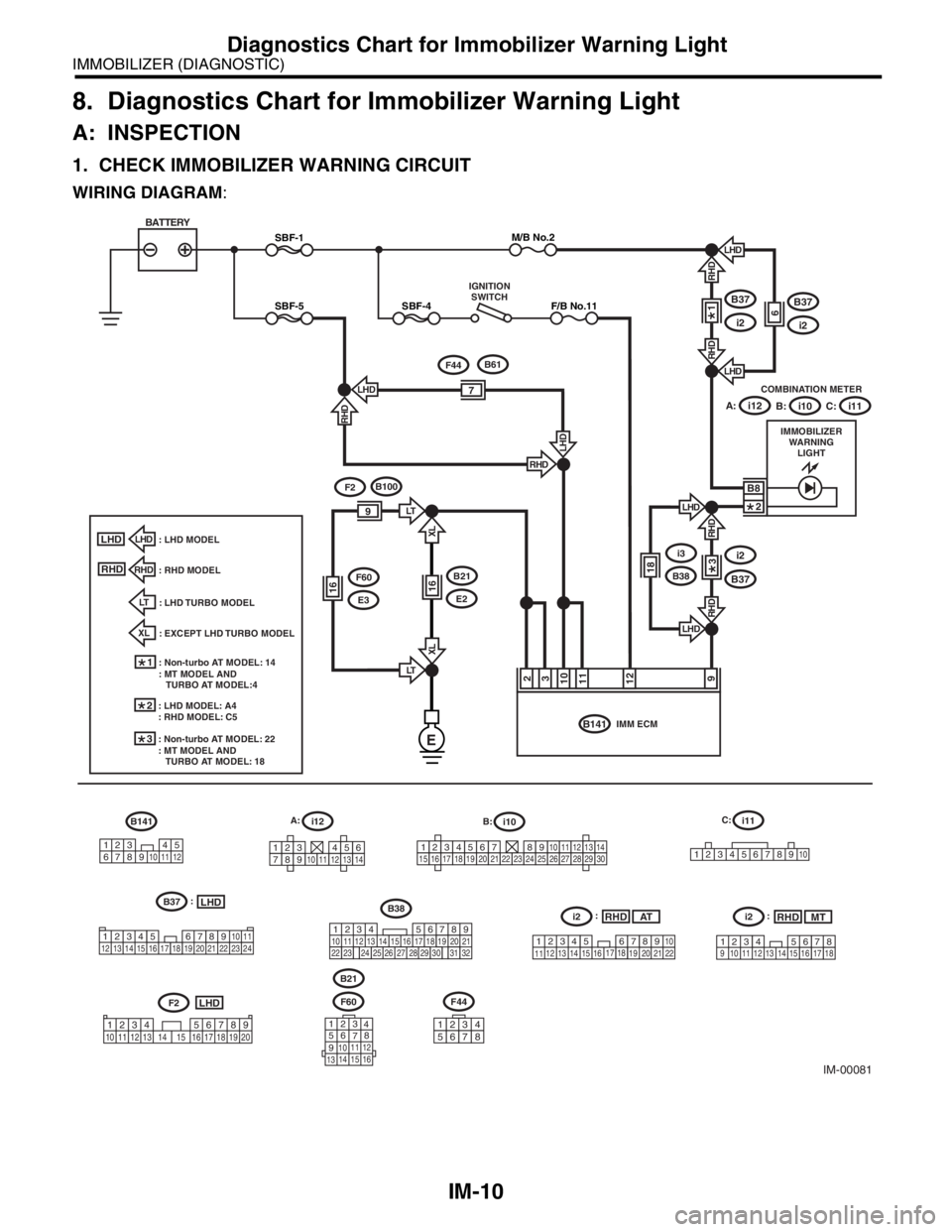
8. Diagnostics Chart for Immobilizer Warning Light
A: INSPECTION
1. CHECK IMMOBILIZER WARNING CIRCUIT
WIRING DIAGRAM:
IM-00081
F60
B21
RHD
SBF-1
SBF-5SBF-4
BATTERY
IMMOBILIZER
WARNING
LIGHT COMBINATION METER
B141IMM ECM
B37
i2
i2
B37
i12
B37
i2
LHD
RHDLHD
6
RHD
M/B No.2
F/B No.11
IGNITION
SWITCH
91211102
B8
3: RHD MODEL
1: Non-turbo AT MODEL: 14
: MT MODEL AND
TURBO AT MODEL:4
i12B141
34 12
89
10 11125
67
219
32
B38
1234 5610 11 12 13 14 15716
23 3019 20
22 26 27 28 29817
24 3118
25
123456789101112131415161718192021222324252627282930
LHDB37
34 12 89
10 11
12 13 14 15 16 17 18 19 20 21 22 23 24567
i10
1
23456789
10
B:
E
A:i10 B:
i11C:
: LHD TURBO MODELLT
: EXCEPT LHD TURBO MODEL
XL
34 12 8910
1112 13 14 15 161718
19 20 21 22567
i2RHD
F2LHD
LHD
LHD
7
F44B61
RHD
RHD
LHD
: LHD MODEL
1
2
i11 C:
LHD
LHD
18
i3
B38
RHD
RHD
3
XL
LT
XL
LT9
1616
F2B100
B21
E2
F60
E3
LHD
RHD
2: LHD MODEL: A4
: RHD MODEL: C5
3: Non-turbo AT MODEL: 22
: MT MODEL AND
TURBO AT MODEL: 18
A:
:
AT:
23 1789 1011121314 15
16 1718456
i2RHDMT:
1234 5678910 11 12 13 14 15 16 17 18 19 20123
4
56
78
9
1011 12
1314 15 16
1234568791011121314
F44
12345678
Page 653 of 2870

IM-11
IMMOBILIZER (DIAGNOSTIC)
Diagnostics Chart for Immobilizer Warning Light
Step Check Yes No
1 CHECK IMMOBILIZER WARNING LIGHT.
1) Turn the ignition switch to OFF.
2) Disconnect the harness connector from
IMM ECM.
3) Connect a resistor (750 Ω) between IMM
ECM harness connector terminal No. 9 and
chassis ground.Does the immobilizer warning
light illuminate?Go to step 2.Go to step 5.
2 CHECK IMM ECM GROUND CIRCUIT.
Measure the resistance between IMM ECM
harness connector terminal and chassis
ground.
Connector & terminal
(B141) No. 2, No. 3 — Chassis ground:Is the resistance less than 10
Ω?Go to step 3.Repair the open
circuit of IMMECM
ground circuit.
3 CHECK IMM ECM IGNITION CIRCUIT.
1) Turn the ignition switch to ON. (engine
OFF.)
2) Measure the voltage between IMM ECM
harness connector terminal and chassis
ground.
Connector & terminal
(B141) No. 12 (+) — Chassis ground(
−):Is the voltage more than 10 V? Go to step 4.Check the harness
for open or short
between IMM
ECM and ignition
switch.
4 CHECK IMM ECM POWER SUPPLY CIR-
CUIT.
1) Turn the ignition switch to OFF.
2) Measure the voltage between IMM ECM
harness connector terminal and chassis
ground.
Connector & terminal
(B141) No. 10, No. 11 (+) — Chassis
ground(
−):Is the voltage more than 10 V? Replace the IMM
ECM
Control Module.>
and then replace
all ignition keys
(including the tran-
sponder). Then
perform teaching
operation. Refer to
teaching opera-
tion manual (Pub.
No. S0820GZ).Check the harness
for open or short
between IMM
ECM and fuse.
5 CHECK COMBINATION METER CIRCUIT.
1) Remove the combination meter.
2) Measure the voltage between combination
meter harness connector terminal and chassis
ground.
Connector & terminal
(i10) No. 8 (+) — Chassis ground (
−):Is the voltage more than 10 V? Go to step 6.Check the harness
for open or short
between combina-
tion meter and
fuse.
6 CHECK COMBINATION METER CIRCUIT.
Measure the resistance between IMM ECM
harness connector terminal and combination
meter harness connector terminal.
Connector & terminal
LHD model
(B141) No. 9 — (i12) No. 4:
RHD model
(B141) No. 9 — (i11) No. 5:Is the resistance less than 10
Ω?Faulty LED.
Replace the com-
bination meter
printed circuit.
Combination
Meter Assembly.>Repair the har-
ness or connector.
Page 715 of 2870

ID-6
IDENTIFICATION
Identification
Transmission
TY755XF3AA
Rear differential 1
VA1REK
Rear differential 2
HP
Option code
ECAJ
Digits Code Meaning Details
1 T Transmission T: Transmission
2 Y Transmission type Y: Full-time AWD MT center differential
Z: Full-time AWD AT MPT
3 and 4 75 Classification 75: MT
1A: AT
1B: AT
55 Series 3: AT
5: MT
6 X Transmission specifica-
tionsV: Full-time AWD 5-speed MT with viscous coupling center dif-
ferential single range
X: Full-time AWD 5-speed MT Dual range with viscous cou-
pling center differential
Z: Full-time AWD 4-speed AT with MPT
L: Full-time AWD 4-speed AT with MPT Turbo
7 F Mounted body F: 2.5L SOHC
R: 2.0L SOHC
N: 2.0L DOHC Turbo
H: 2.5L DOHC Turbo
8 3 Minor change 3: Initial
9 to 10 AA Detailed specifications Used when ordering parts. See the parts catalog for details.
Digits Code Meaning Details
1 V Fo r AW D V: AW D
2 A Type A: A type
3 1 Hypoid gear diameter
mm (in)1: 152 (6.0) dia.
4 R Installation position R: Rear
5 E Reduction gear ratio E: 4.111
F: 4.444
6 K Specification differ-
ences—
Code Reduction gear ratio LSD
HP 4.111 Viscous
JP 4.111 Viscous
CF 4.444 Viscous
Digits Code Meaning Details
1 to 2 EC Destination EC: EC
K4: K4
KS: KS
EK: EK
KA: KA
3 to 4 AJ Main option of vehicle —
Page 746 of 2870
PM-9
PERIODIC MAINTENANCE SERVICE
Engine Oil Filter
4. Engine Oil Filter
A: REPLACEMENT
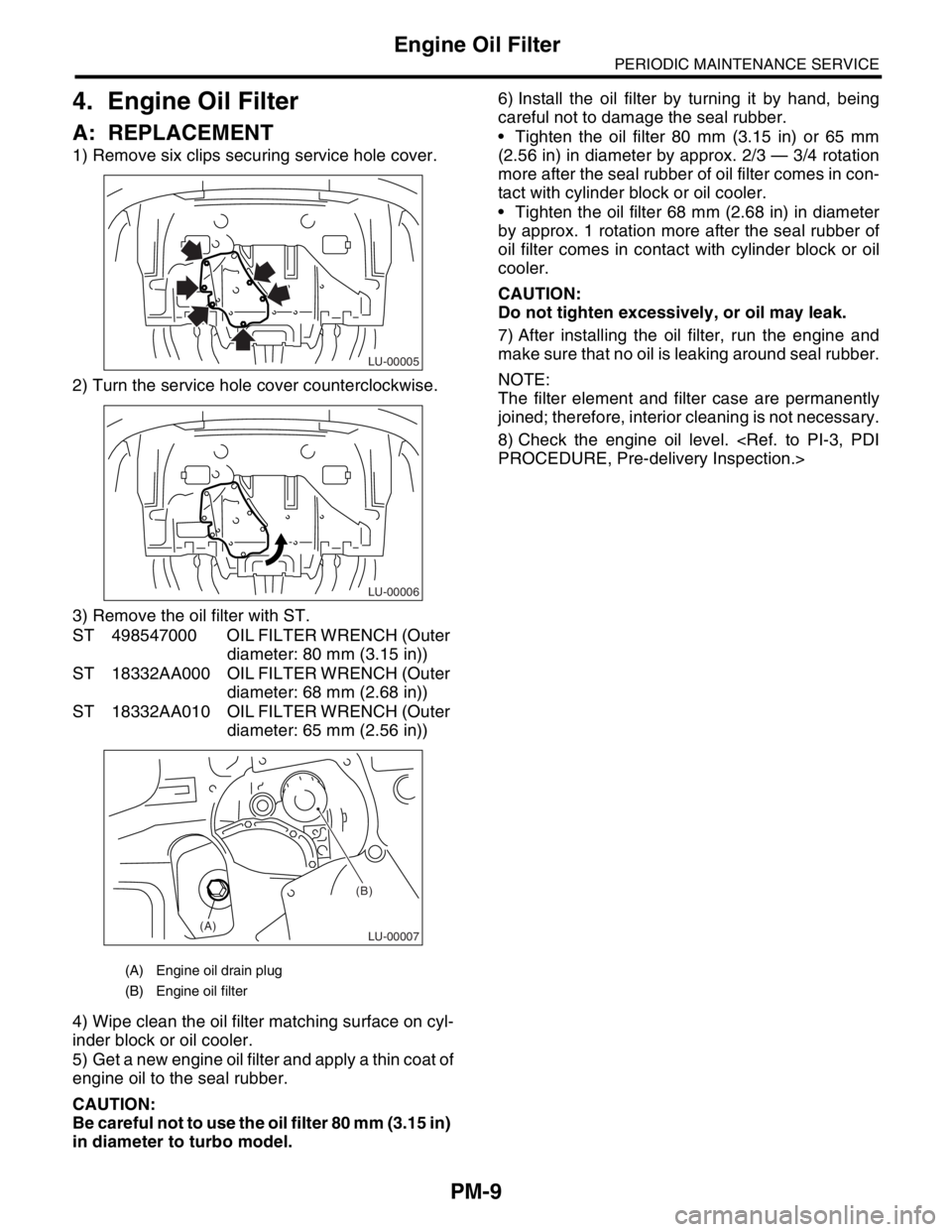
1) Remove six clips securing service hole cover.
2) Turn the service hole cover counterclockwise.
3) Remove the oil filter with ST.
ST 498547000 OIL FILTER WRENCH (Outer
diameter: 80 mm (3.15 in))
ST 18332AA000 OIL FILTER WRENCH (Outer
diameter: 68 mm (2.68 in))
ST 18332AA010 OIL FILTER WRENCH (Outer
diameter: 65 mm (2.56 in))
4) Wipe clean the oil filter matching surface on cyl-
inder block or oil cooler.
5) Get a new engine oil filter and apply a thin coat of
engine oil to the seal rubber.
CAUTION:
Be careful not to use the oil filter 80 mm (3.15 in)
in diameter to turbo model.6) Install the oil filter by turning it by hand, being
careful not to damage the seal rubber.
Tighten the oil filter 80 mm (3.15 in) or 65 mm
(2.56 in) in diameter by approx. 2/3 — 3/4 rotation
more after the seal rubber of oil filter comes in con-
tact with cylinder block or oil cooler.
Tighten the oil filter 68 mm (2.68 in) in diameter
by approx. 1 rotation more after the seal rubber of
oil filter comes in contact with cylinder block or oil
cooler.
CAUTION:
Do not tighten excessively, or oil may leak.
7) After installing the oil filter, run the engine and
make sure that no oil is leaking around seal rubber.
NOTE:
The filter element and filter case are permanently
joined; therefore, interior cleaning is not necessary.
8) Check the engine oil level.
(A) Engine oil drain plug
(B) Engine oil filter
LU-00005
LU-00006
LU-00007
(B)
(A)
Page 767 of 2870
PM-30
PERIODIC MAINTENANCE SERVICE
Brake Line
18.Brake Line
A: INSPECTION
1. BRAKE LINE
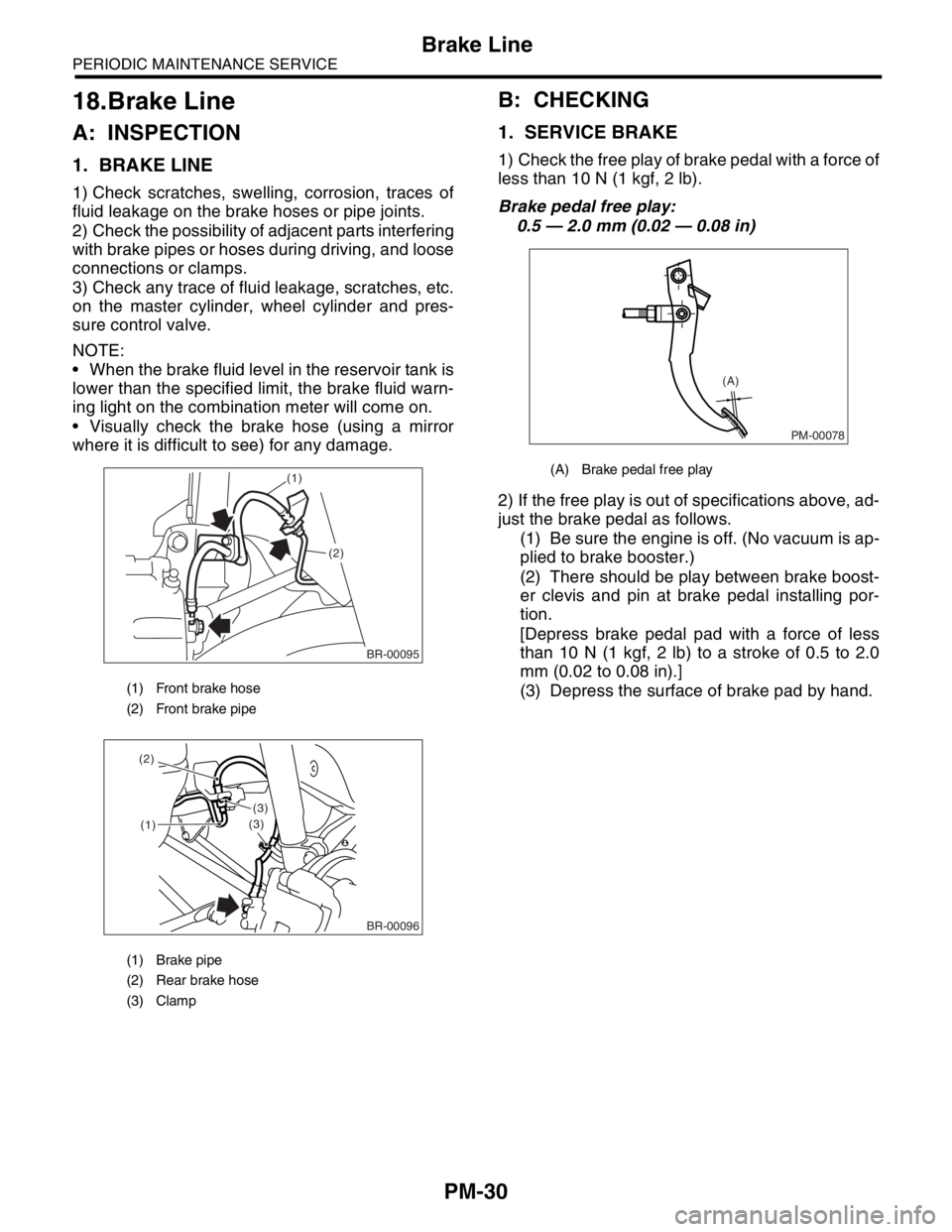
1) Check scratches, swelling, corrosion, traces of
fluid leakage on the brake hoses or pipe joints.
2) Check the possibility of adjacent parts interfering
with brake pipes or hoses during driving, and loose
connections or clamps.
3) Check any trace of fluid leakage, scratches, etc.
on the master cylinder, wheel cylinder and pres-
sure control valve.
NOTE:
When the brake fluid level in the reservoir tank is
lower than the specified limit, the brake fluid warn-
ing light on the combination meter will come on.
Visually check the brake hose (using a mirror
where it is difficult to see) for any damage.
B: CHECKING
1. SERVICE BRAKE
1) Check the free play of brake pedal with a force of
less than 10 N (1 kgf, 2 lb).
Brake pedal free play:
0.5 — 2.0 mm (0.02 — 0.08 in)
2) If the free play is out of specifications above, ad-
just the brake pedal as follows.
(1) Be sure the engine is off. (No vacuum is ap-
plied to brake booster.)
(2) There should be play between brake boost-
er clevis and pin at brake pedal installing por-
tion.
[Depress brake pedal pad with a force of less
than 10 N (1 kgf, 2 lb) to a stroke of 0.5 to 2.0
mm (0.02 to 0.08 in).]
(3) Depress the surface of brake pad by hand.
(1) Front brake hose
(2) Front brake pipe
(1) Brake pipe
(2) Rear brake hose
(3) Clamp
BR-00095
(1)
(2)
(1)
(3)
(3) (2)
BR-00096
(A) Brake pedal free play
PM-00078
(A)
Page 771 of 2870
PM-34
PERIODIC MAINTENANCE SERVICE
Brake Linings and Drums
21.Brake Linings and Drums
A: INSPECTION
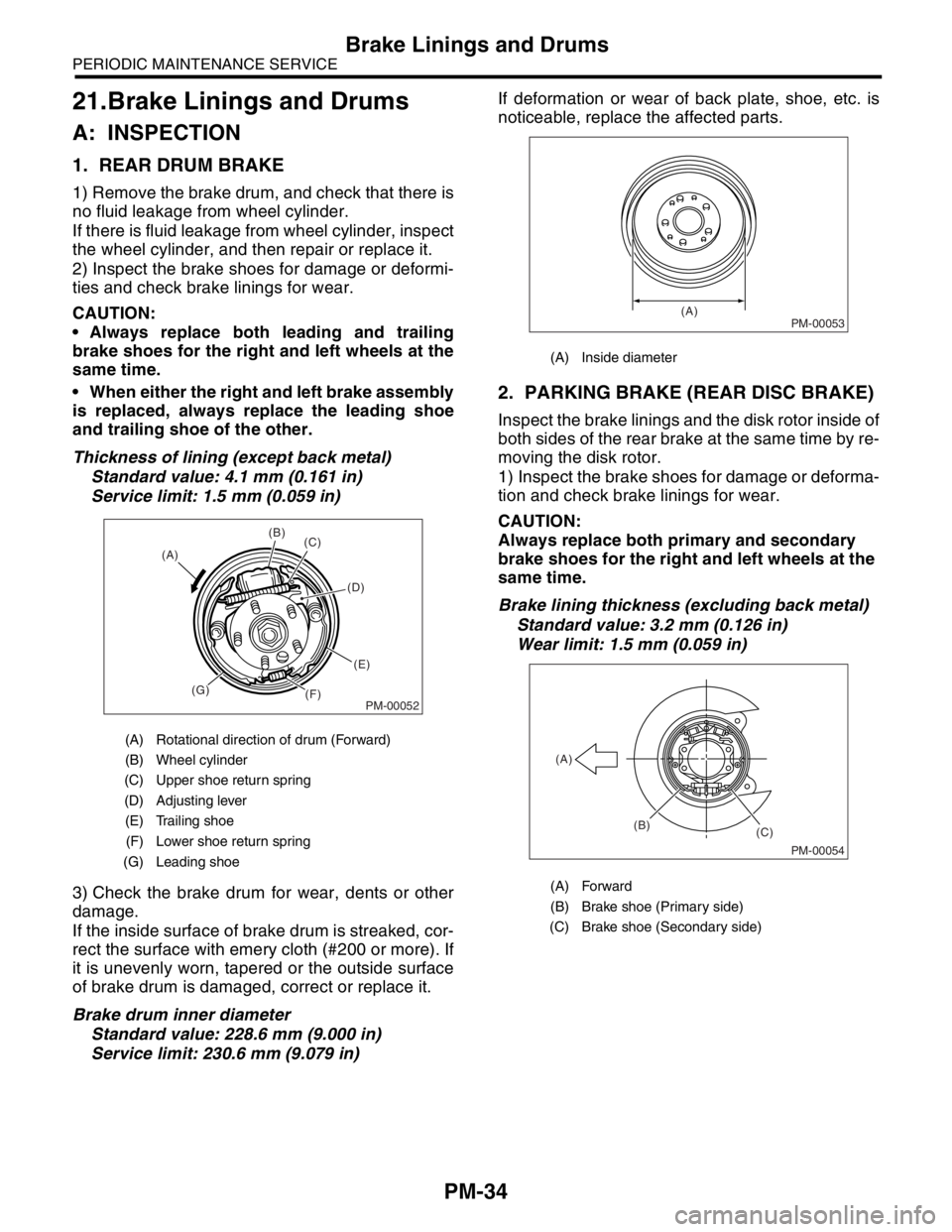
1. REAR DRUM BRAKE
1) Remove the brake drum, and check that there is
no fluid leakage from wheel cylinder.
If there is fluid leakage from wheel cylinder, inspect
the wheel cylinder, and then repair or replace it.
2) Inspect the brake shoes for damage or deformi-
ties and check brake linings for wear.
CAUTION:
Always replace both leading and trailing
brake shoes for the right and left wheels at the
same time.
When either the right and left brake assembly
is replaced, always replace the leading shoe
and trailing shoe of the other.
Thickness of lining (except back metal)
Standard value: 4.1 mm (0.161 in)
Service limit: 1.5 mm (0.059 in)
3) Check the brake drum for wear, dents or other
damage.
If the inside surface of brake drum is streaked, cor-
rect the surface with emery cloth (#200 or more). If
it is unevenly worn, tapered or the outside surface
of brake drum is damaged, correct or replace it.
Brake drum inner diameter
Standard value: 228.6 mm (9.000 in)
Service limit: 230.6 mm (9.079 in)If deformation or wear of back plate, shoe, etc. is
noticeable, replace the affected parts.
2. PARKING BRAKE (REAR DISC BRAKE)
Inspect the brake linings and the disk rotor inside of
both sides of the rear brake at the same time by re-
moving the disk rotor.
1) Inspect the brake shoes for damage or deforma-
tion and check brake linings for wear.
CAUTION:
Always replace both primary and secondary
brake shoes for the right and left wheels at the
same time.
Brake lining thickness (excluding back metal)
Standard value: 3.2 mm (0.126 in)
Wear limit: 1.5 mm (0.059 in)
(A) Rotational direction of drum (Forward)
(B) Wheel cylinder
(C) Upper shoe return spring
(D) Adjusting lever
(E) Trailing shoe
(F) Lower shoe return spring
(G) Leading shoe
PM-00052
(B)
(C)
(D)
(E)
(F) (G) (A)
(A) Inside diameter
(A) Forward
(B) Brake shoe (Primary side)
(C) Brake shoe (Secondary side)
PM-00053(A)
PM-00054
(B)
(C) (A)
Page 772 of 2870

PM-35
PERIODIC MAINTENANCE SERVICE
Brake Linings and Drums
2) Check the disk rotor for wear, dents or other
damage. If the inside surface of disk rotor is
streaked, correct the surface with emery cloth
(#200 or more). If it is unevenly worn or tapered,
correct or replace it.
Brake drum inside diameter
Standard value: 170 mm (6.69 in)
Wear limit: 171 mm (6.73 in)
3) If the deformation or wear of back plate, shoe,
etc. is noticeable, replace them.
4) When the shoe return spring tension is exces-
sively weakened, replace it.B: ADJUSTMENT
1. REAR DRUM BRAKE
The main brake is adjusted automatically, and so
there is no need to adjust it.
2. PARKING BRAKE (REAR DISC BRAKE)
For rear disc brake, adjust the parking brake after
bleeding air.
1) Remove the rear cover (rubber) installed at back
plate.
2) Turn the adjuster toward arrow mark (upward)
until it is locked slightly, by using a flat tip screwdriv-
er as shown in illustration.
3) Turn back (downward) the adjuster 3 to 4 notch-
es.
4) Install the rear cover (rubber) at original position
correctly.
(A) Inside diameter
(B) Disk
PM-00055
(A) (B)
(A) Adjuster
(B) Rear cover (rubber)
(C) Back plate
PM-00056
(B)
(C) (A)
Page 779 of 2870
PM-42
PERIODIC MAINTENANCE SERVICE
Steering System (Power Steering)
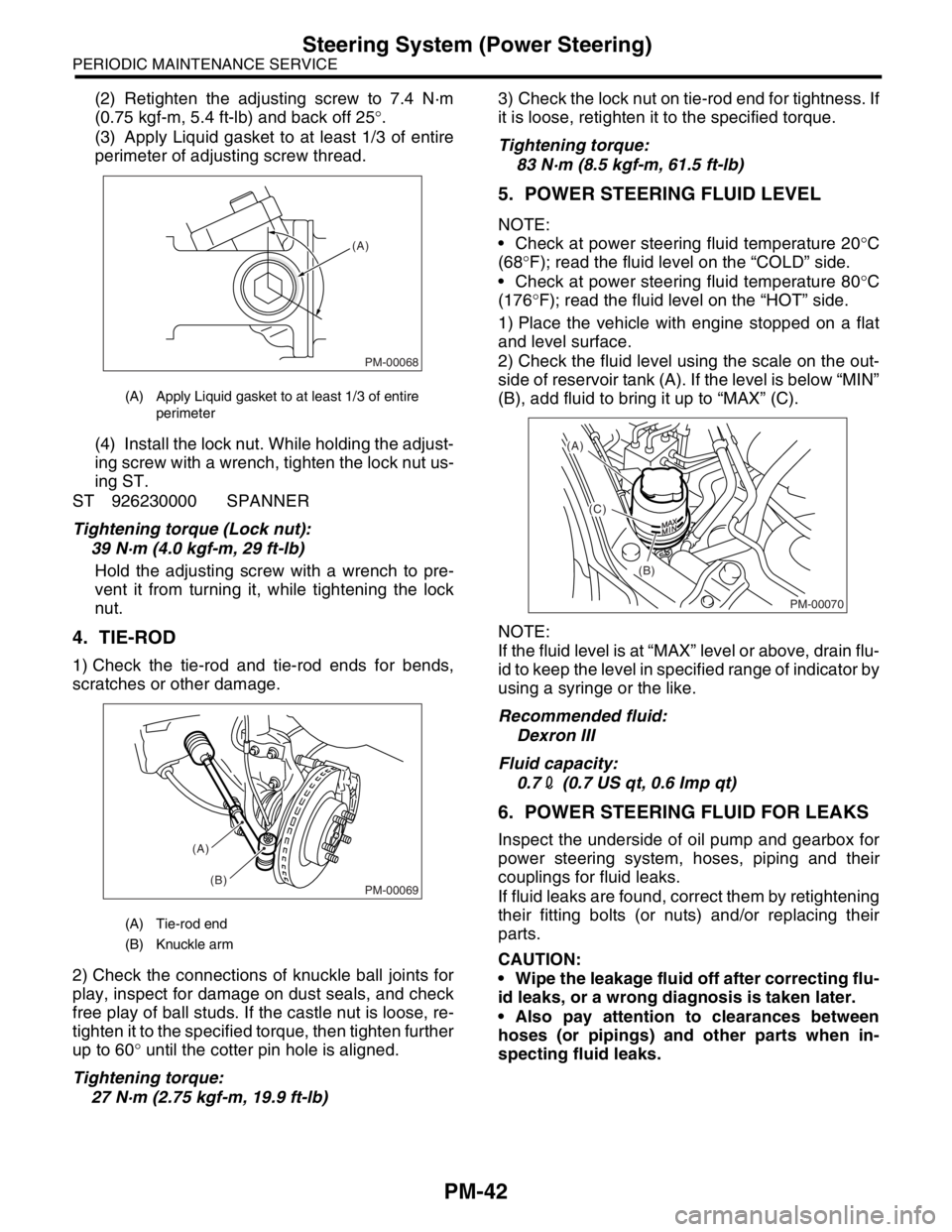
(2) Retighten the adjusting screw to 7.4 N·m
(0.75 kgf-m, 5.4 ft-lb) and back off 25°.
(3) Apply Liquid gasket to at least 1/3 of entire
perimeter of adjusting screw thread.
(4) Install the lock nut. While holding the adjust-
ing screw with a wrench, tighten the lock nut us-
ing ST.
ST 926230000 SPANNER
Tightening torque (Lock nut):
39 N·m (4.0 kgf-m, 29 ft-lb)
Hold the adjusting screw with a wrench to pre-
vent it from turning it, while tightening the lock
nut.
4. TIE-ROD
1) Check the tie-rod and tie-rod ends for bends,
scratches or other damage.
2) Check the connections of knuckle ball joints for
play, inspect for damage on dust seals, and check
free play of ball studs. If the castle nut is loose, re-
tighten it to the specified torque, then tighten further
up to 60° until the cotter pin hole is aligned.
Tightening torque:
27 N·m (2.75 kgf-m, 19.9 ft-lb)3) Check the lock nut on tie-rod end for tightness. If
it is loose, retighten it to the specified torque.
Tightening torque:
83 N·m (8.5 kgf-m, 61.5 ft-lb)
5. POWER STEERING FLUID LEVEL
NOTE:
Check at power steering fluid temperature 20°C
(68°F); read the fluid level on the “COLD” side.
Check at power steering fluid temperature 80°C
(176°F); read the fluid level on the “HOT” side.
1) Place the vehicle with engine stopped on a flat
and level surface.
2) Check the fluid level using the scale on the out-
side of reservoir tank (A). If the level is below “MIN”
(B), add fluid to bring it up to “MAX” (C).
NOTE:
If the fluid level is at “MAX” level or above, drain flu-
id to keep the level in specified range of indicator by
using a syringe or the like.
Recommended fluid:
Dexron III
Fluid capacity:
0.72 (0.7 US qt, 0.6 Imp qt)
6. POWER STEERING FLUID FOR LEAKS
Inspect the underside of oil pump and gearbox for
power steering system, hoses, piping and their
couplings for fluid leaks.
If fluid leaks are found, correct them by retightening
their fitting bolts (or nuts) and/or replacing their
parts.
CAUTION:
Wipe the leakage fluid off after correcting flu-
id leaks, or a wrong diagnosis is taken later.
Also pay attention to clearances between
hoses (or pipings) and other parts when in-
specting fluid leaks.
(A) Apply Liquid gasket to at least 1/3 of entire
perimeter
(A) Tie-rod end
(B) Knuckle arm
PM-00068
(A)
PM-00069
(A)
(B)
PM-00070
(A)
(C)
(B)