check engine SUBARU FORESTER 2004 Service Repair Manual
[x] Cancel search | Manufacturer: SUBARU, Model Year: 2004, Model line: FORESTER, Model: SUBARU FORESTER 2004Pages: 2870, PDF Size: 38.67 MB
Page 2678 of 2870
4AT(H4DOTC)-102
AUTOMATIC TRANSMISSION (DIAGNOSTIC)
Diagnostic Procedure with Diagnostic Trouble Code (DTC)
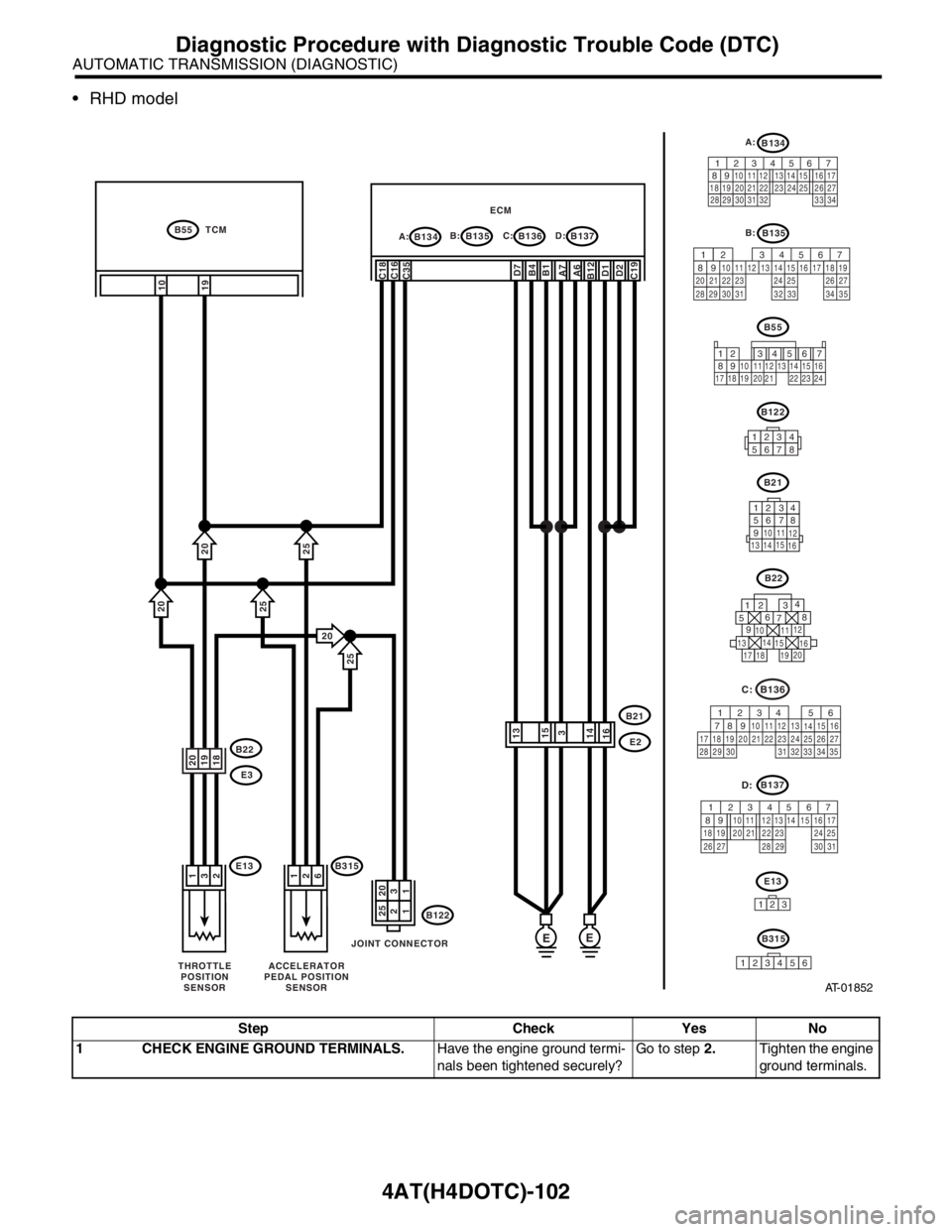
RHD model
Step Check Yes No
1 CHECK ENGINE GROUND TERMINALS.Have the engine ground termi-
nals been tightened securely?Go to step 2.Tighten the engine
ground terminals.
AT-01852
B55
12 7
8956 34
10 11 12
19 20 2113 14 15 16
17 18 22 23 24
E13
B122
B21
B134B55 TCM
A:B135 B:B137 D: ECMB136 C:
E2B22
E3
B21
13 1415
16
12 34
56 78
9
10
11
12
13161415
3
1
3
210
19
C18
C16
C35D2D1D7
B12B4C19A6 A7B1
EE
1225
1320
20
19
18
B22
1
234
56
78
9
1314
15
20
19 1716 10 111218
JOINT CONNECTOR
THROTTLE
POSITION
SENSOR
B3151
2
6
ACCELERATOR
PEDAL POSITION
SENSOR
123
E13
20
20
20
25
25
25
B315
1
23456
B136
56
782 1
94 310
24 22 23 2511 12 13
1415
26 27
2816
17 18 19 20 21
33 34 29
32 30
31 35
C:
B137
567
82 1
94 310
22 23 11 12 13 14 15
24 25
2616 17
18 19 20 21
27 28 29 30 31
D:
B122
12345678
B135 B:
567
82 1
94 310
24 22 23 2511 12 13 14 15
26 27
2816 17 18 19
20 21
29 30 31 32 33 34 35
B134 A:
56 7
82 1
94 310
24 22 23 25 11 12 13 14 15
26 27
2816 17
18 19 20 21
33 34 29
32 30 31
Page 2679 of 2870

4AT(H4DOTC)-103
AUTOMATIC TRANSMISSION (DIAGNOSTIC)
Diagnostic Procedure with Diagnostic Trouble Code (DTC)
2 CHECK GROUND CIRCUIT OF ECM.
1) Turn the ignition switch to OFF.
2) Disconnect the connector from ECM.
3) Measure the resistance of harness
between ECM and engine ground.
Connector & terminal
(B134) No. 7 — Engine ground:
(B134) No. 6 — Engine ground:
(B135) No. 1 — Engine ground:
(B135) No. 4 — Engine ground:
(B135) No. 12 — Engine ground:
(B136) No. 19 — Engine ground:
(B137) No. 1 — Engine ground:
(B137) No. 2 — Engine ground:
(B137) No. 7 — Chassis ground:Is the resistance less than 5
Ω?Go to step 3.Repair the open cir-
cuit in harness
between ECM con-
nector and engine
ground terminal.
3 CONFIRM MODEL.Is the vehicle 2.0 L model? Go to step 4.Go to step 11.
4 CHECK THROTTLE POSITION SENSOR.
1) Disconnect the connector from throttle
position sensor.
2) Measure the resistance between throttle
position sensor connector receptacle’s termi-
nals.
Connector & terminal
No. 1 — No. 2:Is the resistance 2.5 — 6 kΩ? Go to step 5.Replace the throt-
tle position sensor.
5 CHECK THROTTLE POSITION SENSOR.
Measure the resistance between throttle posi-
tion sensor connector receptacle’s terminals.
Connector & terminal
No. 2 — No. 3:Is the resistance 0.5 — 4.5
kΩ?Go to step 6.Replace the throt-
tle position sensor.
6 CHECK HARNESS CONNECTOR BETWEEN
TCM AND THROTTLE POSITION SENSOR.
1) Disconnect the connector from TCM.
2) Measure the resistance of harness
between TCM connector and chassis ground.
Connector & terminal
(B55) No. 19 — Chassis ground:Is the resistance more than 1
MΩ?Go to step 7.Repair the short
circuit in harness
between TCM and
throttle position
sensor connector.
7 CHECK HARNESS CONNECTOR BETWEEN
ECM AND THROTTLE POSITION SENSOR.
1) Disconnect the connector from ECM.
2) Measure the resistance of harness
between ECM connector and throttle position
sensor connector.
Connector & terminal
(E13) No. 2 — (B135) No. 19:Is the resistance less than 1
Ω?Go to step 8.Repair the short
circuit in harness
between ECM and
throttle position
sensor.
8 PREPARE SUBARU SELECT MONITOR.Do you have a Subaru Select
Monitor?Go to step 10.Go to step 9.
9 CHECK INPUT SIGNAL FOR TCM.
1) Connect the connectors to TCM, throttle
position sensor and ECM.
2) Turn the ignition switch to ON (engine OFF).
3) Open the throttle fully.
4) Measure the voltage between TCM con-
nector and chassis ground.
Connector & terminal
(B55) No. 19 (+) — Chassis ground (
−):Is the voltage more than 4.6 V? Go to step 18.Even if the POWER
indicator light was
blinking, the circuit
has returned to a
normal condition at
this time. A tempo-
rary poor contact of
the connector or
harness may be the
cause. Repair the
harness or connec-
tor in throttle posi-
tion sensor circuit. Step Check Yes No
Page 2680 of 2870

4AT(H4DOTC)-104
AUTOMATIC TRANSMISSION (DIAGNOSTIC)
Diagnostic Procedure with Diagnostic Trouble Code (DTC)
10 CHECK INPUT SIGNAL FOR TCM USING
SUBARU SELECT MONITOR.
1) Connect the connectors to TCM, throttle
position sensor and ECM.
2) Connect the Subaru Select Monitor to data
link connector.
3) Turn the ignition switch to ON (engine OFF).
4) Turn the Subaru Select Monitor switch to ON.
5) Open the throttle fully.
6) Read the data of throttle position sensor
using Subaru Select Monitor.
Throttle position sensor input signal is indi-
cated.Is the voltage more than 4.6 V? Go to step 18.Even if the POWER
indicator light was
blinking, the circuit
has returned to a
normal condition at
this time. A tempo-
rary poor contact of
the connector or
harness may be the
cause. Repair the
harness or connec-
tor in throttle posi-
tion sensor circuit.
11 CHECK ACCELERATOR PEDAL POSITION
SENSOR.
1) Disconnect the connector from accelerator
pedal position sensor.
2) Measure the resistance between accelera-
tor pedal position sensor connector recepta-
cle’s terminals.
Connector & terminal
No. 1 — No. 2:Is the resistance 0.75 — 3.15
kΩ?Go to step 12.Replace the accel-
erator pedal posi-
tion sensor.
12 CHECK ACCELERATOR PEDAL POSITION
SENSOR.
Measure the resistance between accelerator
pedal position sensor connector receptacle’s
terminals.
Connector & terminal
No. 2 — No. 3:Is the resistance 0.15 — 0.63
kΩ?Go to step 13.Replace the accel-
erator pedal posi-
tion sensor.
13 CHECK HARNESS CONNECTOR BETWEEN
TCM AND ACCELERATOR PEDAL POSI-
TION SENSOR.
1) Disconnect the connector from TCM.
2) Measure the resistance of harness
between TCM connector and chassis ground.
Connector & terminal
(B55) No. 19 — Chassis ground:Is the resistance more than 1
MΩ?Go to step 14.Repair the short
circuit in harness
between TCM and
accelerator pedal
position sensor
connector.
14 CHECK HARNESS CONNECTOR BETWEEN
ECM AND ACCELERATOR PEDAL POSI-
TION SENSOR.
1) Disconnect the connector from ECM.
2) Measure the resistance of harness
between ECM connector and accelerator pedal
position sensor connector.
Connector & terminal
(E13) No. 2 — (B135) No. 19:Is the resistance less than 1
Ω?Go to step 15.Repair the short
circuit in harness
between ECM and
accelerator pedal
position sensor.
15 PREPARE SUBARU SELECT MONITOR.Do you have a Subaru Select
Monitor?Go to step 17.Go to step 16. Step Check Yes No
Page 2681 of 2870

4AT(H4DOTC)-105
AUTOMATIC TRANSMISSION (DIAGNOSTIC)
Diagnostic Procedure with Diagnostic Trouble Code (DTC)
16 CHECK INPUT SIGNAL FOR TCM.
1) Connect the connectors to TCM, accelera-
tor pedal position sensor and ECM.
2) Turn the ignition switch to ON (engine OFF).
3) Open the throttle fully.
4) Measure the voltage between TCM con-
nector and chassis ground.
Connector & terminal
(B55) No. 19 (+) — Chassis ground (
−):Is the voltage more than 4.6 V? Go to step 18.Even if the POWER
indicator light was
blinking, the circuit
has returned to a
normal condition at
this time. A tempo-
rary poor contact of
the connector or
harness may be the
cause. Repair the
harness or connec-
tor in accelerator
pedal position sen-
sor circuit.
17 CHECK INPUT SIGNAL FOR TCM USING
SUBARU SELECT MONITOR.
1) Connect the connectors to TCM, accelera-
tor pedal position sensor and ECM.
2) Connect the Subaru Select Monitor to data
link connector.
3) Turn the ignition switch to ON (engine OFF).
4) Turn the Subaru Select Monitor switch to ON.
5) Open the throttle fully.
6) Read the data of accelerator pedal position
sensor using Subaru Select Monitor.
Accelerator pedal position sensor input sig-
nal is indicated.Is the voltage more than 4.6 V? Go to step 18.Even if the POWER
indicator light was
blinking, the circuit
has returned to a
normal condition at
this time. A tempo-
rary poor contact of
the connector or
harness may be the
cause. Repair the
harness or connec-
tor in accelerator
pedal position sen-
sor circuit.
18 CHECK POOR CONTACT.Is there poor contact in sensor
circuit?Repair the poor
contact.Replace the TCM.
trol Module
(TCM).> Step Check Yes No
Page 2694 of 2870

4AT(H4DOTC)-118
AUTOMATIC TRANSMISSION (DIAGNOSTIC)
Diagnostic Procedure without Diagnostic Trouble Code (DTC)
2 CHECK POWER SWITCH OPERATION.When the POWER switch is
turned to ON, does LED light
up?Go to step CHECK
HOLD SWITCH.
120, CHECK
HOLD SWITCH,
Diagnostic Proce-
dure without Diag-
nostic Trouble
Code (DTC).>Go to step 3.
3 CHECK POWER INDICATOR LIGHT.
1) Turn the ignition switch to OFF.
2) Remove the combination meter.
3) Remove the POWER indicator light bulb
from combination meter.Is the POWER indicator light
bulb OK?Go to step 4.Replace the
POWER indicator
light bulb.
tion Meter Assem-
bly.>
4 CHECK POWER SWITCH GROUND CIR-
CUIT.
1) Turn the ignition switch to OFF.
2) Disconnect the connector from POWER
switch.
3) Measure the resistance of harness connector
between POWER switch and chassis ground.
Connector & terminal
LHD model
(R92) No. 4 — Chassis ground:
RHD model
(B133) No. 4 — Chassis ground:Is the resistance less than 1
Ω?Go to step 5.Repair the open
circuit in harness
between POWER
switch and chas-
sis ground.
5 CHECK POWER SWITCH.
1) Turn the POWER switch to ON.
2) Measure the resistance between terminals
of POWER switch.
Te r m i n a l s
No. 5 — No. 4:Is the resistance less than 1
Ω?Go to step 6.Replace the
POWER switch.
6 CHECK POWER SWITCH.
1) Turn the POWER switch to OFF.
2) Measure the resistance between terminals
of POWER switch.
Te r m i n a l s
No. 5 — No. 4:Is the resistance more than1
MΩ?Go to step 7.Replace the
POWER switch.
7 CHECK HARNESS CONNECTOR BETWEEN
TCM AND POWER SWITCH.
Measure the resistance of harness connector
between TCM and POWER switch.
Connector & terminal
(B54) No. 8 — (B133) No. 5:Is the resistance less than 1
Ω?Go to step 8.Repair the open
circuit in harness
between TCM and
POWER switch
connector.
8 CHECK HARNESS CONNECTOR BETWEEN
TCM AND POWER SWITCH.
Measure the resistance of harness connector
between TCM connector and chassis ground.
Connector & terminal
(B54) No. 8 — Chassis ground:Is the resistance more than 1
MΩ?Go to step 9.Repair the short
circuit in harness
between TCM and
POWER switch
connector.
9 CHECK INPUT SIGNAL FOR TCM.
1) Connect the connectors to TCM and
POWER switch.
2) Turn the ignition switch to ON (engine OFF).
3) Measure the signal voltage for TCM while
turning POWER switch to OFF.
Connector & terminal
(B54) No. 8 (+) — Chassis ground (–):Is the voltage more than 10 V? Go to step 10.Replace the TCM.
trol Module
(TCM).> Step Check Yes No
Page 2701 of 2870

4AT(H4DOTC)-125
AUTOMATIC TRANSMISSION (DIAGNOSTIC)
Diagnostic Procedure without Diagnostic Trouble Code (DTC)
3 CHECK KICK-DOWN SWITCH GROUND
LINE.
1) Disconnect the connector from kick-down
switch.
2) Measure the resistance of harness connector
between kick-down switch and chassis ground.
Connector & terminal
(B129) No. 1 — Chassis ground:Is the resistance less than 1
Ω?Go to step 4.Repair the open cir-
cuit in harness
between kick-down
switch and TCM.
4 CHECK KICK-DOWN SWITCH.
Measure the resistance for kick-down switch
when depressing the accelerator pedal.
Te r m i n a l s
No. 1 — No. 2:Is the resistance less than 1
Ω?Go to step 5.Replace the kick-
down switch.
Accelerator
Pedal.>
5 CHECK KICK-DOWN SWITCH.
Measure the resistance for kick-down switch
when pressing the accelerator pedal.
Te r m i n a l s
No. 1 — No. 2:Is the resistance more than 1
MΩ?Go to step 6.Replace the kick-
down switch.
6 CHECK HARNESS CONNECTOR BETWEEN
TCM AND KICK-DOWN SWITCH.
1) Turn the ignition switch to OFF.
2) Disconnect the connectors from kick-down
switch.
3) Measure the resistance of harness connec-
tor between TCM and kick-down switch.
Connector & terminal
(B54) No. 11 — (B129) No. 2:Is the resistance less than 1
Ω?Go to step 7.Repair the open
circuit in harness
between TCM and
kick-down switch.
7 CHECK HARNESS CONNECTOR BETWEEN
TCM AND KICK-DOWN SWITCH.
Measure the resistance of harness connector
between TCM connector and chassis ground.
Connector & terminal
(B54) No. 11 — Chassis ground:Is the resistance more than 1
MΩ?Go to step 8.Repair the short
circuit in harness
between TCM and
chassis ground.
8 CHECK INPUT SIGNAL FOR TCM.
1) Turn the ignition switch to OFF.
2) Connect the connector to kick-down switch.
3) Turn the ignition switch to ON (engine OFF).
4) Measure the signal voltage for TCM when
not depressing the accelerator pedal.
Connector & terminal
(B55) No. 11 (+) — Chassis ground (
−):Is the voltage less than 1 V? Go to step 9.Go to step 10.
9 CHECK INPUT SIGNAL FOR TCM.
Measure the signal voltage for TCM when press-
ing the accelerator pedal.
Connector & terminal
(B55) No. 11 (+) — Chassis ground (
−):Is the voltage more than 6.5 V? A temporary poor
contact of the con-
nector and har-
ness may be the
cause. Repair the
harness and con-
nector in TCM.Go to step 10.
10 CHECK POOR CONTACT.Is there poor contact? Repair the poor
contact.Replace the TCM.
trol Module
(TCM).> Step Check Yes No
Page 2743 of 2870
5MT-31
MANUAL TRANSMISSION AND DIFFERENTIAL
Transmission Gear Oil
2. Transmission Gear Oil
A: INSPECTION
1) Park the vehicle on a level surface.
2) Turn the ignition switch to OFF, and wait until the
engine cools.
3) Remove the oil level gauge and wipe it clean.
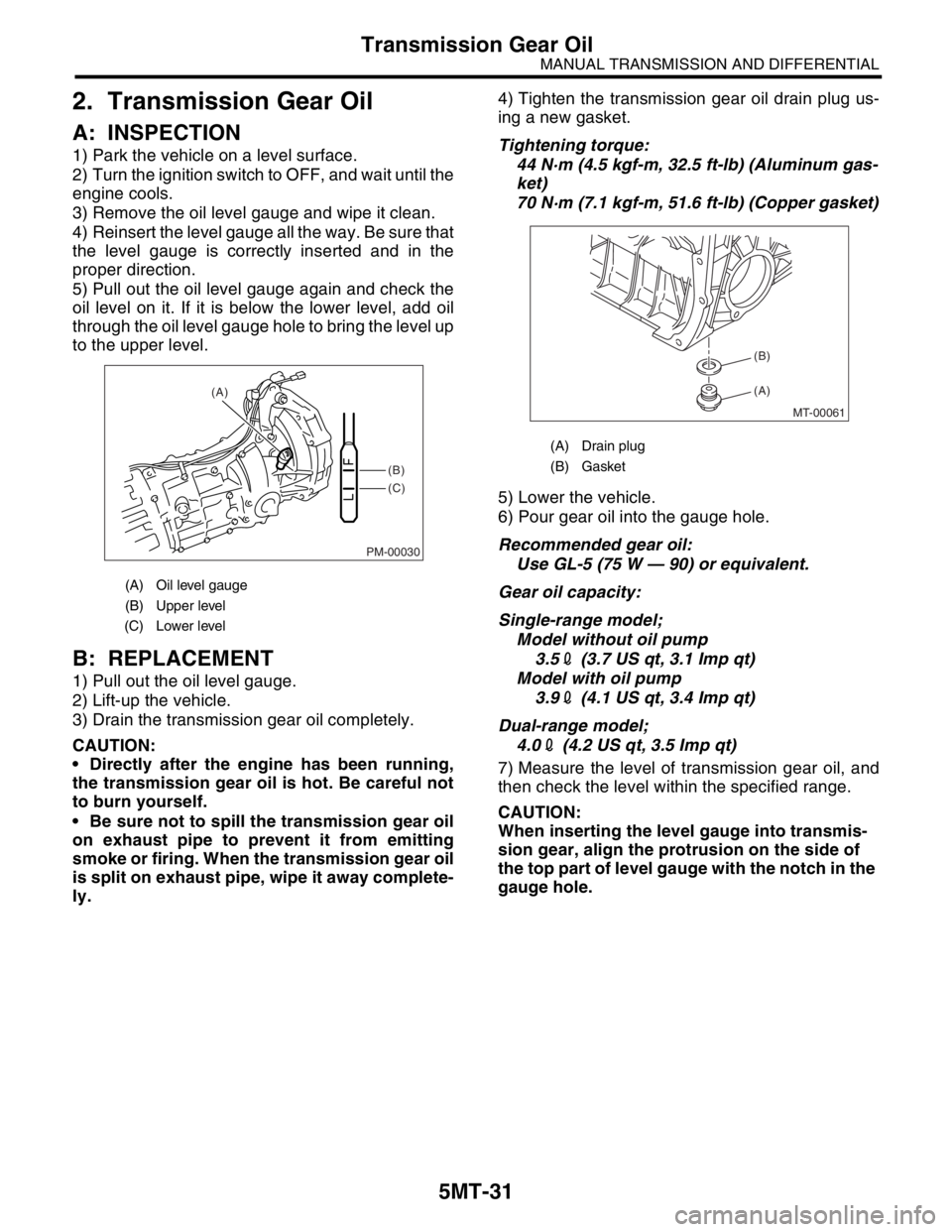
4) Reinsert the level gauge all the way. Be sure that
the level gauge is correctly inserted and in the
proper direction.
5) Pull out the oil level gauge again and check the
oil level on it. If it is below the lower level, add oil
through the oil level gauge hole to bring the level up
to the upper level.
B: REPLACEMENT
1) Pull out the oil level gauge.
2) Lift-up the vehicle.
3) Drain the transmission gear oil completely.
CAUTION:
Directly after the engine has been running,
the transmission gear oil is hot. Be careful not
to burn yourself.
Be sure not to spill the transmission gear oil
on exhaust pipe to prevent it from emitting
smoke or firing. When the transmission gear oil
is split on exhaust pipe, wipe it away complete-
ly.4) Tighten the transmission gear oil drain plug us-
ing a new gasket.
Tightening torque:
44 N·m (4.5 kgf-m, 32.5 ft-lb) (Aluminum gas-
ket)
70 N·m (7.1 kgf-m, 51.6 ft-lb) (Copper gasket)
5) Lower the vehicle.
6) Pour gear oil into the gauge hole.
Recommended gear oil:
Use GL-5 (75 W — 90) or equivalent.
Gear oil capacity:
Single-range model;
Model without oil pump
3.52 (3.7 US qt, 3.1 Imp qt)
Model with oil pump
3.92 (4.1 US qt, 3.4 Imp qt)
Dual-range model;
4.02 (4.2 US qt, 3.5 Imp qt)
7) Measure the level of transmission gear oil, and
then check the level within the specified range.
CAUTION:
When inserting the level gauge into transmis-
sion gear, align the protrusion on the side of
the top part of level gauge with the notch in the
gauge hole.
(A) Oil level gauge
(B) Upper level
(C) Lower level
PM-00030
(B)
(C) (A)
(A) Drain plug
(B) Gasket
MT-00061
(A) (B)
Page 2824 of 2870

5MT-111
MANUAL TRANSMISSION AND DIFFERENTIAL
General Diagnostic
26.General Diagnostic
A: INSPECTION
1. MANUAL TRANSMISSION
Symptom Possible cause Remedy
1. Gears are difficult to intermesh.
N
OTE:
The cause for difficulty in shifting gears
can be classified into two kinds: one is
malfunction of the gear shift system and
the other is malfunction of the transmis-
sion. However, if the operation is heavy
and engagement of the gears is difficult,
defective clutch disengagement may also
be responsible. Check whether the clutch
is correctly functioning, before checking
the gear shift system and transmission.(a) Worn, damaged or burred chamfer of
internal spline of sleeve and reverse
driven gearReplace.
(b) Worn, damaged or burred chamfer of
spline of gearsReplace.
(c) Worn or scratched bushings Replace.
(d) Incorrect contact between synchro-
nizer ring and gear cone or wear Correct or replace.
2. Gear slips out.
Gear slips out when coasting on rough
road.
Gear slips out during acceleration.(a) Defective pitching stopper adjustment Adjust.
(b) Loose engine mounting bolts Tighten or replace.
(c) Worn fork shifter, broken shifter fork
rail springReplace.
(d) Worn or damaged ball bearing Replace.
(e) Excessive clearance between splines
of synchronizer hub and synchronizer
sleeveReplace.
(f) Worn tooth step of synchronizer hub Replace.
(g) Worn 1st driven gear and driven shaft Replace.
(h) Worn 2nd driven gear and 2nd bush Replace.
(i) Worn reverse idler gear and bushing Replace.
3. Unusual noise comes from transmis-
sion.
N
OTE:
If an unusual noise is heard when the ve-
hicle is parked with its engine idling and if
the noise ceases when the clutch is disen-
gaged, it may be considered that the
noise comes from the transmission.(a) Insufficient or improper lubrication Lubricate or replace with specified oil.
(b) Worn or damaged gears and bearings
NOTE:
If the trouble is only wear of the tooth sur-
faces, merely a high roaring noise will oc-
cur at high speeds, but if any part is
broken, rhythmical knocking sound will be
heard even at low speeds.Replace.
Page 2825 of 2870

5MT-112
MANUAL TRANSMISSION AND DIFFERENTIAL
General Diagnostic
2. DIFFERENTIAL
Symptom Possible cause Remedy
1. Broken differential (case, gear, bear-
ing, etc.)
N
OTE:
Noise will develop and finally it will be-
come impossible to continue to run due to
broken pieces obstructing the gear revo-
lution. (a) Insufficient or improper oil Disassemble the differential and replace
broken components and at the same time
check other components for any trouble,
and replace if necessary.
(b) Use of vehicle under severe condi-
tions such as excessive load and
improper use of clutch Readjust the bearing preload and back-
lash and face contact of gears.
(c) Improper adjustment of taper roller
bearingAdjust.
(d) Improper adjustment of drive pinion
and hypoid driven gear Adjust.
(e) Excessive backlash due to worn dif-
ferential side gear, washer or differential
pinion vehicle under severe operating
conditions. Add recommended oil to specified level.
Do not use the vehicle under severe oper-
ating conditions.
(f) Loose hypoid driven gear clamping
boltsTighten.
2. Differential and hypoid gear noises
Troubles of the differential and hypoid
gear always appear as noise problems.
Therefore noise is the first indication of
the trouble. However noises from the
engine, muffler, tire, exhaust gas, bear-
ing, body, etc. are easily mistaken for the
differential noise. Pay special attention to
the hypoid gear noise because it is easily
confused with other gear noises. There
are the following four kinds of noises.
Gear noise when driving: If noise
increases as vehicle speed increases it
may be due to insufficient gear oil, incor-
rect gear engagement, damaged gears,
etc.
Gear noise when coasting: Damaged
gears due to maladjusted bearings and
incorrect shim adjustment
Bearing noise when driving or when
coasting: Cracked, broken or damaged
bearings
Noise which mainly occurs when turn-
ing: Unusual noise from differential side
gear, differential pinion, differential pinion
shaft, etc. (a) Insufficient oil Lubricate.
(b) Improper adjustment of hypoid driven
gear and drive pinionCheck tooth contact.
(c) Worn teeth of hypoid driven gear and
drive pinionReplace as a set.
Readjust the bearing preload.
(d) Loose roller bearing Readjust the hypoid driven gear to drive
pinion backlash and check tooth contact.
(e) Distorted hypoid driven gear or differ-
ential caseReplace.
(f) Worn washer and differential pinion
shaftReplace.
Page 2869 of 2870

CL-43
CLUTCH SYSTEM
General Diagnostic Table
2. CLUTCH PEDAL
3. DIAGNOSTIC DIAGRAM OF CLUTCH DRAG
4. Noisy clutch
Examine whether the noise is generated
when the clutch is disengaged, engaged,
or partially engaged.(a) Broken, worn or unlubricated release
bearingReplace the release bearing.
(b) Insufficient lubrication of pilot bearing Replace.
(c) Loose clutch disc hub Replace the clutch disc.
(d) Loose torsion spring retainer Replace the clutch disc.
(e) Deteriorated or broken torsion spring Replace the clutch disc.
5. Clutch grabs.
When starting the vehicle with the clutch
partially engaged, the clutch engages
suddenly and the vehicle jumps instead
of making a smooth start.(a) Grease or oil on facing Replace the clutch disc.
(b) Deteriorated cushioning spring Replace the clutch disc.
(c) Worn or rusted spline of clutch disc or
main shaftTake off rust, apply grease or replace the
clutch disc or main shaft.
(d) Deteriorated or broken torsion spring Replace the clutch disc.
(e) Loose engine mounting Retighten or replace the mounting.
(f) Deteriorated diaphragm spring Replace.
Trouble Corrective action
Insufficient pedal play Adjust pedal play.
Clutch pedal free play insufficient Adjust pedal free play.
Excessively worn and damaged pedal shaft and/or bushing Replace the bushing and/or shaft with a new one.
Step Check Yes No
1 CHECK GEAR NOISE.
1) Start the engine.
2) Disengage the clutch and shift quickly from
neutral to reverse in idling condition.Is there any abnormal noise
from the transmission gear?Go to step 2.Clutch is normal.
2 CHECK GEAR NOISE.
Disengage the clutch at idle and shift from neu-
tral to reverse within 0.5 — 1.0 seconds.Is there any abnormal noise
from the transmission gear?Go to step 3.Defective trans-
mission or exces-
sive clutch drag
torque. Inspect the
pilot bearing,
clutch disc, trans-
mission and clutch
disc hub spline.
3 CHECK GEAR NOISE.
1) Disengage the clutch at idle and shift from
neutral to reverse within 0.5 — 1.0 seconds.
2) With the clutch disengaged, shift from N to
R, R to N several times.Is there any abnormal noise
from the transmission gear?Defect in clutch
disengaging.
Inspect the clutch
disc, clutch cover,
clutch release, and
clutch pedal free
play.Clutch and fly-
wheel seizure.
Inspect the clutch
disc, spline of
clutch disc hub. Symptom Possible cause Corrective