lock SUBARU FORESTER 2007 SG / 2.G Owners Manual
[x] Cancel search | Manufacturer: SUBARU, Model Year: 2007, Model line: FORESTER, Model: SUBARU FORESTER 2007 SG / 2.GPages: 356, PDF Size: 5.89 MB
Page 301 of 356
Maintenance and service 11 - 29
Replacement of brake pad
and lining
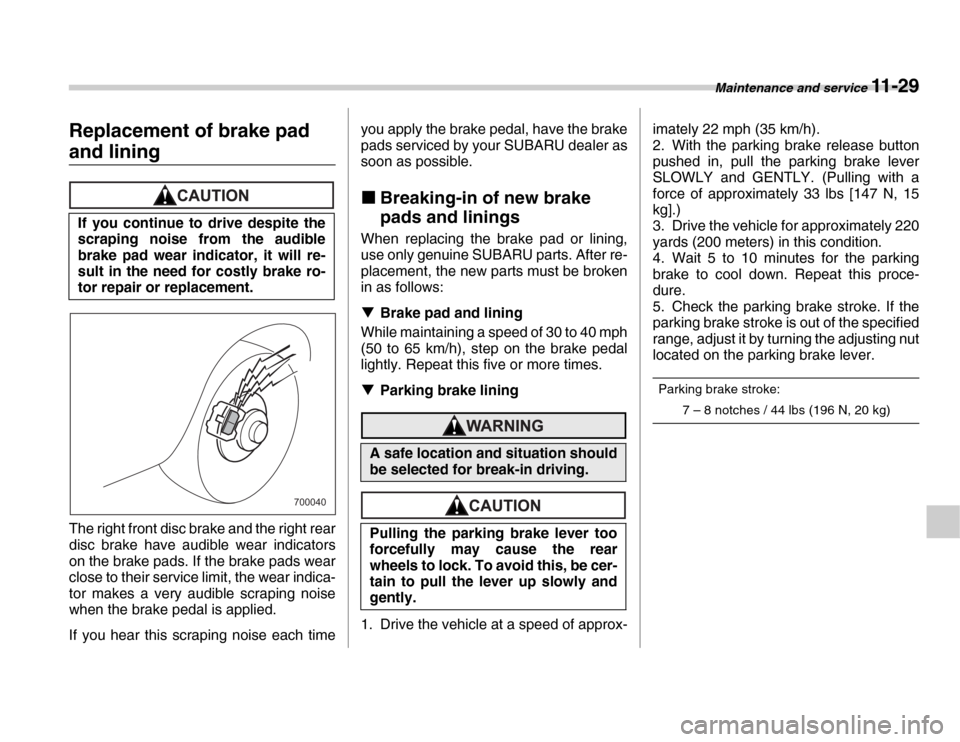
The right front disc brake and the right rear
disc brake have audible wear indicators
on the brake pads. If the brake pads wear
close to their service limit, the wear indica-
tor makes a very audible scraping noise
when the brake pedal is applied.
If you hear this scraping noise each timeyou apply the brake pedal, have the brake
pads serviced by your SUBARU dealer as
soon as possible.
„ Breaking-in of new brake
pads and linings
When replacing the brake pad or lining,
use only genuine SUBARU parts. After re-
placement, the new parts must be broken
in as follows: T Brake pad and lining
While maintaining a speed of 30 to 40 mph
(50 to 65 km/h), step on the brake pedal
lightly. Repeat this five or more times. T Parking brake lining
1. Drive the vehicle at a speed of approx- imately 22 mph (35 km/h).
2. With the parking brake release button
pushed in, pull the parking brake lever
SLOWLY and GENTLY. (Pulling with a
force of approximately 33 lbs [147 N, 15
kg].)
3. Drive the vehicle for approximately 220
yards (200 meters) in this condition.
4. Wait 5 to 10 minutes for the parking
brake to cool down. Repeat this proce-
dure.
5. Check the parking brake stroke. If the
parking brake stroke is out of the specified
range, adjust it by turning the adjusting nut
located on the parking brake lever.
Parking brake stroke:
7 – 8 notches / 44 lbs (196 N, 20 kg)
If you continue to drive despite the
scraping noise from the audible
brake pad wear indicator, it will re-
sult in the need for costly brake ro-
tor repair or replacement.
700040
A safe location and situation should
be selected for break-in driving.
Pulling the parking brake lever too
forcefully may cause the rear
wheels to lock. To avoid this, be cer-
tain to pull the lever up slowly and
gently.
Page 308 of 356
11 - 3 6 Maintenance and service
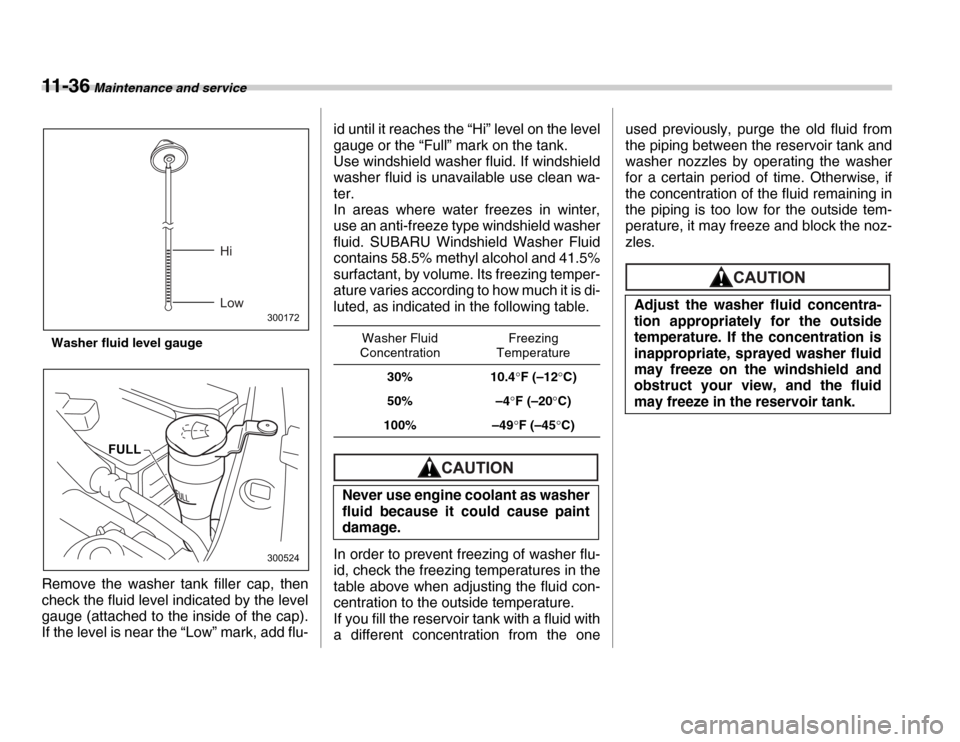
Washer fluid level gauge
Remove the washer tank filler cap, then
check the fluid level indicated by the level
gauge (attached to the inside of the cap).
If the level is near the “Low” mark, add flu- id until it reaches the “Hi” level on the level
gauge or the “Full” mark on the tank.
Use windshield washer fluid. If windshield
washer fluid is unavailable use clean wa- ter.
In areas where water freezes in winter,
use an anti-freeze type windshield washer
fluid. SUBARU Windshield Washer Fluid
contains 58.5% methyl alcohol and 41.5%
surfactant, by volume. Its freezing temper-
ature varies according to how much it is di-
luted, as indicated in the following table.
In order to prevent freezing of washer flu-
id, check the freezing temperatures in the
table above when adjusting the fluid con-
centration to the outside temperature.
If you fill the reservoir tank with a fluid with
a different concentration from the oneused previously, purge the old fluid from
the piping between the reservoir tank and
washer nozzles by operating the washer
for a certain period of time. Otherwise, if
the concentration of the fluid remaining in
the piping is too low for the outside tem-
perature, it may freeze and block the noz-
zles.
Hi Low
300172
FULL
300524
Washer Fluid
Concentration Freezing
Temperature
30% 10.4 qF (–12 qC)
50% –4 qF (–20 qC)
100% –49 qF (–45 qC)
Never use engine coolant as washer
fluid because it could cause paint
damage.
Adjust the washer fluid concentra-
tion appropriately for the outside
temperature. If the concentration is
inappropriate, sprayed washer fluid
may freeze on the windshield and
obstruct your view, and the fluid
may freeze in the reservoir tank.
Page 309 of 356
Maintenance and service 11 - 37
– CONTINUED –
Replacement of wiper blades
Grease, wax, insects, or other material on
the windshield or the wiper blade results in
jerky wiper operation and streaking on the
glass. If you cannot remove the streaks af-
ter operating the windshield washer or if
the wiper operation is jerky, clean the out-
er surface of the windshield (or rear win-
dow) and the wiper blades using a sponge
or soft cloth with a neutral detergent or
mild-abrasive cleaner. After cleaning,
rinse the windshield and wiper blades with
clean water. The windshield is clean if
beads do not form when you rinse the
windshield with water.
If you cannot eliminate the streaking even
after following this method, replace the
wiper blades using the following proce-
dures: „Windshield wiper blades
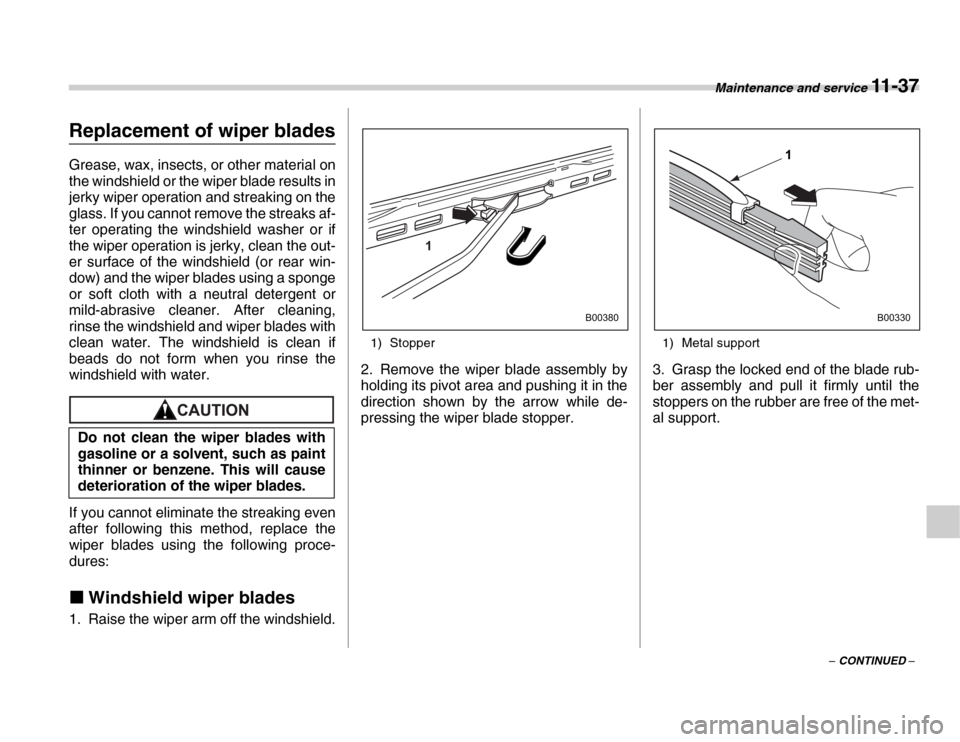
1. Raise the wiper arm off the windshield. 1) Stopper
2. Remove the wiper blade assembly by
holding its pivot area and pushing it in the
direction shown by the arrow while de-
pressing the wiper blade stopper. 1) Metal support
3. Grasp the locked end of the blade rub-
ber assembly and pull it firmly until the
stoppers on the rubber are free of the met-
al support.
Do not clean the wiper blades with
gasoline or a solvent, such as paint
thinner or benzene. This will cause
deterioration of the wiper blades.
1
B00380
1
B00330
Page 310 of 356
11 - 3 8 Maintenance and service
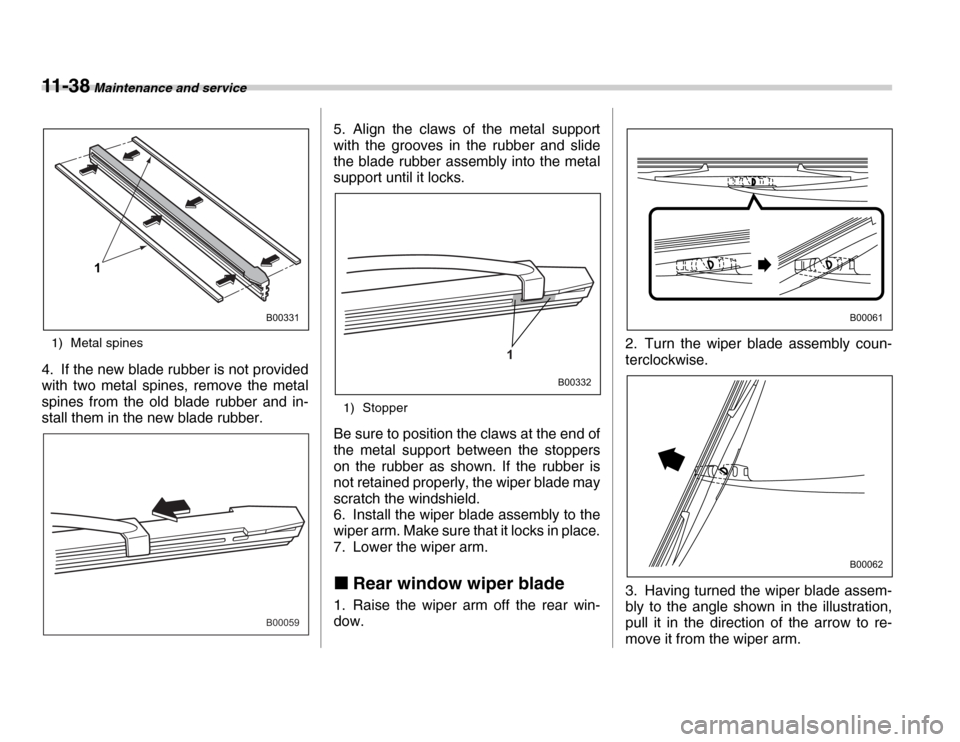
1) Metal spines
4. If the new blade rubber is not provided
with two metal spines, remove the metal
spines from the old blade rubber and in-
stall them in the new blade rubber. 5. Align the claws of the metal support
with the grooves in the rubber and slide
the blade rubber assembly into the metal
support until it locks.
1) Stopper
Be sure to position the claws at the end of
the metal support between the stoppers
on the rubber as shown. If the rubber is
not retained properly, the wiper blade may
scratch the windshield.
6. Install the wiper blade assembly to the
wiper arm. Make sure that it locks in place.
7. Lower the wiper arm. „ Rear window wiper blade
1. Raise the wiper arm off the rear win-
dow. 2. Turn the wiper blade assembly coun-
terclockwise.
3. Having turned the wiper blade assem-
bly to the angle shown in the illustration,
pull it in the direction of the arrow to re-
move it from the wiper arm.
1
B00331
B00059
1
B00332
B00061
B00062
Page 311 of 356
Maintenance and service 11 - 39
– CONTINUED –
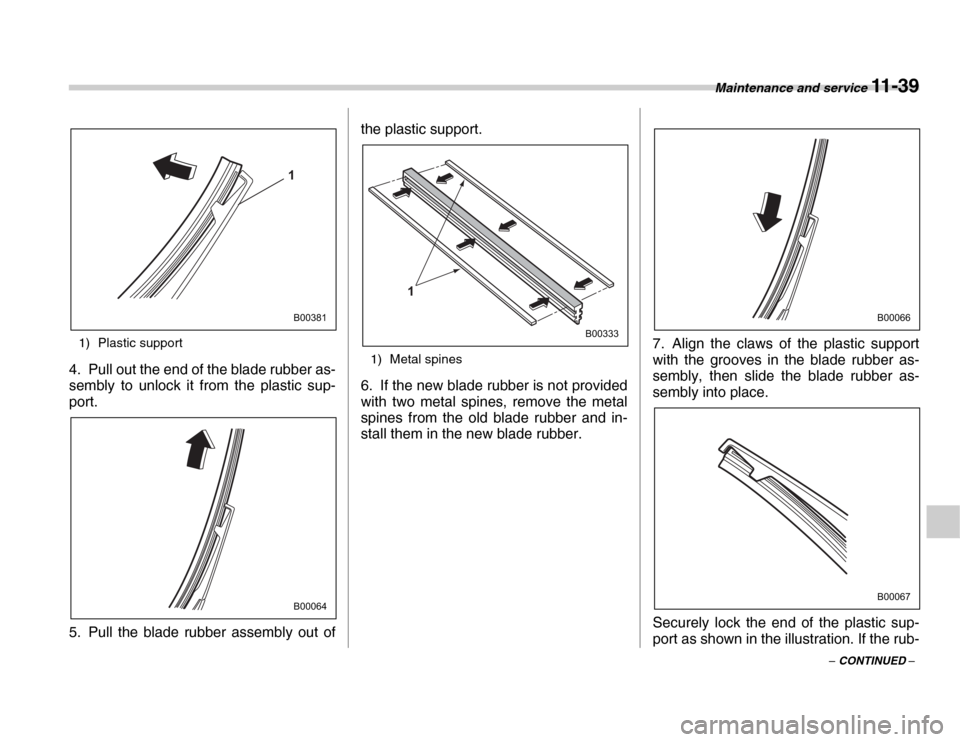
1) Plastic support
4. Pull out the end of the blade rubber as-
sembly to unlock it from the plastic sup-
port.
5. Pull the blade rubber assembly out of the plastic support.
1) Metal spines
6. If the new blade rubber is not provided
with two metal spines, remove the metal
spines from the old blade rubber and in-
stall them in the new blade rubber. 7. Align the claws of the plastic support
with the grooves in the blade rubber as-
sembly, then slide the blade rubber as-
sembly into place.
Securely lock the end of the plastic sup-
port as shown in the illustration. If the rub-
1
B00381
B00064
1
B00333
B00066
B00067
Page 312 of 356
11 - 4 0 Maintenance and service
ber is not retained properly, the wiper may
scratch the rear window glass.
8. Install the wiper blade assembly to the
wiper arm. Make sure that it locks in place.
9. Lower the wiper arm.Battery
yBefore beginning work on or near
any battery, be sure to extinguish
all cigarettes, matches, and light-
ers. Never expose a battery to an
open flame or electric sparks. Bat-
teries give off a gas which is high-
ly flammable and explosive.
yFor safety, in case an explosion
does occur, wear eye protection
or shield your eyes when working
near any battery. Never lean over
a battery.
yDo not let battery fluid contact
eyes, skin, fabrics, or paint be-
cause battery fluid is a corrosive
acid. If battery fluid gets on your
skin or in your eyes, immediately
flush the area with water thor-
oughly. Seek medical help imme-
diately if acid has entered the
eyes.
If battery fluid is accidentally
swallowed, immediately drink a
large amount of milk or water, and
seek medical attention immediate-
ly.
yTo lessen the risk of sparks, re-
move rings, metal watchbands,
and other metal jewelry. Never al-
low metal tools to contact the pos-
itive battery terminal and anything
connected to it WHILE you are at
the same time in contact with any
other metallic portion of the vehi-
cle because a short circuit will re-
sult.
yKeep everyone including children
away from the battery.
yCharge the battery in a well-venti-
lated area.
yBattery posts, terminals and relat-
ed accessories contain lead and
lead compounds, chemicals
known to the State of California to
cause cancer and reproductive
harm. Batteries also contain other
chemicals known to the State of
California to cause cancer. Wash
hands after handling.
Never use more than 10 amperes
when charging the battery because
it will shorten battery life.
Page 314 of 356
11 - 4 2 Maintenance and service
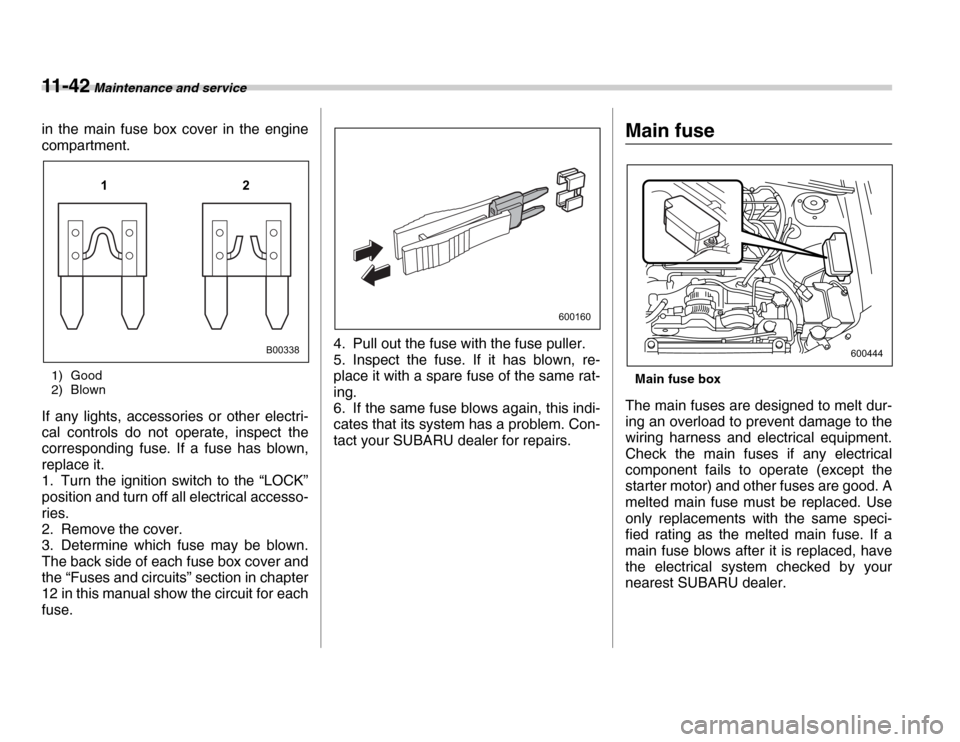
in the main fuse box cover in the engine
compartment.1) Good
2) Blown
If any lights, accessories or other electri-
cal controls do not operate, inspect the
corresponding fuse. If a fuse has blown,
replace it.
1. Turn the ignition switch to the “LOCK”
position and turn off all electrical accesso-
ries.
2. Remove the cover.
3. Determine which fuse may be blown.
The back side of each fuse box cover and
the “Fuses and circuits” section in chapter
12 in this manual show the circuit for each
fuse. 4. Pull out the fuse with the fuse puller.
5. Inspect the fuse. If it has blown, re-
place it with a spare fuse of the same rat-
ing.
6. If the same fuse blows again, this indi-
cates that its system has a problem. Con-
tact your SUBARU dealer for repairs.Main fuse
Main fuse box
The main fuses are designed to melt dur-
ing an overload to prevent damage to the
wiring harness and electrical equipment.
Check the main fuses if any electrical
component fails to operate (except the
starter motor) and other fuses are good. A
melted main fuse must be replaced. Use
only replacements with the same speci-
fied rating as the melted main fuse. If a
main fuse blows after it is replaced, have
the electrical system checked by your
nearest SUBARU dealer.
12
B00338
600160
600444
Page 318 of 356
11 - 4 6 Maintenance and service
„Headlights (Except Canada-
spec. 2.5XT)
NOTE
y If headlight aiming is required, con-
sult your SUBARU dealer for proper
adjustment of the headlight aim. y It may be difficult to replace the
bulbs. Have your SUBARU dealer re-
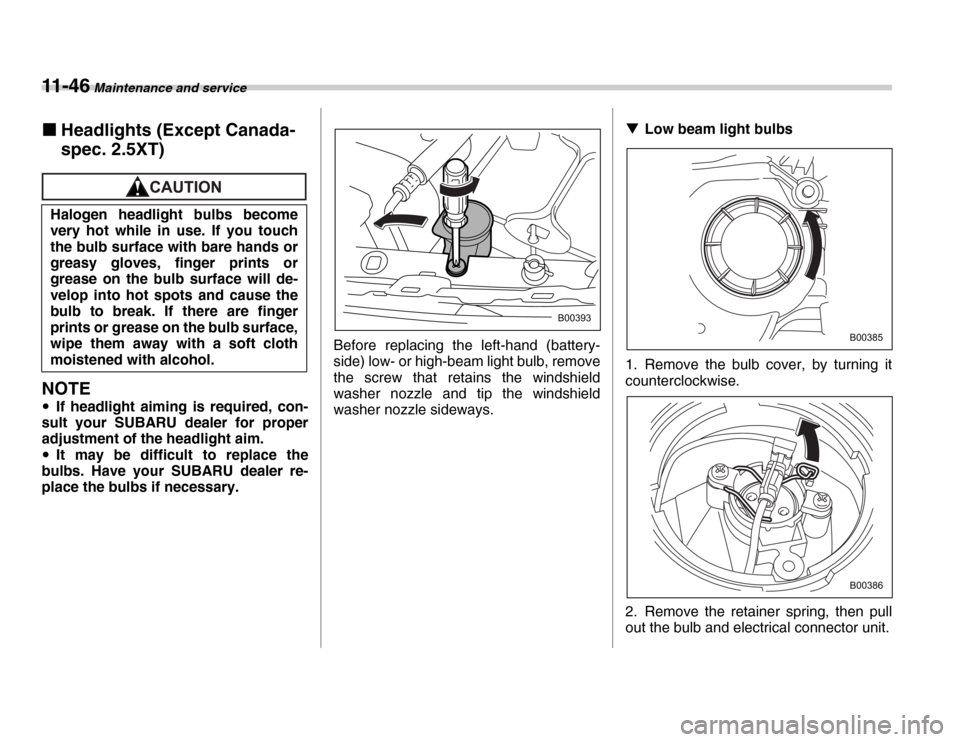
place the bulbs if necessary. Before replacing the left-hand (battery-
side) low- or high-beam light bulb, remove
the screw that retains the windshield
washer nozzle and tip the windshield
washer nozzle sideways. T
Low beam light bulbs
1. Remove the bulb cover, by turning it
counterclockwise.
2. Remove the retainer spring, then pull
out the bulb and electrical connector unit.
Halogen headlight bulbs become
very hot while in use. If you touch
the bulb surface with bare hands or
greasy gloves, finger prints or
grease on the bulb surface will de-
velop into hot spots and cause the
bulb to break. If there are finger
prints or grease on the bulb surface,
wipe them away with a soft cloth
moistened with alcohol.
B00393
B00385
B00386
Page 319 of 356
Maintenance and service 11 - 47
– CONTINUED –
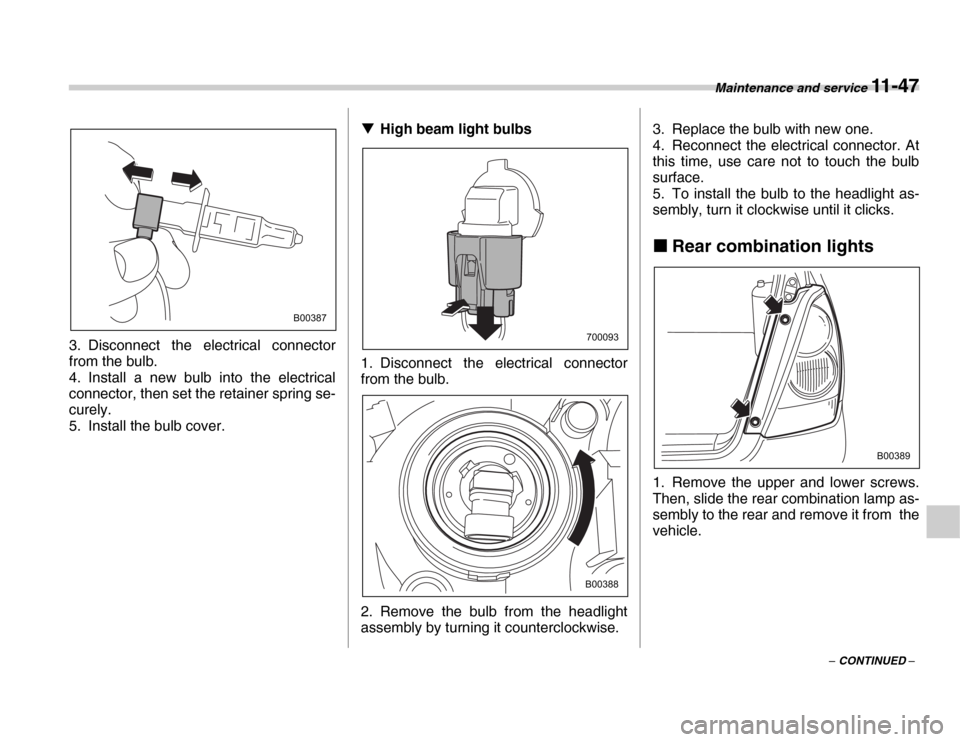
3. Disconnect the electrical connector
from the bulb.
4. Install a new bulb into the electrical
connector, then set the retainer spring se-
curely.
5. Install the bulb cover.
T
High beam light bulbs
1. Disconnect the electrical connector
from the bulb.
2. Remove the bulb from the headlight
assembly by turning it counterclockwise. 3. Replace the bulb with new one.
4. Reconnect the electrical connector. At
this time, use care not to touch the bulb
surface.
5. To install the bulb to the headlight as-
sembly, turn it clockwise until it clicks. „
Rear combination lights
1. Remove the upper and lower screws.
Then, slide the rear combination lamp as-
sembly to the rear and remove it from the
vehicle.
B00387
700093
B00388
B00389
Page 320 of 356
11 - 4 8 Maintenance and service
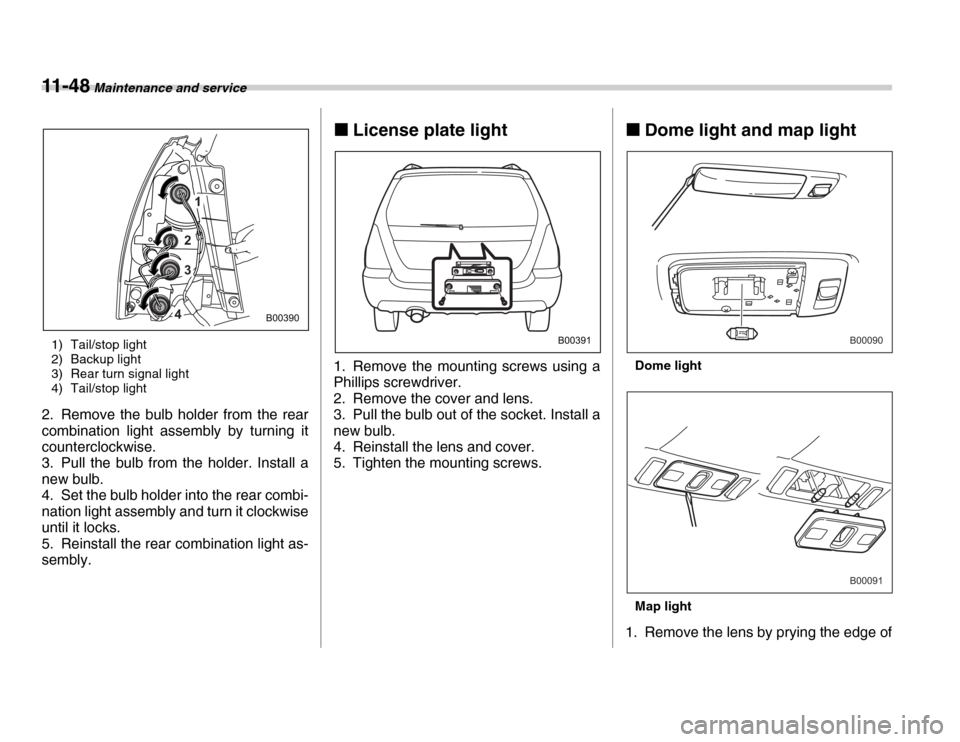
1) Tail/stop light
2) Backup light
3) Rear turn signal light
4) Tail/stop light
2. Remove the bulb holder from the rear
combination light assembly by turning it
counterclockwise.
3. Pull the bulb from the holder. Install a
new bulb.
4. Set the bulb holder into the rear combi-
nation light assembly and turn it clockwise
until it locks.
5. Reinstall the rear combination light as-
sembly. „
License plate light
0
1. Remove the mounting screws using a
Phillips screwdriver.
2. Remove the cover and lens.
3. Pull the bulb out of the socket. Install a
new bulb.
4. Reinstall the lens and cover.
5. Tighten the mounting screws. „
Dome light and map light
Dome light
Map light
1. Remove the lens by prying the edge of
1
2
3
4B00390
B00391B00090
B00091