light SUBARU IMPREZA 2004 2.G User Guide
[x] Cancel search | Manufacturer: SUBARU, Model Year: 2004, Model line: IMPREZA, Model: SUBARU IMPREZA 2004 2.GPages: 491, PDF Size: 5.93 MB
Page 25 of 491
22
!
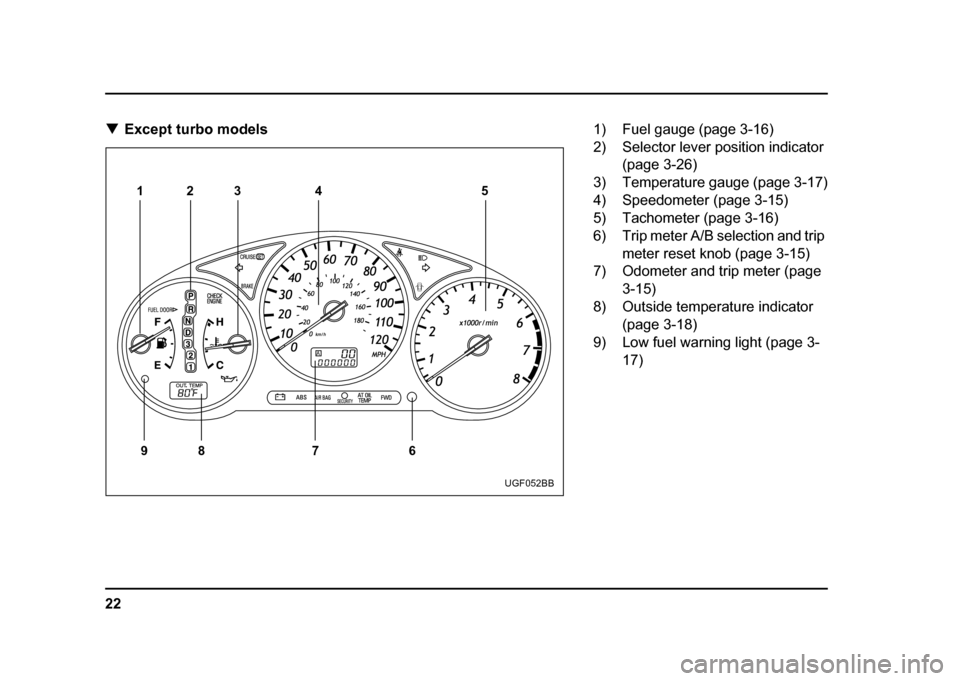
Except turbo models
A
1
98 7 6 3
24 5
UGF052BB
1) Fuel gauge (page 3-16)
2) Selector lever position indicator
(page 3-26)
3) Temperature gauge (page 3-17)
4) Speedometer (page 3-15)
5) Tachometer (page 3-16)
6) Trip meter A/B selection and trip meter reset knob (page 3-15)
7) Odometer and trip meter (page
3-15)
8) Outside temperature indicator
(page 3-18)
9) Low fuel warning light (page 3- 17)
Page 26 of 491
23
–
CONTINUED –
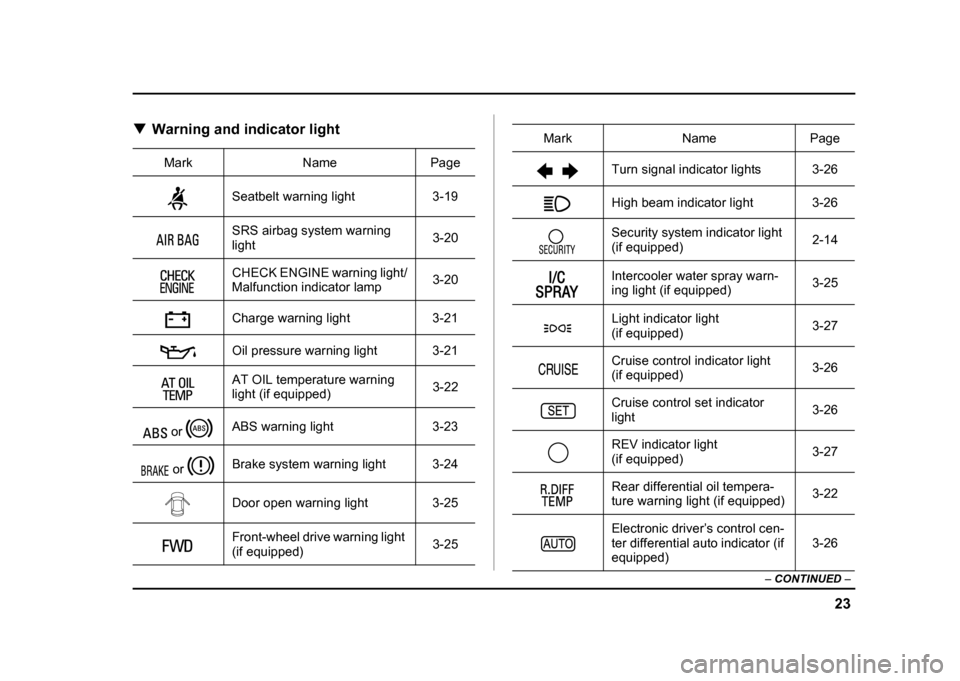
!Warning and indicator light
Mark Name Page
Seatbelt warning light 3-19
SRS airbag system warning light 3-20
CHECK ENGINE warning light/
Malfunction indicator lamp 3-20
Charge warning light 3-21
Oil pressure warning light 3-21
AT OIL temperature warning light (if equipped) 3-22
or ABS warning light 3-23
or Brake system warning light 3-24
Door open warning light 3-25
Front-wheel drive warning light
(if equipped) 3-25
Turn signal indicator lights 3-26
High beam indicator light 3-26
Security system indicator light (if equipped) 2-14
Intercooler water spray warn-
ing light (if equipped) 3-25
Light indicator light (if equipped) 3-27
Cruise control indicator light (if equipped) 3-26
Cruise control set indicator light 3-26
REV indicator light (if equipped) 3-27
Rear differential oil tempera-
ture warning light (if equipped) 3-22
Electronic driver’s control cen-
ter differential auto indicator (if equipped) 3-26
Mark Name Page
Page 28 of 491

1-1
1
Seat, seatbelt and SRS airbags
Front seats .................................................... 1-2 Fore and aft adjustment ................................... 1-3
Reclining the seatback ..................................... 1-4
Seat cushion height adjustment (driver’s seat) 1-5
Head restraint adjustment (if equipped) ......... 1-5
Active head restraint (if equipped) .................. 1-6
Seat heater (if equipped) .............................. 1-7
Rear seats ..................................................... 1-8 Armrest (if equipped) ........................................ 1-9
Headrest adjustment – Wagon ........................ 1-11
Folding down the rear seat – Wagon .............. 1-12
Seatbelts ....................................................... 1-13 Seatbelt safety tips ........................................... 1-13
Emergency Locking Retractor (ELR) .............. 1-14
Automatic/Emergency Locking Retractor (A/ELR) ............................................................ 1-15
Seatbelt warning light and chime ............... 1-15
Fastening the seatbelt ...................................... 1-15
Seatbelt maintenance ....................................... 1-27
Front seatbelt pretensioners ....................... 1-27 System monitors ............................................... 1-29
System servicing .............................................. 1-29
Precautions against vehicle modification ...... 1-30
Child restraint systems ................................ 1-31 Where to place a child restraint system ......... 1-33
Choosing a child restraint system .................. 1-34
Installing child restraint systems with A/ELR seatbelt ............................................................ 1-35
Installing a booster seat ................................... 1-40
Installation of child restraint systems by use of lower and tether anchorages (LATCH) 1-42 Top tether anchorages ..................................... 1-46
SRS airbag (Supplemental Restraint System airbag) 1-52Vehicle with driver’s and front passenger’s SRS airbags and lap/shoulder restraints ..... 1-52
SRS frontal airbag ............................................ 1-56
SRS side airbag (if equipped) .......................... 1-64
SRS airbag system monitors ........................... 1-72
SRS airbag system servicing .......................... 1-73
Precautions against vehicle modification ...... 1-74
Page 29 of 491
1-2
Seat, seatbelt and SRS airbags
Seat, seatbelt and SRS airbagsFront seats
"
Never adjust the seat while driving to avoid
the possibility of loss of vehicle control and of
personal injury." Before adjusting the seat, make sure the
hands and feet of rear seat passengers are
clear of the adjusting mechanism." Seatbelts provide maximum restraint when
the occupant sits well back and upright in the
seat. To reduce the risk of sliding under the
seatbelt in a collision, the front seatbacks
should be always used in the upright position
while the vehicle is running. If the front seat-
backs are not used in the upright position in a
collision, the risk of sliding under the lap belt
and of the lap belt sliding up over the abdomen
will increase, and both can result in serious in-
ternal injury or death.
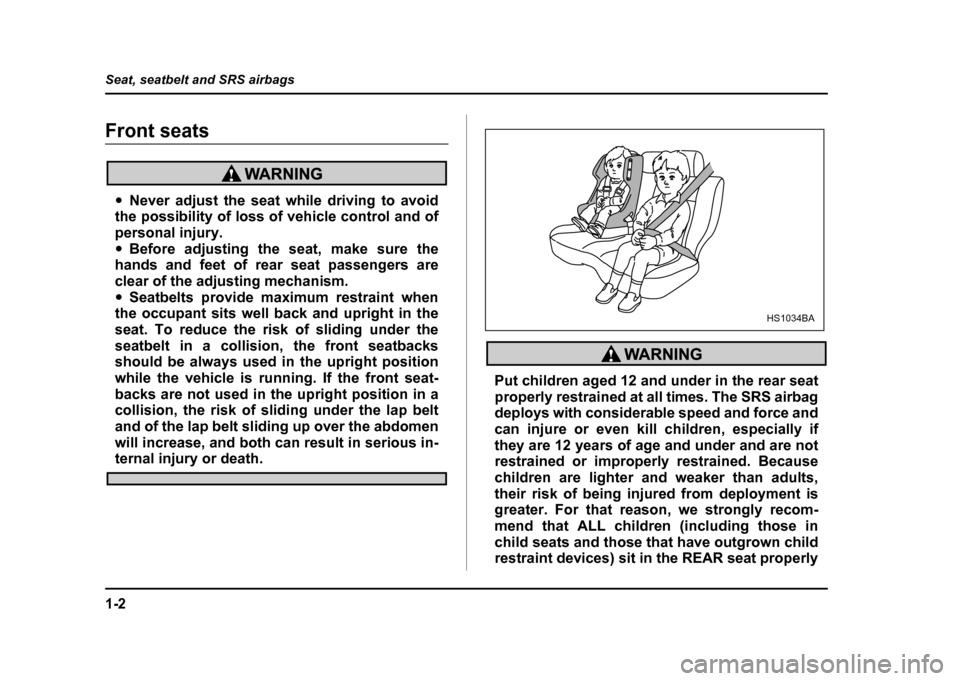
Put children aged 12 and under in the rear seat
properly restrained at all times. The SRS airbag
deploys with considerable speed and force and
can injure or even kill children, especially if
they are 12 years of age and under and are not
restrained or improperly restrained. Because
children are lighter and weaker than adults,
their risk of being injured from deployment is
greater. For that reason, we strongly recom-
mend that ALL children (including those in
child seats and those that have outgrown child
restraint devices) sit in the REAR seat properly
HS1034BA
Page 31 of 491
1-4
Seat, seatbelt and SRS airbags
!
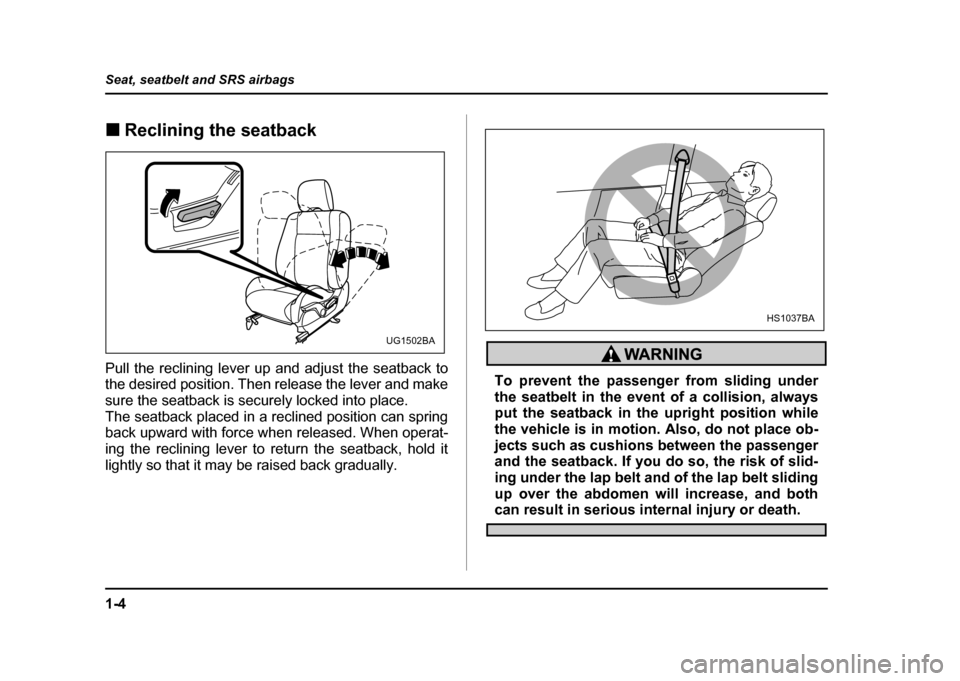
Reclining the seatback
Pull the reclining lever up and adjust the seatback to
the desired position. Then release the lever and make
sure the seatback is securely locked into place.
The seatback placed in a reclined position can spring
back upward with force when released. When operat-
ing the reclining lever to return the seatback, hold it
lightly so that it may be raised back gradually.
To prevent the passenger from sliding under
the seatbelt in the event of a collision, always
put the seatback in the upright position while
the vehicle is in motion. Also, do not place ob-
jects such as cushions between the passenger
and the seatback. If you do so, the risk of slid-
ing under the lap belt and of the lap belt sliding
up over the abdomen will increase, and both
can result in serious internal injury or death.
UG1502BA
HS1037BA
Page 33 of 491
1-6
Seat, seatbelt and SRS airbags
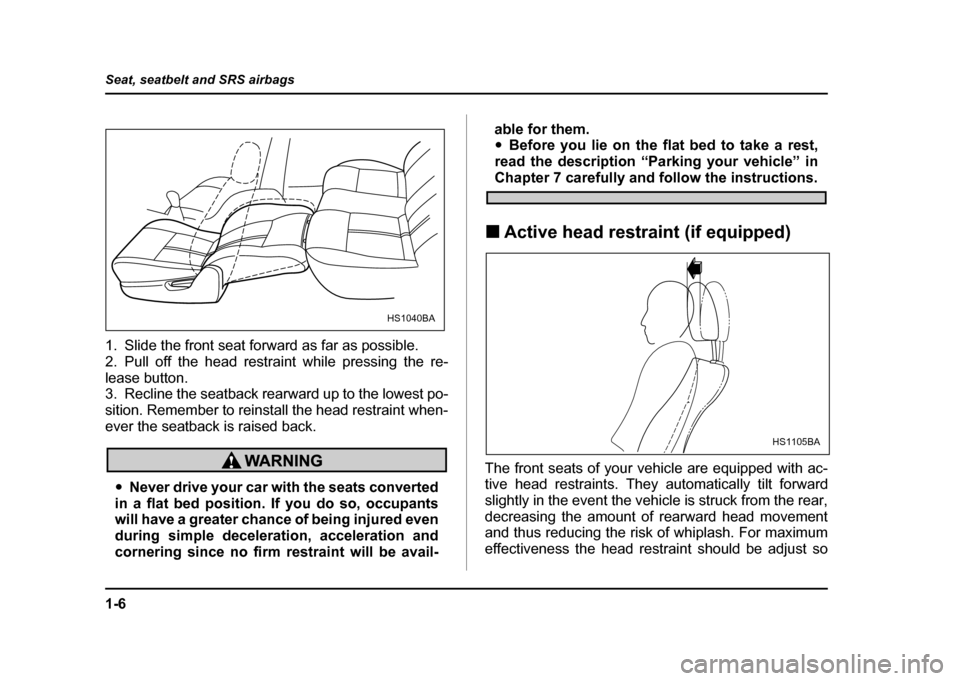
1. Slide the front seat forward as far as possible.
2. Pull off the head restraint while pressing the re-
lease button.
3. Recline the seatback rearward up to the lowest po-
sition. Remember to reinstall the head restraint when-
ever the seatback is raised back.
"
Never drive your car with the seats converted
in a flat bed position. If you do so, occupants
will have a greater chance of being injured even
during simple deceleration, acceleration and
cornering since no firm restraint will be avail- able for them. "
Before you lie on the flat bed to take a rest,
read the description “Parking your vehicle” in
Chapter 7 carefully and follow the instructions.
! Active head restraint (if equipped)
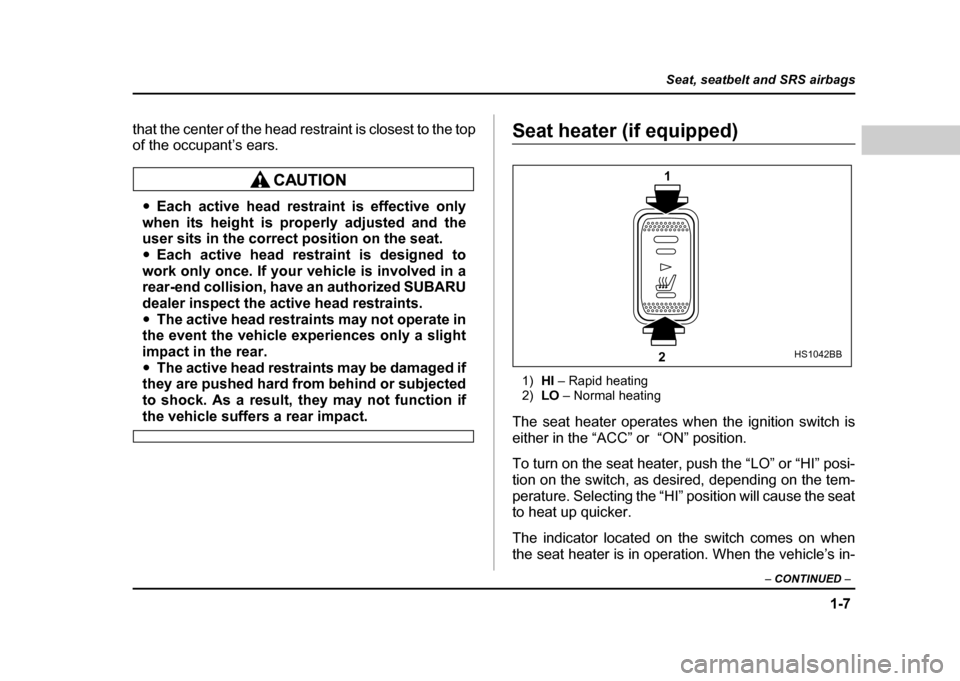
The front seats of your vehicle are equipped with ac-
tive head restraints. They automatically tilt forward
slightly in the event the vehicle is struck from the rear,
decreasing the amount of rearward head movement
and thus reducing the risk of whiplash. For maximum
effectiveness the head restraint should be adjust so
HS1040BA
HS1105BA
Page 34 of 491
1-7
Seat, seatbelt and SRS airbags
– CONTINUED –
that the center of the head restraint is closest to the top
of the occupant’s ears.
"Each active head restraint is effective only
when its height is properly adjusted and the
user sits in the correct position on the seat. " Each active head restraint is designed to
work only once. If your vehicle is involved in a
rear-end collision, have an authorized SUBARU
dealer inspect the active head restraints." The active head restraints may not operate in
the event the vehicle experiences only a slight
impact in the rear." The active head restraints may be damaged if
they are pushed hard from behind or subjected
to shock. As a result, they may not function if
the vehicle suffers a rear impact.
Seat heater (if equipped)
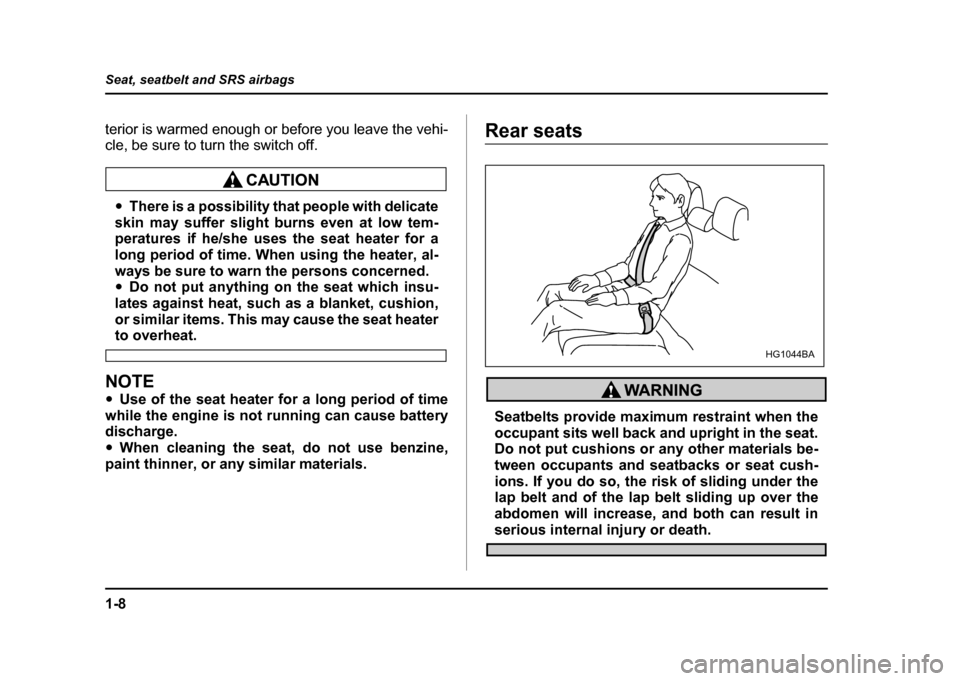
1) HI – Rapid heating
2) LO – Normal heating
The seat heater operates when the ignition switch is
either in the “ACC” or “ON” position.
To turn on the seat heater, push the “LO” or “HI” posi-
tion on the switch, as desired, depending on the tem-
perature. Selecting the “HI” position will cause the seat
to heat up quicker.
The indicator located on the switch comes on when
the seat heater is in operation. When the vehicle’s in-
1
2
HS1042BB
Page 35 of 491
1-8
Seat, seatbelt and SRS airbags
terior is warmed enough or before you leave the vehi-
cle, be sure to turn the switch off.
"
There is a possibility that people with delicate
skin may suffer slight burns even at low tem-
peratures if he/she uses the seat heater for a
long period of time. When using the heater, al-
ways be sure to warn the persons concerned. " Do not put anything on the seat which insu-
lates against heat, such as a blanket, cushion,
or similar items. This may cause the seat heater
to overheat.
NOTE " Use of the seat heater for a long period of time
while the engine is not running can cause battery
discharge. " When cleaning the seat, do not use benzine,
paint thinner, or any similar materials.
Rear seats
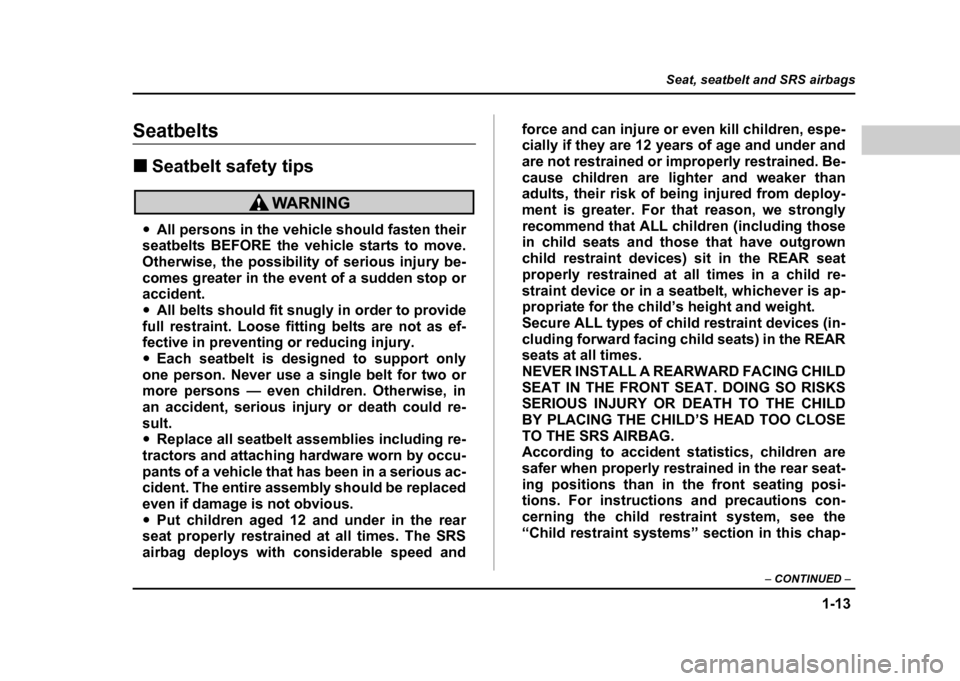
Seatbelts provide maximum restraint when the
occupant sits well back and upright in the seat.
Do not put cushions or any other materials be-
tween occupants and seatbacks or seat cush-
ions. If you do so, the risk of sliding under the
lap belt and of the lap belt sliding up over the
abdomen will increase, and both can result in
serious internal injury or death.
HG1044BA
Page 40 of 491
1-13
Seat, seatbelt and SRS airbags
– CONTINUED –
Seatbelts !Seatbelt safety tips
"All persons in the vehicle should fasten their
seatbelts BEFORE the vehicle starts to move.
Otherwise, the possibility of serious injury be-
comes greater in the event of a sudden stop or
accident. " All belts should fit snugly in order to provide
full restraint. Loose fitting belts are not as ef-
fective in preventing or reducing injury. " Each seatbelt is designed to support only
one person. Never use a single belt for two or
more persons — even children. Otherwise, in
an accident, serious injury or death could re-
sult. " Replace all seatbelt assemblies including re-
tractors and attaching hardware worn by occu-
pants of a vehicle that has been in a serious ac-
cident. The entire assembly should be replaced
even if damage is not obvious." Put children aged 12 and under in the rear
seat properly restrained at all times. The SRS
airbag deploys with considerable speed and force and can injure or even kill children, espe-
cially if they are 12 years of age and under and
are not restrained or improperly restrained. Be-
cause children are lighter and weaker than
adults, their risk of being injured from deploy-
ment is greater. For that reason, we strongly
recommend that ALL children (including those
in child seats and those that have outgrown
child restraint devices) sit in the REAR seat
properly restrained at all times in a child re-
straint device or in a seatbelt, whichever is ap-
propriate for the child’s height and weight.
Secure ALL types of child restraint devices (in-
cluding forward facing child seats) in the REAR
seats at all times.
NEVER INSTALL A REARWARD FACING CHILD
SEAT IN THE FRONT SEAT. DOING SO RISKS SERIOUS INJURY OR DEATH TO THE CHILD
BY PLACING THE CHILD’S HEAD TOO CLOSE
TO THE SRS AIRBAG.
According to accident statistics, children are
safer when properly restrained in the rear seat-
ing positions than in the front seating posi-
tions. For instructions and precautions con-
cerning the child restraint system, see the
“Child restraint systems” section in this chap-
Page 42 of 491
1-15
Seat, seatbelt and SRS airbags
– CONTINUED –
!Automatic/Emergency Locking Retrac- tor (A/ELR)
Each passenger’s seatbelt has an Automatic/Emer-
gency Locking Retractor (A/ELR). The Automatic/
Emergency Locking Retractor normally functions as
an Emergency Locking Retractor (ELR). The A/ELR
has an additional locking mode “Automatic Locking
Retractor (ALR) mode” intended to secure a child re-
straint system. When the seatbelt is once drawn out
completely and is then retracted even slightly, the re-
tractor locks the seatbelt in that position and the seat-
belt cannot be extended. As the belt is rewinding,
clicks will be heard which indicate the retractor func-
tions as an ALR. When the seatbelt is retracted fully,
the ALR mode is released.
When securing a child restraint system on the rear
seats by the use of the seatbelt, the seatbelt must be
changed over to the Automatic Locking Retractor (ALR) mode.
When the child restraint system is removed, make
sure that the seatbelt retracts fully and the retractor re-
turned to the Emergency Locking Retractor (ELR)
mode.
For instructions on how to convert the retractor to the
ALR mode and restore it to the ELR mode, see the
“Child restraint systems” section in this chapter. !
Seatbelt warning light and chime
Your vehicle is equipped with a seatbelt warning de-
vice at the driver’s seat, as required by current safety
standards.
This device causes the seatbelt warning light on the
instrument panel to light up for about six seconds
when the ignition switch is turned to “ON” to remind the
driver to wear the seatbelt. If the driver’s seatbelt is not
fastened, a warning chime sounds at the same time. ! Fastening the seatbelt
"Never use a belt that is twisted or reversed. In
an accident, this can increase the risk or sever-
ity of injury. " Keep the lap belt as low as possible on your
hips. In a collision, this spreads the force of the
lap belt over stronger hip bones instead of
across the weaker abdomen. " Seatbelts provide maximum restraint when
the occupant sits well back and upright in the
seat. To reduce the risk of sliding under the
seatbelt in a collision, the front seatbacks
should be always used in the upright position
while the vehicle is running. If the front seat-