light SUBARU IMPREZA 2004 2.G Owner's Manual
[x] Cancel search | Manufacturer: SUBARU, Model Year: 2004, Model line: IMPREZA, Model: SUBARU IMPREZA 2004 2.GPages: 491, PDF Size: 5.93 MB
Page 43 of 491
1-16
Seat, seatbelt and SRS airbags
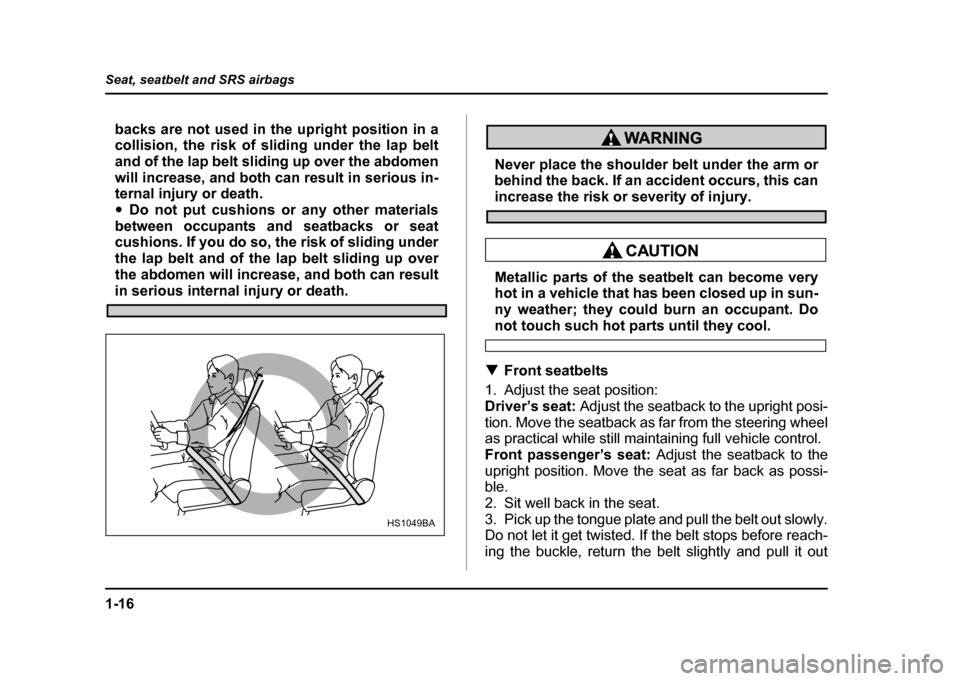
backs are not used in the upright position in a
collision, the risk of sliding under the lap belt
and of the lap belt sliding up over the abdomen
will increase, and both can result in serious in-
ternal injury or death. "
Do not put cushions or any other materials
between occupants and seatbacks or seat
cushions. If you do so, the risk of sliding under
the lap belt and of the lap belt sliding up over
the abdomen will increase, and both can result
in serious internal injury or death.
Never place the shoulder belt under the arm or
behind the back. If an accident occurs, this can
increase the risk or severity of injury.
Metallic parts of the seatbelt can become very
hot in a vehicle that has been closed up in sun-
ny weather; they could burn an occupant. Do
not touch such hot parts until they cool.
! Front seatbelts
1. Adjust the seat position:
Driver’s seat: Adjust the seatback to the upright posi-
tion. Move the seatback as far from the steering wheel
as practical while still maintaining full vehicle control.
Front passenger’s seat: Adjust the seatback to the
upright position. Move the seat as far back as possi-
ble.
2. Sit well back in the seat.
3. Pick up the tongue plate and pull the belt out slowly.
Do not let it get twisted. If the belt stops before reach-
ing the buckle, return the belt slightly and pull it out
HS1049BA
Page 44 of 491
1-17
Seat, seatbelt and SRS airbags
– CONTINUED –
more slowly. If the belt still cannot be unlocked, let the
belt retract slightly after giving it a strong pull, then pull
it out slowly again.
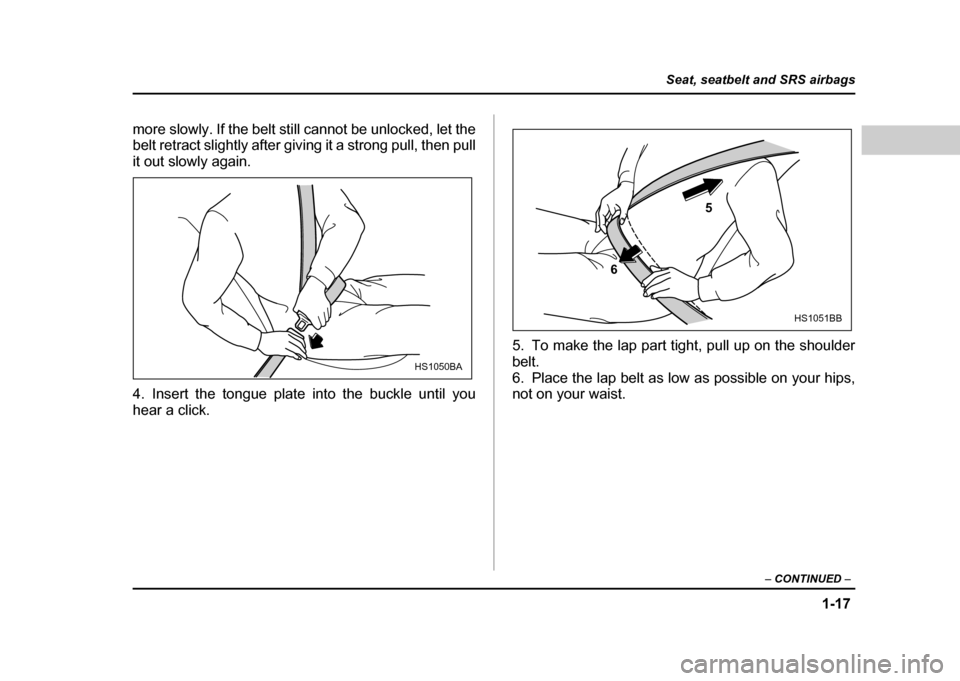
4. Insert the tongue plate into the buckle until you
hear a click. 5. To make the lap part tight, pull up on the shoulder
belt.
6. Place the lap belt as low as possible on your hips,
not on your waist.
HS1050BA
5
6
HS1051BB
Page 46 of 491
1-19
Seat, seatbelt and SRS airbags
– CONTINUED –
in the door. !Rear seatbelts (except rear center seatbelt on
Wagon)
1. Sit well back in the seat.
2. Pick up the tongue plate and pull the belt out slowly.
Do not let it get twisted. If the belt stops before reach-
ing the buckle, return the belt slightly and pull it out
more slowly. If the belt still cannot be unlocked, let the
belt retract slightly after giving a strong pull on it, then
pull it out slowly again.
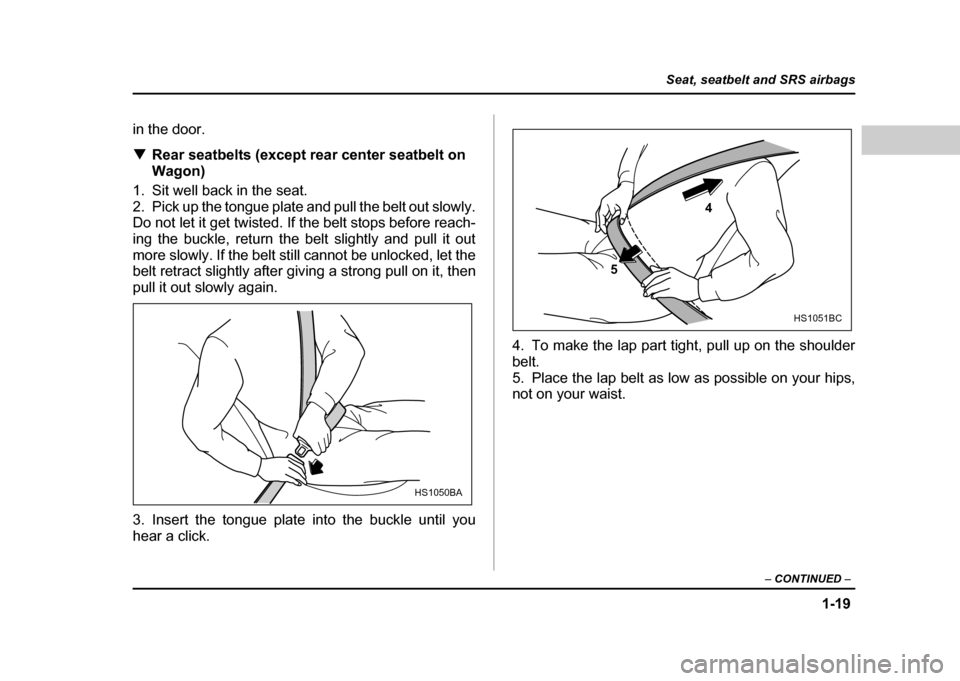
3. Insert the tongue plate into the buckle until you
hear a click. 4. To make the lap part tight, pull up on the shoulder
belt.
5. Place the lap belt as low as possible on your hips,
not on your waist.
HS1050BA
4
5
HS1051BC
Page 50 of 491
1-23
Seat, seatbelt and SRS airbags
– CONTINUED –
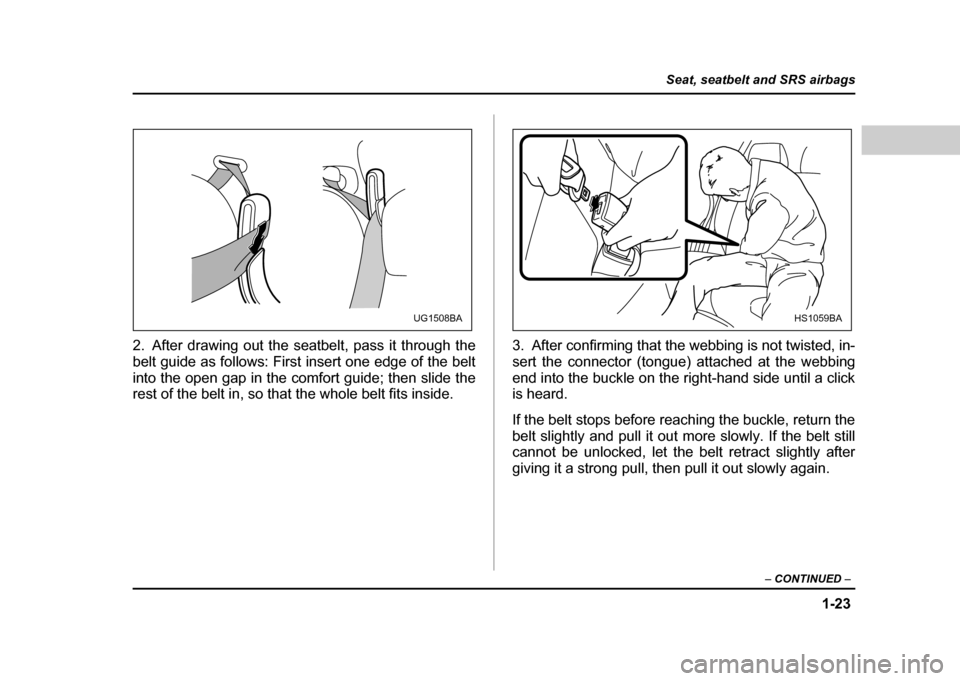
2. After drawing out the seatbelt, pass it through the
belt guide as follows: First insert one edge of the belt
into the open gap in the comfort guide; then slide the
rest of the belt in, so that the whole belt fits inside. 3. After confirming that the webbing is not twisted, in-
sert the connector (tongue) attached at the webbing
end into the buckle on the right-hand side until a click
is heard.
If the belt stops before reaching the buckle, return the
belt slightly and pull it out more slowly. If the belt still
cannot be unlocked, let the belt retract slightly after
giving it a strong pull, then pull it out slowly again.
UG1508BAHS1059BA
Page 56 of 491
1-29
Seat, seatbelt and SRS airbags
– CONTINUED –
your SUBARU dealer.
! System monitors
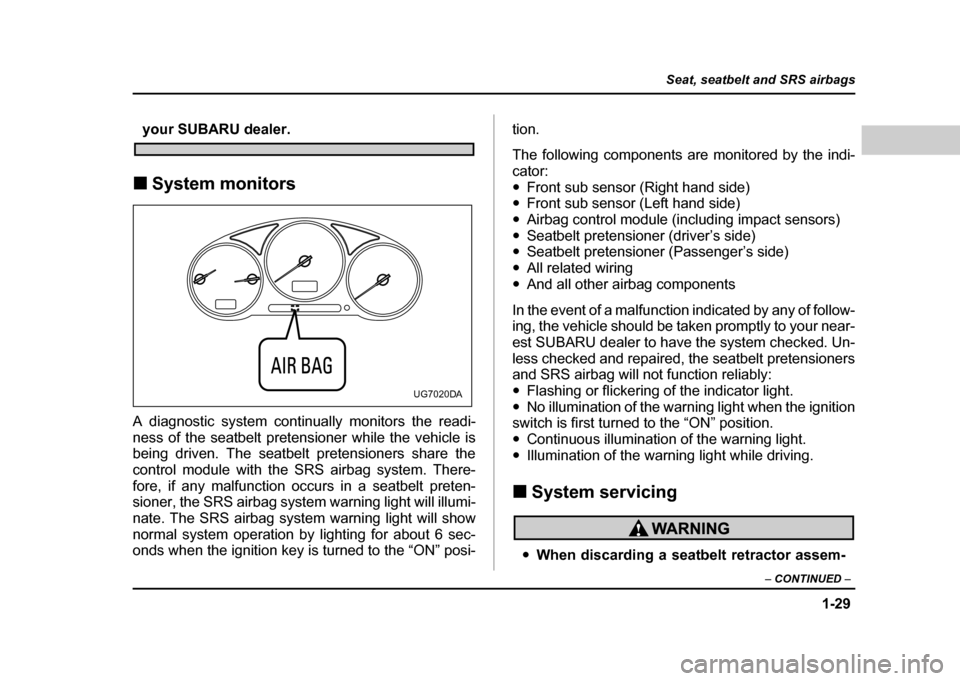
A diagnostic system continually monitors the readi-
ness of the seatbelt pretensioner while the vehicle is
being driven. The seatbelt pretensioners share the
control module with the SRS airbag system. There-
fore, if any malfunction occurs in a seatbelt preten-
sioner, the SRS airbag system warning light will illumi-
nate. The SRS airbag system warning light will show
normal system operation by lighting for about 6 sec-
onds when the ignition key is turned to the “ON” posi- tion.
The following components are monitored by the indi- cator:"
Front sub sensor (Right hand side)
" Front sub sensor (Left hand side)
" Airbag control module (including impact sensors)
" Seatbelt pretensioner (driver’s side)
" Seatbelt pretensioner (Passenger’s side)
" All related wiring
" And all other airbag components
In the event of a malfunction indicated by any of follow-
ing, the vehicle should be taken promptly to your near-
est SUBARU dealer to have the system checked. Un-
less checked and repaired, the seatbelt pretensioners
and SRS airbag will not function reliably: " Flashing or flickering of the indicator light.
" No illumination of the warning light when the ignition
switch is first turned to the “ON” position." Continuous illumination of the warning light.
" Illumination of the warning light while driving.
! System servicing
"When discarding a seatbelt retractor assem-
UG7020DA
Page 60 of 491
1-33
Seat, seatbelt and SRS airbags
– CONTINUED –
!Where to place a child restraint system
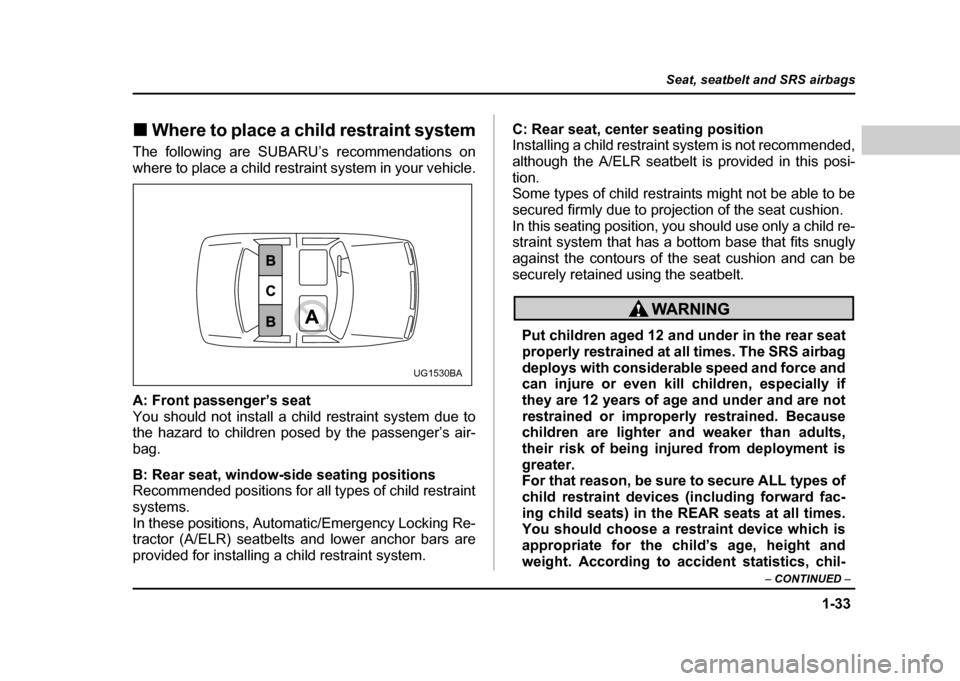
The following are SUBARU’s recommendations on
where to place a child restraint system in your vehicle.
A: Front passenger’s seat
You should not install a child restraint system due to
the hazard to children posed by the passenger’s air-
bag.
B: Rear seat, window-side seating positions
Recommended positions for all types of child restraint systems.
In these positions, Automatic/Emergency Locking Re-
tractor (A/ELR) seatbelts and lower anchor bars are
provided for installing a child restraint system. C: Rear seat, center seating position
Installing a child restraint system is not recommended,
although the A/ELR seatbelt is provided in this posi-
tion.
Some types of child restraints might not be able to be
secured firmly due to projection of the seat cushion.
In this seating position, you should use only a child re-
straint system that has a bottom base that fits snugly
against the contours of the seat cushion and can be
securely retained using the seatbelt.
Put children aged 12 and under in the rear seat
properly restrained at all times. The SRS airbag
deploys with considerable speed and force and
can injure or even kill children, especially if
they are 12 years of age and under and are not
restrained or improperly restrained. Because
children are lighter and weaker than adults,
their risk of being injured from deployment is
greater.
For that reason, be sure to secure ALL types of
child restraint devices (including forward fac-
ing child seats) in the REAR seats at all times.
You should choose a restraint device which is
appropriate for the child’s age, height and
weight. According to accident statistics, chil-
UG1530BA
Page 80 of 491
1-53
Seat, seatbelt and SRS airbags
– CONTINUED –
injury such as abrasions and bruises to the
face or arms because of the SRS airbag deploy-
ment force."The SRS airbags deploy with considerable
speed and force. Occupants who are out of
proper position when the SRS airbag deploys
could suffer very serious injuries. Because the
SRS airbag needs enough space for deploy-
ment, the driver should always sit upright and
well back in the seat as far from the steering
wheel as practical while still maintaining full ve-
hicle control and the front passenger should
move the seat as far back as possible and sit
upright and well back in the seat. " Do not place any objects over or near the
SRS airbag cover or between you and the SRS
airbag. If the SRS airbag deploys, those objects
could interfere with its proper operation and
could be propelled inside the car and cause in-
jury.
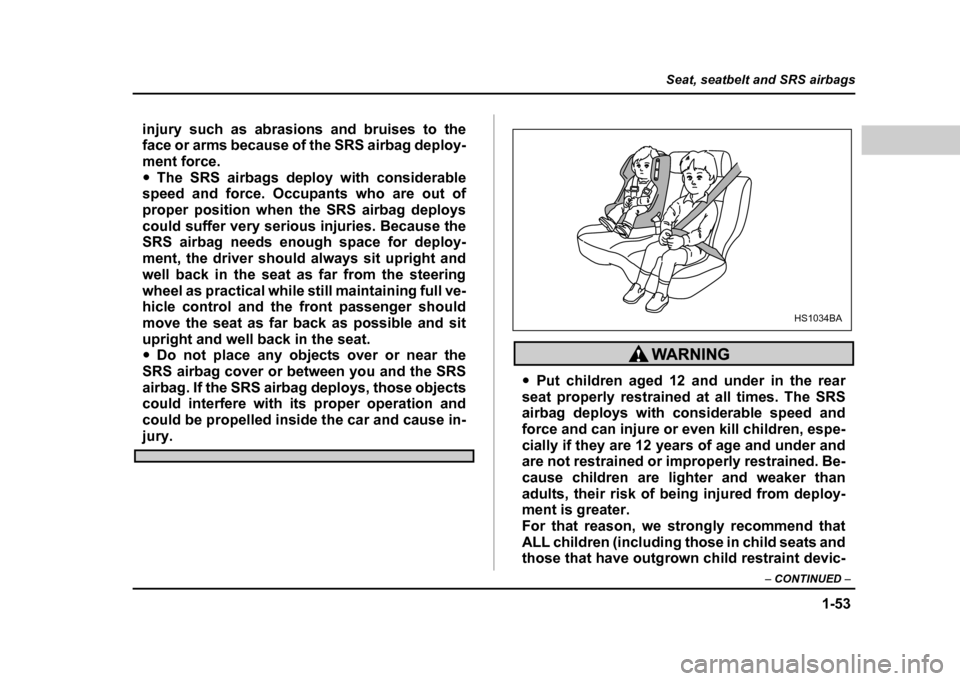
" Put children aged 12 and under in the rear
seat properly restrained at all times. The SRS
airbag deploys with considerable speed and
force and can injure or even kill children, espe-
cially if they are 12 years of age and under and
are not restrained or improperly restrained. Be-
cause children are lighter and weaker than
adults, their risk of being injured from deploy-
ment is greater.
For that reason, we strongly recommend that
ALL children (including those in child seats and
those that have outgrown child restraint devic-
HS1034BA
Page 99 of 491
1-72
Seat, seatbelt and SRS airbags
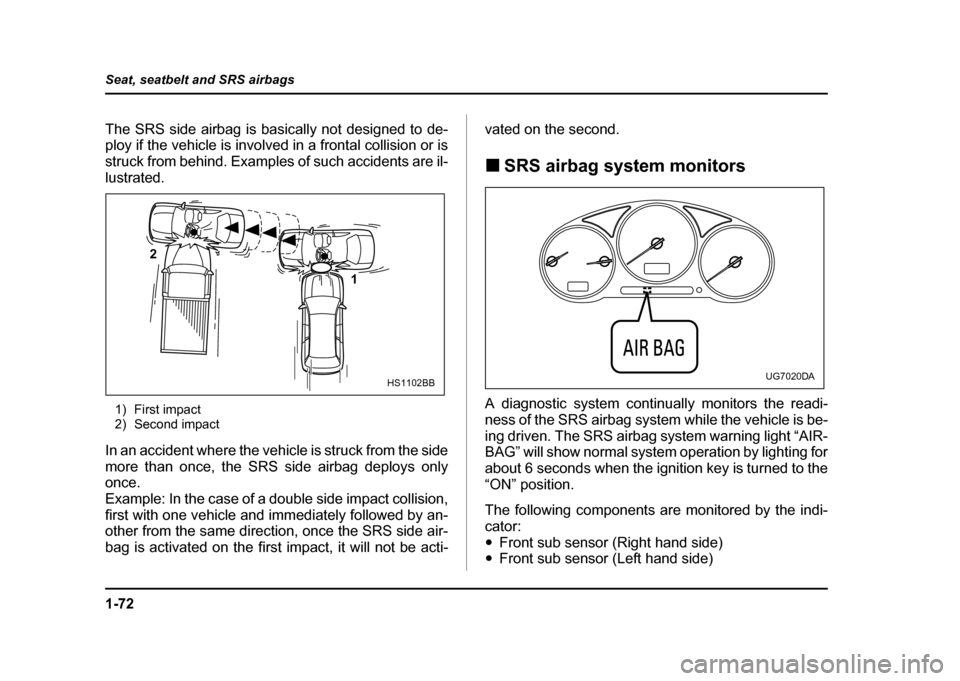
The SRS side airbag is basically not designed to de-
ploy if the vehicle is involved in a frontal collision or is
struck from behind. Examples of such accidents are il-
lustrated.
1) First impact
2) Second impact
In an accident where the vehicle is struck from the side
more than once, the SRS side airbag deploys only
once.
Example: In the case of a double side impact collision,
first with one vehicle and immediately followed by an-
other from the same direction, once the SRS side air-
bag is activated on the first impact, it will not be acti- vated on the second. !
SRS airbag system monitors
A diagnostic system continually monitors the readi-
ness of the SRS airbag system while the vehicle is be-
ing driven. The SRS airbag system warning light “AIR-
BAG” will show normal system operation by lighting for
about 6 seconds when the ignition key is turned to the“ON” position.
The following components are monitored by the indi- cator:" Front sub sensor (Right hand side)
" Front sub sensor (Left hand side)
2
1
HS1102BBUG7020DA
Page 100 of 491
1-73
Seat, seatbelt and SRS airbags
– CONTINUED –
"Airbag control module (including impact sensors)
" Frontal airbag module (Driver’s side)
" Frontal airbag module (Passenger’s side)
" Side airbag sensor (Driver’s side — if equipped)
" Side airbag sensor (Passenger’s side — if
equipped) " Side airbag module (Driver’s side — if equipped)
" Side airbag module (Passenger’s side — if
equipped)" Seatbelt pretensioner (Driver’s side)
" Seatbelt pretensioner (Passenger’s side)
" All related wiring
In the event of a malfunction indicated by any of follow-
ing, the vehicle should be taken promptly to your near-
est SUBARU dealer to have the system checked. Un-
less checked and repaired, the SRS airbags will not
function reliably: " Flashing or flickering of the indicator light.
" No illumination of the warning light when the ignition
switch is first turned to the “ON” position." Continuous illumination of the warning light.
" Illumination of the warning light while driving. !
SRS airbag system servicing
"When discarding an airbag module or scrap-
ping the entire car damaged by a collision, con-
sult your SUBARU dealer." The SRS airbag has no user-serviceable
parts. Do not use electrical test equipment on
any circuit related to the SRS airbag system.
For required servicing of the SRS airbag, see
your nearest SUBARU dealer. Tampering with
or disconnecting the system’s wiring could re-
sult in accidental inflation of the SRS airbag or
could make the system inoperative, which may
result in serious injury. The wiring harnesses of
the SRS airbag system are covered with yellow
insulation and system connectors are yellow
for easy identification.
If you need service or repair in areas listed be-
low, we recommend that you have an autho-
rized SUBARU dealer perform the work. The
SRS airbag control module, impact sensors
and airbag modules are stored in these areas.
Page 111 of 491
2-8
Keys and doors
wagon).
An electronic chirp will sound one time and the turn
signal lights will flash one time.
If any of the doors (or the rear gate) is not fully closed,
an electronic chirp will sound five times and the turn
signal lights will flash five times to alert you that the
doors (or the rear gate) are not properly closed. When
you close the door, it will automatically lock.
NOTE
If the “LOCK/ALARM” button is pressed for two
seconds or longer, the panic alarm will sound.
When locking the doors in normal circumstances,press the “LOCK/ALARM” button for less than two
seconds. For details on the panic alarm, refer to
“Sounding a panic alarm”. !
Unlocking the doors
Briefly press the “UNLOCK/DISARM” button (for less
than two seconds) to unlock the driver’s door. An elec-
tronic chirp will sound two times and the turn signal
lights will flash two times. To unlock all other doors
(and rear gate on the wagon), briefly press the “UN-
LOCK/DISARM” button a second time within 5 sec-
onds.
NOTE
If the interval between the first and second press-
es of the “UNLOCK/DISARM” button (for unlock-
ing of all of the doors and the rear gate) is extreme-
ly short, the system may not respond. ! Illuminated entry
The interior (dome) light and ignition switch light (for
turbo models) will illuminate when the “UNLOCK/DIS-
ARM” button is pressed. These lights stay illuminated
for approximately 30 seconds if any of the doors (or
the rear gate on the wagon) is not opened.
If the “LOCK/ARM” button is pressed before 30 sec-
onds have elapsed, these lights will go out. Also, these
lights will go out if the key is inserted in the ignition switch. The interior light must be set to the middle po-
sition in order for this function to operate.
! Vehicle finder function
Use this function to find your vehicle parked among
many vehicles in a large parking lot. Provided you are
within 30 feet (10 meters) of the vehicle, pressing the
“LOCK/ARM” button three times in a five-second peri-
od will cause your vehicle’s horn to sound one time
and its turn signal lights to flash three times.