ECO mode SUBARU IMPREZA 2004 2.G Owner's Guide
[x] Cancel search | Manufacturer: SUBARU, Model Year: 2004, Model line: IMPREZA, Model: SUBARU IMPREZA 2004 2.GPages: 491, PDF Size: 5.93 MB
Page 312 of 491

8-1
8
Driving tips
New vehicle break-in driving – the first 1,000 miles (1,600 km) ................ 8-2
Fuel economy hints ...................................... 8-2
Engine exhaust gas (Carbon monoxide) .... 8-3
Catalytic converter ....................................... 8-4
Periodic inspections .................................... 8-6
Driving in foreign countries ......................... 8-6
Driving tips for AWD vehicles ..................... 8-7
Off road driving ............................................ 8-8 All AWD models except OUTBACK SPORT and vehicles with 17 inch tires ..................... 8-9
OUTBACK SPORT ............................................. 8-9
Winter driving ............................................... 8-11 Operation during cold weather ........................ 8-11
Driving on snowy and icy roads ...................... 8-13
Corrosion protection ........................................ 8-14
Snow tires .......................................................... 8-14
Tire chains ......................................................... 8-16
Rocking the vehicle .......................................... 8-16
Loading your vehicle ................................... 8-17 Vehicle capacity weight .................................... 8-19
GVWR and GAWR (Gross Vehicle Weight Rating and Gross Axle Weight Rating) ........ 8-20
Roof rail and crossbar (if equipped) ............... 8-21
Trailer hitch (if equipped) ............................ 8-25 Connecting a trailer .......................................... 8-25
When you do not tow a trailer .......................... 8-28
Trailer towing ................................................ 8-29 Warranties and maintenance ........................... 8-29 Maximum load limits ........................................ 8-29
Trailer hitches ................................................... 8-34
Connecting a trailer .......................................... 8-35
Trailer towing tips ............................................. 8-37
Page 325 of 491
8-14
Driving tips
!
Wiper operation when snowing
Before driving in cold weather, make sure the wiper
blades are not frozen to the windshield or rear window.
If the wiper blades are frozen to the windshield or rear
window, use the defroster with the airflow control dial
in the “ ” position and the temperature control dial
set for maximum warmth until the wiper blades are
completely thawed out. If your vehicle is equipped with
a wiper deicer, it is helpful to thaw the windshield wiper
blades. To thaw out the rear wiper blade, use the rear
window defogger.
When driving in snow, if frozen snow starts to stick on
the surface of the windshield despite wiper operation,
use the defroster with the airflow control dial in “ ”
and the temperature control dial set for maximum
warmth. After the windshield gets warmed enough to
melt the frozen snow on it, wash it away using the
windshield washer.
Snow stuck on the wiper arm prevents the wiper from
working effectively. If snow is stuck on the wiper arm,
pull off the road to a safe place, then remove it. If you
stop the car at road side, use the hazard warning
flasher to alert other drivers.
We recommend use of non-freezing type wiper blades
(winter blades) during the seasons you could have snow and sub-zero temperatures. Blades of this type
give superior wiping performance in snowy conditions.
Be sure to use blades that are suitable for your vehi-cle. !
Corrosion protection
Refer to the “Corrosion protection” section (chapter
10). ! Snow tires
! All models except WRX-STi
"When replacing original tires with winter
(snow) tires, make sure you use only the same
size, construction and load range as the origi-
nal tires listed on the tire placard. Using other
sizes and construction may affect speedome-
ter/odometer calibration and clearance be-
tween the body and tires. It also may be danger-
ous and lead to loss of vehicle control. " You must install four winter tires that are of
the same size, construction, brand, and load
range. Mixing other sizes or constructions may
result in severe mechanical damage to the drive
Page 386 of 491

11 - 1
11
Maintenance and service
Maintenance schedule ................................. 11-3
Maintenance precautions ............................ 11-3 Before checking or servicing in the engine compartment .................................................. 11-4
When you do checking or servicing in the engine compartment while the engine is
running ............................................................ 11-5
Engine hood .................................................. 11-5
Engine compartment overview ................... 11-8 2.5 liter model .................................................... 11-8
2.0 liter (Turbo) model ...................................... 11-9
2.5 liter (Turbo) model ...................................... 11-10
Engine oil ...................................................... 11-11 Checking the oil level ....................................... 11-11
Changing the oil and oil filter .......................... 11-12
Recommended grade and viscosity ................ 11-16
Recommended grade and viscosity under severe driving conditions .............................. 11-18
Synthetic oil ....................................................... 11-18
Cooling system ............................................. 11-18 Cooling fan, hose and connections ................ 11-19
Engine coolant .................................................. 11-19
Air cleaner element ...................................... 11-23 Replacing the air cleaner element ................... 11-23
Spark plugs ................................................... 11-26 Recommended spark plugs ............................. 11-27
Drive belts ..................................................... 11-27
Manual transmission oil ............................... 11-28 Checking the oil level ....................................... 11-28
Recommended grade and viscosity ................ 11-30 Automatic transmission fluid ...................... 11-31
Checking the fluid level .................................... 11-31
Recommended fluid ......................................... 11-32
Front differential gear oil (AT vehicles) ...... 11-33 Checking the oil level ....................................... 11-33
Recommended grade and viscosity ............... 11-33
Rear differential gear oil ............................... 11-34 Checking the gear oil level .............................. 11-34
Recommended grade and viscosity ............... 11-35
Power steering fluid ...................................... 11-36 Checking the fluid level .................................... 11-36
Recommended fluid ......................................... 11-37
Brake fluid ..................................................... 11-37 Checking the fluid level .................................... 11-37
Recommended brake fluid ............................... 11-38
Clutch fluid (MT vehicles) ............................ 11-38 Checking the fluid level .................................... 11-38
Recommended clutch fluid .............................. 11-39
Brake booster ................................................ 11-40
Brake pedal .................................................... 11-40 Checking the brake pedal free play ................ 11-40
Checking the brake pedal reserve distance ... 11-41
Clutch pedal (MT vehicles) ........................... 11-41 Checking the clutch function .......................... 11-41
Checking the clutch pedal free play ............... 11-42
Replacement of brake pad and lining ......... 11-42 Breaking-in of new brake pads and linings .... 11-43
Parking brake stroke .................................... 11-44
Tires and wheels ........................................... 11-44
Page 391 of 491
11 - 6
Maintenance and service
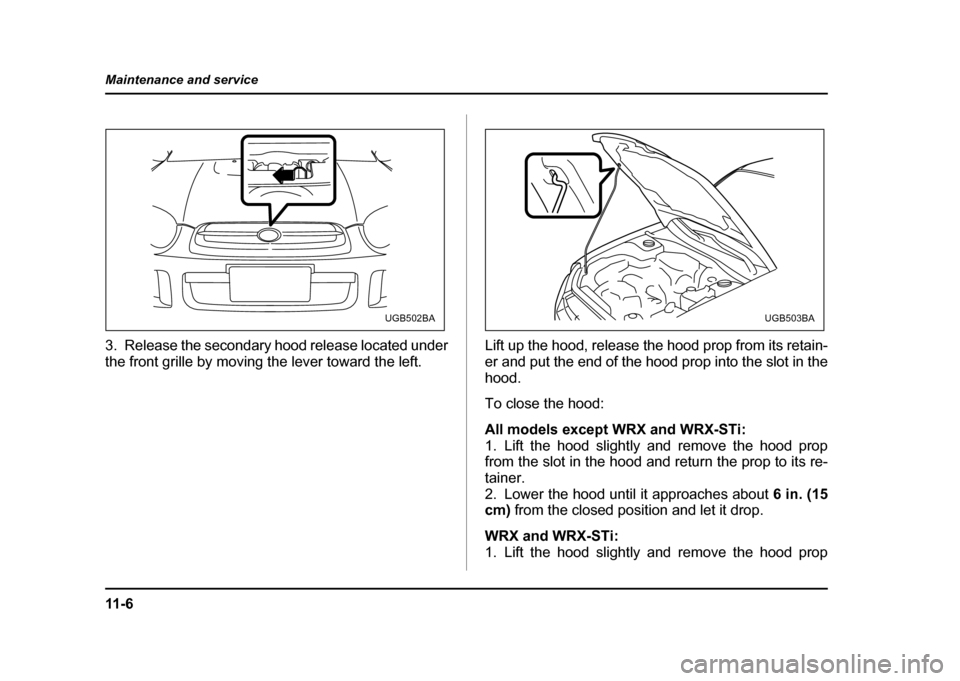
3. Release the secondary hood release located under
the front grille by moving the lever toward the left.
Lift up the hood, release the hood prop from its retain-
er and put the end of the hood prop into the slot in the
hood.
To close the hood:
All models except WRX and WRX-STi:
1. Lift the hood slightly and remove the hood prop
from the slot in the hood and return the prop to its re-
tainer.
2. Lower the hood until it approaches about
6 in. (15
cm) from the closed position and let it drop.
WRX and WRX-STi:
1. Lift the hood slightly and remove the hood prop
UGB502BAUGB503BA
Page 397 of 491
11 - 1 2
Maintenance and service
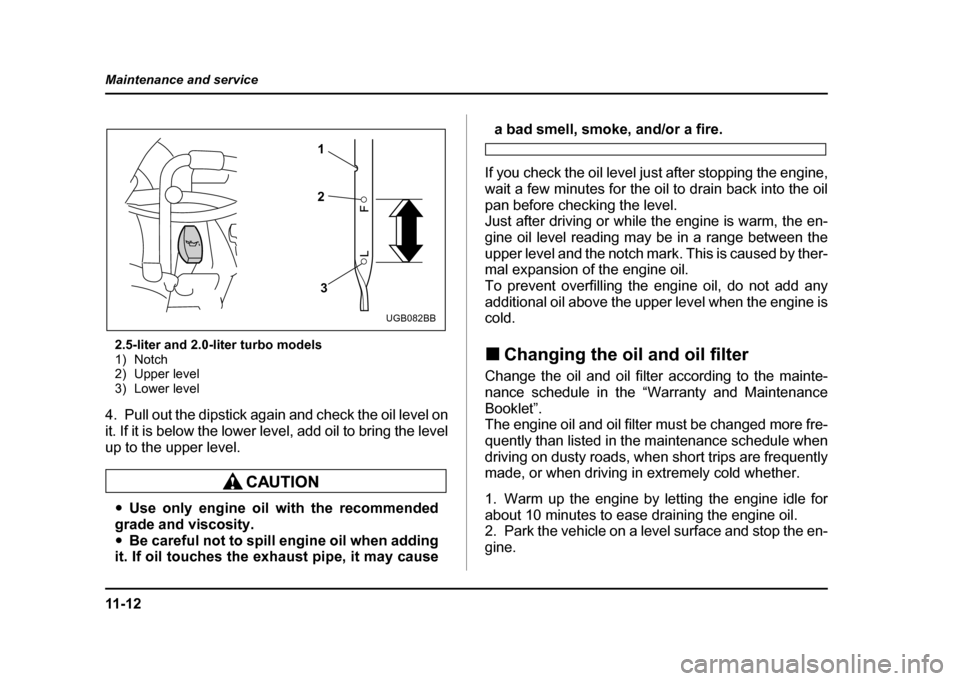
2.5-liter and 2.0-liter turbo models
1) Notch
2) Upper level
3) Lower level
4. Pull out the dipstick again and check the oil level on
it. If it is below the lower level, add oil to bring the level
up to the upper level.
" Use only engine oil with the recommended
grade and viscosity. " Be careful not to spill engine oil when adding
it. If oil touches the exhaust pipe, it may cause
a bad smell, smoke, and/or a fire.
If you check the oil level just after stopping the engine,
wait a few minutes for the oil to drain back into the oil
pan before checking the level.
Just after driving or while the engine is warm, the en-
gine oil level reading may be in a range between the
upper level and the notch mark. This is caused by ther-
mal expansion of the engine oil.
To prevent overfilling the engine oil, do not add any
additional oil above the upper level when the engine iscold. ! Changing the oil and oil filter
Change the oil and oil filter according to the mainte-
nance schedule in the “Warranty and Maintenance Booklet”.
The engine oil and oil filter must be changed more fre-
quently than listed in the maintenance schedule when
driving on dusty roads, when short trips are frequently
made, or when driving in extremely cold whether.
1. Warm up the engine by letting the engine idle for
about 10 minutes to ease draining the engine oil.
2. Park the vehicle on a level surface and stop the en-
gine.
1 2
3
UGB082BB
Page 408 of 491
11 -2 3
Maintenance and service
– CONTINUED –
7. Put the radiator cap back on and tighten firmly. At
this time, make sure that the rubber gasket in the radi-
ator cap is correctly in place.
8. Start and run the engine for more than five minutes
at 2,000 to 3,000 rpm.
9. Stop the engine and wait until the coolant cools
down (122 to 140 °F [50 to 60 °C]). If there is any loss
of coolant, add coolant to the radiator’s filler neck and
to the reserve tank’s “FULL” level.
10.Put the radiator cap and reservoir cap back on and
tighten firmly.Air cleaner element
The air cleaner element functions as a filter screen.
When the element is perforated or removed, engine
wear will be excessive and engine life shortened.
The air cleaner element is a viscous type. It is unnec-
essary to clean or wash the element.
Do not operate the engine with the air cleaner
element removed. The air cleaner element not
only filters intake air but also stops flames if the
engine backfires. If the air cleaner element is
not installed when the engine backfires, you
could be burned.
! Replacing the air cleaner element
! Non-turbo models
Replace the air cleaner element according to the
maintenance schedule in the “Warranty and Mainte-
nance Booklet”. Under extremely dusty conditions, re-
place it more frequently. It is recommended that you
always use genuine SUBARU parts.
Page 412 of 491
11 -2 7
Maintenance and service
– CONTINUED –
bles. "Make sure the cables are replaced in the cor-
rect order.
! Recommended spark plugs
Non-turbo models:
RC10YC4 (Champion)
BKR6E-11 (NGK)
BKR5E-11 (NGK)
2.0-liter turbo models: PFR6G (NGK)
2.5-liter turbo models:
IFLR6B (NGK)
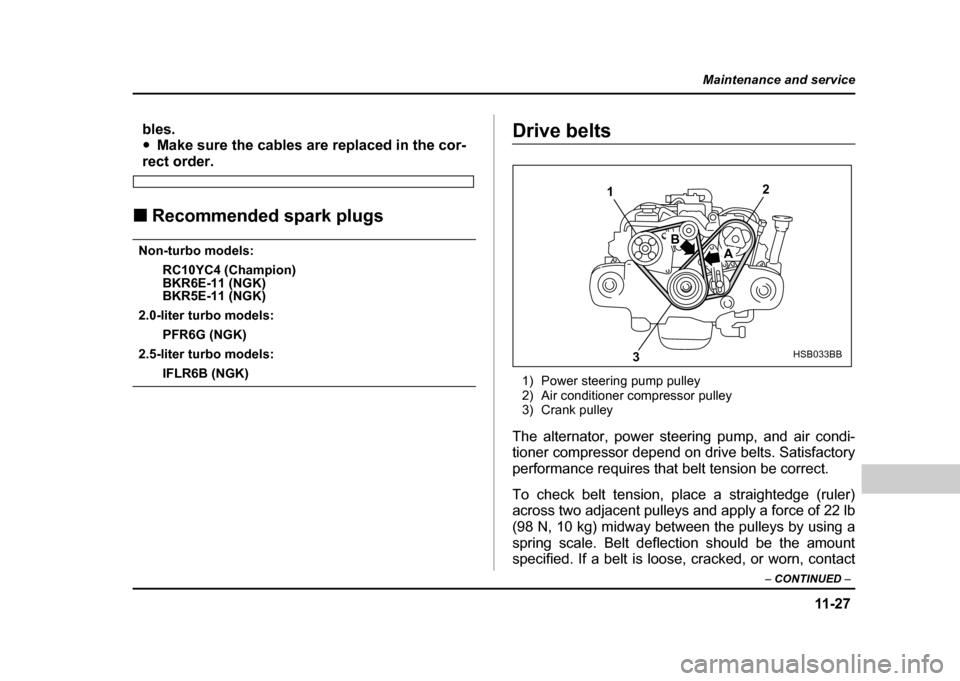
Drive belts
1) Power steering pump pulley
2) Air conditioner compressor pulley
3) Crank pulley
The alternator, power steering pump, and air condi-
tioner compressor depend on drive belts. Satisfactory
performance requires that belt tension be correct.
To check belt tension, place a straightedge (ruler)
across two adjacent pulleys and apply a force of 22 lb
(98 N, 10 kg) midway between the pulleys by using a
spring scale. Belt deflection should be the amount
specified. If a belt is loose, cracked, or worn, contact
2
3 A
B
1
HSB033BB
Page 491 of 491

GAS STATION REFERENCE
Fuel: !2.5 Liter models
Use only unleaded gasoline with an octane rat-
ing of 87 AKI or higher. ! 2.0 Liter (Turbo) models
Use premium unleaded gasoline with an oc-
tane rating of 91 AKI or higher. If premium un-
leaded gasoline is not available, regular un-
leaded gasoline with octane rating of 87 AKI or
higher may be temporarily used. For optimum
engine performance and driveability, it is rec-
ommended that you use premium grade un-
leaded gasoline. ! 2.5 Liter (Turbo) models
Use premium unleaded gasoline with an oc-
tane rating of 94 AKI or higher. If premium un-
leaded gasoline with an octane rating of 93 AKI
is not available, premium unleaded gasoline
with octane rating of 91 AKI or higher may be
temporarily used. For optimum engine perfor-
mance and driveability, it is recommended that
you use premium grade unleaded gasoline
with an octane rating of 93 AKI or higher. !
Fuel octane rating
This octane rating is the average of the Re-
search Octane and Motor Octane numbers and
is commonly referred to as the Anti Knock In-
dex (AKI). Refer to “Fuel” section in this manu-
al.
Fuel capacity:
15.9 US gal (60 liters, 13.2 Imp gal) Engine oil:
Use only API classification SL with the words
“ENERGY CONSERVING” and the New API
certification mark (starburst mark) displayed on
the container. Engine oil capacity:
Non turbo models: 4.2 US qt (4.0 liters, 3.5 Imp
qt)
Turbo models: 4.8 US qt (4.5 liters, 4.0 Imp qt)
Cold tire pressure:
See the label located under the driver’s door
latch.