automatic transmission SUBARU LEGACY 1999 Service User Guide
[x] Cancel search | Manufacturer: SUBARU, Model Year: 1999, Model line: LEGACY, Model: SUBARU LEGACY 1999Pages: 1456, PDF Size: 59.93 MB
Page 537 of 1456
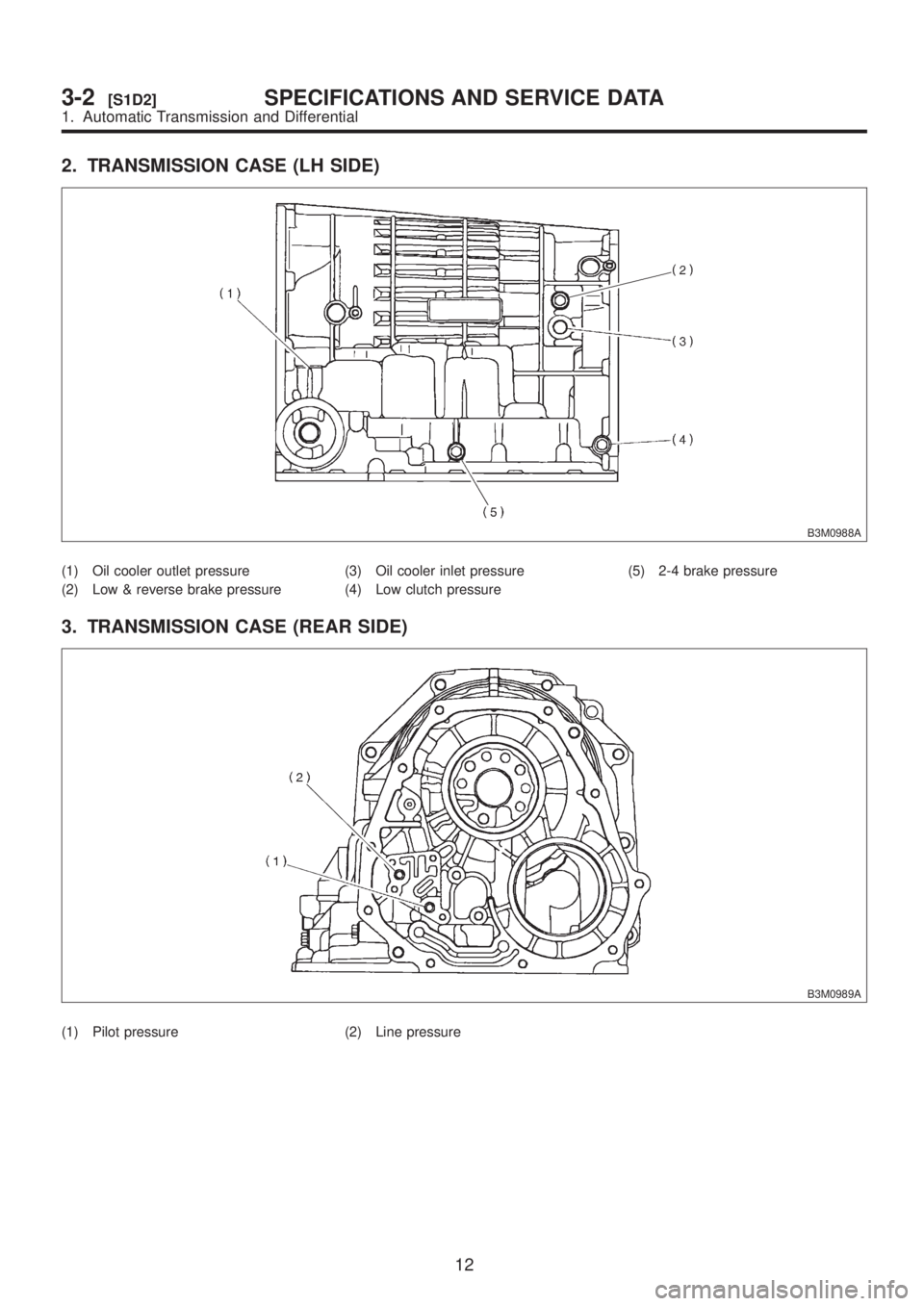
2. TRANSMISSION CASE (LH SIDE)
B3M0988A
(1) Oil cooler outlet pressure
(2) Low & reverse brake pressure(3) Oil cooler inlet pressure
(4) Low clutch pressure(5) 2-4 brake pressure
3. TRANSMISSION CASE (REAR SIDE)
B3M0989A
(1) Pilot pressure (2) Line pressure
12
3-2[S1D2]SPECIFICATIONS AND SERVICE DATA
1. Automatic Transmission and Differential
Page 538 of 1456
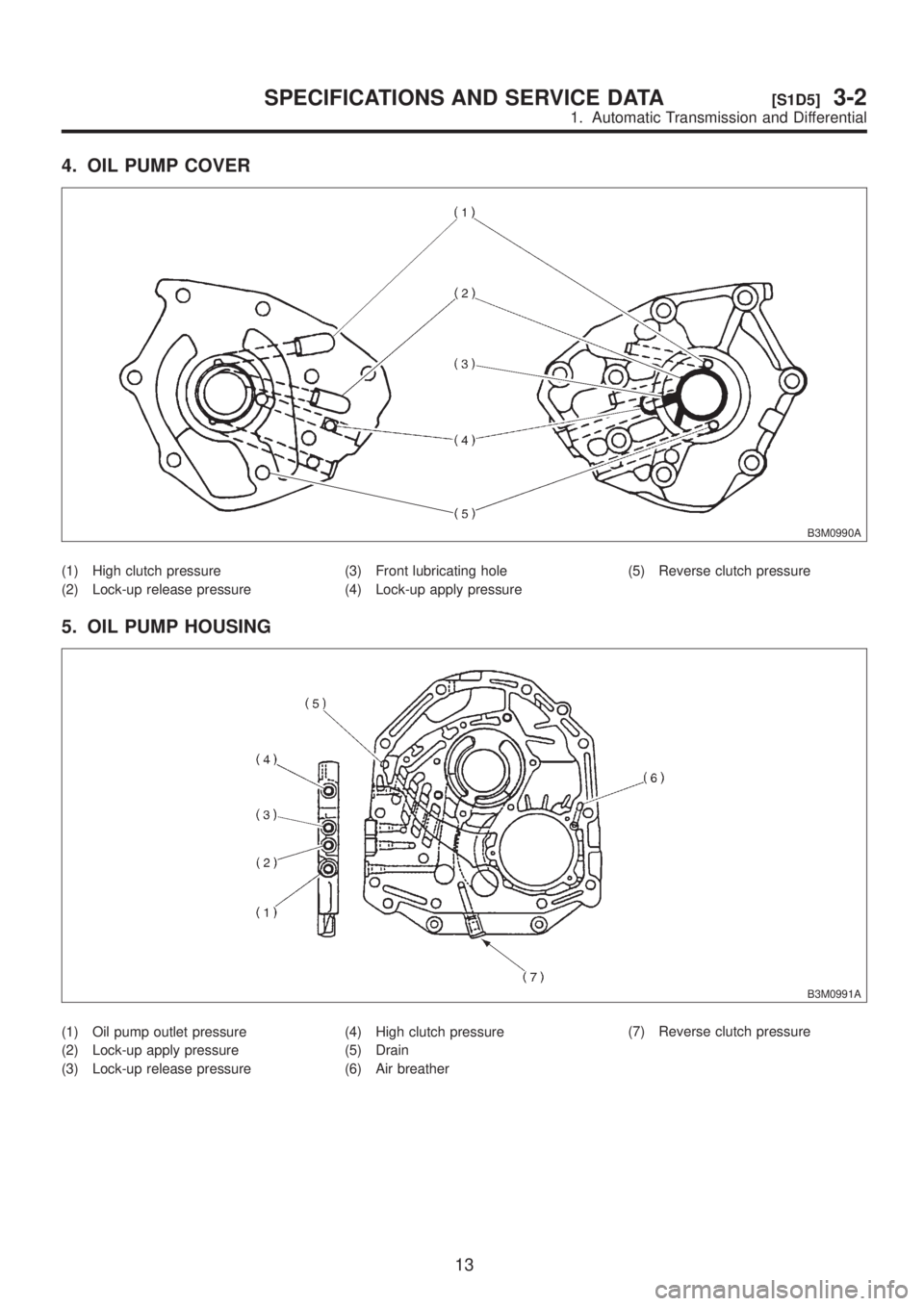
4. OIL PUMP COVER
B3M0990A
(1) High clutch pressure
(2) Lock-up release pressure(3) Front lubricating hole
(4) Lock-up apply pressure(5) Reverse clutch pressure
5. OIL PUMP HOUSING
B3M0991A
(1) Oil pump outlet pressure
(2) Lock-up apply pressure
(3) Lock-up release pressure(4) High clutch pressure
(5) Drain
(6) Air breather(7) Reverse clutch pressure
13
[S1D5]3-2SPECIFICATIONS AND SERVICE DATA
1. Automatic Transmission and Differential
Page 539 of 1456
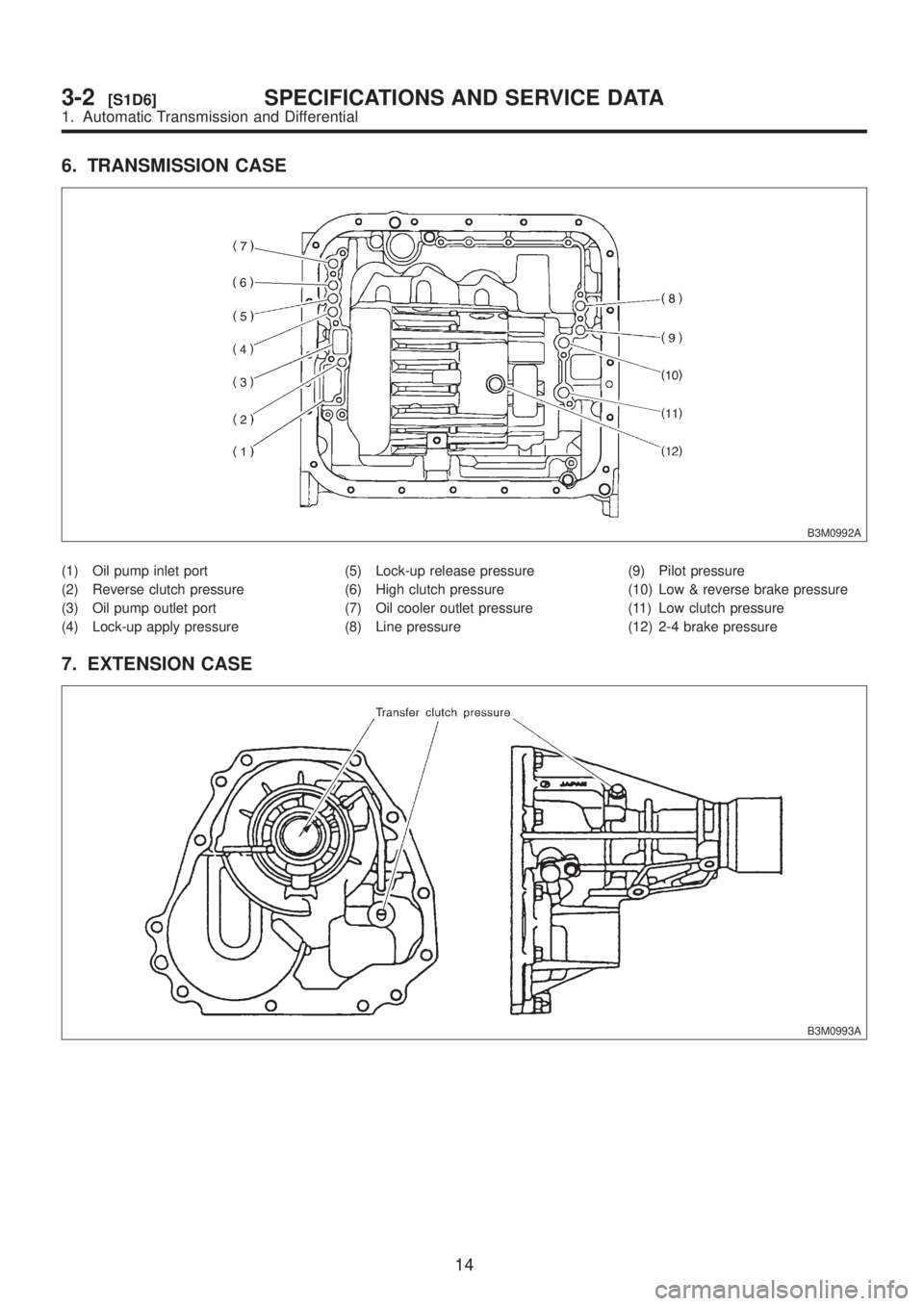
6. TRANSMISSION CASE
B3M0992A
(1) Oil pump inlet port
(2) Reverse clutch pressure
(3) Oil pump outlet port
(4) Lock-up apply pressure(5) Lock-up release pressure
(6) High clutch pressure
(7) Oil cooler outlet pressure
(8) Line pressure(9) Pilot pressure
(10) Low & reverse brake pressure
(11) Low clutch pressure
(12) 2-4 brake pressure
7. EXTENSION CASE
B3M0993A
14
3-2[S1D6]SPECIFICATIONS AND SERVICE DATA
1. Automatic Transmission and Differential
Page 552 of 1456
1. General
A: PRECAUTION
When disassembling or assembling the automatic
transmission, observe the following instructions.
1) Workshop
Provide a place that is clean and free from dust.
Principally the conventional workshop is suitable
except for a dusty place. In a workshop where
grinding work, etc. which produces fine particles is
done, make independent place divided by the vinyl
curtain or the equivalent.
2) Work table
The size of 1 x 1.5 m (40 x 60 in) is large enough
to work, and it is more desirable that its surface be
covered with flat plate like iron plate which is not
rusted too much.
3) Cleaning of exterior
(1) Clean the exterior surface of transmission
with steam and/or kerosene prior to
disassembly, however it should be noted that
vinyl tape be placed on the air breather or oil
level gauge to prevent infiltration of the steam
into the transmission and also the cleaning job
be done away from the place of disassembly
and assembly.
(2) Partial cleaning will do, depending on the
extent of disassembly (such as when disassem-
bly is limited to some certain parts).
4) Disassembly, assembly and cleaning
(1) Disassemble and assemble the transmis-
sion while inspecting the parts in accordance
with the Diagnostics.
(2) During job, do not use gloves. Do not clean
the parts with rags: Use chamois or nylon cloth.
(3) Pay special attention to the air to be used
for cleaning. Get the moisture and the dust rid
of the air as much as possible. Be careful not to
scratch or dent any part while checking for
proper operation with an air gun.
(4) Complete the job from cleaning to comple-
tion of assembly as continuously and speedily
as possible in order to avoid occurrence of sec-
ondary troubles caused by dust. When stopping
the job unavoidably cover the parts with clean
chamois or nylon cloth to keep them away from
any dust.
(5) Use kerosene, white gasoline or the equiva-
lent as washing fluid. Use always new fluid for
cleaning the automatic transmission parts and
never reuse. The used fluid is usable in disas-
semble and assemble work of engine and
manual transmission.
(6) Although the cleaning should be done by
dipping into the washing fluid or blowing of the
pressurized washing fluid, the dipping is more
desirable. (Do not rub with a brush.) Assemblethe parts immediately after the cleaning without
exposure to the air for a while. Besides in case
of washing rubber parts, perform the job quickly
not to dip them into the washing fluid for long
time.
(7) Apply the automatic transmission fluid
(ATF) onto the parts immediately prior to
assembly, and the specified tightening torque
should be observed carefully.
(8) Use vaseline if it is necessary to hold parts
in the position when assembling.
(9) Drain ATF and differential gear oil into a
saucer so that the conditions of fluid and oil can
be inspected.
(10) Do not support axle drive shaft, stator
shaft, input shaft or various pipes when moving
transmission from one place to another.
(11) Always discard old oil seals and O-ring,
and install new ones.
(12) Always discard old oil seals and O-ring,
and install new ones.
(13) Be sure to replace parts which are
damaged, worn, scratched, discolored, etc.
B: INSPECTION
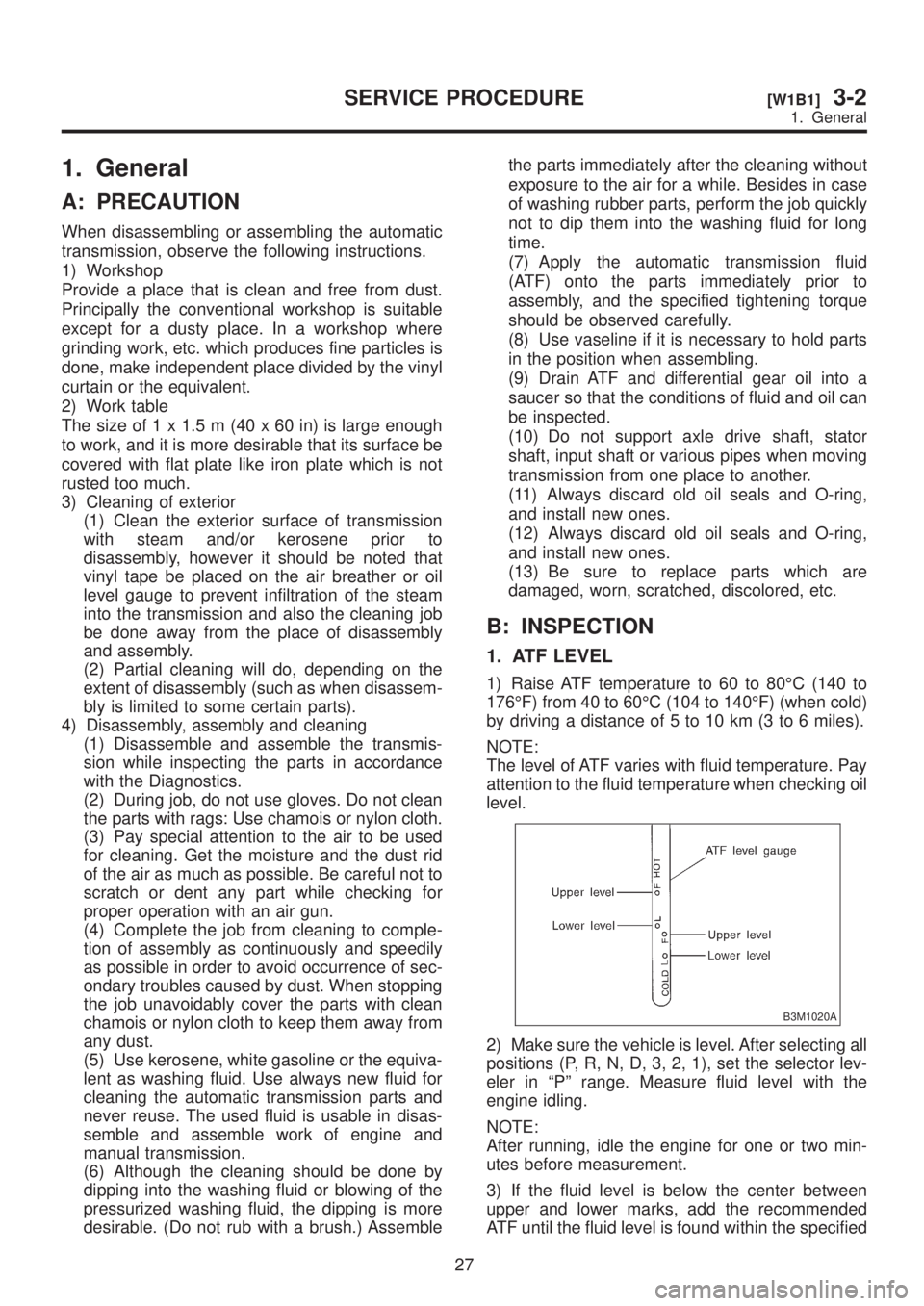
1. ATF LEVEL
1) Raise ATF temperature to 60 to 80ÉC (140 to
176ÉF) from 40 to 60ÉC (104 to 140ÉF) (when cold)
by driving a distance of 5 to 10 km (3 to 6 miles).
NOTE:
The level of ATF varies with fluid temperature. Pay
attention to the fluid temperature when checking oil
level.
B3M1020A
2) Make sure the vehicle is level. After selecting all
positions (P, R, N, D, 3, 2, 1), set the selector lev-
eler in ªPº range. Measure fluid level with the
engine idling.
NOTE:
After running, idle the engine for one or two min-
utes before measurement.
3) If the fluid level is below the center between
upper and lower marks, add the recommended
ATF until the fluid level is found within the specified
27
[W1B1]3-2SERVICE PROCEDURE
1. General
Page 553 of 1456
range (above the center between upper and lower
marks). When the transmission is hot, the level
should be above the center of upper and lower
marks, and when it is cold, the level should be
found below the center of these two marks.
CAUTION:
IUse care not to exceed the upper limit level.
IATF level varies with temperature. Remem-
ber that the addition of fluid to the upper limit
mark when the transmission is cold will result
in the overfilling of fluid.
4) Fluid temperature rising speed
IBy idling the engine
Time for temperature rise to 60ÉC (140ÉF) with
atmospheric temperature of 0ÉC (32ÉF): More than
25 minutes
Time for temperature rise to 30ÉC (86ÉF) with
atmospheric temperature of 0ÉC (32ÉF): Approx. 8
minutes
IBy running the vehicle
Time for temperature rise to 60ÉC (140ÉF) with
atmospheric temperature of 0ÉC (32ÉF): More than
10 minutes
5) Method for checking fluid level upon delivery or
at periodic inspection
Check fluid level after a warm-up run of approx. 10
minutes. During the warm-up period, the automatic
transmission functions can also be checked.
2. DIFFERENTIAL GEAR OIL LEVEL
1) Ensure the vehicle is in safe condition.
NOTE:
Do not check the oil level nor add oil to the case
with the front end of the vehicle jacked-up; this will
result in an incorrect reading of the oil level.
2) Check whether the oil level is between the
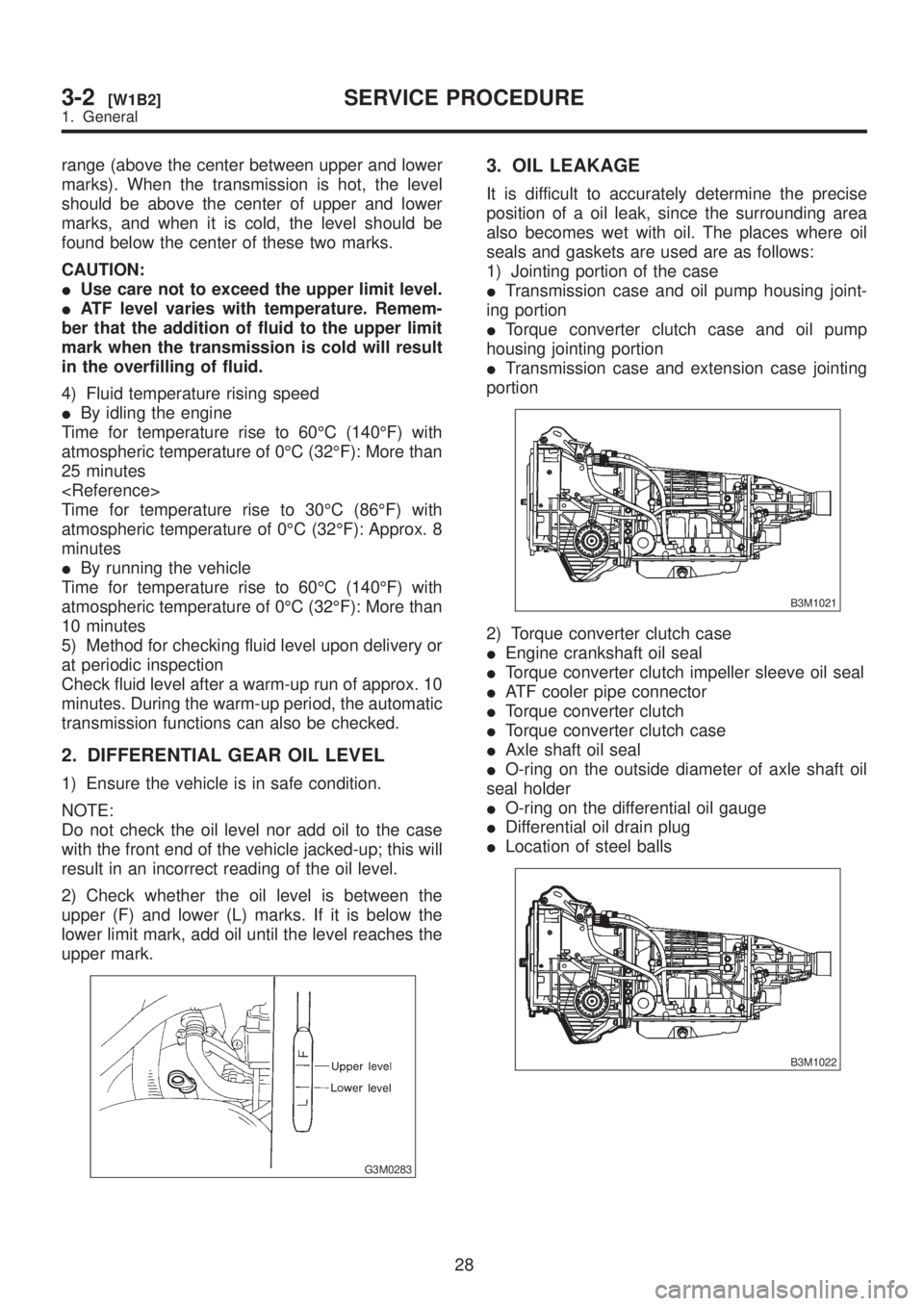
upper (F) and lower (L) marks. If it is below the
lower limit mark, add oil until the level reaches the
upper mark.
G3M0283
3. OIL LEAKAGE
It is difficult to accurately determine the precise
position of a oil leak, since the surrounding area
also becomes wet with oil. The places where oil
seals and gaskets are used are as follows:
1) Jointing portion of the case
ITransmission case and oil pump housing joint-
ing portion
ITorque converter clutch case and oil pump
housing jointing portion
ITransmission case and extension case jointing
portion
B3M1021
2) Torque converter clutch case
IEngine crankshaft oil seal
ITorque converter clutch impeller sleeve oil seal
IATF cooler pipe connector
ITorque converter clutch
ITorque converter clutch case
IAxle shaft oil seal
IO-ring on the outside diameter of axle shaft oil
seal holder
IO-ring on the differential oil gauge
IDifferential oil drain plug
ILocation of steel balls
B3M1022
28
3-2[W1B2]SERVICE PROCEDURE
1. General
Page 554 of 1456
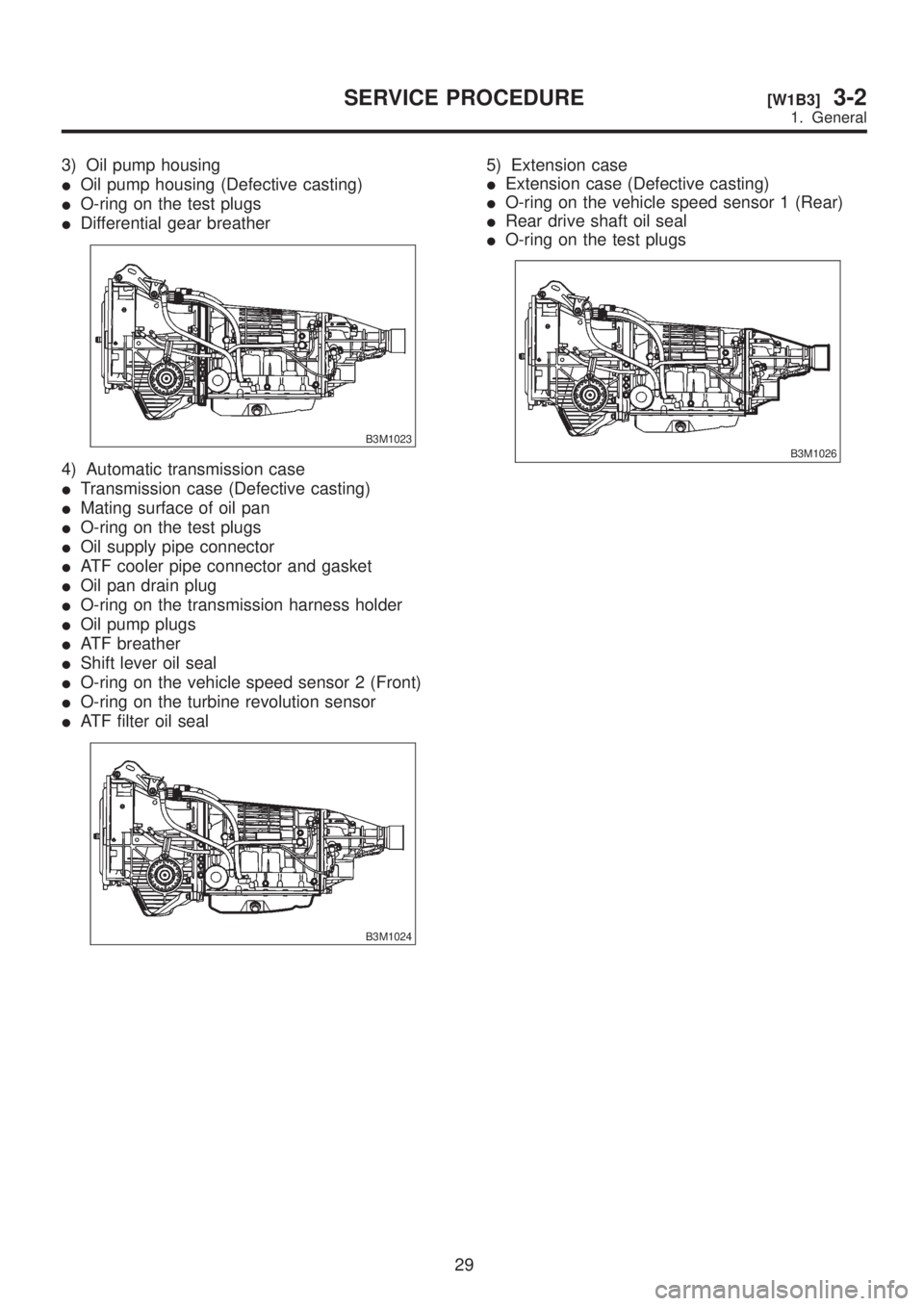
3) Oil pump housing
IOil pump housing (Defective casting)
IO-ring on the test plugs
IDifferential gear breather
B3M1023
4) Automatic transmission case
ITransmission case (Defective casting)
IMating surface of oil pan
IO-ring on the test plugs
IOil supply pipe connector
IATF cooler pipe connector and gasket
IOil pan drain plug
IO-ring on the transmission harness holder
IOil pump plugs
IATF breather
IShift lever oil seal
IO-ring on the vehicle speed sensor 2 (Front)
IO-ring on the turbine revolution sensor
IATF filter oil seal
B3M1024
5) Extension case
IExtension case (Defective casting)
IO-ring on the vehicle speed sensor 1 (Rear)
IRear drive shaft oil seal
IO-ring on the test plugs
B3M1026
29
[W1B3]3-2SERVICE PROCEDURE
1. General
Page 566 of 1456
9) Install pitching stopper.
Tightening torque:
T1: 49
±5 N´m (5.0±0.5 kg-m, 36.2±3.6 ft-lb)
T2: 57
±10 N´m (5.8±1.0 kg-m, 42±7 ft-lb)
B3M1042A
10) Replenish ATF and check oil level. Check for
leaks.
B3M1020A
6. Road Test
A: INSPECTION
1. GENERAL PRECAUTION
Road tests should be conducted to properly diag-
nose the condition of the automatic transmission.
CAUTION:
When performing test, do not exceed posted
speed limit.
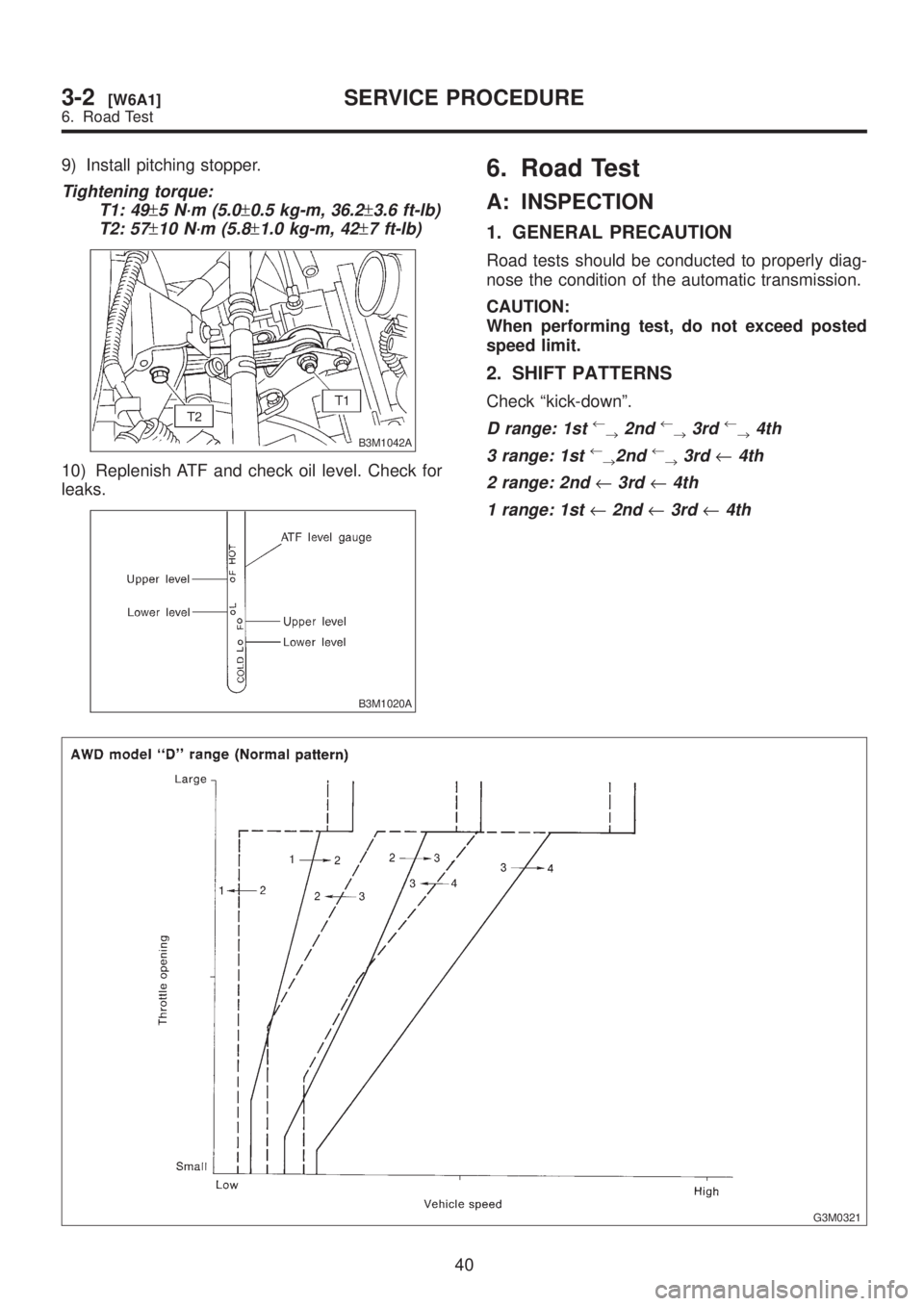
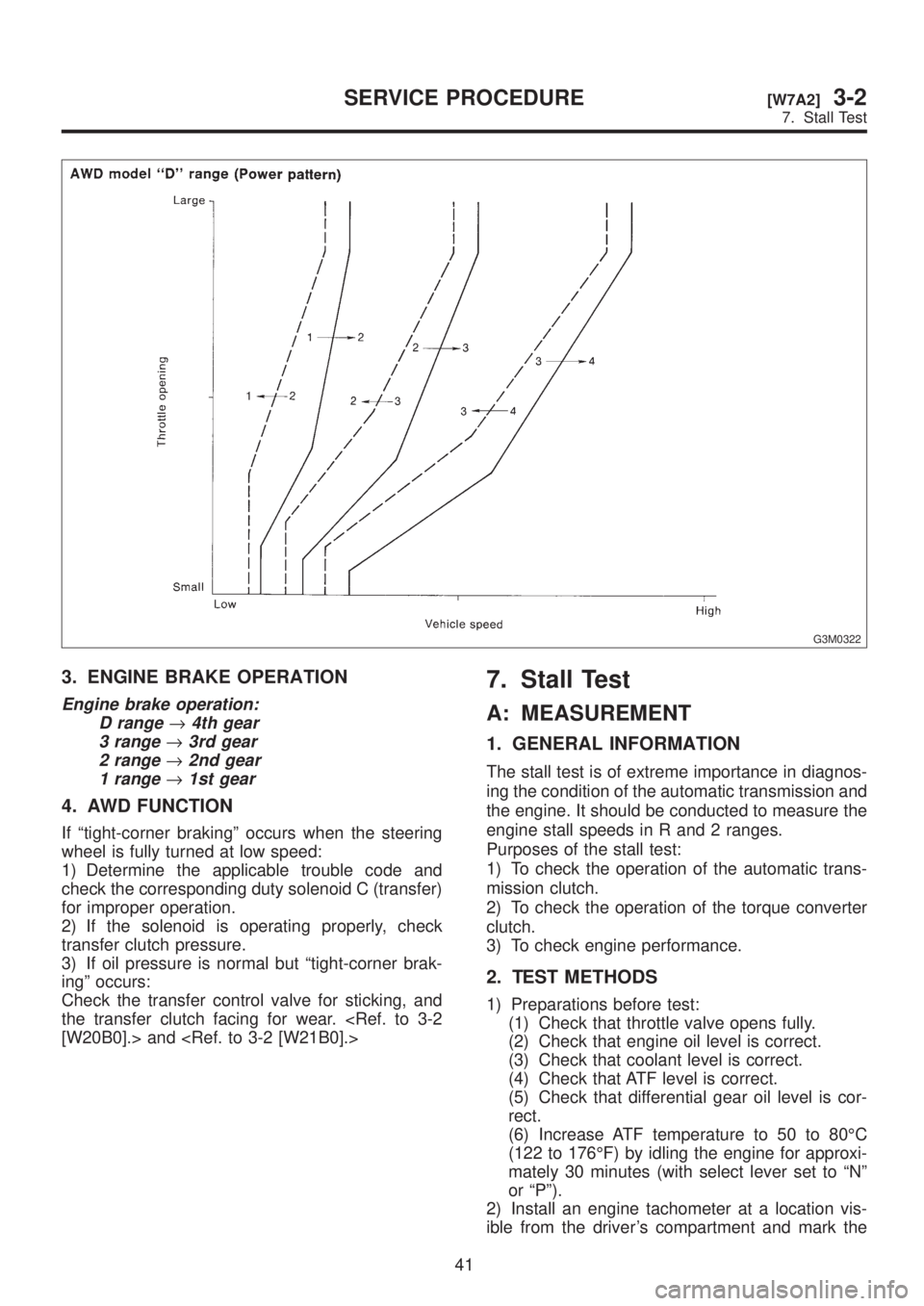
2. SHIFT PATTERNS
Check ªkick-downº.
D range: 1st¬
®2nd¬
®3rd¬
®4th
3 range: 1st
¬
®2nd¬
®3rd¬4th
2 range: 2nd
¬3rd¬4th
1 range: 1st
¬2nd¬3rd¬4th
G3M0321
40
3-2[W6A1]SERVICE PROCEDURE
6. Road Test
Page 567 of 1456
9) Install pitching stopper.
Tightening torque:
T1: 49
±5 N´m (5.0±0.5 kg-m, 36.2±3.6 ft-lb)
T2: 57
±10 N´m (5.8±1.0 kg-m, 42±7 ft-lb)
B3M1042A
10) Replenish ATF and check oil level. Check for
leaks.
B3M1020A
6. Road Test
A: INSPECTION
1. GENERAL PRECAUTION
Road tests should be conducted to properly diag-
nose the condition of the automatic transmission.
CAUTION:
When performing test, do not exceed posted
speed limit.
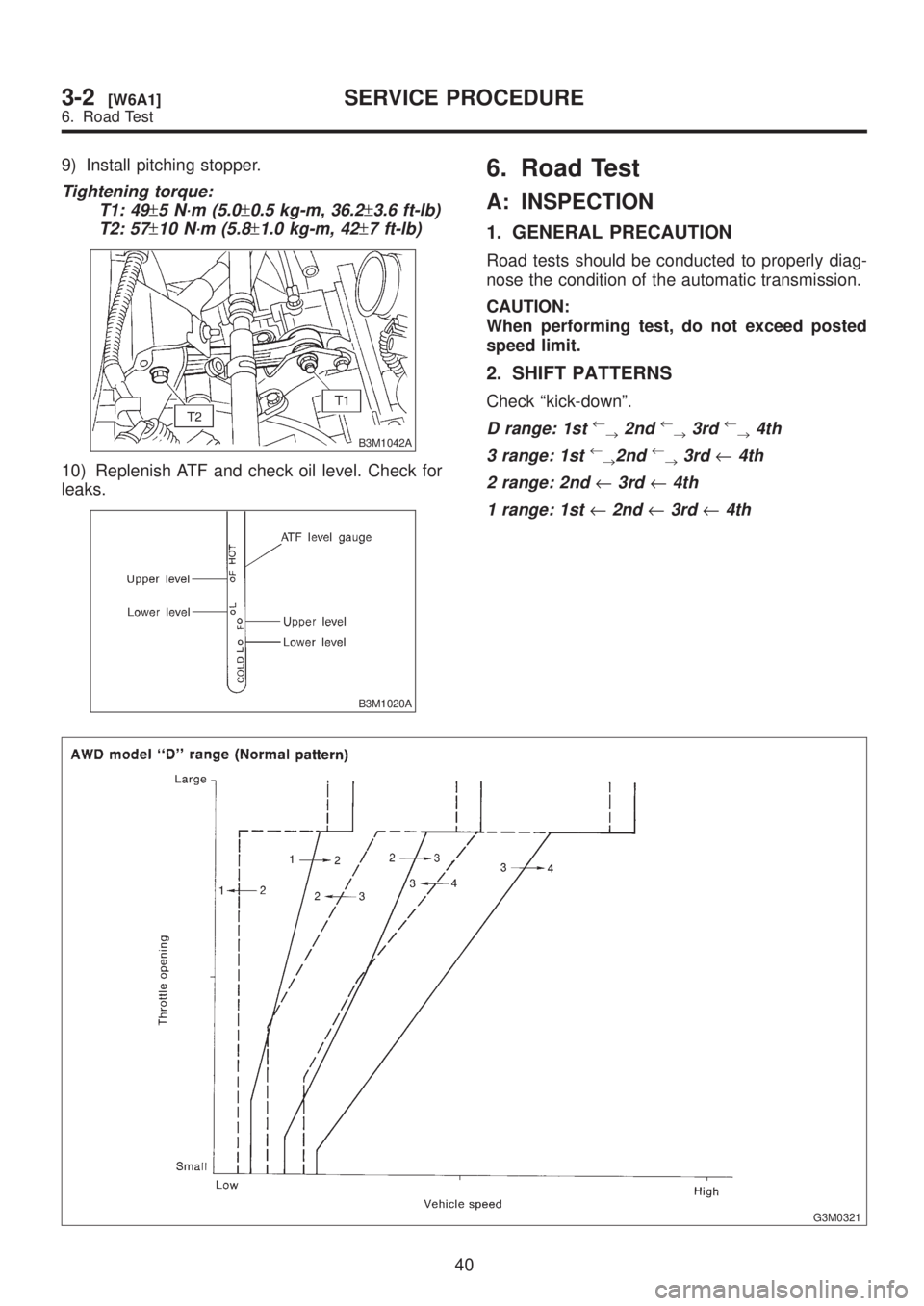
2. SHIFT PATTERNS
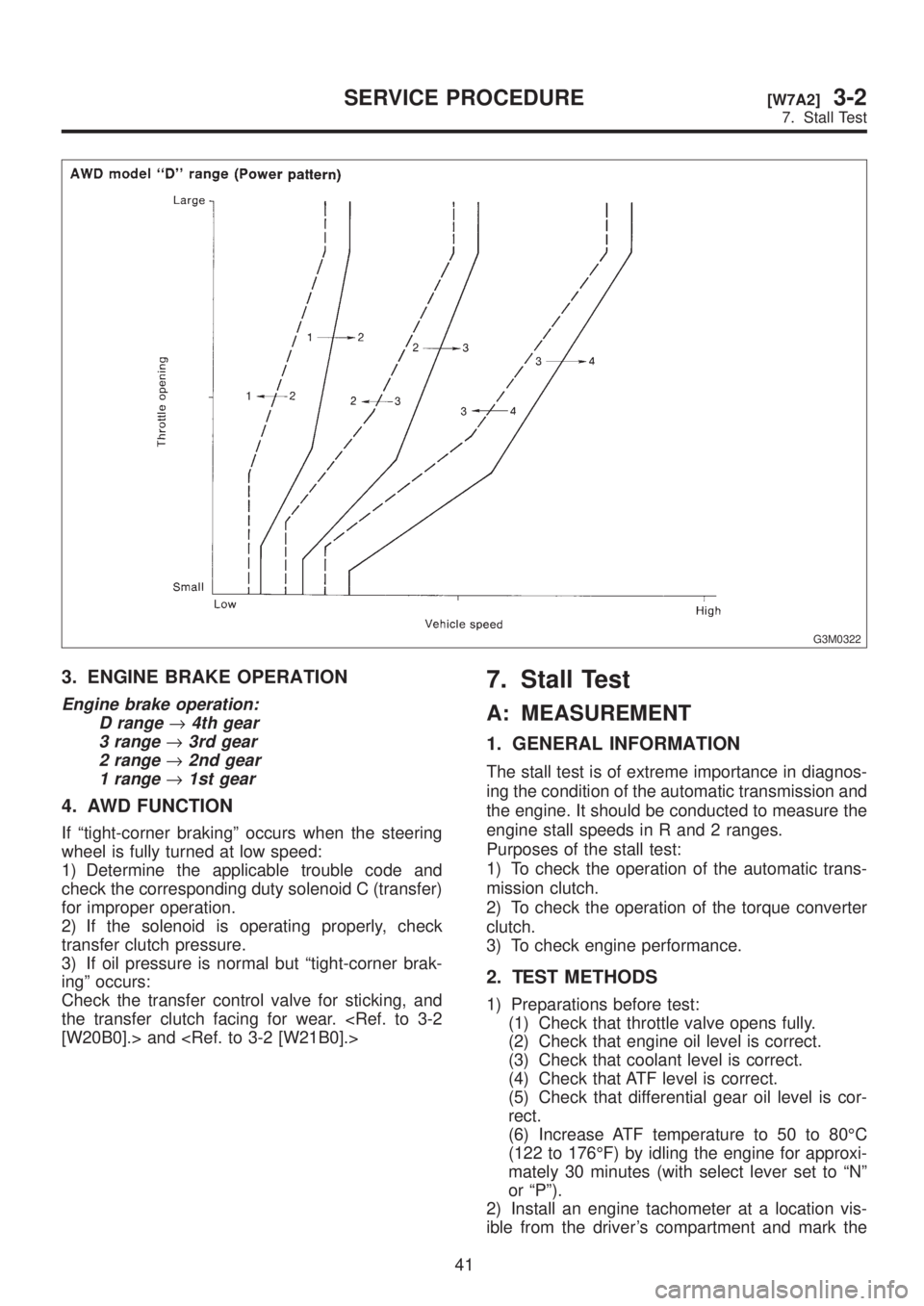
Check ªkick-downº.
D range: 1st¬
®2nd¬
®3rd¬
®4th
3 range: 1st
¬
®2nd¬
®3rd¬4th
2 range: 2nd
¬3rd¬4th
1 range: 1st
¬2nd¬3rd¬4th
G3M0321
40
3-2[W6A1]SERVICE PROCEDURE
6. Road Test
Page 568 of 1456
G3M0322
3. ENGINE BRAKE OPERATION
Engine brake operation:
D range
®4th gear
3 range
®3rd gear
2 range
®2nd gear
1 range
®1st gear
4. AWD FUNCTION
If ªtight-corner brakingº occurs when the steering
wheel is fully turned at low speed:
1) Determine the applicable trouble code and
check the corresponding duty solenoid C (transfer)
for improper operation.
2) If the solenoid is operating properly, check
transfer clutch pressure.
3) If oil pressure is normal but ªtight-corner brak-
ingº occurs:
Check the transfer control valve for sticking, and
the transfer clutch facing for wear.
7. Stall Test
A: MEASUREMENT
1. GENERAL INFORMATION
The stall test is of extreme importance in diagnos-
ing the condition of the automatic transmission and
the engine. It should be conducted to measure the
engine stall speeds in R and 2 ranges.
Purposes of the stall test:
1) To check the operation of the automatic trans-
mission clutch.
2) To check the operation of the torque converter
clutch.
3) To check engine performance.
2. TEST METHODS
1) Preparations before test:
(1) Check that throttle valve opens fully.
(2) Check that engine oil level is correct.
(3) Check that coolant level is correct.
(4) Check that ATF level is correct.
(5) Check that differential gear oil level is cor-
rect.
(6) Increase ATF temperature to 50 to 80ÉC
(122 to 176ÉF) by idling the engine for approxi-
mately 30 minutes (with select lever set to ªNº
or ªPº).
2) Install an engine tachometer at a location vis-
ible from the driver's compartment and mark the
41
[W7A2]3-2SERVICE PROCEDURE
7. Stall Test
Page 569 of 1456
G3M0322
3. ENGINE BRAKE OPERATION
Engine brake operation:
D range
®4th gear
3 range
®3rd gear
2 range
®2nd gear
1 range
®1st gear
4. AWD FUNCTION
If ªtight-corner brakingº occurs when the steering
wheel is fully turned at low speed:
1) Determine the applicable trouble code and
check the corresponding duty solenoid C (transfer)
for improper operation.
2) If the solenoid is operating properly, check
transfer clutch pressure.
3) If oil pressure is normal but ªtight-corner brak-
ingº occurs:
Check the transfer control valve for sticking, and
the transfer clutch facing for wear.
7. Stall Test
A: MEASUREMENT
1. GENERAL INFORMATION
The stall test is of extreme importance in diagnos-
ing the condition of the automatic transmission and
the engine. It should be conducted to measure the
engine stall speeds in R and 2 ranges.
Purposes of the stall test:
1) To check the operation of the automatic trans-
mission clutch.
2) To check the operation of the torque converter
clutch.
3) To check engine performance.
2. TEST METHODS
1) Preparations before test:
(1) Check that throttle valve opens fully.
(2) Check that engine oil level is correct.
(3) Check that coolant level is correct.
(4) Check that ATF level is correct.
(5) Check that differential gear oil level is cor-
rect.
(6) Increase ATF temperature to 50 to 80ÉC
(122 to 176ÉF) by idling the engine for approxi-
mately 30 minutes (with select lever set to ªNº
or ªPº).
2) Install an engine tachometer at a location vis-
ible from the driver's compartment and mark the
41
[W7A2]3-2SERVICE PROCEDURE
7. Stall Test