compressor SUBARU LEGACY 1999 Service Owner's Manual
[x] Cancel search | Manufacturer: SUBARU, Model Year: 1999, Model line: LEGACY, Model: SUBARU LEGACY 1999Pages: 1456, PDF Size: 59.93 MB
Page 978 of 1456
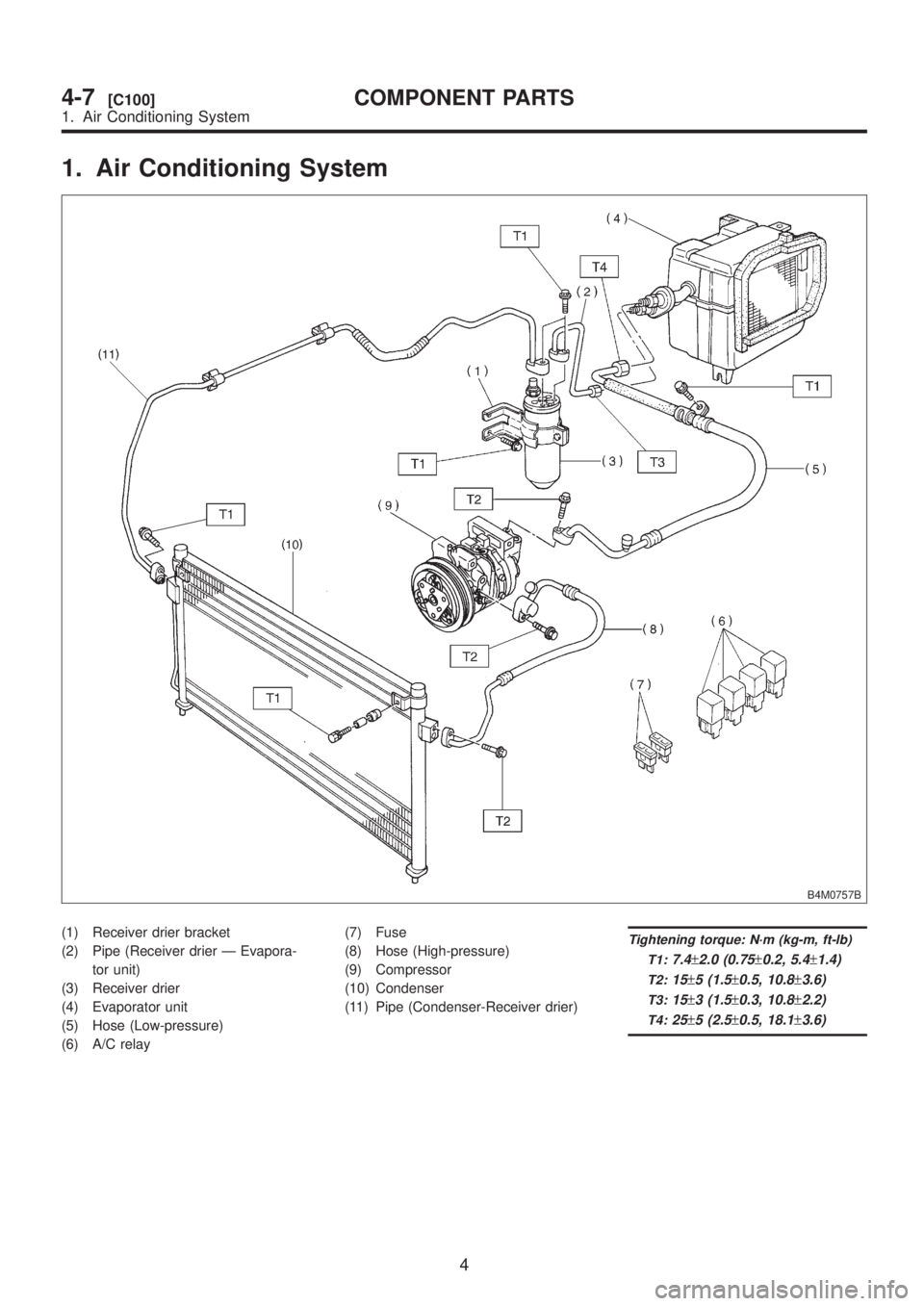
1. Air Conditioning System
B4M0757B
(1) Receiver drier bracket
(2) Pipe (Receiver drier Ð Evapora-
tor unit)
(3) Receiver drier
(4) Evaporator unit
(5) Hose (Low-pressure)
(6) A/C relay(7) Fuse
(8) Hose (High-pressure)
(9) Compressor
(10) Condenser
(11) Pipe (Condenser-Receiver drier)Tightening torque: N´m (kg-m, ft-lb)
T1:
7.4±2.0 (0.75±0.2, 5.4±1.4)
T2:15±5 (1.5±0.5, 10.8±3.6)
T3:15±3 (1.5±0.3, 10.8±2.2)
T4:25±5 (2.5±0.5, 18.1±3.6)
4
4-7[C100]COMPONENT PARTS
1. Air Conditioning System
Page 980 of 1456
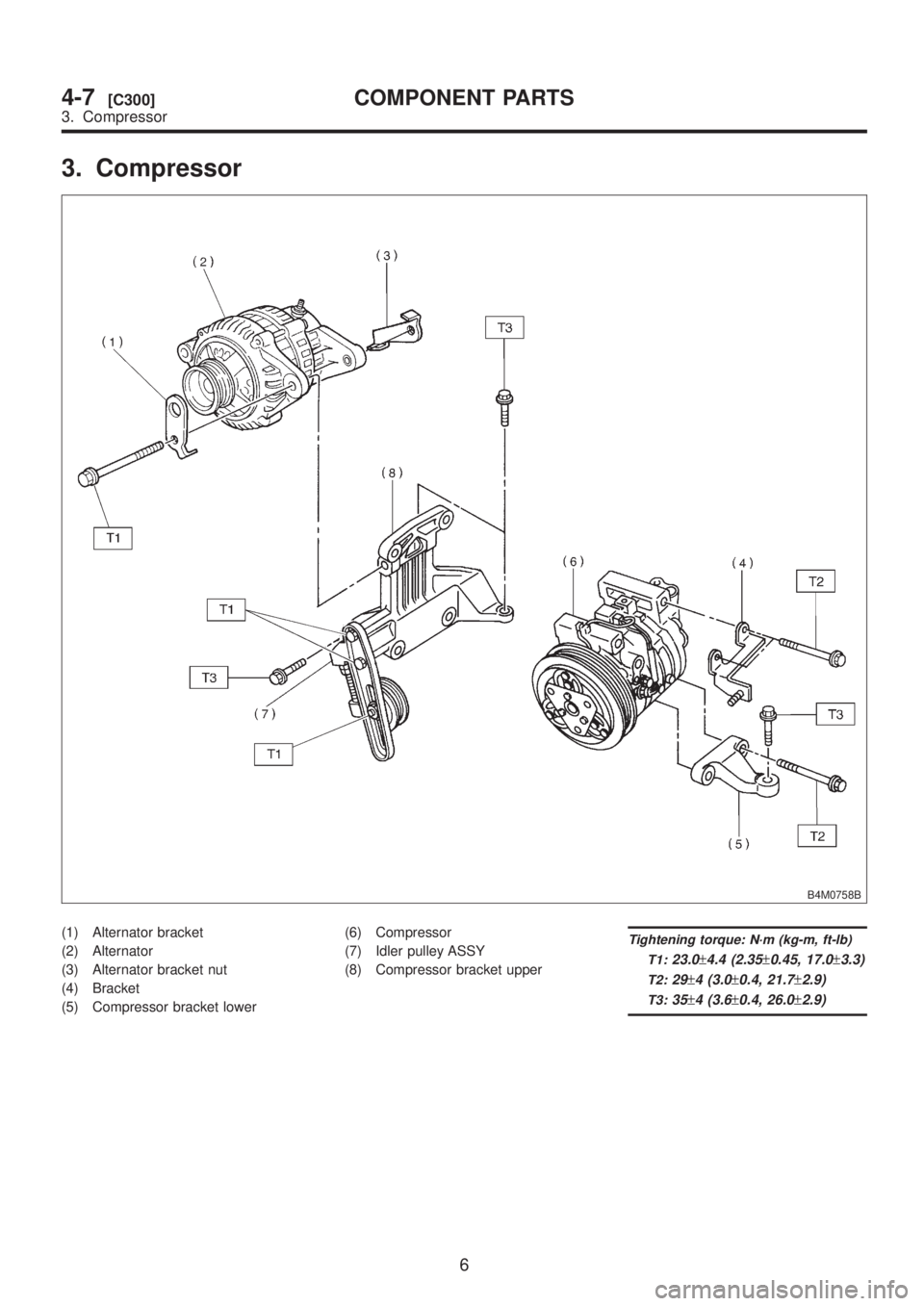
3. Compressor
B4M0758B
(1) Alternator bracket
(2) Alternator
(3) Alternator bracket nut
(4) Bracket
(5) Compressor bracket lower(6) Compressor
(7) Idler pulley ASSY
(8) Compressor bracket upperTightening torque: N´m (kg-m, ft-lb)
T1:
23.0±4.4 (2.35±0.45, 17.0±3.3)
T2:29±4 (3.0±0.4, 21.7±2.9)
T3:35±4 (3.6±0.4, 26.0±2.9)
6
4-7[C300]COMPONENT PARTS
3. Compressor
Page 981 of 1456
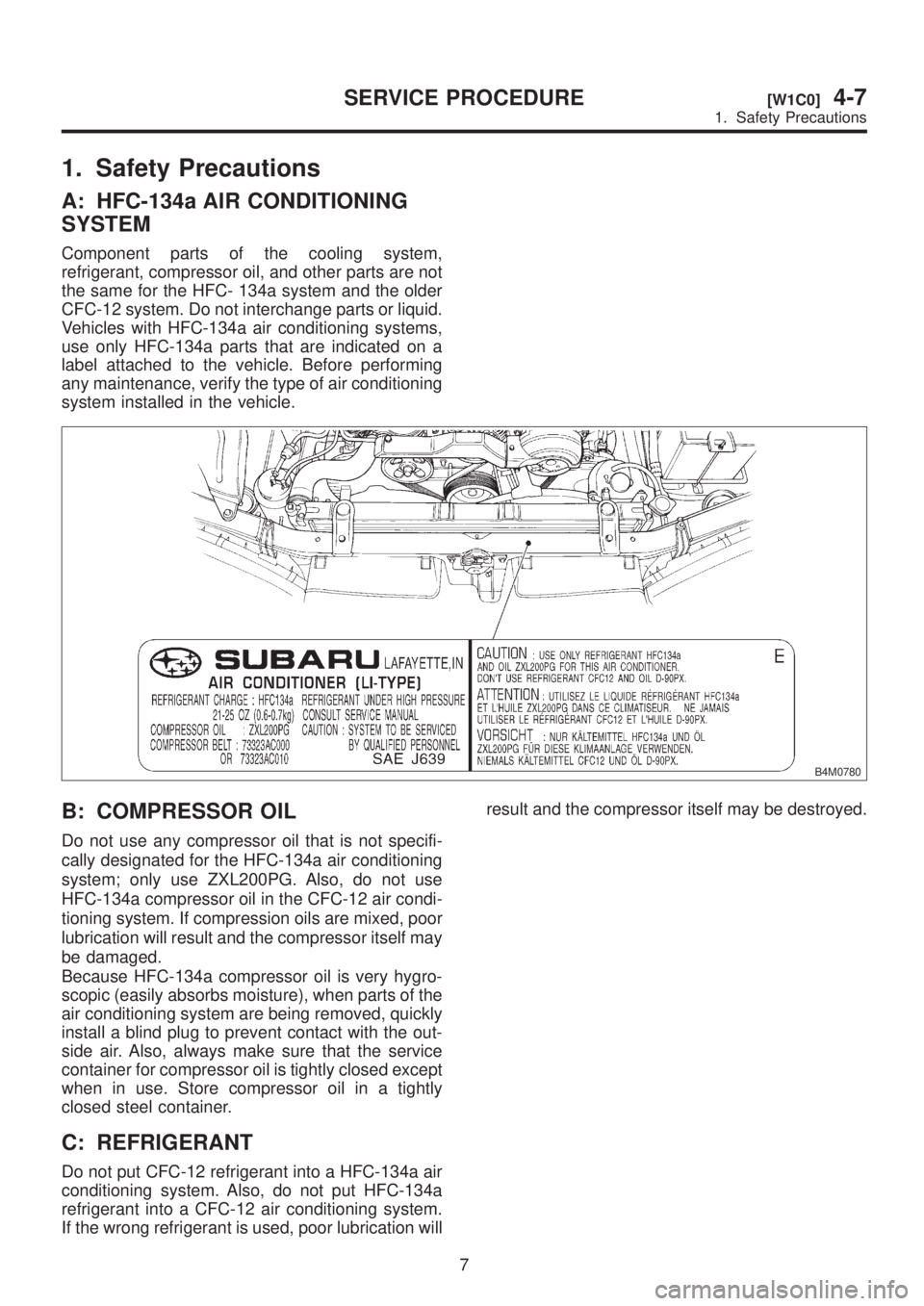
1. Safety Precautions
A: HFC-134a AIR CONDITIONING
SYSTEM
Component parts of the cooling system,
refrigerant, compressor oil, and other parts are not
the same for the HFC- 134a system and the older
CFC-12 system. Do not interchange parts or liquid.
Vehicles with HFC-134a air conditioning systems,
use only HFC-134a parts that are indicated on a
label attached to the vehicle. Before performing
any maintenance, verify the type of air conditioning
system installed in the vehicle.
B4M0780
B: COMPRESSOR OIL
Do not use any compressor oil that is not specifi-
cally designated for the HFC-134a air conditioning
system; only use ZXL200PG. Also, do not use
HFC-134a compressor oil in the CFC-12 air condi-
tioning system. If compression oils are mixed, poor
lubrication will result and the compressor itself may
be damaged.
Because HFC-134a compressor oil is very hygro-
scopic (easily absorbs moisture), when parts of the
air conditioning system are being removed, quickly
install a blind plug to prevent contact with the out-
side air. Also, always make sure that the service
container for compressor oil is tightly closed except
when in use. Store compressor oil in a tightly
closed steel container.
C: REFRIGERANT
Do not put CFC-12 refrigerant into a HFC-134a air
conditioning system. Also, do not put HFC-134a
refrigerant into a CFC-12 air conditioning system.
If the wrong refrigerant is used, poor lubrication willresult and the compressor itself may be destroyed.
7
[W1C0]4-7SERVICE PROCEDURE
1. Safety Precautions
Page 984 of 1456
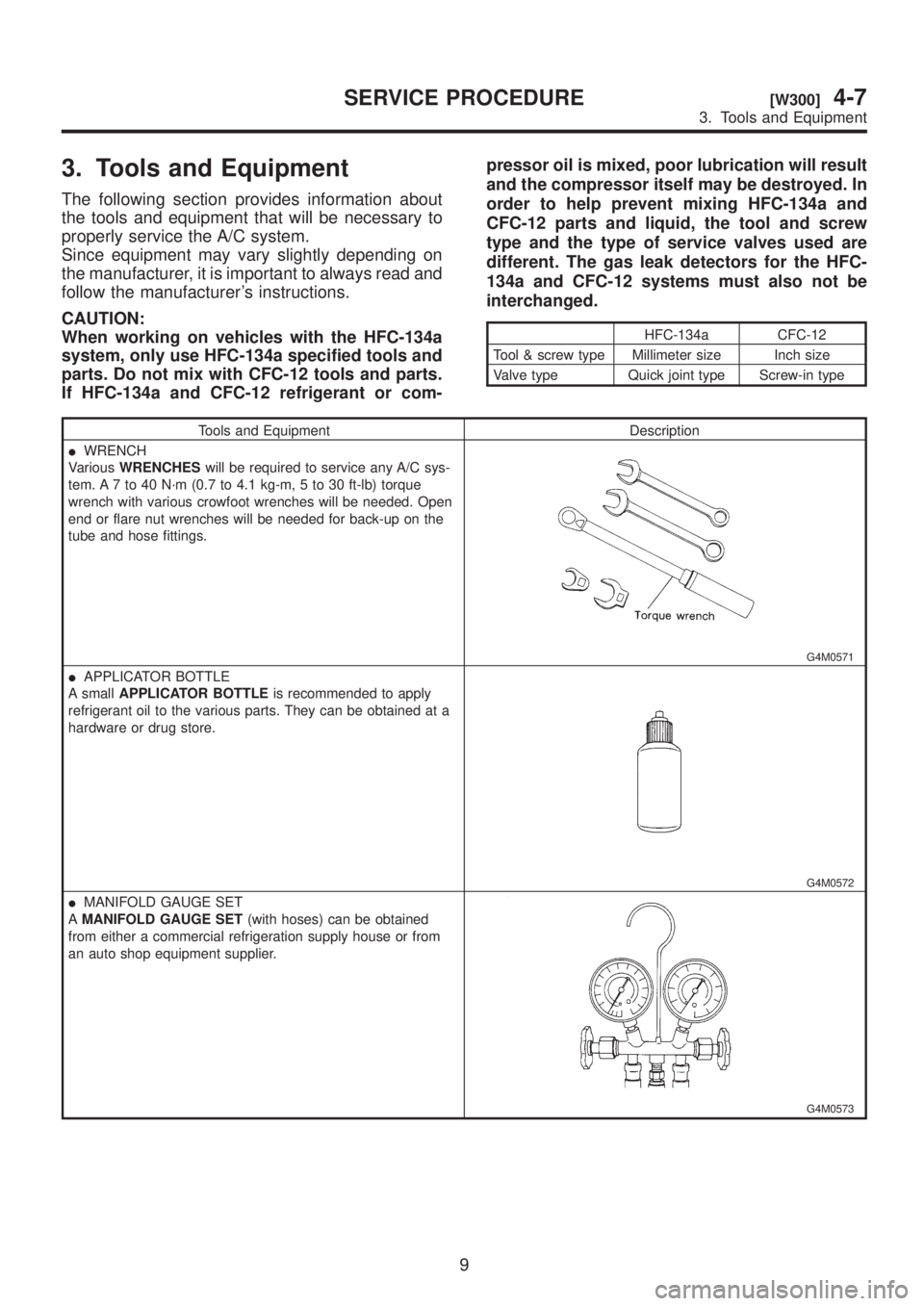
3. Tools and Equipment
The following section provides information about
the tools and equipment that will be necessary to
properly service the A/C system.
Since equipment may vary slightly depending on
the manufacturer, it is important to always read and
follow the manufacturer's instructions.
CAUTION:
When working on vehicles with the HFC-134a
system, only use HFC-134a specified tools and
parts. Do not mix with CFC-12 tools and parts.
If HFC-134a and CFC-12 refrigerant or com-pressor oil is mixed, poor lubrication will result
and the compressor itself may be destroyed. In
order to help prevent mixing HFC-134a and
CFC-12 parts and liquid, the tool and screw
type and the type of service valves used are
different. The gas leak detectors for the HFC-
134a and CFC-12 systems must also not be
interchanged.
HFC-134a CFC-12
Tool & screw type Millimeter size Inch size
Valve type Quick joint type Screw-in type
Tools and Equipment Description
IWRENCH
VariousWRENCHESwill be required to service any A/C sys-
tem. A 7 to 40 N´m (0.7 to 4.1 kg-m, 5 to 30 ft-lb) torque
wrench with various crowfoot wrenches will be needed. Open
end or flare nut wrenches will be needed for back-up on the
tube and hose fittings.
G4M0571
IAPPLICATOR BOTTLE
A smallAPPLICATOR BOTTLEis recommended to apply
refrigerant oil to the various parts. They can be obtained at a
hardware or drug store.
G4M0572
IMANIFOLD GAUGE SET
AMANIFOLD GAUGE SET(with hoses) can be obtained
from either a commercial refrigeration supply house or from
an auto shop equipment supplier.
G4M0573
9
[W300]4-7SERVICE PROCEDURE
3. Tools and Equipment
Page 994 of 1456
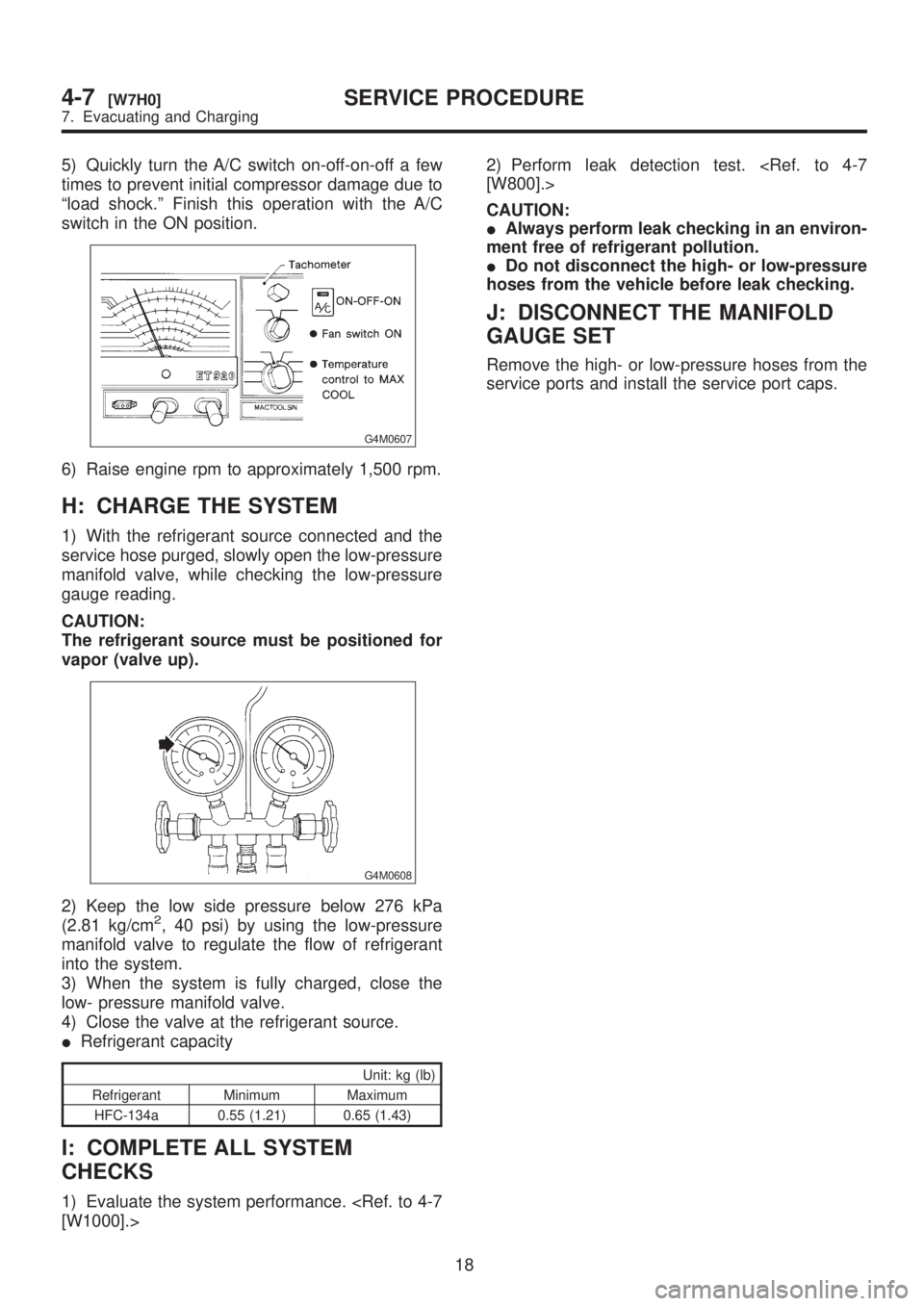
5) Quickly turn the A/C switch on-off-on-off a few
times to prevent initial compressor damage due to
ªload shock.º Finish this operation with the A/C
switch in the ON position.
G4M0607
6) Raise engine rpm to approximately 1,500 rpm.
H: CHARGE THE SYSTEM
1) With the refrigerant source connected and the
service hose purged, slowly open the low-pressure
manifold valve, while checking the low-pressure
gauge reading.
CAUTION:
The refrigerant source must be positioned for
vapor (valve up).
G4M0608
2) Keep the low side pressure below 276 kPa
(2.81 kg/cm2, 40 psi) by using the low-pressure
manifold valve to regulate the flow of refrigerant
into the system.
3) When the system is fully charged, close the
low- pressure manifold valve.
4) Close the valve at the refrigerant source.
IRefrigerant capacity
Unit: kg (lb)
Refrigerant Minimum Maximum
HFC-134a 0.55 (1.21) 0.65 (1.43)
I: COMPLETE ALL SYSTEM
CHECKS
1) Evaluate the system performance.
CAUTION:
IAlways perform leak checking in an environ-
ment free of refrigerant pollution.
IDo not disconnect the high- or low-pressure
hoses from the vehicle before leak checking.
J: DISCONNECT THE MANIFOLD
GAUGE SET
Remove the high- or low-pressure hoses from the
service ports and install the service port caps.
18
4-7[W7H0]SERVICE PROCEDURE
7. Evacuating and Charging
Page 996 of 1456
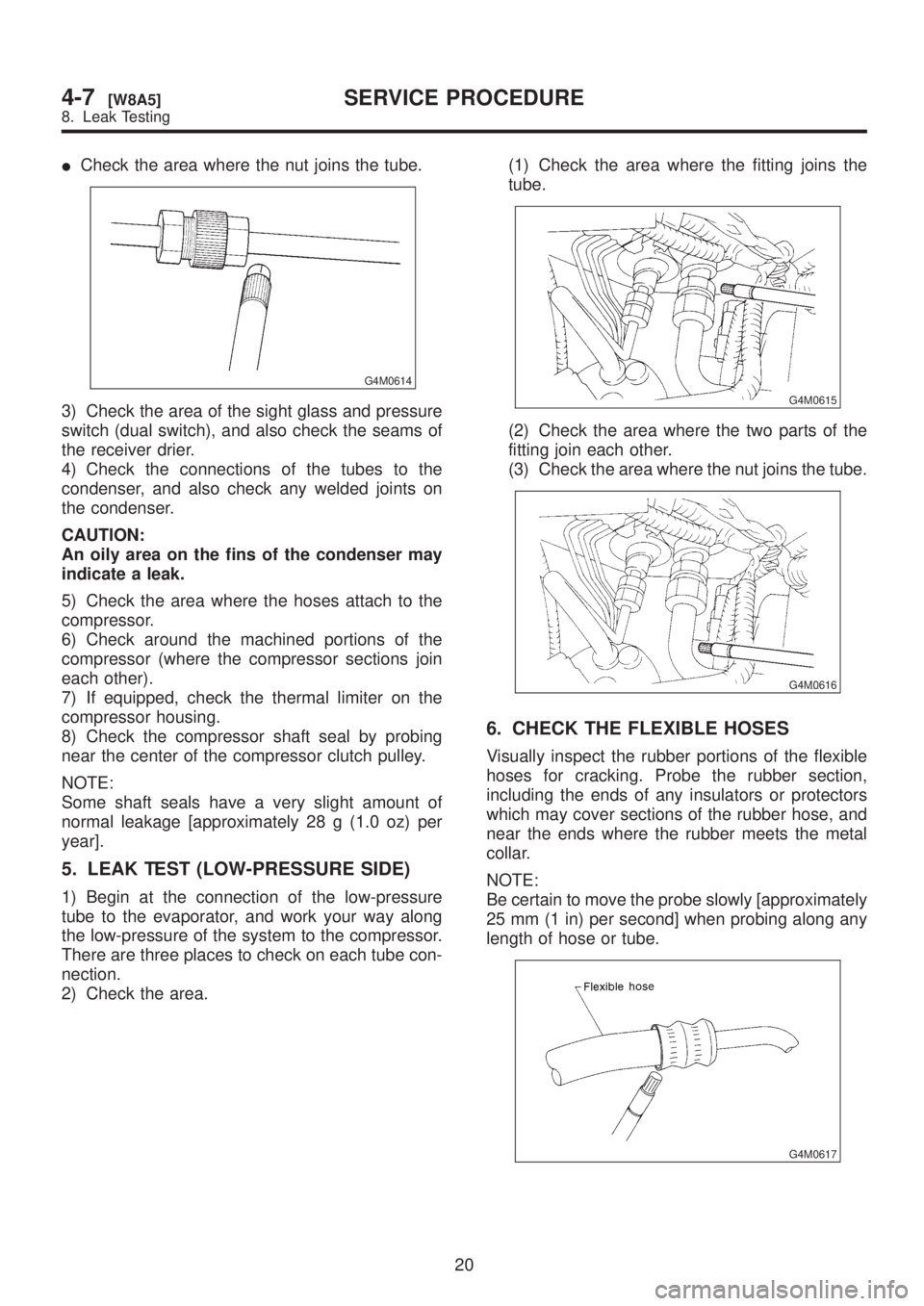
ICheck the area where the nut joins the tube.
G4M0614
3) Check the area of the sight glass and pressure
switch (dual switch), and also check the seams of
the receiver drier.
4) Check the connections of the tubes to the
condenser, and also check any welded joints on
the condenser.
CAUTION:
An oily area on the fins of the condenser may
indicate a leak.
5) Check the area where the hoses attach to the
compressor.
6) Check around the machined portions of the
compressor (where the compressor sections join
each other).
7) If equipped, check the thermal limiter on the
compressor housing.
8) Check the compressor shaft seal by probing
near the center of the compressor clutch pulley.
NOTE:
Some shaft seals have a very slight amount of
normal leakage [approximately 28 g (1.0 oz) per
year].
5. LEAK TEST (LOW-PRESSURE SIDE)
1) Begin at the connection of the low-pressure
tube to the evaporator, and work your way along
the low-pressure of the system to the compressor.
There are three places to check on each tube con-
nection.
2) Check the area.(1) Check the area where the fitting joins the
tube.
G4M0615
(2) Check the area where the two parts of the
fitting join each other.
(3) Check the area where the nut joins the tube.
G4M0616
6. CHECK THE FLEXIBLE HOSES
Visually inspect the rubber portions of the flexible
hoses for cracking. Probe the rubber section,
including the ends of any insulators or protectors
which may cover sections of the rubber hose, and
near the ends where the rubber meets the metal
collar.
NOTE:
Be certain to move the probe slowly [approximately
25 mm (1 in) per second] when probing along any
length of hose or tube.
G4M0617
20
4-7[W8A5]SERVICE PROCEDURE
8. Leak Testing
Page 997 of 1456
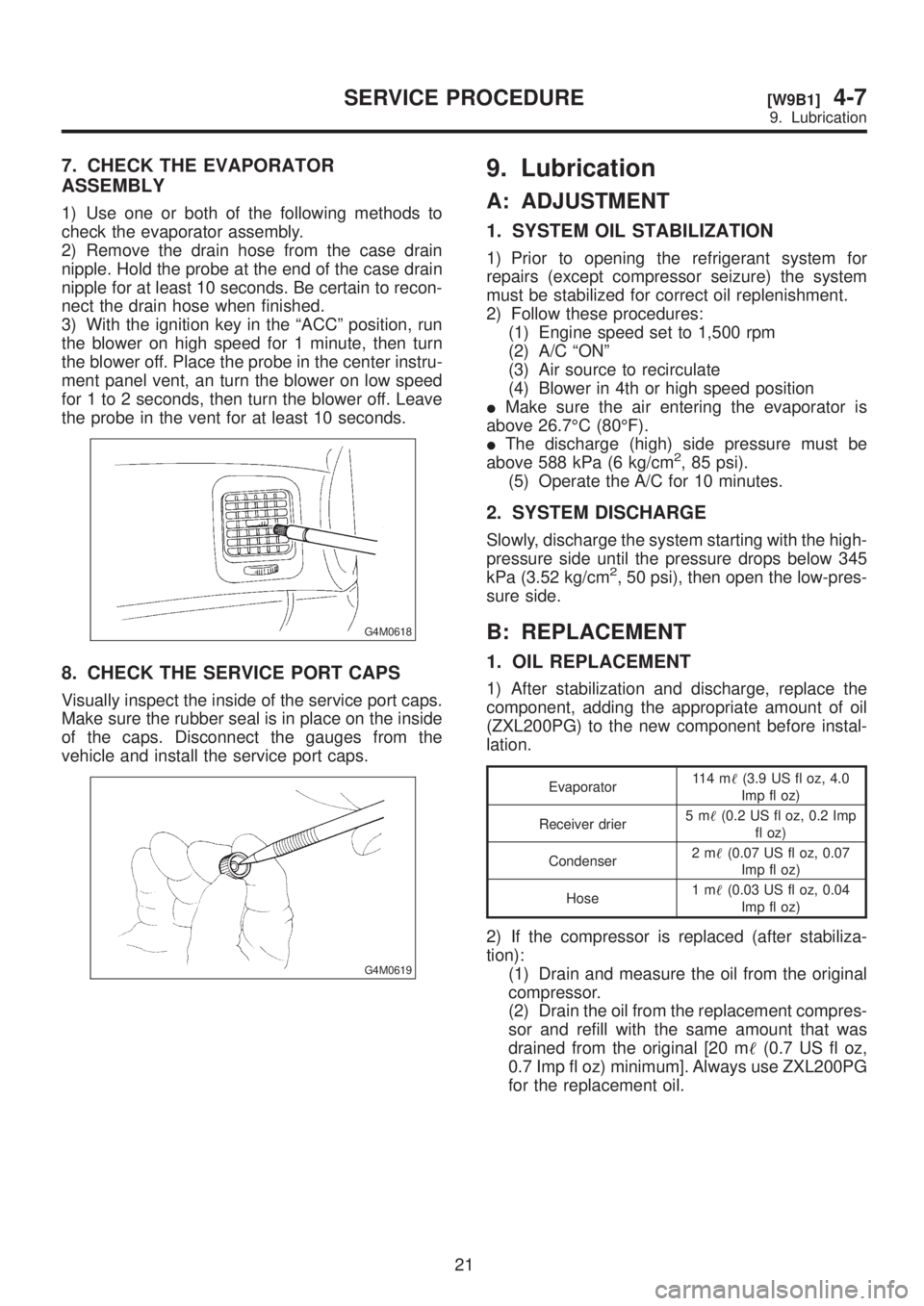
7. CHECK THE EVAPORATOR
ASSEMBLY
1) Use one or both of the following methods to
check the evaporator assembly.
2) Remove the drain hose from the case drain
nipple. Hold the probe at the end of the case drain
nipple for at least 10 seconds. Be certain to recon-
nect the drain hose when finished.
3) With the ignition key in the ªACCº position, run
the blower on high speed for 1 minute, then turn
the blower off. Place the probe in the center instru-
ment panel vent, an turn the blower on low speed
for 1 to 2 seconds, then turn the blower off. Leave
the probe in the vent for at least 10 seconds.
G4M0618
8. CHECK THE SERVICE PORT CAPS
Visually inspect the inside of the service port caps.
Make sure the rubber seal is in place on the inside
of the caps. Disconnect the gauges from the
vehicle and install the service port caps.
G4M0619
9. Lubrication
A: ADJUSTMENT
1. SYSTEM OIL STABILIZATION
1) Prior to opening the refrigerant system for
repairs (except compressor seizure) the system
must be stabilized for correct oil replenishment.
2) Follow these procedures:
(1) Engine speed set to 1,500 rpm
(2) A/C ªONº
(3) Air source to recirculate
(4) Blower in 4th or high speed position
IMake sure the air entering the evaporator is
above 26.7ÉC (80ÉF).
IThe discharge (high) side pressure must be
above 588 kPa (6 kg/cm
2, 85 psi).
(5) Operate the A/C for 10 minutes.
2. SYSTEM DISCHARGE
Slowly, discharge the system starting with the high-
pressure side until the pressure drops below 345
kPa (3.52 kg/cm
2, 50 psi), then open the low-pres-
sure side.
B: REPLACEMENT
1. OIL REPLACEMENT
1) After stabilization and discharge, replace the
component, adding the appropriate amount of oil
(ZXL200PG) to the new component before instal-
lation.
Evaporator11 4 m(3.9 US fl oz, 4.0
Imp fl oz)
Receiver drier5m(0.2 US fl oz, 0.2 Imp
fl oz)
Condenser2m(0.07 US fl oz, 0.07
Imp fl oz)
Hose1m(0.03 US fl oz, 0.04
Imp fl oz)
2) If the compressor is replaced (after stabiliza-
tion):
(1) Drain and measure the oil from the original
compressor.
(2) Drain the oil from the replacement compres-
sor and refill with the same amount that was
drained from the original [20 m(0.7 US fl oz,
0.7 Imp fl oz) minimum]. Always use ZXL200PG
for the replacement oil.
21
[W9B1]4-7SERVICE PROCEDURE
9. Lubrication
Page 998 of 1456
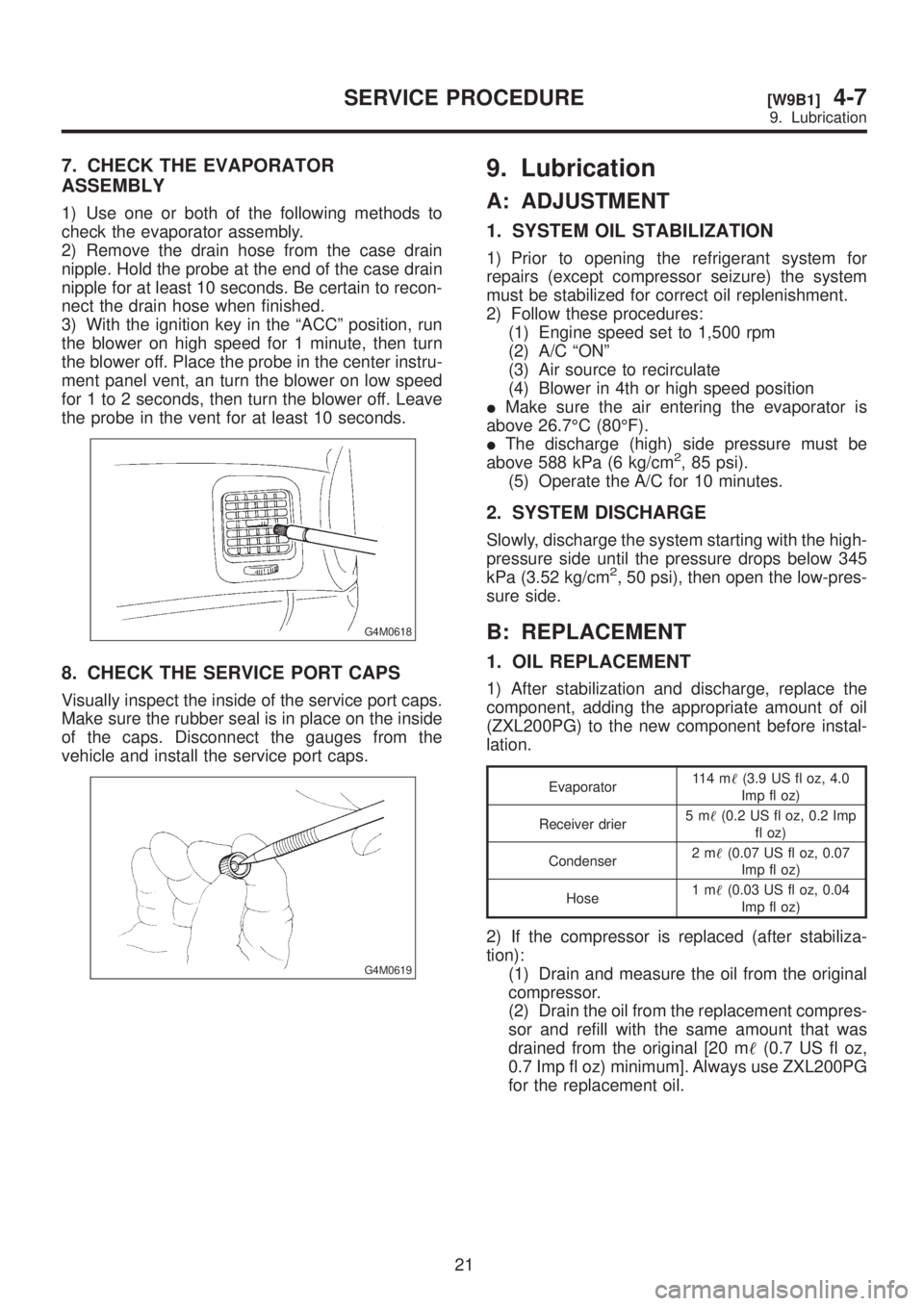
7. CHECK THE EVAPORATOR
ASSEMBLY
1) Use one or both of the following methods to
check the evaporator assembly.
2) Remove the drain hose from the case drain
nipple. Hold the probe at the end of the case drain
nipple for at least 10 seconds. Be certain to recon-
nect the drain hose when finished.
3) With the ignition key in the ªACCº position, run
the blower on high speed for 1 minute, then turn
the blower off. Place the probe in the center instru-
ment panel vent, an turn the blower on low speed
for 1 to 2 seconds, then turn the blower off. Leave
the probe in the vent for at least 10 seconds.
G4M0618
8. CHECK THE SERVICE PORT CAPS
Visually inspect the inside of the service port caps.
Make sure the rubber seal is in place on the inside
of the caps. Disconnect the gauges from the
vehicle and install the service port caps.
G4M0619
9. Lubrication
A: ADJUSTMENT
1. SYSTEM OIL STABILIZATION
1) Prior to opening the refrigerant system for
repairs (except compressor seizure) the system
must be stabilized for correct oil replenishment.
2) Follow these procedures:
(1) Engine speed set to 1,500 rpm
(2) A/C ªONº
(3) Air source to recirculate
(4) Blower in 4th or high speed position
IMake sure the air entering the evaporator is
above 26.7ÉC (80ÉF).
IThe discharge (high) side pressure must be
above 588 kPa (6 kg/cm
2, 85 psi).
(5) Operate the A/C for 10 minutes.
2. SYSTEM DISCHARGE
Slowly, discharge the system starting with the high-
pressure side until the pressure drops below 345
kPa (3.52 kg/cm
2, 50 psi), then open the low-pres-
sure side.
B: REPLACEMENT
1. OIL REPLACEMENT
1) After stabilization and discharge, replace the
component, adding the appropriate amount of oil
(ZXL200PG) to the new component before instal-
lation.
Evaporator11 4 m(3.9 US fl oz, 4.0
Imp fl oz)
Receiver drier5m(0.2 US fl oz, 0.2 Imp
fl oz)
Condenser2m(0.07 US fl oz, 0.07
Imp fl oz)
Hose1m(0.03 US fl oz, 0.04
Imp fl oz)
2) If the compressor is replaced (after stabiliza-
tion):
(1) Drain and measure the oil from the original
compressor.
(2) Drain the oil from the replacement compres-
sor and refill with the same amount that was
drained from the original [20 m(0.7 US fl oz,
0.7 Imp fl oz) minimum]. Always use ZXL200PG
for the replacement oil.
21
[W9B1]4-7SERVICE PROCEDURE
9. Lubrication
Page 1001 of 1456
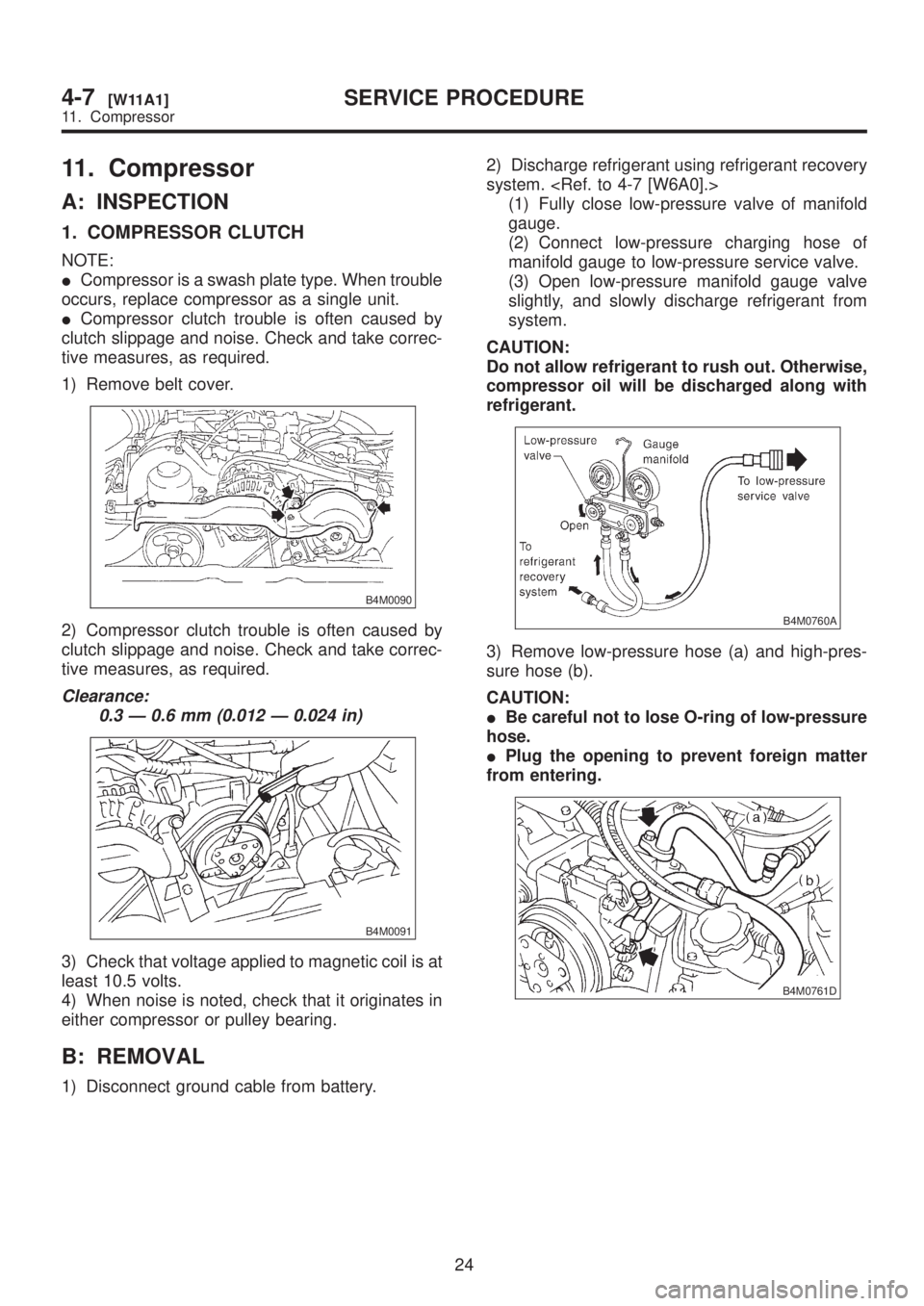
11. Compressor
A: INSPECTION
1. COMPRESSOR CLUTCH
NOTE:
ICompressor is a swash plate type. When trouble
occurs, replace compressor as a single unit.
ICompressor clutch trouble is often caused by
clutch slippage and noise. Check and take correc-
tive measures, as required.
1) Remove belt cover.
B4M0090
2) Compressor clutch trouble is often caused by
clutch slippage and noise. Check and take correc-
tive measures, as required.
Clearance:
0.3 Ð 0.6 mm (0.012 Ð 0.024 in)
B4M0091
3) Check that voltage applied to magnetic coil is at
least 10.5 volts.
4) When noise is noted, check that it originates in
either compressor or pulley bearing.
B: REMOVAL
1) Disconnect ground cable from battery.2) Discharge refrigerant using refrigerant recovery
system.
(1) Fully close low-pressure valve of manifold
gauge.
(2) Connect low-pressure charging hose of
manifold gauge to low-pressure service valve.
(3) Open low-pressure manifold gauge valve
slightly, and slowly discharge refrigerant from
system.
CAUTION:
Do not allow refrigerant to rush out. Otherwise,
compressor oil will be discharged along with
refrigerant.
B4M0760A
3) Remove low-pressure hose (a) and high-pres-
sure hose (b).
CAUTION:
IBe careful not to lose O-ring of low-pressure
hose.
IPlug the opening to prevent foreign matter
from entering.
B4M0761D
24
4-7[W11A1]SERVICE PROCEDURE
11. Compressor
Page 1002 of 1456
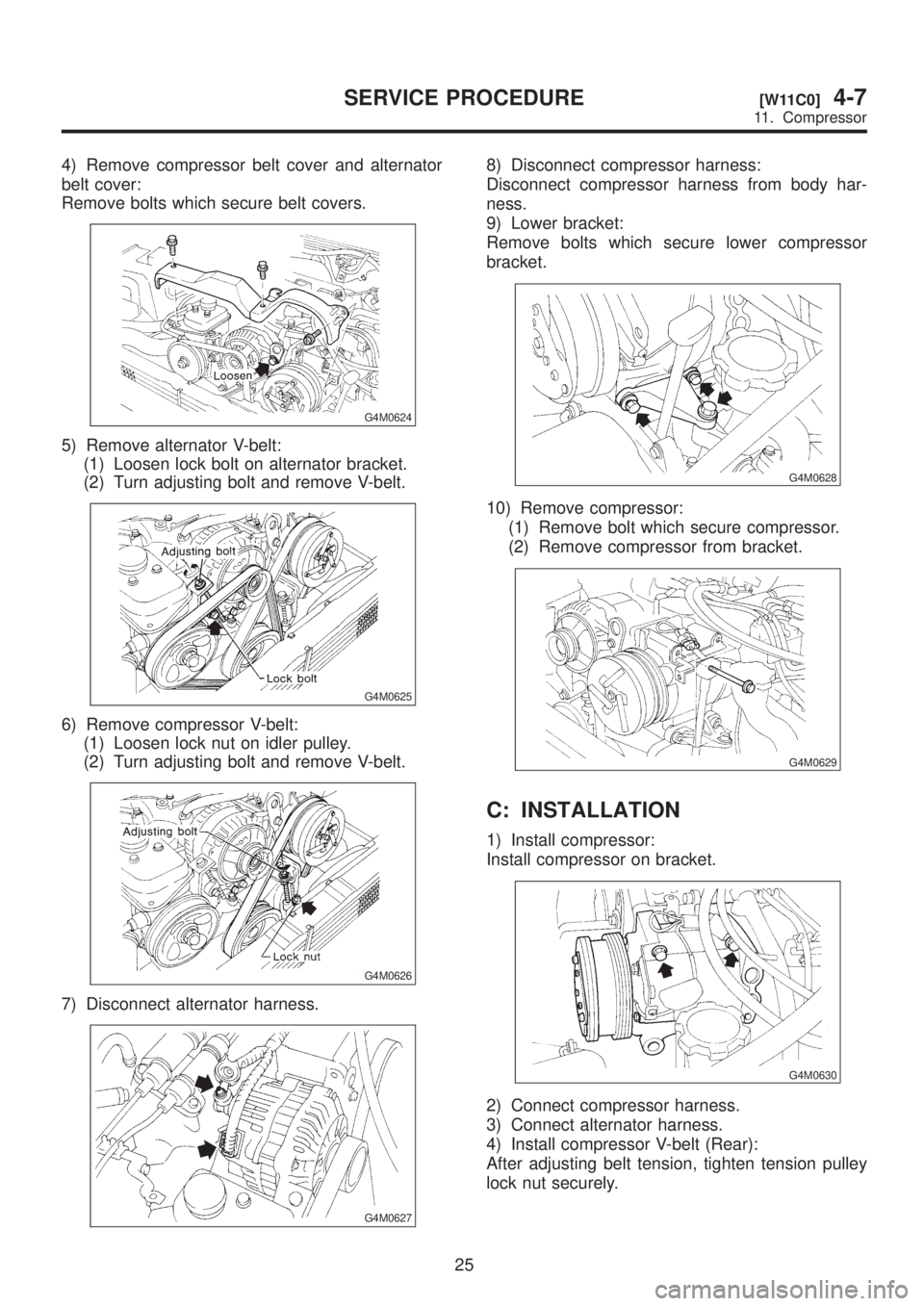
4) Remove compressor belt cover and alternator
belt cover:
Remove bolts which secure belt covers.
G4M0624
5) Remove alternator V-belt:
(1) Loosen lock bolt on alternator bracket.
(2) Turn adjusting bolt and remove V-belt.
G4M0625
6) Remove compressor V-belt:
(1) Loosen lock nut on idler pulley.
(2) Turn adjusting bolt and remove V-belt.
G4M0626
7) Disconnect alternator harness.
G4M0627
8) Disconnect compressor harness:
Disconnect compressor harness from body har-
ness.
9) Lower bracket:
Remove bolts which secure lower compressor
bracket.
G4M0628
10) Remove compressor:
(1) Remove bolt which secure compressor.
(2) Remove compressor from bracket.
G4M0629
C: INSTALLATION
1) Install compressor:
Install compressor on bracket.
G4M0630
2) Connect compressor harness.
3) Connect alternator harness.
4) Install compressor V-belt (Rear):
After adjusting belt tension, tighten tension pulley
lock nut securely.
25
[W11C0]4-7SERVICE PROCEDURE
11. Compressor