check engine SUBARU LEGACY 1999 Service Workshop Manual
[x] Cancel search | Manufacturer: SUBARU, Model Year: 1999, Model line: LEGACY, Model: SUBARU LEGACY 1999Pages: 1456, PDF Size: 59.93 MB
Page 916 of 1456
4. LACK OF BOOSTING ACTION CHECK
Turn off engine, and set the vacuum gauge read-
ing at ª0º. Then, check the fluid pressure when
brake pedal is depressed. The pressure must be
greater than the standard value listed below.
Brake pedal force147N (15 kg,
33 lb)294N (30kg, 66
lb)
Models without ABS785 kPa (8
kg/cm
2,114
psi)2,158 kPa (22
kg/cm2, 313 psi)
Models with ABS588 kPa (6
kg/cm
2, 85 psi)1,667 kPa (17
kg/cm2, 242 psi)
5. BOOSTING ACTION CHECK
Set the vacuum gauge reading at 66.7 kPa (500
mmHg, 19.69 inHg) by running engine. Then,
check the fluid pressure when brake pedal is
depressed. The pressure must be greater than the
standard value listed below.
Brake pedal force147N (15 kg,
33 lb)294N (30kg, 66
lb)
Models without ABS5,492 kPa (56
kg/cm
2, 796
psi)8,434 kPa (86
kg/cm2, 1,223 psi)
Models with ABS5,394 kPa (55
kg/cm
2,782 psi)10,003 kPa (102
kg/cm2, 1,450 psi)
7. Brake Hose
A: REMOVAL
1) Separate brake pipe from brake hose.
(Always use flare nut wrench and be careful not to
deform flare nut.)
G4M0426
2) Pull out clamp to remove brake hose.
3) Remove clamp at strut and union bolt.
B: INSTALLATION
1. FRONT BRAKE HOSE
1) Route end of brake hose (on caliper side)
through hole in brake hose bracket at strut loca-
tion.
2) Tighten end of brake hose at caliper using a
union bolt.
Tightening torque (Union bolt):
18
±3 N´m (1.8±0.3 kg-m, 13.0±2.2 ft-lb)
G4M0427
3) Secure middle fitting of brake hose to bracket at
strut location using a clamp.
4) Position disc in straight-forward direction and
route brake hose through hole in bracket on wheel
apron side.
CAUTION:
Be sure brake hose is not twisted.
5) Temporarily tighten flare nut to connect brake
pipe and hose.
6) Fix brake hose with clamp at wheel apron
bracket.
43
[W7B1]4-4SERVICE PROCEDURE
7. Brake Hose
Page 917 of 1456
4. LACK OF BOOSTING ACTION CHECK
Turn off engine, and set the vacuum gauge read-
ing at ª0º. Then, check the fluid pressure when
brake pedal is depressed. The pressure must be
greater than the standard value listed below.
Brake pedal force147N (15 kg,
33 lb)294N (30kg, 66
lb)
Models without ABS785 kPa (8
kg/cm
2,114
psi)2,158 kPa (22
kg/cm2, 313 psi)
Models with ABS588 kPa (6
kg/cm
2, 85 psi)1,667 kPa (17
kg/cm2, 242 psi)
5. BOOSTING ACTION CHECK
Set the vacuum gauge reading at 66.7 kPa (500
mmHg, 19.69 inHg) by running engine. Then,
check the fluid pressure when brake pedal is
depressed. The pressure must be greater than the
standard value listed below.
Brake pedal force147N (15 kg,
33 lb)294N (30kg, 66
lb)
Models without ABS5,492 kPa (56
kg/cm
2, 796
psi)8,434 kPa (86
kg/cm2, 1,223 psi)
Models with ABS5,394 kPa (55
kg/cm
2,782 psi)10,003 kPa (102
kg/cm2, 1,450 psi)
7. Brake Hose
A: REMOVAL
1) Separate brake pipe from brake hose.
(Always use flare nut wrench and be careful not to
deform flare nut.)
G4M0426
2) Pull out clamp to remove brake hose.
3) Remove clamp at strut and union bolt.
B: INSTALLATION
1. FRONT BRAKE HOSE
1) Route end of brake hose (on caliper side)
through hole in brake hose bracket at strut loca-
tion.
2) Tighten end of brake hose at caliper using a
union bolt.
Tightening torque (Union bolt):
18
±3 N´m (1.8±0.3 kg-m, 13.0±2.2 ft-lb)
G4M0427
3) Secure middle fitting of brake hose to bracket at
strut location using a clamp.
4) Position disc in straight-forward direction and
route brake hose through hole in bracket on wheel
apron side.
CAUTION:
Be sure brake hose is not twisted.
5) Temporarily tighten flare nut to connect brake
pipe and hose.
6) Fix brake hose with clamp at wheel apron
bracket.
43
[W7B1]4-4SERVICE PROCEDURE
7. Brake Hose
Page 918 of 1456
7) While holding hexagonal part of brake hose fit-
ting with a wrench, tighten flare nut to the specified
torque.
Tightening torque (Brake pipe flare nut):
15+3/þ2N´m (1.5+0.3/þ0.2kg-m, 10.8+2.2/þ1.4ft-lb)
8) Bleed air from the brake system.
2. REAR BRAKE HOSE
1) Pass brake hose through the hole of bracket,
and lightly tighten flare nut to connect brake pipe.
2) Insert clamp upward to fix brake hose.
3) While holding hexagonal part of brake hose fit-
ting with a wrench, tighten flare nut to the specified
torque.
Tightening torque (Brake pipe flare nut):
15+3/þ2N´m (1.5+0.3/þ0.2kg-m, 10.8+2.2/þ1.4ft-lb)
4) Bleed air from the brake system.
8. Hill Holder
A: REMOVAL
1) Drain brake fluid from reservoir of master cylin-
der.
2) Remove adjusting nut and cable clamp, and
disconnect PHV cable from cable bracket on
engine.
G4M0428
3) Detach PHV cable from clips.
4) Remove cable clamp, and disconnect PHV
cable from PHV stay.
CAUTION:
Carefully protect boots and inner cable from
damage when disconnecting PHV cable.
5) Disconnect brake pipes from PHV.
CAUTION:
IPay attention not to drop brake fluid onto
body painting since it may dissolve paint.
IPay attention not to damage hexagonal head
of flare nut by using pipe wrench without fail.
6) Detach PHV along with support from side
frame.
CAUTION:
Exercise utmost care to prevent foreign matter
from entering into PHV when removing it.
B: INSPECTION
Check up removed parts as follows, and replace
defective ones.
1) Check if boots of PHV cable are damaged or
degraded, and if inner cable is damaged or cor-
roded.
2) Check if return spring is worn out, damaged or
corroded.
3) Confirm that rolling sound of ball is heard with
PHV inclined and lever rotates smoothly.
CAUTION:
Never disassemble PHV. Replace entire PHV
assembly if necessary.
C: INSTALLATION
1) Install PHV onto side frame.
44
4-4[W7B2]SERVICE PROCEDURE
8. Hill Holder
Page 919 of 1456
7) While holding hexagonal part of brake hose fit-
ting with a wrench, tighten flare nut to the specified
torque.
Tightening torque (Brake pipe flare nut):
15+3/þ2N´m (1.5+0.3/þ0.2kg-m, 10.8+2.2/þ1.4ft-lb)
8) Bleed air from the brake system.
2. REAR BRAKE HOSE
1) Pass brake hose through the hole of bracket,
and lightly tighten flare nut to connect brake pipe.
2) Insert clamp upward to fix brake hose.
3) While holding hexagonal part of brake hose fit-
ting with a wrench, tighten flare nut to the specified
torque.
Tightening torque (Brake pipe flare nut):
15+3/þ2N´m (1.5+0.3/þ0.2kg-m, 10.8+2.2/þ1.4ft-lb)
4) Bleed air from the brake system.
8. Hill Holder
A: REMOVAL
1) Drain brake fluid from reservoir of master cylin-
der.
2) Remove adjusting nut and cable clamp, and
disconnect PHV cable from cable bracket on
engine.
G4M0428
3) Detach PHV cable from clips.
4) Remove cable clamp, and disconnect PHV
cable from PHV stay.
CAUTION:
Carefully protect boots and inner cable from
damage when disconnecting PHV cable.
5) Disconnect brake pipes from PHV.
CAUTION:
IPay attention not to drop brake fluid onto
body painting since it may dissolve paint.
IPay attention not to damage hexagonal head
of flare nut by using pipe wrench without fail.
6) Detach PHV along with support from side
frame.
CAUTION:
Exercise utmost care to prevent foreign matter
from entering into PHV when removing it.
B: INSPECTION
Check up removed parts as follows, and replace
defective ones.
1) Check if boots of PHV cable are damaged or
degraded, and if inner cable is damaged or cor-
roded.
2) Check if return spring is worn out, damaged or
corroded.
3) Confirm that rolling sound of ball is heard with
PHV inclined and lever rotates smoothly.
CAUTION:
Never disassemble PHV. Replace entire PHV
assembly if necessary.
C: INSTALLATION
1) Install PHV onto side frame.
44
4-4[W7B2]SERVICE PROCEDURE
8. Hill Holder
Page 925 of 1456
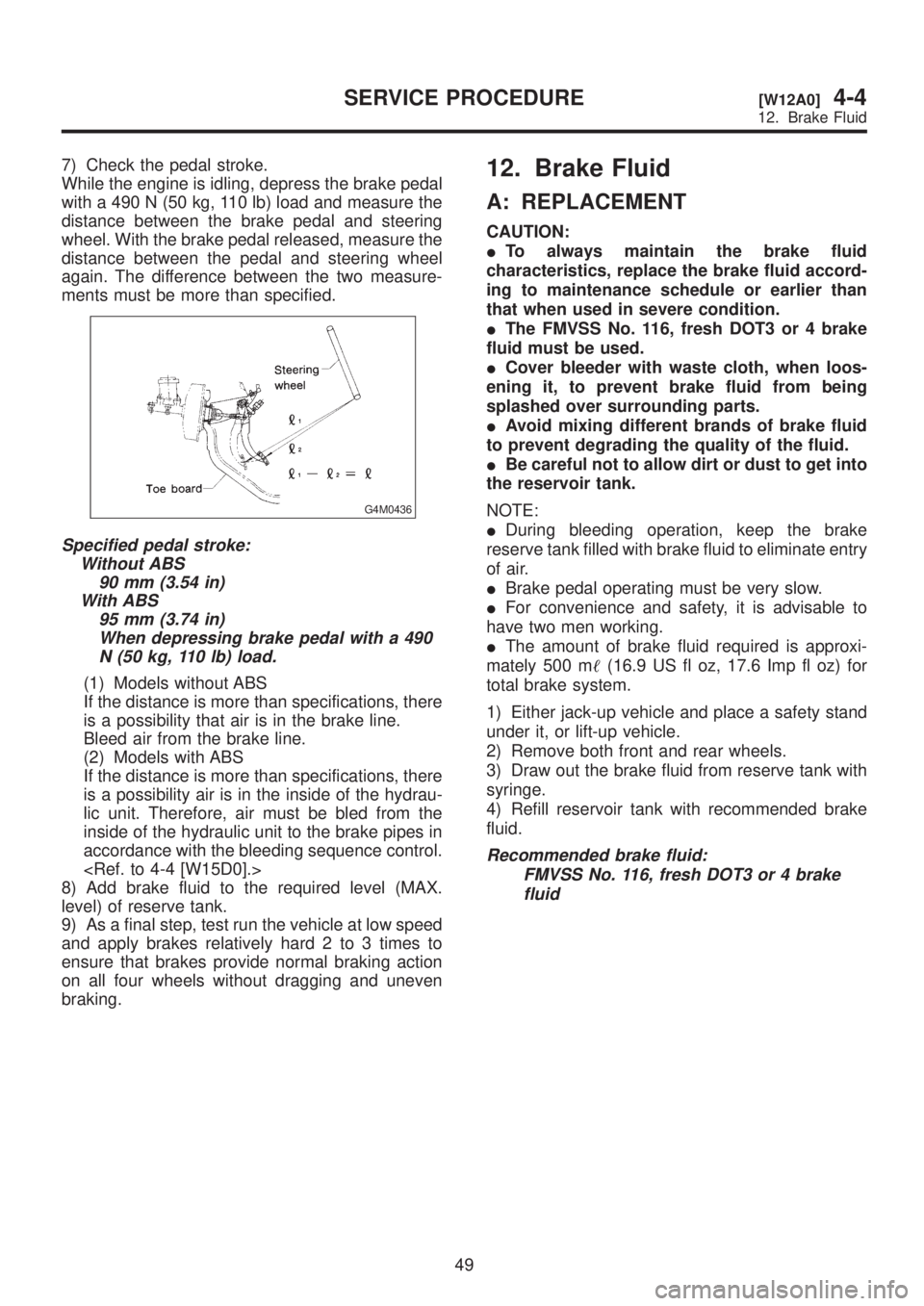
7) Check the pedal stroke.
While the engine is idling, depress the brake pedal
with a 490 N (50 kg, 110 lb) load and measure the
distance between the brake pedal and steering
wheel. With the brake pedal released, measure the
distance between the pedal and steering wheel
again. The difference between the two measure-
ments must be more than specified.
G4M0436
Specified pedal stroke:
Without ABS
90 mm (3.54 in)
With ABS
95 mm (3.74 in)
When depressing brake pedal with a 490
N (50 kg, 110 lb) load.
(1) Models without ABS
If the distance is more than specifications, there
is a possibility that air is in the brake line.
Bleed air from the brake line.
(2) Models with ABS
If the distance is more than specifications, there
is a possibility air is in the inside of the hydrau-
lic unit. Therefore, air must be bled from the
inside of the hydraulic unit to the brake pipes in
accordance with the bleeding sequence control.
8) Add brake fluid to the required level (MAX.
level) of reserve tank.
9) As a final step, test run the vehicle at low speed
and apply brakes relatively hard 2 to 3 times to
ensure that brakes provide normal braking action
on all four wheels without dragging and uneven
braking.
12. Brake Fluid
A: REPLACEMENT
CAUTION:
ITo always maintain the brake fluid
characteristics, replace the brake fluid accord-
ing to maintenance schedule or earlier than
that when used in severe condition.
IThe FMVSS No. 116, fresh DOT3 or 4 brake
fluid must be used.
ICover bleeder with waste cloth, when loos-
ening it, to prevent brake fluid from being
splashed over surrounding parts.
IAvoid mixing different brands of brake fluid
to prevent degrading the quality of the fluid.
IBe careful not to allow dirt or dust to get into
the reservoir tank.
NOTE:
IDuring bleeding operation, keep the brake
reserve tank filled with brake fluid to eliminate entry
of air.
IBrake pedal operating must be very slow.
IFor convenience and safety, it is advisable to
have two men working.
IThe amount of brake fluid required is approxi-
mately 500 m(16.9 US fl oz, 17.6 Imp fl oz) for
total brake system.
1) Either jack-up vehicle and place a safety stand
under it, or lift-up vehicle.
2) Remove both front and rear wheels.
3) Draw out the brake fluid from reserve tank with
syringe.
4) Refill reservoir tank with recommended brake
fluid.
Recommended brake fluid:
FMVSS No. 116, fresh DOT3 or 4 brake
fluid
49
[W12A0]4-4SERVICE PROCEDURE
12. Brake Fluid
Page 926 of 1456
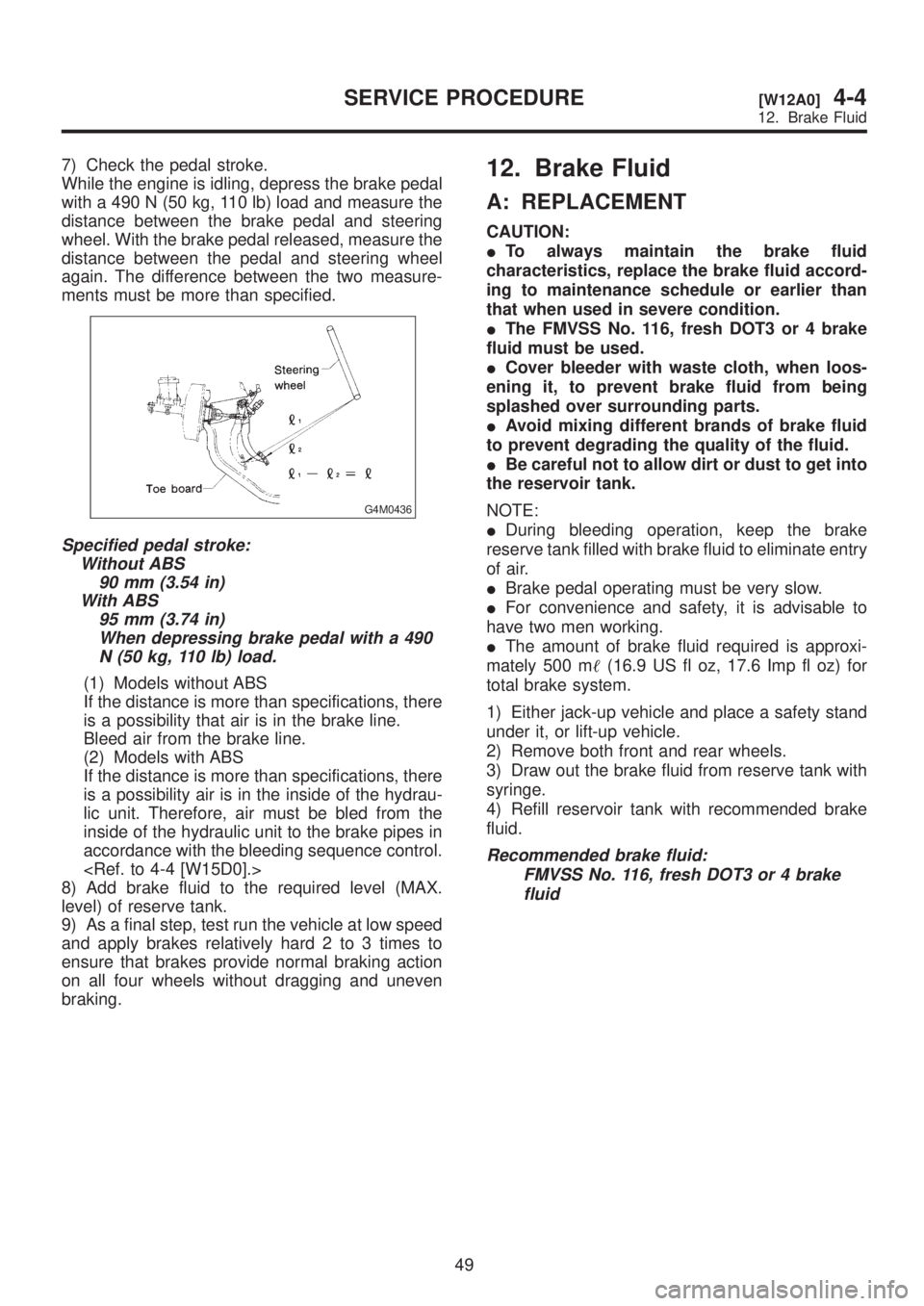
7) Check the pedal stroke.
While the engine is idling, depress the brake pedal
with a 490 N (50 kg, 110 lb) load and measure the
distance between the brake pedal and steering
wheel. With the brake pedal released, measure the
distance between the pedal and steering wheel
again. The difference between the two measure-
ments must be more than specified.
G4M0436
Specified pedal stroke:
Without ABS
90 mm (3.54 in)
With ABS
95 mm (3.74 in)
When depressing brake pedal with a 490
N (50 kg, 110 lb) load.
(1) Models without ABS
If the distance is more than specifications, there
is a possibility that air is in the brake line.
Bleed air from the brake line.
(2) Models with ABS
If the distance is more than specifications, there
is a possibility air is in the inside of the hydrau-
lic unit. Therefore, air must be bled from the
inside of the hydraulic unit to the brake pipes in
accordance with the bleeding sequence control.
8) Add brake fluid to the required level (MAX.
level) of reserve tank.
9) As a final step, test run the vehicle at low speed
and apply brakes relatively hard 2 to 3 times to
ensure that brakes provide normal braking action
on all four wheels without dragging and uneven
braking.
12. Brake Fluid
A: REPLACEMENT
CAUTION:
ITo always maintain the brake fluid
characteristics, replace the brake fluid accord-
ing to maintenance schedule or earlier than
that when used in severe condition.
IThe FMVSS No. 116, fresh DOT3 or 4 brake
fluid must be used.
ICover bleeder with waste cloth, when loos-
ening it, to prevent brake fluid from being
splashed over surrounding parts.
IAvoid mixing different brands of brake fluid
to prevent degrading the quality of the fluid.
IBe careful not to allow dirt or dust to get into
the reservoir tank.
NOTE:
IDuring bleeding operation, keep the brake
reserve tank filled with brake fluid to eliminate entry
of air.
IBrake pedal operating must be very slow.
IFor convenience and safety, it is advisable to
have two men working.
IThe amount of brake fluid required is approxi-
mately 500 m(16.9 US fl oz, 17.6 Imp fl oz) for
total brake system.
1) Either jack-up vehicle and place a safety stand
under it, or lift-up vehicle.
2) Remove both front and rear wheels.
3) Draw out the brake fluid from reserve tank with
syringe.
4) Refill reservoir tank with recommended brake
fluid.
Recommended brake fluid:
FMVSS No. 116, fresh DOT3 or 4 brake
fluid
49
[W12A0]4-4SERVICE PROCEDURE
12. Brake Fluid
Page 929 of 1456
14. ABS Sensor
A: REMOVAL
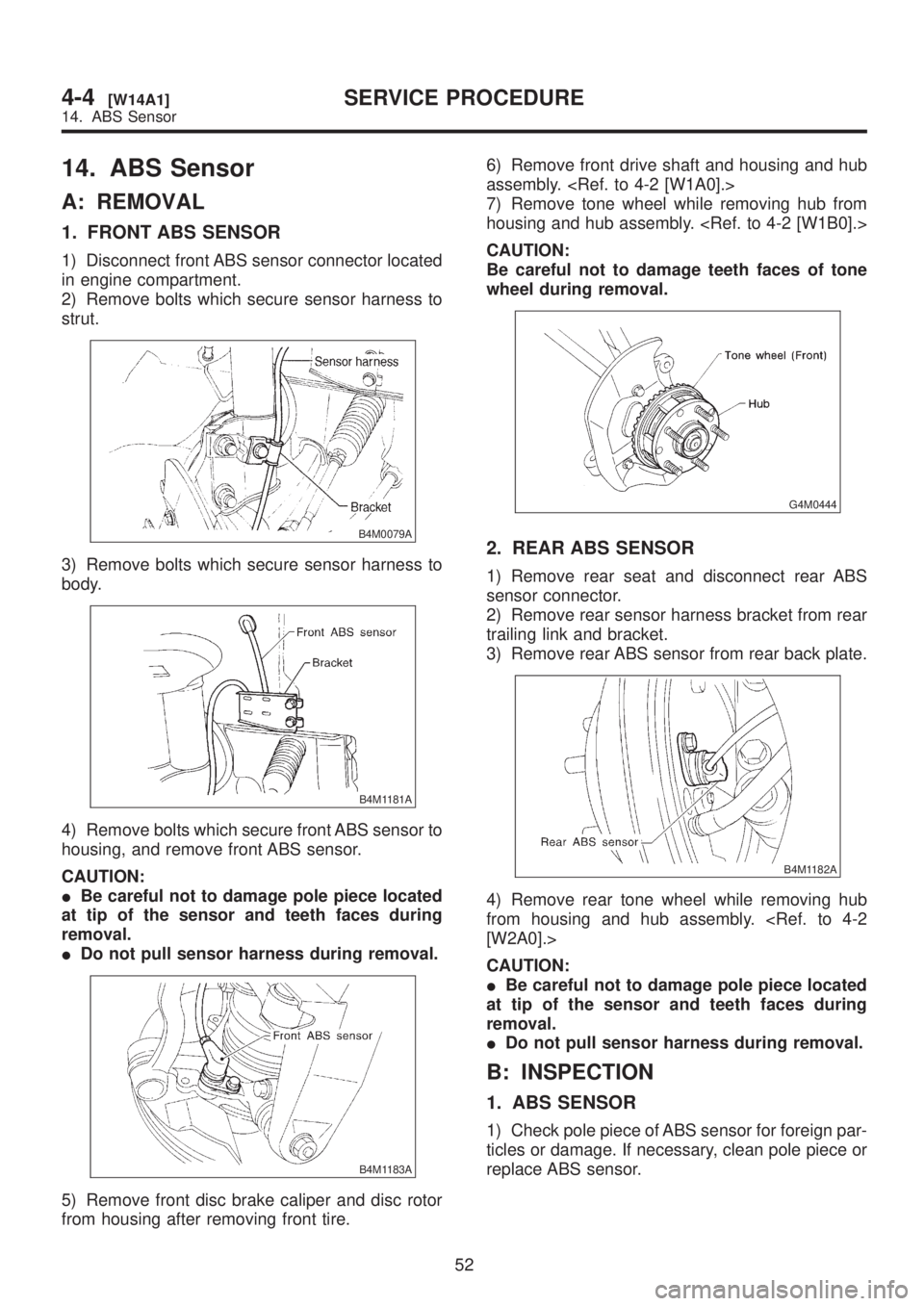
1. FRONT ABS SENSOR
1) Disconnect front ABS sensor connector located
in engine compartment.
2) Remove bolts which secure sensor harness to
strut.
B4M0079A
3) Remove bolts which secure sensor harness to
body.
B4M1181A
4) Remove bolts which secure front ABS sensor to
housing, and remove front ABS sensor.
CAUTION:
IBe careful not to damage pole piece located
at tip of the sensor and teeth faces during
removal.
IDo not pull sensor harness during removal.
B4M1183A
5) Remove front disc brake caliper and disc rotor
from housing after removing front tire.6) Remove front drive shaft and housing and hub
assembly.
7) Remove tone wheel while removing hub from
housing and hub assembly.
CAUTION:
Be careful not to damage teeth faces of tone
wheel during removal.
G4M0444
2. REAR ABS SENSOR
1) Remove rear seat and disconnect rear ABS
sensor connector.
2) Remove rear sensor harness bracket from rear
trailing link and bracket.
3) Remove rear ABS sensor from rear back plate.
B4M1182A
4) Remove rear tone wheel while removing hub
from housing and hub assembly.
CAUTION:
IBe careful not to damage pole piece located
at tip of the sensor and teeth faces during
removal.
IDo not pull sensor harness during removal.
B: INSPECTION
1. ABS SENSOR
1) Check pole piece of ABS sensor for foreign par-
ticles or damage. If necessary, clean pole piece or
replace ABS sensor.
52
4-4[W14A1]SERVICE PROCEDURE
14. ABS Sensor
Page 933 of 1456
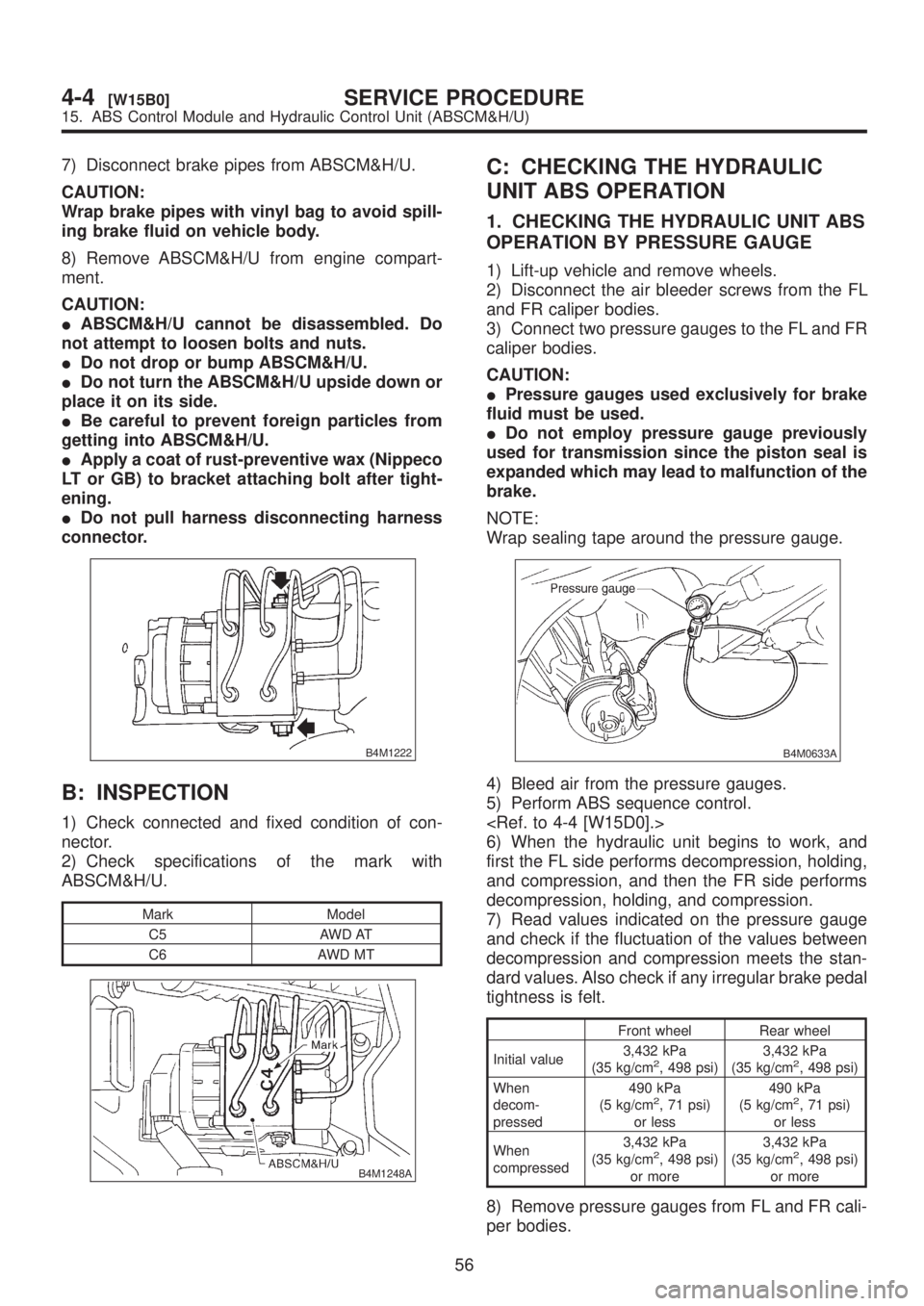
7) Disconnect brake pipes from ABSCM&H/U.
CAUTION:
Wrap brake pipes with vinyl bag to avoid spill-
ing brake fluid on vehicle body.
8) Remove ABSCM&H/U from engine compart-
ment.
CAUTION:
IABSCM&H/U cannot be disassembled. Do
not attempt to loosen bolts and nuts.
IDo not drop or bump ABSCM&H/U.
IDo not turn the ABSCM&H/U upside down or
place it on its side.
IBe careful to prevent foreign particles from
getting into ABSCM&H/U.
IApply a coat of rust-preventive wax (Nippeco
LT or GB) to bracket attaching bolt after tight-
ening.
IDo not pull harness disconnecting harness
connector.
B4M1222
B: INSPECTION
1) Check connected and fixed condition of con-
nector.
2) Check specifications of the mark with
ABSCM&H/U.
Mark Model
C5 AWD AT
C6 AWD MT
B4M1248A
C: CHECKING THE HYDRAULIC
UNIT ABS OPERATION
1. CHECKING THE HYDRAULIC UNIT ABS
OPERATION BY PRESSURE GAUGE
1) Lift-up vehicle and remove wheels.
2) Disconnect the air bleeder screws from the FL
and FR caliper bodies.
3) Connect two pressure gauges to the FL and FR
caliper bodies.
CAUTION:
IPressure gauges used exclusively for brake
fluid must be used.
IDo not employ pressure gauge previously
used for transmission since the piston seal is
expanded which may lead to malfunction of the
brake.
NOTE:
Wrap sealing tape around the pressure gauge.
B4M0633A
4) Bleed air from the pressure gauges.
5) Perform ABS sequence control.
6) When the hydraulic unit begins to work, and
first the FL side performs decompression, holding,
and compression, and then the FR side performs
decompression, holding, and compression.
7) Read values indicated on the pressure gauge
and check if the fluctuation of the values between
decompression and compression meets the stan-
dard values. Also check if any irregular brake pedal
tightness is felt.
Front wheel Rear wheel
Initial value3,432 kPa
(35 kg/cm
2, 498 psi)3,432 kPa
(35 kg/cm2, 498 psi)
When
decom-
pressed490 kPa
(5 kg/cm
2, 71 psi)
or less490 kPa
(5 kg/cm2, 71 psi)
or less
When
compressed3,432 kPa
(35 kg/cm
2, 498 psi)
or more3,432 kPa
(35 kg/cm2, 498 psi)
or more
8) Remove pressure gauges from FL and FR cali-
per bodies.
56
4-4[W15B0]SERVICE PROCEDURE
15. ABS Control Module and Hydraulic Control Unit (ABSCM&H/U)
Page 934 of 1456
9) Remove air bleeder screws from the RL and RR
caliper bodies.
10) Connect the air bleeder screws to the FL and
FR caliper bodies.
11) Connect two pressure gauges to the RL and
RR caliper bodies.
12) Bleed air from the pressure gauges and the FL
and FR caliper bodies.
13) Perform ABS sequence control.
14) When the hydraulic unit begins to work, at first
the RR side performs decompression, holding, and
compression, and then the RL side performs
decompression, holding, and compression.
15) Read values indicated on the pressure
gauges and check if they meet the standard value.
16) After checking, remove the pressure gauges
from caliper bodies.
17) Connect the air bleeder screws to RL and RR
caliper bodies.
18) Bleed air from brake line.
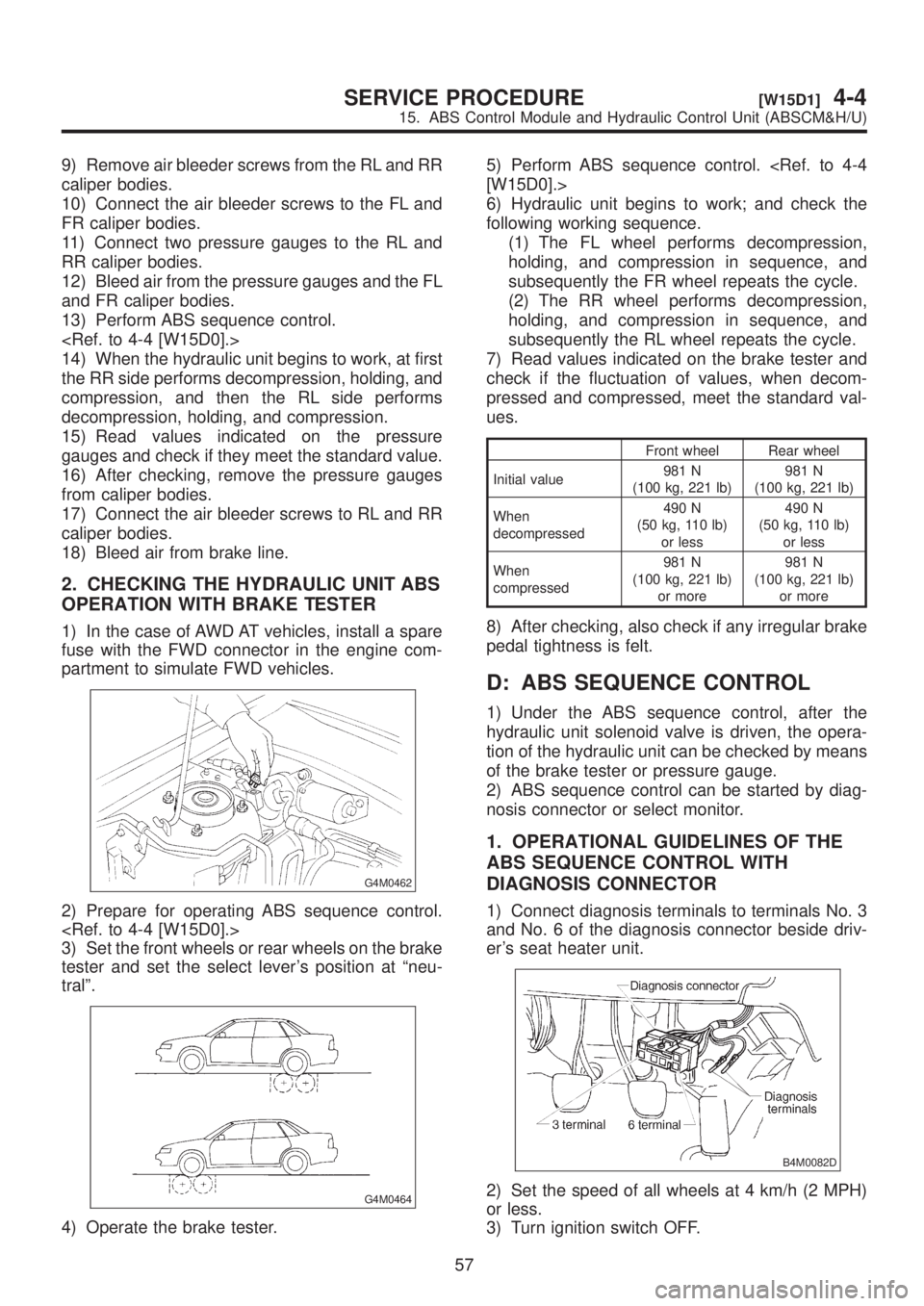
2. CHECKING THE HYDRAULIC UNIT ABS
OPERATION WITH BRAKE TESTER
1) In the case of AWD AT vehicles, install a spare
fuse with the FWD connector in the engine com-
partment to simulate FWD vehicles.
G4M0462
2) Prepare for operating ABS sequence control.
3) Set the front wheels or rear wheels on the brake
tester and set the select lever's position at ªneu-
tralº.
G4M0464
4) Operate the brake tester.5) Perform ABS sequence control.
6) Hydraulic unit begins to work; and check the
following working sequence.
(1) The FL wheel performs decompression,
holding, and compression in sequence, and
subsequently the FR wheel repeats the cycle.
(2) The RR wheel performs decompression,
holding, and compression in sequence, and
subsequently the RL wheel repeats the cycle.
7) Read values indicated on the brake tester and
check if the fluctuation of values, when decom-
pressed and compressed, meet the standard val-
ues.
Front wheel Rear wheel
Initial value981 N
(100 kg, 221 lb)981 N
(100 kg, 221 lb)
When
decompressed490 N
(50 kg, 110 lb)
or less490 N
(50 kg, 110 lb)
or less
When
compressed981 N
(100 kg, 221 lb)
or more981 N
(100 kg, 221 lb)
or more
8) After checking, also check if any irregular brake
pedal tightness is felt.
D: ABS SEQUENCE CONTROL
1) Under the ABS sequence control, after the
hydraulic unit solenoid valve is driven, the opera-
tion of the hydraulic unit can be checked by means
of the brake tester or pressure gauge.
2) ABS sequence control can be started by diag-
nosis connector or select monitor.
1. OPERATIONAL GUIDELINES OF THE
ABS SEQUENCE CONTROL WITH
DIAGNOSIS CONNECTOR
1) Connect diagnosis terminals to terminals No. 3
and No. 6 of the diagnosis connector beside driv-
er's seat heater unit.
B4M0082D
2) Set the speed of all wheels at 4 km/h (2 MPH)
or less.
3) Turn ignition switch OFF.
57
[W15D1]4-4SERVICE PROCEDURE
15. ABS Control Module and Hydraulic Control Unit (ABSCM&H/U)
Page 935 of 1456
4) Within 0.5 seconds after the ABS warning light
goes out, depress the brake pedal and hold it
immediately after ignition switch is turned to ON.
CAUTION:
Do not depress the clutch pedal.
NOTE:
IWhen the ignition switch is set to on, the brake
pedal must not be depressed.
IEngine must not operate.
5) After completion of ABS sequence control, turn
ignition switch OFF.
2. OPERATIONAL GUIDELINES OF THE
ABS SEQUENCE CONTROL WITH
SELECT MONITOR
NOTE:
IIn the event of any trouble, the sequence con-
trol may not be operative. In such a case, activate
the sequence control, referring to ªOPERATIONAL
GUIDELINES OF THE ABS SEQUENCE CON-
TROL WITH DIAGNOSIS CONNECTORº.
IWhen the diagnosis terminal is connected to the
diagnosis connector, the sequence control will not
operate.
1) Connect select monitor to data link connector
beside driver's seat instrument panel lower cover.
2) Turn ignition switch ON.
3) Turn select monitor switch ON.
4) Put select monitor to {ABS/TCS} mode.
5) When {Function check sequence} is selected,
`ABS sequence control' will start.
6) The message `Press Brake Pedal Firmly' is dis-
played as follows:
(1) When using the brake tester, depress brake
pedal with braking force of 981 N (100 kg, 221
lb).
(2) When using the pressure gauge, depress
brake pedal so as to make the pressure gauge
indicate 3,432 kPa (35 kg/cm
2, 498 psi).
CAUTION:
Do not depress the clutch pedal.
7) When the message ªPress YESº is displayed,
press YES key.
8) Operation points will be displayed on select
monitor.
3. CONDITIONS FOR COMPLETION OF
ABS SEQUENCE CONTROL
When the following conditions develop, the ABS
sequence control stops and ABS operation is
returned to the normal control mode.
1) When the speed of at least one wheel reaches
10 km/h (6 MPH).
2) When terminal No. 3 or No. 6 are separated
from diagnosis terminals. (When select monitor is
not used.)
3) When the brake pedal is released during
sequence control and the braking lamp switch is
set to off.
4) When brake pedal is depressed after ignition
key is turned to ON, and before ABS warning light
goes out. (When select monitor is not used.)
5) When brake pedal is not depressed after igni-
tion key is turned to ON, and within 0.5 seconds
after ABS warning light goes out. (When select
monitor is not used.)
6) After completion of the sequence control.
7) When malfunction is detected. (When select
monitor is used.)
58
4-4[W15D2]SERVICE PROCEDURE
15. ABS Control Module and Hydraulic Control Unit (ABSCM&H/U)