check engine SUBARU LEGACY 1999 Service Manual PDF
[x] Cancel search | Manufacturer: SUBARU, Model Year: 1999, Model line: LEGACY, Model: SUBARU LEGACY 1999Pages: 1456, PDF Size: 59.93 MB
Page 952 of 1456
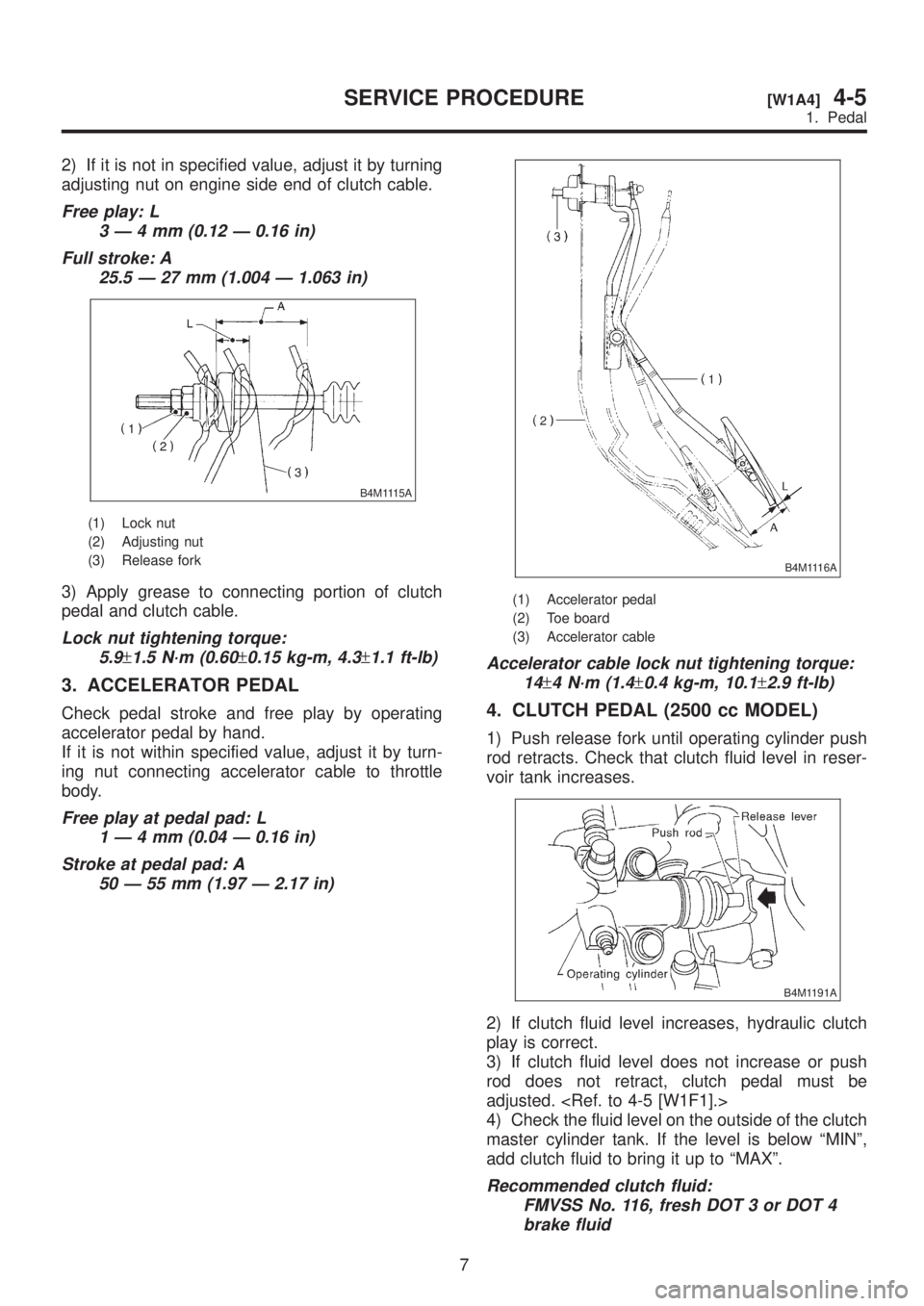
2) If it is not in specified value, adjust it by turning
adjusting nut on engine side end of clutch cable.
Free play: L
3Ð4mm(0.12 Ð 0.16 in)
Full stroke: A
25.5 Ð 27 mm (1.004 Ð 1.063 in)
B4M1115A
(1) Lock nut
(2) Adjusting nut
(3) Release fork
3) Apply grease to connecting portion of clutch
pedal and clutch cable.
Lock nut tightening torque:
5.9
±1.5 N´m (0.60±0.15 kg-m, 4.3±1.1 ft-lb)
3. ACCELERATOR PEDAL
Check pedal stroke and free play by operating
accelerator pedal by hand.
If it is not within specified value, adjust it by turn-
ing nut connecting accelerator cable to throttle
body.
Free play at pedal pad: L
1Ð4mm(0.04 Ð 0.16 in)
Stroke at pedal pad: A
50 Ð 55 mm (1.97 Ð 2.17 in)
B4M1116A
(1) Accelerator pedal
(2) Toe board
(3) Accelerator cable
Accelerator cable lock nut tightening torque:
14
±4 N´m (1.4±0.4 kg-m, 10.1±2.9 ft-lb)
4. CLUTCH PEDAL (2500 cc MODEL)
1) Push release fork until operating cylinder push
rod retracts. Check that clutch fluid level in reser-
voir tank increases.
B4M1191A
2) If clutch fluid level increases, hydraulic clutch
play is correct.
3) If clutch fluid level does not increase or push
rod does not retract, clutch pedal must be
adjusted.
4) Check the fluid level on the outside of the clutch
master cylinder tank. If the level is below ªMINº,
add clutch fluid to bring it up to ªMAXº.
Recommended clutch fluid:
FMVSS No. 116, fresh DOT 3 or DOT 4
brake fluid
7
[W1A4]4-5SERVICE PROCEDURE
1. Pedal
Page 990 of 1456
6. Discharge the System
CAUTION:
The following points should be kept in mind
when discharging the system.
IBe certain that goggles and gloves are worn.
IConnect refrigerant recovery system to
manifold gauge set and remove recycle refrig-
erant from A/C system.
NOTE:
Refer to appropriate refrigerant recovery system
instruction manual for operation.
A: CONNECTING THE MANIFOLD
GAUGE SET
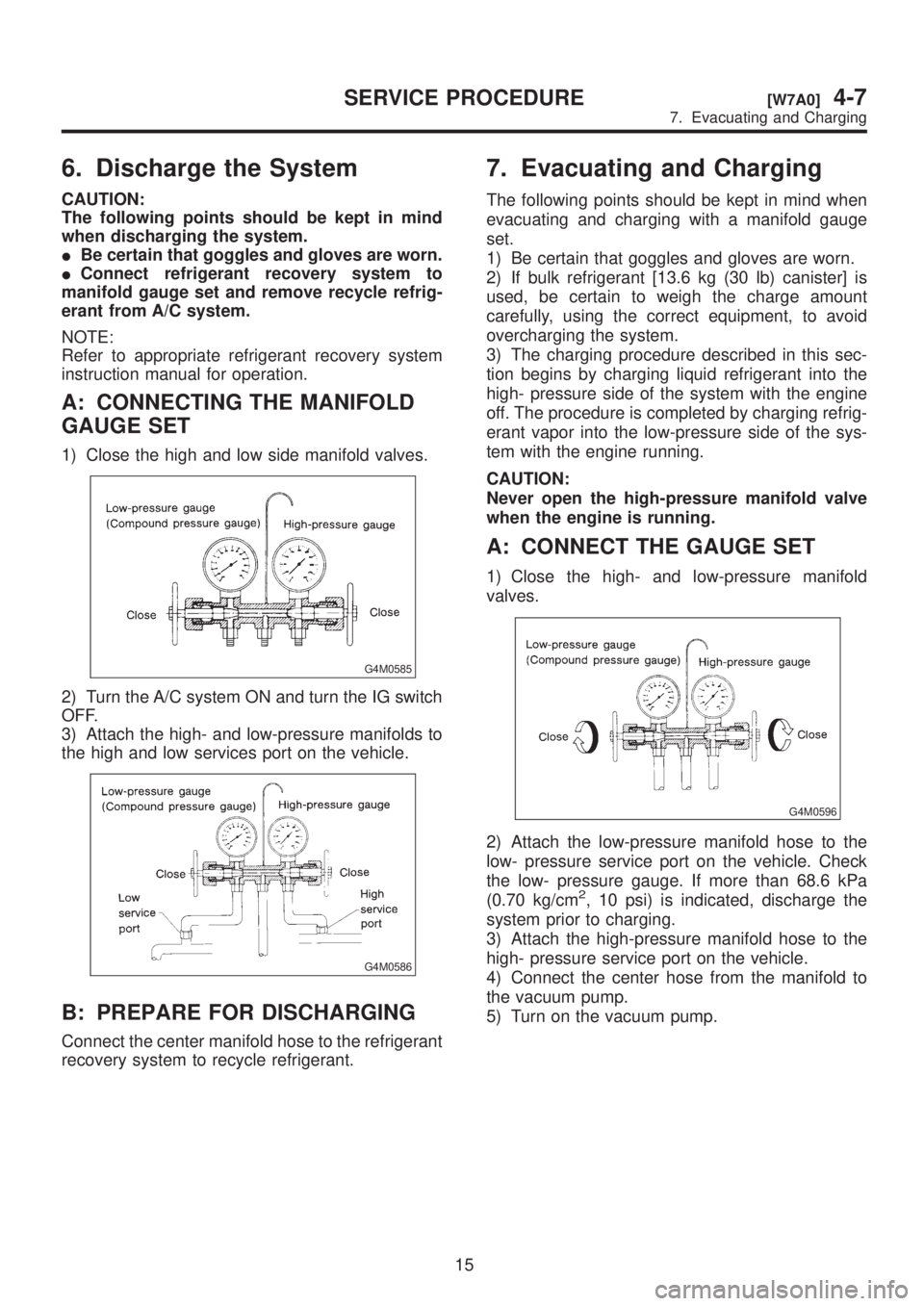
1) Close the high and low side manifold valves.
G4M0585
2) Turn the A/C system ON and turn the IG switch
OFF.
3) Attach the high- and low-pressure manifolds to
the high and low services port on the vehicle.
G4M0586
B: PREPARE FOR DISCHARGING
Connect the center manifold hose to the refrigerant
recovery system to recycle refrigerant.
7. Evacuating and Charging
The following points should be kept in mind when
evacuating and charging with a manifold gauge
set.
1) Be certain that goggles and gloves are worn.
2) If bulk refrigerant [13.6 kg (30 lb) canister] is
used, be certain to weigh the charge amount
carefully, using the correct equipment, to avoid
overcharging the system.
3) The charging procedure described in this sec-
tion begins by charging liquid refrigerant into the
high- pressure side of the system with the engine
off. The procedure is completed by charging refrig-
erant vapor into the low-pressure side of the sys-
tem with the engine running.
CAUTION:
Never open the high-pressure manifold valve
when the engine is running.
A: CONNECT THE GAUGE SET
1) Close the high- and low-pressure manifold
valves.
G4M0596
2) Attach the low-pressure manifold hose to the
low- pressure service port on the vehicle. Check
the low- pressure gauge. If more than 68.6 kPa
(0.70 kg/cm
2, 10 psi) is indicated, discharge the
system prior to charging.
3) Attach the high-pressure manifold hose to the
high- pressure service port on the vehicle.
4) Connect the center hose from the manifold to
the vacuum pump.
5) Turn on the vacuum pump.
15
[W7A0]4-7SERVICE PROCEDURE
7. Evacuating and Charging
Page 991 of 1456
6. Discharge the System
CAUTION:
The following points should be kept in mind
when discharging the system.
IBe certain that goggles and gloves are worn.
IConnect refrigerant recovery system to
manifold gauge set and remove recycle refrig-
erant from A/C system.
NOTE:
Refer to appropriate refrigerant recovery system
instruction manual for operation.
A: CONNECTING THE MANIFOLD
GAUGE SET
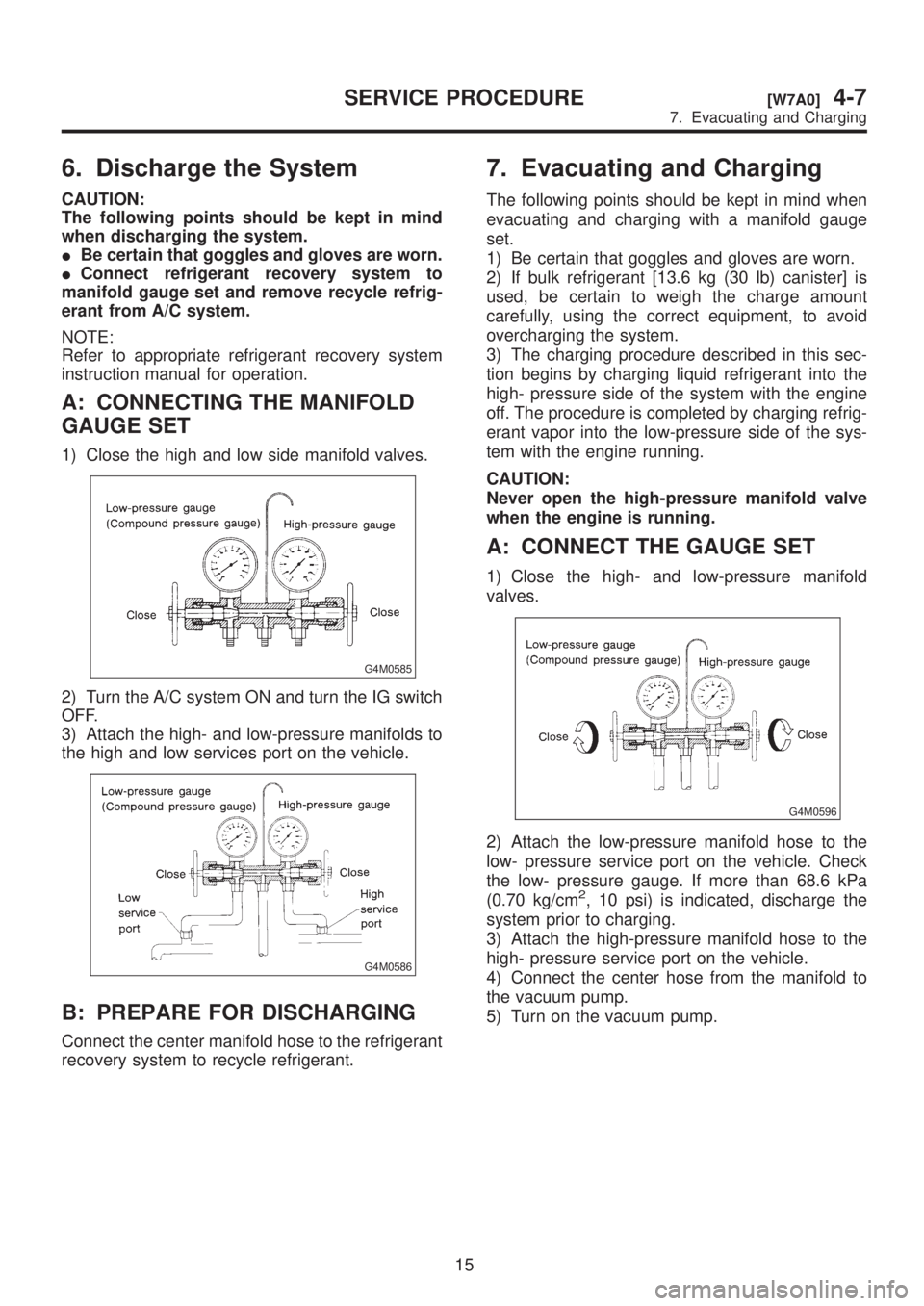
1) Close the high and low side manifold valves.
G4M0585
2) Turn the A/C system ON and turn the IG switch
OFF.
3) Attach the high- and low-pressure manifolds to
the high and low services port on the vehicle.
G4M0586
B: PREPARE FOR DISCHARGING
Connect the center manifold hose to the refrigerant
recovery system to recycle refrigerant.
7. Evacuating and Charging
The following points should be kept in mind when
evacuating and charging with a manifold gauge
set.
1) Be certain that goggles and gloves are worn.
2) If bulk refrigerant [13.6 kg (30 lb) canister] is
used, be certain to weigh the charge amount
carefully, using the correct equipment, to avoid
overcharging the system.
3) The charging procedure described in this sec-
tion begins by charging liquid refrigerant into the
high- pressure side of the system with the engine
off. The procedure is completed by charging refrig-
erant vapor into the low-pressure side of the sys-
tem with the engine running.
CAUTION:
Never open the high-pressure manifold valve
when the engine is running.
A: CONNECT THE GAUGE SET
1) Close the high- and low-pressure manifold
valves.
G4M0596
2) Attach the low-pressure manifold hose to the
low- pressure service port on the vehicle. Check
the low- pressure gauge. If more than 68.6 kPa
(0.70 kg/cm
2, 10 psi) is indicated, discharge the
system prior to charging.
3) Attach the high-pressure manifold hose to the
high- pressure service port on the vehicle.
4) Connect the center hose from the manifold to
the vacuum pump.
5) Turn on the vacuum pump.
15
[W7A0]4-7SERVICE PROCEDURE
7. Evacuating and Charging
Page 993 of 1456
C: PURGE THE CENTER HOSE
CAUTION:
Be certain that goggles and gloves are worn.
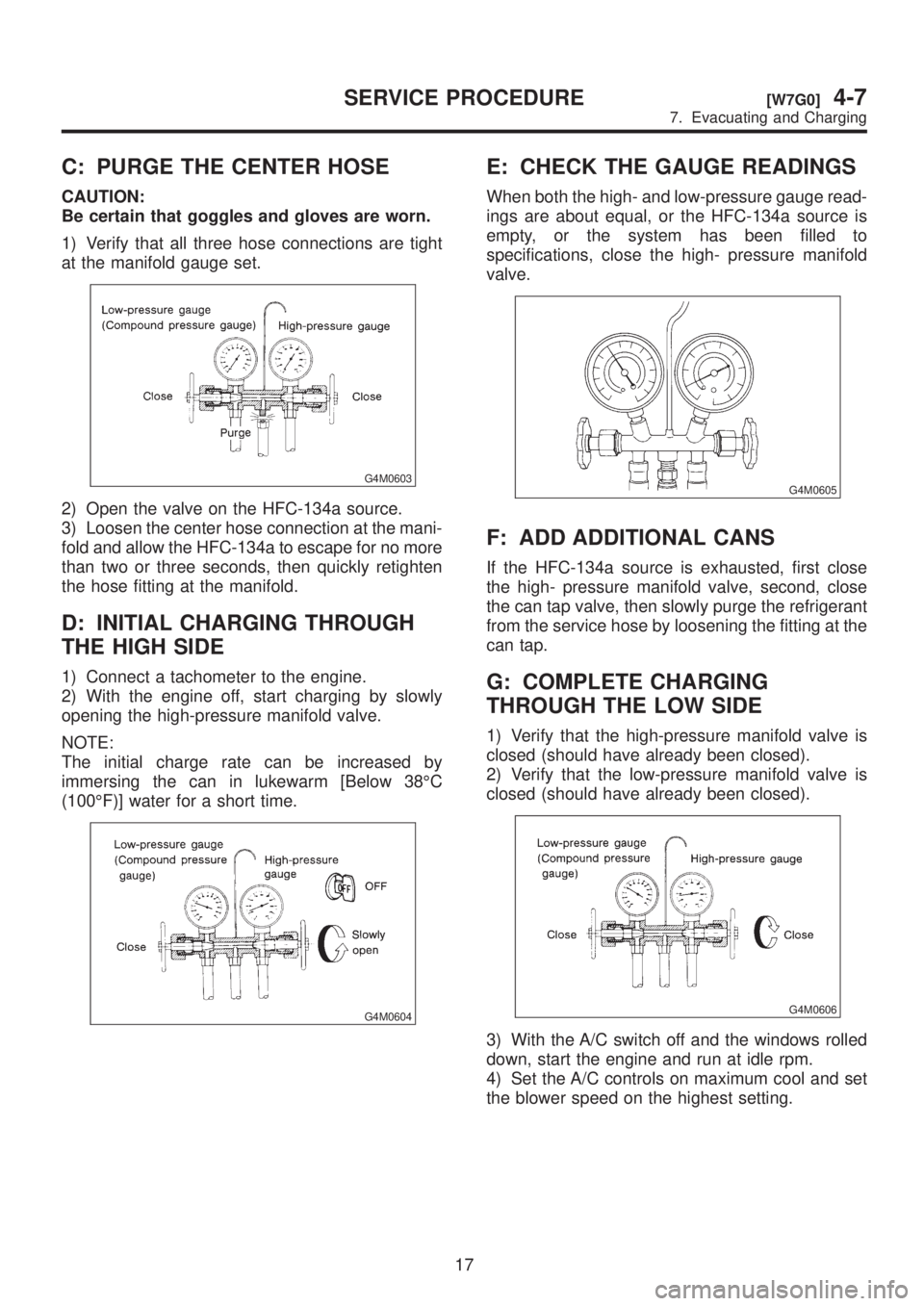
1) Verify that all three hose connections are tight
at the manifold gauge set.
G4M0603
2) Open the valve on the HFC-134a source.
3) Loosen the center hose connection at the mani-
fold and allow the HFC-134a to escape for no more
than two or three seconds, then quickly retighten
the hose fitting at the manifold.
D: INITIAL CHARGING THROUGH
THE HIGH SIDE
1) Connect a tachometer to the engine.
2) With the engine off, start charging by slowly
opening the high-pressure manifold valve.
NOTE:
The initial charge rate can be increased by
immersing the can in lukewarm [Below 38ÉC
(100ÉF)] water for a short time.
G4M0604
E: CHECK THE GAUGE READINGS
When both the high- and low-pressure gauge read-
ings are about equal, or the HFC-134a source is
empty, or the system has been filled to
specifications, close the high- pressure manifold
valve.
G4M0605
F: ADD ADDITIONAL CANS
If the HFC-134a source is exhausted, first close
the high- pressure manifold valve, second, close
the can tap valve, then slowly purge the refrigerant
from the service hose by loosening the fitting at the
can tap.
G: COMPLETE CHARGING
THROUGH THE LOW SIDE
1) Verify that the high-pressure manifold valve is
closed (should have already been closed).
2) Verify that the low-pressure manifold valve is
closed (should have already been closed).
G4M0606
3) With the A/C switch off and the windows rolled
down, start the engine and run at idle rpm.
4) Set the A/C controls on maximum cool and set
the blower speed on the highest setting.
17
[W7G0]4-7SERVICE PROCEDURE
7. Evacuating and Charging
Page 994 of 1456
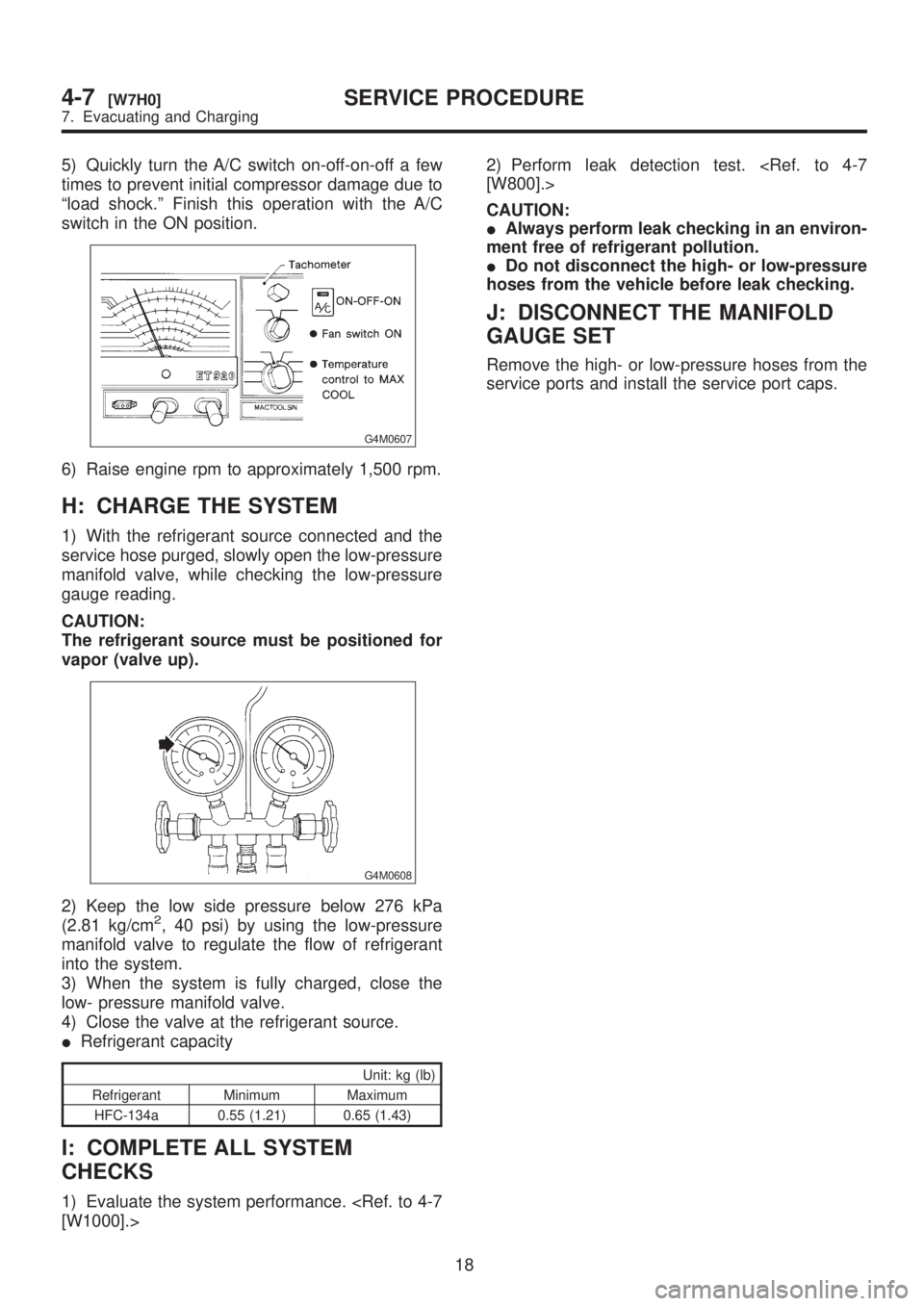
5) Quickly turn the A/C switch on-off-on-off a few
times to prevent initial compressor damage due to
ªload shock.º Finish this operation with the A/C
switch in the ON position.
G4M0607
6) Raise engine rpm to approximately 1,500 rpm.
H: CHARGE THE SYSTEM
1) With the refrigerant source connected and the
service hose purged, slowly open the low-pressure
manifold valve, while checking the low-pressure
gauge reading.
CAUTION:
The refrigerant source must be positioned for
vapor (valve up).
G4M0608
2) Keep the low side pressure below 276 kPa
(2.81 kg/cm2, 40 psi) by using the low-pressure
manifold valve to regulate the flow of refrigerant
into the system.
3) When the system is fully charged, close the
low- pressure manifold valve.
4) Close the valve at the refrigerant source.
IRefrigerant capacity
Unit: kg (lb)
Refrigerant Minimum Maximum
HFC-134a 0.55 (1.21) 0.65 (1.43)
I: COMPLETE ALL SYSTEM
CHECKS
1) Evaluate the system performance.
CAUTION:
IAlways perform leak checking in an environ-
ment free of refrigerant pollution.
IDo not disconnect the high- or low-pressure
hoses from the vehicle before leak checking.
J: DISCONNECT THE MANIFOLD
GAUGE SET
Remove the high- or low-pressure hoses from the
service ports and install the service port caps.
18
4-7[W7H0]SERVICE PROCEDURE
7. Evacuating and Charging
Page 995 of 1456
8. Leak Testing
A: INSPECTION
The following points should be kept in mind when
conducting a refrigerant leak test.
1) The A/C system to be tested must have an
adequate refrigerant charge to begin with.
2) The area where the leak test is conducted must
be free of wind and drafts, with still air being the
ideal condition.
3) The atmosphere where the leak test is con-
ducted must be free of refrigerant contamination.
4) Operate the A/C system for approx. 10 minutes,
then turn the engine off an begin the leak test.
5) Refrigerant gas is heavier than air, therefore
always hold the probe below the connection being
tested.
6) When checking for a leak along a length of
hose or tube, the leak detector probe must be
moved slowly, approx. 25 mm (1 in) per second
making sure probe does not come in contact with
the component being tested.
7) When checking for a leak at a certain point, the
leak detector probe must be held at that point for
at least 5 seconds.
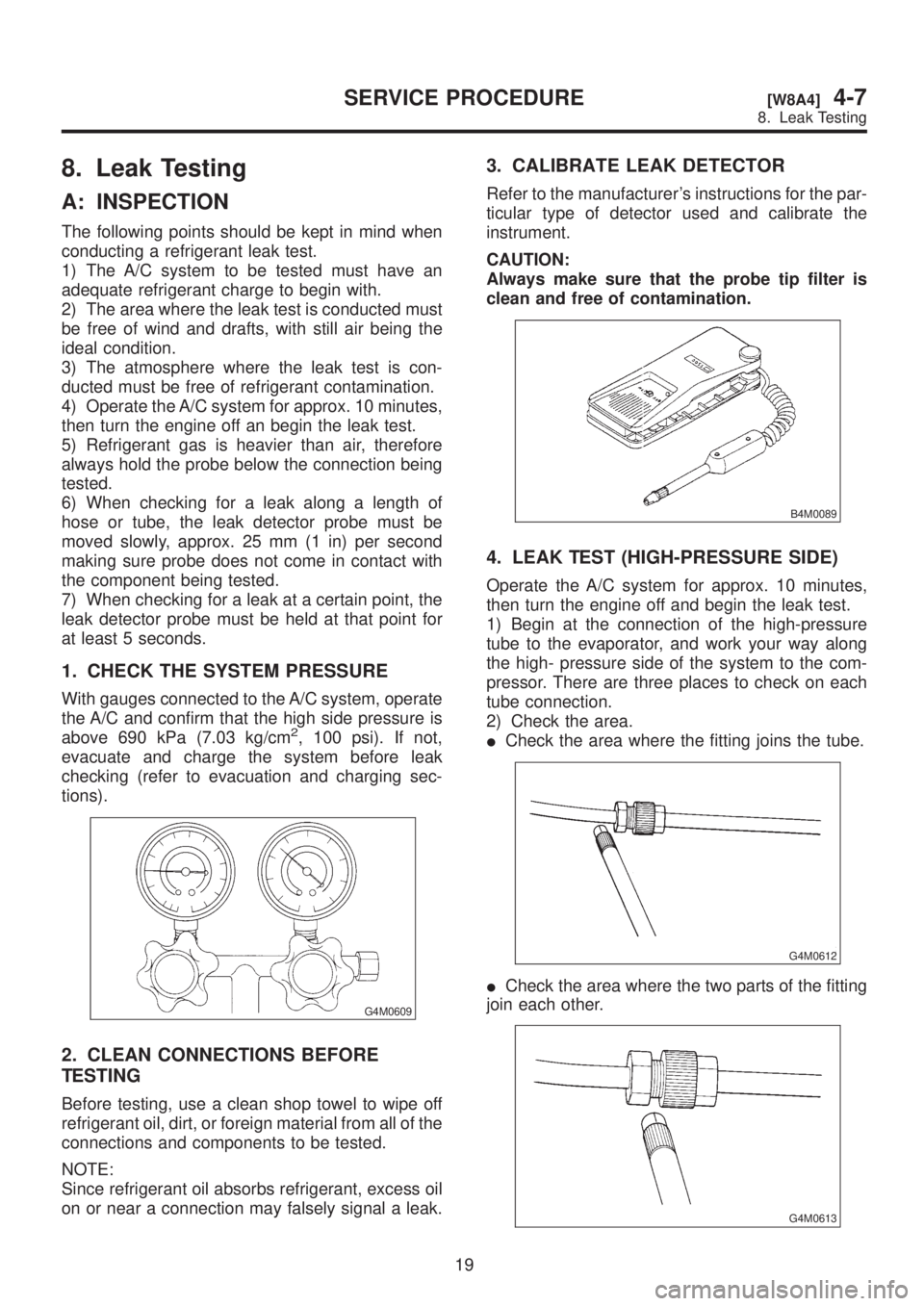
1. CHECK THE SYSTEM PRESSURE
With gauges connected to the A/C system, operate
the A/C and confirm that the high side pressure is
above 690 kPa (7.03 kg/cm
2, 100 psi). If not,
evacuate and charge the system before leak
checking (refer to evacuation and charging sec-
tions).
G4M0609
2. CLEAN CONNECTIONS BEFORE
TESTING
Before testing, use a clean shop towel to wipe off
refrigerant oil, dirt, or foreign material from all of the
connections and components to be tested.
NOTE:
Since refrigerant oil absorbs refrigerant, excess oil
on or near a connection may falsely signal a leak.
3. CALIBRATE LEAK DETECTOR
Refer to the manufacturer's instructions for the par-
ticular type of detector used and calibrate the
instrument.
CAUTION:
Always make sure that the probe tip filter is
clean and free of contamination.
B4M0089
4. LEAK TEST (HIGH-PRESSURE SIDE)
Operate the A/C system for approx. 10 minutes,
then turn the engine off and begin the leak test.
1) Begin at the connection of the high-pressure
tube to the evaporator, and work your way along
the high- pressure side of the system to the com-
pressor. There are three places to check on each
tube connection.
2) Check the area.
ICheck the area where the fitting joins the tube.
G4M0612
ICheck the area where the two parts of the fitting
join each other.
G4M0613
19
[W8A4]4-7SERVICE PROCEDURE
8. Leak Testing
Page 997 of 1456
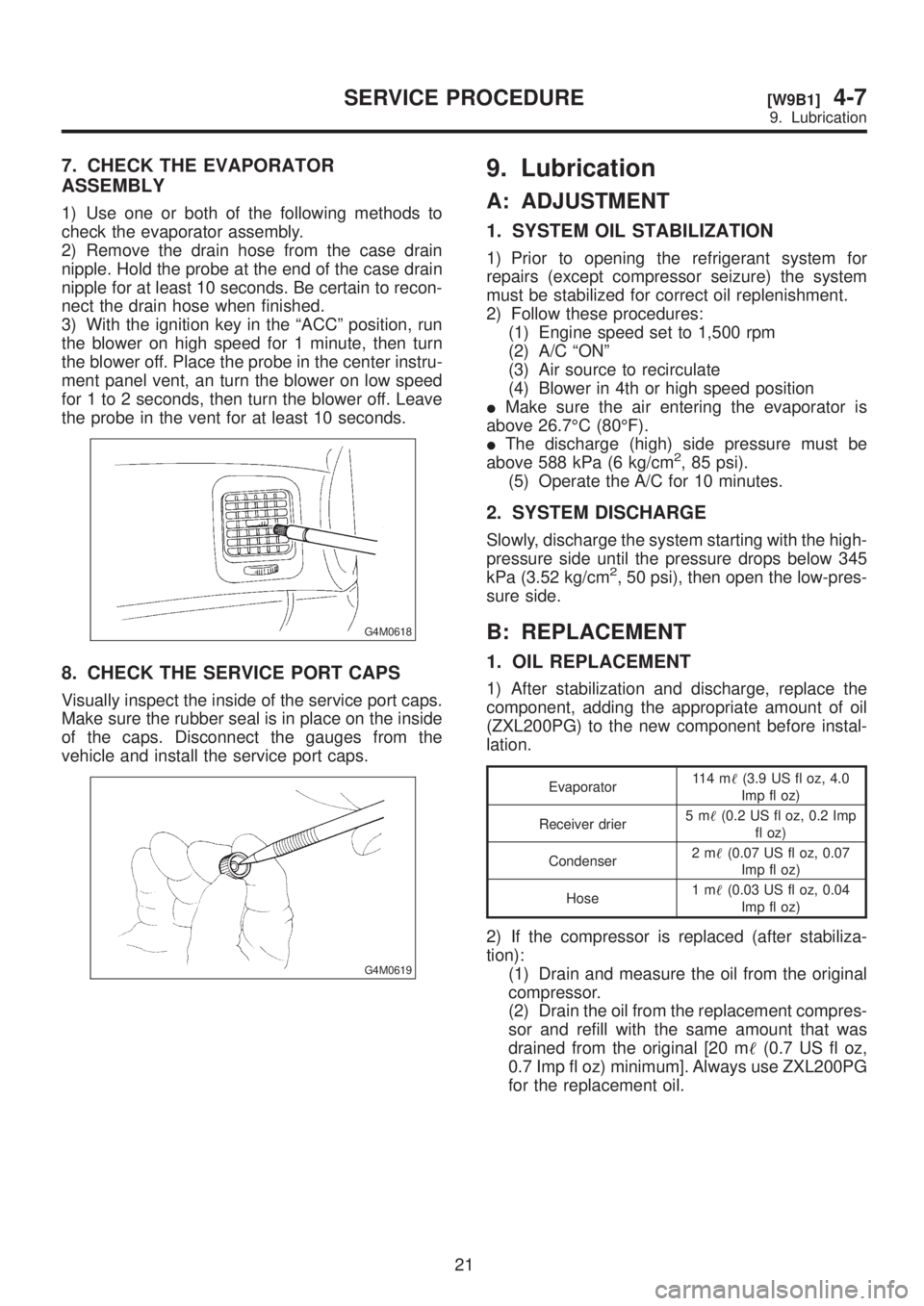
7. CHECK THE EVAPORATOR
ASSEMBLY
1) Use one or both of the following methods to
check the evaporator assembly.
2) Remove the drain hose from the case drain
nipple. Hold the probe at the end of the case drain
nipple for at least 10 seconds. Be certain to recon-
nect the drain hose when finished.
3) With the ignition key in the ªACCº position, run
the blower on high speed for 1 minute, then turn
the blower off. Place the probe in the center instru-
ment panel vent, an turn the blower on low speed
for 1 to 2 seconds, then turn the blower off. Leave
the probe in the vent for at least 10 seconds.
G4M0618
8. CHECK THE SERVICE PORT CAPS
Visually inspect the inside of the service port caps.
Make sure the rubber seal is in place on the inside
of the caps. Disconnect the gauges from the
vehicle and install the service port caps.
G4M0619
9. Lubrication
A: ADJUSTMENT
1. SYSTEM OIL STABILIZATION
1) Prior to opening the refrigerant system for
repairs (except compressor seizure) the system
must be stabilized for correct oil replenishment.
2) Follow these procedures:
(1) Engine speed set to 1,500 rpm
(2) A/C ªONº
(3) Air source to recirculate
(4) Blower in 4th or high speed position
IMake sure the air entering the evaporator is
above 26.7ÉC (80ÉF).
IThe discharge (high) side pressure must be
above 588 kPa (6 kg/cm
2, 85 psi).
(5) Operate the A/C for 10 minutes.
2. SYSTEM DISCHARGE
Slowly, discharge the system starting with the high-
pressure side until the pressure drops below 345
kPa (3.52 kg/cm
2, 50 psi), then open the low-pres-
sure side.
B: REPLACEMENT
1. OIL REPLACEMENT
1) After stabilization and discharge, replace the
component, adding the appropriate amount of oil
(ZXL200PG) to the new component before instal-
lation.
Evaporator11 4 m(3.9 US fl oz, 4.0
Imp fl oz)
Receiver drier5m(0.2 US fl oz, 0.2 Imp
fl oz)
Condenser2m(0.07 US fl oz, 0.07
Imp fl oz)
Hose1m(0.03 US fl oz, 0.04
Imp fl oz)
2) If the compressor is replaced (after stabiliza-
tion):
(1) Drain and measure the oil from the original
compressor.
(2) Drain the oil from the replacement compres-
sor and refill with the same amount that was
drained from the original [20 m(0.7 US fl oz,
0.7 Imp fl oz) minimum]. Always use ZXL200PG
for the replacement oil.
21
[W9B1]4-7SERVICE PROCEDURE
9. Lubrication
Page 998 of 1456
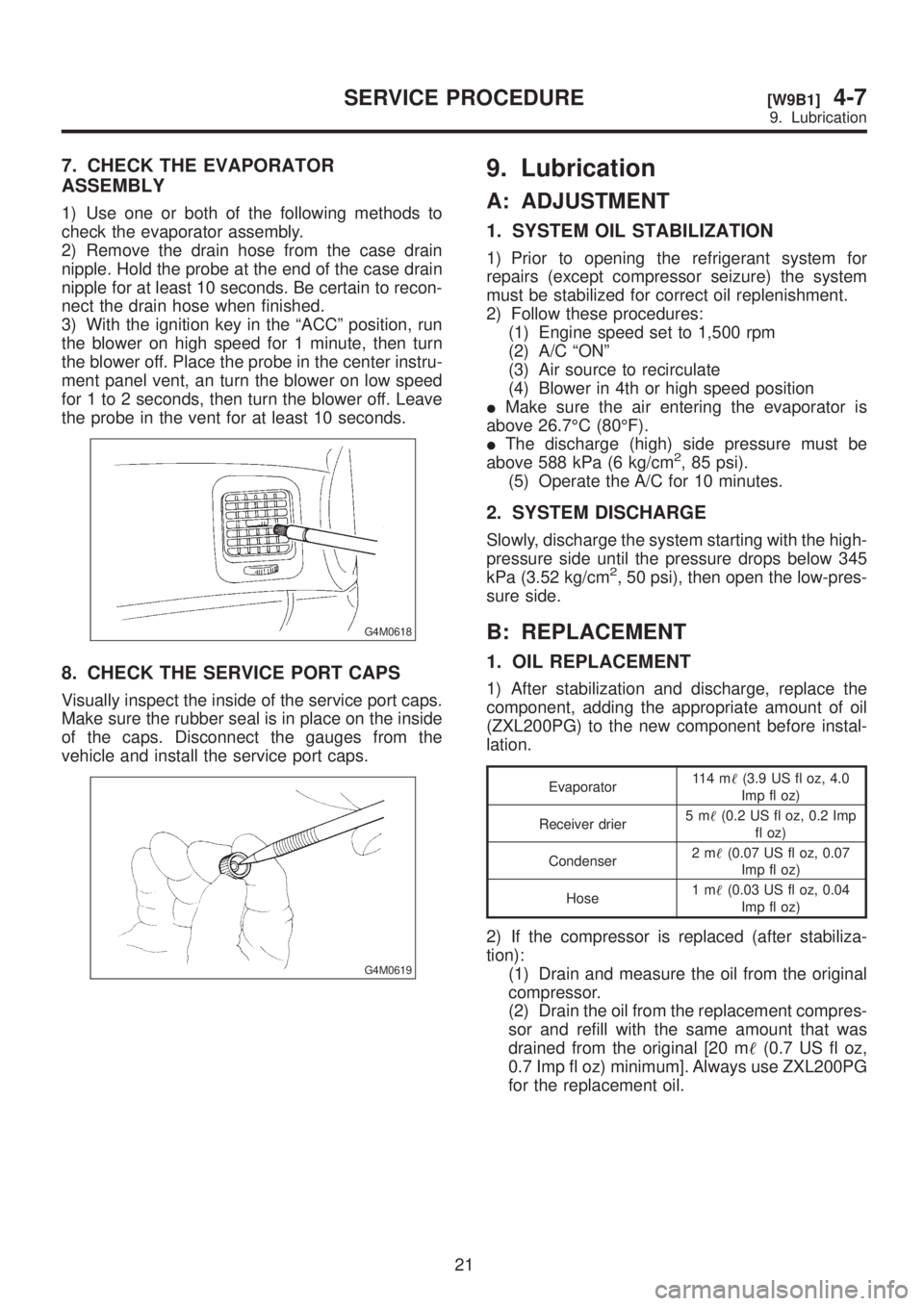
7. CHECK THE EVAPORATOR
ASSEMBLY
1) Use one or both of the following methods to
check the evaporator assembly.
2) Remove the drain hose from the case drain
nipple. Hold the probe at the end of the case drain
nipple for at least 10 seconds. Be certain to recon-
nect the drain hose when finished.
3) With the ignition key in the ªACCº position, run
the blower on high speed for 1 minute, then turn
the blower off. Place the probe in the center instru-
ment panel vent, an turn the blower on low speed
for 1 to 2 seconds, then turn the blower off. Leave
the probe in the vent for at least 10 seconds.
G4M0618
8. CHECK THE SERVICE PORT CAPS
Visually inspect the inside of the service port caps.
Make sure the rubber seal is in place on the inside
of the caps. Disconnect the gauges from the
vehicle and install the service port caps.
G4M0619
9. Lubrication
A: ADJUSTMENT
1. SYSTEM OIL STABILIZATION
1) Prior to opening the refrigerant system for
repairs (except compressor seizure) the system
must be stabilized for correct oil replenishment.
2) Follow these procedures:
(1) Engine speed set to 1,500 rpm
(2) A/C ªONº
(3) Air source to recirculate
(4) Blower in 4th or high speed position
IMake sure the air entering the evaporator is
above 26.7ÉC (80ÉF).
IThe discharge (high) side pressure must be
above 588 kPa (6 kg/cm
2, 85 psi).
(5) Operate the A/C for 10 minutes.
2. SYSTEM DISCHARGE
Slowly, discharge the system starting with the high-
pressure side until the pressure drops below 345
kPa (3.52 kg/cm
2, 50 psi), then open the low-pres-
sure side.
B: REPLACEMENT
1. OIL REPLACEMENT
1) After stabilization and discharge, replace the
component, adding the appropriate amount of oil
(ZXL200PG) to the new component before instal-
lation.
Evaporator11 4 m(3.9 US fl oz, 4.0
Imp fl oz)
Receiver drier5m(0.2 US fl oz, 0.2 Imp
fl oz)
Condenser2m(0.07 US fl oz, 0.07
Imp fl oz)
Hose1m(0.03 US fl oz, 0.04
Imp fl oz)
2) If the compressor is replaced (after stabiliza-
tion):
(1) Drain and measure the oil from the original
compressor.
(2) Drain the oil from the replacement compres-
sor and refill with the same amount that was
drained from the original [20 m(0.7 US fl oz,
0.7 Imp fl oz) minimum]. Always use ZXL200PG
for the replacement oil.
21
[W9B1]4-7SERVICE PROCEDURE
9. Lubrication
Page 1017 of 1456
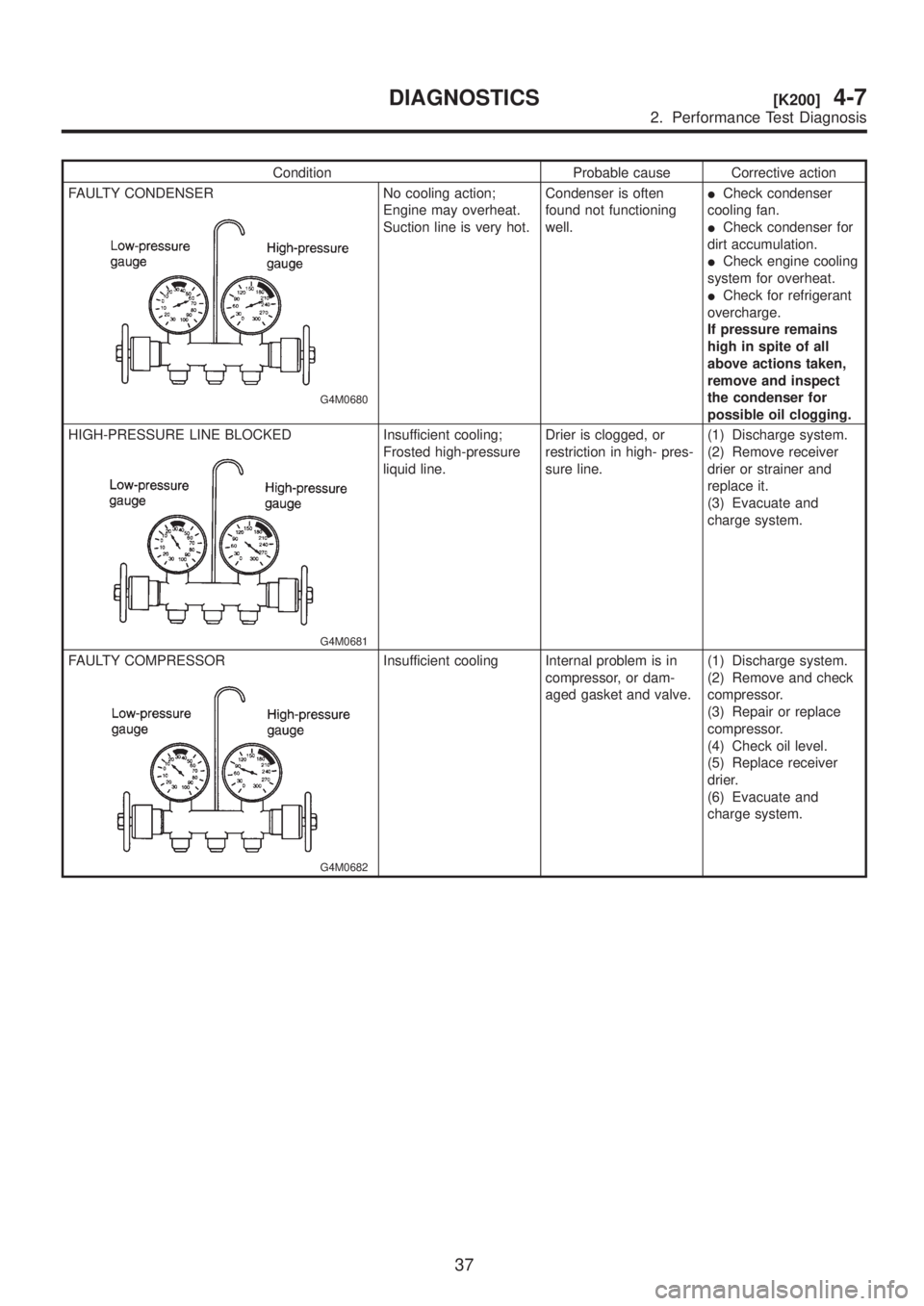
Condition Probable cause Corrective action
FAULTY CONDENSER
G4M0680
No cooling action;
Engine may overheat.
Suction line is very hot.Condenser is often
found not functioning
well.ICheck condenser
cooling fan.
ICheck condenser for
dirt accumulation.
ICheck engine cooling
system for overheat.
ICheck for refrigerant
overcharge.
If pressure remains
high in spite of all
above actions taken,
remove and inspect
the condenser for
possible oil clogging.
HIGH-PRESSURE LINE BLOCKED
G4M0681
Insufficient cooling;
Frosted high-pressure
liquid line.Drier is clogged, or
restriction in high- pres-
sure line.(1) Discharge system.
(2) Remove receiver
drier or strainer and
replace it.
(3) Evacuate and
charge system.
FAULTY COMPRESSOR
G4M0682
Insufficient cooling Internal problem is in
compressor, or dam-
aged gasket and valve.(1) Discharge system.
(2) Remove and check
compressor.
(3) Repair or replace
compressor.
(4) Check oil level.
(5) Replace receiver
drier.
(6) Evacuate and
charge system.
37
[K200]4-7DIAGNOSTICS
2. Performance Test Diagnosis
Page 1215 of 1456
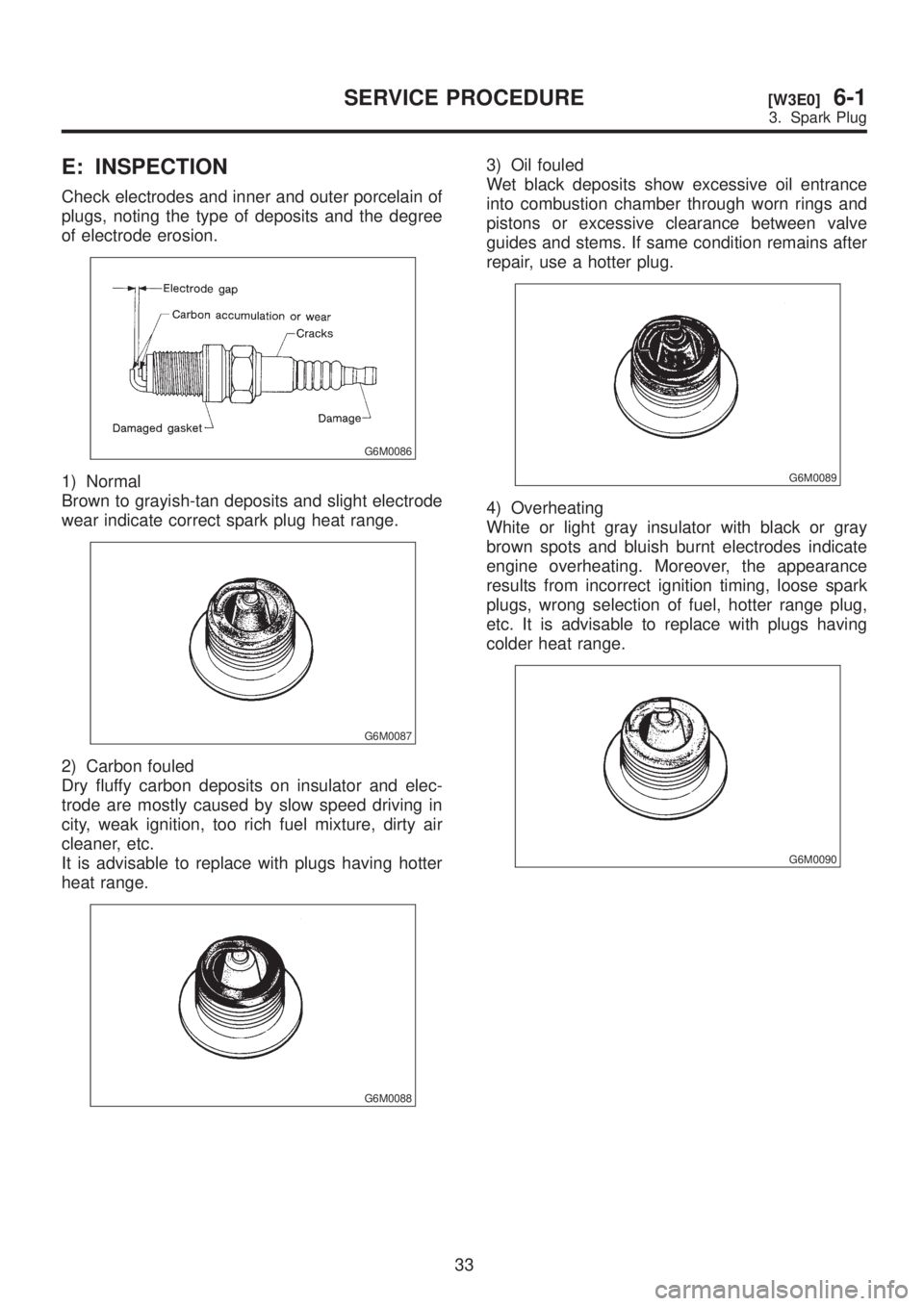
E: INSPECTION
Check electrodes and inner and outer porcelain of
plugs, noting the type of deposits and the degree
of electrode erosion.
G6M0086
1) Normal
Brown to grayish-tan deposits and slight electrode
wear indicate correct spark plug heat range.
G6M0087
2) Carbon fouled
Dry fluffy carbon deposits on insulator and elec-
trode are mostly caused by slow speed driving in
city, weak ignition, too rich fuel mixture, dirty air
cleaner, etc.
It is advisable to replace with plugs having hotter
heat range.
G6M0088
3) Oil fouled
Wet black deposits show excessive oil entrance
into combustion chamber through worn rings and
pistons or excessive clearance between valve
guides and stems. If same condition remains after
repair, use a hotter plug.
G6M0089
4) Overheating
White or light gray insulator with black or gray
brown spots and bluish burnt electrodes indicate
engine overheating. Moreover, the appearance
results from incorrect ignition timing, loose spark
plugs, wrong selection of fuel, hotter range plug,
etc. It is advisable to replace with plugs having
colder heat range.
G6M0090
33
[W3E0]6-1SERVICE PROCEDURE
3. Spark Plug