ECU SUBARU OUTBACK 2005 4.G User Guide
[x] Cancel search | Manufacturer: SUBARU, Model Year: 2005, Model line: OUTBACK, Model: SUBARU OUTBACK 2005 4.GPages: 627, PDF Size: 6.42 MB
Page 69 of 627
1-38
Seat, seatbelt and SRS airbags
Child restraint systems
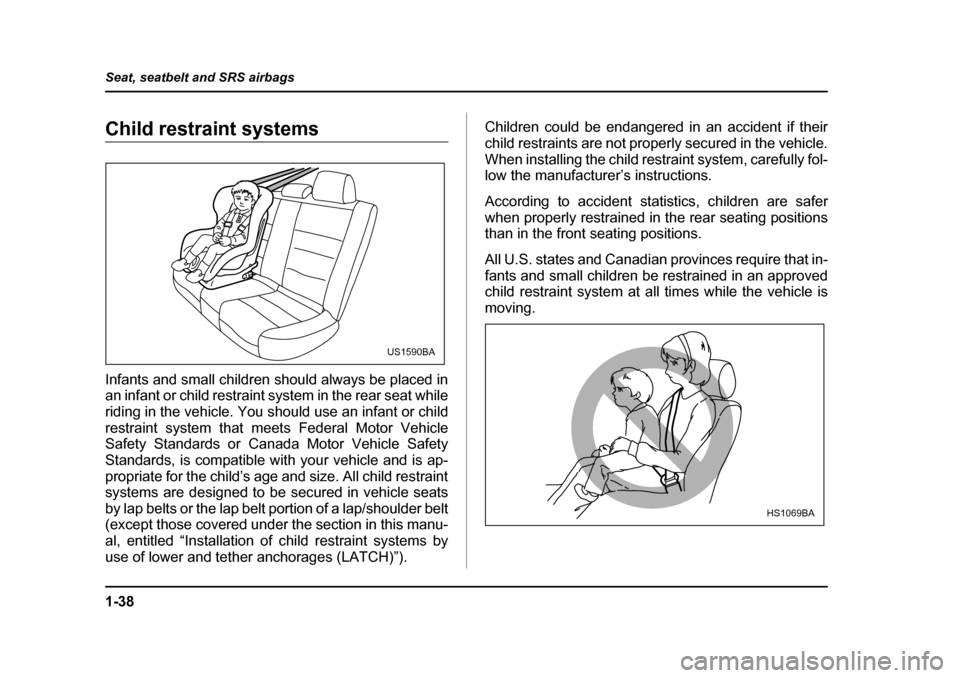
Infants and small children should always be placed in
an infant or child restraint system in the rear seat while
riding in the vehicle. You should use an infant or child
restraint system that meets Federal Motor Vehicle
Safety Standards or Canada Motor Vehicle Safety
Standards, is compatible with your vehicle and is ap-
propriate for the child’s age and size. All child restraint
systems are designed to be secured in vehicle seats
by lap belts or the lap belt portion of a lap/shoulder belt
(except those covered under the section in this manu-
al, entitled “Installation of child restraint systems by
use of lower and tether anchorages (LATCH)”).
Children could be endangered in an accident if their
child restraints are not properly secured in the vehicle.When installing the child restraint system, carefully fol-
low the manufacturer’s instructions.
According to accident statistics, children are safer
when properly restrained in the rear seating positions
than in the front seating positions.
All U.S. states and Canadian provinces require that in-
fants and small children be restrained in an approved
child restraint system at all times while the vehicle is
moving.
US1590BA
HS1069BA
Page 71 of 627
1-40
Seat, seatbelt and SRS airbags
!
Where to place a child restraint system
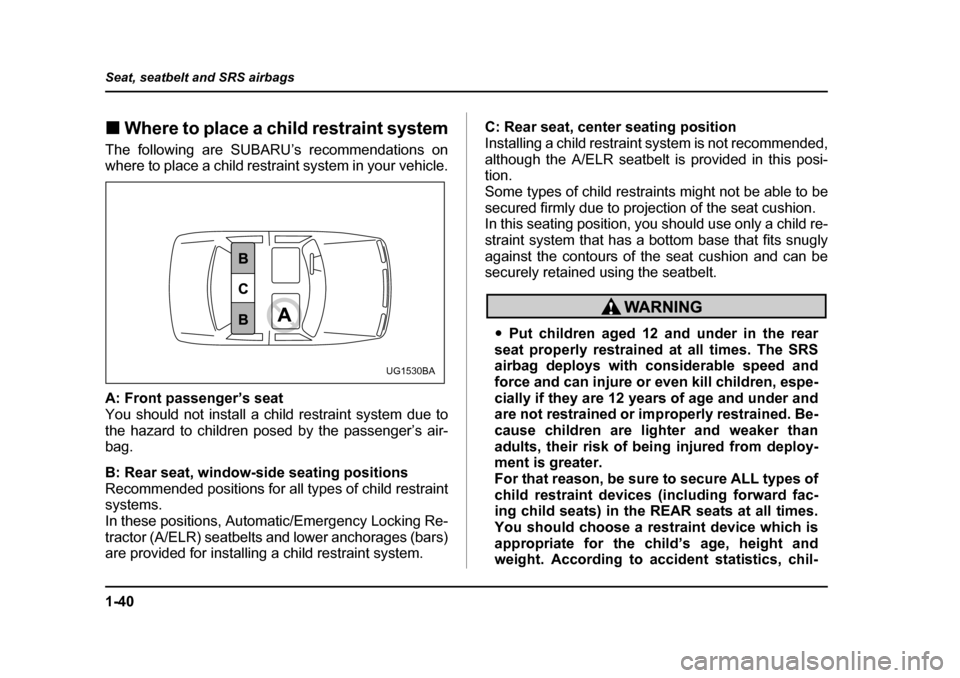
The following are SUBARU’s recommendations on
where to place a child restraint system in your vehicle.
A: Front passenger’s seat
You should not install a child restraint system due to
the hazard to children posed by the passenger’s air-
bag.
B: Rear seat, window-side seating positions
Recommended positions for all types of child restraint
systems.
In these positions, Automatic/Emergency Locking Re-
tractor (A/ELR) seatbelts and lower anchorages (bars)
are provided for installing a child restraint system. C: Rear seat, center seating position
Installing a child restraint system is not recommended,
although the A/ELR seatbelt is provided in this posi- tion.
Some types of child restraints might not be able to be
secured firmly due to projection of the seat cushion.
In this seating position, you should use only a child re-
straint system that has a bottom base that fits snugly
against the contours of the seat cushion and can be
securely retained using the seatbelt.
"
Put children aged 12 and under in the rear
seat properly restrained at all times. The SRS
airbag deploys with considerable speed and
force and can injure or even kill children, espe-
cially if they are 12 years of age and under and
are not restrained or improperly restrained. Be-
cause children are lighter and weaker than
adults, their risk of being injured from deploy-
ment is greater.
For that reason, be sure to secure ALL types of
child restraint devices (including forward fac-
ing child seats) in the REAR seats at all times.
You should choose a restraint device which is
appropriate for the child’s age, height and
weight. According to accident statistics, chil-
UG1530BA
Page 73 of 627
1-42
Seat, seatbelt and SRS airbags
system. Also it is important for you to make sure that
the child restraint system is compatible with the vehi-
cle in which it will be used. !
Installing child restraint systems with
A/ELR seatbelt
"Child restraint systems and seatbelts can be-
come hot in a vehicle that has been closed up
in sunny weather; they could burn a small child.
Check the child restraint system before you
place a child in it. " Do not leave an unsecured child restraint
system in your vehicle. Unsecured child re-
straint systems can be thrown around inside of
the vehicle in a sudden stop, turn or accident; it
can strike and injure vehicle occupants as well
as result in serious injuries or death to the
child.
When you install a child restraint system, fol-
low the manufacturer’s instructions supplied with it. After installing the child restraint sys-
tem, check to ensure that it is held securely in
position. If it is not held tight and secure, the
danger of your child suffering personal injury in
the event of an accident may be increased.
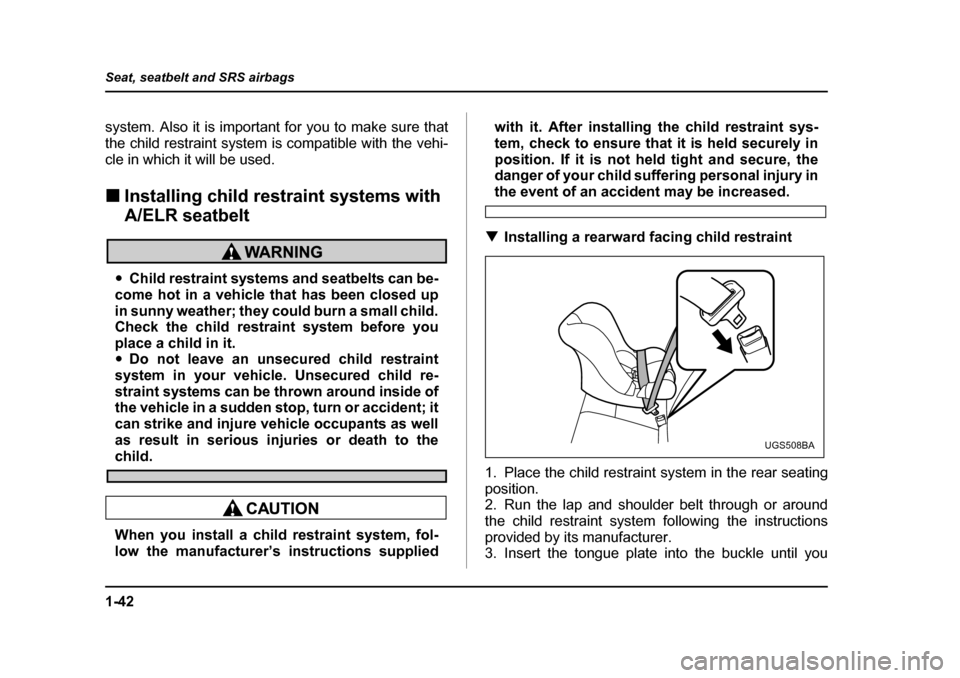
! Installing a rearward facing child restraint
1. Place the child restraint system in the rear seating position.
2. Run the lap and shoulder belt through or around
the child restraint system following the instructions
provided by its manufacturer.
3. Insert the tongue plate into the buckle until you
UGS508BA
Page 74 of 627
1-43
Seat, seatbelt and SRS airbags
– CONTINUED –
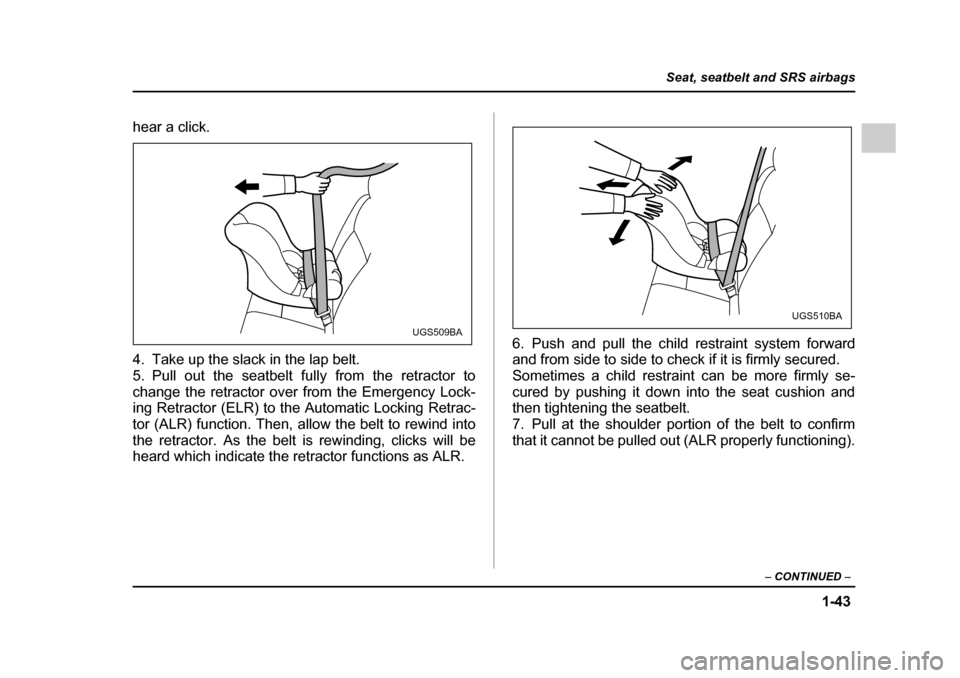
hear a click.
4. Take up the slack in the lap belt.
5. Pull out the seatbelt fully from the retractor to
change the retractor over from the Emergency Lock-
ing Retractor (ELR) to the Automatic Locking Retrac-
tor (ALR) function. Then, allow the belt to rewind into
the retractor. As the belt is rewinding, clicks will be
heard which indicate the retractor functions as ALR. 6. Push and pull the child restraint system forward
and from side to side to check if it is firmly secured.
Sometimes a child restraint can be more firmly se-
cured by pushing it down into the seat cushion and
then tightening the seatbelt.
7. Pull at the shoulder portion of the belt to confirm
that it cannot be pulled out (ALR properly functioning).
UGS509BA
UGS510BA
Page 76 of 627
1-45
Seat, seatbelt and SRS airbags
– CONTINUED –
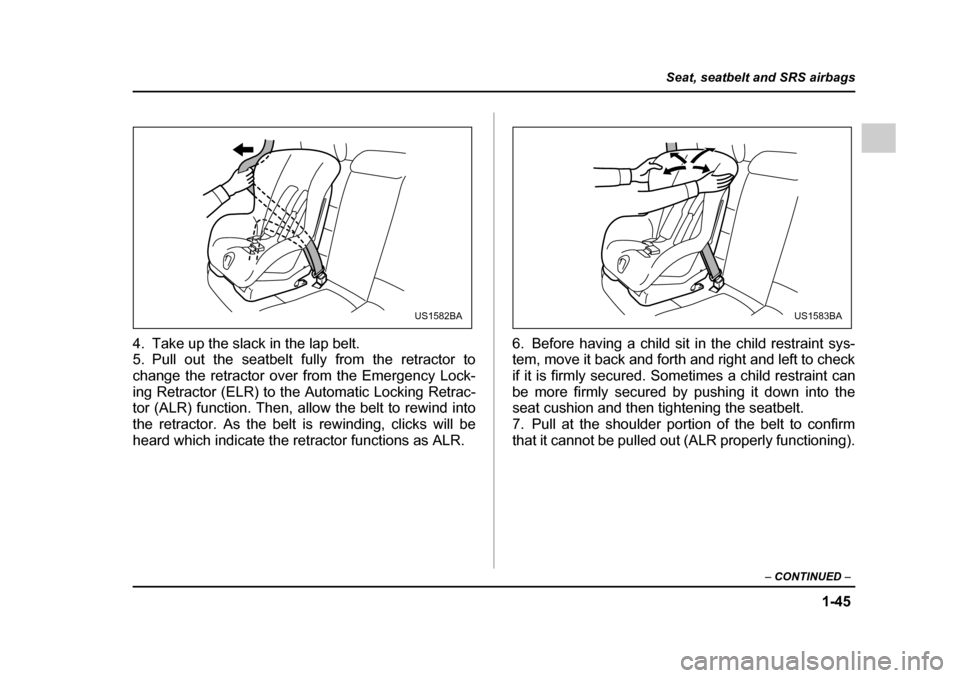
4. Take up the slack in the lap belt.
5. Pull out the seatbelt fully from the retractor to
change the retractor over from the Emergency Lock-
ing Retractor (ELR) to the Automatic Locking Retrac-
tor (ALR) function. Then, allow the belt to rewind into
the retractor. As the belt is rewinding, clicks will be
heard which indicate the retractor functions as ALR. 6. Before having a child sit in the child restraint sys-
tem, move it back and forth and right and left to check
if it is firmly secured. Sometimes a child restraint can
be more firmly secured by pushing it down into the
seat cushion and then tightening the seatbelt.
7. Pull at the shoulder portion of the belt to confirm
that it cannot be pulled out (ALR properly functioning).
US1582BAUS1583BA
Page 78 of 627
1-47
Seat, seatbelt and SRS airbags
– CONTINUED –
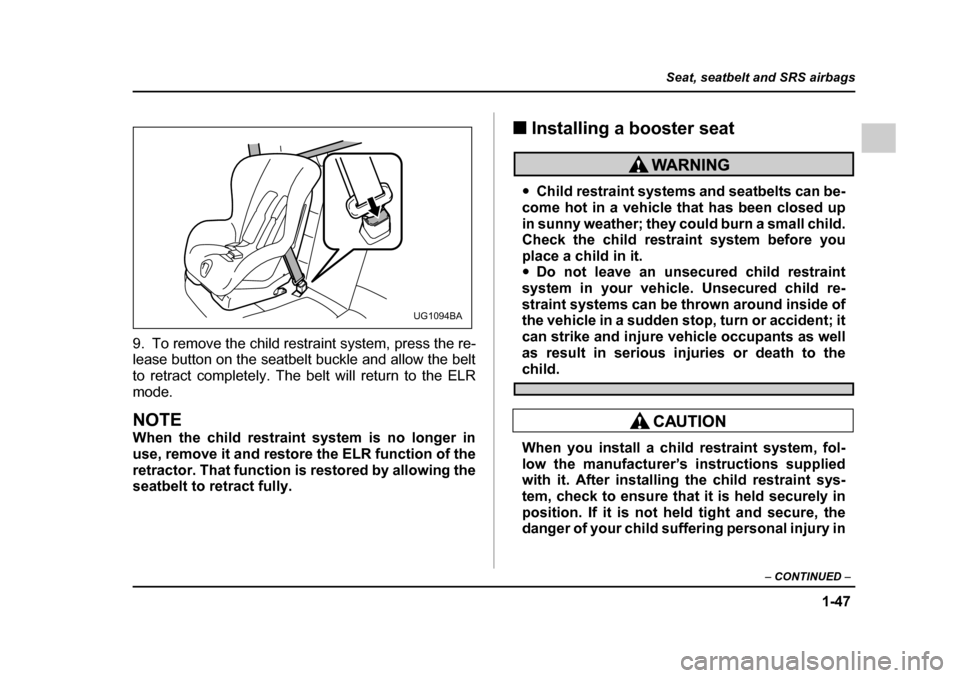
9. To remove the child restraint system, press the re-
lease button on the seatbelt buckle and allow the belt
to retract completely. The belt will return to the ELR
mode.
NOTE
When the child restraint system is no longer in
use, remove it and restore the ELR function of the
retractor. That function is restored by allowing the
seatbelt to retract fully. !
Installing a booster seat
"Child restraint systems and seatbelts can be-
come hot in a vehicle that has been closed up
in sunny weather; they could burn a small child.
Check the child restraint system before you
place a child in it. " Do not leave an unsecured child restraint
system in your vehicle. Unsecured child re-
straint systems can be thrown around inside of
the vehicle in a sudden stop, turn or accident; it
can strike and injure vehicle occupants as well
as result in serious injuries or death to the
child.
When you install a child restraint system, fol-
low the manufacturer’s instructions supplied
with it. After installing the child restraint sys-
tem, check to ensure that it is held securely in
position. If it is not held tight and secure, the
danger of your child suffering personal injury in
UG1094BA
Page 80 of 627
1-49
Seat, seatbelt and SRS airbags
– CONTINUED –
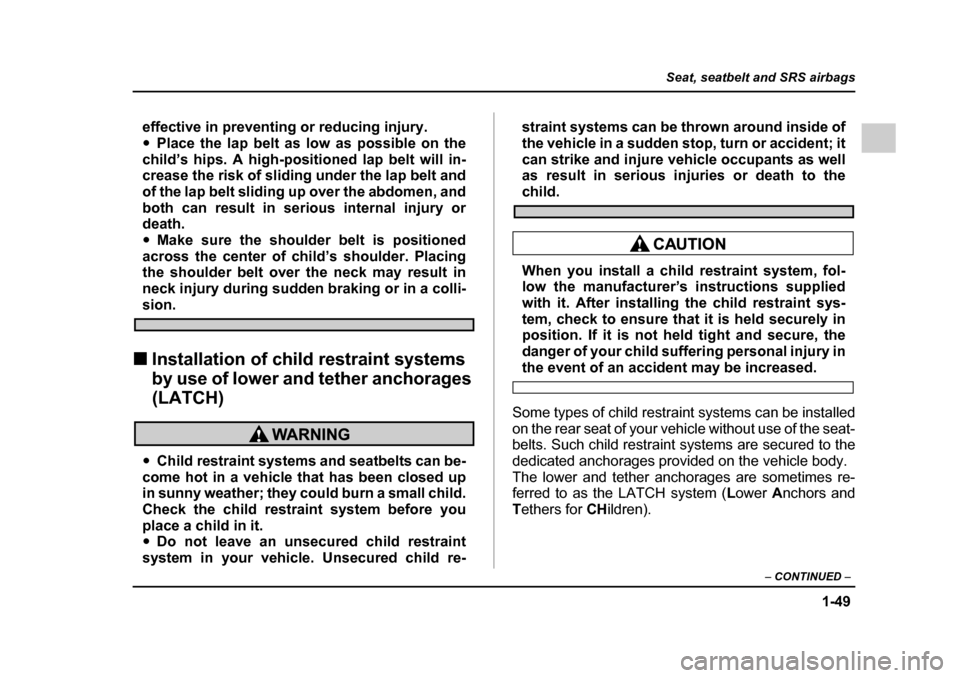
effective in preventing or reducing injury. "Place the lap belt as low as possible on the
child’s hips. A high-positioned lap belt will in-
crease the risk of sliding under the lap belt and
of the lap belt sliding up over the abdomen, and
both can result in serious internal injury or
death. " Make sure the shoulder belt is positioned
across the center of child’s shoulder. Placing
the shoulder belt over the neck may result in
neck injury during sudden braking or in a colli-
sion.
! Installation of child restraint systems
by use of lower and tether anchorages
(LATCH)
"Child restraint systems and seatbelts can be-
come hot in a vehicle that has been closed up
in sunny weather; they could burn a small child.
Check the child restraint system before you
place a child in it." Do not leave an unsecured child restraint
system in your vehicle. Unsecured child re- straint systems can be thrown around inside of
the vehicle in a sudden stop, turn or accident; it
can strike and injure vehicle occupants as well
as result in serious injuries or death to the
child.
When you install a child restraint system, fol-
low the manufacturer’s instructions supplied
with it. After installing the child restraint sys-
tem, check to ensure that it is held securely in
position. If it is not held tight and secure, the
danger of your child suffering personal injury in
the event of an accident may be increased.
Some types of child restraint systems can be installed
on the rear seat of your vehicle without use of the seat-
belts. Such child restraint systems are secured to the
dedicated anchorages provided on the vehicle body.
The lower and tether anchorages are sometimes re-
ferred to as the LATCH system ( Lower Anchors and
T ethers for CHildren).
Page 83 of 627
1-52
Seat, seatbelt and SRS airbags
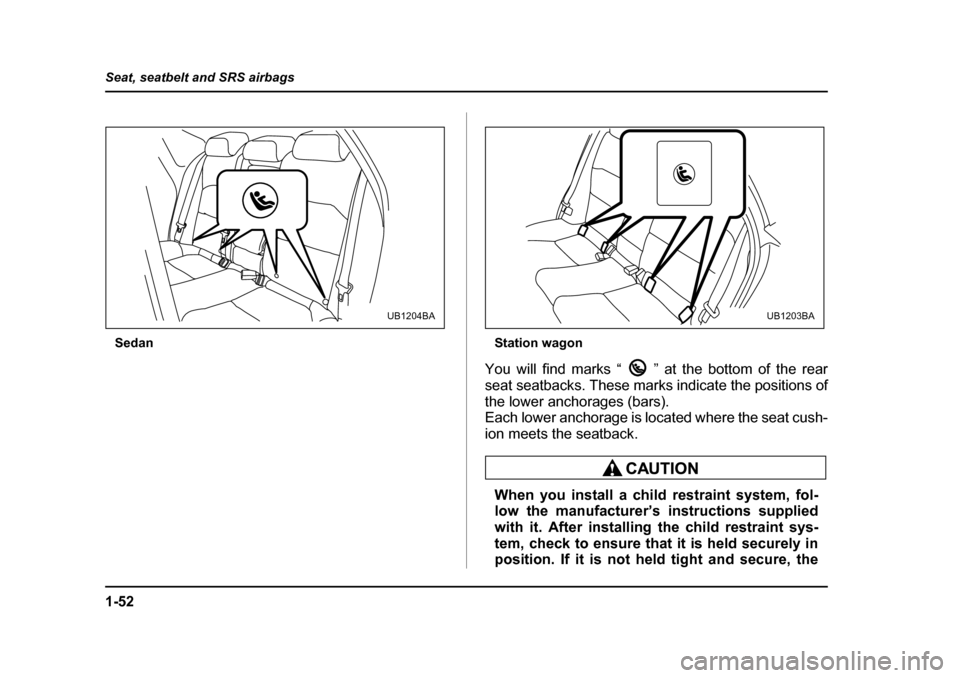
Sedan
Station wagon
You will find marks “ ” at the bottom of the rear
seat seatbacks. These marks indicate the positions of
the lower anchorages (bars).
Each lower anchorage is located where the seat cush-
ion meets the seatback.
When you install a child restraint system, fol-
low the manufacturer’s instructions supplied
with it. After installing the child restraint sys-
tem, check to ensure that it is held securely in
position. If it is not held tight and secure, the
UB1204BAUB1203BA
Page 85 of 627
1-54
Seat, seatbelt and SRS airbags
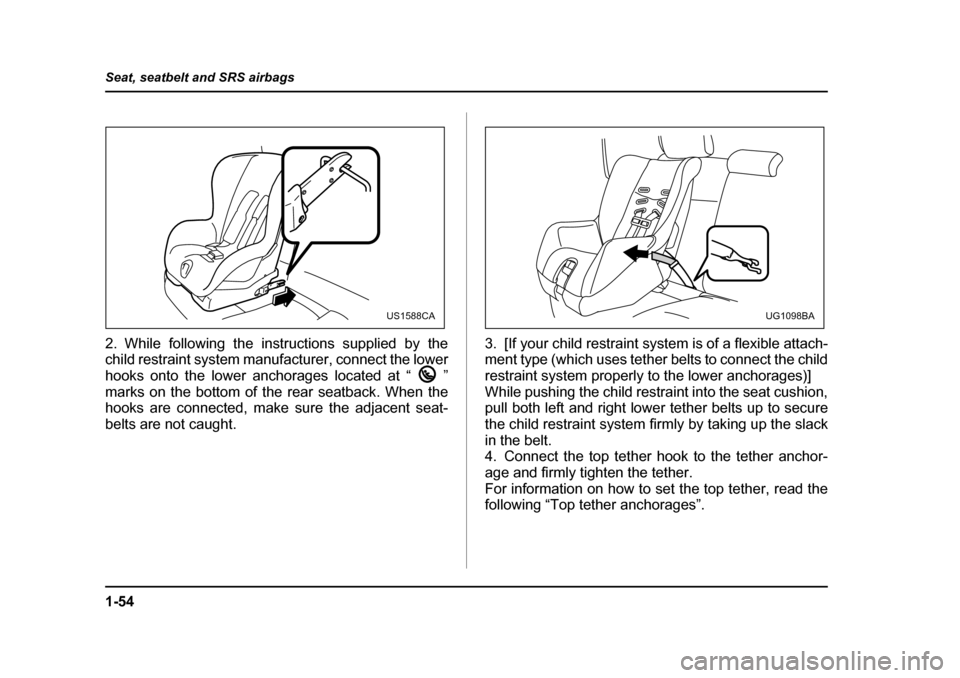
2. While following the instructions supplied by the
child restraint system manufacturer, connect the lower
hooks onto the lower anchorages located at “ ”
marks on the bottom of the rear seatback. When the
hooks are connected, make sure the adjacent seat-
belts are not caught.
3. [If your child restraint system is of a flexible attach-
ment type (which uses tether belts to connect the child
restraint system properly to the lower anchorages)]
While pushing the child restraint into the seat cushion,
pull both left and right lower tether belts up to secure
the child restraint system firmly by taking up the slack
in the belt.
4. Connect the top tether hook to the tether anchor-
age and firmly tighten the tether.
For information on how to set the top tether, read the
following “Top tether anchorages”.
US1588CAUG1098BA
Page 86 of 627
1-55
Seat, seatbelt and SRS airbags
– CONTINUED –
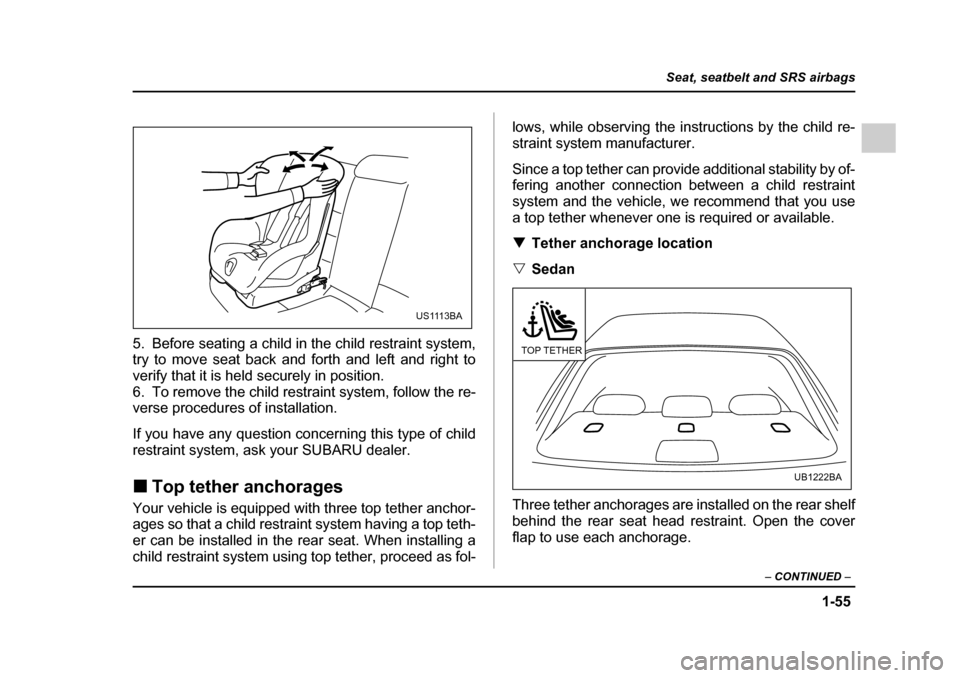
5. Before seating a child in the child restraint system,
try to move seat back and forth and left and right to
verify that it is held securely in position.
6. To remove the child restraint system, follow the re-
verse procedures of installation.
If you have any question concerning this type of child
restraint system, ask your SUBARU dealer. !Top tether anchorages
Your vehicle is equipped with three top tether anchor-
ages so that a child restraint system having a top teth-
er can be installed in the rear seat. When installing a
child restraint system using top tether, proceed as fol- lows, while observing the instructions by the child re-straint system manufacturer.
Since a top tether can provide additional stability by of-
fering another connection between a child restraint
system and the vehicle, we recommend that you use
a top tether whenever one is required or available. !
Tether anchorage location
" Sedan
Three tether anchorages are installed on the rear shelf
behind the rear seat head restraint. Open the cover
flap to use each anchorage.
US1113BA
TOP TETHER
UB1222BA