ECU SUBARU OUTBACK 2005 4.G Workshop Manual
[x] Cancel search | Manufacturer: SUBARU, Model Year: 2005, Model line: OUTBACK, Model: SUBARU OUTBACK 2005 4.GPages: 627, PDF Size: 6.42 MB
Page 431 of 627
8-18
Driving tips
Loading your vehicle
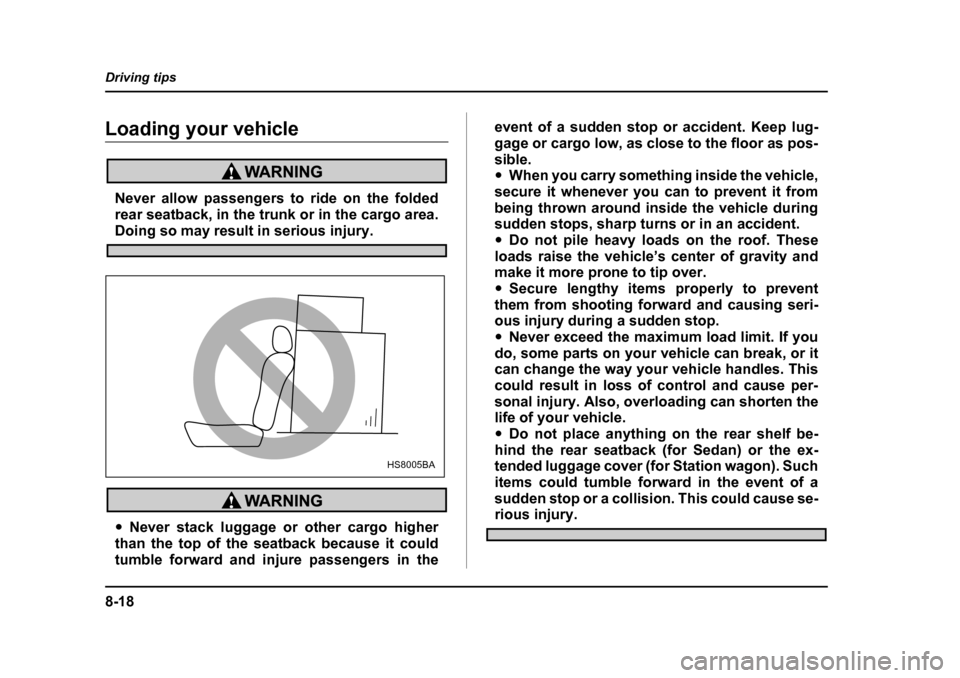
Never allow passengers to ride on the folded
rear seatback, in the trunk or in the cargo area.
Doing so may result in serious injury.
"
Never stack luggage or other cargo higher
than the top of the seatback because it could
tumble forward and injure passengers in the event of a sudden stop or accident. Keep lug-
gage or cargo low, as close to the floor as pos-
sible. "
When you carry something inside the vehicle,
secure it whenever you can to prevent it from
being thrown around inside the vehicle during
sudden stops, sharp turns or in an accident. " Do not pile heavy loads on the roof. These
loads raise the vehicle’s center of gravity and
make it more prone to tip over. " Secure lengthy items properly to prevent
them from shooting forward and causing seri-
ous injury during a sudden stop. " Never exceed the maximum load limit. If you
do, some parts on your vehicle can break, or it
can change the way your vehicle handles. This
could result in loss of control and cause per-
sonal injury. Also, overloading can shorten the
life of your vehicle. " Do not place anything on the rear shelf be-
hind the rear seatback (for Sedan) or the ex-
tended luggage cover (for Station wagon). Such
items could tumble forward in the event of a
sudden stop or a collision. This could cause se-rious injury.
HS8005BA
Page 434 of 627
8-21
Driving tips
– CONTINUED –
!Roof rail and crossbar (if equipped)
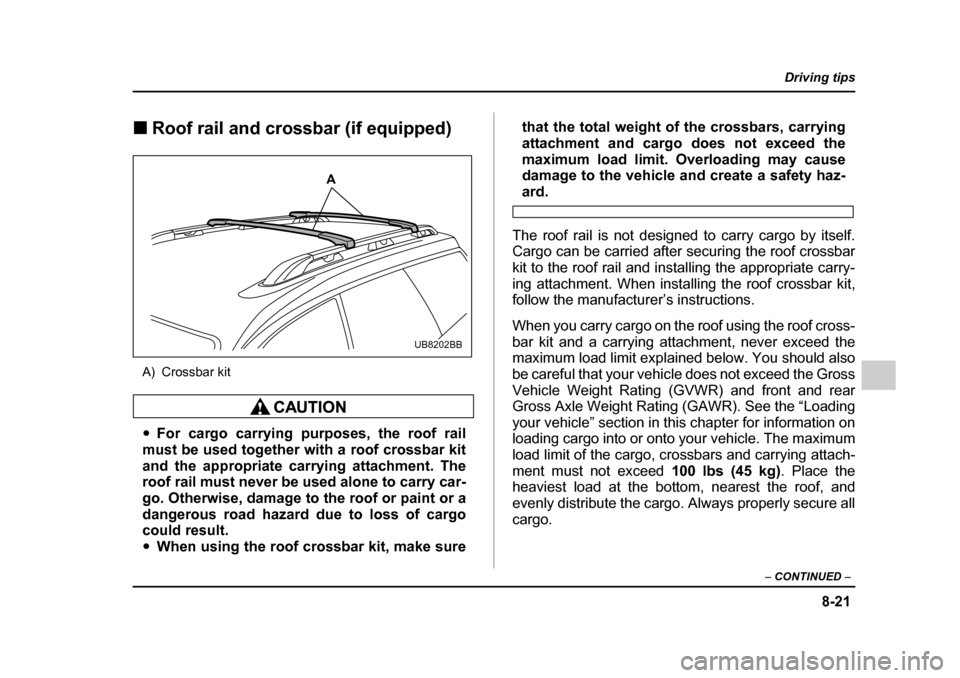
A) Crossbar kit
" For cargo carrying purposes, the roof rail
must be used together with a roof crossbar kit
and the appropriate carrying attachment. The
roof rail must never be used alone to carry car-
go. Otherwise, damage to the roof or paint or a
dangerous road hazard due to loss of cargo
could result. " When using the roof crossbar kit, make sure that the total weight of the crossbars, carrying
attachment and cargo does not exceed the
maximum load limit. Overloading may cause
damage to the vehicle and create a safety haz-
ard.
The roof rail is not designed to carry cargo by itself.
Cargo can be carried after securing the roof crossbar
kit to the roof rail and installing the appropriate carry-
ing attachment. When installing the roof crossbar kit,
follow the manufacturer’s instructions.
When you carry cargo on the roof using the roof cross-
bar kit and a carrying attachment, never exceed the
maximum load limit explained below. You should also
be careful that your vehicle does not exceed the Gross
Vehicle Weight Rating (GVWR) and front and rear
Gross Axle Weight Rating (GAWR). See the “Loading
your vehicle” section in this chapter for information on
loading cargo into or onto your vehicle. The maximum
load limit of the cargo, crossbars and carrying attach-
ment must not exceed 100 lbs (45 kg). Place the
heaviest load at the bottom, nearest the roof, and
evenly distribute the cargo. Always properly secure all cargo.A
UB8202BB
Page 435 of 627
8-22
Driving tips
!
Installing carrying attachments on the cross-
bars
When installing any carrying attachment such as a
bike carrier, ski carrier, kayak carrier, cargo basket,
etc. on the crossbars, follow the manufacturer’s in-
structions and make sure that the attachment is se-
curely fixed to the crossbars. Use only attachments
designed specifically for the crossbars. A set of the
crossbars is designed to carry loads (cargo and at-tachment) of not more than 100 lbs (45 kg). Before
operating the vehicle, make sure that the cargo is
properly secured on the attachment.
NOTE
Remember that the vehicle’s center of gravity is al-
tered with the weight of the load on the roof, thus
affecting the driving characteristics.
Drive carefully. Avoid rapid starts, hard cornering
and abrupt stops. Crosswind effects will be in-
creased. ! Removal and installation of the crossbars
The crossbars can be removed when you do not use the roof to carry cargo. "
To remove the crossbar
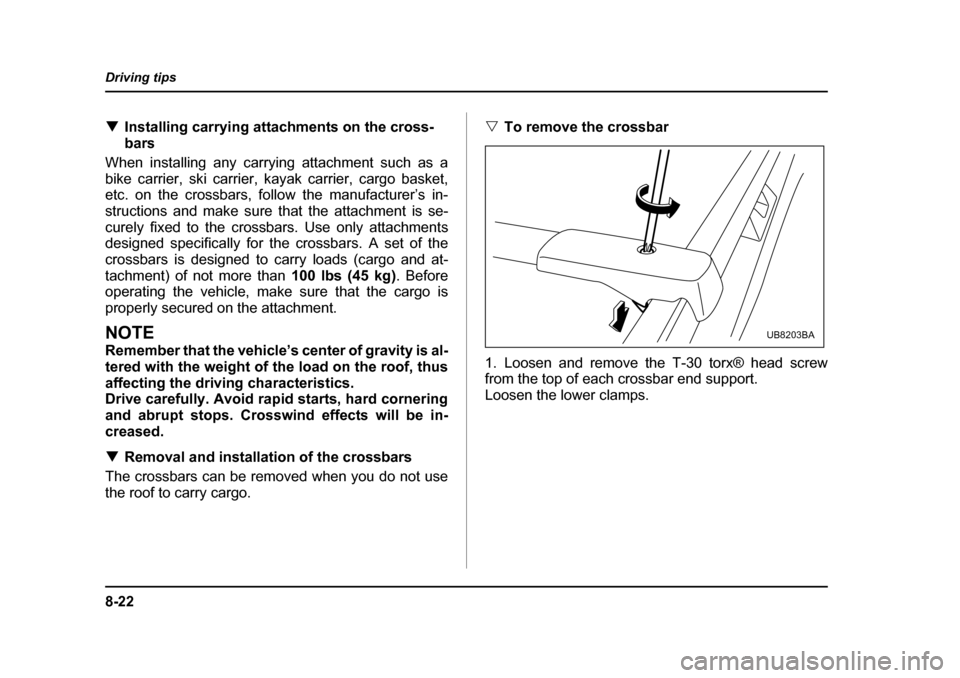
1. Loosen and remove the T-30 torx® head screw
from the top of each crossbar end support.
Loosen the lower clamps.UB8203BA
Page 438 of 627
8-25
Driving tips
– CONTINUED –
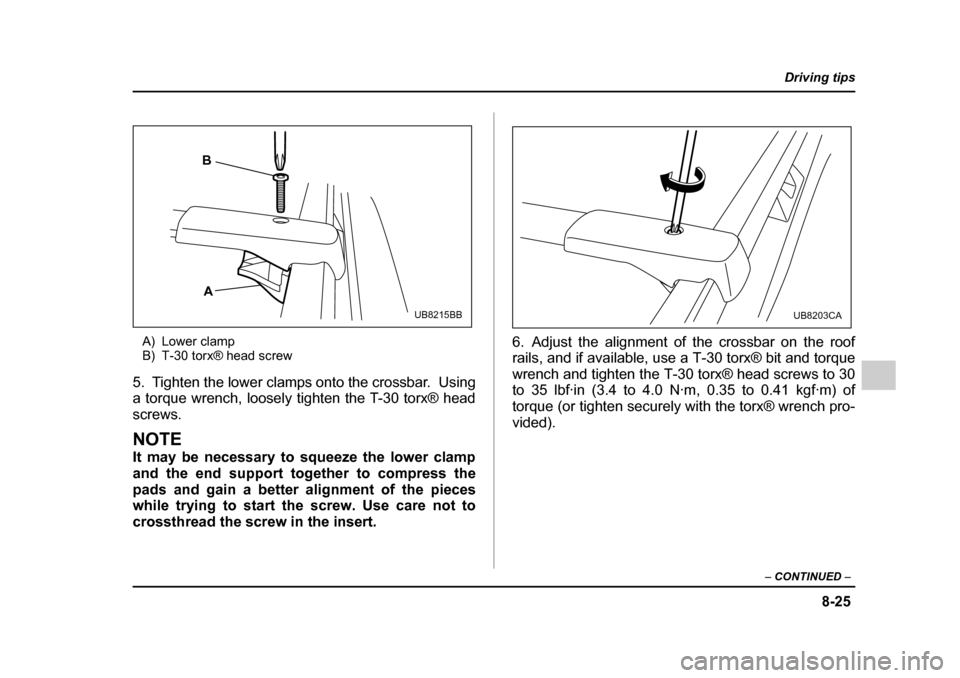
A) Lower clamp
B) T-30 torx® head screw
5. Tighten the lower clamps onto the crossbar. Using
a torque wrench, loosely tighten the T-30 torx® head
screws.
NOTE
It may be necessary to squeeze the lower clamp
and the end support together to compress the
pads and gain a better alignment of the pieces
while trying to start the screw. Use care not to
crossthread the screw in the insert. 6. Adjust the alignment of the crossbar on the roof
rails, and if available, use a T-30 torx® bit and torque
wrench and tighten the T-30 torx® head screws to 30
to 35 lbf·in (3.4 to 4.0 N·m, 0.35 to 0.41 kgf·m) of
torque (or tighten securely with the torx® wrench pro-
vided).
A
B
UB8215BBUB8203CA
Page 441 of 627
8-28
Driving tips
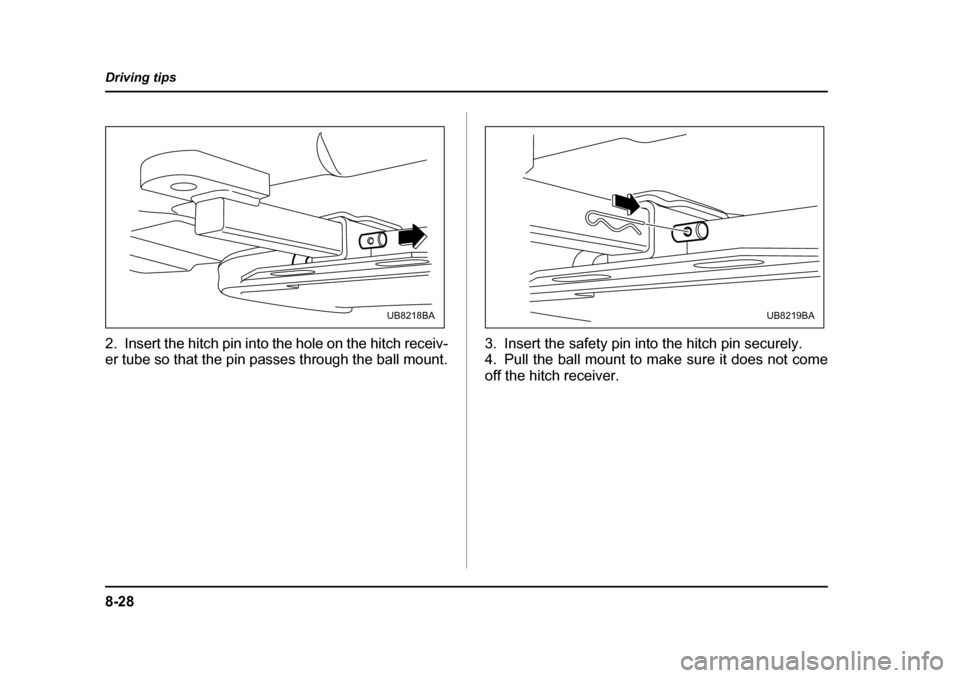
2. Insert the hitch pin into the hole on the hitch receiv-
er tube so that the pin passes through the ball mount.
3. Insert the safety pin into the hitch pin securely.
4. Pull the ball mount to make sure it does not come
off the hitch receiver.
UB8218BAUB8219BA
Page 442 of 627
8-29
Driving tips
– CONTINUED –
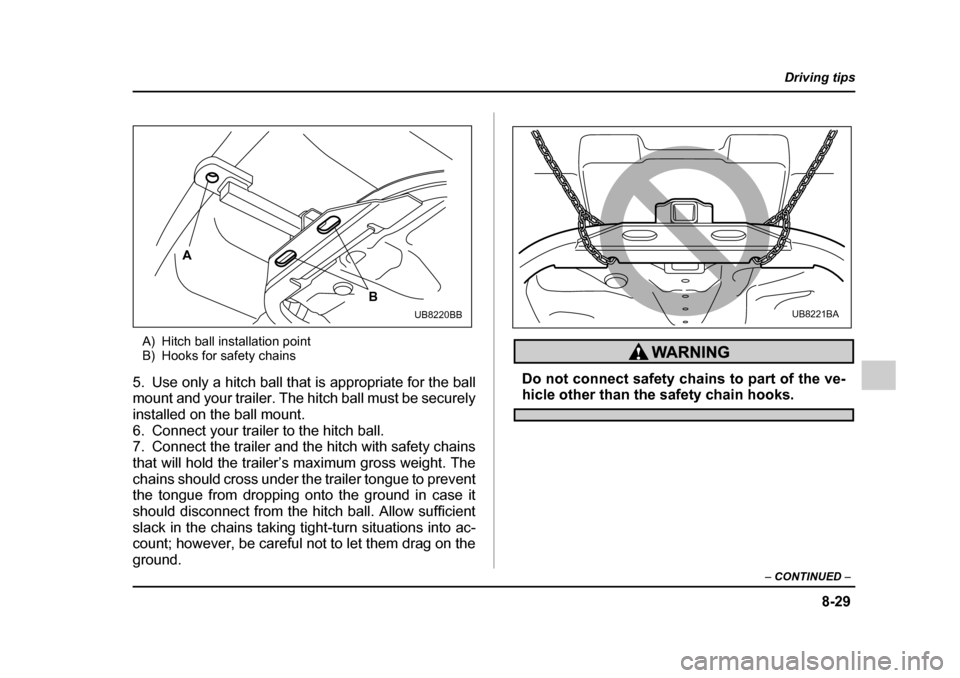
A) Hitch ball installation point
B) Hooks for safety chains
5. Use only a hitch ball that is appropriate for the ball
mount and your trailer. The hitch ball must be securely
installed on the ball mount.
6. Connect your trailer to the hitch ball.
7. Connect the trailer and the hitch with safety chains
that will hold the trailer’s maximum gross weight. The
chains should cross under the trailer tongue to prevent
the tongue from dropping onto the ground in case it
should disconnect from the hitch ball. Allow sufficient
slack in the chains taking tight-turn situations into ac-
count; however, be careful not to let them drag on the
ground.
Do not connect safety chains to part of the ve-
hicle other than the safety chain hooks.
A
B
UB8220BBUB8221BA
Page 448 of 627
8-35
Driving tips
– CONTINUED –
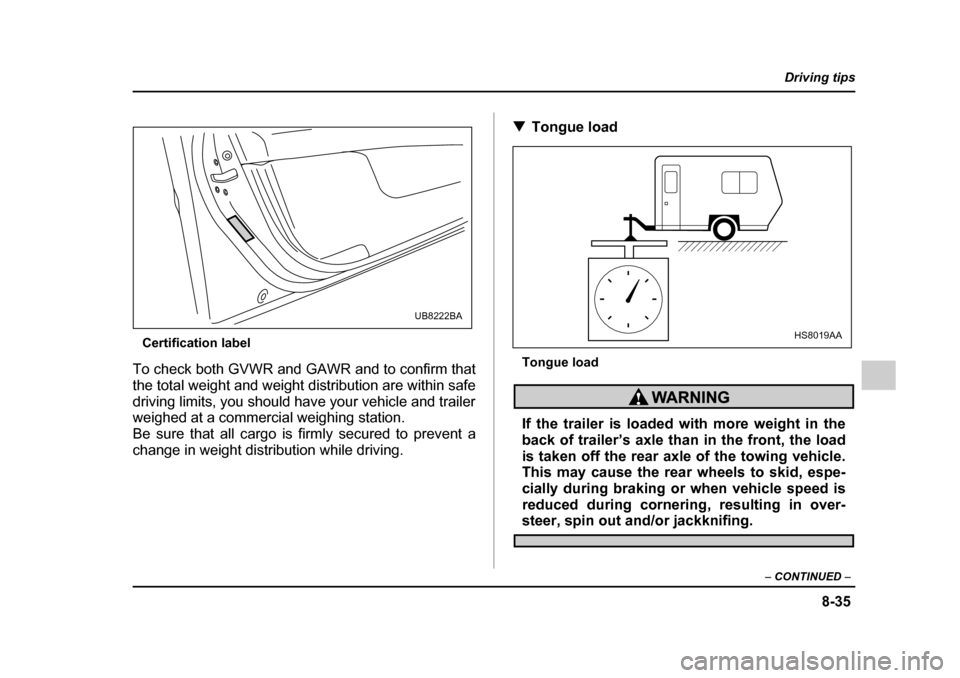
Certification label
To check both GVWR and GAWR and to confirm that
the total weight and weight distribution are within safe
driving limits, you should have your vehicle and trailer
weighed at a commercial weighing station.
Be sure that all cargo is firmly secured to prevent a
change in weight distribution while driving. !
Tongue load
Tongue load
If the trailer is loaded with more weight in the
back of trailer’s axle than in the front, the load
is taken off the rear axle of the towing vehicle.
This may cause the rear wheels to skid, espe-
cially during braking or when vehicle speed is
reduced during cornering, resulting in over-
steer, spin out and/or jackknifing.
UB8222BA
HS8019AA
Page 449 of 627
8-36
Driving tips
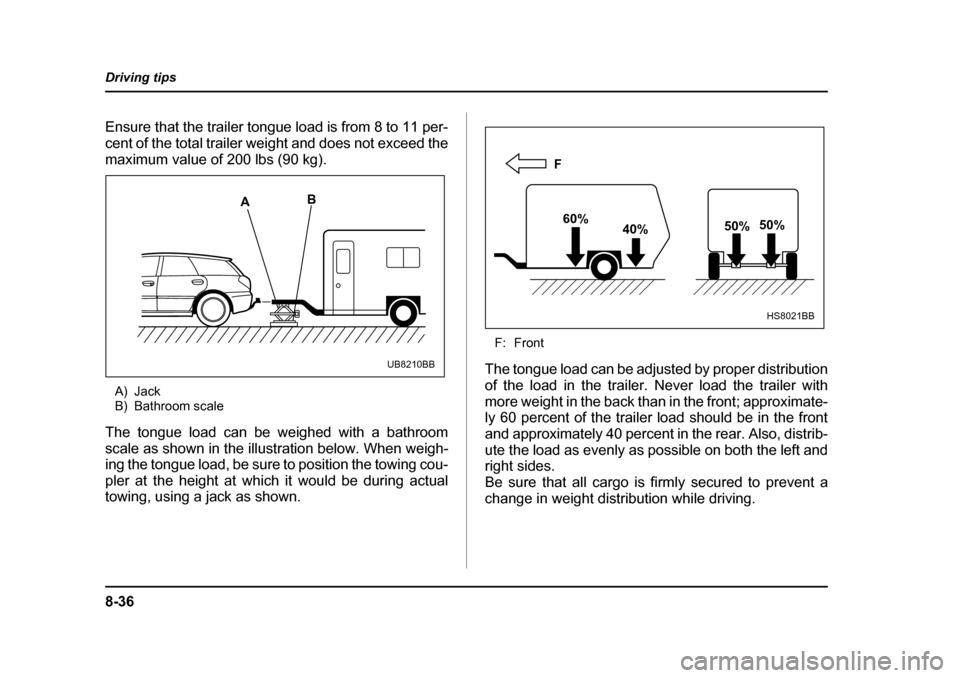
Ensure that the trailer tongue load is from 8 to 11 per-
cent of the total trailer weight and does not exceed the
maximum value of 200 lbs (90 kg).
A) Jack
B) Bathroom scale
The tongue load can be weighed with a bathroom
scale as shown in the illustration below. When weigh-
ing the tongue load, be sure to position the towing cou-
pler at the height at which it would be during actual
towing, using a jack as shown. F: Front
The tongue load can be adjusted by proper distribution
of the load in the trailer. Never load the trailer with
more weight in the back than in the front; approximate-
ly 60 percent of the trailer load should be in the front
and approximately 40 percent in the rear. Also, distrib-
ute the load as evenly as possible on both the left and
right sides.
Be sure that all cargo is firmly secured to prevent a
change in weight distribution while driving.
A B
UB8210BB
F
60% 40% 50%
50%
HS8021BB
Page 453 of 627
8-40
Driving tips
and in “GAS STATION REFERENCE” at the end of
this manual. Adjust the rear tire pressure to the recom-
mended pressure when the tires are cold. Normal
pressure should be maintained in the front tires.
Trailer tire condition, size, load rating and proper infla-
tion pressure should be in accordance with the trailer
manufacturer’s specifications.
In the event your vehicle gets a flat tire when towing a
trailer, ask a commercial road service to repair the flat tire.
If you carry a regular size spare tire in your vehicle or
trailer as a precaution against getting a flat tire, be
sure that the spare tire is firmly secured. !
Trailer towing tips
"Never exceed 45 mph (72 km/h) when towing
a trailer in hilly country on hot days. " When towing a trailer, steering, stability,
stopping distance and braking performance
will be different from normal operation. For
safety’s sake, you should employ extra caution
when towing a trailer and you should never speed. You should also keep the following tips
in mind:
! Before starting out on a trip
" Check that the vehicle and vehicle-to-hitch mount-
ing are in good condition. If any problems are appar-
ent, do not tow the trailer." Check that the vehicle sits horizontally with the trail-
er attached. If the vehicle is tipped sharply up at the
front and down at the rear, check the total trailer
weight, GVW, GAWs and tongue load again, then con-
firm that the load and its distribution are acceptable. " Check that the tire pressures are correct.
" Check that the vehicle and trailer are connected
properly. Confirm that.
– the trailer tongue is connected properly to the
hitch ball.
– the trailer lights connector is connected properly
and trailer’s brake lights illuminate when the vehi-
cle’s brake pedal is pressed, and that the trailer’s
turn signal lights flash when the vehicle’s turn signal
lever is operated.
– the safety chains are connected properly.
– all cargo in the trailer is secured safety in position.
– the side mirrors provide a good rearward field of
view without a significant blind spot.
Page 460 of 627
9-5
In case of emergency
– CONTINUED –
Flat tires
If you have a flat tire while driving, never brake sud-
denly; keep driving straight ahead while gradually re-
ducing speed. Then slowly pull off the road to a safe
place. !Changing a flat tire
"Do not jack up the vehicle on an incline or a
loose road surface. The jack can come out of
the jacking point or sink into the ground and
this can result in a severe accident." Use only the jack provided with your vehicle.
The jack supplied with the vehicle is designed
only for changing a tire. Never get under the ve-
hicle while supporting the vehicle with this jack. " Always turn the engine off before raising the
flat tire off the ground using the jack. Never
swing or push the vehicle supported with the
jack. The jack can come out of the jacking point
due to a jolt and this can result in a severe acci-
dent. 1. Park on a hard, level surface, whenever possible,
then stop the engine.
2. Set the parking brake securely and shift a manual
transmission vehicle in reverse or an automatic trans-
mission vehicle in the “P” (Park) position.
3. Turn on the hazard warning flasher and have ev-
eryone get out of the vehicle.
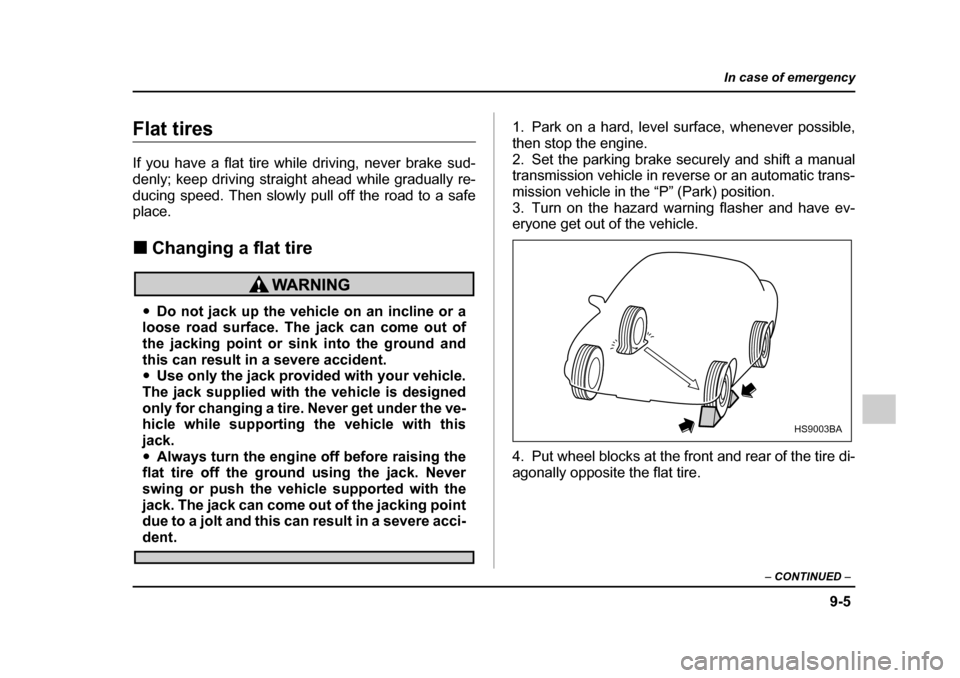
4. Put wheel blocks at the front and rear of the tire di-
agonally opposite the flat tire.
HS9003BA