sensor SUBARU OUTBACK 2016 6.G User Guide
[x] Cancel search | Manufacturer: SUBARU, Model Year: 2016, Model line: OUTBACK, Model: SUBARU OUTBACK 2016 6.GPages: 572, PDF Size: 21.79 MB
Page 91 of 572
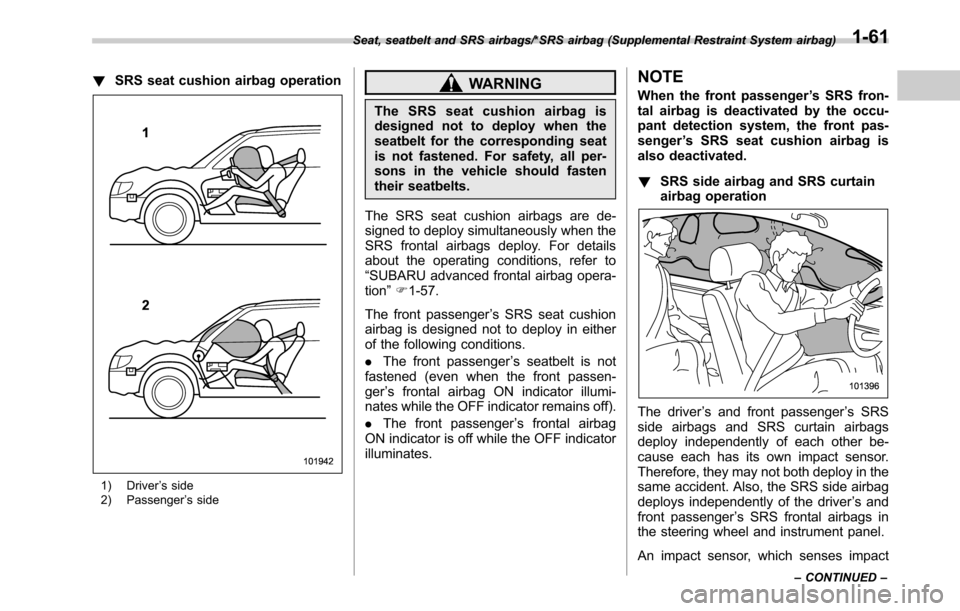
!SRS seat cushion airbag operation
1) Driver’s side
2) Passenger’s side
WARNING
The SRS seat cushion airbag is
designed not to deploy when the
seatbelt for the corresponding seat
is not fastened. For safety, all per-
sons in the vehicle should fasten
their seatbelts.
The SRS seat cushion airbags are de-
signed to deploy simultaneously when the
SRS frontal airbags deploy. For details
about the operating conditions, refer to
“SUBARU advanced frontal airbag opera-
tion”F1-57.
The front passenger’s SRS seat cushion
airbag is designed not to deploy in either
of the following conditions.
.The front passenger’s seatbelt is not
fastened (even when the front passen-
ger’s frontal airbag ON indicator illumi-
nates while the OFF indicator remains off).
.The front passenger’s frontal airbag
ON indicator is off while the OFF indicator
illuminates.
NOTE
When the front passenger’s SRS fron-
tal airbag is deactivated by the occu-
pant detection system, the front pas-
senger’s SRS seat cushion airbag is
also deactivated.
!SRS side airbag and SRS curtain
airbag operation
The driver’s and front passenger’s SRS
side airbags and SRS curtain airbags
deploy independently of each other be-
cause each has its own impact sensor.
Therefore, they may not both deploy in the
same accident. Also, the SRS side airbag
deploys independently of the driver’s and
front passenger’s SRS frontal airbags in
the steering wheel and instrument panel.
An impact sensor, which senses impact
Seat, seatbelt and SRS airbags/*SRS airbag (Supplemental Restraint System airbag)
–CONTINUED–1-61
Page 92 of 572

Seat, seatbelt and SRS airbags/*SRS airbag (Supplemental Restraint System airbag)
force, is located in each of the following
locations.
.In the left and right front doors
.In the left and right center pillars
.In the left and right rear wheel houses
.In the airbag control module
.In the left and right front fenders (only
SRS curtain airbags are designed to
deploy when the front sub sensors sense
a severe impact.)
A rollover sensor is also located inside the
airbag control module.
If the impact sensor that is located in the
airbag control module and one of the
center pillar impact sensors or front door
impact sensors together sense an impact
force above a predetermined level in a
side collision, the control module causes
both the SRS side airbag and curtain
airbag on the impacted side to inflate
regardless of whether the rear wheel
house impact sensor on the same side
senses an impact.
If the impact sensor that is located in the
airbag control module and one of the rear
wheel house impact sensors together
sense an impact force above a predeter-
mined level in a side collision, the control
module causes only the SRS curtain
airbag on the impacted side to inflate.Even if a frontal collision occurs, both right
and left SRS curtain airbags will deploy
when the front sensor and the control unit
determine that the impact results from an
offset frontal collision.
The SRS curtain airbags are designed to
deploy when the driver’sSRSfrontal
airbag deploys or the driver’s and pas-
senger’s SRS frontal airbags deploy in a
frontal collision, and also when the system
determines that the collision is an offset
frontal collision. The SRS curtain airbags
are basically designed not to deploy in a
frontal collision when the SRS frontal
airbags do not deploy or the system
determines that the collision is other than
an offset frontal collision.
If the rollover sensor detects rollover of the
vehicle, the control module inflates the
SRS curtain airbags. At this time, the
driver’s and front passenger’s seatbelt
pretensioners also operate at the same
time.
After the deployment, the SRS side airbag
immediately starts to deflate. The time
required from detection of an impact to
deflation of an SRS side airbag after
deployment is shorter than the blink of
an eye.
The SRS curtain airbag remains inflatedfor a while following deployment then
slowly deflates.
The SRS side airbag and SRS curtain
airbag deploy even when no one occupies
the seat on the side on which an impact is
applied.
The SRS side airbag and SRS curtain
airbag are designed to deploy in the event
of an accident involving a moderate to
severe side impact collision. They are not
designed to deploy in most lesser side
impact. Also, they are not designed to
deploy in most rear impacts because SRS
side airbag and SRS curtain airbag
deployment would not help the occupant
in those situations.
The SRS side airbag and SRS curtain
airbag deployment depend on the level of
force experienced in the passenger com-
partment during a side impact collision.
That level differs from one type of collision
to another, and it may have no bearing on
the visible damage done to the vehicle
itself.
The SRS curtain airbags are also de-
signed to deploy when the vehicle is in an
extremely inclined state such as during a
rollover. They are not designed to deploy
in most lesser inclined state.
Each SRS side airbag and SRS curtain
1-62
Page 99 of 572
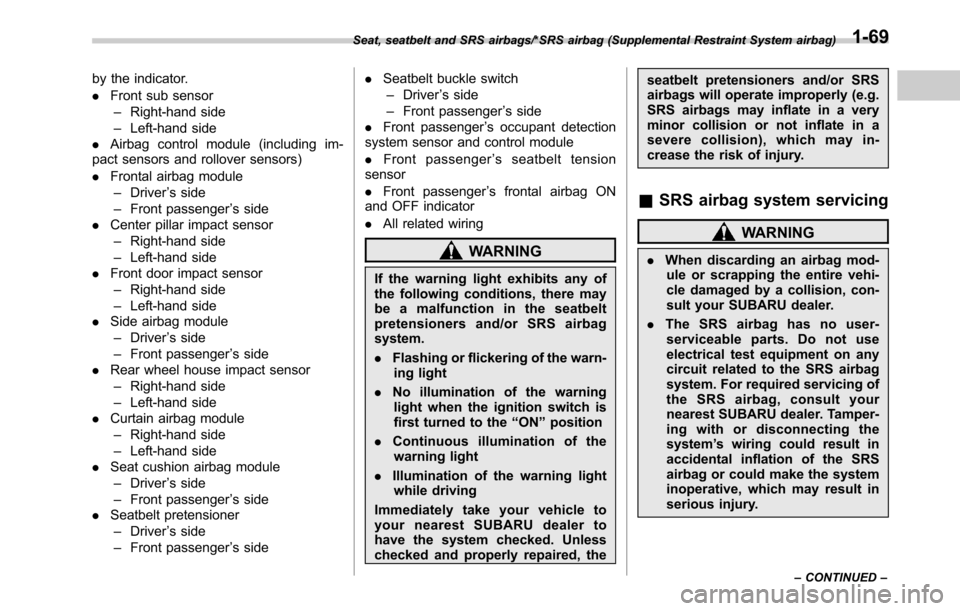
by the indicator.
.Front sub sensor
–Right-hand side
–Left-hand side
.Airbag control module (including im-
pact sensors and rollover sensors)
.Frontal airbag module
–Driver’s side
–Front passenger’s side
.Center pillar impact sensor
–Right-hand side
–Left-hand side
.Front door impact sensor
–Right-hand side
–Left-hand side
.Side airbag module
–Driver’s side
–Front passenger’s side
.Rear wheel house impact sensor
–Right-hand side
–Left-hand side
.Curtain airbag module
–Right-hand side
–Left-hand side
.Seat cushion airbag module
–Driver’s side
–Front passenger’s side
.Seatbelt pretensioner
–Driver’s side
–Front passenger’s side.Seatbelt buckle switch
–Driver’s side
–Front passenger’s side
.Front passenger’s occupant detection
system sensor and control module
.Front passenger’s seatbelt tension
sensor
.Front passenger’s frontal airbag ON
and OFF indicator
.All related wiring
WARNING
If the warning light exhibits any of
the following conditions, there may
be a malfunction in the seatbelt
pretensioners and/or SRS airbag
system.
.Flashing or flickering of the warn-
ing light
.No illumination of the warning
light when the ignition switch is
first turned to the“ON”position
.Continuous illumination of the
warning light
.Illumination of the warning light
while driving
Immediatelytakeyourvehicleto
your nearest SUBARU dealer to
have the system checked. Unless
checked and properly repaired, theseatbelt pretensioners and/or SRS
airbags will operate improperly (e.g.
SRS airbags may inflate in a very
minor collision or not inflate in a
severe collision), which may in-
crease the risk of injury.
&SRS airbag system servicing
WARNING
.When discarding an airbag mod-
ule or scrapping the entire vehi-
cle damaged by a collision, con-
sult your SUBARU dealer.
.The SRS airbag has no user-
serviceable parts. Do not use
electrical test equipment on any
circuit related to the SRS airbag
system. For required servicing of
the SRS airbag, consult your
nearest SUBARU dealer. Tamper-
ing with or disconnecting the
system’s wiring could result in
accidental inflation of the SRS
airbag or could make the system
inoperative, which may result in
serious injury.
Seat, seatbelt and SRS airbags/*SRS airbag (Supplemental Restraint System airbag)
–CONTINUED–1-69
Page 100 of 572
Seat, seatbelt and SRS airbags/*SRS airbag (Supplemental Restraint System airbag)
CAUTION
If you need service or repair in areas
indicated in the following list, have
the work performed by an author-
ized SUBARU dealer. The SRS air-
bag control module, impact sensors
and airbag modules are stored in
these areas.
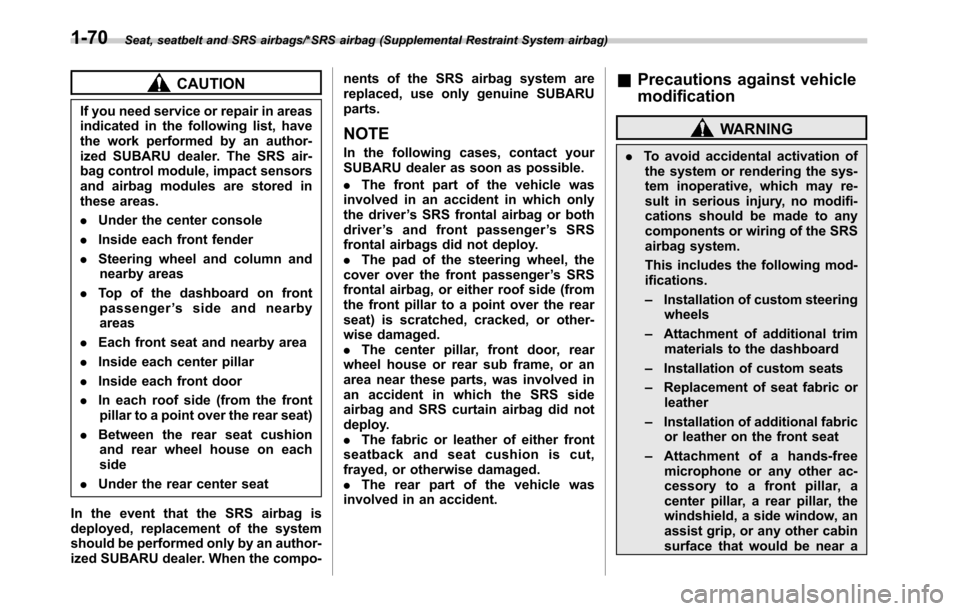
.Under the center console
.Inside each front fender
.Steering wheel and column and
nearby areas
.Top of the dashboard on front
passenger’ssideandnearby
areas
.Each front seat and nearby area
.Inside each center pillar
.Inside each front door
.In each roof side (from the front
pillar to a point over the rear seat)
.Between the rear seat cushion
and rear wheel house on each
side
.Under the rear center seat
In the event that the SRS airbag is
deployed, replacement of the system
should be performed only by an author-
ized SUBARU dealer. When the compo-nents of the SRS airbag system are
replaced, use only genuine SUBARU
parts.
NOTE
In the following cases, contact your
SUBARU dealer as soon as possible.
.The front part of the vehicle was
involved in an accident in which only
the driver’s SRS frontal airbag or both
driver’s and front passenger’sSRS
frontal airbags did not deploy.
.The pad of the steering wheel, the
cover over the front passenger’s SRS
frontal airbag, or either roof side (from
the front pillar to a point over the rear
seat) is scratched, cracked, or other-
wise damaged.
.The center pillar, front door, rear
wheel house or rear sub frame, or an
area near these parts, was involved in
an accident in which the SRS side
airbag and SRS curtain airbag did not
deploy.
.The fabric or leather of either front
seatback and seat cushion is cut,
frayed, or otherwise damaged.
.The rear part of the vehicle was
involved in an accident.
&Precautions against vehicle
modification
WARNING
.To avoid accidental activation of
the system or rendering the sys-
tem inoperative, which may re-
sult in serious injury, no modifi-
cations should be made to any
components or wiring of the SRS
airbag system.
This includes the following mod-
ifications.
–Installation of custom steering
wheels
–Attachment of additional trim
materials to the dashboard
–Installation of custom seats
–Replacement of seat fabric or
leather
–Installation of additional fabric
or leather on the front seat
–Attachment of a hands-free
microphone or any other ac-
cessory to a front pillar, a
center pillar, a rear pillar, the
windshield, a side window, an
assist grip, or any other cabin
surface that would be near a
1-70
Page 101 of 572
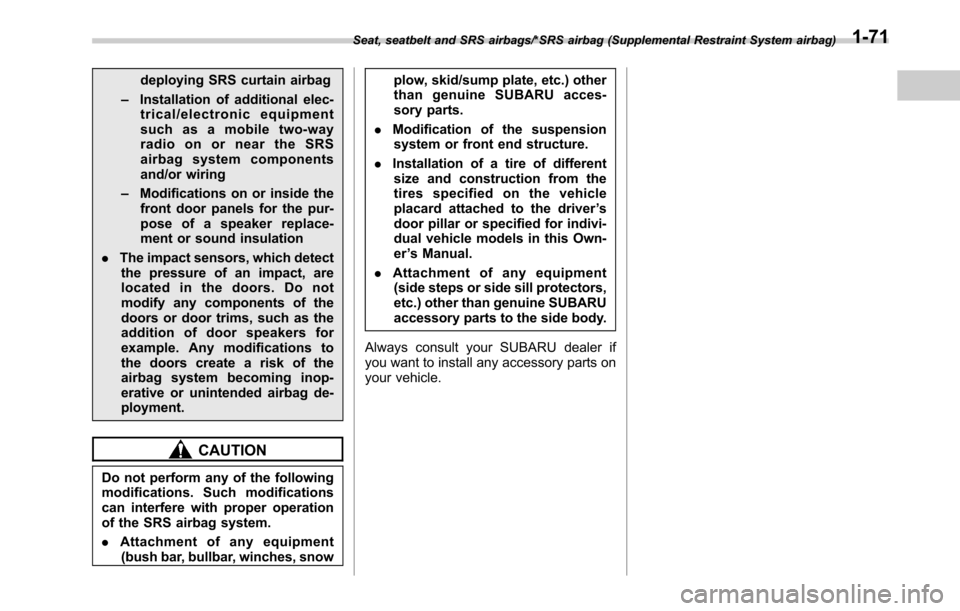
deploying SRS curtain airbag
–Installation of additional elec-
trical/electronic equipment
such as a mobile two-way
radio on or near the SRS
airbag system components
and/or wiring
–Modifications on or inside the
front door panels for the pur-
pose of a speaker replace-
ment or sound insulation
.The impact sensors, which detect
the pressure of an impact, are
located in the doors. Do not
modify any components of the
doors or door trims, such as the
addition of door speakers for
example. Any modifications to
the doors create a risk of the
airbag system becoming inop-
erative or unintended airbag de-
ployment.
CAUTION
Do not perform any of the following
modifications. Such modifications
can interfere with proper operation
of the SRS airbag system.
.Attachment of any equipment
(bush bar, bullbar, winches, snowplow, skid/sump plate, etc.) other
than genuine SUBARU acces-
sory parts.
.Modification of the suspension
system or front end structure.
.Installation of a tire of different
size and construction from the
tires specified on the vehicle
placard attached to the driver’s
door pillar or specified for indivi-
dual vehicle models in this Own-
er’s Manual.
.Attachment of any equipment
(side steps or side sill protectors,
etc.) other than genuine SUBARU
accessory parts to the side body.
Always consult your SUBARU dealer if
you want to install any accessory parts on
your vehicle.
Seat, seatbelt and SRS airbags/*SRS airbag (Supplemental Restraint System airbag)1-71
Page 103 of 572

Keys..................................................................... 2-3
Key number plate................................................ 2-3
Immobilizer.......................................................... 2-4Certification for immobilizer system..................... 2-4
Security indicator light........................................ 2-5
Key replacement................................................. 2-5
Door locks........................................................... 2-6Locking and unlocking from the outside .............. 2-6
Locking and unlocking from the inside................ 2-7
Battery drainage prevention function................... 2-8
Power door locking switches............................. 2-9Key lock-in prevention function........................... 2-9
Keyless access with push-button start
system (if equipped)....................................... 2-10
Safety precautions............................................. 2-10
Locking and unlocking with“keyless access”
entry function................................................... 2-13
Selecting audible signal operation...................... 2-18
Selecting hazard warning flasher operation......... 2-18
Warning chimes and warning indicator............... 2-18
Disabling keyless access function...................... 2-18
When access key does not operate properly....... 2-20
Replacing battery of access key......................... 2-20
Replacing access key......................................... 2-20
Certification for keyless access with push-button
start system..................................................... 2-20
PIN Code Access (models with“keyless
access with push-button start system”)........ 2-21
Registering a PIN code....................................... 2-22Unlocking.......................................................... 2-23
Remote keyless entry system........................... 2-23Operating the access key................................... 2-24
Operating the transmitter................................... 2-25
Replacing the battery......................................... 2-26
Replacing lost transmitters................................ 2-27
Certification for remote keyless entry system..... 2-27
Alarm system..................................................... 2-28
System alarm operation..................................... 2-28
Activating and deactivating the alarm system..... 2-28
If you have accidentally triggered the alarm
system............................................................ 2-29
Arming the system............................................ 2-29
Disarming the system........................................ 2-32
Valet mode........................................................ 2-32
Tripped sensor identification.............................. 2-32
Shock sensors (dealer option)............................ 2-32
Child safety locks.............................................. 2-33
Windows............................................................. 2-33
Power window operation by driver..................... 2-34
Power window operation by passengers............. 2-36
Initialization of power window ............................ 2-37
Trunk lid (Legacy).............................................. 2-38To open and close the trunk lid from outside ...... 2-38
To open the trunk lid from inside........................ 2-38
Internal trunk lid release handle......................... 2-39
Rear gate (Outback)........................................... 2-40Manual rear gate (if equipped) ............................ 2-40
Power rear gate (if equipped) ............................. 2-41
Keys and doors
2
Page 116 of 572
Keys and doors/Keyless access with push–button start system
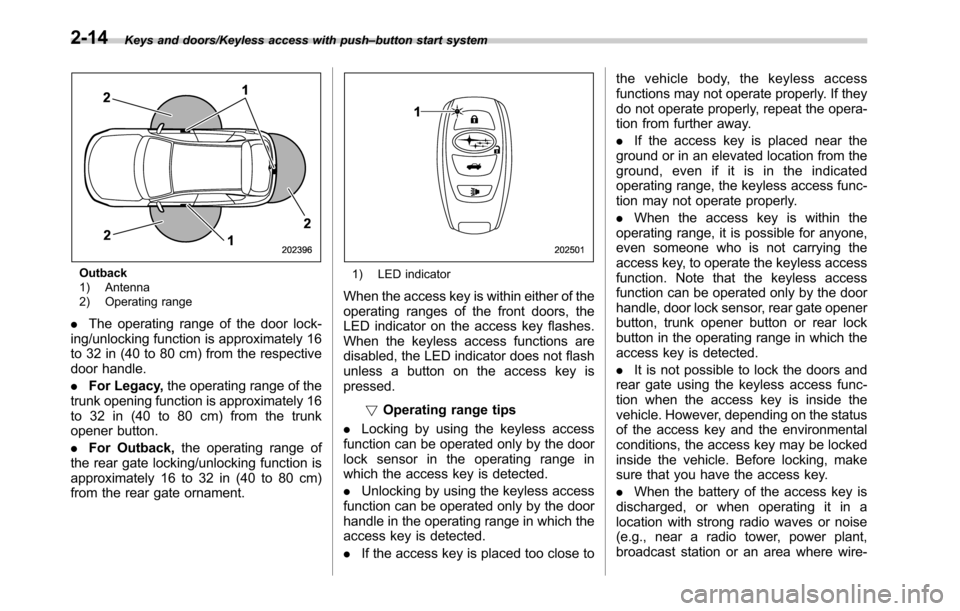
Outback
1) Antenna
2) Operating range
.The operating range of the door lock-
ing/unlocking function is approximately 16
to 32 in (40 to 80 cm) from the respective
door handle.
.For Legacy,the operating range of the
trunk opening function is approximately 16
to 32 in (40 to 80 cm) from the trunk
opener button.
.For Outback,the operating range of
the rear gate locking/unlocking function is
approximately 16 to 32 in (40 to 80 cm)
from the rear gate ornament.
1) LED indicator
When the access key is within either of the
operating ranges of the front doors, the
LED indicator on the access key flashes.
When the keyless access functions are
disabled, the LED indicator does not flash
unless a button on the access key is
pressed.
!Operating range tips
.Locking by using the keyless access
function can be operated only by the door
lock sensor in the operating range in
which the access key is detected.
.Unlocking by using the keyless access
function can be operated only by the door
handle in the operating range in which the
access key is detected.
.If the access key is placed too close tothe vehicle body, the keyless access
functions may not operate properly. If they
do not operate properly, repeat the opera-
tion from further away.
.If the access key is placed near the
ground or in an elevated location from the
ground, even if it is in the indicated
operating range, the keyless access func-
tion may not operate properly.
.When the access key is within the
operating range, it is possible for anyone,
even someone who is not carrying the
access key, to operate the keyless access
function. Note that the keyless access
function can be operated only by the door
handle, door lock sensor, rear gate opener
button, trunk opener button or rear lock
button in the operating range in which the
access key is detected.
.It is not possible to lock the doors and
rear gate using the keyless access func-
tion when the access key is inside the
vehicle. However, depending on the status
of the access key and the environmental
conditions, the access key may be locked
inside the vehicle. Before locking, make
sure that you have the access key.
.When the battery of the access key is
discharged, or when operating it in a
location with strong radio waves or noise
(e.g., near a radio tower, power plant,
broadcast station or an area where wire-
2-14
Page 117 of 572

less equipment is used), or while talking
on a cell phone, the operating ranges may
be reduced, or the keyless access func-
tion may not operate.
In such a case, perform the procedure
described in“Locking and unlocking”F9-
18.
.When an access key is in the operating
range, if the door handle becomes wet
due to exposure to a significant amount of
water when the vehicle is washed or
during heavy rain, the doors may be
locked or unlocked.
.The keyless access function may not
operate properly depending on the status
of the access key and the radio wave
conditions around the vehicle. In such a
case, perform the procedure described in
“Locking and unlocking”F9-18.
!How to use keyless access func-
tions
!Keyless access function tips
.When you lock the doors and rear gate
using the keyless access function, turn the
push-button ignition switch off. It is not
possible to lock the doors and rear gate
using the keyless access function when
the push-button ignition switch is on the
“ACC”or“ON”position. Refer to“Switch-
ing power”F3-6.
.If the door handle is gripped with agloved hand, the door lock may not be
released.
.If the door lock sensor is touched three
times or more repeatedly, the system will
ignore the sensor operation.
.When performing the locking proce-
dure too quickly, locking may not have
been completed. After locking the doors, it
is recommended to pull the REAR door
handles to confirm that the doors have
been locked.
.It is possible to lock the doors even
when one of the doors is open. After
performing the locking procedure, close
the opened door or rear gate to lock it.
.Within 3 seconds after locking the
doors and the rear gate by using the
keyless access function, it is not possible
to unlock doors and/or the rear gate by
using the keyless access function.
.When locking, be sure to carry the
access key to prevent locking the access
key in the vehicle.!Unlocking
Carry the access key, and grip the door
handle.
.When the driver’s door handle is
gripped, only the driver’s door will be
unlocked.
.When the front passenger’s door han-
dle is gripped, all doors (for Outback,
including the rear gate) will be unlocked.
Also, an electronic chirp will sound twice
and the hazard warning flashers will flash
twice.
Keys and doors/Keyless access with push–button start system
–CONTINUED–2-15
Page 118 of 572
Keys and doors/Keyless access with push–button start system
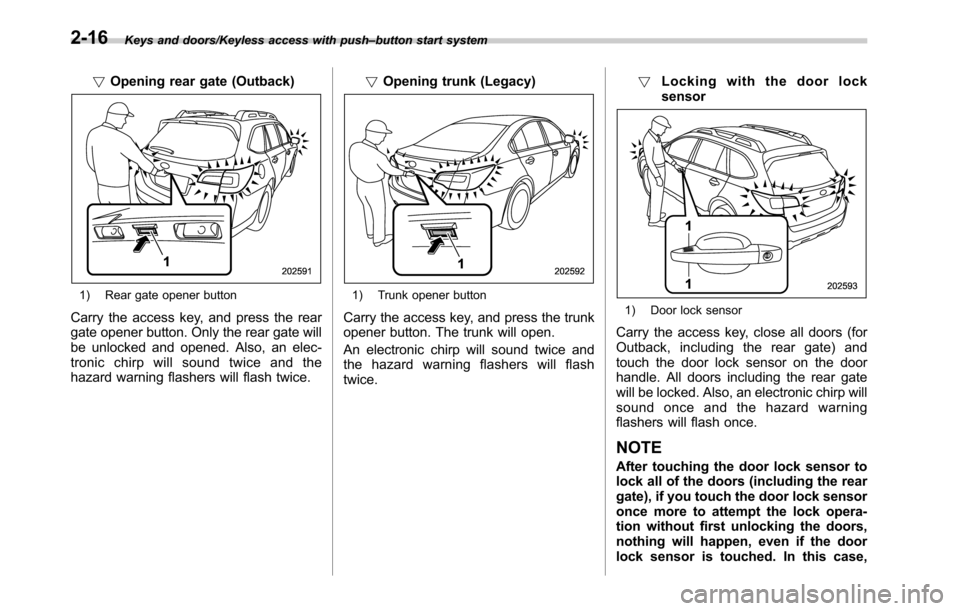
!Opening rear gate (Outback)
1) Rear gate opener button
Carry the access key, and press the rear
gate opener button. Only the rear gate will
be unlocked and opened. Also, an elec-
tronic chirp will sound twice and the
hazard warning flashers will flash twice.!Opening trunk (Legacy)
1) Trunk opener button
Carry the access key, and press the trunk
opener button. The trunk will open.
An electronic chirp will sound twice and
the hazard warning flashers will flash
twice.!Locking with the door lock
sensor1) Door lock sensor
Carry the access key, close all doors (for
Outback, including the rear gate) and
touch the door lock sensor on the door
handle. All doors including the rear gate
will be locked. Also, an electronic chirp will
sound once and the hazard warning
flashers will flash once.
NOTE
After touching the door lock sensor to
lock all of the doors (including the rear
gate), if you touch the door lock sensor
once more to attempt the lock opera-
tion without first unlocking the doors,
nothing will happen, even if the door
lock sensor is touched. In this case,
2-16
Page 119 of 572
perform the unlocking operation once
first. You can then touch the door lock
sensor to lock the doors.
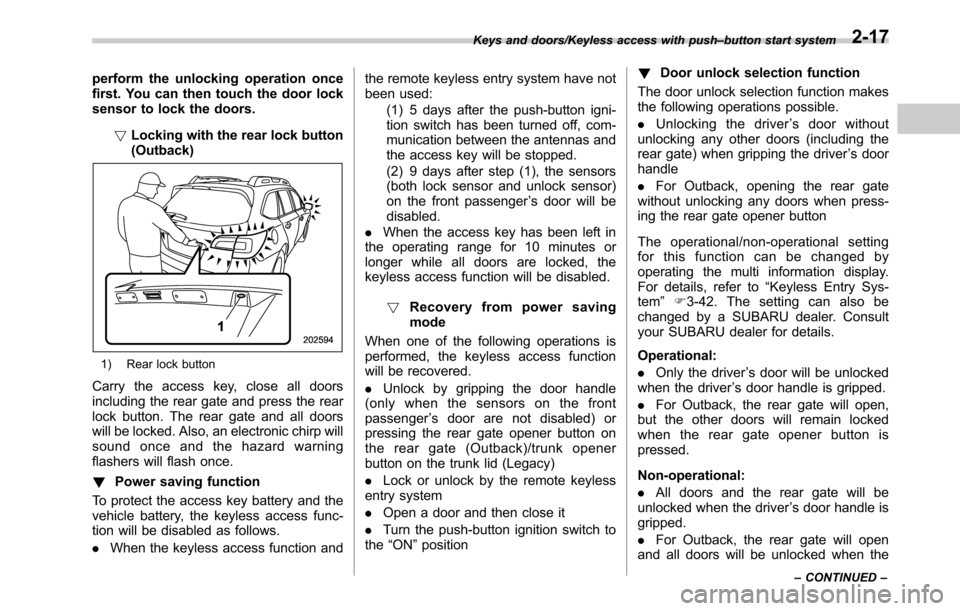
!Locking with the rear lock button
(Outback)
1) Rear lock button
Carry the access key, close all doors
including the rear gate and press the rear
lock button. The rear gate and all doors
will be locked. Also, an electronic chirp will
sound once and the hazard warning
flashers will flash once.
!Power saving function
To protect the access key battery and the
vehicle battery, the keyless access func-
tion will be disabled as follows.
.When the keyless access function andthe remote keyless entry system have not
been used:
(1) 5 days after the push-button igni-
tion switch has been turned off, com-
munication between the antennas and
the access key will be stopped.
(2) 9 days after step (1), the sensors
(both lock sensor and unlock sensor)
on the front passenger’s door will be
disabled.
.When the access key has been left in
the operating range for 10 minutes or
longer while all doors are locked, the
keyless access function will be disabled.
!Recovery from power saving
mode
When one of the following operations is
performed, the keyless access function
will be recovered.
.Unlock by gripping the door handle
(only when the sensors on the front
passenger’s door are not disabled) or
pressing the rear gate opener button on
the rear gate (Outback)/trunk opener
button on the trunk lid (Legacy)
.Lock or unlock by the remote keyless
entry system
.Open a door and then close it
.Turn the push-button ignition switch to
the“ON”position!Door unlock selection function
The door unlock selection function makes
the following operations possible.
.Unlocking the driver’s door without
unlocking any other doors (including the
rear gate) when gripping the driver’s door
handle
.For Outback, opening the rear gate
without unlocking any doors when press-
ing the rear gate opener button
The operational/non-operational setting
for this function can be changed by
operating the multi information display.
For details, refer to“Keyless Entry Sys-
tem”F3-42. The setting can also be
changed by a SUBARU dealer. Consult
your SUBARU dealer for details.
Operational:
.Only the driver’s door will be unlocked
when the driver’s door handle is gripped.
.For Outback, the rear gate will open,
but the other doors will remain locked
when the rear gate opener button is
pressed.
Non-operational:
.All doors and the rear gate will be
unlocked when the driver’s door handle is
gripped.
.For Outback, the rear gate will open
and all doors will be unlocked when the
Keys and doors/Keyless access with push–button start system
–CONTINUED–2-17