2-9 SUBARU OUTBACK 2016 6.G Owners Manual
[x] Cancel search | Manufacturer: SUBARU, Model Year: 2016, Model line: OUTBACK, Model: SUBARU OUTBACK 2016 6.GPages: 572, PDF Size: 21.79 MB
Page 29 of 572

Function settings
A SUBARU dealer can change the settings of the functions shown in the following table to meet your personal requirements. Contact
the nearest SUBARU dealer for details. Furthermore, some useful function settings are available using the multi information display.
For details, refer to“Menu screens”F3-38.
Item Function Possible settings Default setting Page
Alarm system Alarm system Operation/Non-operation Operation 2-28
Monitoring start delay time
(after closing doors)0 seconds/30 seconds 30 seconds 2-29
Impact sensor operation (only
models with shock sensors
(dealer option))Operation/Non-operation Non-operation 2-32
Map light/Dome light/Cargo
area light illuminationON/OFF OFF 2-28
Keyless access with push-
button start system
*1Audible signal*2ON/OFF ON 2-18, 2-47, 3-42
Audible signal volume*3Level 1 to 7 Level 5 2-18, 3-24, 3-42
Hazard warning flasher ON/OFF ON 2-18, 3-42
Door unlock selection (driver’s
door unlock)Driver’s door only/All doors Driver’s door only 2-17, 3-42
Door unlock selection (rear
gate unlock)Rear gate only, All doors Rear gate only
Remote keyless entry system Audible signal
*2ON/OFF ON 2-25, 2-26,
2-47, 3-42
Audible signal volume
*3Level 1 to 7 Level 5 2-25, 2-26, 3-42
Hazard warning flasher ON/OFF ON 2-25, 2-26, 3-42
Key lock-in prevention Key lock-in prevention Operation/Non-operation Operation 2-9
–CONTINUED–
25
Page 103 of 572

Keys..................................................................... 2-3
Key number plate................................................ 2-3
Immobilizer.......................................................... 2-4Certification for immobilizer system..................... 2-4
Security indicator light........................................ 2-5
Key replacement................................................. 2-5
Door locks........................................................... 2-6Locking and unlocking from the outside .............. 2-6
Locking and unlocking from the inside................ 2-7
Battery drainage prevention function................... 2-8
Power door locking switches............................. 2-9Key lock-in prevention function........................... 2-9
Keyless access with push-button start
system (if equipped)....................................... 2-10
Safety precautions............................................. 2-10
Locking and unlocking with“keyless access”
entry function................................................... 2-13
Selecting audible signal operation...................... 2-18
Selecting hazard warning flasher operation......... 2-18
Warning chimes and warning indicator............... 2-18
Disabling keyless access function...................... 2-18
When access key does not operate properly....... 2-20
Replacing battery of access key......................... 2-20
Replacing access key......................................... 2-20
Certification for keyless access with push-button
start system..................................................... 2-20
PIN Code Access (models with“keyless
access with push-button start system”)........ 2-21
Registering a PIN code....................................... 2-22Unlocking.......................................................... 2-23
Remote keyless entry system........................... 2-23Operating the access key................................... 2-24
Operating the transmitter................................... 2-25
Replacing the battery......................................... 2-26
Replacing lost transmitters................................ 2-27
Certification for remote keyless entry system..... 2-27
Alarm system..................................................... 2-28
System alarm operation..................................... 2-28
Activating and deactivating the alarm system..... 2-28
If you have accidentally triggered the alarm
system............................................................ 2-29
Arming the system............................................ 2-29
Disarming the system........................................ 2-32
Valet mode........................................................ 2-32
Tripped sensor identification.............................. 2-32
Shock sensors (dealer option)............................ 2-32
Child safety locks.............................................. 2-33
Windows............................................................. 2-33
Power window operation by driver..................... 2-34
Power window operation by passengers............. 2-36
Initialization of power window ............................ 2-37
Trunk lid (Legacy).............................................. 2-38To open and close the trunk lid from outside ...... 2-38
To open the trunk lid from inside........................ 2-38
Internal trunk lid release handle......................... 2-39
Rear gate (Outback)........................................... 2-40Manual rear gate (if equipped) ............................ 2-40
Power rear gate (if equipped) ............................. 2-41
Keys and doors
2
Page 111 of 572
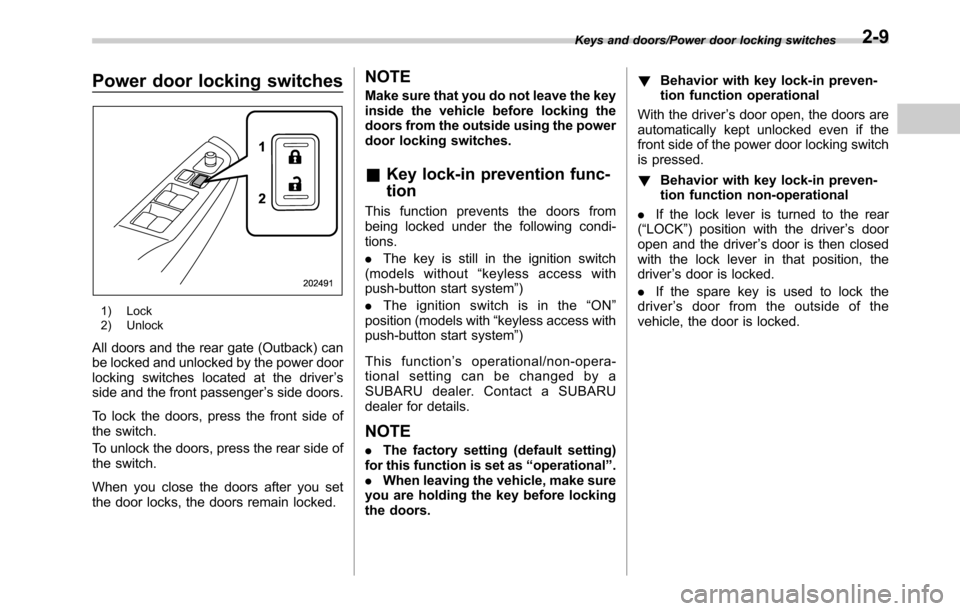
Power door locking switches
1) Lock
2) Unlock
All doors and the rear gate (Outback) can
be locked and unlocked by the power door
locking switches located at the driver’s
side and the front passenger’s side doors.
To lock the doors, press the front side of
the switch.
To unlock the doors, press the rear side of
the switch.
When you close the doors after you set
the door locks, the doors remain locked.
NOTE
Make sure that you do not leave the key
inside the vehicle before locking the
doors from the outside using the power
door locking switches.
&Key lock-in prevention func-
tion
This function prevents the doors from
being locked under the following condi-
tions.
.The key is still in the ignition switch
(models without“keyless access with
push-button start system”)
.Theignitionswitchisinthe“ON”
position (models with“keyless access with
push-button start system”)
This function’s operational/non-opera-
tional setting can be changed by a
SUBARU dealer. Contact a SUBARU
dealer for details.
NOTE
.The factory setting (default setting)
for this function is set as“operational”.
.When leaving the vehicle, make sure
you are holding the key before locking
the doors.!Behavior with key lock-in preven-
tion function operational
With the driver’s door open, the doors are
automatically kept unlocked even if the
front side of the power door locking switch
is pressed.
!Behavior with key lock-in preven-
tion function non-operational
.If the lock lever is turned to the rear
(“LOCK”) position with the driver’s door
open and the driver’s door is then closed
with the lock lever in that position, the
driver’s door is locked.
.If the spare key is used to lock the
driver’s door from the outside of the
vehicle, the door is locked.
Keys and doors/Power door locking switches2-9
Page 142 of 572
Keys and doors/Rear gate (Outback)
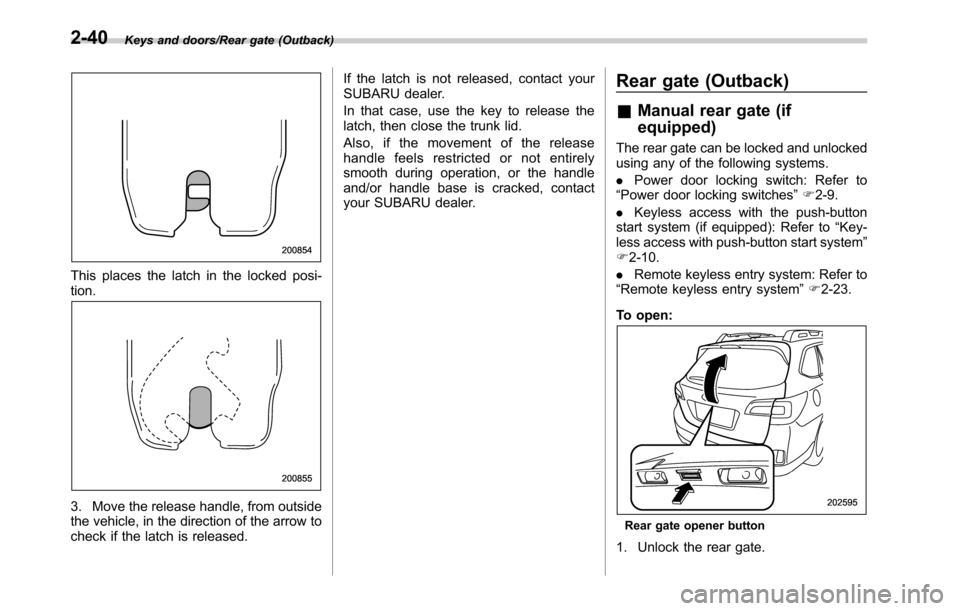
This places the latch in the locked posi-
tion.
3. Move the release handle, from outside
the vehicle, in the direction of the arrow to
check if the latch is released.If the latch is not released, contact your
SUBARU dealer.
In that case, use the key to release the
latch, then close the trunk lid.
Also, if the movement of the release
handle feels restricted or not entirely
smooth during operation, or the handle
and/or handle base is cracked, contact
your SUBARU dealer.
Rear gate (Outback)
&Manual rear gate (if
equipped)
The rear gate can be locked and unlocked
using any of the following systems.
.Power door locking switch: Refer to
“Power door locking switches”F2-9.
.Keyless access with the push-button
start system (if equipped): Refer to“Key-
less access with push-button start system”
F2-10.
.Remote keyless entry system: Refer to
“Remote keyless entry system”F2-23.
To open:
Rear gate opener button
1. Unlock the rear gate.
2-40
Page 446 of 572
In case of emergency/Flat tires
14. Put on the spare tire. Replace the
wheel nuts. Tighten them by hand.
WARNING
Do not use oil or grease on the
wheel studs or nuts when the spare
tire is installed. This could cause the
nuts to become loose and lead to an
accident.
15. Turn the jack handle counterclockwise
to lower the vehicle.
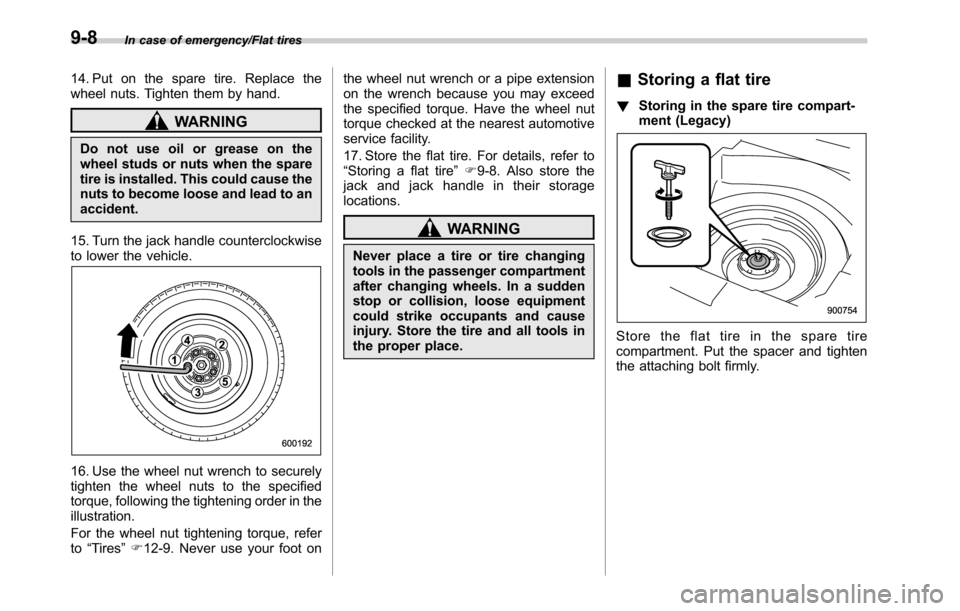
16. Use the wheel nut wrench to securely
tighten the wheel nuts to the specified
torque, following the tightening order in the
illustration.
For the wheel nut tightening torque, refer
to“Tires”F12-9. Never use your foot onthe wheel nut wrench or a pipe extension
on the wrench because you may exceed
the specified torque. Have the wheel nut
torque checked at the nearest automotive
service facility.
17. Store the flat tire. For details, refer to
“Storing a flat tire”F9-8. Also store the
jack and jack handle in their storage
locations.
WARNING
Never place a tire or tire changing
tools in the passenger compartment
after changing wheels. In a sudden
stop or collision, loose equipment
could strike occupants and cause
injury. Store the tire and all tools in
the proper place.
&Storing a flat tire
!Storing in the spare tire compart-
ment (Legacy)
Store the flat tire in the spare tire
compartment. Put the spacer and tighten
the attaching bolt firmly.
9-8
Page 486 of 572

Maintenance and service/Spark plugs
Spark plugs
It may be difficult to replace the spark
plugs. It is recommended that you have
the spark plugs replaced by your
SUBARU dealer.
The spark plugs should be replaced
according to the maintenance schedule
in the“Warranty and Maintenance Book-
let”.
&Recommended spark plugs
Refer to“Electrical system”F12-9.
Drive belts
It is unnecessary to check the deflection of
the drive belt periodically because your
engine is equipped with an automatic belt
tension adjuster. However, replacement of
the belt should be done according to the
maintenance schedule in the“Warranty
and Maintenance Booklet”. Consult your
SUBARU dealer for replacement.
If the belt is loose, cracked or worn,
contact your SUBARU dealer.
Manual transmission oil
It is unnecessary to check the manual
transmission oil level. However, if neces-
sary, consult your SUBARU dealer for
inspection.
&Recommended grade and
viscosity
Each oil manufacturer has its own base
oils and additives. Never use different
brands together. For details, refer to
“Manual transmission, front differential
and rear differential gear oil”F12-7.
11-18
Page 521 of 572

Specifications..................................................... 12-2
Dimensions........................................................ 12-2
Engine............................................................... 12-3
Fuel................................................................... 12-3
Engine oil.......................................................... 12-4
Manual transmission, front differential and rear
differential gear oil........................................... 12-7
Fluids................................................................ 12-8
Engine coolant................................................... 12-8
Electrical system................................................ 12-9
Tires.................................................................. 12-9Brake disc......................................................... 12-9Fuses and circuits........................................... 12-10
Fuse panel located in the passenger
compartment................................................. 12-10
Fuse panel located in the engine
compartment................................................. 12-12
Bulb chart......................................................... 12-14Safety precautions........................................... 12-14
Bulb chart....................................................... 12-15
Vehicle identification....................................... 12-18
Specifications
12
Page 529 of 572

&Electrical system
Battery type
2.5 L models 55D23R
3.6 L models
75D23R
Alternator
12V-130A
Spark plugs
2.5 L models SILZKAR7B11 (NGK)
3.6 L modelsSILFR6C11 (NGK)
&Tires
Tire size
225/55R17
97V225/50R18
95H225/65R17
102H225/60R18
100H
Wheel size
1767J
1767 1/2J1867 1/2J 1767J 1867J
Pressure Front
33 psi (230 kPa, 2.3 kgf/cm
2) 35 psi (240 kPa, 2.4 kgf/cm2)
Rear
32 psi (220 kPa, 2.2 kgf/cm2) 33 psi (230 kPa, 2.3 kgf/cm2)
Temporary spare tire
Size T155/70 D17 110M T155/80 R17 101M
Pressure 60 psi (420 kPa, 4.2 kgf/cm
2)
Wheel nut tightening torque
88.5 lbf·ft (120 N·m, 12.2 kgf·m)*1
*1: This torque is equivalent to applying approximately 88 to 110 lbf (40 to 50 kgf) at the end of the wheel nut wrench. If you have tightened the wheel
nuts by yourself, have the tightening torque checked at the nearest automotive service facility as soon as possible. For the wheel nut tightening
procedure, refer to“Changing a flat tire”F9-5.
&Brake disc
If you need information on the usage limit value of brake discs and the method for measuring them, consult your SUBARU dealer.
Specifications/Specifications12-9
Page 542 of 572
Consumer information and Reporting safety defects/Tire information
!Maximum load rating
The load rating at the maximum
permissible weight load for this tire.
For example,“MAX. LOAD 615 kg
(1,356 LBS) @ 350 kPa (51 PSI)
MAX. PRESS.”
WARNING
Maximum load rating applies
only to the tire, not to the
vehicle. Putting a load rated
tire on any vehicle does not
mean the vehicle can be
loaded up to the tire’s rated
load.
!Construction type
Applicable construction of this tire.
For example,“TUBELESS STEEL
BELTED RADIAL”
!Construction
The generic name of each cord
material used in the plies (both
sidewall and tread area) of this tire.
For example,“PLIES: TREAD 2STEEL + 2 POLYESTER + 1
NYLON SIDEWALL 2 POLYE-
STER”
!Uniform Tire Quality Grading
(UTQG)
For details, refer to“Uniform tire
quality grading standards”F13-14
.
&Recommended tire inflation
pressure
!Recommended cold tire infla-
tion pressure
For the recommended cold tire
inflation pressure for your vehicle’s
tires, refer to“Tires”F12-9
.
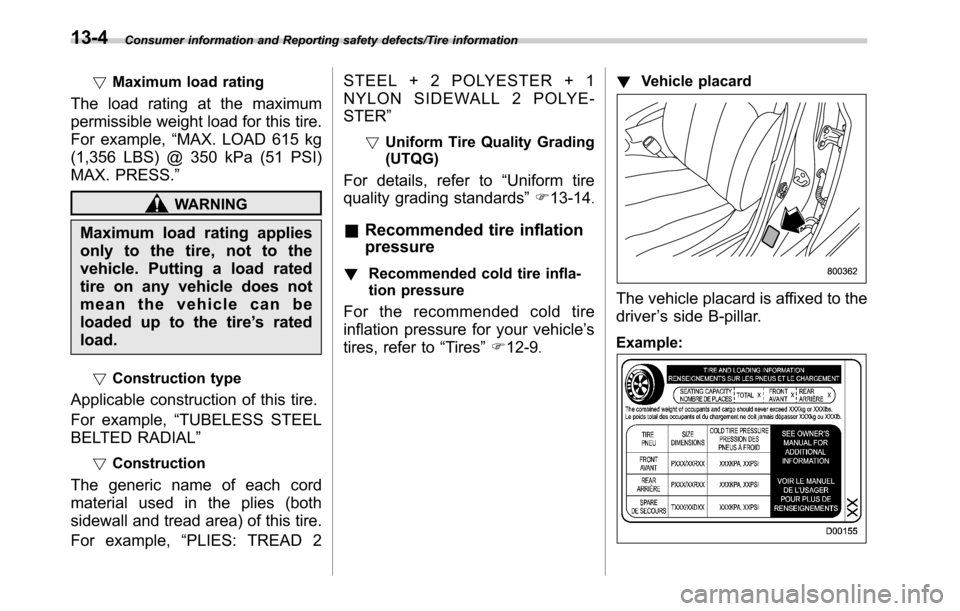
!Vehicle placard
The vehicle placard is affixed to the
driver’s side B-pillar.
Example:
13-4
Page 557 of 572

Booster seat.............................................................. 1-34
Bottle holder................................................................ 6-9
Brake
Assist................................................................... 7-32
Booster........................................................ 7-32, 11-22
Disc..................................................................... 12-9
Fluid............................................................ 11-19, 12-8
Pad ..................................................................... 11-24
Parking................................................................. 7-42
Pedal.................................................................. 11-22
System................................................................. 7-32
Brake pedal
Free play............................................................. 11-22
Reserve distance.................................................. 11-23
Brake system............................................................ 7-32
Warning light......................................................... 3-18
Braking..................................................................... 7-32
Tips...................................................................... 7-32
Breaking-in of new brake pads................................... 11-24
BSD/RCTA................................................................ 7-53
Approach indicator light/warning buzzer.................... 7-56
OFF indicator........................................ 3-31, 3-38, 7-56
OFF switch........................................................... 7-59
Warning indicator................................... 3-31, 3-38, 7-58
Warning volume..................................................... 3-42
Bulb
Chart.................................................................. 12-14
Replacing............................................................. 11-40C
Cargo area
Cover.................................................................... 6-16
Light............................................................. 6-3, 11-49
Tie-down hooks...................................................... 6-19
Catalytic converter....................................................... 8-3
Center
Console................................................................. 6-6
Changing
Coolant............................................................... 11-15
Flat tire.................................................................. 9-5
Oil and oil filter..................................................... 11-13
Charge warning light................................................... 3-15
CHECK ENGINE warning light/Malfunction indicator
light....................................................................... 3-15
Checking
Brake pedal free play............................................ 11-22
Brake pedal reserve distance................................. 11-23
Clutch function..................................................... 11-23
Clutch pedal free play........................................... 11-23
Coolant level........................................................ 11-14
Fluid level (brake fluid).......................................... 11-19
Fluid level (clutch fluid).......................................... 11-21
Fluid level (washer fluid)........................................ 11-32
Oil level (engine oil).............................................. 11-11
Child restraint systems................................................ 1-27
Installation of a booster seat.................................... 1-34
Installation with A/ELR seatbelt................................ 1-30
Lower and tether anchorages
................................... 1-35
Top tether anchorages............................................ 1-38
Child safety................................................................... 4
Index14-3