brake SUBARU OUTBACK 2017 6.G Owners Manual
[x] Cancel search | Manufacturer: SUBARU, Model Year: 2017, Model line: OUTBACK, Model: SUBARU OUTBACK 2017 6.GPages: 610, PDF Size: 10.28 MB
Page 527 of 610
Maintenance and service/Replacement of brake pad
&Checking the clutch pedal
free play
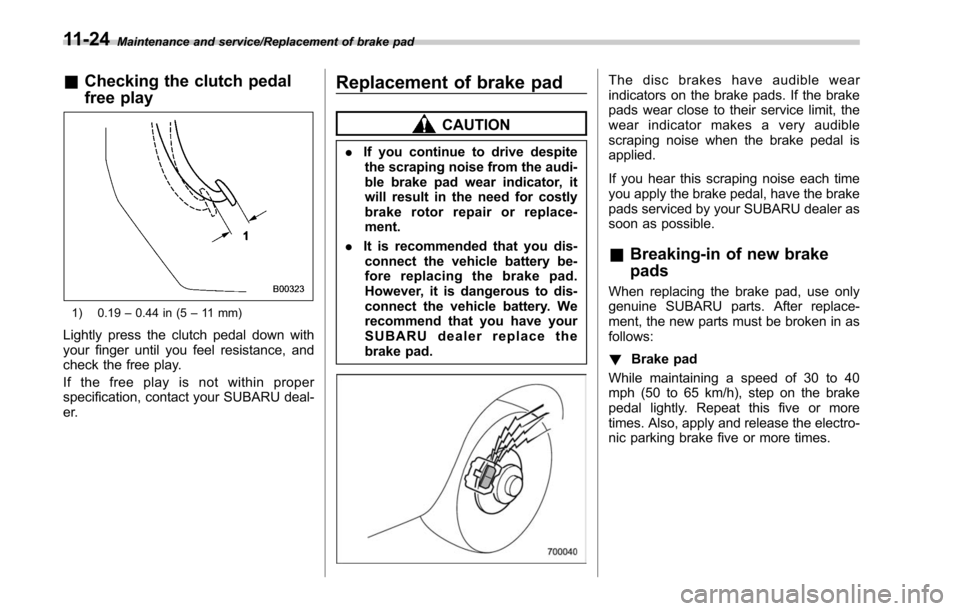
1) 0.19 –0.44 in (5 –11 mm)
Lightly press the clutch pedal down with
your finger until you feel resistance, and
check the free play.
If the free play is not within proper
specification, contact your SUBARU deal-
er.
Replacement of brake pad
CAUTION
. If you continue to drive despite
the scraping noise from the audi-
ble brake pad wear indicator, it
will result in the need for costly
brake rotor repair or replace-
ment.
. It is recommended that you dis-
connect the vehicle battery be-
fore replacing the brake pad.
However, it is dangerous to dis-
connect the vehicle battery. We
recommend that you have your
SUBARU dealer replace the
brake pad.
The disc brakes have audible wear
indicators on the brake pads. If the brake
pads wear close to their service limit, the
wear indicator makes a very audible
scraping noise when the brake pedal is
applied.
If you hear this scraping noise each time
you apply the brake pedal, have the brake
pads serviced by your SUBARU dealer as
soon as possible.
& Breaking-in of new brake
pads
When replacing the brake pad, use only
genuine SUBARU parts. After replace-
ment, the new parts must be broken in as
follows:
! Brake pad
While maintaining a speed of 30 to 40
mph (50 to 65 km/h), step on the brake
pedal lightly. Repeat this five or more
times. Also, apply and release the electro-
nic parking brake five or more times.
11-24
Page 529 of 610
![SUBARU OUTBACK 2017 6.G Owners Manual Maintenance and service/Tires and wheels
Outside
temperature Adjusted pressure
[psi (kPa, kgf/cm2)]
Front Rear
30 8F( −18C) 38 (265, 2.65) 36 (250, 2.5)
10 8F( −12 8C) 40 (280, 2.8) 38 (265, 2.65)](/img/17/7317/w960_7317-528.png "SUBARU OUTBACK 2017 6.G Owners Manual Maintenance and service/Tires and wheels
Outside
temperature Adjusted pressure
[psi (kPa, kgf/cm2)]
Front Rear
30 8F( −18C) 38 (265, 2.65) 36 (250, 2.5)
10 8F( −12 8C) 40 (280, 2.8) 38 (265, 2.65)")
Maintenance and service/Tires and wheels
Outside
temperature Adjusted pressure
[psi (kPa, kgf/cm2)]
Front Rear
30 8F( −18C) 38 (265, 2.65) 36 (250, 2.5)
10 8F( −12 8C) 40 (280, 2.8) 38 (265, 2.65)
−10 8F( −23 8C) 42 (295, 2.95) 40 (280, 2.8)
If the low tire pressure warning light
illuminates when you drive the vehicle in
cold outside air after adjusting the tire
pressures in a warm garage, re-adjust the
tire pressures using the method described
above. Then, increase the vehicle speed
to at least 20 mph (32 km/h) and check to
see that the low tire pressure warning light
goes off a few minutes later. If the low tire
pressure warning light does not go off, the
tire pressure monitoring system may not
be functioning normally. In this event, go
to a SUBARU dealer to have the system
inspected as soon as possible.
While the vehicle is driven, friction be-
tween tires and the road surface causes
the tires to warm up. After illumination of
the low tire pressure warning light, any
increase in the tire pressures caused by
an increase in the outside air temperature
or by an increase in the temperature in the
tires can cause the low tire pressure
warning light to go off. System resetting is necessary when the
wheels are changed (for example, a
switch to snow tires) and new TPMS
valves are installed on the newly fitted
wheels. Have this work performed by a
SUBARU dealer following wheel replace-
ment.
It may not be possible to install TPMS
valves on certain wheels that are on the
market. Therefore, if you change the
wheels (for example, a switch to snow
tires), use wheels that have the same part
number as the standard-equipment
wheels. Without four operational TPMS
valve/sensors on the wheels, the TPMS
will not fully function and the warning light
in the instrument panel will illuminate
steadily after blinking for approximately
one minute.
When a tire is replaced, adjustments are
necessary to ensure continued normal
operation of the tire pressure monitoring
system. As with wheel replacement, there-
fore, you should have the work performed
by a SUBARU dealer.
WARNING
If the low tire pressure warning light
does not illuminate briefly after the
ignition switch is turned ON or the
light illuminates steadily after blink-ing for approximately one minute,
you should have your Tire Pressure
Monitoring System checked at a
SUBARU dealer as soon as possi-
ble.
If this light illuminates while driving,
never brake suddenly. Instead, per-
form the following procedure. Other-
wise an accident involving serious
vehicle damage and serious perso-
nal injury could occur.
1) Keep driving straight ahead while
gradually reducing speed.
2) Slowly pull off the road to a safe place.
If this light still illuminates while
driving after adjusting the tire pres-
sure, a tire may have significant
damage and a fast leak that causes
the tire to lose air rapidly. If you have
a flat tire, replace it with a spare tire
as soon as possible.
When a spare tire is mounted or a
wheel rim is replaced without the
original pressure sensor/transmitter
being transferred, the low tire pres-
sure warning light will illuminate
steadily after blinking for approxi-
mately one minute. This indicates
the TPMS is unable to monitor all
four road wheels. Contact your
11-26
Page 534 of 610
WARNING
.When replacing or installing
tire(s), all four tires must be the
same for the following items.
(a) Size
(b) Circumference
(c) Speed symbol
(d) Load index
(e) Construction
(f) Manufacturer
(g) Brand (tread pattern)
(h) Degrees of wear
For items (a) to (d), you must
obey the specification that is
printed on the tire placard. The
tire placard is located on the
driver ’s door pillar.
If all four tires are not the same in
items (a) to (h), it may lead to
serious mechanical damage to
the drive train of your car and
affect the following factors.
— Ride
— Handling
— Braking
— Speedometer/Odometer calibration
—
Clearance between the body
and tires
It also may be dangerous and
lead to loss of vehicle control,
and it can lead to an accident.
. Use only radial tires. Do not use
radial tires together with belted
bias tires and/or bias-ply tires.
Doing so can dangerously re-
duce controllability, resulting in
an accident.
& Wheel replacement
When replacing wheels due, for example,
to damage, make sure the replacement
wheels match the specifications of the
wheels that are fitted as standard equip-
ment. Replacement wheels are available
from SUBARU dealers.
WARNING
Use only those wheels that are
specified for your vehicle. Wheels
not meeting specifications could
interfere with brake caliper opera-
tion and may cause the tires to rub
against the wheel well housing dur-
ing turns. The resulting loss of vehicle control could lead to an
accident.
Maintenance and service/Tires and wheels11-31
Page 556 of 610
Specifications..................................................... 12-2
Dimensions........................................................ 12-2
Engine ............................................................... 12-3
Fuel ................................................................... 12-3
Engine oil .......................................................... 12-4
Manual transmission, front differential and rear differential gear oil ........................................... 12-7
Fluids ................................................................ 12-8
Engine coolant ................................................... 12-8
Electrical system ................................................ 12-9
Tires .................................................................. 12-9 Brake disc
......................................................... 12-9Fuses and circuits ........................................... 12-10
Fuse panel located in the passenger
compartment ................................................. 12-10
Fuse panel located in the engine compartment ................................................. 12-12
Bulb chart......................................................... 12-14Safety precautions ........................................... 12-14
Bulb chart ....................................................... 12-15
Vehicle identification ....................................... 12-18
Specifications
12
Page 563 of 610
Specifications/Specifications
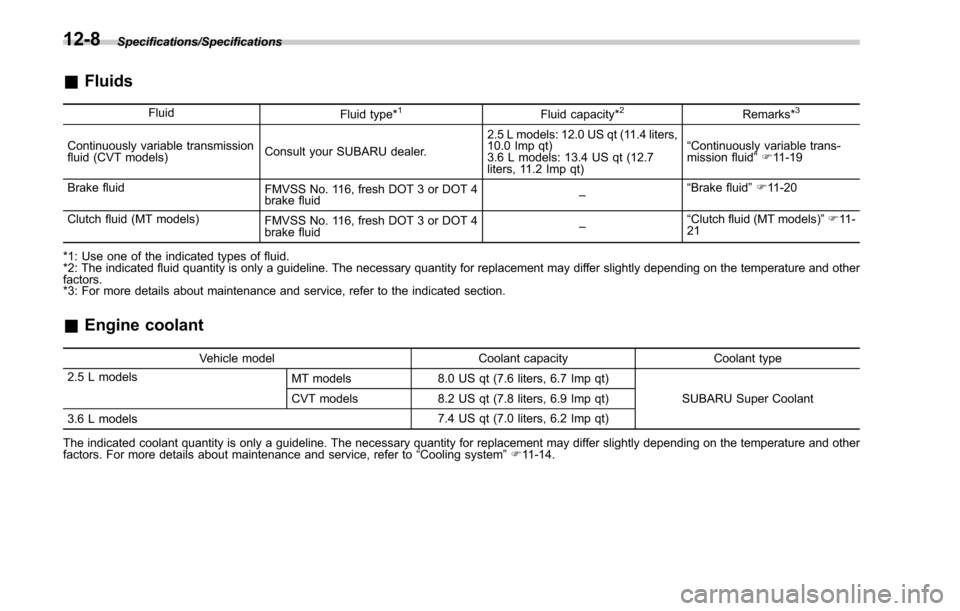
&Fluids
Fluid
Fluid type*1Fluid capacity*2Remarks*3
Continuously variable transmission
fluid (CVT models) Consult your SUBARU dealer. 2.5 L models: 12.0 US qt (11.4 liters,
10.0 Imp qt)
3.6 L models: 13.4 US qt (12.7
liters, 11.2 Imp qt)“
Continuously variable trans-
mission fluid ”F 11-19
Brake fluid FMVSS No. 116, fresh DOT 3 or DOT 4
brake fluid –“
Brake fluid ”F 11-20
Clutch fluid (MT models) FMVSS No. 116, fresh DOT 3 or DOT 4
brake fluid –“
Clutch fluid (MT models) ”F 11 -
21
*1: Use one of the indicated types of fluid.
*2: The indicated fluid quantity is only a guideline. The necessary quantity for replacement may differ slightly depending on the temperature and other
factors.
*3: For more details about maintenance and service, refer to the indicated section.
& Engine coolant
Vehicle model Coolant capacityCoolant type
2.5 L models MT models8.0 US qt (7.6 liters, 6.7 Imp qt)
SUBARU Super Coolant
CVT models 8.2 US qt (7.8 liters, 6.9 Imp qt)
3.6 L models 7.4 US qt (7.0 liters, 6.2 Imp qt)
The indicated coolant quantity is only a guideline. The necessary quantity for replacement may differ slightly depending on the temperature and other
factors. For more details about maintenance and service, refer to “Cooling system ”F 11-14.
12-8
Page 564 of 610
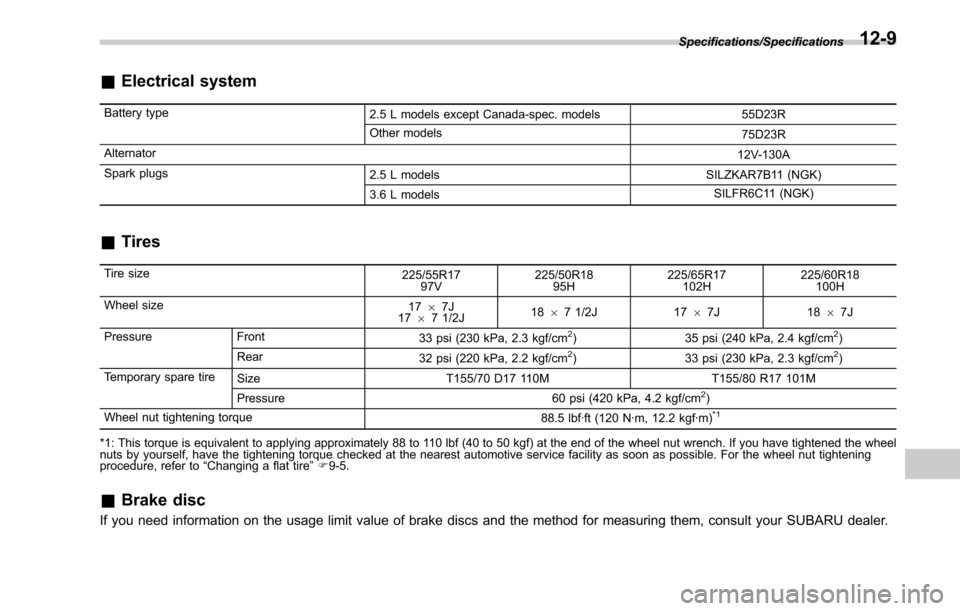
&Electrical system
Battery type
2.5 L models except Canada-spec. models 55D23R
Other models 75D23R
Alternator 12V-130A
Spark plugs 2.5 L models SILZKAR7B11 (NGK)
3.6 L models SILFR6C11 (NGK)
&
Tires
Tire size
225/55R17
97V 225/50R18
95H 225/65R17
102H 225/60R18
100H
Wheel size 1767J
17 67 1/2J 18
67 1/2J 17 67J 18 67J
Pressure Front 33 psi (230 kPa, 2.3 kgf/cm
2)35 psi (240 kPa, 2.4 kgf/cm2)
Rear 32 psi (220 kPa, 2.2 kgf/cm2)33 psi (230 kPa, 2.3 kgf/cm2)
Temporary spare tire Size T155/70 D17 110M T155/80 R17 101M
Pressure 60 psi (420 kPa, 4.2 kgf/cm
2)
Wheel nut tightening torque 88.5 lbf·ft (120 N·m, 12.2 kgf·m)*1
*1: This torque is equivalent to applying approximately 88 to 110 lbf (40 to 50 kgf) at the end of the wheel nut wrench. If you have tightened the wheel
nuts by yourself, have the tightening torque checked at the nearest automotive service facility as soon as possible. For the wheel nut tightening
procedure, refer to“Changing a flat tire ”F 9-5.
& Brake disc
If you need information on the usage limit value of brake discs and the method for measuring them, consult your SUBARU dealer.
Specifications/Specifications12-9
Page 578 of 610
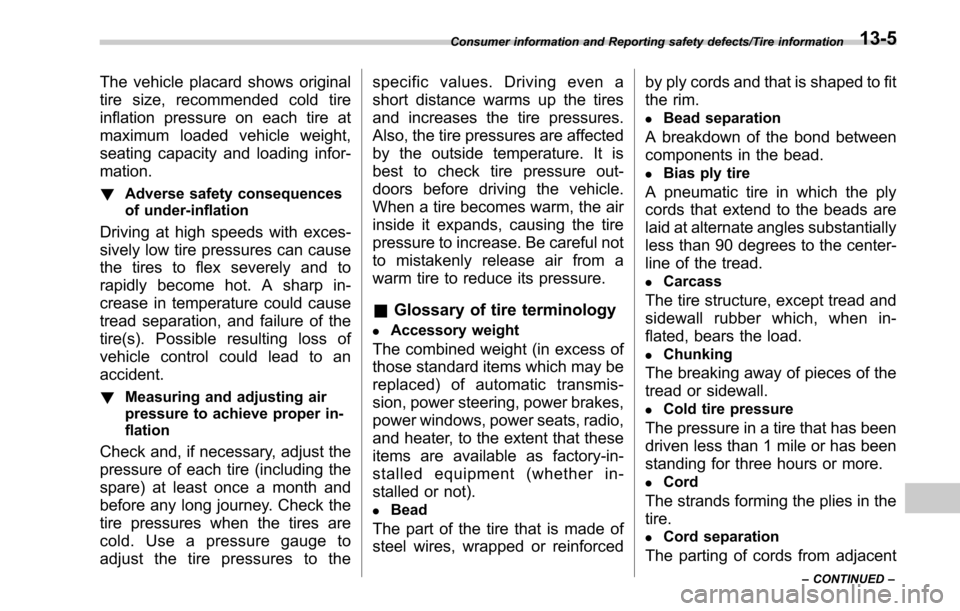
The vehicle placard shows original
tire size, recommended cold tire
inflation pressure on each tire at
maximum loaded vehicle weight,
seating capacity and loading infor-
mation.
!Adverse safety consequences
of under-inflation
Driving at high speeds with exces-
sively low tire pressures can cause
the tires to flex severely and to
rapidly become hot. A sharp in-
crease in temperature could cause
tread separation, and failure of the
tire(s). Possible resulting loss of
vehicle control could lead to an
accident.
!Measuring and adjusting air
pressure to achieve proper in-
flation
Check and, if necessary, adjust the
pressure of each tire (including the
spare) at least once a month and
before any long journey. Check the
tire pressures when the tires are
cold. Use a pressure gauge to
adjust the tire pressures to the specific values. Driving even a
short distance warms up the tires
and increases the tire pressures.
Also, the tire pressures are affected
by the outside temperature. It is
best to check tire pressure out-
doors before driving the vehicle.
When a tire becomes warm, the air
inside it expands, causing the tire
pressure to increase. Be careful not
to mistakenly release air from a
warm tire to reduce its pressure.
&
Glossary of tire terminology
.Accessory weight
The combined weight (in excess of
those standard items which may be
replaced) of automatic transmis-
sion, power steering, power brakes,
power windows, power seats, radio,
and heater, to the extent that these
items are available as factory-in-
stalled equipment (whether in-
stalled or not).
.Bead
The part of the tire that is made of
steel wires, wrapped or reinforced by ply cords and that is shaped to fit
the rim.
.Bead separation
A breakdown of the bond between
components in the bead.
.Bias ply tire
A pneumatic tire in which the ply
cords that extend to the beads are
laid at alternate angles substantially
less than 90 degrees to the center-
line of the tread.
.Carcass
The tire structure, except tread and
sidewall rubber which, when in-
flated, bears the load.
.Chunking
The breaking away of pieces of the
tread or sidewall.
.Cold tire pressure
The pressure in a tire that has been
driven less than 1 mile or has been
standing for three hours or more.
.Cord
The strands forming the plies in the
tire.
.Cord separation
The parting of cords from adjacent
Consumer information and Reporting safety defects/Tire information
–CONTINUED –13-5
Page 580 of 610
sidewall, or innerliner that extends
to cord material.
.Outer diameter
The overall diameter of an inflated
new tire.
.Overall width
The linear distance between the
exteriors of the sidewalls of an
inflated tire, including elevations
due to labeling, decorations, or
protective bands or ribs.
.Passenger car tire
A tire intended for use on passen-
ger cars, multipurpose passenger
vehicles, and trucks, that have a
gross vehicle weight rating (GVWR)
of 10,000 lbs (4,535 kg) or less.
.Ply
A layer of rubber-coated parallel
cords.
.Ply separation
A parting of rubber compound
between adjacent plies.
.Pneumatic tire
A mechanical device made of rub-
ber, chemicals, fabric and steel or
other materials, that, whenmounted on an automotive wheel,
provides the traction and contains
the gas or fluid that sustains the
load.
.Production options weight
The combined weight of those
installed regular production options
weighing over 5.1 lbs (2.3 kg) in
excess of those standard items
which they replace, not previously
considered in curb weight or acces-
sory weight, including heavy duty
brakes, ride levelers, roof rack,
heavy duty battery, and special
trim.
.Radial ply tire
A pneumatic tire in which the ply
cords that extend to the beads are
laid at substantially 90 degrees to
the centerline of the tread.
.Recommended inflation pres-
sure
The cold inflation pressure recom-
mended by a vehicle manufacturer.
.Reinforced tire
A tire designed to operate at higher
loads and at higher inflation pres- sures than the corresponding stan-
dard tire.
.Rim
A metal support for a tire or a tire
and tube assembly upon which the
tire beads are seated.
.Rim diameter
Nominal diameter of the bead seat.
.Rim size designation
Rim diameter and width.
.Rim type designation
The industry of manufacturer
’s des-
ignation for a rim by style or code.
.Rim width
Nominal distance between rim
flanges.
.Section width
The linear distance between the
exteriors of the sidewalls of an
inflated tire, excluding elevations
due to labeling, decoration, or
protective bands.
.Sidewall
That portion of a tire between the
tread and bead.
.Sidewall separation
The parting of the rubber com-
Consumer information and Reporting safety defects/Tire information
–CONTINUED –13-7
Page 586 of 610
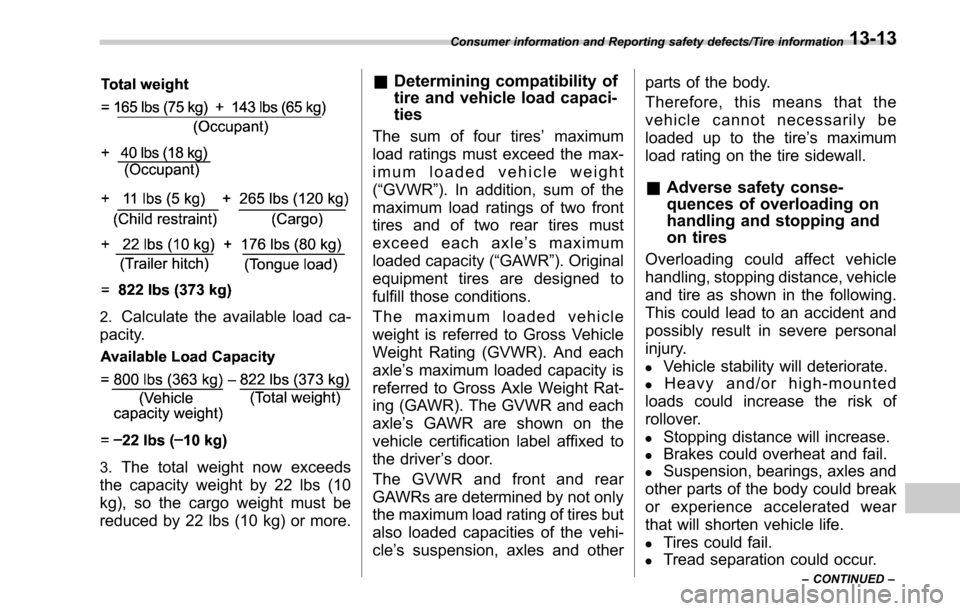
2.Calculate the available load ca-
pacity.
3.The total weight now exceeds
the capacity weight by 22 lbs (10
kg), so the cargo weight must be
reduced by 22 lbs (10 kg) or more.
& Determining compatibility of
tire and vehicle load capaci-
ties
The sum of four tires ’maximum
load ratings must exceed the max-
imum loaded vehicle weight
( “ GVWR ”). In addition, sum of the
maximum load ratings of two front
tires and of two rear tires must
exceed each axle ’smaximum
loaded capacity ( “GAWR ”). Original
equipment tires are designed to
fulfill those conditions.
The maximum loaded vehicle
weight is referred to Gross Vehicle
Weight Rating (GVWR). And each
axle ’s maximum loaded capacity is
referred to Gross Axle Weight Rat-
ing (GAWR). The GVWR and each
axle ’s GAWR are shown on the
vehicle certification label affixed to
the driver ’s door.
The GVWR and front and rear
GAWRs are determined by not only
the maximum load rating of tires but
also loaded capacities of the vehi-
cle ’s suspension, axles and other parts of the body.
Therefore, this means that the
vehicle cannot necessarily be
loaded up to the tire
’s maximum
load rating on the tire sidewall.
& Adverse safety conse-
quences of overloading on
handling and stopping and
on tires
Overloading could affect vehicle
handling, stopping distance, vehicle
and tire as shown in the following.
This could lead to an accident and
possibly result in severe personal
injury.
.Vehicle stability will deteriorate.
.Heavy and/or high-mounted
loads could increase the risk of
rollover.
.Stopping distance will increase.
.Brakes could overheat and fail.
.Suspension, bearings, axles and
other parts of the body could break
or experience accelerated wear
that will shorten vehicle life.
.Tires could fail.
.Tread separation could occur.
Consumer information and Reporting safety defects/Tire information
–CONTINUED –13-13
Page 591 of 610
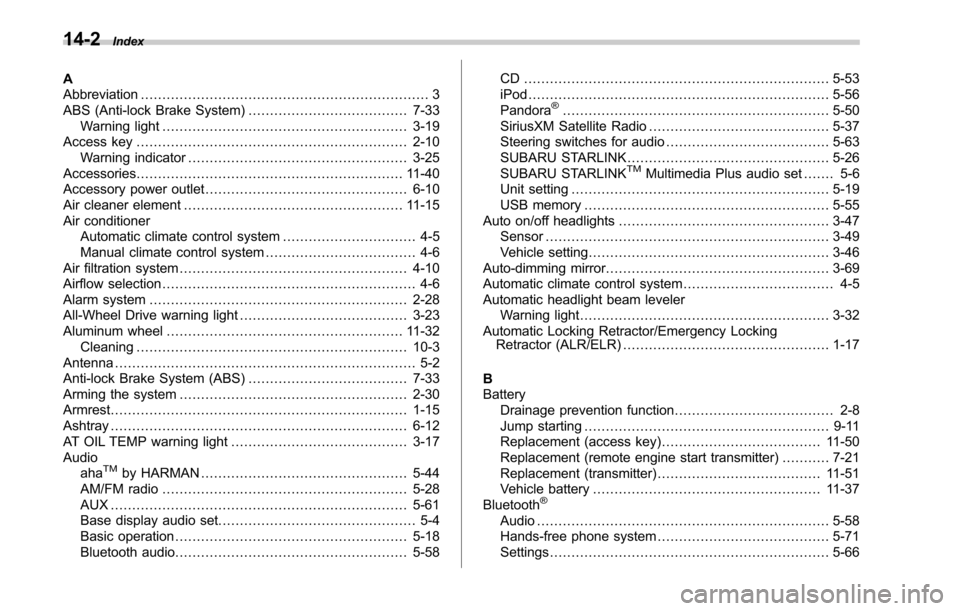
14-2Index
A
Abbreviation................................................................... 3
ABS (Anti-lock Brake System) ..................................... 7-33
Warning light ......................................................... 3-19
Access key ............................................................... 2-10
Warning indicator ................................................... 3-25
Accessories .............................................................. 11-40
Accessory power outlet ............................................... 6-10
Air cleaner element ................................................... 11-15
Air conditioner Automatic climate control system ............................... 4-5
Manual climate control system ................................... 4-6
Air filtration system ..................................................... 4-10
Airflow selection ........................................................... 4-6
Alarm system ............................................................ 2-28
All-Wheel Drive warning light ....................................... 3-23
Aluminum wheel ....................................................... 11-32
Cleaning ............................................................... 10-3
Antenna ...................................................................... 5-2
Anti-lock Brake System (ABS) ..................................... 7-33
Arming the system ..................................................... 2-30
Armrest ..................................................................... 1-15
Ashtray ..................................................................... 6-12
AT OIL TEMP warning light ......................................... 3-17
Audio aha
TMby HARMAN ................................................ 5-44
AM/FM radio ......................................................... 5-28
AUX ..................................................................... 5-61
Base display audio set. ............................................. 5-4
Basic operation ...................................................... 5-18
Bluetooth audio ...................................................... 5-58 CD ....................................................................... 5-53
iPod
...................................................................... 5-56
Pandora
®.............................................................. 5-50
SiriusXM Satellite Radio .......................................... 5-37
Steering switches for audio ...................................... 5-63
SUBARU STARLINK ............................................... 5-26
SUBARU STARLINK
TMMultimedia Plus audio set ... .... 5-6
Unit setting ............................................................ 5-19
USB memory ......................................................... 5-55
Auto on/off headlights ................................................. 3-47
Sensor .................................................................. 3-49
Vehicle setting ........................................................ 3-46
Auto-dimming mirror .................................................... 3-69
Automatic climate control system ................................... 4-5
Automatic headlight beam leveler Warning light .......................................................... 3-32
Automatic Locking Retractor/Emergency Locking Retractor (ALR/ELR) ................................................ 1-17
B
Battery Drainage prevention function ..................................... 2-8
Jump starting ......................................................... 9-11
Replacement (access key) ..................................... 11-50
Replacement (remote engine start transmitter) ........... 7-21
Replacement (transmitter) ...................................... 11-51
Vehicle battery ..................................................... 11-37
Bluetooth
®
Audio .................................................................... 5-58
Hands-free phone system ........................................ 5-71
Settings ................................................................. 5-66