battery SUBARU SOLTERRA 2023 Owners Manual
[x] Cancel search | Manufacturer: SUBARU, Model Year: 2023, Model line: SOLTERRA, Model: SUBARU SOLTERRA 2023Pages: 628, PDF Size: 11.91 MB
Page 541 of 628
5418-2. Steps to take in an emergency
Owners Manual_USA_M42C01_en
8
When trouble arises
cannot be started, contact your Toy-
ota dealer.
■Stopping the EV system
Shift the shift position to P, set the
parking brake and press the power
switch as you no rmally do when
stopping the EV system.
■Replacing the key battery
As the above proc edure is a tempo-
rary measure, it is recommended
that the electronic key battery be
replaced immediate ly when the bat-
tery is depleted. ( P.497)
■Alarm
If a door is unlocked using the
mechanical key when the alarm sys-
tem is set, the alarm may be trig-
gered. ( P. 6 9 )
■Changing power switch modes
Release the brake pedal and press
the power switch in step 3 above.
The EV system does not start and
modes will be cha nged each time
the switch is pressed. ( P.234)
If you have a set of jumper (or
booster) cables and a second
vehicle with a 12-volt battery,
you can jump start your vehicle
by following the steps below.
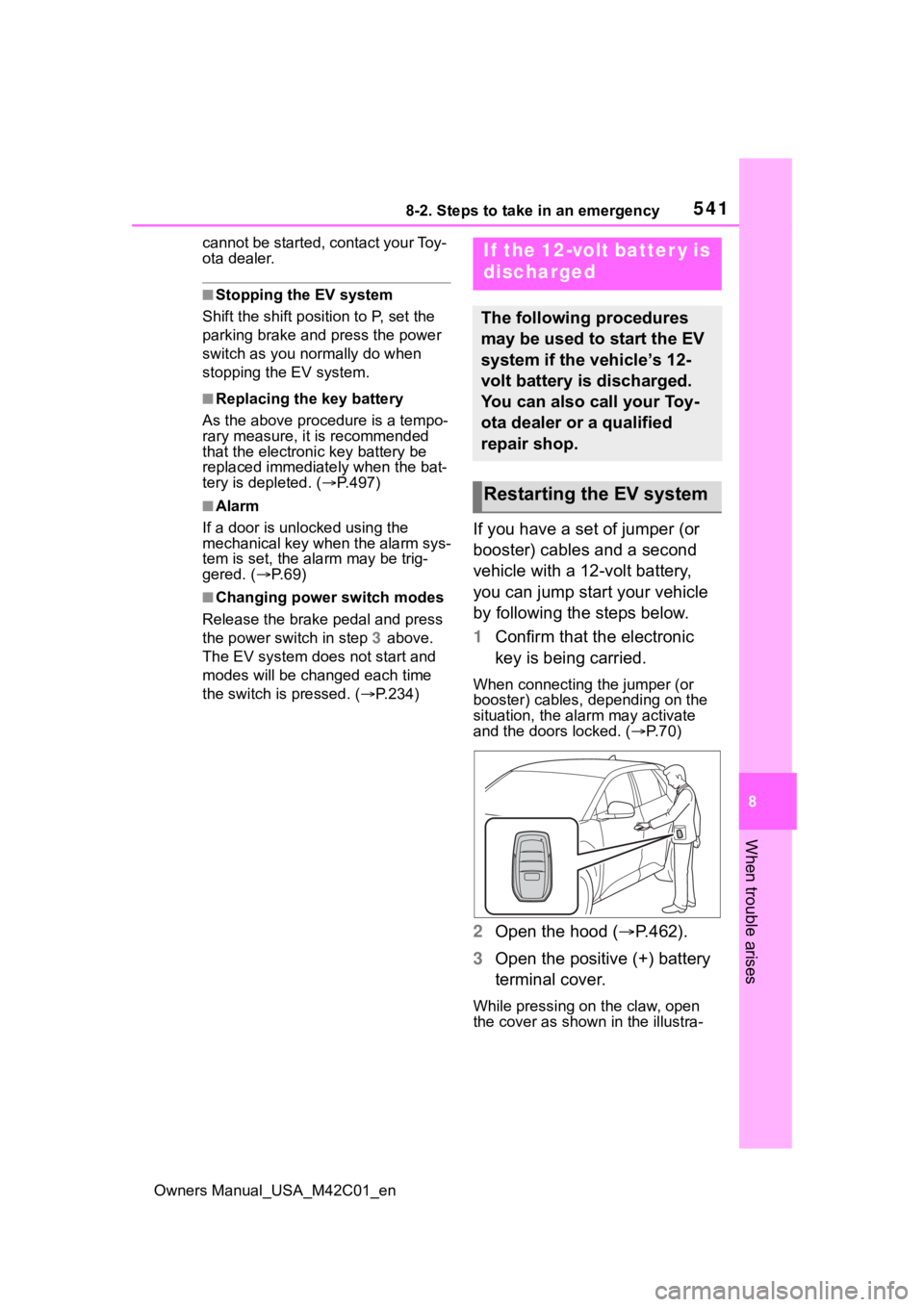
1Confirm that the electronic
key is being carried.
When connecting the jumper (or
booster) cables, depending on the
situation, the alarm may activate
and the doors locked. ( P. 7 0 )
2 Open the hood ( P.462).
3 Open the positive (+) battery
terminal cover.
While pressing on the claw, open
the cover as shown in the illustra-
If the 12-volt batter y is
discharged
The following procedures
may be used to start the EV
system if the vehicle’s 12-
volt battery is discharged.
You can also call your Toy-
ota dealer or a qualified
repair shop.
Restarting the EV system
Page 542 of 628
5428-2. Steps to take in an emergency
Owners Manual_USA_M42C01_ention.
4
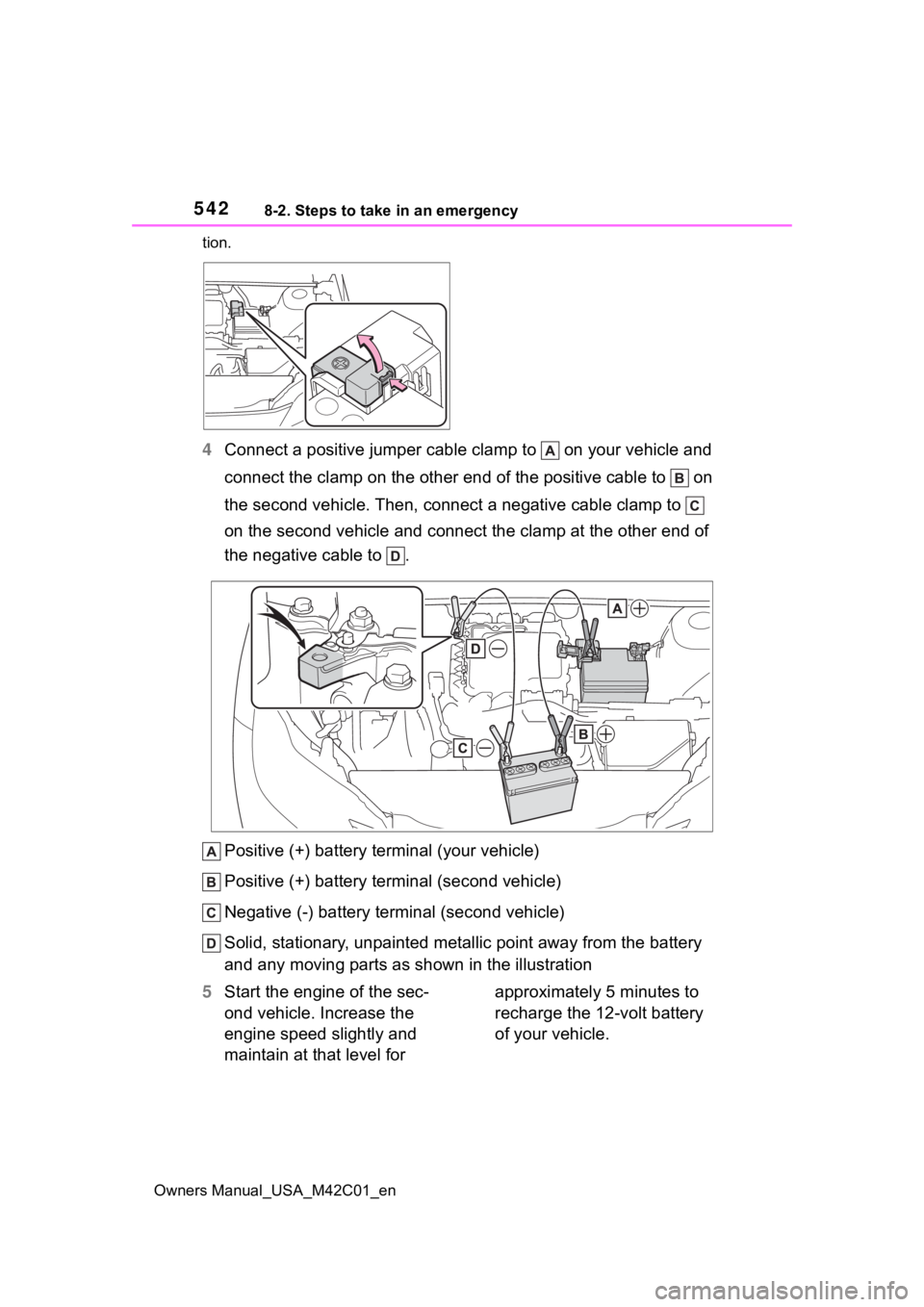
Connect a positive jumper cabl e clamp to on your vehicle and
connect the clamp on the other end of the positive cable to on
the second vehicle. Then, connect a negative cable clamp to
on the second vehicle and connect the clamp at the other end of
the negative cable to .
Positive (+) battery terminal (your vehicle)
Positive (+) battery terminal (second vehicle)
Negative (-) battery term inal (second vehicle)
Solid, stationary, unpainted metallic point away from the batte ry
and any moving parts as shown in the illustration
5 Start the engine of the sec-
ond vehicle. Increase the
engine speed slightly and
maintain at that level for approximately 5 minutes to
recharge the 12-volt battery
of your vehicle.
Page 543 of 628
5438-2. Steps to take in an emergency
Owners Manual_USA_M42C01_en
8
When trouble arises
6 Open and close any of the
doors of your vehicle with the
power switch OFF.
7 Maintain the engine speed of
the second vehicle and start
the EV system of your vehi-
cle by turning the power
switch to ON.
8 Make sure the “READY” indi-
cator comes on. If the indica-
tor light does not come on,
contact your Toyota dealer.
9 Once the EV system has
started, remove the jumper
cables in the exact reverse
order from which they were
connected.
10 Close the positive (+) battery
terminal cover.
Once the EV system starts,
have the vehicle inspected at
your Toyota dealer as soon as
possible.
■Starting the EV system when
the 12-volt battery is dis-
charged
The EV system cannot be started by
push-starting.
■To prevent 12-volt battery dis-
charge
●Turn off the headlights, the air
conditioning system, the audio
system, etc. while the EV system
is off.
●Turn off any unnecessary electri-
cal components when the vehicle
is running at a low speed for an
extended period, such as in heavy
traffic.
■Charging the 12-volt battery
The electricity stored in the 12-volt
battery will discha rge gradually even
when the vehicle i s not in use, due
to natural dischar ge and the drain-
ing effects of certain electrical appli-
ances. If the vehicle is left for a long
time, the 12-volt battery may dis-
charge, and the EV system may be
unable to start. (The 12-volt battery
recharges automatically while the
EV system is operating.)
■When the 12-volt battery is
removed or discharged
●Information stored in the ECU is
cleared. When the 12-volt battery
is depleted, have the vehicle
inspected at your Toyota dealer.
●In some cases, it may not be pos-
sible to unlock the doors using the
smart key system when the 12-
volt battery is discharged. Use the
wireless remote c ontrol or the
mechanical key to lock or unlock
the doors.
●The EV system may not start on
the first attempt a fter the 12-volt
battery has recharged but will start
normally after the second attempt.
This is not a malfunction.
●The power switch mode is memo-
rized by the vehicle. When the 12-
volt battery is reconnected, the
system will return to the mode it
was in before the 12-volt battery
was discharged. Before discon-
necting the 12-volt battery, turn
the power switch off.
If you are unsure what mode the
power switch was in before the
12-volt battery discharged, be
especially careful when recon-
necting the 12-volt battery.
●If the 12-volt battery discharges, it
may not be possible to shift the
shift position to o ther positions. In
this case, the vehicle cannot be
towed without lifting both front
wheels because the front wheels
will be locked.
●The power back door (if equipped)
Page 544 of 628
5448-2. Steps to take in an emergency
Owners Manual_USA_M42C01_enmust be initialized. (
P.181)
■When replacing the 12-volt bat-
tery
●Use a 12-volt battery that con-
forms to European regulations.
●Use a 12-volt battery that the case
size is same as the previous one
(LN1), 20 hour rate capacity
(20HR) is equiva lent (45Ah) or
greater, and performance rating
(CCA) is equivalent (286A) or
greater.
• If the sizes differ, the 12-volt bat- tery cannot be properly secured.
• If an improper 12- volt battery is
used, battery performance may
decrease and the EV system may
not be able to restart.
• If the 20 hour rate capacity is low,
even if the time period where the
vehicle is not used is a short time,
the 12-volt battery may discharge
and EV system may not be able to
start.
For details, consult your Toyota
dealer.
WARNING
■When removing the 12-volt
battery terminals
Always remove the negative (-)
terminal first. If the positive (+) ter-
minal contacts any metal in the
surrounding area when the posi-
tive (+) terminal is removed, a
spark may occur, l eading to a fire
in addition to electrical shocks
and death or serious injury.
■Avoiding 12-volt battery fires
or explosions
Observe the following precautions
to prevent accidentally igniting the
flammable gas that may be emit-
ted from the 12-volt battery:
●Make sure each jumper cable is
connected to the correct termi-
nal and that it is not unintention-
ally in contact with any other
than the intended terminal.
●Do not allow the other end of
the jumper cable connected to
the “+” terminal to come into
contact with any other parts or
metal surfaces in the area, such
as brackets or unpainted metal.
●Do not allow the + and - clamps
of the jumper cables to come
into contact with each other.
●Do not smoke, use matches,
cigarette lighter s or allow open
flame near the 1 2-volt battery.
■12-volt battery precautions
The 12-volt battery contains poi-
sonous and corrosive acidic elec-
trolyte, while related parts contain
lead and lead compounds.
Observe the following precautions
when handling the 12-volt battery:
●When working with the 12-volt
battery, always wear safety
glasses and take care not to
allow any battery fluids (acid) to
come into contact with skin,
clothing or the vehicle body.
●Do not lean over the 12-volt bat-
tery.
●In the event that battery fluid
(acid) comes into contact with
the skin or eyes, immediately
wash the affected area with
water and seek medical atten-
tion.
Place a wet sponge or cloth
over the affected area until
medical attention can be
received.
●Always wash your hands after
handling the 12-volt battery and
other battery-related parts.
●Do not allow children near the
12-volt battery.
Page 545 of 628
5458-2. Steps to take in an emergency
Owners Manual_USA_M42C01_en
8
When trouble arises1 Stop the vehicle in a safe
place and turn off the air con-
ditioning system.
2 Leave the EV system operat-
ing and carefully lift the hood.
3 Check if the cooling fan is
operating.
If the fan is operating:
Wait until the “EV System
overheated Output power
reduced” message disap-
WARNING
■When replacing the 12-volt
battery
●When the vent plug is close to
the hold down cl amp, the bat-
tery fluid (acid) may leak.
●For information regarding bat-
tery replacement, contact your
Toyota dealer.
NOTICE
■When handling jumper cables
When connecting the jumper
cables, ensure that they do not
become entangled in the cooling
fan.
If your vehicle over-
heats
When “EV System over-
heated Output power
reduced” is shown on the
multi-information display,
your vehicle may be over-
heating.
NOTICE
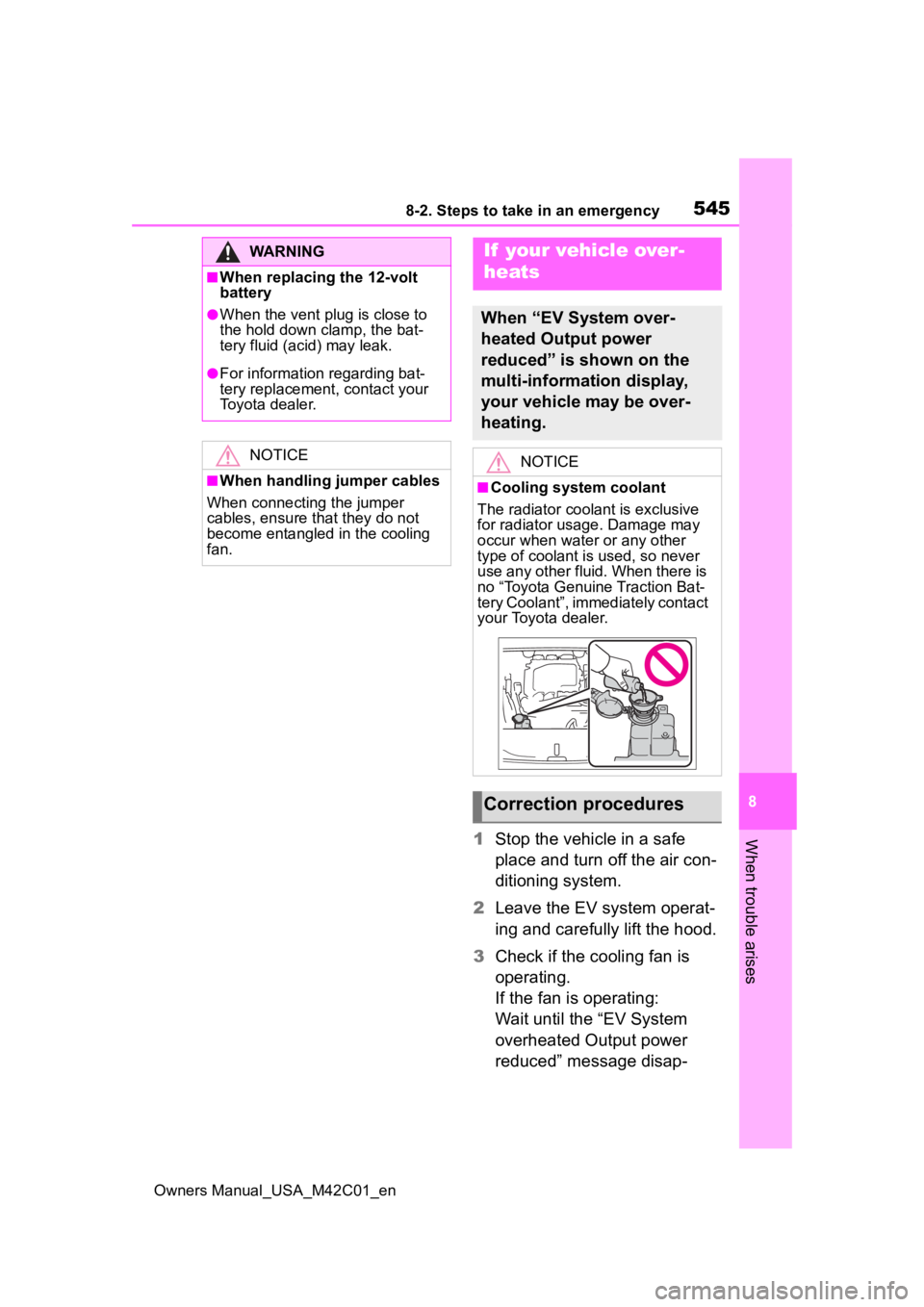
■Cooling system coolant
The radiator coolant is exclusive
for radiator usage. Damage may
occur when water or any other
type of coolant is used, so never
use any other fluid. When there is
no “Toyota Genuine Traction Bat-
tery Coolant”, immediately contact
your Toyota dealer.
Correction procedures
Page 546 of 628
5468-2. Steps to take in an emergency
Owners Manual_USA_M42C01_en
pears and then stop the EV
system. If the message does
not disappear, call your Toy-
ota dealer.
If the fan is not operating:
Stop the EV system immedi-
ately and call your Toyota
dealer.
4 After the EV system has
cooled down, inspect the
hoses and radiator core (radi-
ator) for any leaks.
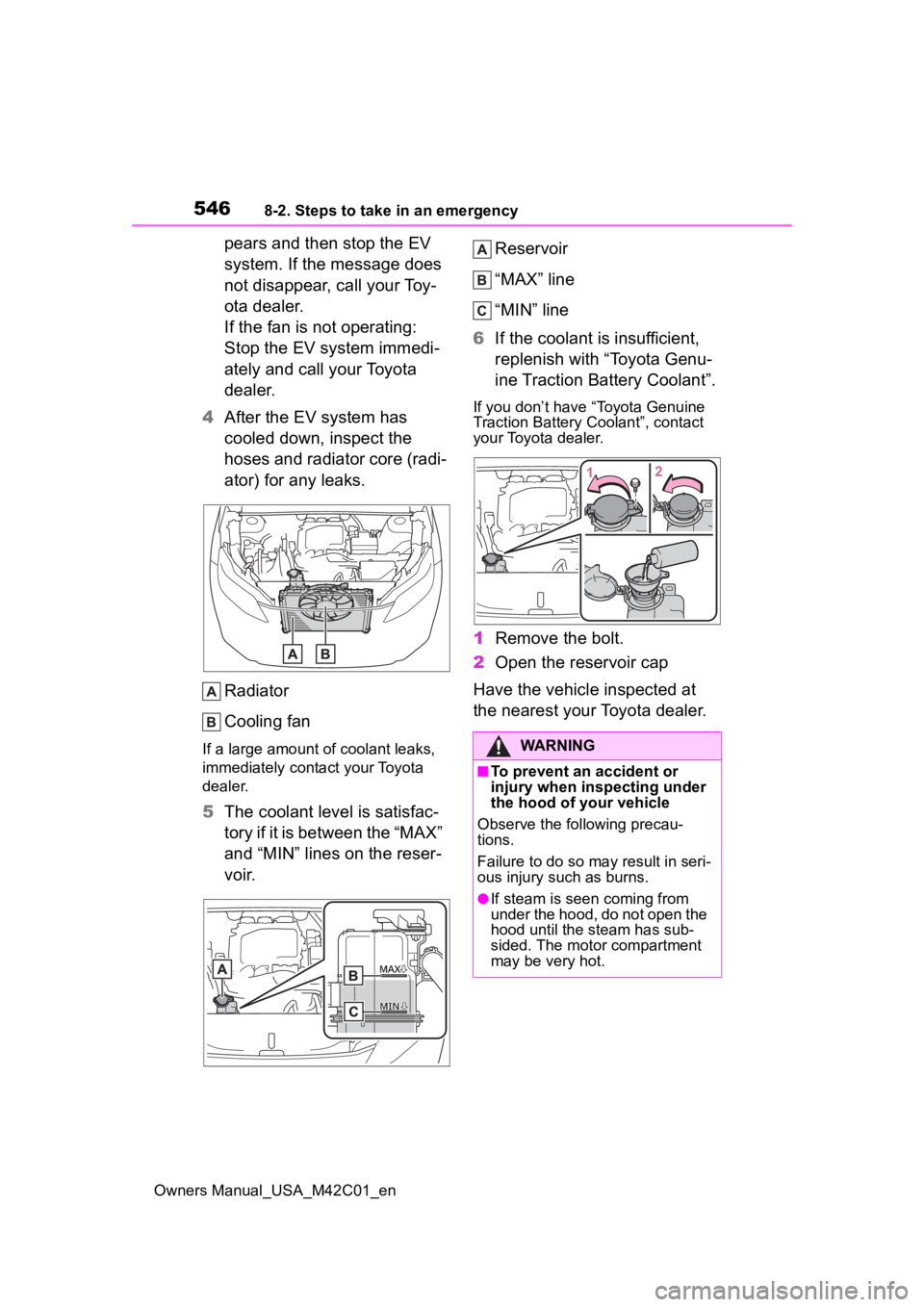
Radiator
Cooling fan
If a large amount of coolant leaks,
immediately cont act your Toyota
dealer.
5 The coolant level is satisfac-
tory if it is between the “MAX”
and “MIN” lines on the reser-
voir. Reservoir
“MAX” line
“MIN” line
6 If the coolant is insufficient,
replenish with “Toyota Genu-
ine Traction Battery Coolant”.
If you don’t have “Toyota Genuine
Traction Battery Coolant”, contact
your Toyota dealer.
1Remove the bolt.
2 Open the reservoir cap
Have the vehicle inspected at
the nearest your Toyota dealer.
WARNING
■To prevent an accident or
injury when inspecting under
the hood of your vehicle
Observe the following precau-
tions.
Failure to do so may result in seri-
ous injury such as burns.
●If steam is seen coming from
under the hood, do not open the
hood until the steam has sub-
sided. The motor compartment
may be very hot.
Page 552 of 628
5529-1. Specifications
Owners Manual_USA_M42C01_en
*1: 2WD models
*2: AWD models
*1: The coolant capacity is the quantity of reference.
If replacement is ne cessary, contact your Toyota dealer.
*2: 2WD models
*3: AWD models
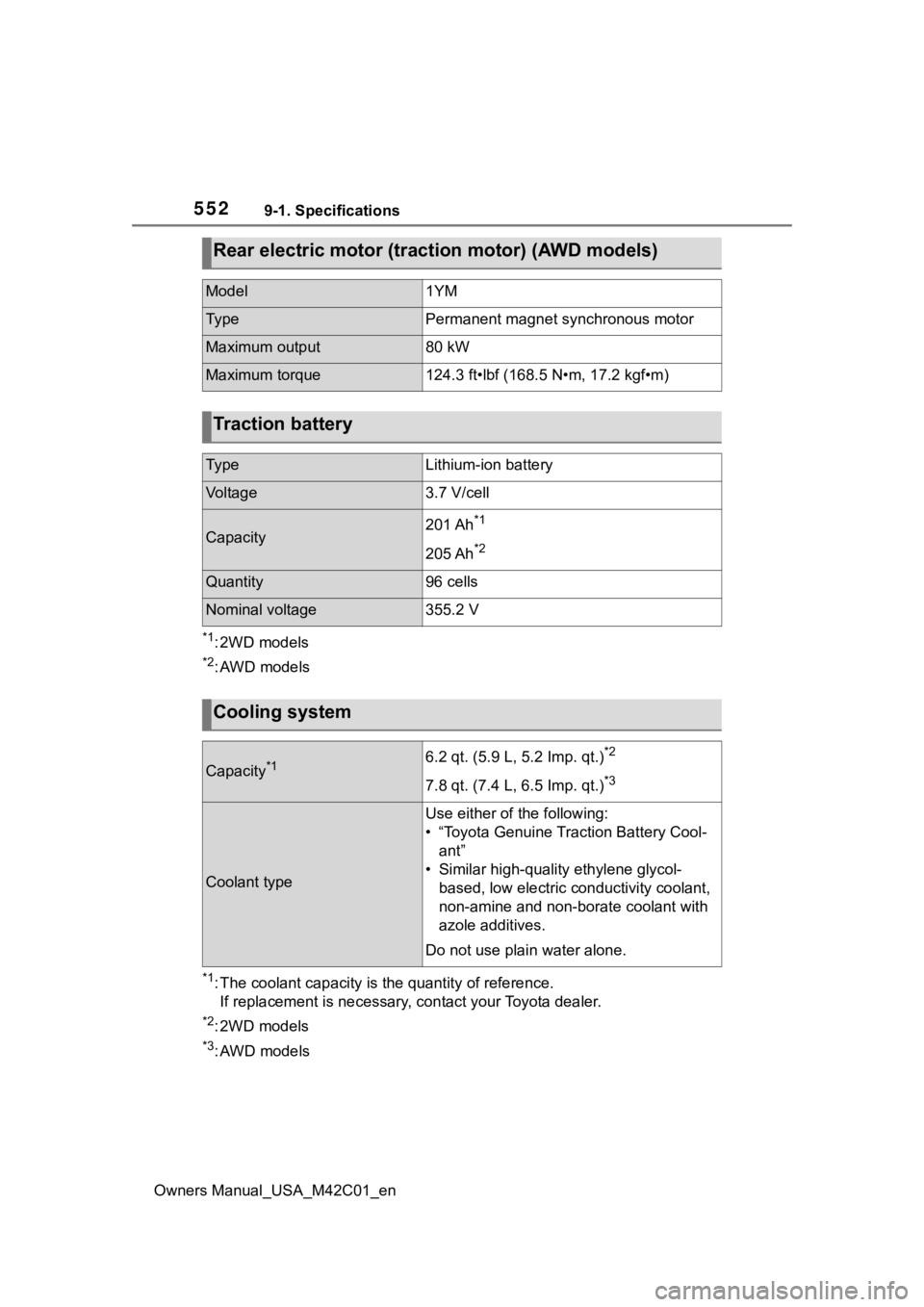
Rear electric motor (traction motor) (AWD models)
Model1YM
Ty p ePermanent magnet synchronous motor
Maximum output80 kW
Maximum torque124.3 ft•lbf (168.5 N•m, 17.2 kgf•m)
Traction battery
Ty p eLithium-ion battery
Voltage3.7 V/cell
Capacity201 Ah*1
205 Ah*2
Quantity96 cells
Nominal voltage355.2 V
Cooling system
Capacity*16.2 qt. (5.9 L, 5.2 Imp. qt.)*2
7.8 qt. (7.4 L, 6.5 Imp. qt.)*3
Coolant type
Use either of the following:
• “Toyota Genuine Tra ction Battery Cool-
ant”
• Similar high-quality ethylene glycol- based, low electric conductivity coolant,
non-amine and non-b orate coolant with
azole additives.
Do not use plain water alone.
Page 553 of 628
5539-1. Specifications
Owners Manual_USA_M42C01_en
9
Vehicle specifications
NOTICE
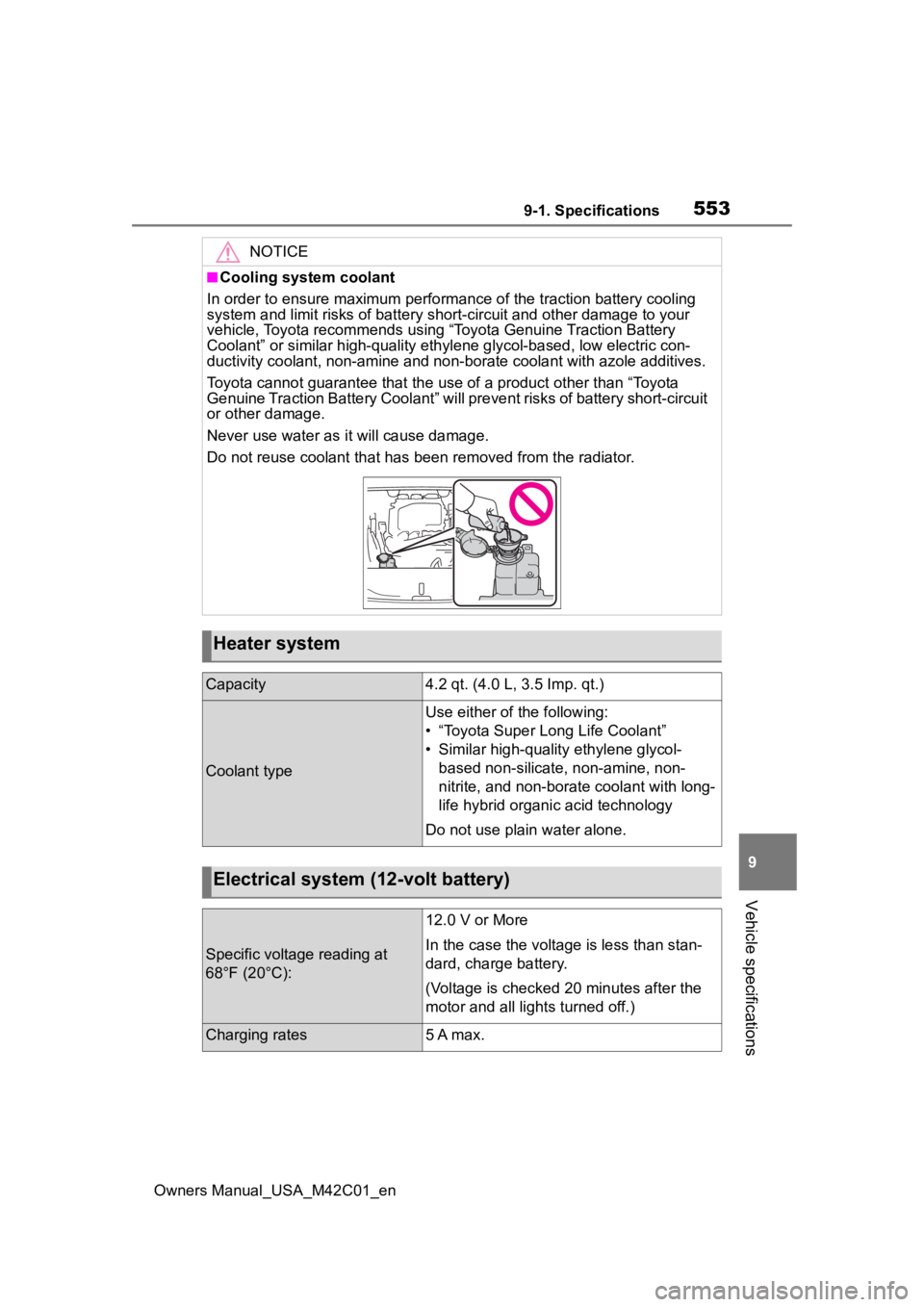
■Cooling system coolant
In order to ensure maximum perfor mance of the traction battery cooling
system and limit risks of battery short-circuit and other damag e to your
vehicle, Toyota recommends using “Toyota Genuine Traction Battery
Coolant” or similar high-quality ethylene glycol-based, low electric con-
ductivity coolant, non-amine and non-borate coolant with azole additives.
Toyota cannot guarantee that th e use of a product other than “Toyota
Genuine Traction Battery Cool ant” will prevent risks of battery short-circuit
or other damage.
Never use water as it will cause damage.
Do not reuse coolant that has been removed from the radiator.
Heater system
Capacity4.2 qt. (4.0 L, 3.5 Imp. qt.)
Coolant type
Use either of the following:
• “Toyota Super Long Life Coolant”
• Similar high-quality ethylene glycol- based non-silicate , non-amine, non-
nitrite, and non-borate coolant with long-
life hybrid organic acid technology
Do not use plain water alone.
Electrical system ( 12-volt battery)
Specific voltage reading at
68°F (20°C):
12.0 V or More
In the case the voltage is less than stan-
dard, charge battery.
(Voltage is checked 20 minutes after the
motor and all lights turned off.)
Charging rates5 A max.
Page 560 of 628
5609-1. Specifications
Owners Manual_USA_M42C01_enheat buildup and possible tire fail- ure.
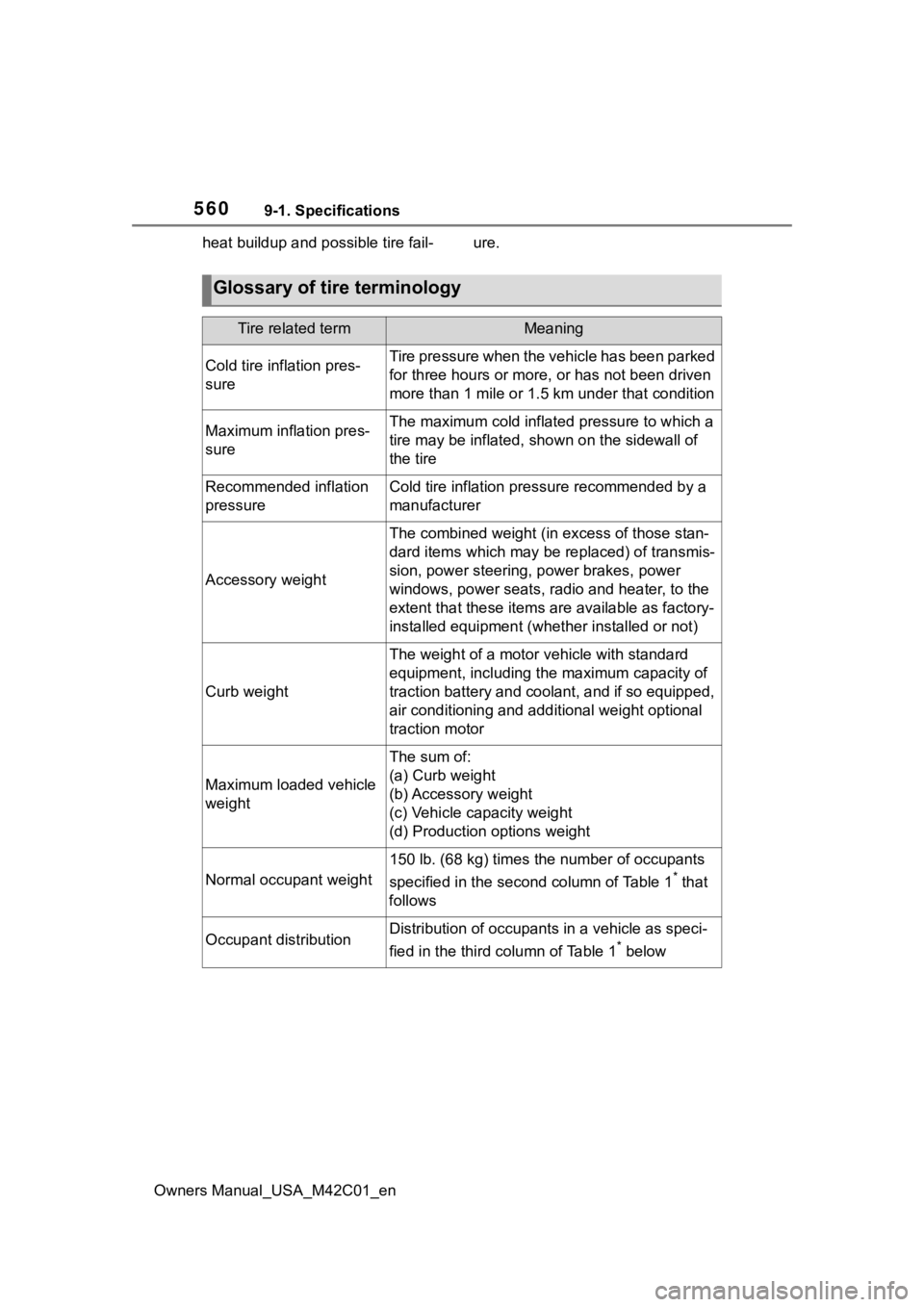
Glossary of tire terminology
Tire related termMeaning
Cold tire inflation pres-
sureTire pressure when the vehicle has been parked
for three hours or more, or has not been driven
more than 1 mile or 1.5 km under that condition
Maximum inflation pres-
sureThe maximum cold inflated pressure to which a
tire may be inflated, shown on the sidewall of
the tire
Recommended inflation
pressureCold tire inflation pressure recommended by a
manufacturer
Accessory weight
The combined weight (in
excess of those stan-
dard items which may be replaced) of transmis-
sion, power steering, power brakes, power
windows, power seats, radio and heater, to the
extent that these items are available as factory-
installed equipment (whether installed or not)
Curb weight
The weight of a motor vehicle with standard
equipment, including th e maximum capacity of
traction battery and coolant, and if so equipped,
air conditioning and additional weight optional
traction motor
Maximum loaded vehicle
weight
The sum of:
(a) Curb weight
(b) Accessory weight
(c) Vehicle capacity weight
(d) Production options weight
Normal occupant weight
150 lb. (68 kg) times the number of occupants
specified in the second column of Table 1
* that
follows
Occupant distributionDistribution of occupant s in a vehicle as speci-
fied in the third column of Table 1
* below
Page 561 of 628
5619-1. Specifications
Owners Manual_USA_M42C01_en
9
Vehicle specifications
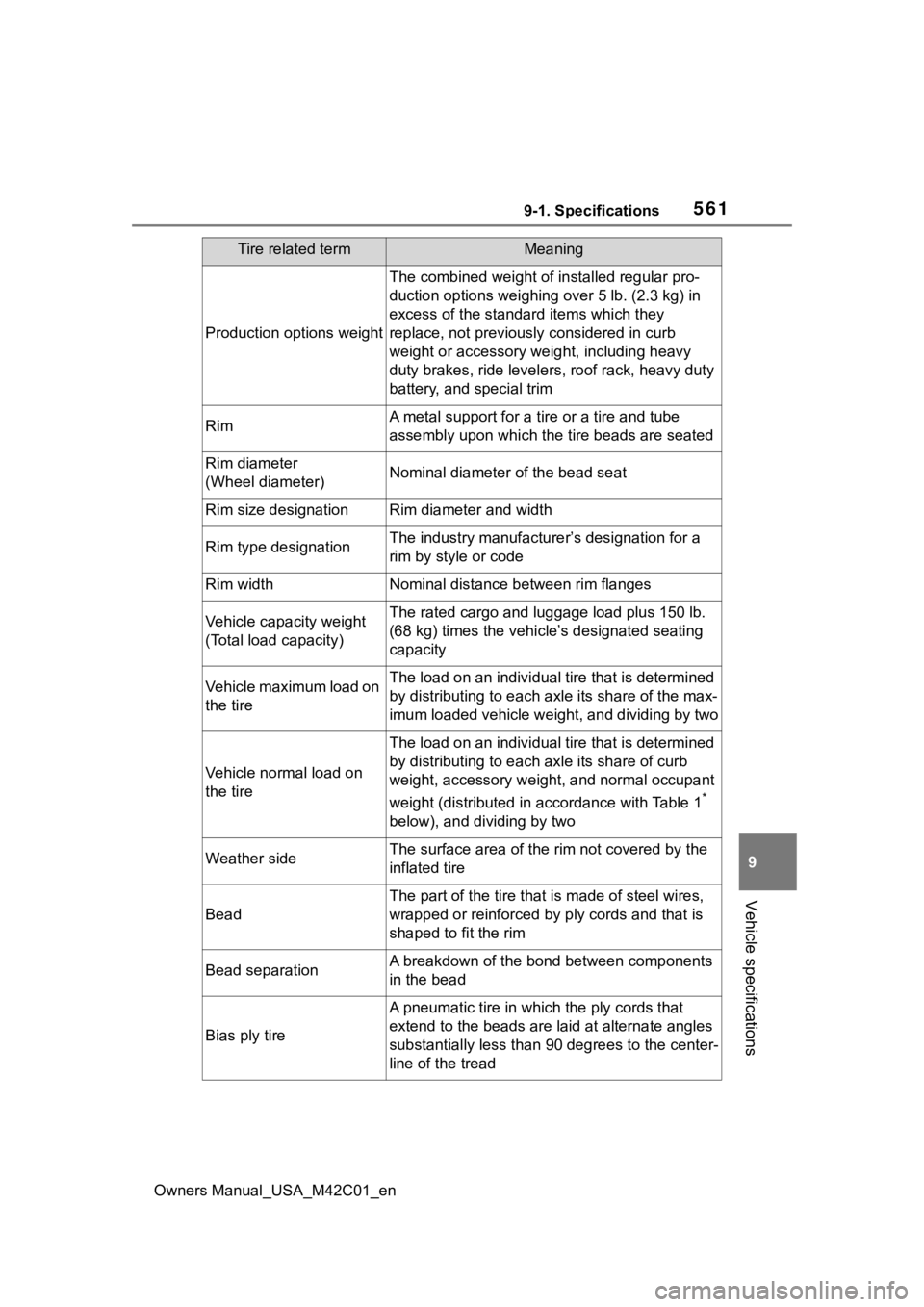
Production options weight
The combined weight of installed regular pro-
duction options weighing over 5 lb. (2.3 kg) in
excess of the standard items which they
replace, not previously considered in curb
weight or accessory weight, including heavy
duty brakes, ride leveler s, roof rack, heavy duty
battery, and special trim
RimA metal support for a ti re or a tire and tube
assembly upon which the tire beads are seated
Rim diameter
(Wheel diameter)Nominal diameter o f the bead seat
Rim size designationRim diameter and width
Rim type designationThe industry manufacture r’s designation for a
rim by style or code
Rim widthNominal distance between rim flanges
Vehicle capacity weight
(Total load capacity)The rated cargo and luggage load plus 150 lb.
(68 kg) times the vehicl e’s designated seating
capacity
Vehicle maximum load on
the tireThe load on an individual tire that is determined
by distributing to each ax le its share of the max-
imum loaded vehicle weight, and dividing by two
Vehicle normal load on
the tire
The load on an individual tire that is determined
by distributing to each axle its share of curb
weight, accessory weight, and normal occupant
weight (distributed in accordance with Table 1
*
below), and dividing by two
Weather sideThe surface area of the rim not covered by the
inflated tire
Bead
The part of the tire that is made of steel wires,
wrapped or reinforced by ply cords and that is
shaped to fit the rim
Bead separationA breakdown of the bond between components
in the bead
Bias ply tire
A pneumatic tire in which the ply cords that
extend to the beads are la id at alternate angles
substantially less than 9 0 degrees to the center-
line of the tread
Tire related termMeaning