battery SUBARU SOLTERRA 2023 Owners Manual
[x] Cancel search | Manufacturer: SUBARU, Model Year: 2023, Model line: SOLTERRA, Model: SUBARU SOLTERRA 2023Pages: 628, PDF Size: 11.91 MB
Page 467 of 628
4677-3. Do-it-yourself maintenance
Owners Manual_USA_M42C01_en
7
Maintenance and care
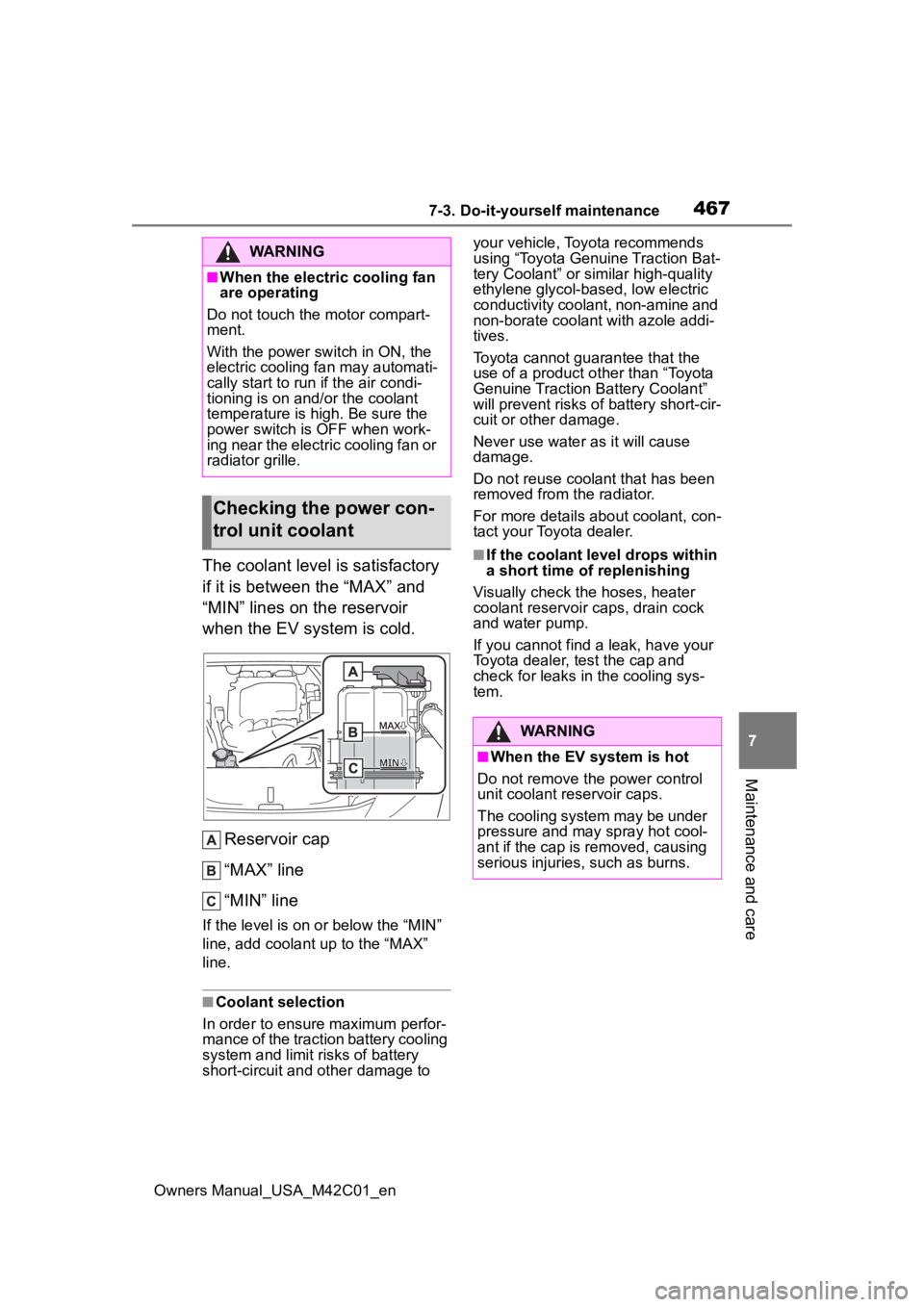
The coolant level is satisfactory
if it is between the “MAX” and
“MIN” lines on the reservoir
when the EV system is cold. Reservoir cap
“MAX” line
“MIN” line
If the level is on or below the “MIN”
line, add coolant up to the “MAX”
line.
■Coolant selection
In order to ensure maximum perfor-
mance of the traction battery cooling
system and limit risks of battery
short-circuit and other damage to your vehicle, Toyota recommends
using “Toyota Genuine Traction Bat-
tery Coolant” or similar high-quality
ethylene glycol-based, low electric
conductivity coolant, non-amine and
non-borate coolant with azole addi-
tives.
Toyota cannot guarantee that the
use of a product o
ther than “Toyota
Genuine Traction Battery Coolant”
will prevent risks of battery short-cir-
cuit or other damage.
Never use water as it will cause
damage.
Do not reuse cool ant that has been
removed from the radiator.
For more details about coolant, con-
tact your Toyota dealer.
■If the coolant level drops within
a short time of replenishing
Visually check the hoses, heater
coolant reservoir caps, drain cock
and water pump.
If you cannot find a leak, have your
Toyota dealer, t est the cap and
check for leaks in the cooling sys-
tem.
WARNING
■When the electric cooling fan
are operating
Do not touch the motor compart-
ment.
With the power switch in ON, the
electric cooling fan may automati-
cally start to run if the air condi-
tioning is on and/or the coolant
temperature is high. Be sure the
power switch is OFF when work-
ing near the electric cooling fan or
radiator grille.
Checking the power con-
trol unit coolant
WARNING
■When the EV system is hot
Do not remove the power control
unit coolant reservoir caps.
The cooling system may be under
pressure and may spray hot cool-
ant if the cap is removed, causing
serious injuries, such as burns.
Page 468 of 628
4687-3. Do-it-yourself maintenance
Owners Manual_USA_M42C01_en
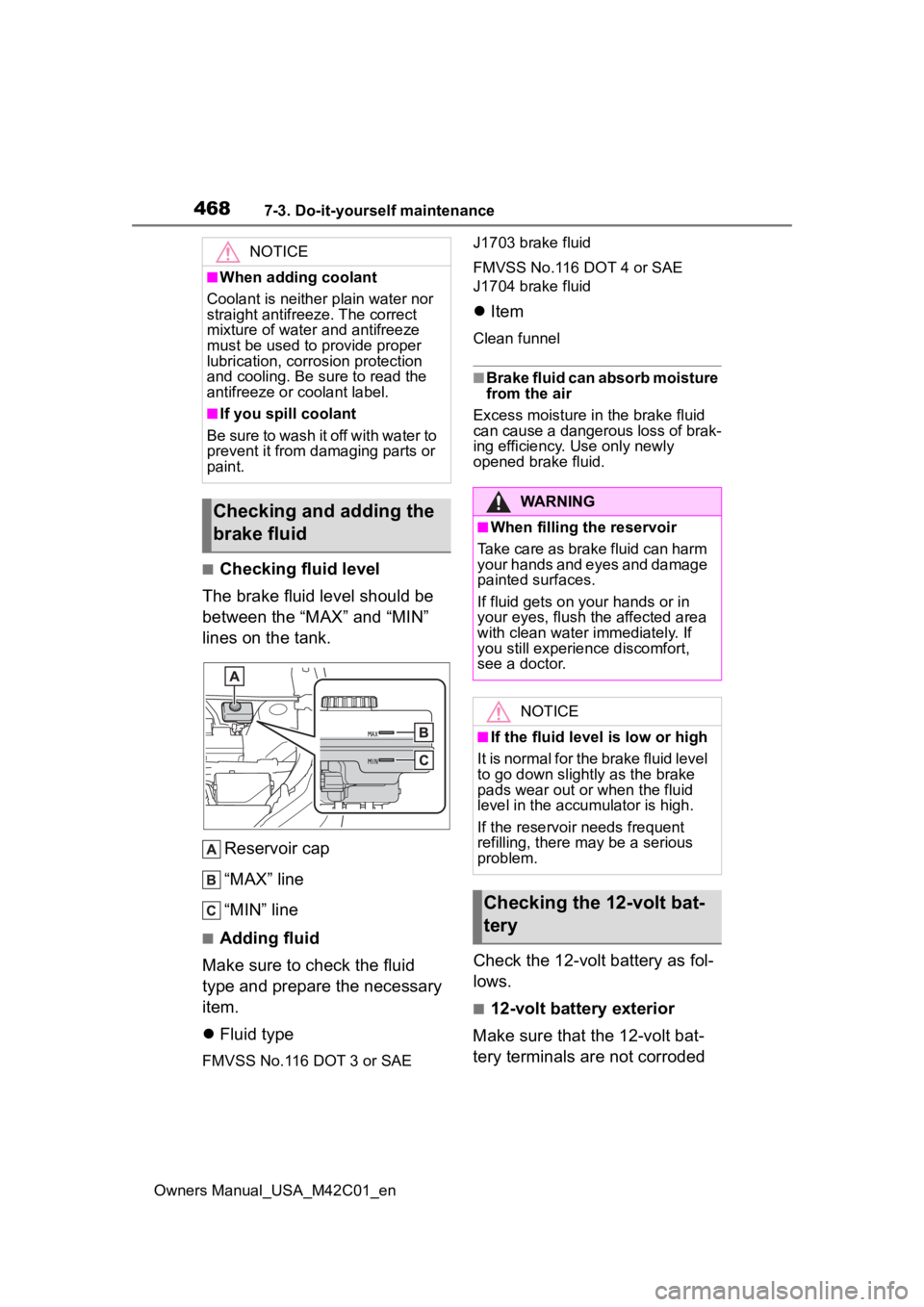
■Checking fluid level
The brake fluid level should be
between the “MAX” and “MIN”
lines on the tank.
Reservoir cap
“MAX” line
“MIN” line
■Adding fluid
Make sure to check the fluid
type and prepare the necessary
item.
Fluid type
FMVSS No.116 DOT 3 or SAE J1703 brake fluid
FMVSS No.116 DOT 4 or SAE
J1704 brake fluid
Item
Clean funnel
■Brake fluid can absorb moisture
from the air
Excess moisture in the brake fluid
can cause a dangerous loss of brak-
ing efficiency. Use only newly
opened brake fluid.
Check the 12-volt battery as fol-
lows.
■12-volt battery exterior
Make sure that the 12-volt bat-
tery terminals are not corroded
NOTICE
■When adding coolant
Coolant is neither plain water nor
straight antifreeze. The correct
mixture of water and antifreeze
must be used to provide proper
lubrication, corrosion protection
and cooling. Be sure to read the
antifreeze or coolant label.
■If you spill coolant
Be sure to wash it off with water to
prevent it from d amaging parts or
paint.
Checking and adding the
brake fluidWARNING
■When filling the reservoir
Take care as brake fluid can harm
your hands and eyes and damage
painted surfaces.
If fluid gets on your hands or in
your eyes, flush the affected area
with clean water immediately. If
you still experience discomfort,
see a doctor.
NOTICE
■If the fluid level is low or high
It is normal for the brake fluid level
to go down slight ly as the brake
pads wear out or when the fluid
level in the accumulator is high.
If the reservoir needs frequent
refilling, there m ay be a serious
problem.
Checking the 12-volt bat-
tery
Page 469 of 628
4697-3. Do-it-yourself maintenance
Owners Manual_USA_M42C01_en
7
Maintenance and care
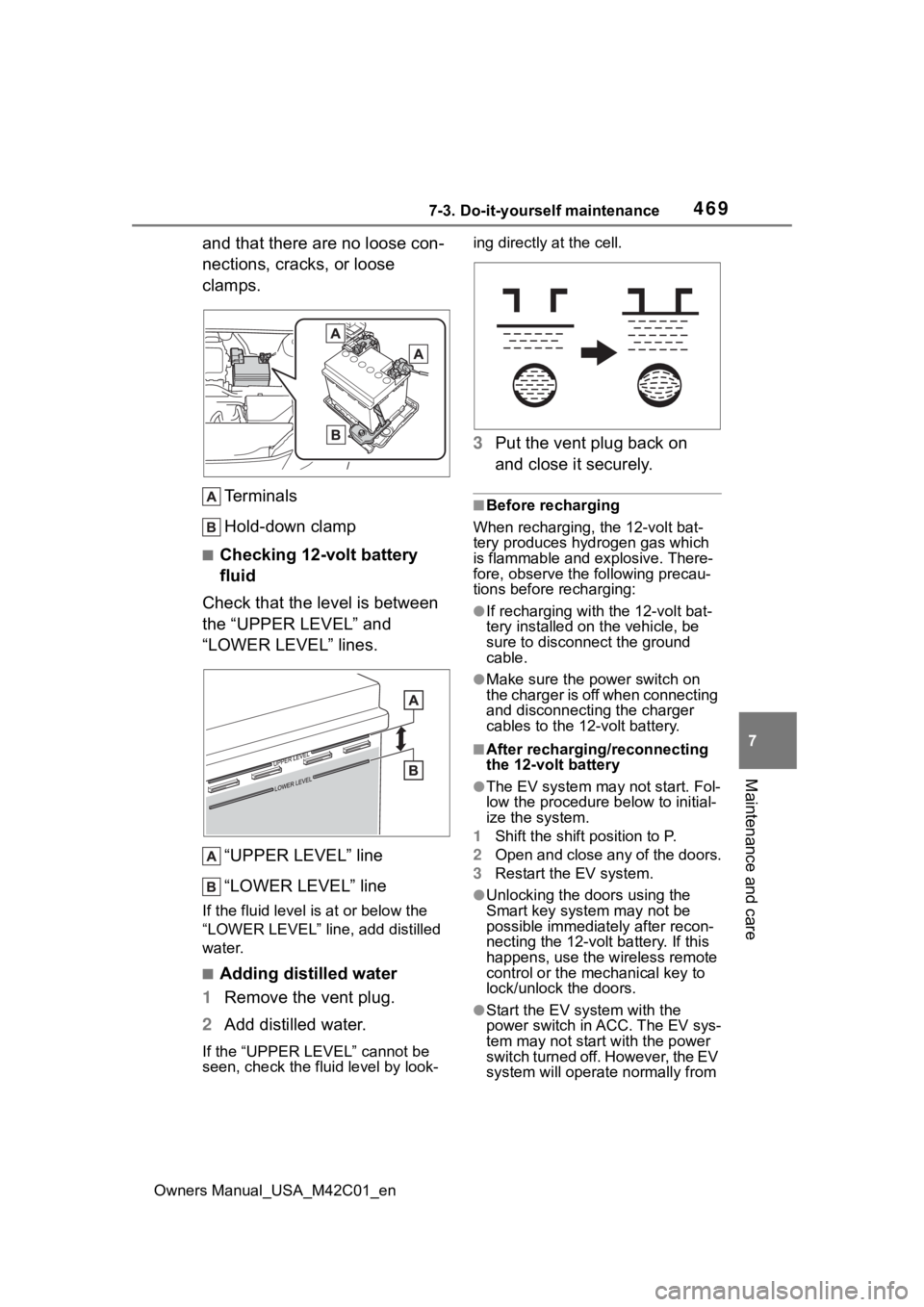
and that there are no loose con-
nections, cracks, or loose
clamps. Terminals
Hold-down clamp
■Checking 12-volt battery
fluid
Check that the level is between
the “UPPER LEVEL” and
“LOWER LEVEL” lines.
“UPPER LEVEL” line
“LOWER LEVEL” line
If the fluid level is at or below the
“LOWER LEVEL” line, add distilled
water.
■Adding distilled water
1 Remove the vent plug.
2 Add distilled water.
If the “UPPER LEVEL” cannot be
seen, check the fluid level by look- ing directly at the cell.
3
Put the vent plug back on
and close it securely.
■Before recharging
When recharging, the 12-volt bat-
tery produces hydrogen gas which
is flammable and explosive. There-
fore, observe the following precau-
tions before recharging:
●If recharging with the 12-volt bat-
tery installed on the vehicle, be
sure to disconnect the ground
cable.
●Make sure the power switch on
the charger is off when connecting
and disconnecting the charger
cables to the 12-volt battery.
■After recharging/reconnecting
the 12-volt battery
●The EV system may not start. Fol-
low the procedure below to initial-
ize the system.
1 Shift the shift position to P.
2 Open and close any of the doors.
3 Restart the EV system.
●Unlocking the doors using the
Smart key system may not be
possible immediately after recon-
necting the 12-volt battery. If this
happens, use the wireless remote
control or the mechanical key to
lock/unlock the doors.
●Start the EV system with the
power switch in ACC. The EV sys-
tem may not start with the power
switch turned off. However, the EV
system will operate normally from
Page 470 of 628
4707-3. Do-it-yourself maintenance
Owners Manual_USA_M42C01_enthe second attempt.
●The power switch mode is
recorded by the vehicle. If the 12-
volt battery is
disconnected and
reconnected, the vehicle will
return the power switch mode to
the status it was in before the 12-
volt battery was disconnected.
Make sure to turn off the power
switch before disconnecting the
12-volt battery. Take extra care
when connecting the 12-volt bat-
tery if the power switch mode prior
to the 12-volt battery being dis-
connected is unknown.
If the EV system will not start even
after multiple att empts at all the
methods above, contact your Toyota
dealer.
WARNING
■Chemicals in the 12-volt bat-
tery
Batteries contai n poisonous and
corrosive sulfuric acid and may
produce hydrogen gas which is
flammable and explosive. To
reduce the risk of death or serious
injury, take the following precau-
tions while working on or near the
12-volt battery:
●Do not cause sparks by touch-
ing the 12-volt battery terminals
with tools.
●Do not smoke or light a match
near the 12-volt battery.
●Avoid contact with eyes, skin
and clothes.
●Never inhale or swallow electro-
lyte.
●Wear protective safety glasses
when working near the 12-volt
battery.
●Keep children away from the
12-volt battery.
■Where to safely charge the
12-volt battery
Always charge the 12-volt battery
in an open area. Do not charge
the 12-volt battery in a garage or
closed room where there is insuf-
ficient ventilation.
■Emergency measures regard-
ing electrolyte
●If electrolyte gets in your eyes
Flush your eyes with clean
water for at least 15 minutes
and get immediate medical
attention. If possible, continue
to apply water with a sponge or
cloth while traveling to the near-
est medical facility.
●If electrolyte gets on your skin
Wash the affected area thor-
oughly. If you feel pain or burn-
ing, get medical attention
immediately.
●If electrolyte gets on your
clothes
It can soak through clothing on
to your skin. Imm ediately take
off the clothing and follow the
procedure above if necessary.
●If you accidentally swallow elec-
trolyte
Drink a large quantity of water
or milk. Get emergency medical
attention immediately.
■When there is insufficient 12-
volt battery fluid
Do not use if there is insufficient
fluid in the 12-volt battery. There
is a possible danger that the 12-
volt battery may explode.
Page 471 of 628
4717-3. Do-it-yourself maintenance
Owners Manual_USA_M42C01_en
7
Maintenance and care
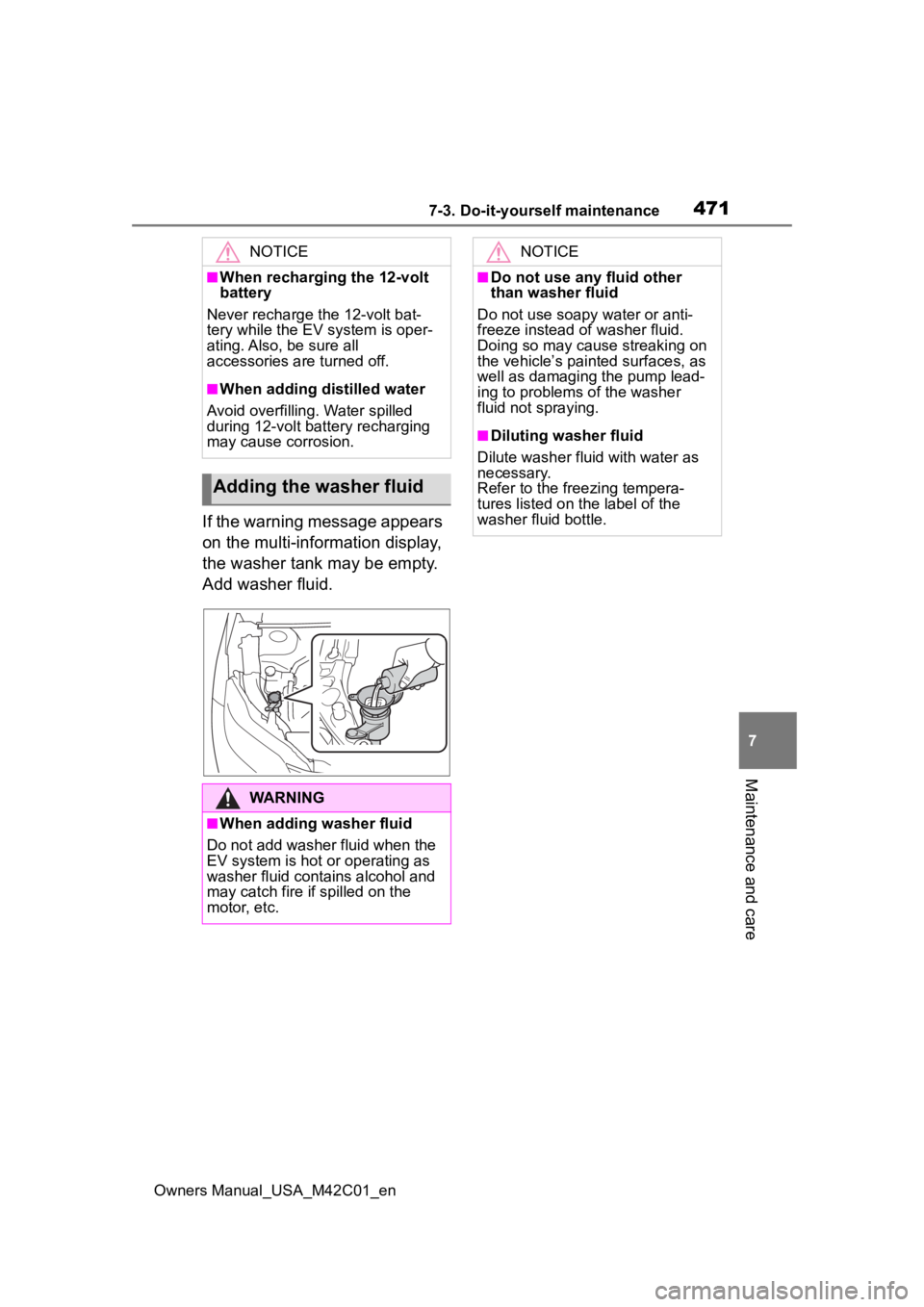
If the warning message appears
on the multi-information display,
the washer tank may be empty.
Add washer fluid.
NOTICE
■When recharging the 12-volt
battery
Never recharge the 12-volt bat-
tery while the EV system is oper-
ating. Also, be sure all
accessories are turned off.
■When adding distilled water
Avoid overfilling. Water spilled
during 12-volt battery recharging
may cause corrosion.
Adding the washer fluid
WARNING
■When adding washer fluid
Do not add washer fluid when the
EV system is hot or operating as
washer fluid contains alcohol and
may catch fire if spilled on the
motor, etc.
NOTICE
■Do not use any fluid other
than washer fluid
Do not use soapy water or anti-
freeze instead of washer fluid.
Doing so may cause streaking on
the vehicle’s painted surfaces, as
well as damaging the pump lead-
ing to problems of the washer
fluid not spraying.
■Diluting washer fluid
Dilute washer fluid with water as
necessary.
Refer to the freezing tempera-
tures listed on the label of the
washer fluid bottle.
Page 497 of 628
4977-3. Do-it-yourself maintenance
Owners Manual_USA_M42C01_en
7
Maintenance and care
■If the key battery is depleted
The following symptoms may occur:
●The smart key system and wire-
less remote contr ol will not func-
tion properly.
●The operational range will be
reduced.
Prepare the following before
replacing the battery:
Flathead screwdriver
Small flathead screwdriver
Lithium battery CR2450
■Use a CR2450 lithium battery
●Batteries can be purchased at
your Toyota dealer, local electrical
appliance shops or camera stores.
●Replace only with the same or
equivalent type recommended by
the manufacturer.
●Dispose of used ba tteries accord-
ing to the local laws.
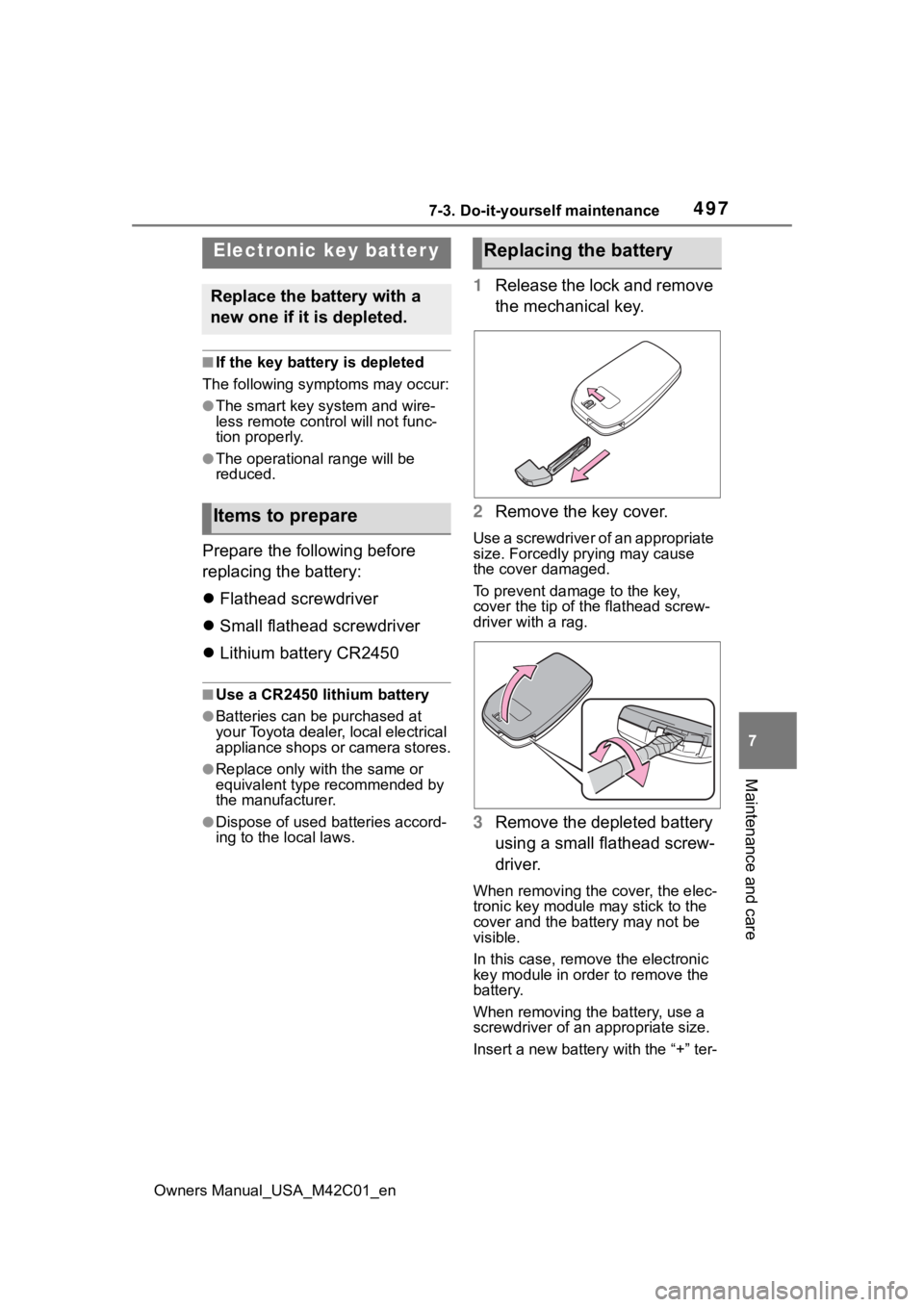
1 Release the lock and remove
the mechanical key.
2 Remove the key cover.
Use a screwdriver of an appropriate
size. Forcedly prying may cause
the cover damaged.
To prevent damage to the key,
cover the tip of the flathead screw-
driver with a rag.
3Remove the depleted battery
using a small flathead screw-
driver.
When removing the cover, the elec-
tronic key module may stick to the
cover and the batt ery may not be
visible.
In this case, remove the electronic
key module in order to remove the
battery.
When removing the battery, use a
screwdriver of an appropriate size.
Insert a new battery with the “+” ter-
Electronic key batter y
Replace the battery with a
new one if it is depleted.
Items to prepare
Replacing the battery
Page 498 of 628
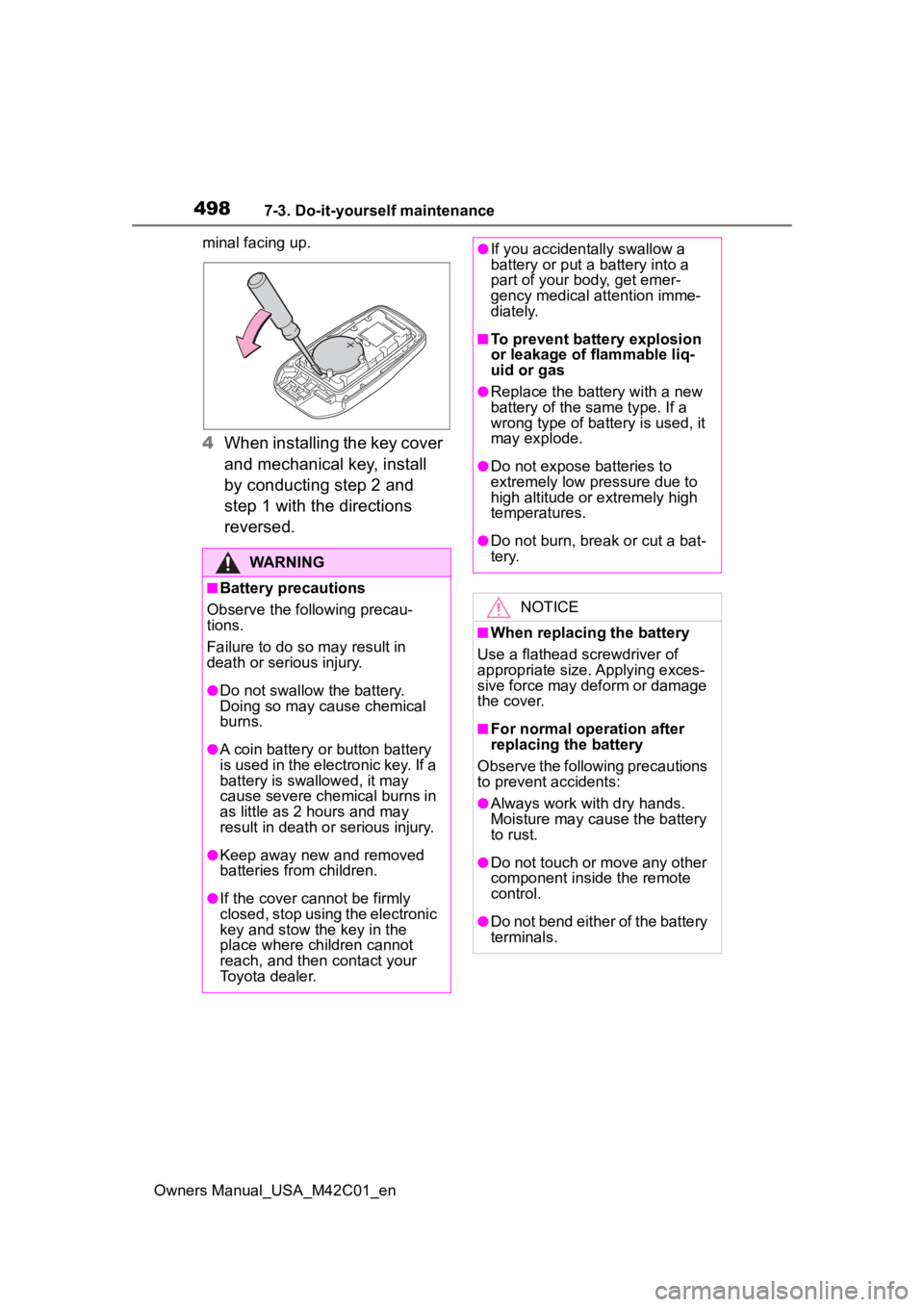
4987-3. Do-it-yourself maintenance
Owners Manual_USA_M42C01_enminal facing up.
4
When installing the key cover
and mechanical key, install
by conducting step 2 and
step 1 with the directions
reversed.
WARNING
■Battery precautions
Observe the following precau-
tions.
Failure to do so m ay result in
death or serious injury.
●Do not swallow the battery.
Doing so may cause chemical
burns.
●A coin battery o r button battery
is used in the electronic key. If a
battery is swallowed, it may
cause severe chemical burns in
as little as 2 hours and may
result in death or serious injury.
●Keep away new and removed
batteries from children.
●If the cover cannot be firmly
closed, stop using the electronic
key and stow the key in the
place where children cannot
reach, and then contact your
Toyota dealer.
●If you accidentally swallow a
battery or put a battery into a
part of your b ody, get emer-
gency medical attention imme-
diately.
■To prevent battery explosion
or leakage of flammable liq-
uid or gas
●Replace the battery with a new
battery of the same type. If a
wrong type of battery is used, it
may explode.
●Do not expose batteries to
extremely low pr essure due to
high altitude or extremely high
temperatures.
●Do not burn, bre ak or cut a bat-
tery.
NOTICE
■When replacing the battery
Use a flathead screwdriver of
appropriate size. Applying exces-
sive force may deform or damage
the cover.
■For normal operation after
replacing the battery
Observe the following precautions
to prevent accidents:
●Always work with dry hands.
Moisture may cause the battery
to rust.
●Do not touch or move any other
component inside the remote
control.
●Do not bend either of the battery
terminals.
Page 503 of 628
503
Owners Manual_USA_M42C01_en
8
8
When trouble arises
When trouble arises
8-1. Essential informationEmergency flashers .... 504
If your vehicle has to be stopped in an emergency.................................. 505
If the vehicle is submerged or water on the road is ris-
ing ............................. 506
8-2. Steps to take in an emer- gency
If your vehicle needs to be towed......................... 507
If you think something is wrong ........................ 511
If a warning light turns on or a warning buzzer sounds
.................................. 513
If a warning message is dis- played........................ 522
If you have a flat tire.... 527
If the EV syst em will not
start ........................... 537
If you lose your keys ... 539
If the electronic key does not operate properly .. 539
If the 12-volt battery is dis- charged ..................... 541
If your vehicle overheats .................................. 545
If the vehicle becomes stuck .................................. 547
Page 504 of 628
5048-1. Essential information
Owners Manual_USA_M42C01_en
8-1.Essential information
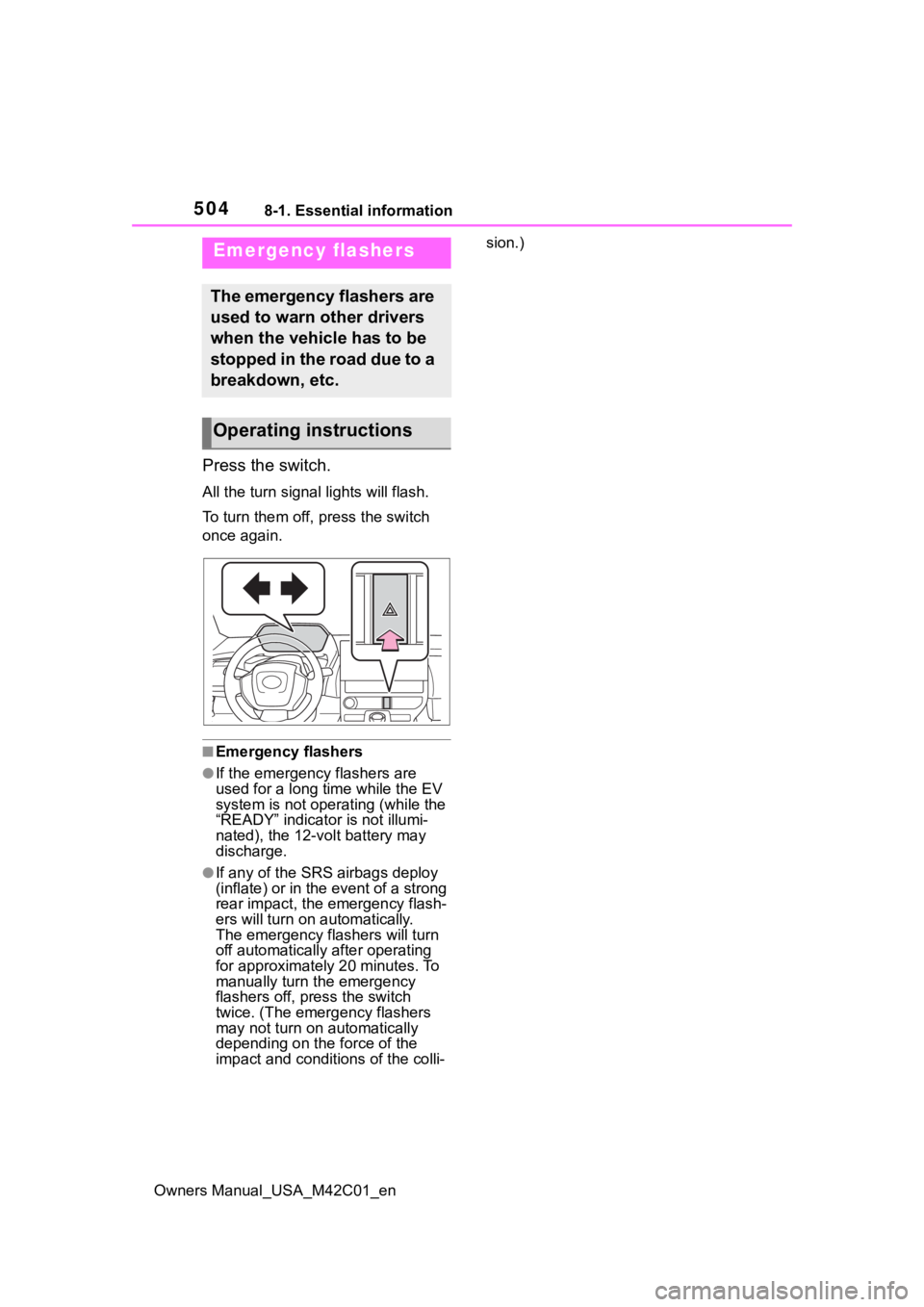
Press the switch.
All the turn signal lights will flash.
To turn them off, press the switch
once again.
■Emergency flashers
●If the emergency flashers are
used for a long time while the EV
system is not operating (while the
“READY” indicator is not illumi-
nated), the 12-volt battery may
discharge.
●If any of the SRS airbags deploy
(inflate) or in the event of a strong
rear impact, the emergency flash-
ers will turn on automatically.
The emergency flashers will turn
off automatically after operating
for approximately 20 minutes. To
manually turn t he emergency
flashers off, press the switch
twice. (The emergency flashers
may not turn on automatically
depending on the force of the
impact and conditions of the colli- sion.)
Emergency flashers
The emergency flashers are
used to warn other drivers
when the vehicle has to be
stopped in the road due to a
breakdown, etc.
Operating instructions
Page 505 of 628
5058-1. Essential information
Owners Manual_USA_M42C01_en
8
When trouble arises
1 Steadily step on the brake
pedal with both feet and
firmly depress it.
Do not pump the brake pedal
repeatedly as this will increase the
effort required to slow the vehicle.
2Shift the shift position to N.
If the shift position is shifted to
N
3 After slowing down, stop the
vehicle in a safe place by the
road.
4 Stop the EV system.
If the shift position cannot be
shifted to N
3 Keep depressing the brake
pedal with both feet to reduce
vehicle speed as much as
possible.
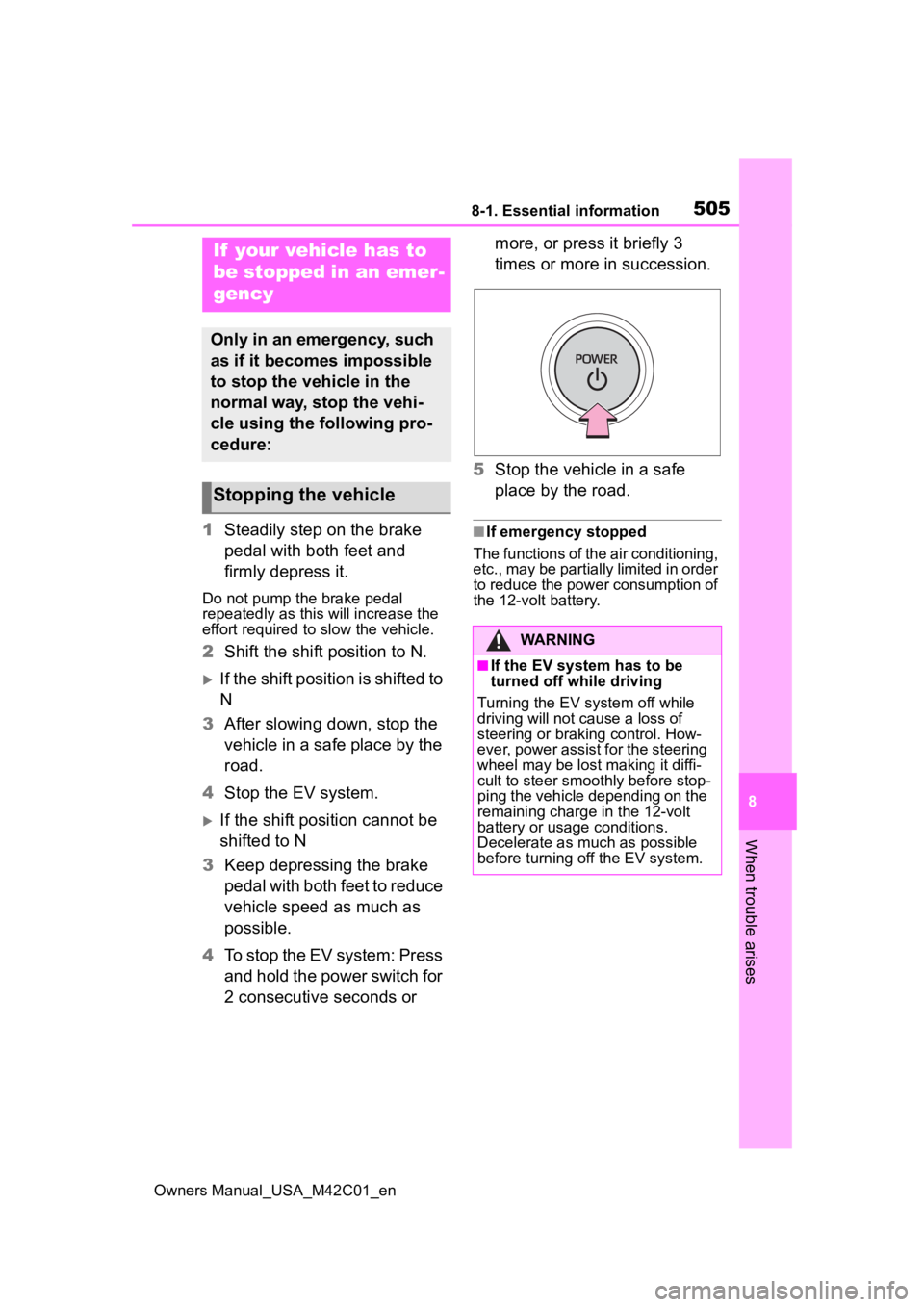
4 To stop the EV system: Press
and hold the power switch for
2 consecutive seconds or more, or press it briefly 3
times or more in succession.
5 Stop the vehicle in a safe
place by the road.
■If emergency stopped
The functions of the air conditioning,
etc., may be partially limited in order
to reduce the power consumption of
the 12-volt battery.
If your vehicle has to
be stopped in an emer-
gency
Only in an emergency, such
as if it becomes impossible
to stop the vehicle in the
normal way, stop the vehi-
cle using the following pro-
cedure:
Stopping the vehicle
WARNING
■If the EV system has to be
turned off while driving
Turning the EV system off while
driving will not cause a loss of
steering or braking control. How-
ever, power assist for the steering
wheel may be lost making it diffi-
cult to steer smoothly before stop-
ping the vehicle depending on the
remaining charge in the 12-volt
battery or usage conditions.
Decelerate as mu ch as possible
before turning off the EV system.