air conditioning SUBARU SOLTERRA 2023 Owners Manual
[x] Cancel search | Manufacturer: SUBARU, Model Year: 2023, Model line: SOLTERRA, Model: SUBARU SOLTERRA 2023Pages: 628, PDF Size: 11.91 MB
Page 4 of 628
4TABLE OF CONTENTS
Owners Manual_USA_M42C01_en
5-4. Using the driving support
systems
Software update ............ 257
Toyota Safety Sense 3.0 259
PCS (Pre-Collision System) .................................... 265
LTA (Lane Tracing Assist) .................................... 276
LDA (Lane Departure Alert) .................................... 281
RSA (Road Sign Assist) 286
Dynamic radar cruise control .................................... 288
Cruise control ................ 296
Emergency Driving Stop Sys- tem .............................. 299
BSM (Blind Spot Monitor) .................................... 302
SEA (Safe Exit Assist) ... 307
Intuitive parking assist... 311
RCTA (Rear Cross Traffic Alert)............................ 322
RCD (Rear Camera Detec- tion) ............................. 328
PKSB (Parking Support Brake).......................... 331
Static Objects Front and Rear of the Vehicle............... 336
Moving Vehicle Rear of the Vehicle......................... 339
Pedestrians Rear of the Vehi- cle................................ 340
Static Objects Around the Vehicle (vehicles with
Advanced Park)........... 342
Toyota Teammate Advanced Park ............................. 344
Snow mode ................... 382X-MODE ........................
382
Driving assist systems ... 387
5-5. Driving tips Winter driving tips .......... 393
Utility vehicle precautions .................................... 396
6-1. Using the ai r conditioning
system and defogger
ALL AUTO (“ECO”) control .................................... 400
Automatic air conditioning system ......................... 402
Remote Air Conditioning Sys- tem .............................. 409
Heated steering wheel/seat heaters/seat ventila-
tors/radiant heater ....... 411
6-2. Using the interior lights Interior lights list ............ 415
6-3. Using the storage features List of storage features .. 418
Luggage compartment fea- tures ............................ 421
6-4. Using the other interior fea- tures
Electronic sunshade ...... 426
Other interior features ... 428
Garage door opener ...... 439
6Interior features
Page 5 of 628
5TABLE OF CONTENTS
Owners Manual_USA_M42C01_en
1
2
3
4
5
6
8 7
9
10
7-1. Maintenance and care Cleaning and protecting the vehicle exterior ............ 448
Cleaning and protecting the vehicle interior ............. 451
7-2. Maintenance Maintenance requirements.................................... 455
General maintenance.... 456
Emission inspection and maintenance (I/M) programs.................................... 459
7-3. Do-it-yourself maintenance Do-it-yourself service precau-tions............................. 460
Hood ............................. 462
Positioning a floor jack .. 464
Motor compartment ....... 465
Tires .............................. 472
Replacing the tire .......... 485
Tire inflation pressure.... 491
Wheels ......... .................493
Air conditioning filter ...... 494
Electronic key battery.... 497
Checking and replacing fuses .................................... 499
Headlight aim ................ 501
Light bulbs..................... 5028-1. Essential information
Emergency flashers....... 504
If your vehicle has to be stopped in an emergency.................................... 505
If the vehicle is submerged or water on the road is rising.................................... 506
8-2. Steps to take in an emer- gency
If your vehicle needs to be towed ........................... 507
If you think something is wrong........................... 511
If a warning light turns on or a warning buzzer sounds 513
If a warning message is dis- played .......................... 522
If you have a flat tire ...... 527
If the EV system will not start
.................................... 537
If you lose your keys...... 539
If the electronic key does not operate properly .......... 539
If the 12-volt battery is dis- charged ....................... 541
If your vehicle overheats 545
If the vehicle becomes stuck .................................... 547
7Maintenance and care8When trouble arises
Page 18 of 628
18Pictorial index
Owners Manual_USA_M42C01_en
Turn signal lever.............................................. ................... P.242
Headlight switch ............................................... ................. P.248
Headlights/parking lights/tail lig hts/license plate lights/daytime run-
ning lights .................................................... ......................... P.248
Windshield wiper and washer switch............................... P.253
Usage................................................................................... P.253
Adding washer fluid .............................................................. P.471
Warning messages ............................................... ............... P.522
Emergency flasher switch ....................................... .......... P.504
Hood lock release lever ........................................ ............. P.462
Tilt and telescopic steering lock release lever ................P. 1 9 9
Adjustment ..................................................... ...................... P.199
Air conditioning system ............................. ....................... P.402
Usage................................................................................... P.402
Rear window defogger ........................................... .............. P.404
Multimedia system
*
*
: Refer to “MULTIMEDIA OWNER’S MANUAL”.
Page 74 of 628
742-1. Electric vehicle system
Owners Manual_USA_M42C01_en
■Charging the traction battery
Be sure to maintain the traction bat-
tery charge level suitable for your
driving needs.
If the traction battery fully dis-
charges, the vehicle cannot be
driven at all. When the battery
becomes low, charge it as soon as
possible.
■If the traction battery becomes
low
●If the traction battery becomes
low, the traction battery charge
warning light comes on or flashes
and a message will be displayed
on the multi-information display.
( P.515)
●If the traction batte ry is completely
discharged, the EV system cannot
be started and dri ving will not be
possible. When the traction bat-
tery becomes low, charge it as
soon as possible.
■Sounds and vibrations specific
to an battery electric vehicle
Because there is no engine sound
or vibration, it is easy to mistake the
battery electric vehi cle for being off
when it is actually still running, as
indicated by the “READY” indicator
being illuminated. F or safety, make
sure to always shift the shift position
to P and apply the parking brake
when parked.
Before and after the EV system is
started, the following sounds and
vibrations may occur. However,
these sounds and/o r vibrations are
not signs of malfunctions:
●The brake system operation
sound may be heard from the
front of the vehicle when the
driver’s door is opened.
●Motor sounds may be heard from
the motor compartment or lug-
gage compartment.
●Electrical relay sounds may be
heard from the motor compart-
ment when the EV system starts or stops.
●Relay operating sounds such as a
snap or soft clank will be emitted
from the traction b
attery in the fol-
lowing situations:
• When the EV system is started or stopped
• When charging starts or com-
pletes
• When the vehicle is driven the first time after the traction battery has
been charged using DC charging
●Sounds may be heard due to
regenerative braking when the
brake pedal is depressed or as
the accelerator pedal is released.
●Cooling fan operating sounds
from the radiator.
●The operation sound of the air
conditioning system (air condition-
ing compressor, blower motor).
■Maintenance, repair, recycling,
and disposal
Contact your Toyota dealer regard-
ing maintenance, repair, recycling
and disposal. Do n ot dispose of the
vehicle yourself.
A sound which changes in
accordance with the driving
speed, will be played in order to
warn people nearby of the vehi-
cle’s approach. This sound may
be heard inside the vehicle. The
sound will stop when the vehicle
speed exceeds approximately
23 mph (37 km/h).
■Acoustic Vehicle Alerting Sys-
tem
In the following cases, the Acoustic
Vehicle Alerting System may be dif-
ficult for surrounding people to hear.
Acoustic Vehicle Alerting
System
Page 77 of 628
772-1. Electric vehicle system
Owners Manual_USA_M42C01_en
2
Electric Vehicle system
DC charging inlet
Traction battery
Electric motor (traction motor)/Inverter (front/rear
*)
Air conditioning compressor
*: AWD models only
■Electromagnetic waves
●High-voltage parts and cables on
the battery electric vehicles incor-
porate electro-magnetic shield-
ing, and the refore emit
approximately the same amount
of electromagnetic waves as con-
ventional gasoli ne-powered vehi-
cles or home electronic
appliances.
●Your vehicle may cause sound
interference in so me third party-
produced radio parts.
■Traction battery (Lithium-ion
battery)
The traction batte ry has a limited
service life.
The traction battery capacity (the
ability to store ene rgy) reduces with
time and use in the same way as
other rechargeable batteries. The
extent at which capacity reduces
changes drastically depending on
the environment (outside tempera-
ture, etc.) and us age conditions,
such as how the vehicle is driven
and how the traction battery is
charged.
This is a natural characteristic of
lithium-ion batteries, and is not a
malfunction. Also, even though the
driving range decreases when the
traction battery capacity reduces,
vehicle performance does not sig-
nificantly become worse. In order to
reduce the possibility of the capacity
reducing, follow the directions listed
on P.103, “Capacity reduction of the
traction battery”.
■Starting the EV system in an
extremely cold environment
When the traction battery is
extremely cold (below approxi-
mately -22°F [-30°C]) due to the
temperature outside of the vehicle, it
may not be possible to start the EV
system. In this case, try to start the
EV system again after the tempera-
ture of the traction battery increases
due to the outside temperature
increasing, etc.
WARNING
■High-voltage precautions
The vehicle has high voltage DC
and AC systems as well as a 12-
volt system.
DC and AC high voltage systems
are very dangerous and can
cause severe burns and electric
shock that may result in death or
serious injury.
●Never touch, disassemble,
remove, or replace the high volt-
age parts, cables (orange) or
their connectors.
●The EV system will become hot
after starting as the system
uses high voltage. Be careful of
both the high voltage and the
high temperature, and always
obey the warning labels
attached to the vehicle.
Page 79 of 628
792-1. Electric vehicle system
Owners Manual_USA_M42C01_en
2
Electric Vehicle system
WARNING
●If your vehicle needs to be
towed, be sure to transport the
vehicle with the front wheels
(2WD models) or four wheels
(AWD models) raised. If the
vehicle is towed with the wheels
which are connected to the
electric motor (traction motor)
contacting the ground, electric-
ity generated by the operation of
the motor may cause a fire to
occur depending on the nature
of the damage or malfunction.
( P.507)
●Carefully inspect the ground
under the vehicle. If leaked liq-
uid (other than water from the
air conditioning) is found on the
ground, the traction battery may
have been damaged. Leave the
vehicle as soon as possible.
In addition, contact your Toyota
dealer with regard to the leak-
age found on the ground.
Even in the event of a minor
accident, the traction battery
and surrounding parts may be
damaged. In case of an acci-
dent, have the traction battery
inspected at a Toyota dealer.
■Traction battery
●Your vehicle contains a sealed
lithium-ion battery.
●Never resell, hand over or mod-
ify the traction battery. To pre-
vent accidents, traction
batteries that have been
removed from a disposed vehi-
cle are collected through your
Toyota dealer. Do not dispose of
the battery yourself. Unless the
battery is properly collected, the
following may occur, resulting in
death or serious injury:
• Do not illegally dispose of or
dump the traction battery, and it
is hazardous to the environment
or someone may touch a high
voltage part, resulting in an
electric shock.
• The traction battery is intended to be used exclusively with your
battery electric vehicle. If the
traction battery is used outside
of your vehicle or modified in
any way, accidents such as
electric shock, heat generation,
smoke generation, an explo-
sion and electrolyte leakage
may occur. When reselling or
handing over your vehicle, the
possibility of an accident is
extremely high because the per-
son receiving the vehicle may
not be aware of the dangers
from these modifications.
●If your vehicle is disposed of
without the traction battery hav-
ing been removed, there is a
danger of serious electric shock
if high voltage parts, cables and
their connectors are touched. In
the event that your vehicle must
be disposed of, the traction bat-
tery must be disposed of by
your Toyota dealer or a qualified
service shop. If the traction bat-
tery is not disposed of properly,
it may cause electric shock that
can result in dea th or serious
injury.
●For information about traction
battery collection locations, con-
tact information, or the recycling
process, contact your Toyota
dealer.
Page 82 of 628
822-1. Electric vehicle system
Owners Manual_USA_M42C01_en
battery cannot be charged. Also,
when using the air conditioning
system, etc., the traction battery
electricity is consumed.
(P.237)
Repeated acceleration and
deceleration due to traffic con-
gestion, long waits at traffic
lights, and driving on steep
inclines will lead to poor electric-
ity consumption. In order to
avoid those situations as much
as possible, check traffic reports
before leaving. If the vehicle is
driven in traffic congestion, gen-
tly release the brake pedal to
allow the vehicle to move for-
ward slightly, avoid overuse of
the accelerator pedal. Doing so
can help minimize unnecessary
electricity consumption.
Make sure to operate the brakes
gently and a timely manner. A
greater amount of electrical
energy can be regenerated
when slowing down.
Control and maintain the vehicle
at a constant speed. Before
stopping at a toll booth or simi-
lar, allow plenty of time to release the accelerator and gen-
tly apply the brakes. A greater
amount of electrical energy can
be regenerated when slowing
down.
Use the air conditioning only
when necessary. Doing so
can help reduce excessive
electricity consumption.
In summer: When the ambient tem-
perature is high, use the recircu-
lated air mode. Doing so will help to
reduce the burden on the air condi-
tioning system and reduce electric-
ity consumption as well.
In winter: Exce ssive or unneces-
sary heating should be avoided.
Also, electricity consumption can
be improved by avoiding overuse of
the heater.
When using the Remote Air
Conditioning System
( P.409) while the AC
charging cable is connected
to the vehicle, electricity con-
sumption immediately after
starting off will be reduced
because air conditioning is
operated mainly using elec-
tricity from an external power
source.
Make sure to check the tire infla-
tion pressure frequently.
Delays
When braking
Highway (or freeways)
driving
Air conditioning
Checking tire inflation
pressure
Page 84 of 628
842-1. Electric vehicle system
Owners Manual_USA_M42C01_en
number of occupants.
Possible driving distance could
be extended if the followings are
performed:
Maintain a safe distance from
the vehicle in front and avoid
unnecessary acceleration and
deceleration
Accelerate and decelerate the
vehicle as smoothly as possi-
ble
Drive at moderate speeds as
much as possible and main-
tain a constant speed
Set the air conditioning sys-
tem to a moderate tempera-
ture and avoid using the
heating and cooling functions
excessively.
Use tires of the specified size
and maintain the specified tire
pressure
Do not add unnecessary
weight to the vehicle
The followings indicate that
charging has been carried out
properly.
The AC charging indicator
turns off
“Charging complete” is dis-
played on the multi-informa-
tion display when a door is
opened while the power switch is off. (
P.101)
Regardless of the type of power
source or whether the charging
schedule function is used,
charging is completed if the
above can be confirmed.
Charging-related messages:
P.140
Display when charging is
completed
Page 100 of 628
1002-2. Charging
Owners Manual_USA_M42C01_enminate when the tr
action battery
cooler is on standby or operating.
●When the charge level of the trac-
tion battery is low, the traction bat-
tery cooler may n ot operate, even
if the temperature of the traction
battery is high.
●When the following conditions are
met while the trac tion battery
cooler is operating, the cooling
operation will stop.
• The hood is opened
• The power switch is turned to ACC or ON.
• The shift position is changed to any position other than P
• The Remote Air Conditioning Sys- tem is operated ( P.409)
• The remaining charge of the trac-
tion battery drops below a certain
amount
●The traction battery cooler oper-
ates using power s upplied by the
traction battery and an external
power source.
• While the traction battery cooler is
operating, the charge of the trac-
tion battery will increase and
decrease within a certain range,
and will not increase as during AC
charging.
• When the traction battery cooler operates, charger will recognize it
as the battery being charged. If
this function ope rates while a
charger which charges a charging
fee is connected to the vehicle,
AC charging fees will apply.
■Changing of the traction battery
cooler setting
Setting can be changed on the
multi-information display.
Use the meter control switches
( P.156) and select “Vehicle Set-
tings”, “Charging Se ttings”, “Battery
Cooler”, and change the setting.
When selecting to off, the traction
battery output may be restricted
depending on the driving situation.
To enable the use of battery
electric vehicle, we recommend
systematically charging the
vehicle.
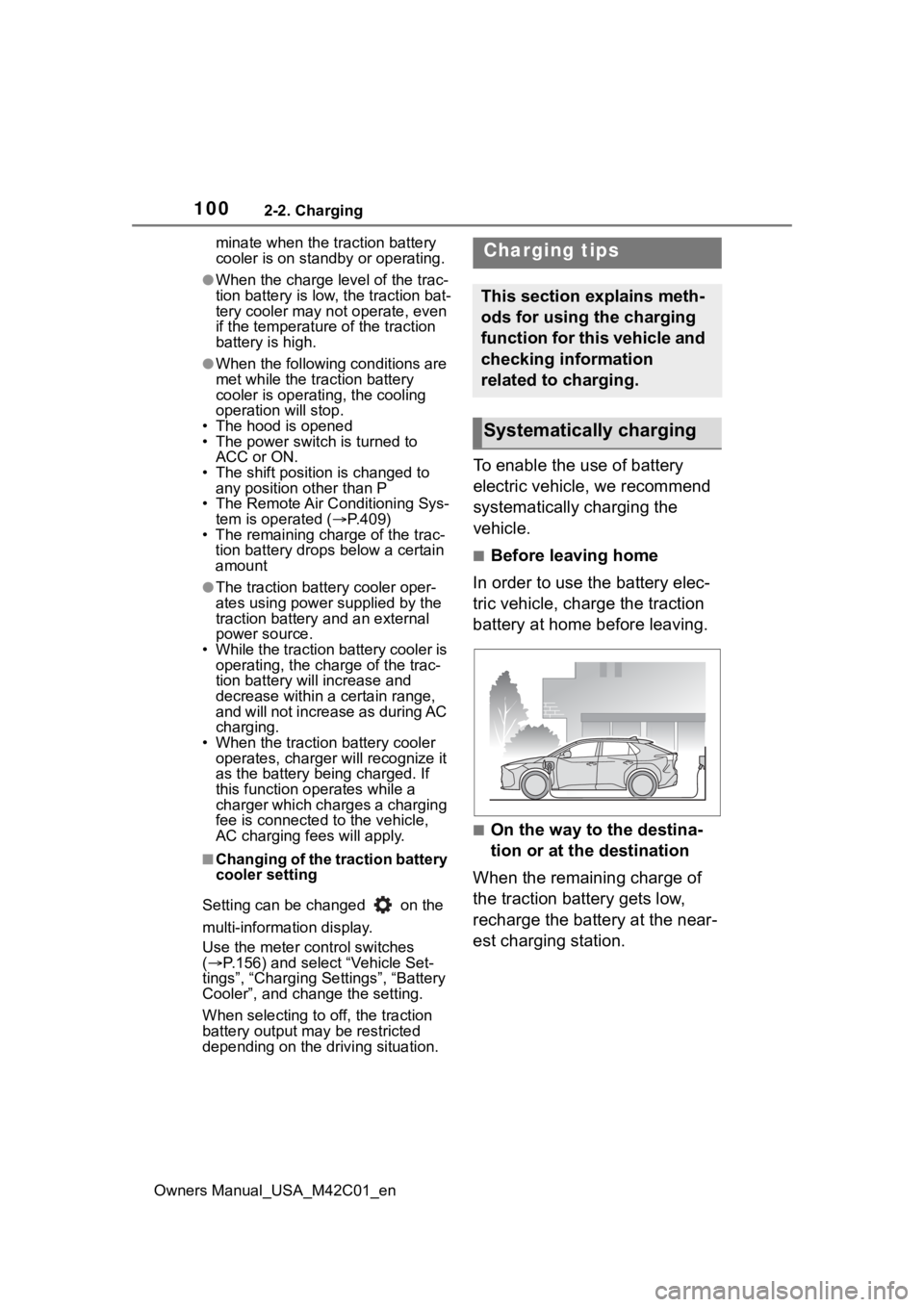
■Before leaving home
In order to use the battery elec-
tric vehicle, charge the traction
battery at home before leaving.
■On the way to the destina-
tion or at the destination
When the remaining charge of
the traction battery gets low,
recharge the battery at the near-
est charging station.
Charging tips
This section explains meth-
ods for using the charging
function for this vehicle and
checking information
related to charging.
Systematically charging
Page 103 of 628
1032-2. Charging
Owners Manual_USA_M42C01_en
2
Electric Vehicle system
Before charging, always check
the following items.
The parking brake is applied.
( P.243)
The power switch is turned to
OFF. ( P.231)
Lights such as the headlights,
emergency flashers and inte-
rior lights, etc. are turned off.
If these light switches are turned
on, then these features will con-
sume electricity, and charging time
will increase.
Before charging, make sure that
each part of the AC charging
cable is in good condition.
( P.92)
■During charging
●The charging starting time may
differ depending on the state of
the vehicle, but this does not indi-
cate a malfunction.
●During charging, sounds may be
heard from near the traction bat-
tery in accordance with the opera-
tion of the air conditioning system
or “Battery Cooler” ( P.99).
●During and after charging, the motor compartment and its sur-
rounding area in which the
onboard traction battery charger is
installed may get warm.
●The surface of the CCID
(Charging Circuit Interrupting
Device) may become hot, but this
does not indicate a malfunction.
●Depending on radio wave condi-
tions, interference may be heard
on the radio.
■When charging using a public
charging facility
●When charging using a public
charging facility, check the setting
of the charging schedule function.
• When the charging schedule is registered, temporarily turn off the
function or turn “ Charge Now” on.
( P. 1 1 9 )
• When the charging schedule is set to on, charging will not start even
if the AC charging cable is con-
nected. Also, charging fee may
occur due to connection of the AC
charging cable.
■Capacity reduction of the trac-
tion battery
The capacity of the traction battery
will decline gradually when the trac-
tion battery is in use. The rate at
which it declines will differ in accor-
dance with environmental conditions
and the way in which the vehicle is
used. Observing the following can
help suppress the decline in the
traction battery capacity.
●Avoid parking the vehicle in high
temperature areas, under direct
sunlight when the traction battery
is fully charged.
●Avoid accelerating and decelerat-
ing frequently and suddenly.
●Avoid frequent d riving at high
speed.
●Use the charging schedule func-
tion as much as possible in order
to fully charged the traction bat-
tery before starting off. ( P. 1 1 8 )
NOTICE
●When charging with a charger,
follow the procedures for using
each charger.
Confirm the following
before charging
Inspecting the AC
charging cable