change time SUBARU TRIBECA 2009 1.G Service User Guide
[x] Cancel search | Manufacturer: SUBARU, Model Year: 2009, Model line: TRIBECA, Model: SUBARU TRIBECA 2009 1.GPages: 2453, PDF Size: 46.32 MB
Page 656 of 2453
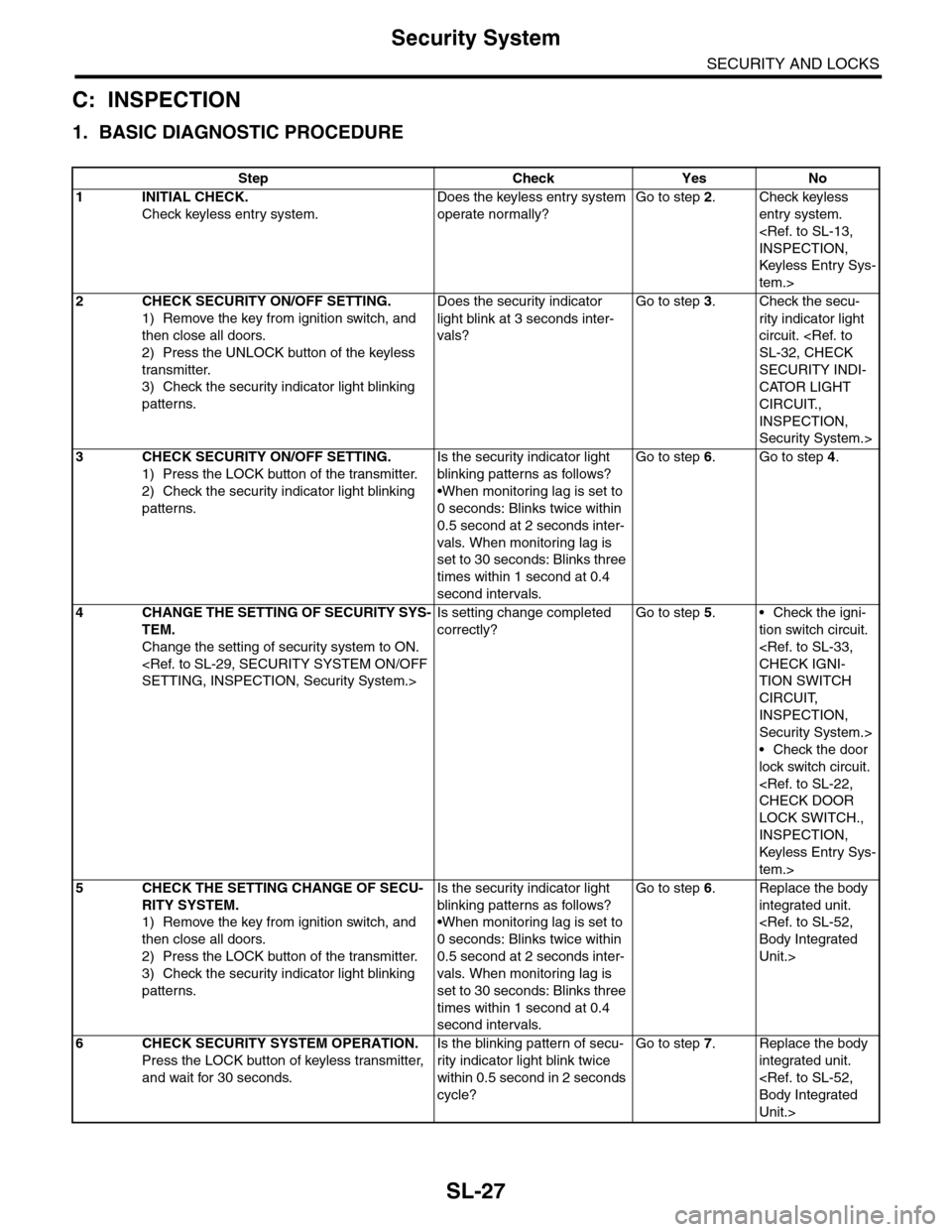
SL-27
Security System
SECURITY AND LOCKS
C: INSPECTION
1. BASIC DIAGNOSTIC PROCEDURE
Step Check Yes No
1 INITIAL CHECK.
Check keyless entry system.
Does the keyless entry system
operate normally?
Go to step 2.Check keyless
entry system.
Keyless Entr y Sys-
tem.>
2CHECK SECURITY ON/OFF SETTING.
1) Remove the key from ignition switch, and
then close all doors.
2) Press the UNLOCK button of the keyless
transmitter.
3) Check the security indicator light blinking
patterns.
Does the security indicator
light blink at 3 seconds inter-
vals?
Go to step 3.Check the secu-
rity indicator light
circuit.
SECURITY INDI-
CATOR LIGHT
CIRCUIT.,
INSPECTION,
Security System.>
3CHECK SECURITY ON/OFF SETTING.
1) Press the LOCK button of the transmitter.
2) Check the security indicator light blinking
patterns.
Is the security indicator light
blinking patterns as follows?
•When monitoring lag is set to
0 seconds: Blinks twice within
0.5 second at 2 seconds inter-
vals. When monitoring lag is
set to 30 seconds: Blinks three
times within 1 second at 0.4
second intervals.
Go to step 6.Go to step 4.
4CHANGE THE SETTING OF SECURITY SYS-
TEM.
Change the setting of security system to ON.
Is setting change completed
correctly?
Go to step 5.•Check the igni-
tion switch circuit.
TION SWITCH
CIRCUIT,
INSPECTION,
Security System.>
•Check the door
lock switch circuit.
LOCK SWITCH.,
INSPECTION,
Keyless Entr y Sys-
tem.>
5CHECK THE SETTING CHANGE OF SECU-
RITY SYSTEM.
1) Remove the key from ignition switch, and
then close all doors.
2) Press the LOCK button of the transmitter.
3) Check the security indicator light blinking
patterns.
Is the security indicator light
blinking patterns as follows?
•When monitoring lag is set to
0 seconds: Blinks twice within
0.5 second at 2 seconds inter-
vals. When monitoring lag is
set to 30 seconds: Blinks three
times within 1 second at 0.4
second intervals.
Go to step 6.Replace the body
integrated unit.
Unit.>
6CHECK SECURITY SYSTEM OPERATION.
Press the LOCK button of keyless transmitter,
and wait for 30 seconds.
Is the blinking pattern of secu-
rity indicator light blink twice
within 0.5 second in 2 seconds
cycle?
Go to step 7.Replace the body
integrated unit.
Unit.>
Page 742 of 2453
BR-28
Brake Booster
BRAKE
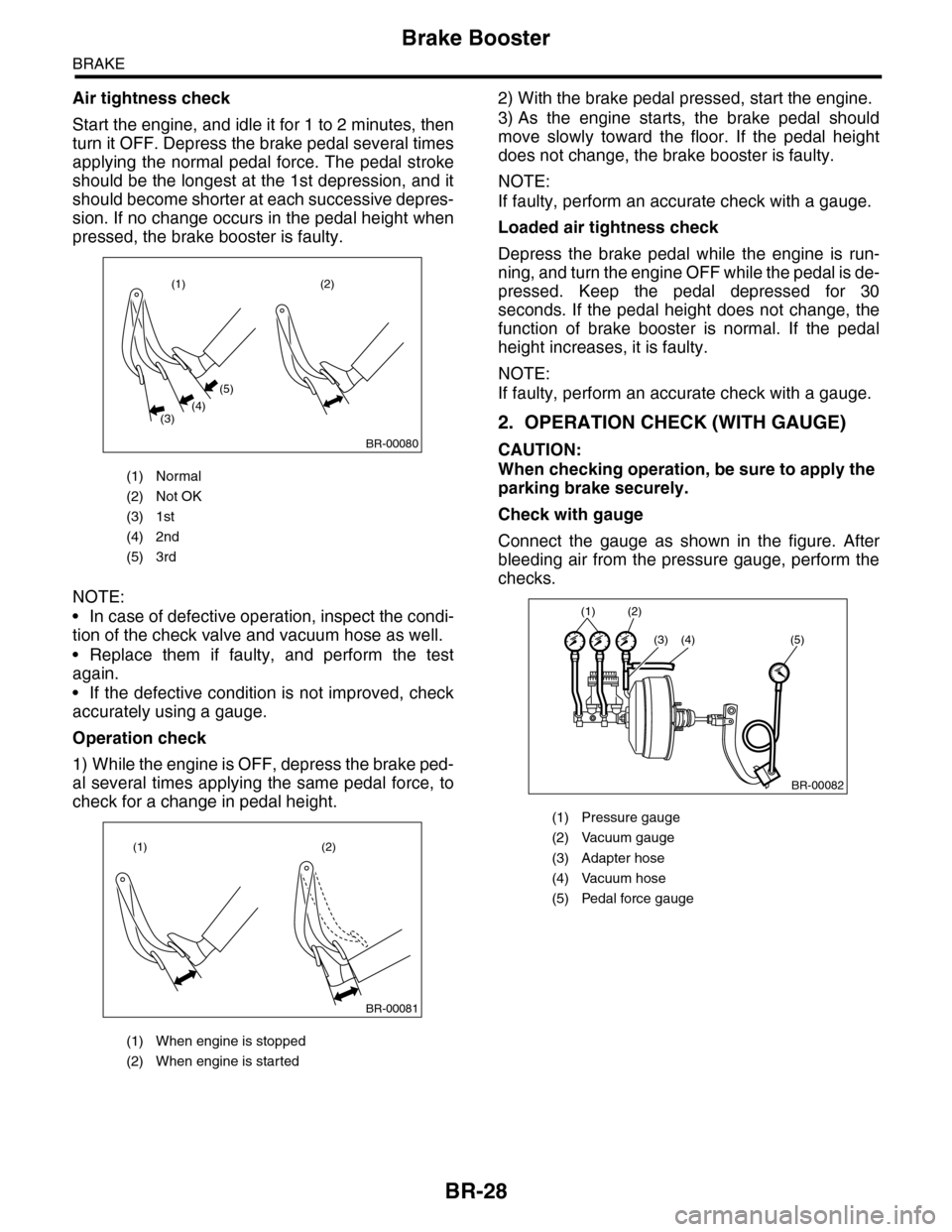
Air tightness check
Start the engine, and idle it for 1 to 2 minutes, then
turn it OFF. Depress the brake pedal several times
applying the normal pedal force. The pedal stroke
should be the longest at the 1st depression, and it
should become shorter at each successive depres-
sion. If no change occurs in the pedal height when
pressed, the brake booster is faulty.
NOTE:
•In case of defective operation, inspect the condi-
tion of the check valve and vacuum hose as well.
•Replace them if faulty, and perform the test
again.
•If the defective condition is not improved, check
accurately using a gauge.
Operation check
1) While the engine is OFF, depress the brake ped-
al several times applying the same pedal force, to
check for a change in pedal height.
2) With the brake pedal pressed, start the engine.
3) As the engine starts, the brake pedal should
move slowly toward the floor. If the pedal height
does not change, the brake booster is faulty.
NOTE:
If faulty, perform an accurate check with a gauge.
Loaded air tightness check
Depress the brake pedal while the engine is run-
ning, and turn the engine OFF while the pedal is de-
pressed. Keep the pedal depressed for 30
seconds. If the pedal height does not change, the
function of brake booster is normal. If the pedal
height increases, it is faulty.
NOTE:
If faulty, perform an accurate check with a gauge.
2. OPERATION CHECK (WITH GAUGE)
CAUTION:
When checking operation, be sure to apply the
parking brake securely.
Check with gauge
Connect the gauge as shown in the figure. After
bleeding air from the pressure gauge, perform the
checks.
(1) Normal
(2) Not OK
(3) 1st
(4) 2nd
(5) 3rd
(1) When engine is stopped
(2) When engine is started
(1)
(3)(4)
(5)
(2)
BR-00080
(1) (2)
BR-00081
(1) Pressure gauge
(2) Vacuum gauge
(3) Adapter hose
(4) Vacuum hose
(5) Pedal force gauge
(1) (2)
(3) (4) (5)
BR-00082
Page 928 of 2453
PS-48
Power Steering Fluid
POWER ASSISTED SYSTEM (POWER STEERING)
9. Power Steering Fluid
A: SPECIFICATION
B: INSPECTION
1) Check the power steering fluid for deterioration
or contamination. If the fluid is highly deteriorated
or contaminated, drain it and refill with new fluid.
2) Check the joints and units for oil leakage. If any
oil leaks are found, repair or replace the applicable
part.
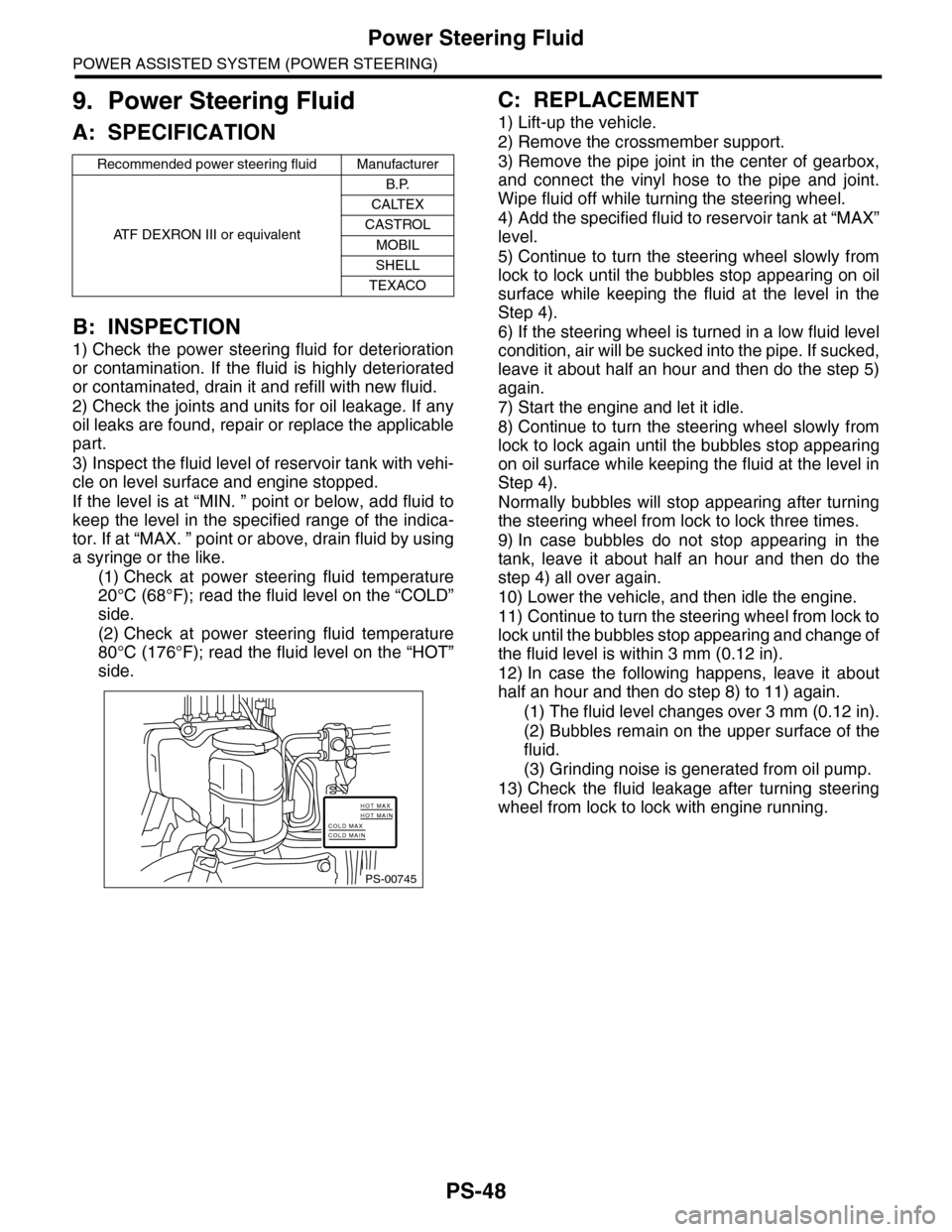
3) Inspect the fluid level of reservoir tank with vehi-
cle on level surface and engine stopped.
If the level is at “MIN. ” point or below, add fluid to
keep the level in the specified range of the indica-
tor. If at “MAX. ” point or above, drain fluid by using
a syringe or the like.
(1) Check at power steering fluid temperature
20°C (68°F); read the fluid level on the “COLD”
side.
(2) Check at power steering fluid temperature
80°C (176°F); read the fluid level on the “HOT”
side.
C: REPLACEMENT
1) Lift-up the vehicle.
2) Remove the crossmember support.
3) Remove the pipe joint in the center of gearbox,
and connect the vinyl hose to the pipe and joint.
Wipe fluid off while turning the steering wheel.
4) Add the specified fluid to reservoir tank at “MAX”
level.
5) Continue to turn the steering wheel slowly from
lock to lock until the bubbles stop appearing on oil
surface while keeping the fluid at the level in the
Step 4).
6) If the steering wheel is turned in a low fluid level
condition, air will be sucked into the pipe. If sucked,
leave it about half an hour and then do the step 5)
again.
7) Start the engine and let it idle.
8) Continue to turn the steering wheel slowly from
lock to lock again until the bubbles stop appearing
on oil surface while keeping the fluid at the level in
Step 4).
Normally bubbles will stop appearing after turning
the steering wheel from lock to lock three times.
9) In case bubbles do not stop appearing in the
tank, leave it about half an hour and then do the
step 4) all over again.
10) Lower the vehicle, and then idle the engine.
11) Continue to turn the steering wheel from lock to
lock until the bubbles stop appearing and change of
the fluid level is within 3 mm (0.12 in).
12) In case the following happens, leave it about
half an hour and then do step 8) to 11) again.
(1) The fluid level changes over 3 mm (0.12 in).
(2) Bubbles remain on the upper surface of the
fluid.
(3) Grinding noise is generated from oil pump.
13) Check the fluid leakage after turning steering
wheel from lock to lock with engine running.
Recommended power steering fluid Manufacturer
AT F D E X R O N I I I o r e q u i v a l e n t
B.P.
CALTEX
CASTROL
MOBIL
SHELL
TEXACO
PS-00745
HOT MAXHOT MAINCOLD MAXCOLD MAIN
Page 1293 of 2453
EN(H6DO)(diag)-132
Diagnostic Procedure with Diagnostic Trouble Code (DTC)
ENGINE (DIAGNOSTICS)
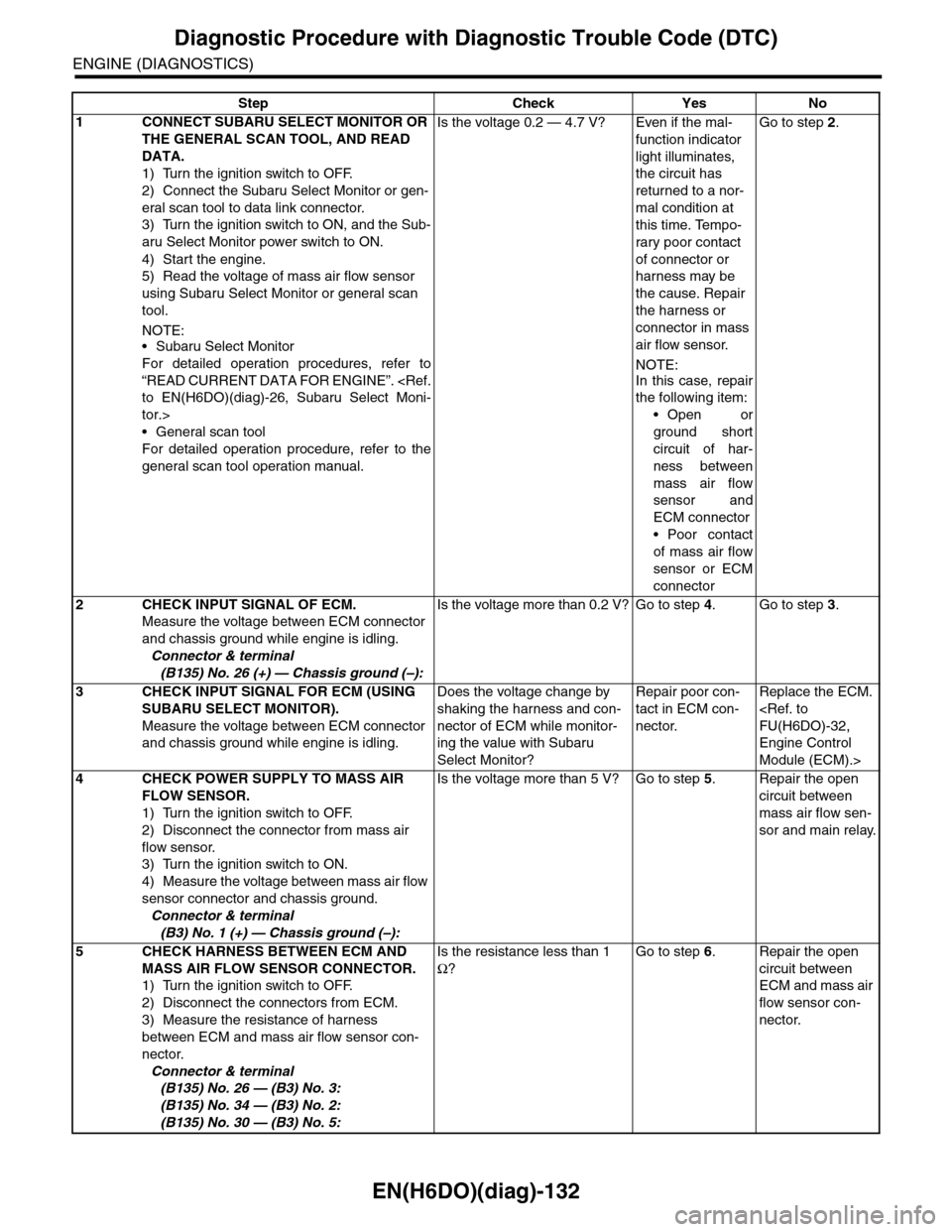
Step Check Yes No
1CONNECT SUBARU SELECT MONITOR OR
THE GENERAL SCAN TOOL, AND READ
DATA.
1) Turn the ignition switch to OFF.
2) Connect the Subaru Select Monitor or gen-
eral scan tool to data link connector.
3) Turn the ignition switch to ON, and the Sub-
aru Select Monitor power switch to ON.
4) Start the engine.
5) Read the voltage of mass air flow sensor
using Subaru Select Monitor or general scan
tool.
NOTE:•Subaru Select Monitor
For detailed operation procedures, refer to
“READ CURRENT DATA FOR ENGINE”.
tor.>
•General scan tool
For detailed operation procedure, refer to the
general scan tool operation manual.
Is the voltage 0.2 — 4.7 V? Even if the mal-
function indicator
light illuminates,
the circuit has
returned to a nor-
mal condition at
this time. Tempo-
rary poor contact
of connector or
harness may be
the cause. Repair
the harness or
connector in mass
air flow sensor.
NOTE:
In this case, repair
the following item:
•Open or
ground short
circuit of har-
ness between
mass air flow
sensor and
ECM connector
•Poor contact
of mass air flow
sensor or ECM
connector
Go to step 2.
2CHECK INPUT SIGNAL OF ECM.
Measure the voltage between ECM connector
and chassis ground while engine is idling.
Connector & terminal
(B135) No. 26 (+) — Chassis ground (–):
Is the voltage more than 0.2 V? Go to step 4.Go to step 3.
3CHECK INPUT SIGNAL FOR ECM (USING
SUBARU SELECT MONITOR).
Measure the voltage between ECM connector
and chassis ground while engine is idling.
Does the voltage change by
shaking the harness and con-
nector of ECM while monitor-
ing the value with Subaru
Select Monitor?
Repair poor con-
tact in ECM con-
nector.
Replace the ECM.
Engine Control
Module (ECM).>
4CHECK POWER SUPPLY TO MASS AIR
FLOW SENSOR.
1) Turn the ignition switch to OFF.
2) Disconnect the connector from mass air
flow sensor.
3) Turn the ignition switch to ON.
4) Measure the voltage between mass air flow
sensor connector and chassis ground.
Connector & terminal
(B3) No. 1 (+) — Chassis ground (–):
Is the voltage more than 5 V? Go to step 5.Repair the open
circuit between
mass air flow sen-
sor and main relay.
5CHECK HARNESS BETWEEN ECM AND
MASS AIR FLOW SENSOR CONNECTOR.
1) Turn the ignition switch to OFF.
2) Disconnect the connectors from ECM.
3) Measure the resistance of harness
between ECM and mass air flow sensor con-
nector.
Connector & terminal
(B135) No. 26 — (B3) No. 3:
(B135) No. 34 — (B3) No. 2:
(B135) No. 30 — (B3) No. 5:
Is the resistance less than 1
Ω?
Go to step 6.Repair the open
circuit between
ECM and mass air
flow sensor con-
nector.
Page 1298 of 2453
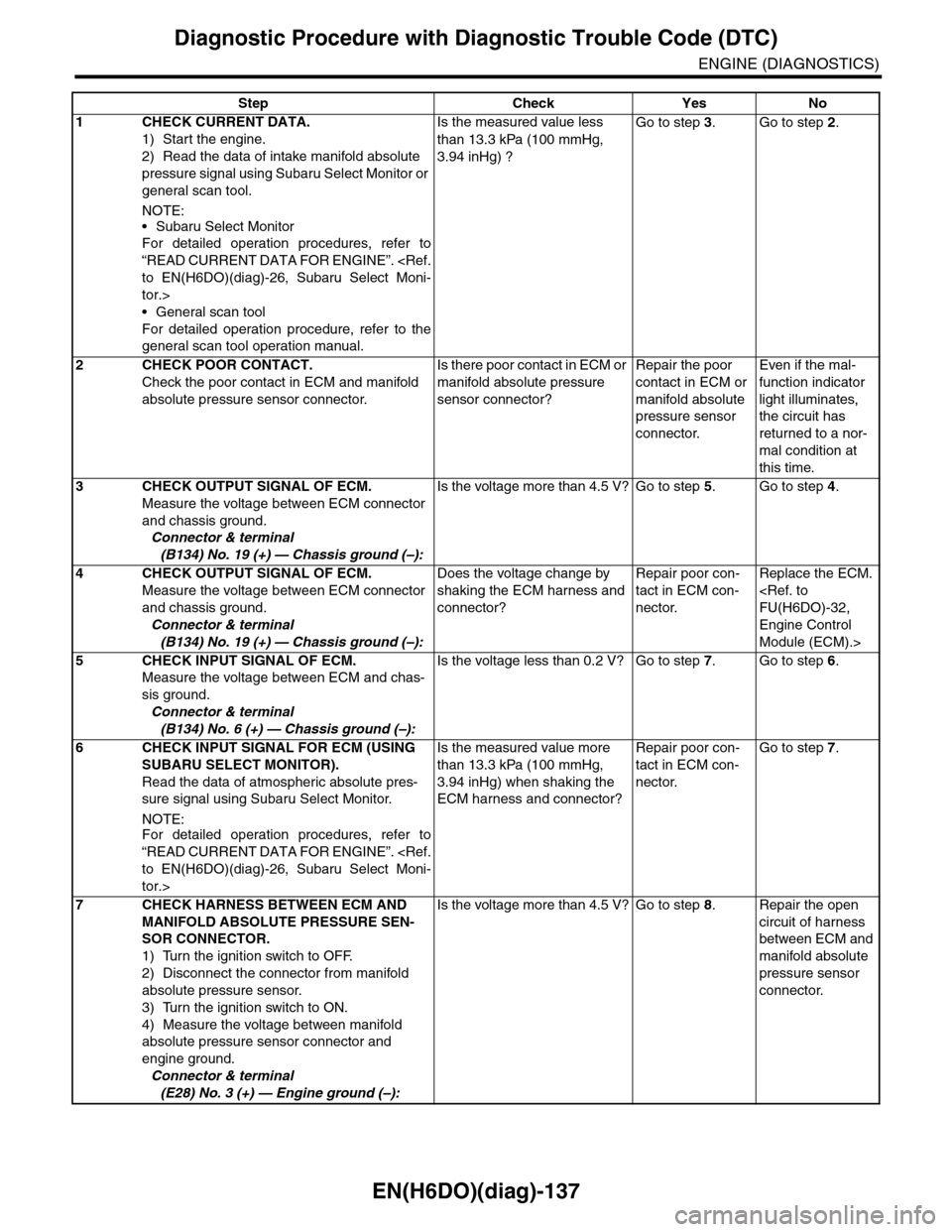
EN(H6DO)(diag)-137
Diagnostic Procedure with Diagnostic Trouble Code (DTC)
ENGINE (DIAGNOSTICS)
Step Check Yes No
1CHECK CURRENT DATA.
1) Start the engine.
2) Read the data of intake manifold absolute
pressure signal using Subaru Select Monitor or
general scan tool.
NOTE:
•Subaru Select Monitor
For detailed operation procedures, refer to
“READ CURRENT DATA FOR ENGINE”.
tor.>
•General scan tool
For detailed operation procedure, refer to the
general scan tool operation manual.
Is the measured value less
than 13.3 kPa (100 mmHg,
3.94 inHg) ?
Go to step 3.Go to step 2.
2CHECK POOR CONTACT.
Check the poor contact in ECM and manifold
absolute pressure sensor connector.
Is there poor contact in ECM or
manifold absolute pressure
sensor connector?
Repair the poor
contact in ECM or
manifold absolute
pressure sensor
connector.
Even if the mal-
function indicator
light illuminates,
the circuit has
returned to a nor-
mal condition at
this time.
3CHECK OUTPUT SIGNAL OF ECM.
Measure the voltage between ECM connector
and chassis ground.
Connector & terminal
(B134) No. 19 (+) — Chassis ground (–):
Is the voltage more than 4.5 V? Go to step 5.Go to step 4.
4CHECK OUTPUT SIGNAL OF ECM.
Measure the voltage between ECM connector
and chassis ground.
Connector & terminal
(B134) No. 19 (+) — Chassis ground (–):
Does the voltage change by
shaking the ECM harness and
connector?
Repair poor con-
tact in ECM con-
nector.
Replace the ECM.
Engine Control
Module (ECM).>
5CHECK INPUT SIGNAL OF ECM.
Measure the voltage between ECM and chas-
sis ground.
Connector & terminal
(B134) No. 6 (+) — Chassis ground (–):
Is the voltage less than 0.2 V? Go to step 7.Go to step 6.
6CHECK INPUT SIGNAL FOR ECM (USING
SUBARU SELECT MONITOR).
Read the data of atmospheric absolute pres-
sure signal using Subaru Select Monitor.
NOTE:For detailed operation procedures, refer to
“READ CURRENT DATA FOR ENGINE”.
tor.>
Is the measured value more
than 13.3 kPa (100 mmHg,
3.94 inHg) when shaking the
ECM harness and connector?
Repair poor con-
tact in ECM con-
nector.
Go to step 7.
7CHECK HARNESS BETWEEN ECM AND
MANIFOLD ABSOLUTE PRESSURE SEN-
SOR CONNECTOR.
1) Turn the ignition switch to OFF.
2) Disconnect the connector from manifold
absolute pressure sensor.
3) Turn the ignition switch to ON.
4) Measure the voltage between manifold
absolute pressure sensor connector and
engine ground.
Connector & terminal
(E28) No. 3 (+) — Engine ground (–):
Is the voltage more than 4.5 V? Go to step 8.Repair the open
circuit of harness
between ECM and
manifold absolute
pressure sensor
connector.
Page 1441 of 2453
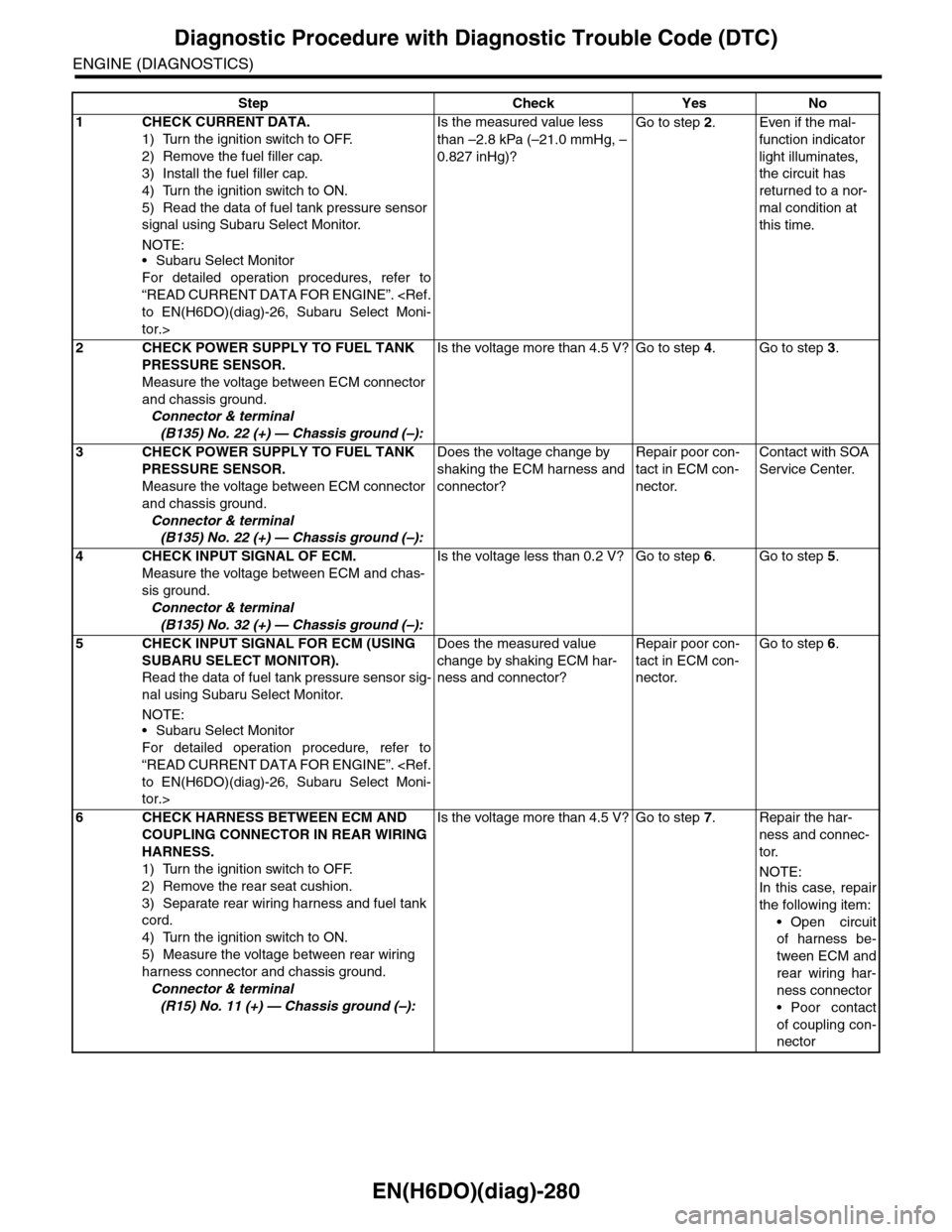
EN(H6DO)(diag)-280
Diagnostic Procedure with Diagnostic Trouble Code (DTC)
ENGINE (DIAGNOSTICS)
Step Check Yes No
1CHECK CURRENT DATA.
1) Turn the ignition switch to OFF.
2) Remove the fuel filler cap.
3) Install the fuel filler cap.
4) Turn the ignition switch to ON.
5) Read the data of fuel tank pressure sensor
signal using Subaru Select Monitor.
NOTE:•Subaru Select Monitor
For detailed operation procedures, refer to
“READ CURRENT DATA FOR ENGINE”.
tor.>
Is the measured value less
than –2.8 kPa (–21.0 mmHg, –
0.827 inHg)?
Go to step 2.Even if the mal-
function indicator
light illuminates,
the circuit has
returned to a nor-
mal condition at
this time.
2CHECK POWER SUPPLY TO FUEL TANK
PRESSURE SENSOR.
Measure the voltage between ECM connector
and chassis ground.
Connector & terminal
(B135) No. 22 (+) — Chassis ground (–):
Is the voltage more than 4.5 V? Go to step 4.Go to step 3.
3CHECK POWER SUPPLY TO FUEL TANK
PRESSURE SENSOR.
Measure the voltage between ECM connector
and chassis ground.
Connector & terminal
(B135) No. 22 (+) — Chassis ground (–):
Does the voltage change by
shaking the ECM harness and
connector?
Repair poor con-
tact in ECM con-
nector.
Contact with SOA
Service Center.
4CHECK INPUT SIGNAL OF ECM.
Measure the voltage between ECM and chas-
sis ground.
Connector & terminal
(B135) No. 32 (+) — Chassis ground (–):
Is the voltage less than 0.2 V? Go to step 6.Go to step 5.
5CHECK INPUT SIGNAL FOR ECM (USING
SUBARU SELECT MONITOR).
Read the data of fuel tank pressure sensor sig-
nal using Subaru Select Monitor.
NOTE:
•Subaru Select Monitor
For detailed operation procedure, refer to
“READ CURRENT DATA FOR ENGINE”.
tor.>
Does the measured value
change by shaking ECM har-
ness and connector?
Repair poor con-
tact in ECM con-
nector.
Go to step 6.
6CHECK HARNESS BETWEEN ECM AND
COUPLING CONNECTOR IN REAR WIRING
HARNESS.
1) Turn the ignition switch to OFF.
2) Remove the rear seat cushion.
3) Separate rear wiring harness and fuel tank
cord.
4) Turn the ignition switch to ON.
5) Measure the voltage between rear wiring
harness connector and chassis ground.
Connector & terminal
(R15) No. 11 (+) — Chassis ground (–):
Is the voltage more than 4.5 V? Go to step 7.Repair the har-
ness and connec-
tor.
NOTE:In this case, repair
the following item:
•Open circuit
of harness be-
tween ECM and
rear wiring har-
ness connector
•Poor contact
of coupling con-
nector
Page 1687 of 2453
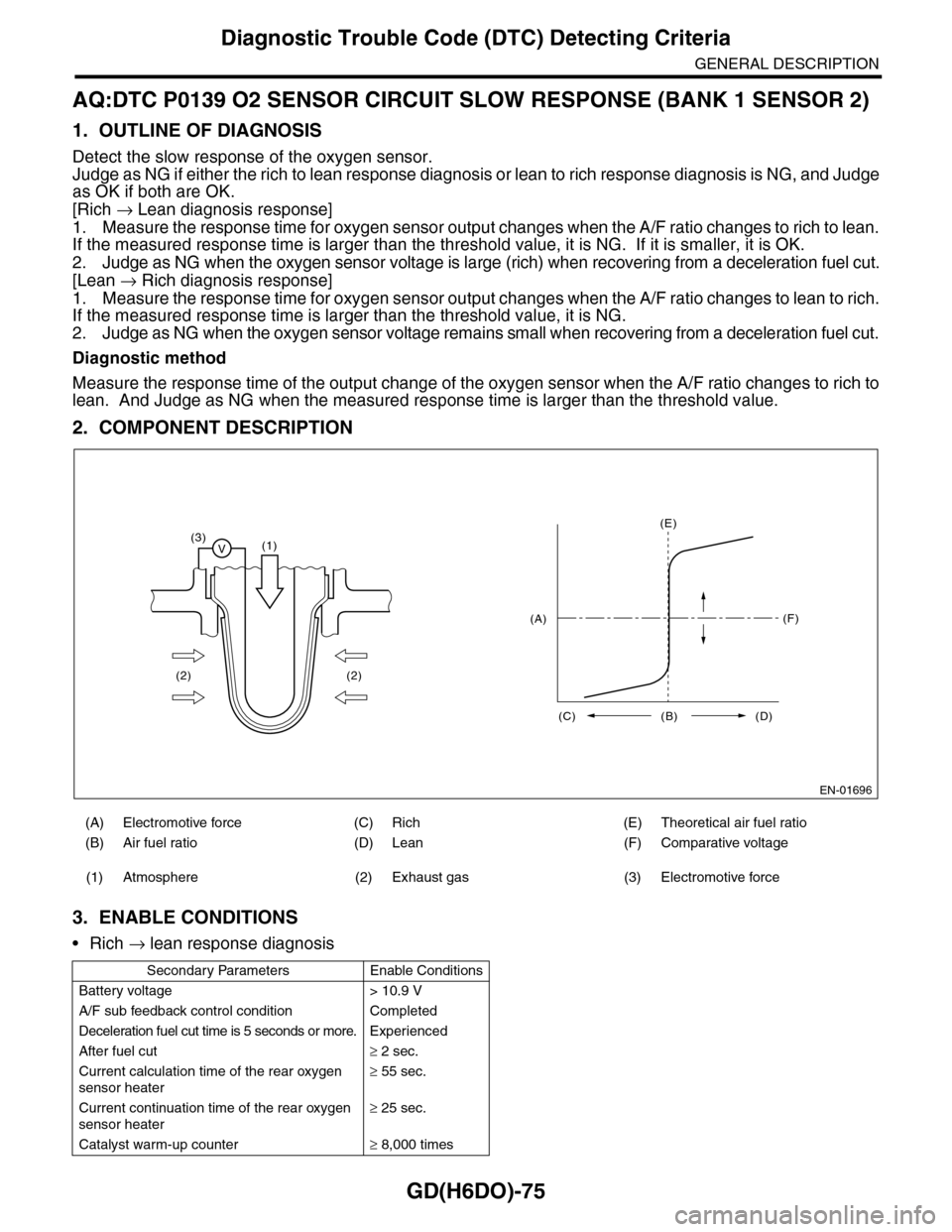
GD(H6DO)-75
Diagnostic Trouble Code (DTC) Detecting Criteria
GENERAL DESCRIPTION
AQ:DTC P0139 O2 SENSOR CIRCUIT SLOW RESPONSE (BANK 1 SENSOR 2)
1. OUTLINE OF DIAGNOSIS
Detect the slow response of the oxygen sensor.
Judge as NG if either the rich to lean response diagnosis or lean to rich response diagnosis is NG, and Judge
as OK if both are OK.
[Rich → Lean diagnosis response]
1. Measure the response time for oxygen sensor output changes when the A/F ratio changes to rich to lean.
If the measured response time is larger than the threshold value, it is NG. If it is smaller, it is OK.
2. Judge as NG when the oxygen sensor voltage is large (rich) when recovering from a deceleration fuel cut.
[Lean → Rich diagnosis response]
1. Measure the response time for oxygen sensor output changes when the A/F ratio changes to lean to rich.
If the measured response time is larger than the threshold value, it is NG.
2. Judge as NG when the oxygen sensor voltage remains small when recovering from a deceleration fuel cut.
Diagnostic method
Measure the response time of the output change of the oxygen sensor when the A/F ratio changes to rich to
lean. And Judge as NG when the measured response time is larger than the threshold value.
2. COMPONENT DESCRIPTION
3. ENABLE CONDITIONS
•Rich → lean response diagnosis
(A) Electromotive force (C) Rich (E) Theoretical air fuel ratio
(B) Air fuel ratio (D) Lean (F) Comparative voltage
(1) Atmosphere (2) Exhaust gas (3) Electromotive force
Secondary Parameters Enable Conditions
Battery voltage > 10.9 V
A/F sub feedback control condition Completed
Deceleration fuel cut time is 5 seconds or more. Experienced
After fuel cut≥ 2 sec.
Current calculation time of the rear oxygen
sensor heater
≥ 55 sec.
Current continuation time of the rear oxygen
sensor heater
≥ 25 sec.
Catalyst warm-up counter≥ 8,000 times
EN-01696
(3)V(1)
(2) (2)
(E)
(F)
(C) (B) (D)
(A)
Page 1688 of 2453
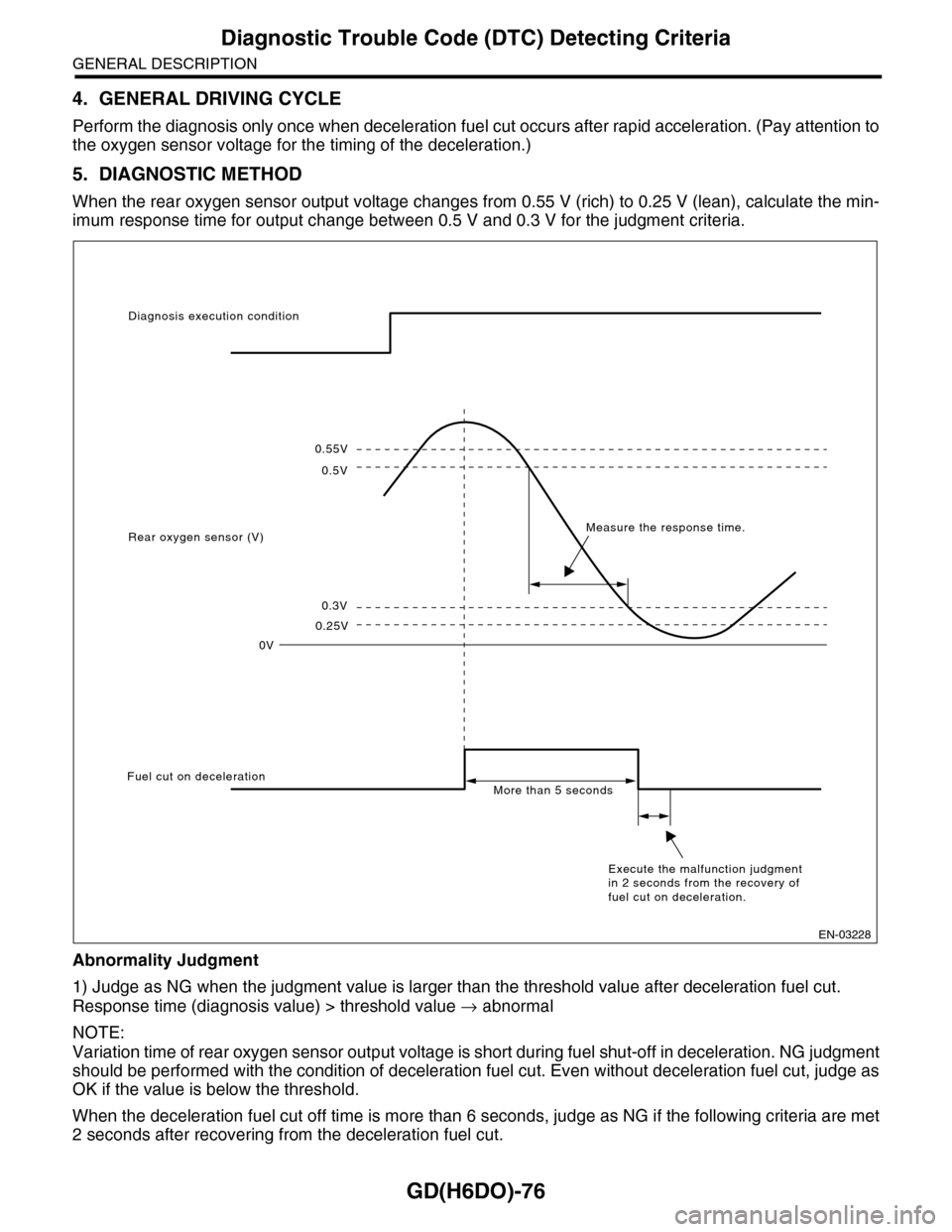
GD(H6DO)-76
Diagnostic Trouble Code (DTC) Detecting Criteria
GENERAL DESCRIPTION
4. GENERAL DRIVING CYCLE
Perform the diagnosis only once when deceleration fuel cut occurs after rapid acceleration. (Pay attention to
the oxygen sensor voltage for the timing of the deceleration.)
5. DIAGNOSTIC METHOD
When the rear oxygen sensor output voltage changes from 0.55 V (rich) to 0.25 V (lean), calculate the min-
imum response time for output change between 0.5 V and 0.3 V for the judgment criteria.
Abnormality Judgment
1) Judge as NG when the judgment value is larger than the threshold value after deceleration fuel cut.
Response time (diagnosis value) > threshold value → abnormal
NOTE:
Variation time of rear oxygen sensor output voltage is short during fuel shut-off in deceleration. NG judgment
should be performed with the condition of deceleration fuel cut. Even without deceleration fuel cut, judge as
OK if the value is below the threshold.
When the deceleration fuel cut off time is more than 6 seconds, judge as NG if the following criteria are met
2 seconds after recovering from the deceleration fuel cut.
0.55V
0.5V
0.3V
0.25V
0V
Diagnosis execution condition
Rear oxygen sensor (V)Measure the response time.
Fuel cut on decelerationMore than 5 seconds
Execute the malfunction judgment in 2 seconds from the recovery of fuel cut on deceleration.
EN-03228
Page 1689 of 2453
GD(H6DO)-77
Diagnostic Trouble Code (DTC) Detecting Criteria
GENERAL DESCRIPTION
2) Judge as NG when the oxygen sensor voltage at recovery from a deceleration fuel cut, is large.
If the fuel cut time in a deceleration fuel cut is long (more than 6 s), and even after recovering from a decel-
eration fuel cut, the oxygen sensor voltage is high (0.55 V or more), judge as NG.
Time Needed for Diagnosis: 1 time
Malfunction Indicator Light Illumination: Illuminates when malfunctions occur in 2 continuous driving cy-
cles.
Normality Judgment
1) Regardless of a deceleration fuel cut, if the response time (diagnosis value) when the oxygen sensor volt-
age has changed from rich to lean is shorter than the threshold value (judgment value), judge as a normal
condition.
Response time (diagnosis value) ≤ threshold value → normal
2) Do not judge as a normal condition.
Judge as OK when the criteria below are met.
6. DTC CLEAR CONDITION
•When the OK idling cycle is completed 40 times in a row
•When “Clear Memory” is performed
7. MALFUNCTION INDICATOR LIGHT CLEAR CONDITIONS
•When the OK driving cycle is completed 3 times in a row
•When “Clear Memory” is performed
8. FAIL SAFE
Sub feedback control: Not allowed
9. ECM OPERATION AT DTC SETTING
•Memorize the freeze frame data. (For test mode $02)
•Memorize the diagnostic value and trouble standard value. (For test mode $06)
10.ENABLE CONDITIONS
•Lean → rich response diagnosis
11.GENERAL DRIVING CYCLE
Perform the diagnosis only once when deceleration fuel cut occurs after rapid acceleration. (Pay attention to
the oxygen sensor voltage for the timing of the deceleration.)
Judgment Value
Malfunction Criteria Threshold Value
Shortest time change from rich (500 mV
O2 output) to lean (300 mV) if voltage
reduces from 550 mV to 250 mV.
> 0.327 sec.
or
Longest time over 550 mV > 2 sec.
Judgment Value
Malfunction Criteria Threshold Value
Shortest time change from rich (500 mV
O2 output) to lean (300 mV) if voltage
reduces from 550 mV to 250 mV.
≤ 0.327 sec.
Secondary Parameters Enable Conditions
Battery voltage > 10.9 V
A/F main feedback control condition Complete
5 seconds or more deceleration fuel cut. Experienced
After fuel cut≥ 2 sec.
Page 1690 of 2453
GD(H6DO)-78
Diagnostic Trouble Code (DTC) Detecting Criteria
GENERAL DESCRIPTION
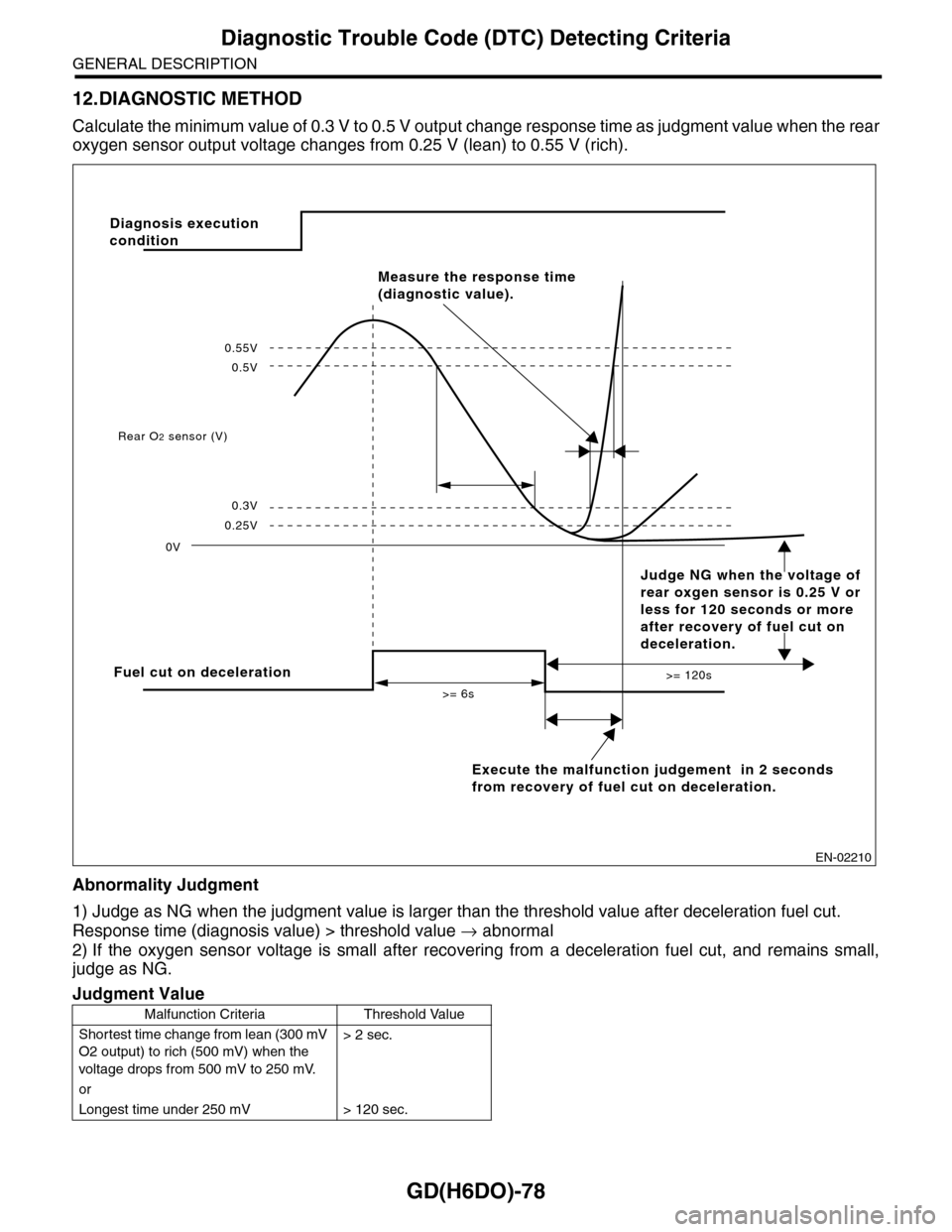
12.DIAGNOSTIC METHOD
Calculate the minimum value of 0.3 V to 0.5 V output ch a n g e r e s p on s e t im e a s ju d g m e n t v a lu e w h en th e re a r
oxygen sensor output voltage changes from 0.25 V (lean) to 0.55 V (rich).
Abnormality Judgment
1) Judge as NG when the judgment value is larger than the threshold value after deceleration fuel cut.
Response time (diagnosis value) > threshold value → abnormal
2) If the oxygen sensor voltage is small after recovering from a deceleration fuel cut, and remains small,
judge as NG.
Judgment Value
Malfunction Criteria Threshold Value
Shortest time change from lean (300 mV
O2 output) to rich (500 mV) when the
voltage drops from 500 mV to 250 mV.
> 2 sec.
or
Longest time under 250 mV > 120 sec.
EN-02210
Fuel cut on deceleration
Execute the malfunction judgement in 2 seconds
from recovery of fuel cut on deceleration.
Rear O2 sensor (V)
0V
>= 6s
>= 120s
0.25V
0.3V
0.5V
0.55V
Measure the response time
(diagnostic value).
Diagnosis execution
condition
Judge NG when the voltage of
rear oxgen sensor is 0.25 V or
less for 120 seconds or more
after recovery of fuel cut on
deceleration.