remove seats SUBARU TRIBECA 2009 1.G Service Owner's Manual
[x] Cancel search | Manufacturer: SUBARU, Model Year: 2009, Model line: TRIBECA, Model: SUBARU TRIBECA 2009 1.GPages: 2453, PDF Size: 46.32 MB
Page 629 of 2453
SE-19
Seat Heater System
SEATS
5. Seat Heater System
A: REMOVAL
1. SEAT HEATER UNIT
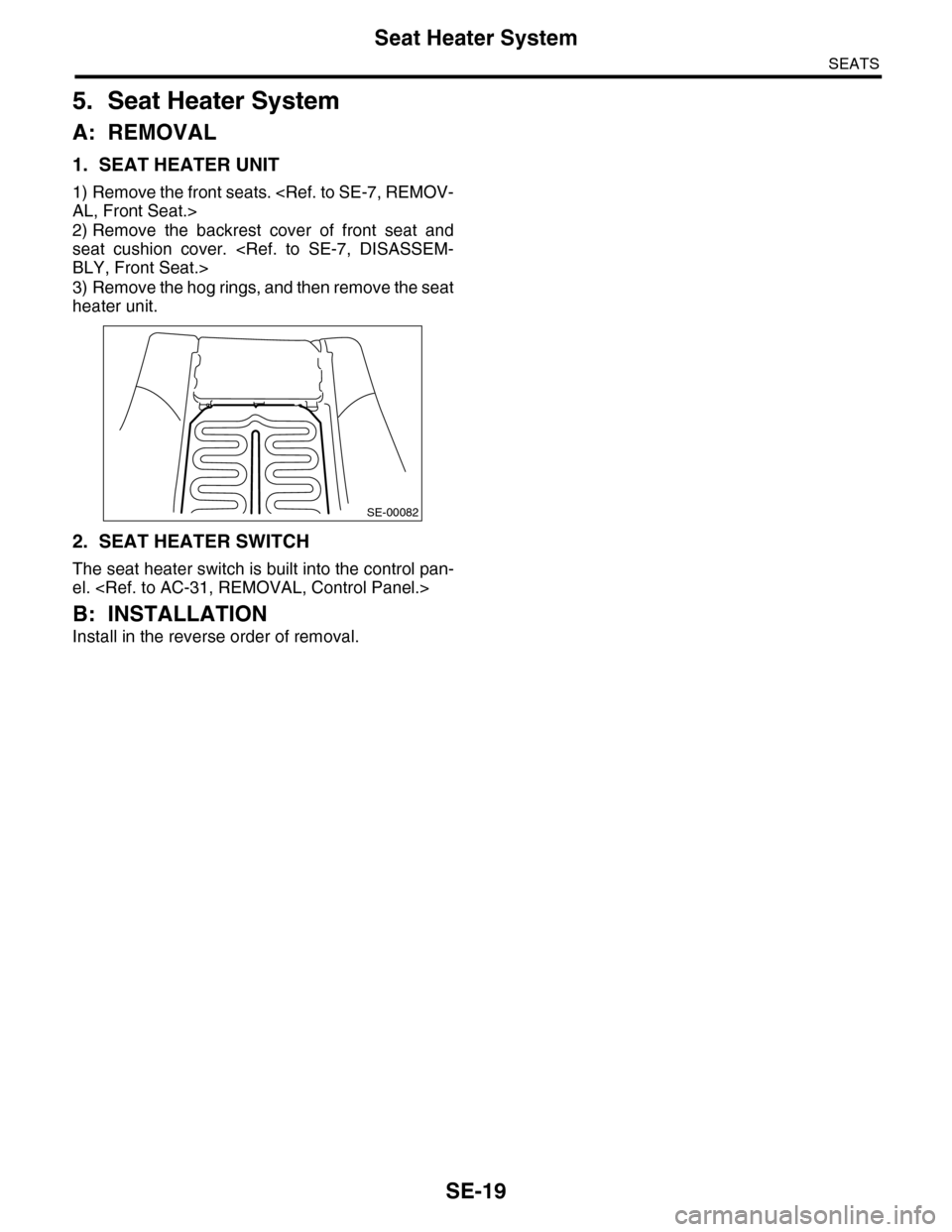
1) Remove the front seats.
2) Remove the backrest cover of front seat and
seat cushion cover.
3) Remove the hog rings, and then remove the seat
heater unit.
2. SEAT HEATER SWITCH
The seat heater switch is built into the control pan-
el.
B: INSTALLATION
Install in the reverse order of removal.
SE-00082
Page 674 of 2453
SL-45
Remote Openers
SECURITY AND LOCKS
16.Remote Openers
A: REMOVAL
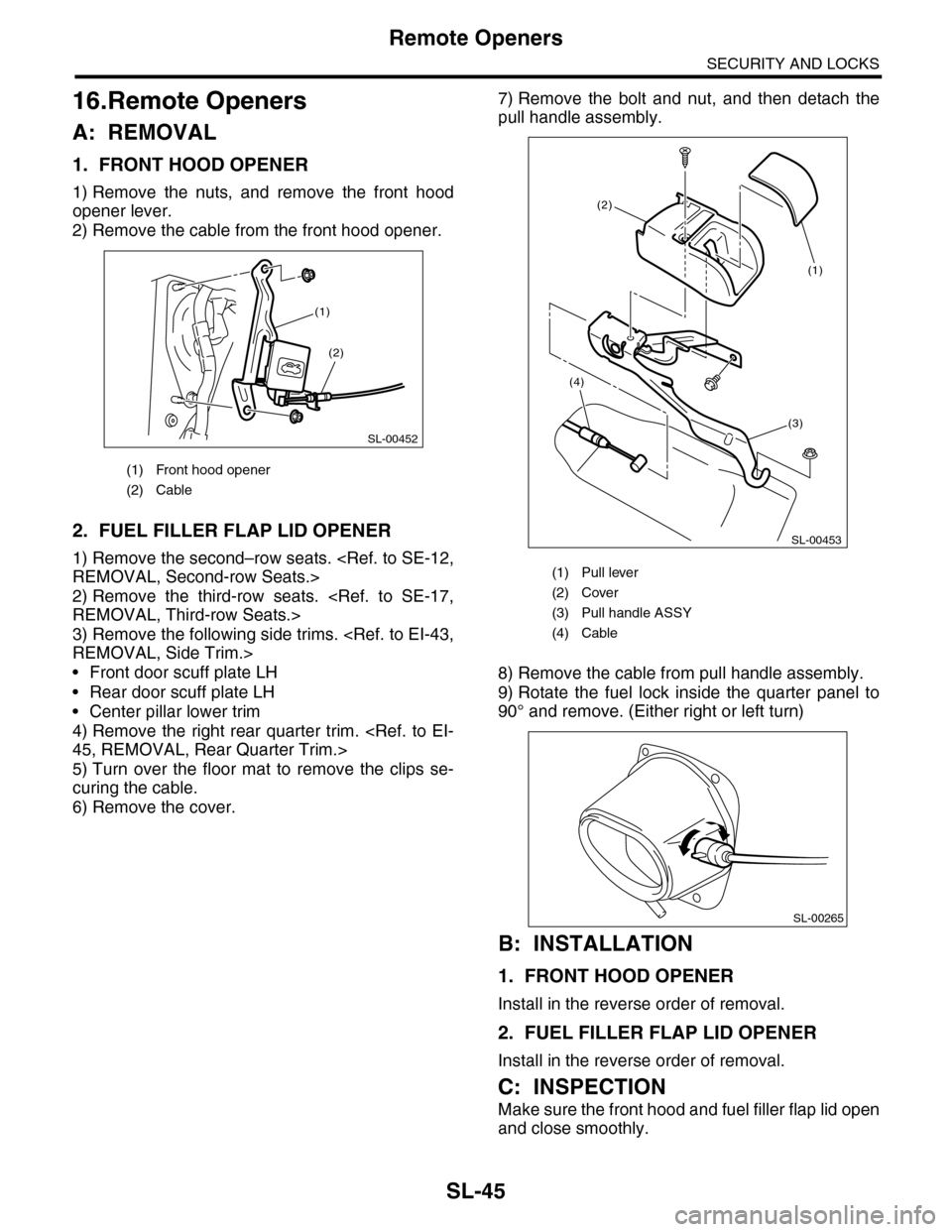
1. FRONT HOOD OPENER
1) Remove the nuts, and remove the front hood
opener lever.
2) Remove the cable from the front hood opener.
2. FUEL FILLER FLAP LID OPENER
1) Remove the second–row seats.
2) Remove the third-row seats.
3) Remove the following side trims.
•Front door scuff plate LH
•Rear door scuff plate LH
•Center pillar lower trim
4) Remove the right rear quarter trim.
5) Turn over the floor mat to remove the clips se-
curing the cable.
6) Remove the cover.
7) Remove the bolt and nut, and then detach the
pull handle assembly.
8) Remove the cable from pull handle assembly.
9) Rotate the fuel lock inside the quarter panel to
90° and remove. (Either right or left turn)
B: INSTALLATION
1. FRONT HOOD OPENER
Install in the reverse order of removal.
2. FUEL FILLER FLAP LID OPENER
Install in the reverse order of removal.
C: INSPECTION
Make sure the front hood and fuel filler flap lid open
and close smoothly.
(1) Front hood opener
(2) Cable
SL-00452
(2)
(1)
(1) Pull lever
(2) Cover
(3) Pull handle ASSY
(4) Cable
SL-00453
(3)
(2)
(4)
(1)
SL-00265
Page 802 of 2453
DI-18
Rear Differential (VA–type)
DIFFERENTIALS
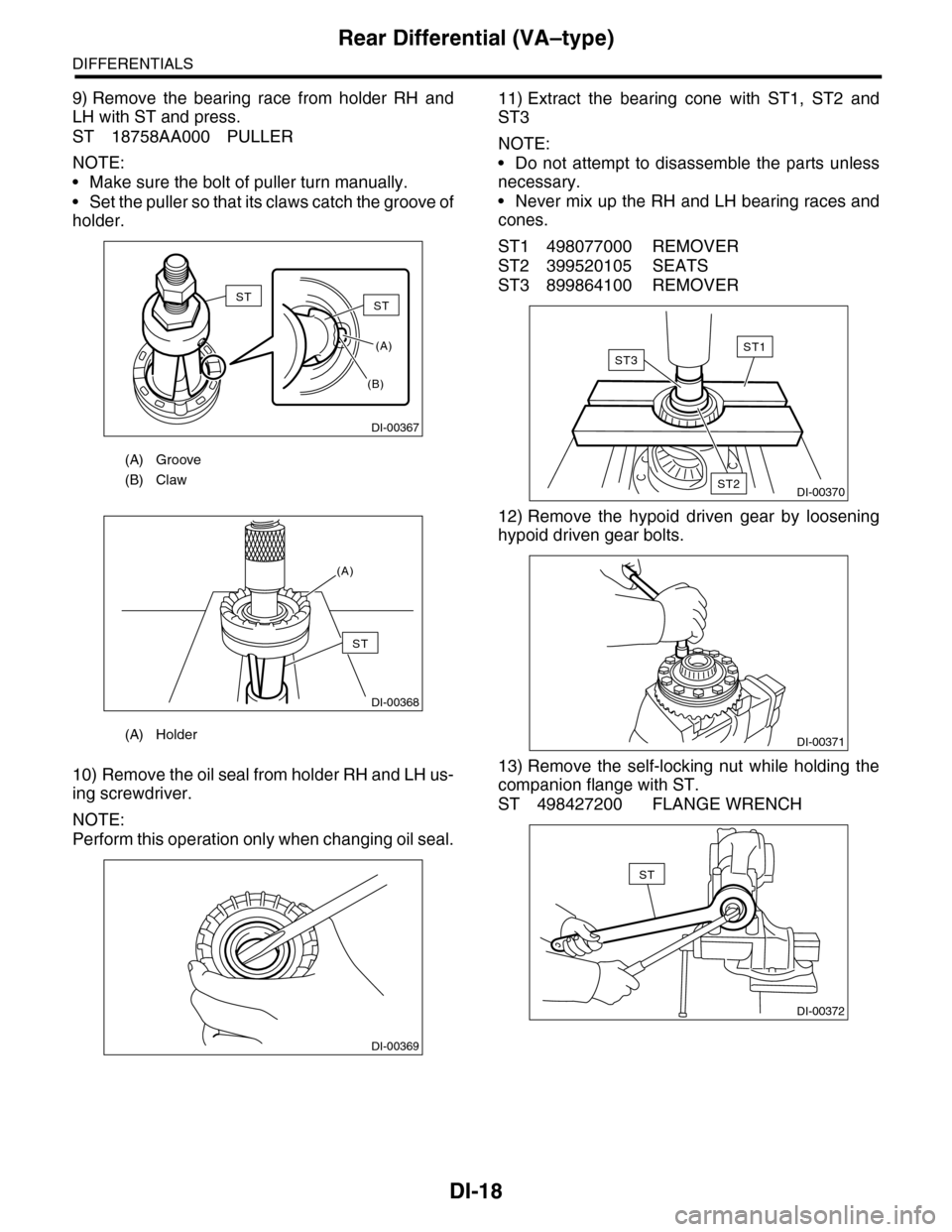
9) Remove the bearing race from holder RH and
LH with ST and press.
ST 18758AA000 PULLER
NOTE:
•Make sure the bolt of puller turn manually.
•Set the puller so that its claws catch the groove of
holder.
10) Remove the oil seal from holder RH and LH us-
ing screwdriver.
NOTE:
Perform this operation only when changing oil seal.
11) Extract the bearing cone with ST1, ST2 and
ST3
NOTE:
•Do not attempt to disassemble the parts unless
necessary.
•Never mix up the RH and LH bearing races and
cones.
ST1 498077000 REMOVER
ST2 399520105 SEATS
ST3 899864100 REMOVER
12) Remove the hypoid driven gear by loosening
hypoid driven gear bolts.
13) Remove the self-locking nut while holding the
companion flange with ST.
ST 498427200 FLANGE WRENCH
(A) Groove
(B) Claw
(A) Holder
ST
DI-00367
ST
(A)
(B)
(A)
ST
DI-00368
DI-00369
DI-00370
ST1
ST2
ST3
DI-00371
DI-00372
ST
Page 868 of 2453
FS-20
Front Strut
FRONT SUSPENSION
C: DISASSEMBLY
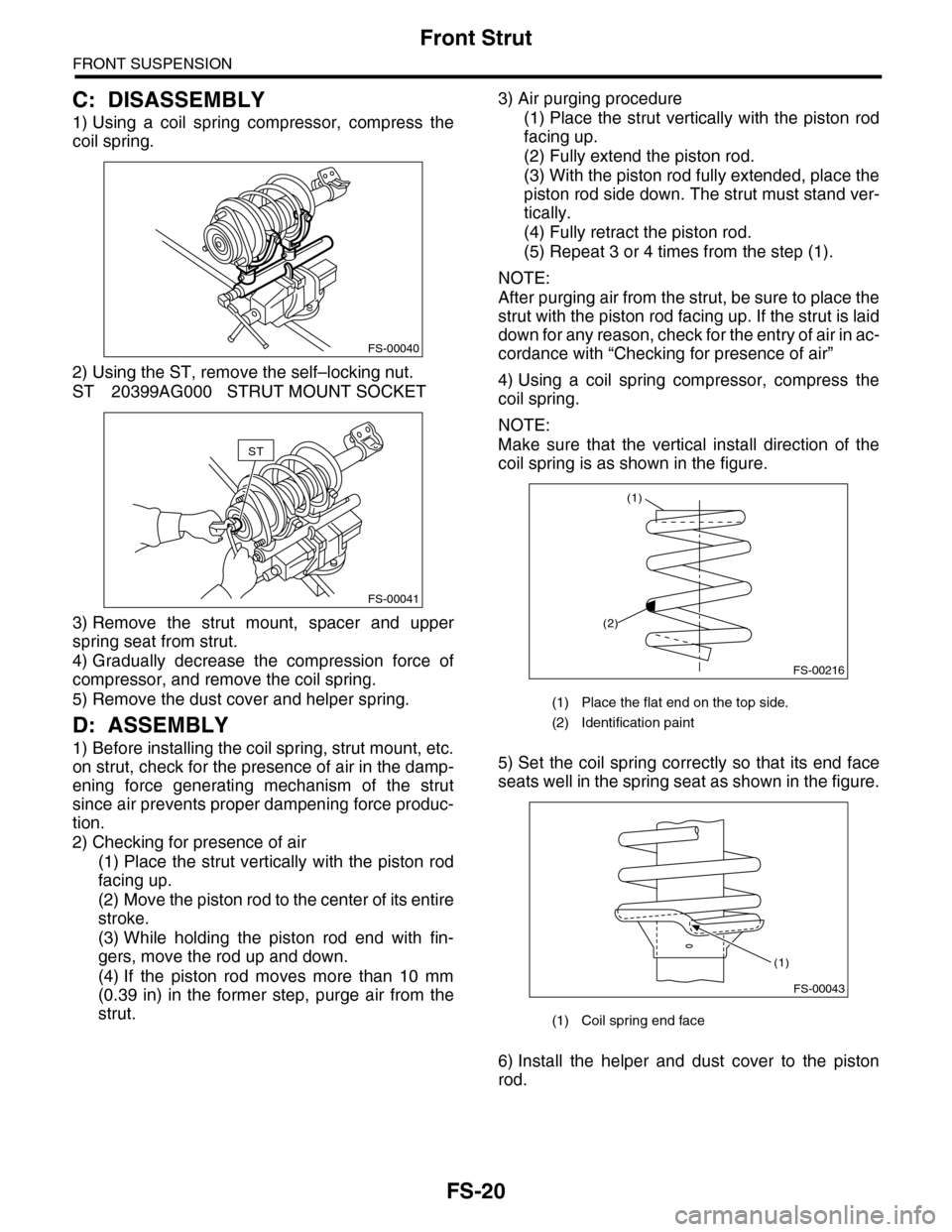
1) Using a coil spring compressor, compress the
coil spring.
2) Using the ST, remove the self–locking nut.
ST 20399AG000 STRUT MOUNT SOCKET
3) Remove the strut mount, spacer and upper
spring seat from strut.
4) Gradually decrease the compression force of
compressor, and remove the coil spring.
5) Remove the dust cover and helper spring.
D: ASSEMBLY
1) Before installing the coil spring, strut mount, etc.
on strut, check for the presence of air in the damp-
ening force generating mechanism of the strut
since air prevents proper dampening force produc-
tion.
2) Checking for presence of air
(1) Place the strut vertically with the piston rod
facing up.
(2) Move the piston rod to the center of its entire
stroke.
(3) While holding the piston rod end with fin-
gers, move the rod up and down.
(4) If the piston rod moves more than 10 mm
(0.39 in) in the former step, purge air from the
strut.
3) Air purging procedure
(1) Place the strut vertically with the piston rod
facing up.
(2) Fully extend the piston rod.
(3) With the piston rod fully extended, place the
piston rod side down. The strut must stand ver-
tically.
(4) Fully retract the piston rod.
(5) Repeat 3 or 4 times from the step (1).
NOTE:
After purging air from the strut, be sure to place the
strut with the piston rod facing up. If the strut is laid
down for any reason, check for the entry of air in ac-
cordance with “Checking for presence of air”
4) Using a coil spring compressor, compress the
coil spring.
NOTE:
Make sure that the vertical install direction of the
coil spring is as shown in the figure.
5) Set the coil spring correctly so that its end face
seats well in the spring seat as shown in the figure.
6) Install the helper and dust cover to the piston
rod.
FS-00040
FS-00041
ST
(1) Place the flat end on the top side.
(2) Identification paint
(1) Coil spring end face
FS-00216
(2)
(1)
FS-00043
(1)
Page 1599 of 2453
FU(H6DO)-38
Fuel Tank
FUEL INJECTION (FUEL SYSTEMS)
22.Fuel Tank
A: REMOVAL
WARNING:
•Place “NO FIRE” signs near the working area.
•Be careful not to spill fuel on the floor.
1) Set the vehicle on a lift.
2) Release the fuel pressure.
DURE, Fuel.>
3) Disconnect the ground cable from battery.
4) Drain fuel from fuel tank.
5) Remove the second seat.
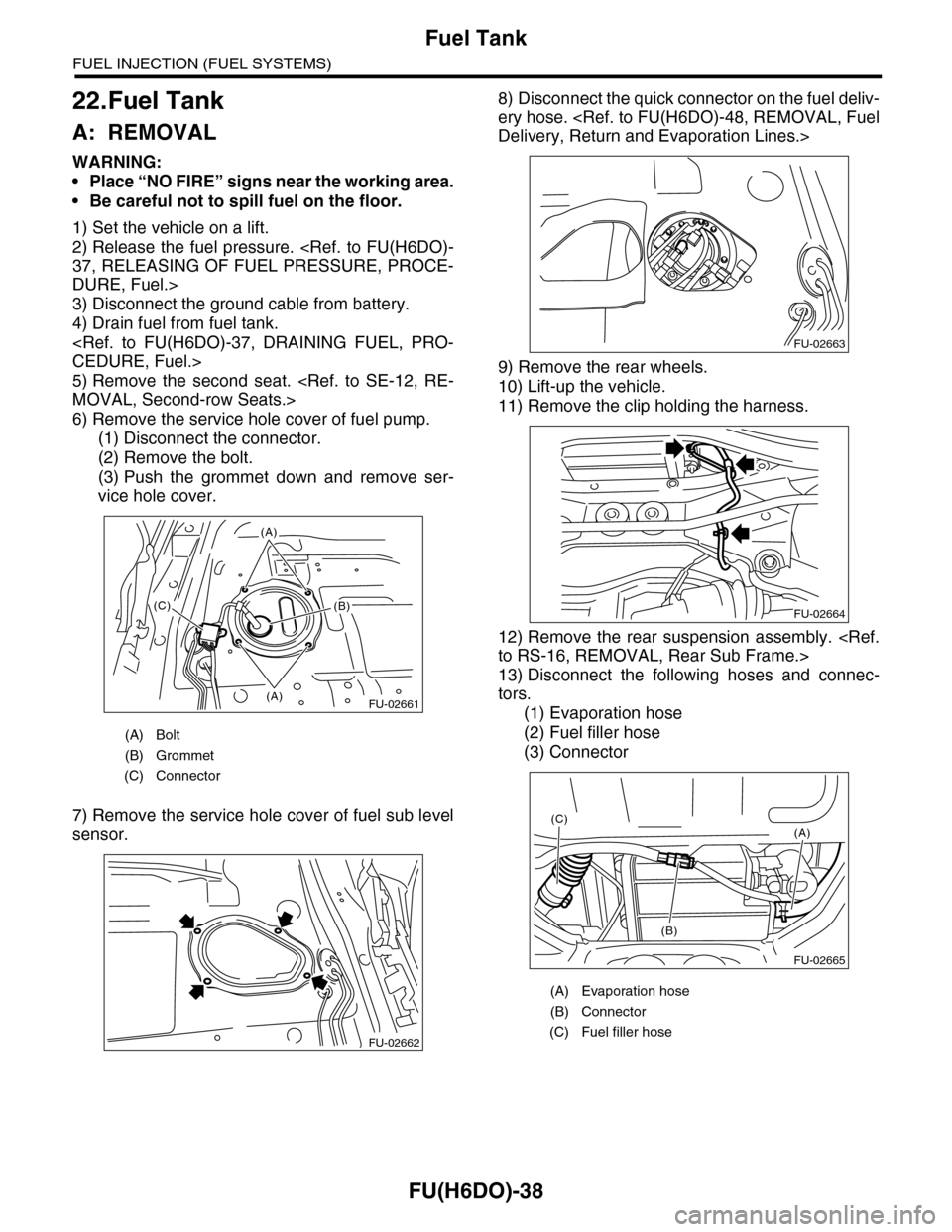
6) Remove the service hole cover of fuel pump.
(1) Disconnect the connector.
(2) Remove the bolt.
(3) Push the grommet down and remove ser-
vice hole cover.
7) Remove the service hole cover of fuel sub level
sensor.
8) Disconnect the quick connector on the fuel deliv-
ery hose.
9) Remove the rear wheels.
10) Lift-up the vehicle.
11) Remove the clip holding the harness.
12) Remove the rear suspension assembly.
13) Disconnect the following hoses and connec-
tors.
(1) Evaporation hose
(2) Fuel filler hose
(3) Connector
(A) Bolt
(B) Grommet
(C) Connector
FU-02661(A)
(A)
(B)(C)
FU-02662
(A) Evaporation hose
(B) Connector
(C) Fuel filler hose
FU-02663
FU-02664
FU-02665
(A)
(B)
(C)
Page 1604 of 2453
FU(H6DO)-43
Fuel Pump
FUEL INJECTION (FUEL SYSTEMS)
24.Fuel Pump
A: REMOVAL
WARNING:
•Place “NO FIRE” signs near the working area.
•Be careful not to spill fuel on the floor.
NOTE:
Fuel pump assembly consists of fuel pump and fuel
level sensor.
1) Release the fuel pressure.
DURE, Fuel.>
2) Drain fuel.
3) Remove the second seat.
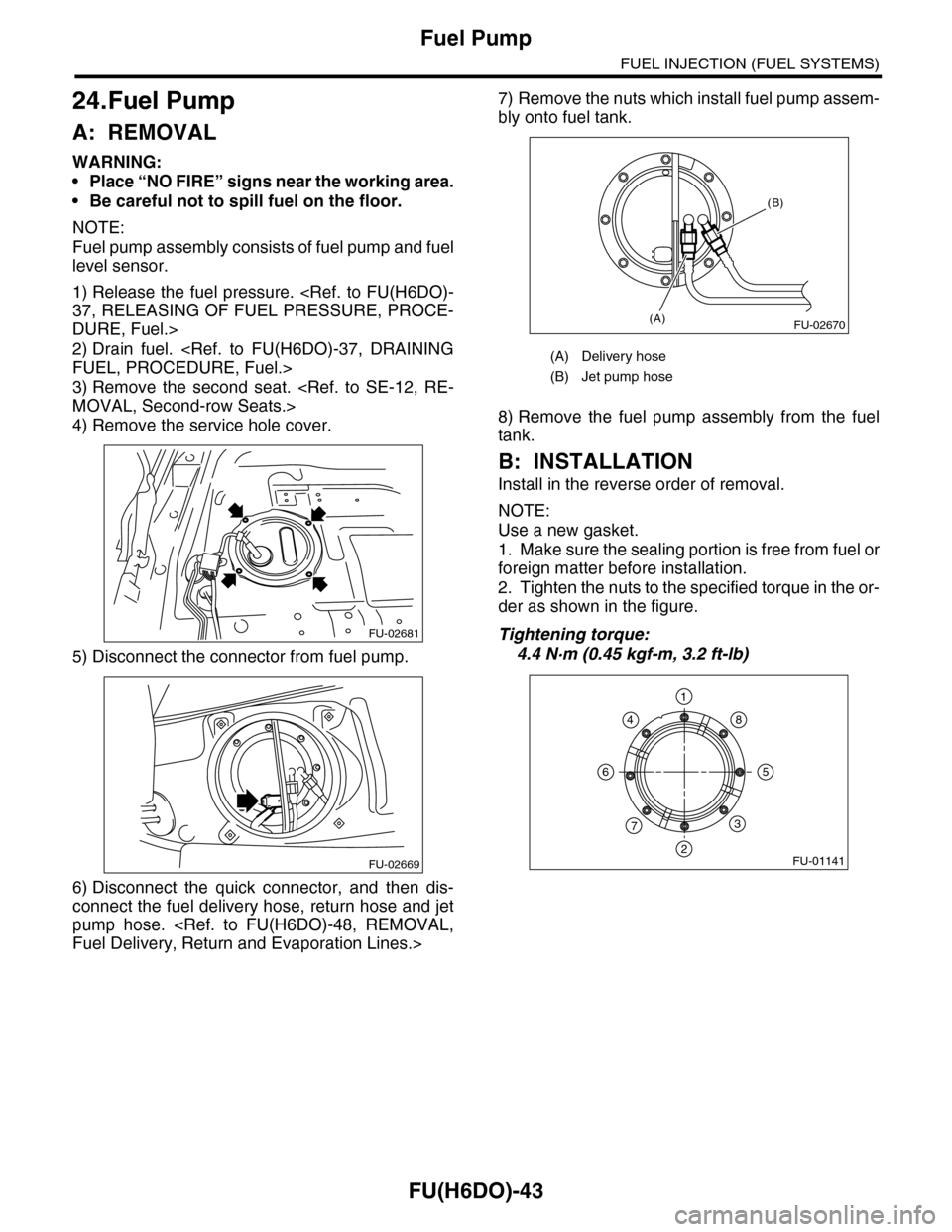
4) Remove the service hole cover.
5) Disconnect the connector from fuel pump.
6) Disconnect the quick connector, and then dis-
connect the fuel delivery hose, return hose and jet
pump hose.
7) Remove the nuts which install fuel pump assem-
bly onto fuel tank.
8) Remove the fuel pump assembly from the fuel
tank.
B: INSTALLATION
Install in the reverse order of removal.
NOTE:
Use a new gasket.
1. Make sure the sealing portion is free from fuel or
foreign matter before installation.
2. Tighten the nuts to the specified torque in the or-
der as shown in the figure.
Tightening torque:
4.4 N·m (0.45 kgf-m, 3.2 ft-lb)
FU-02681
FU-02669
(A) Delivery hose
(B) Jet pump hose
FU-02670(A)
(B)
FU-01141
1
2
3
4
56
7
8
Page 1607 of 2453
FU(H6DO)-46
Fuel Sub Level Sensor
FUEL INJECTION (FUEL SYSTEMS)
26.Fuel Sub Level Sensor
A: REMOVAL
WARNING:
•Place “NO FIRE” signs near the working area.
•Be careful not to spill fuel on the floor.
1) Drain fuel.
2) Remove the second seat.
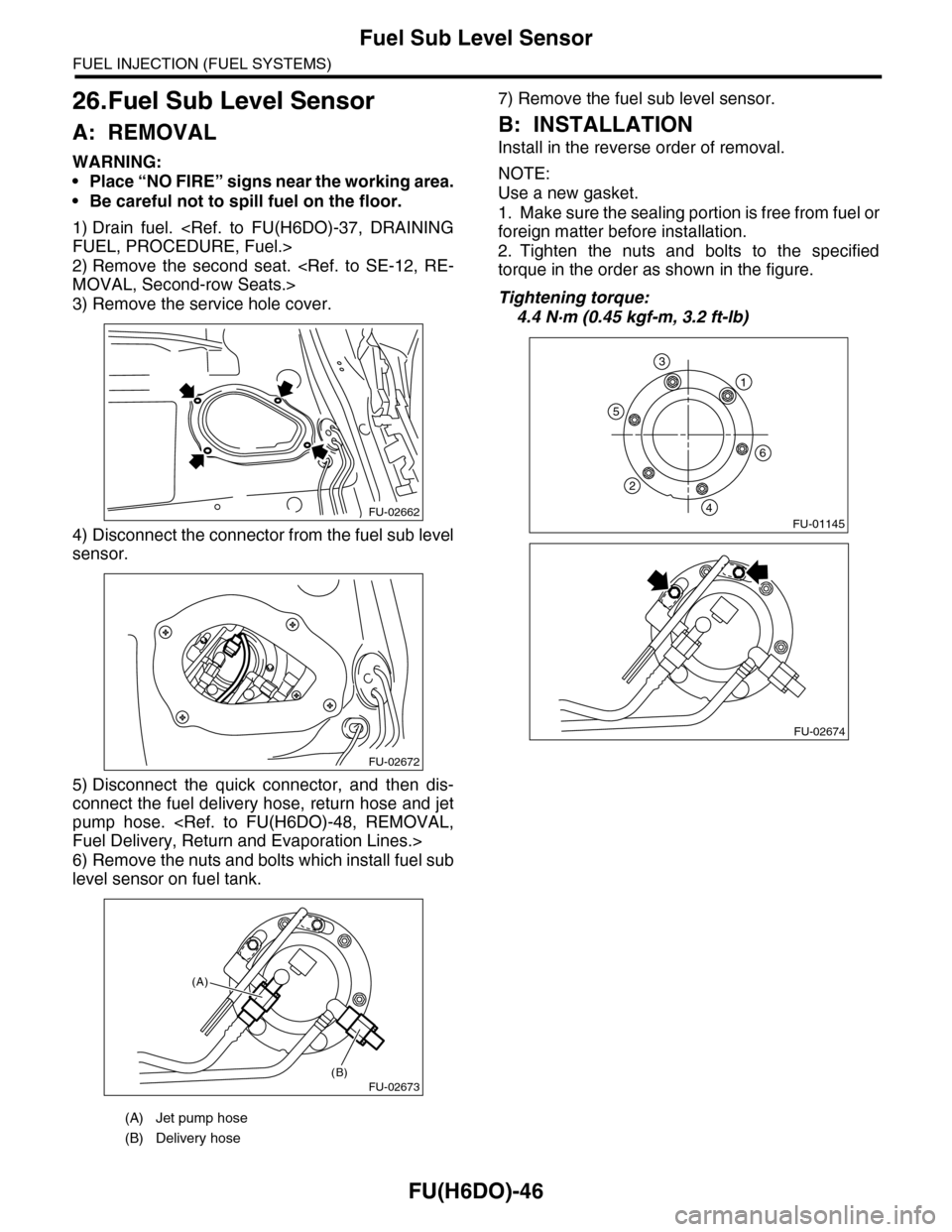
3) Remove the service hole cover.
4) Disconnect the connector from the fuel sub level
sensor.
5) Disconnect the quick connector, and then dis-
connect the fuel delivery hose, return hose and jet
pump hose.
6) Remove the nuts and bolts which install fuel sub
level sensor on fuel tank.
7) Remove the fuel sub level sensor.
B: INSTALLATION
Install in the reverse order of removal.
NOTE:
Use a new gasket.
1. Make sure the sealing portion is free from fuel or
foreign matter before installation.
2. Tighten the nuts and bolts to the specified
torque in the order as shown in the figure.
Tightening torque:
4.4 N·m (0.45 kgf-m, 3.2 ft-lb)
(A) Jet pump hose
(B) Delivery hose
FU-02662
FU-02672
FU-02673(B)
(A)
FU-01145
1
6
5
2
4
3
FU-02674
Page 1880 of 2453
ME(H6DO)-14
General Description
MECHANICAL
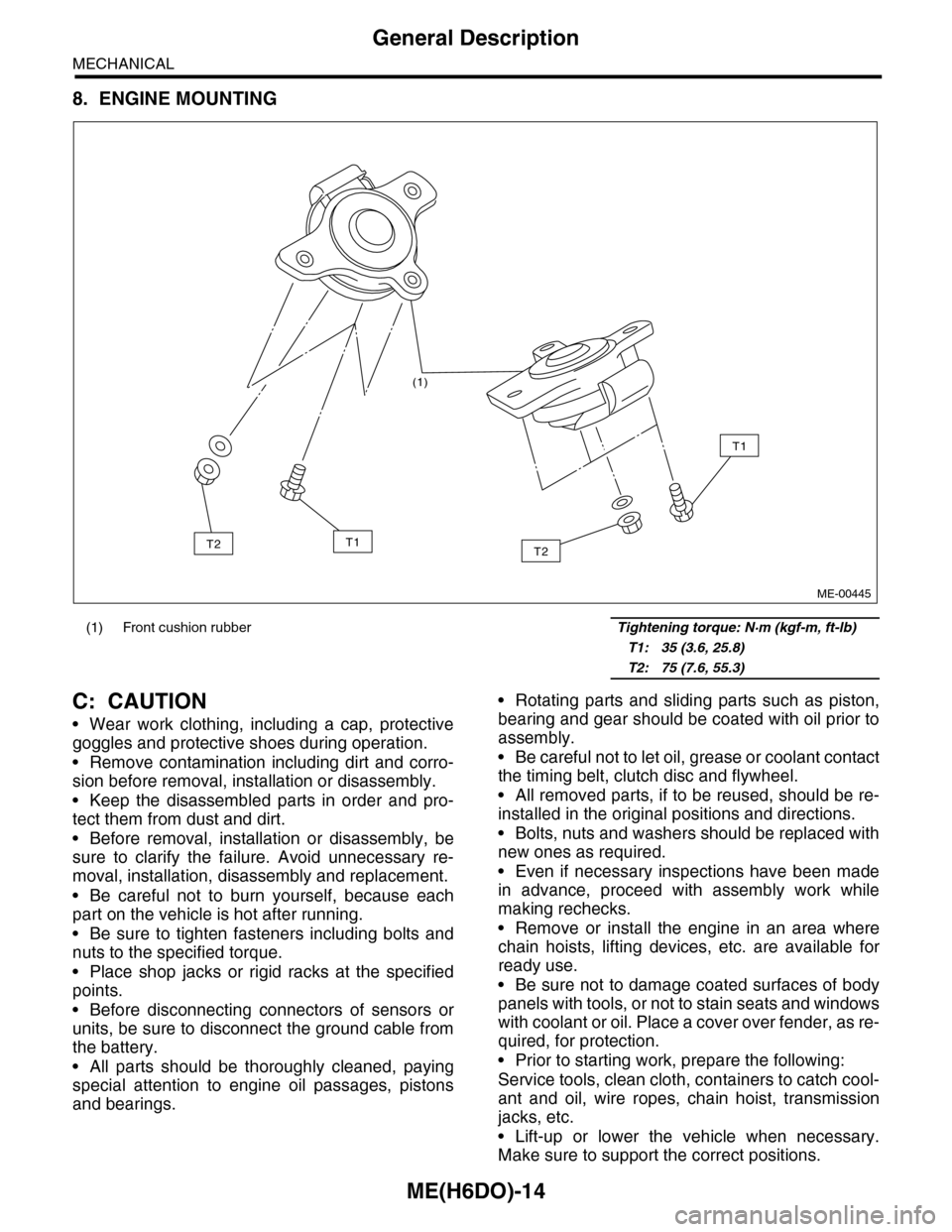
8. ENGINE MOUNTING
C: CAUTION
•Wear work clothing, including a cap, protective
goggles and protective shoes during operation.
•Remove contamination including dirt and corro-
sion before removal, installation or disassembly.
•Keep the disassembled parts in order and pro-
tect them from dust and dirt.
•Before removal, installation or disassembly, be
sure to clarify the failure. Avoid unnecessary re-
moval, installation, disassembly and replacement.
•Be careful not to burn yourself, because each
part on the vehicle is hot after running.
•Be sure to tighten fasteners including bolts and
nuts to the specified torque.
•Place shop jacks or rigid racks at the specified
points.
•Before disconnecting connectors of sensors or
units, be sure to disconnect the ground cable from
the battery.
•All parts should be thoroughly cleaned, paying
special attention to engine oil passages, pistons
and bearings.
•Rotating parts and sliding parts such as piston,
bearing and gear should be coated with oil prior to
assembly.
•Be careful not to let oil, grease or coolant contact
the timing belt, clutch disc and flywheel.
•All removed parts, if to be reused, should be re-
installed in the original positions and directions.
•Bolts, nuts and washers should be replaced with
new ones as required.
•Even if necessary inspections have been made
in advance, proceed with assembly work while
making rechecks.
•Remove or install the engine in an area where
chain hoists, lifting devices, etc. are available for
ready use.
•Be sure not to damage coated surfaces of body
panels with tools, or not to stain seats and windows
with coolant or oil. Place a cover over fender, as re-
quired, for protection.
•Prior to starting work, prepare the following:
Service tools, clean cloth, containers to catch cool-
ant and oil, wire ropes, chain hoist, transmission
jacks, etc.
•Lift-up or lower the vehicle when necessary.
Make sure to support the correct positions.
(1) Front cushion rubber Tightening torque: N·m (kgf-m, ft-lb)
T1: 35 (3.6, 25.8)
T2: 75 (7.6, 55.3)
(1)
T2
T1
T1T2
ME-00445
Page 1925 of 2453

ME(H6DO)-59
Cylinder Head
MECHANICAL
3) Measure the flatness of the cylinder head sur-
face that mates with crankcase using a straight
edge (A) and thickness gauge (B).
Flatness:
Standard
0.02 mm (0.0008 in)
Standard height of cylinder head:
124±0.05 mm (4.88±0.0020 in)
NOTE:
Uneven torque for the cylinder head nuts can
cause warping. When reinstalling, pay special at-
tention to the torque so as to tighten evenly.
2. VALVE SEAT
Inspect the intake and exhaust valve seats, and
correct the contact surfaces with a valve seat cutter
if they are defective or when valve guides are re-
placed.
Valve seat width W:
Intake
Standard
1.0 mm (0.039 in)
Exhaust
Standard
1.5 mm (0.059 in)
3. VALVE GUIDE
1) Check the clearance between valve guide and
stem. The clearance can be checked by measuring
respectively the outer diameter of valve stem and
inner diameter of valve guide with a micrometer.
Clearance between the valve guide and valve
stem:
Standard
Intake
0.030 — 0.057 mm (0.0012 — 0.0022 in)
Exhaust
0.040 — 0.067 mm (0.0016 — 0.0026 in)
2) If the clearance between valve guide and stem
exceeds the standard, replace the valve guide or
valve itself whichever shows greater amount of
wear or damaged and etc. See the following proce-
dure for valve guide replacement.
Valve guide inner diameter:
5.500 — 5.512 mm (0.2165 — 0.2170 in
Valve stem outer diameters:
Intake
5.455 — 5.470 mm (0.2148 — 0.2154 in)
Exhaust
5.445 — 5.460 mm (0.2144 — 0.2150 in)
(1) Place the cylinder head on ST1 with the
combustion chamber upward so that valve
guides fit the holes in ST1.
(2) Insert the ST2 into valve guide and press it
down to remove the valve guide.
ST1 18250AA010 CYLINDER HEAD TABLE
ST2 499765700 VALVE GUIDE REMOVER
(A)
(B)
ME-00551
ME-00127
WME-00553