light SUBARU TRIBECA 2009 1.G Service Workshop Manual
[x] Cancel search | Manufacturer: SUBARU, Model Year: 2009, Model line: TRIBECA, Model: SUBARU TRIBECA 2009 1.GPages: 2453, PDF Size: 46.32 MB
Page 2272 of 2453
CS-20
Select Lever
CONTROL SYSTEMS
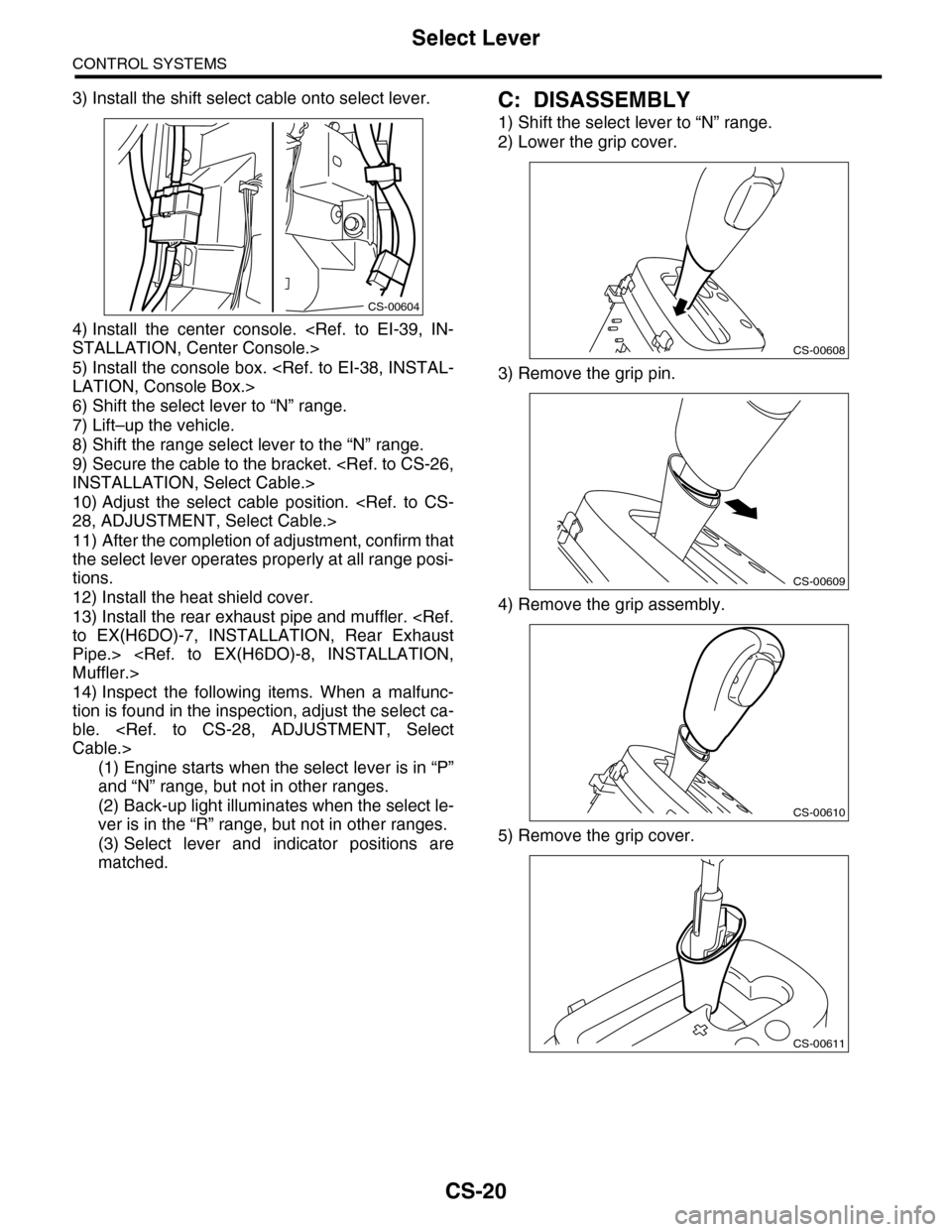
3) Install the shift select cable onto select lever.
4) Install the center console.
5) Install the console box.
6) Shift the select lever to “N” range.
7) Lift–up the vehicle.
8) Shift the range select lever to the “N” range.
9) Secure the cable to the bracket.
10) Adjust the select cable position.
11) After the completion of adjustment, confirm that
the select lever operates properly at all range posi-
tions.
12) Install the heat shield cover.
13) Install the rear exhaust pipe and muffler.
Pipe.>
14) Inspect the following items. When a malfunc-
tion is found in the inspection, adjust the select ca-
ble.
(1) Engine starts when the select lever is in “P”
and “N” range, but not in other ranges.
(2) Back-up light illuminates when the select le-
ver is in the “R” range, but not in other ranges.
(3) Select lever and indicator positions are
matched.
C: DISASSEMBLY
1) Shift the select lever to “N” range.
2) Lower the grip cover.
3) Remove the grip pin.
4) Remove the grip assembly.
5) Remove the grip cover.
CS-00604
CS-00608
CS-00609
CS-00610
CS-00611
Page 2279 of 2453
CS-27
Select Cable
CONTROL SYSTEMS
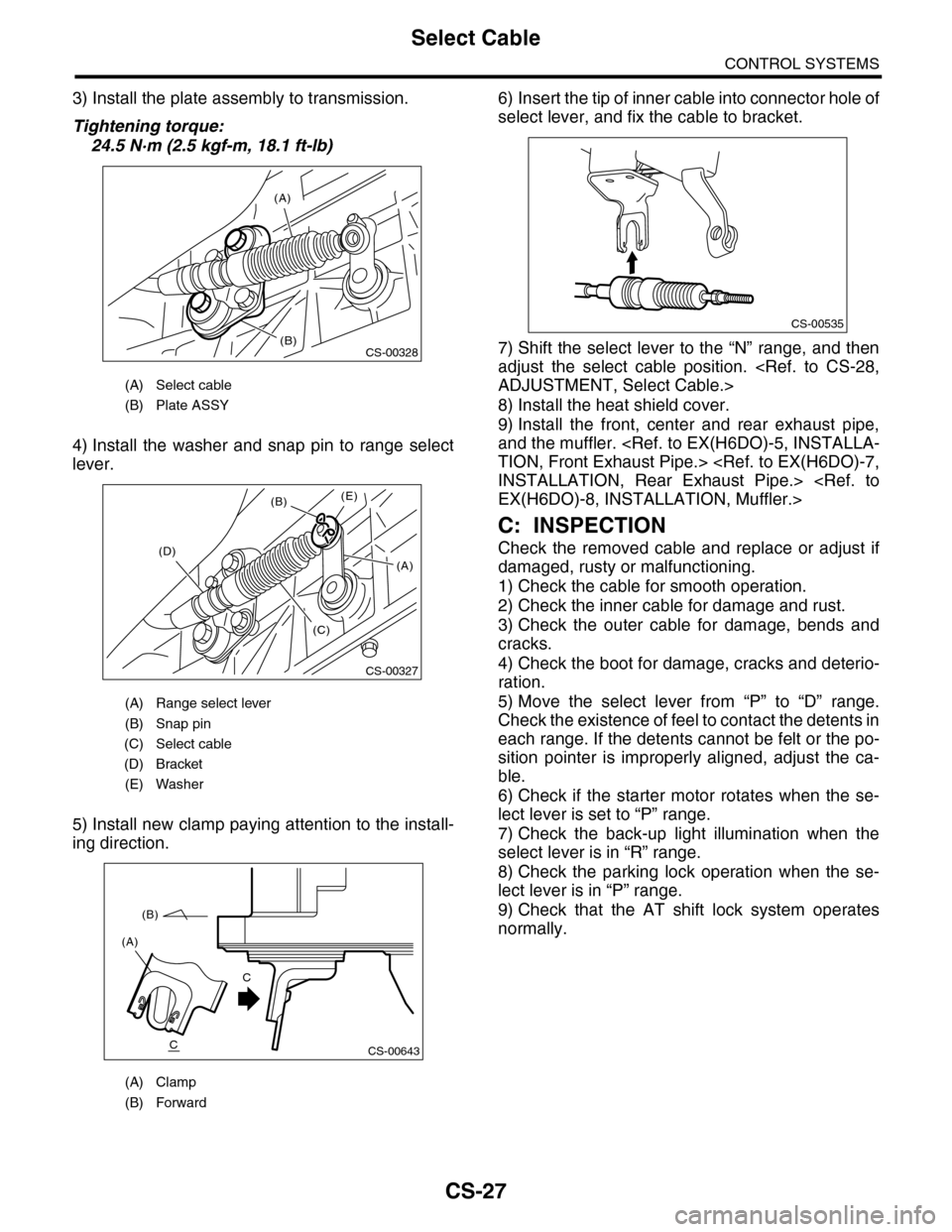
3) Install the plate assembly to transmission.
Tightening torque:
24.5 N·m (2.5 kgf-m, 18.1 ft-lb)
4) Install the washer and snap pin to range select
lever.
5) Install new clamp paying attention to the install-
ing direction.
6) Insert the tip of inner cable into connector hole of
select lever, and fix the cable to bracket.
7) Shift the select lever to the “N” range, and then
adjust the select cable position.
8) Install the heat shield cover.
9) Install the front, center and rear exhaust pipe,
and the muffler.
C: INSPECTION
Check the removed cable and replace or adjust if
damaged, rusty or malfunctioning.
1) Check the cable for smooth operation.
2) Check the inner cable for damage and rust.
3) Check the outer cable for damage, bends and
cracks.
4) Check the boot for damage, cracks and deterio-
ration.
5) Move the select lever from “P” to “D” range.
Check the existence of feel to contact the detents in
each range. If the detents cannot be felt or the po-
sition pointer is improperly aligned, adjust the ca-
ble.
6) Check if the starter motor rotates when the se-
lect lever is set to “P” range.
7) Check the back-up light illumination when the
select lever is in “R” range.
8) Check the parking lock operation when the se-
lect lever is in “P” range.
9) Check that the AT shift lock system operates
normally.
(A) Select cable
(B) Plate ASSY
(A) Range select lever
(B) Snap pin
(C) Select cable
(D) Bracket
(E) Washer
(A) Clamp
(B) Forward
(A)
(B)CS-00328
CS-00327
(B)
(D)
(C)
(E)
(A)
CS-00643
(A)
(B)
C
C
CS-00535
Page 2285 of 2453
CS-33
General Diagnostic Table
CONTROL SYSTEMS
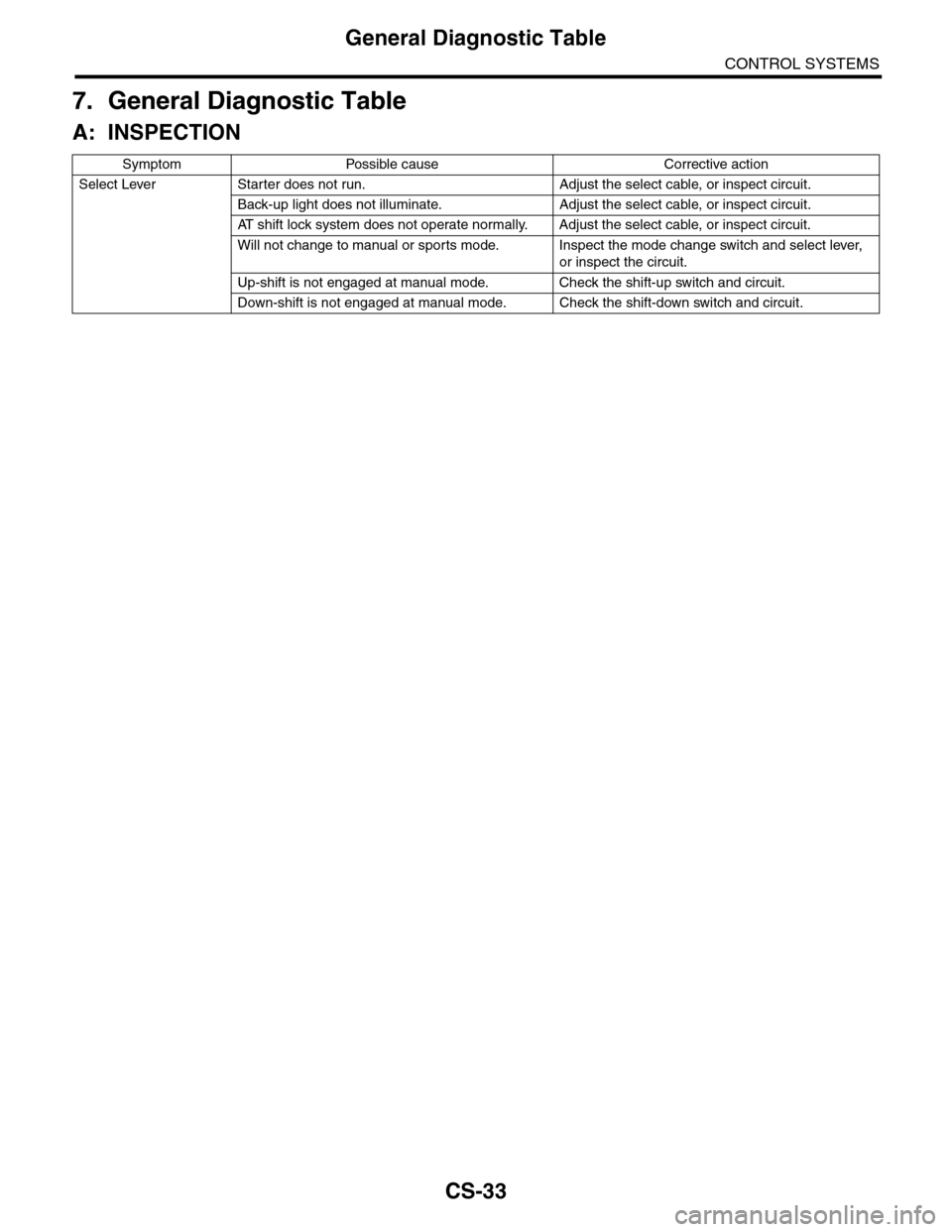
7. General Diagnostic Table
A: INSPECTION
Symptom Possible cause Corrective action
Select Lever Starter does not run. Adjust the select cable, or inspect circuit.
Back-up light does not illuminate. Adjust the select cable, or inspect circuit.
AT s h i f t l o c k s y s t e m d o e s n o t o p e r a t e n o r m a l l y. A d j u s t t h e s e l e c t c a b l e , o r i n s p e c t c i r c u i t .
Will not change to manual or sports mode. Inspect the mode change switch and select lever,
or inspect the circuit.
Up-shift is not engaged at manual mode. Check the shift-up switch and circuit.
Down-shift is not engaged at manual mode. Check the shift-down switch and circuit.
Page 2287 of 2453
WI-3
Basic Diagnostic Procedure
WIRING SYSTEM
1. Basic Diagnostic Procedure
A: BASIC PROCEDURES
1. GENERAL DESCRIPTION
The most important purpose of diagnostics is to
quickly determine which part is malfunctioning, to
save time and labor.
2. IDENTIFICATION OF TROUBLE SYMP-
TOM
Determine what the problem is based on the symp-
tom.
3. PROBABLE CAUSE OF TROUBLE
Look at the wiring diagram and check the system’s
circuit. Then check the switch, relay, fuse, ground,
etc.
4. LOCATION AND REPAIR OF TROUBLE
1) Using the diagnostics, narrow down the causes.
2) If necessary, use a voltmeter, ohmmeter, etc.
3) Before replacing certain component parts
(switch, relay, etc.), check the power supply,
ground, for open wiring harness, poor connectors,
etc. If no problem is encountered, check the com-
ponent parts.
5. SYSTEM OPERATION CHECK
After repairing, ensure that the system operates
properly.
B: BASIC INSPECTION
1. VOLTAGE MEASUREMENT
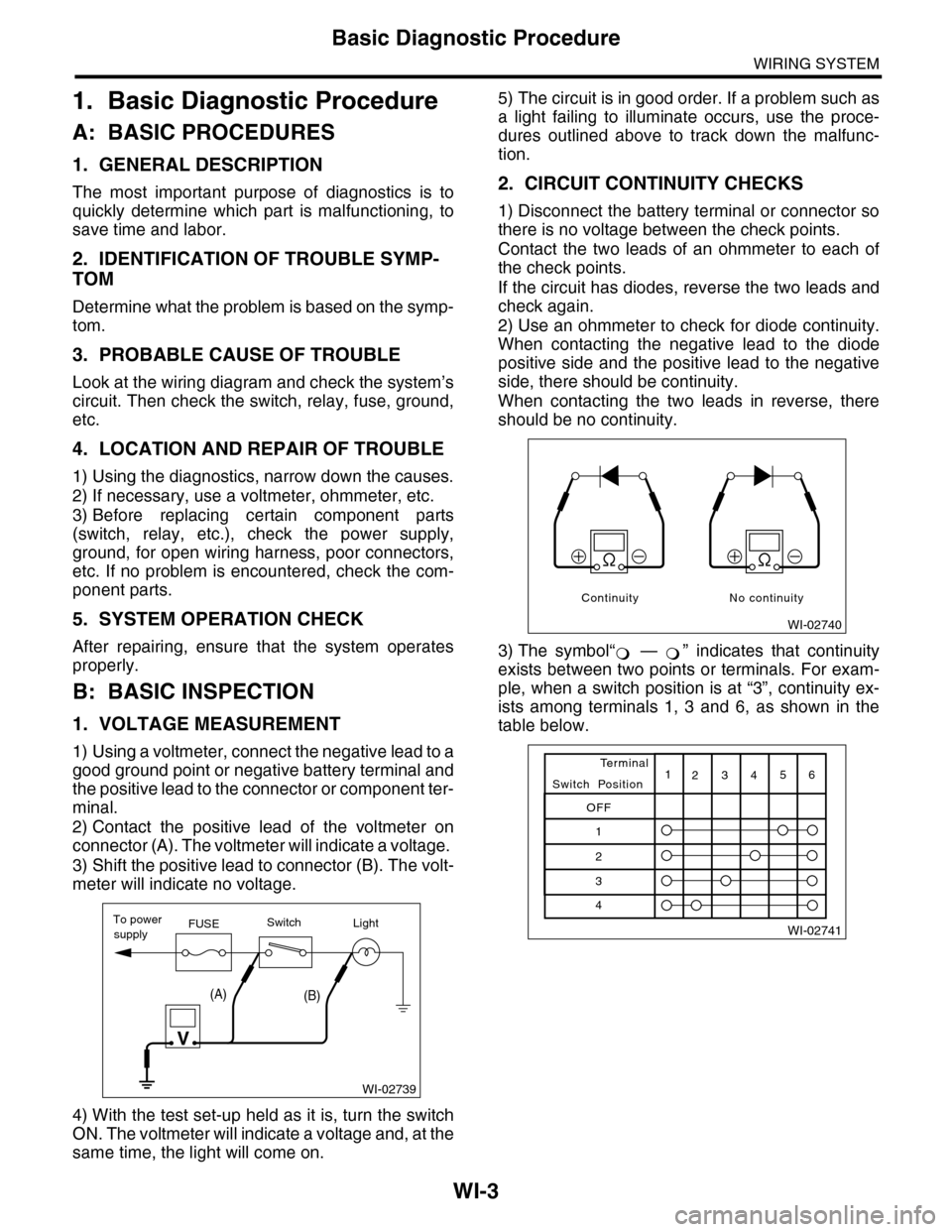
1) Using a voltmeter, connect the negative lead to a
good ground point or negative battery terminal and
the positive lead to the connector or component ter-
minal.
2) Contact the positive lead of the voltmeter on
connector (A). The voltmeter will indicate a voltage.
3) Shift the positive lead to connector (B). The volt-
meter will indicate no voltage.
4) With the test set-up held as it is, turn the switch
ON. The voltmeter will indicate a voltage and, at the
same time, the light will come on.
5) The circuit is in good order. If a problem such as
a light failing to illuminate occurs, use the proce-
dures outlined above to track down the malfunc-
tion.
2. CIRCUIT CONTINUITY CHECKS
1) Disconnect the battery terminal or connector so
there is no voltage between the check points.
Contact the two leads of an ohmmeter to each of
the check points.
If the circuit has diodes, reverse the two leads and
check again.
2) Use an ohmmeter to check for diode continuity.
When contacting the negative lead to the diode
positive side and the positive lead to the negative
side, there should be continuity.
When contacting the two leads in reverse, there
should be no continuity.
3) The symbol“ — ” indicates that continuity
exists between two points or terminals. For exam-
ple, when a switch position is at “3”, continuity ex-
ists among terminals 1, 3 and 6, as shown in the
table below.
WI-02739
To powerFUSEsupplySwitchLight
V
(A)(B)
WI-02740
Continuity No continuity
Page 2288 of 2453
WI-4
Basic Diagnostic Procedure
WIRING SYSTEM
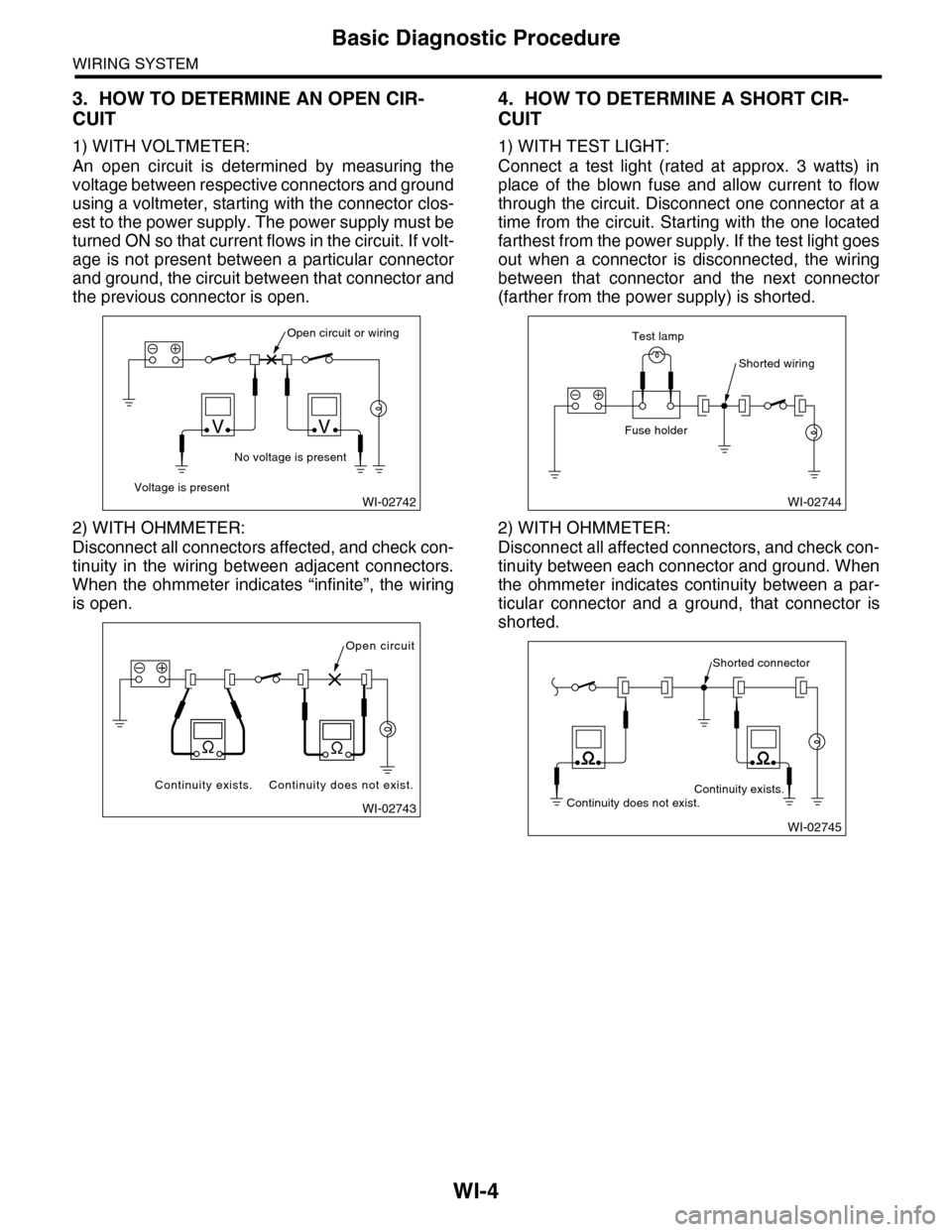
3. HOW TO DETERMINE AN OPEN CIR-
CUIT
1) WITH VOLTMETER:
An open circuit is determined by measuring the
voltage between respective connectors and ground
using a voltmeter, starting with the connector clos-
est to the power supply. The power supply must be
turned ON so that current flows in the circuit. If volt-
age is not present between a particular connector
and ground, the circuit between that connector and
the previous connector is open.
2) WITH OHMMETER:
Disconnect all connectors affected, and check con-
tinuity in the wiring between adjacent connectors.
When the ohmmeter indicates “infinite”, the wiring
is open.
4. HOW TO DETERMINE A SHORT CIR-
CUIT
1) WITH TEST LIGHT:
Connect a test light (rated at approx. 3 watts) in
place of the blown fuse and allow current to flow
through the circuit. Disconnect one connector at a
time from the circuit. Starting with the one located
farthest from the power supply. If the test light goes
out when a connector is disconnected, the wiring
between that connector and the next connector
(farther from the power supply) is shorted.
2) WITH OHMMETER:
Disconnect all affected connectors, and check con-
tinuity between each connector and ground. When
the ohmmeter indicates continuity between a par-
ticular connector and a ground, that connector is
shorted.
WI-02742
Open circuit or wiring
No voltage is present
Voltage is present
VV
WI-02743
Open circuit
Continuity does not exist.Continuity exists.
WI-02744
Shorted wiring
Test lamp
Fuse holder
WI-02745
Shorted connector
Continuity does not exist.Continuity exists.
Page 2290 of 2453
WI-6
Basic Diagnostic Procedure
WIRING SYSTEM
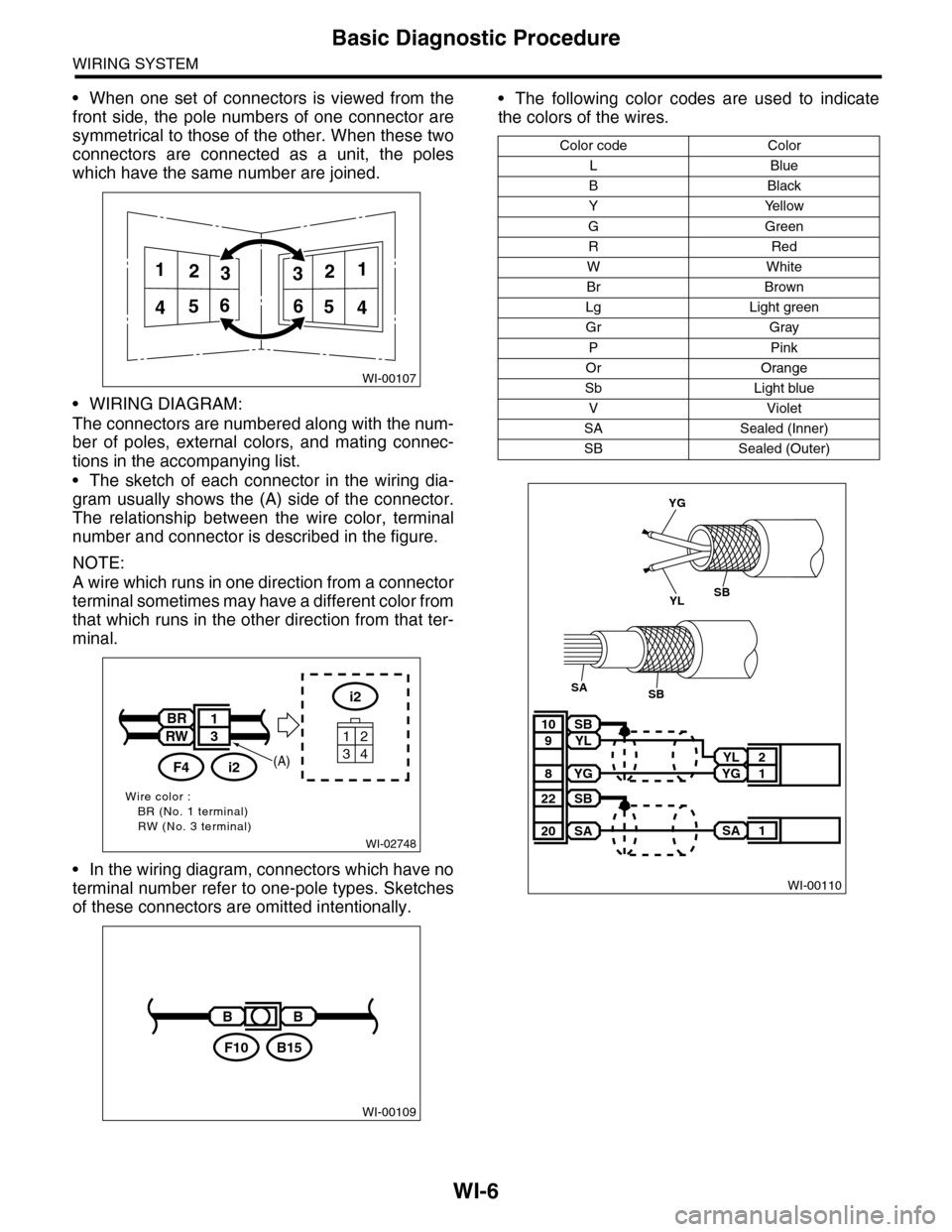
•When one set of connectors is viewed from the
front side, the pole numbers of one connector are
symmetrical to those of the other. When these two
connectors are connected as a unit, the poles
which have the same number are joined.
•WIRING DIAGRAM:
The connectors are numbered along with the num-
ber of poles, external colors, and mating connec-
tions in the accompanying list.
•The sketch of each connector in the wiring dia-
gram usually shows the (A) side of the connector.
The relationship between the wire color, terminal
number and connector is described in the figure.
NOTE:
A wire which runs in one direction from a connector
terminal sometimes may have a different color from
that which runs in the other direction from that ter-
minal.
•In the wiring diagram, connectors which have no
terminal number refer to one-pole types. Sketches
of these connectors are omitted intentionally.
•The following color codes are used to indicate
the colors of the wires.
WI-00107
112233
445566
WI-02748
Wire color :BR (No. 1 terminal)RW (No. 3 terminal)
i2
34
12
BR
RW
i2F4
1
3
(A)
WI-00109
BB
B15F10
Color code Color
LBlue
BBlack
YYellow
GGreen
RRed
WWhite
Br Brown
Lg Light green
Gr Gray
PPink
Or Orange
Sb Light blue
VViolet
SA Sealed (Inner)
SB Sealed (Outer)
WI-00110
YL 2
YG 1
SB10
YL9
YG8
SA 1
SB22
SA20
YG
YLSB
SBSA
Page 2293 of 2453
WI-9
Basic Diagnostic Procedure
WIRING SYSTEM
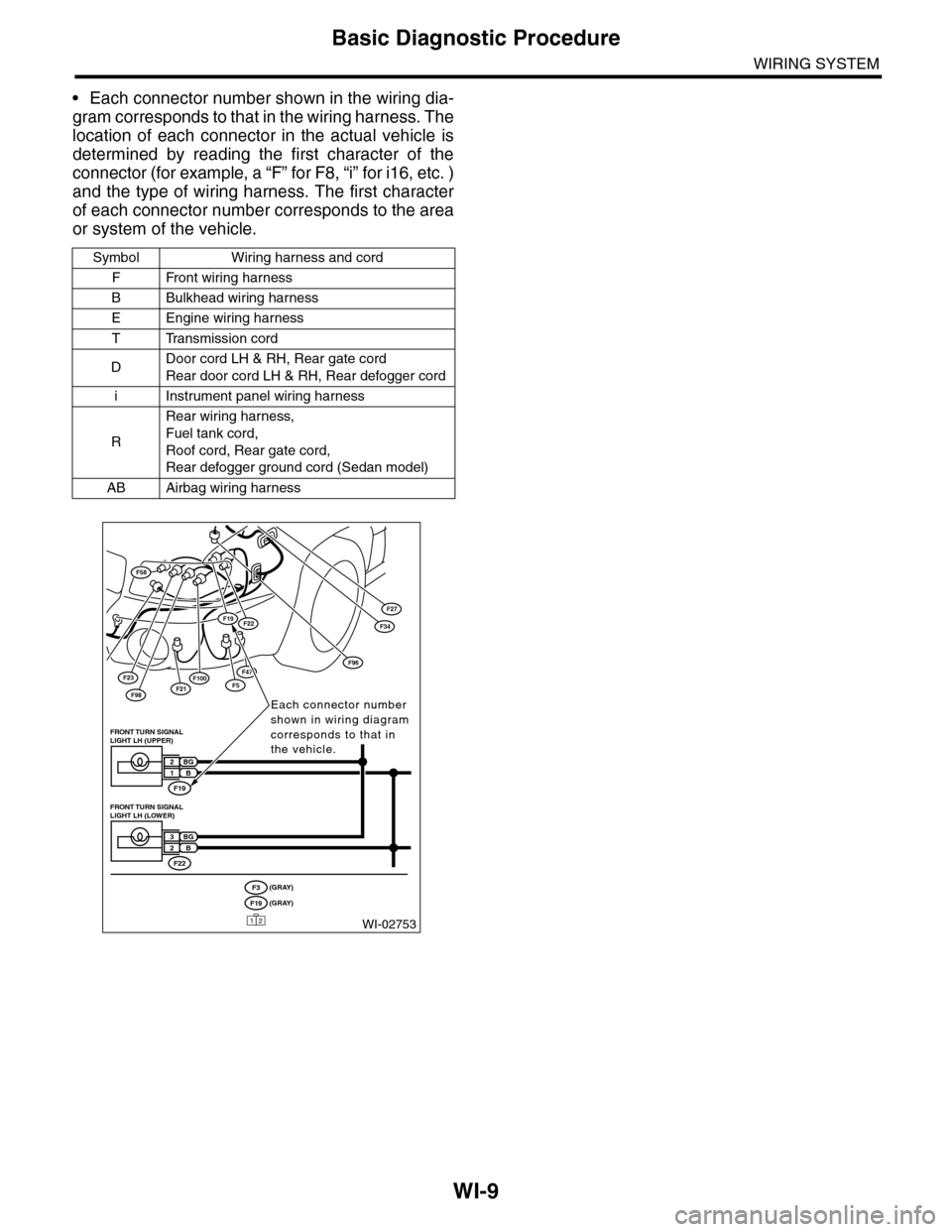
•Each connector number shown in the wiring dia-
gram corresponds to that in the wiring harness. The
location of each connector in the actual vehicle is
determined by reading the first character of the
connector (for example, a “F” for F8, “i” for i16, etc. )
and the type of wiring harness. The first character
of each connector number corresponds to the area
or system of the vehicle.
Symbol Wiring harness and cord
FFront wiring harness
BBulkhead wiring harness
EEngine wiring harness
TTransmission cord
DDoor cord LH & RH, Rear gate cord
Rear door cord LH & RH, Rear defogger cord
iInstrument panel wiring harness
R
Rear wiring harness,
Fuel tank cord,
Roof cord, Rear gate cord,
Rear defogger ground cord (Sedan model)
AB Airbag wiring harness
F23
F98F21
F58
F100F5
F27
F47
F34F19F22
F96
WI-02753
Each connector number shown in wiring diagram corresponds to that in the vehicle.
F19
FRONT TURN SIGNAL LIGHT LH (UPPER)
BG2B1
F22
FRONT TURN SIGNAL LIGHT LH (LOWER)
BG3B2
(GRAY)F3(GRAY)F19
12
Page 2294 of 2453
WI-10
Basic Diagnostic Procedure
WIRING SYSTEM
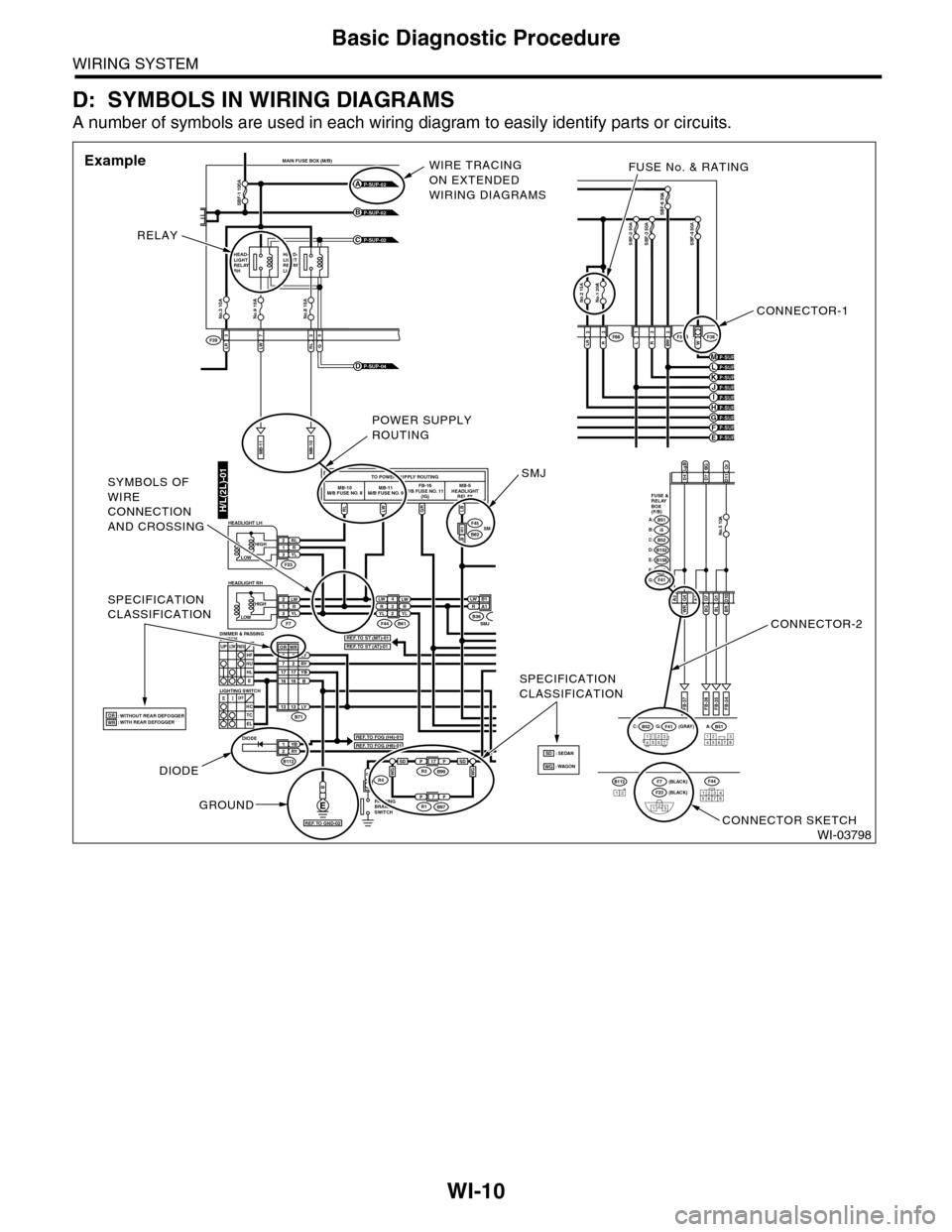
D: SYMBOLS IN WIRING DIAGRAMS
A number of symbols are used in each wiring diagram to easily identify parts or circuits.
WI-03798
LRLWRL3725
MAIN FUSE BOX (M/B)
MB-11MB-10
F39
P-SUP-02B
P-SUP-02A
P-SUP-02C
No.3 10ANo.9 15ANo.8 15A
SBF-1 100A
HEAD-LIGHTRELAYRH
HEAD-LIGHTRELAYLH
G
P-SUP-04D
H/L(2L)-01RLLWGRLB
TO POWER SUPPLY ROUTINGMB-10M/B FUSE NO. 8MB-11M/B FUSE NO. 9FB-16F/B FUSE NO. 11(IG)MB-5HEADLIGHTRELAY
LW 4R3YLLWRYL2
YB1RY2
LW2R1YL3
P
LW B 1RA1
F44
F45
F23
F7B61
B62
B
RL2R1YL3
B71
B112
LY8RY7YBB1716
3
1716
UPLOWPA S SHFHUHLE
SMJLB H1
B36SMJ
DIODE
: WITHOUT REAR DEFOGGER: WITH REAR DEFOGGER
PA R K I N GBRAKESWITCH
R4
OFFHCTCEL
LOWHIGH
HEADLIGHT RH
HEADLIGHT LH
LIGHTING SWITCH
DIMMER & PASSINGSWITCH
LOWHIGH
B51A:B52C:F41G: (GRAY)
(BLACK)(BLACK)
FB-37
D4D7BGD11
A2WR G4BLG1BR D10
FB-35FB-34
123456712345678
LgBOr
FUSE &RELAYBOX(F/B)
i5B:B51A:
B152D:B52C:
B158E:
F41G:F40F:
FB-36
A3BGG7
No.5 10A
P-SUP-03H
P-SUP-03F
P-SUP-04KP-SUP-04J
No.1 20ANo.2 15A
SBF-6 30A
LR2R3L1R3BW 2W
SBF-2 50ASBF-3 50ASBF-4 50A
F36F38F68
P-SUP-04E
P-SUP-04MP-SUP-04L
P-SUP-03I
P-SUP-04G
12345678
F44B11212F23
123
F7
SPECIFICATIONCLASSIFICATION
SPECIFICATIONCLASSIFICATION
2
LY1313
WROR
ORWRREF. TO FOG (H4)-01
REF. TO ST (MT)-01REF. TO ST (AT)-01
REF. TO FOG (H6)-01
REF. TO GND-02
CONNECTOR-1
FUSE No. & RATING
CONNECTOR-2
CONNECTOR SKETCH
RELAY
WIRE TRACINGON EXTENDEDWIRING DIAGRAMS
Example
DIODE
GROUND
POWER SUPPLYROUTING
SMJSYMBOLS OFWIRECONNECTIONAND CROSSING
PP17R3B99
PP7R1B97
WGWGSDSD: WAGON: SEDANSDWG
Page 2297 of 2453
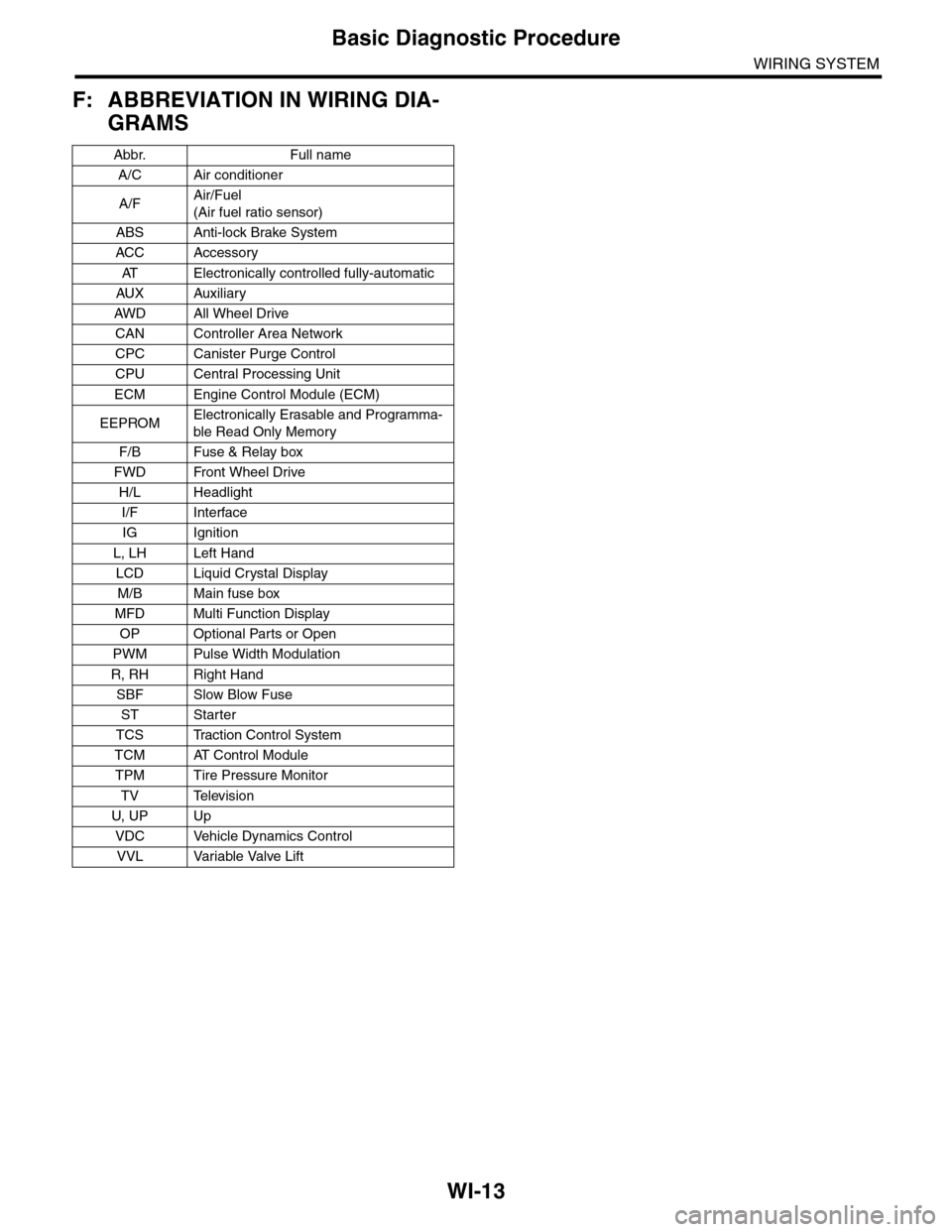
WI-13
Basic Diagnostic Procedure
WIRING SYSTEM
F: ABBREVIATION IN WIRING DIA-
GRAMS
Abbr. Full name
A/C Air conditioner
A/FAir/Fuel
(Air fuel ratio sensor)
ABS Anti-lock Brake System
ACC Accessor y
AT E l e c t r o n i c a l l y c o n t r o l l e d f u l l y - a u t o m a t i c
AUX Auxiliar y
AW D A ll W he e l D r i ve
CAN Controller Area Network
CPC Canister Purge Control
CPU Central Processing Unit
ECM Engine Control Module (ECM)
EEPROMElectronically Erasable and Programma-
ble Read Only Memory
F/B Fuse & Relay box
FWD Front Wheel Drive
H/L Headlight
I/F Interface
IG Ignition
L, LH Left Hand
LCD Liquid Crystal Display
M/B Main fuse box
MFD Multi Function Display
OP Optional Parts or Open
PWM Pulse Width Modulation
R, RH Right Hand
SBF Slow Blow Fuse
ST Starter
TCS Traction Control System
TCM AT Control Module
TPM Tire Pressure Monitor
TV Television
U, UP Up
VDC Vehicle Dynamics Control
VVL Variable Valve Lift
Page 2301 of 2453
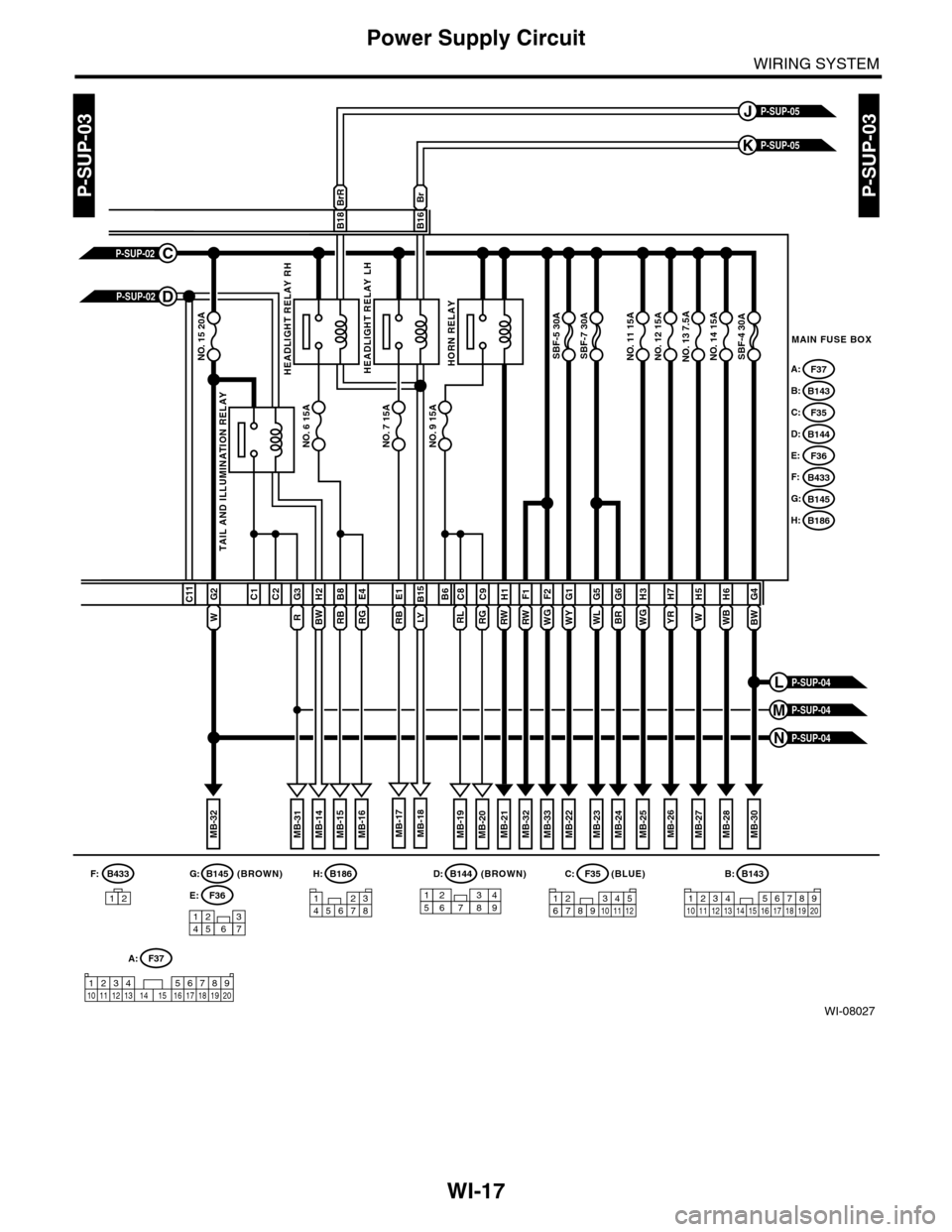
WI-17
Power Supply Circuit
WIRING SYSTEM
WI-08027
P-SUP-03P-SUP-03
WB
H6
W
H5G4
MAIN FUSE BOX
P-SUP-05K
P-SUP-05J
NO. 14 15ANO. 13 7.5ANO. 12 15ANO. 11 15ANO. 15 20A
NO. 6 15A
SBF-4 30ASBF-7 30ASBF-5 30A
BWWG
H3
BR
G6H7
YRWY
G1G5F2F1
WL
BrBrR
B18B16
B145G:B186H:(BROWN)B144D:(BLUE)F35C:
123456781234567891011121234 567891011 12 13 1415 16 17 18 19 20
B:B143
NO. 7 15ANO. 9 15A
TAIL AND ILLUMINATION RELAY
F37A:
B143B:
F35C:
B144D:
F36E:
B433F:
B145G:
B186H:
RW
H1B6
RL
C8
RG
C9B15
RB
E1C1C2
R
G3H2
RB
B8
RG
E4
W
G2C11
1234567
157628349
P-SUP-02C
P-SUP-02D
MB-21MB-22MB-26MB-25MB-24MB-33MB-27MB-32MB-28MB-19MB-14MB-23MB-32
WGRW
MB-31MB-18MB-17MB-16MB-15MB-20MB-30
P-SUP-04N
P-SUP-04M
P-SUP-04L
HEADLIGHT RELAY RHHEADLIGHT RELAY LHHORN RELAY
LYBW
F36E:
A:F37
1234 5678910 11 12 13 14 15 16 17 18 19 20
(BROWN)B433
12
F: