Ecm SUBARU TRIBECA 2009 1.G Service Repair Manual
[x] Cancel search | Manufacturer: SUBARU, Model Year: 2009, Model line: TRIBECA, Model: SUBARU TRIBECA 2009 1.GPages: 2453, PDF Size: 46.32 MB
Page 517 of 2453
LAN(diag)-61
Diagnostic Procedure with Diagnostic Trouble Code (DTC)
LAN SYSTEM (DIAGNOSTICS)
P: DTC B0223 CAN-HS VDC/ABS NO-RECEIVE DATA
DTC DETECTING CONDITION:
Defective VDC CM. (If error is in the main harness, DTC P0600 High-speed CAN circuit is input at the same
time.)
NOTE:
When more than two DTCs are displayed.
TROUBLE SYMPTOM:
•ABS warning light and VDC warning light come on.
•“Er HC” is displayed in odo/trip meter.
•P0600 (ECM) and C1718 (TCM) are output.
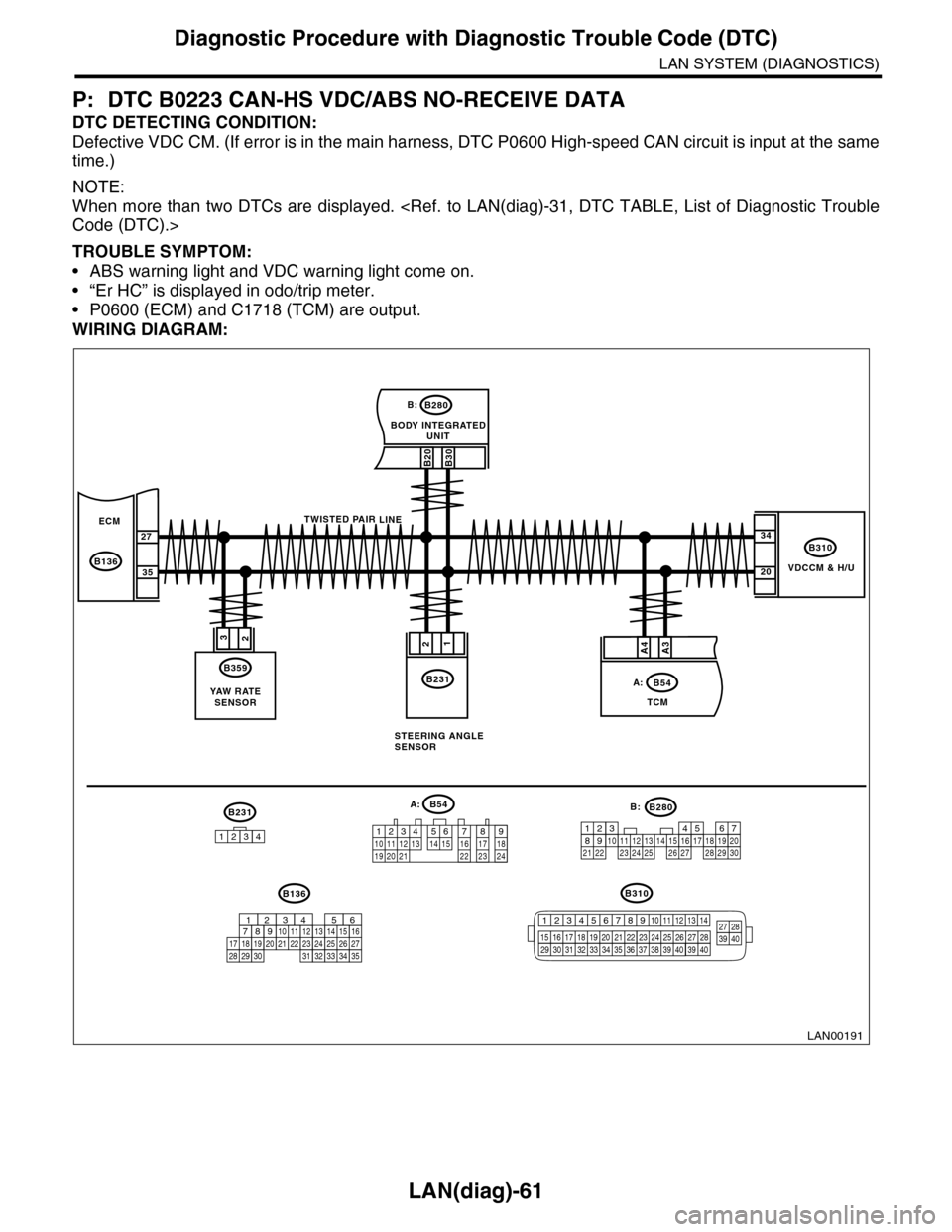
WIRING DIAGRAM:
VDCCM & H/U
B310
B20B30
BODY INTEGRATEDUNIT
B280B:
TCM
B54A:
23
B359
YAW R AT ESENSOR
34
20
B231
21
STEERING ANGLESENSOR
B231
1234
B54A:
12 7 8 9563410 11 1219 20 2113 14 15 16 17 1822 23 24
B136B310
B280B:
5467821931022 23111213141524 25 26 2716171828 29192021 30
ECM
B136
27
35
A3A4
TWISTED PAIR LINE
12345678910 11 12 13 14
15 16 17 18 19 2021 22 23 24 25 26 27 2829 30 31 32 33 3435 36 37 38 39403940
27 28394016101112131415252430
9871718192028212223293231
123456
2726333435
LAN00191
Page 522 of 2453
LAN(diag)-66
Diagnostic Procedure with Diagnostic Trouble Code (DTC)
LAN SYSTEM (DIAGNOSTICS)
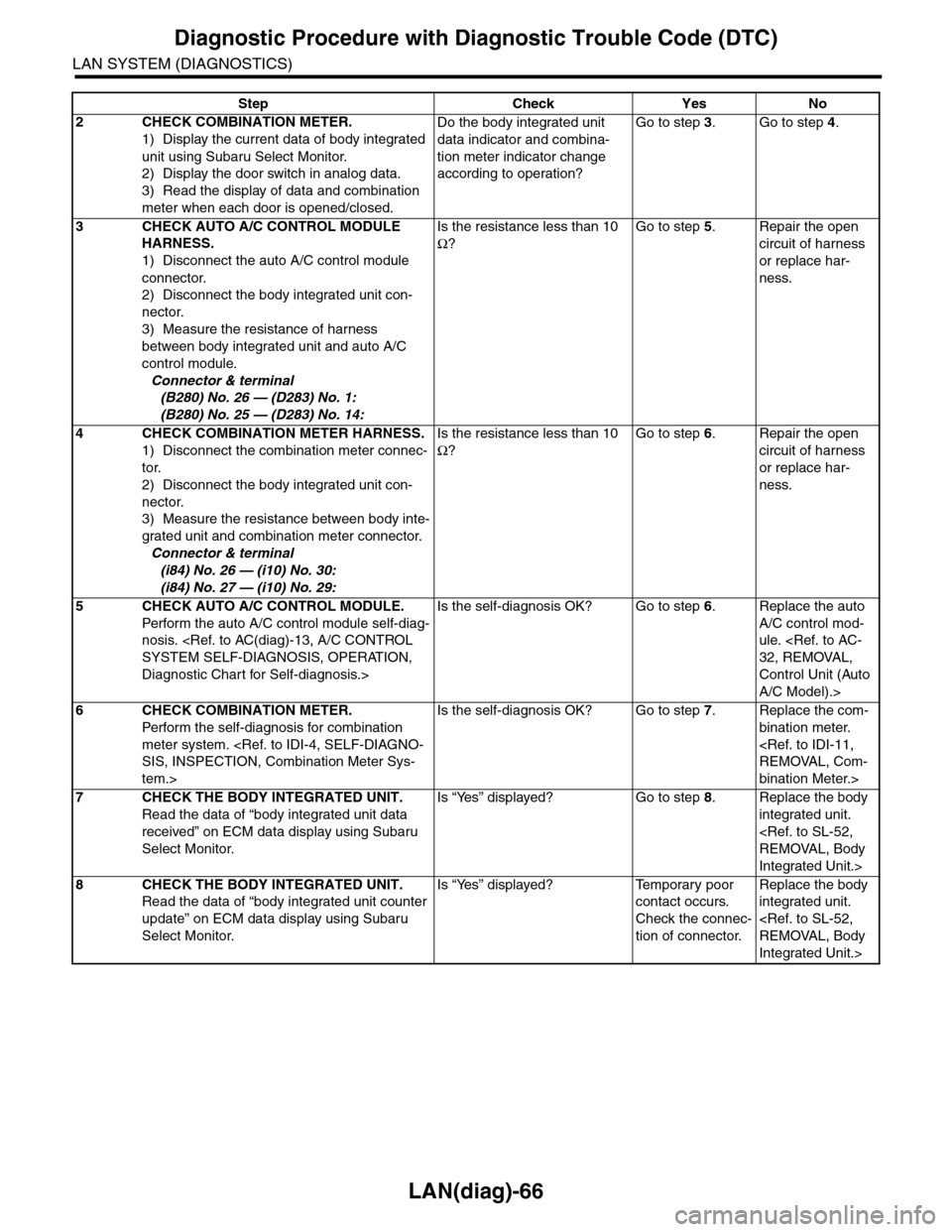
2CHECK COMBINATION METER.
1) Display the current data of body integrated
unit using Subaru Select Monitor.
2) Display the door switch in analog data.
3) Read the display of data and combination
meter when each door is opened/closed.
Do the body integrated unit
data indicator and combina-
tion meter indicator change
according to operation?
Go to step 3.Go to step 4.
3CHECK AUTO A/C CONTROL MODULE
HARNESS.
1) Disconnect the auto A/C control module
connector.
2) Disconnect the body integrated unit con-
nector.
3) Measure the resistance of harness
between body integrated unit and auto A/C
control module.
Connector & terminal
(B280) No. 26 — (D283) No. 1:
(B280) No. 25 — (D283) No. 14:
Is the resistance less than 10
Ω?
Go to step 5.Repair the open
circuit of harness
or replace har-
ness.
4CHECK COMBINATION METER HARNESS.
1) Disconnect the combination meter connec-
tor.
2) Disconnect the body integrated unit con-
nector.
3) Measure the resistance between body inte-
grated unit and combination meter connector.
Connector & terminal
(i84) No. 26 — (i10) No. 30:
(i84) No. 27 — (i10) No. 29:
Is the resistance less than 10
Ω?
Go to step 6.Repair the open
circuit of harness
or replace har-
ness.
5CHECK AUTO A/C CONTROL MODULE.
Perfor m the auto A/C control module self-diag-
nosis.
Diagnostic Chart for Self-diagnosis.>
Is the self-diagnosis OK? Go to step 6.Replace the auto
A/C control mod-
ule.
Control Unit (Auto
A/C Model).>
6CHECK COMBINATION METER.
Perfor m the self-diagnosis for combination
meter system.
tem.>
Is the self-diagnosis OK? Go to step 7.Replace the com-
bination meter.
bination Meter.>
7CHECK THE BODY INTEGRATED UNIT.
Read the data of “body integrated unit data
received” on ECM data display using Subaru
Select Monitor.
Is “Yes” displayed? Go to step 8.Replace the body
integrated unit.
Integrated Unit.>
8CHECK THE BODY INTEGRATED UNIT.
Read the data of “body integrated unit counter
update” on ECM data display using Subaru
Select Monitor.
Is “Yes” displayed? Temporary poor
contact occurs.
Check the connec-
tion of connector.
Replace the body
integrated unit.
Integrated Unit.>
Step Check Yes No
Page 524 of 2453
LAN(diag)-68
Diagnostic Procedure with Diagnostic Trouble Code (DTC)
LAN SYSTEM (DIAGNOSTICS)
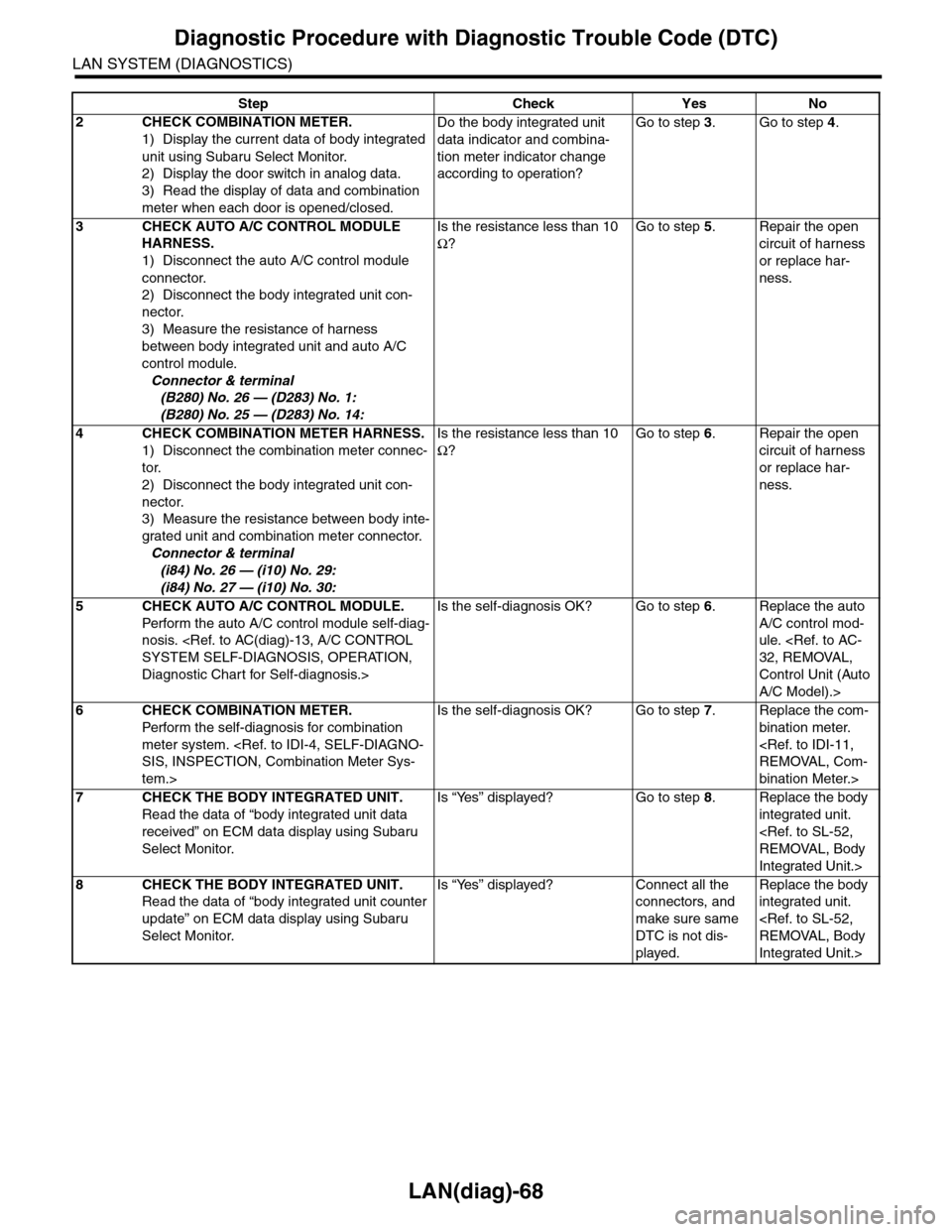
2CHECK COMBINATION METER.
1) Display the current data of body integrated
unit using Subaru Select Monitor.
2) Display the door switch in analog data.
3) Read the display of data and combination
meter when each door is opened/closed.
Do the body integrated unit
data indicator and combina-
tion meter indicator change
according to operation?
Go to step 3.Go to step 4.
3CHECK AUTO A/C CONTROL MODULE
HARNESS.
1) Disconnect the auto A/C control module
connector.
2) Disconnect the body integrated unit con-
nector.
3) Measure the resistance of harness
between body integrated unit and auto A/C
control module.
Connector & terminal
(B280) No. 26 — (D283) No. 1:
(B280) No. 25 — (D283) No. 14:
Is the resistance less than 10
Ω?
Go to step 5.Repair the open
circuit of harness
or replace har-
ness.
4CHECK COMBINATION METER HARNESS.
1) Disconnect the combination meter connec-
tor.
2) Disconnect the body integrated unit con-
nector.
3) Measure the resistance between body inte-
grated unit and combination meter connector.
Connector & terminal
(i84) No. 26 — (i10) No. 29:
(i84) No. 27 — (i10) No. 30:
Is the resistance less than 10
Ω?
Go to step 6.Repair the open
circuit of harness
or replace har-
ness.
5CHECK AUTO A/C CONTROL MODULE.
Perfor m the auto A/C control module self-diag-
nosis.
Diagnostic Chart for Self-diagnosis.>
Is the self-diagnosis OK? Go to step 6.Replace the auto
A/C control mod-
ule.
Control Unit (Auto
A/C Model).>
6CHECK COMBINATION METER.
Perfor m the self-diagnosis for combination
meter system.
tem.>
Is the self-diagnosis OK? Go to step 7.Replace the com-
bination meter.
bination Meter.>
7CHECK THE BODY INTEGRATED UNIT.
Read the data of “body integrated unit data
received” on ECM data display using Subaru
Select Monitor.
Is “Yes” displayed? Go to step 8.Replace the body
integrated unit.
Integrated Unit.>
8CHECK THE BODY INTEGRATED UNIT.
Read the data of “body integrated unit counter
update” on ECM data display using Subaru
Select Monitor.
Is “Yes” displayed? Connect all the
connectors, and
make sure same
DTC is not dis-
played.
Replace the body
integrated unit.
Integrated Unit.>
Step Check Yes No
Page 532 of 2453
LAN(diag)-76
General Diagnostic Table
LAN SYSTEM (DIAGNOSTICS)
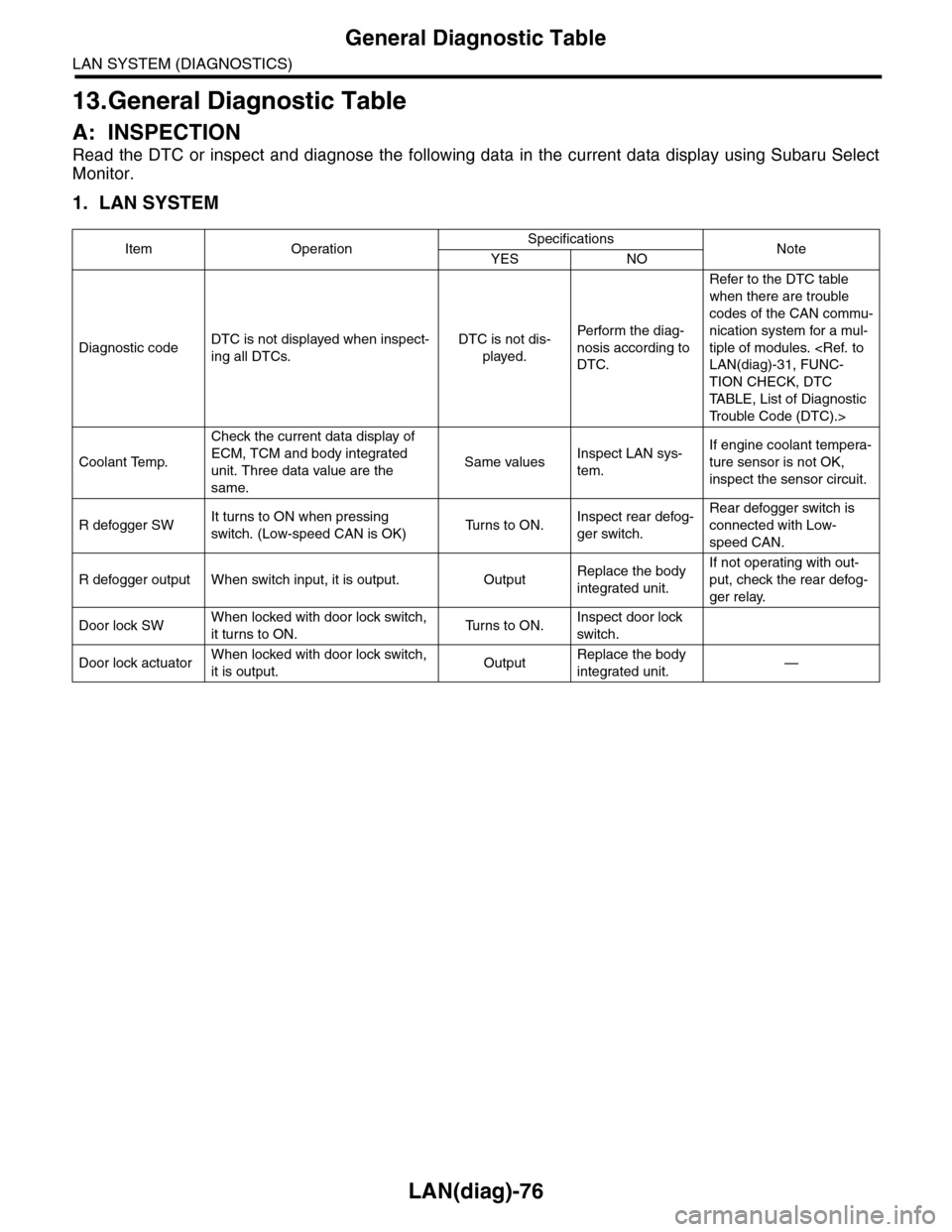
13.General Diagnostic Table
A: INSPECTION
Read the DTC or inspect and diagnose the following data in the current data display using Subaru Select
Monitor.
1. LAN SYSTEM
Item OperationSpecificationsNoteYES NO
Diagnostic codeDTC is not displayed when inspect-
ing all DTCs.
DTC is not dis-
played.
Perfor m the diag-
nosis according to
DTC.
Refer to the DTC table
when there are trouble
codes of the CAN commu-
nication system for a mul-
tiple of modules.
TION CHECK, DTC
TA B L E , L i s t o f D i a g n o s t i c
Tr o u b l e C o d e ( D T C ) . >
Coolant Temp.
Check the current data display of
ECM, TCM and body integrated
unit. Three data value are the
same.
Same valuesInspect LAN sys-
tem.
If engine coolant tempera-
ture sensor is not OK,
inspect the sensor circuit.
R defogger SWIt turns to ON when pressing
switch. (Low-speed CAN is OK)Tu r n s t o O N .Inspect rear defog-
ger switch.
Rear defogger switch is
connected with Low-
speed CAN.
R defogger output When switch input, it is output. OutputReplace the body
integrated unit.
If not operating with out-
put, check the rear defog-
ger relay.
Door lock SWWhen locked with door lock switch,
it turns to ON.Tu r n s t o O N .Inspect door lock
switch.
Door lock actuatorWhen locked with door lock switch,
it is output.OutputReplace the body
integrated unit.—
Page 662 of 2453
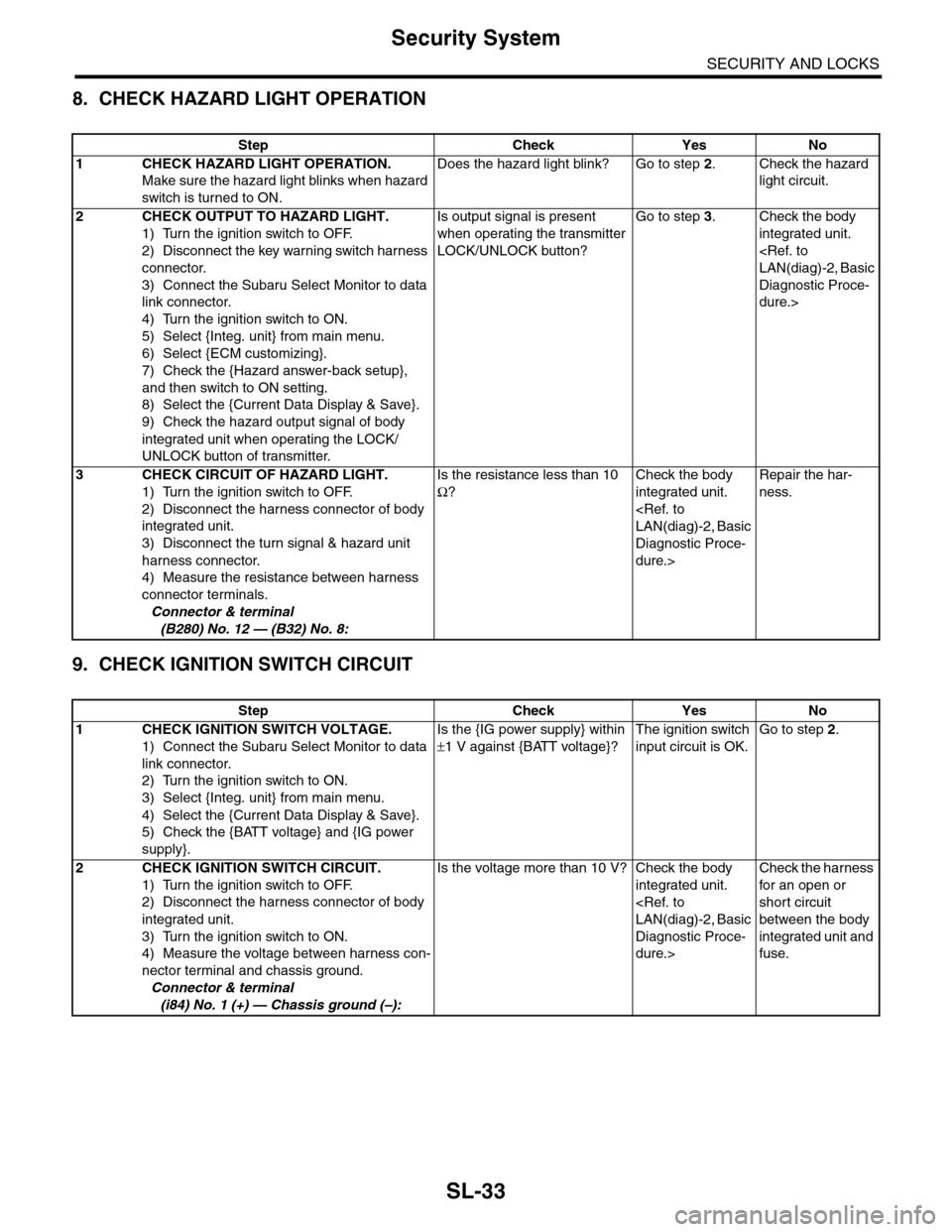
SL-33
Security System
SECURITY AND LOCKS
8. CHECK HAZARD LIGHT OPERATION
9. CHECK IGNITION SWITCH CIRCUIT
Step Check Yes No
1CHECK HAZARD LIGHT OPERATION.
Make sure the hazard light blinks when hazard
switch is turned to ON.
Does the hazard light blink? Go to step 2.Check the hazard
light circuit.
2CHECK OUTPUT TO HAZARD LIGHT.
1) Turn the ignition switch to OFF.
2) Disconnect the key warning switch harness
connector.
3) Connect the Subaru Select Monitor to data
link connector.
4) Turn the ignition switch to ON.
5) Select {Integ. unit} from main menu.
6) Select {ECM customizing}.
7) Check the {Hazard answer-back setup},
and then switch to ON setting.
8) Select the {Current Data Display & Save}.
9) Check the hazard output signal of body
integrated unit when operating the LOCK/
UNLOCK button of transmitter.
Is output signal is present
when operating the transmitter
LOCK/UNLOCK button?
Go to step 3.Check the body
integrated unit.
Diagnostic Proce-
dure.>
3CHECK CIRCUIT OF HAZARD LIGHT.
1) Turn the ignition switch to OFF.
2) Disconnect the harness connector of body
integrated unit.
3) Disconnect the turn signal & hazard unit
harness connector.
4) Measure the resistance between harness
connector terminals.
Connector & terminal
(B280) No. 12 — (B32) No. 8:
Is the resistance less than 10
Ω?
Check the body
integrated unit.
Diagnostic Proce-
dure.>
Repair the har-
ness.
Step Check Yes No
1CHECK IGNITION SWITCH VOLTAGE.
1) Connect the Subaru Select Monitor to data
link connector.
2) Turn the ignition switch to ON.
3) Select {Integ. unit} from main menu.
4) Select the {Current Data Display & Save}.
5) Check the {BATT voltage} and {IG power
supply}.
Is the {IG power supply} within
±1 V against {BATT voltage}?
The ignition switch
input circuit is OK.
Go to step 2.
2 CHECK IGNITION SWITCH CIRCUIT.
1) Turn the ignition switch to OFF.
2) Disconnect the harness connector of body
integrated unit.
3) Turn the ignition switch to ON.
4) Measure the voltage between harness con-
nector terminal and chassis ground.
Connector & terminal
(i84) No. 1 (+) — Chassis ground (–):
Is the voltage more than 10 V? Check the body
integrated unit.
Diagnostic Proce-
dure.>
Check the harness
for an open or
short circuit
between the body
integrated unit and
fuse.
Page 757 of 2453
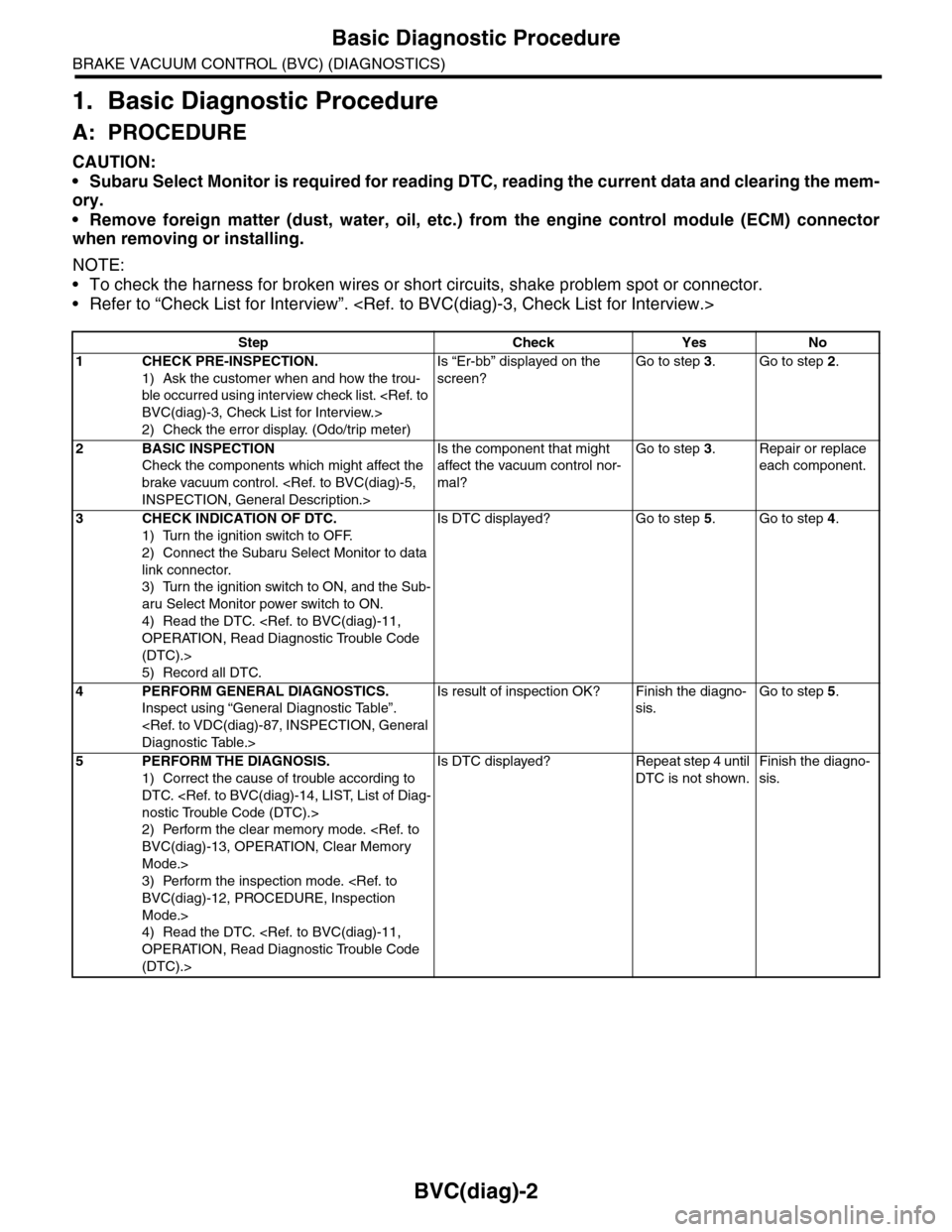
BVC(diag)-2
Basic Diagnostic Procedure
BRAKE VACUUM CONTROL (BVC) (DIAGNOSTICS)
1. Basic Diagnostic Procedure
A: PROCEDURE
CAUTION:
•Subaru Select Monitor is required for reading DTC, reading the current data and clearing the mem-
ory.
•Remove foreign matter (dust, water, oil, etc.) from the engine control module (ECM) connector
when removing or installing.
NOTE:
•To check the harness for broken wires or short circuits, shake problem spot or connector.
•Refer to “Check List for Interview”.
Step Check Yes No
1CHECK PRE-INSPECTION.
1) Ask the customer when and how the trou-
ble occurred using interview check list.
2) Check the error display. (Odo/trip meter)
Is “Er-bb” displayed on the
screen?
Go to step 3.Go to step 2.
2BASIC INSPECTION
Check the components which might affect the
brake vacuum control.
Is the component that might
affect the vacuum control nor-
mal?
Go to step 3.Repair or replace
each component.
3CHECK INDICATION OF DTC.
1) Turn the ignition switch to OFF.
2) Connect the Subaru Select Monitor to data
link connector.
3) Turn the ignition switch to ON, and the Sub-
aru Select Monitor power switch to ON.
4) Read the DTC.
(DTC).>
5) Record all DTC.
Is DTC displayed? Go to step 5.Go to step 4.
4PERFORM GENERAL DIAGNOSTICS.
Inspect using “General Diagnostic Table”.
Is result of inspection OK? Finish the diagno-
sis.
Go to step 5.
5PERFORM THE DIAGNOSIS.
1) Correct the cause of trouble according to
DTC.
2) Perform the clear memory mode.
Mode.>
3) Perform the inspection mode.
Mode.>
4) Read the DTC.
(DTC).>
Is DTC displayed? Repeat step 4 until
DTC is not shown.
Finish the diagno-
sis.
Page 761 of 2453
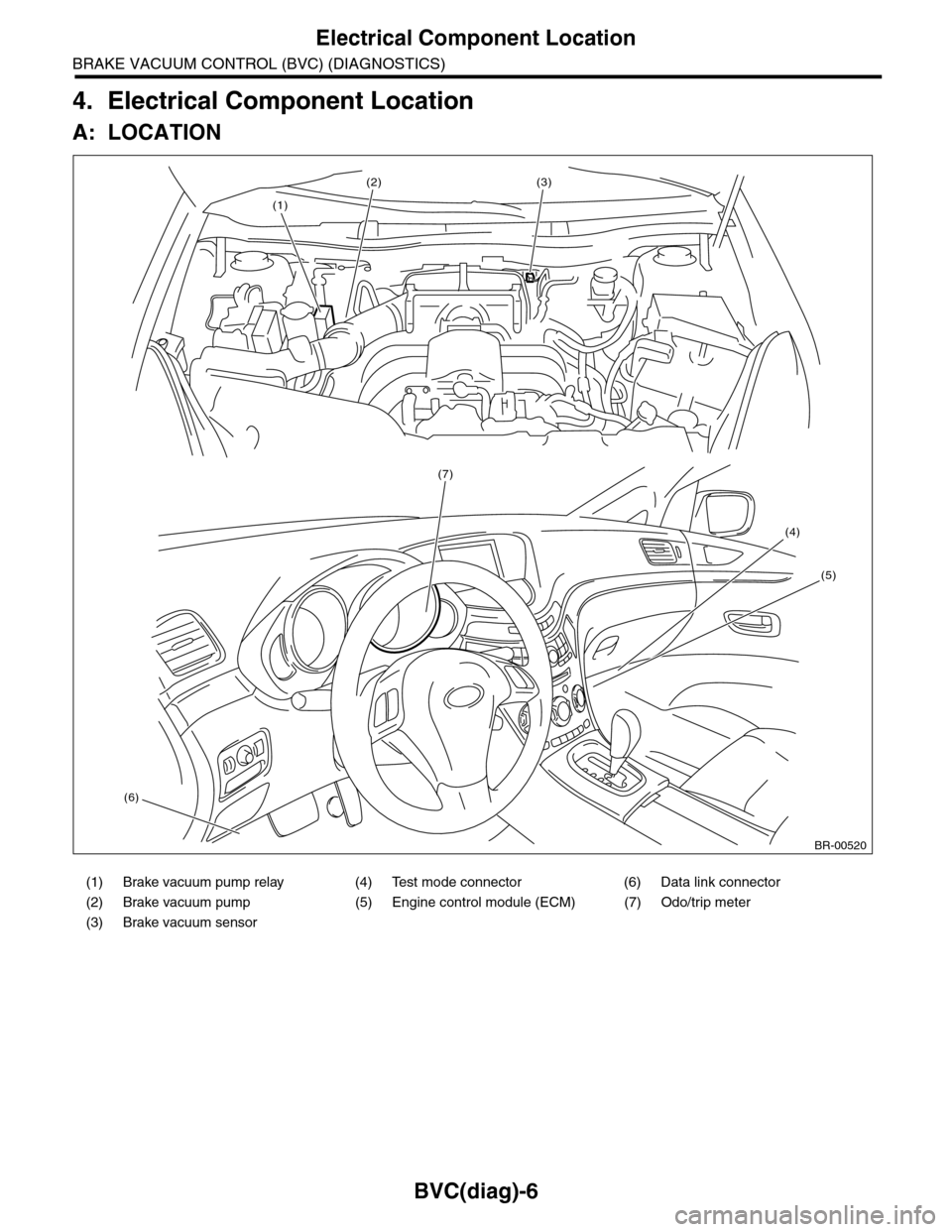
BVC(diag)-6
Electrical Component Location
BRAKE VACUUM CONTROL (BVC) (DIAGNOSTICS)
4. Electrical Component Location
A: LOCATION
(1) Brake vacuum pump relay (4) Test mode connector (6) Data link connector
(2) Brake vacuum pump (5) Engine control module (ECM) (7) Odo/trip meter
(3) Brake vacuum sensor
BR-00520
(1)
(2)(3)
(7)
(4)
(5)
(6)
Page 763 of 2453
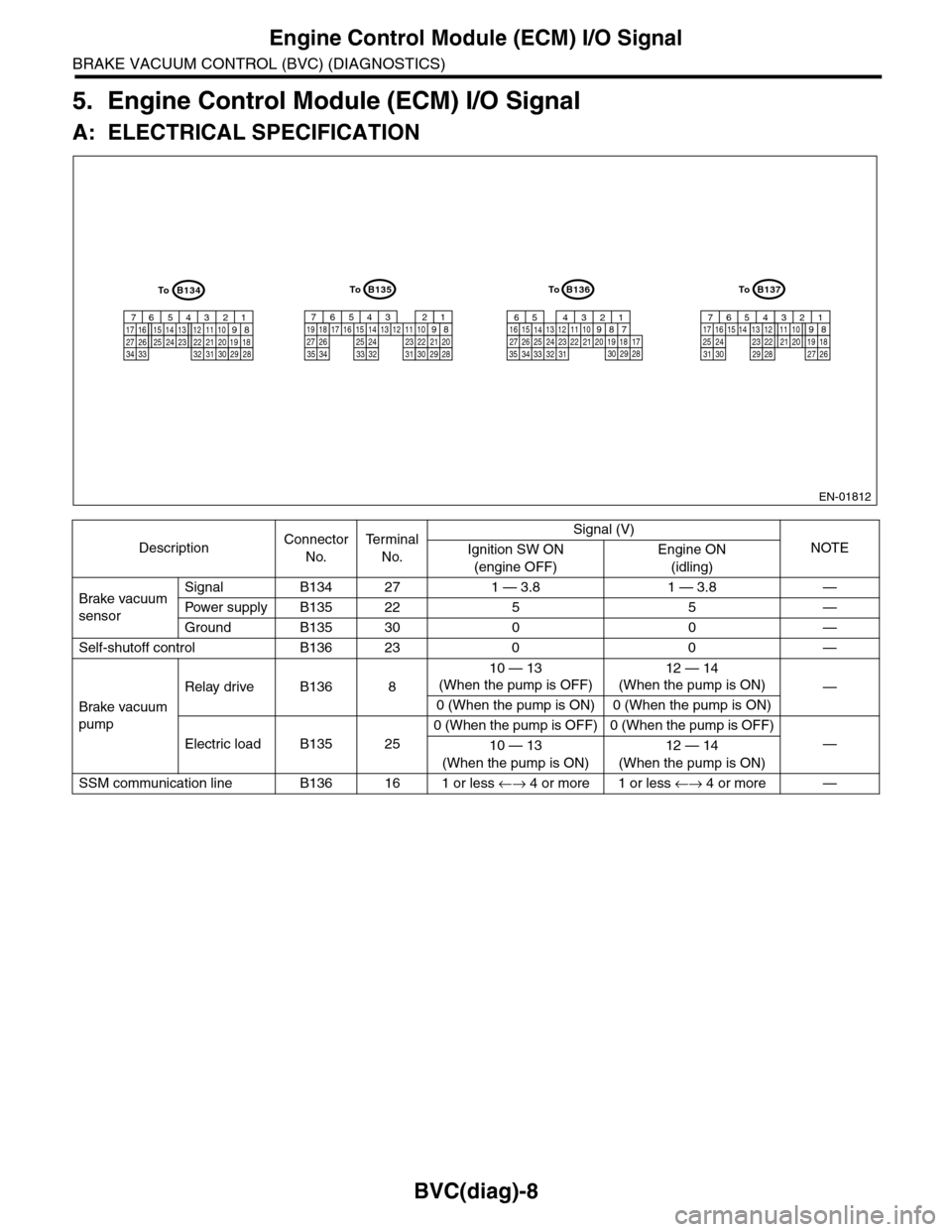
BVC(diag)-8
Engine Control Module (ECM) I/O Signal
BRAKE VACUUM CONTROL (BVC) (DIAGNOSTICS)
5. Engine Control Module (ECM) I/O Signal
A: ELECTRICAL SPECIFICATION
DescriptionConnector
No.
Te r m i n a l
No.
Signal (V)
NOTEIgnition SW ON
(engine OFF)
Engine ON
(idling)
Brake vacuum
sensor
Signal B134 27 1 — 3.8 1 — 3.8 —
Pow er s up pl y B 1 35 2 2 5 5 —
Ground B135 30 0 0 —
Self-shutoff control B136 23 0 0 —
Brake vacuum
pump
Relay drive B136 8
10 — 13
(When the pump is OFF)
12 — 14
(When the pump is ON)—
0 (When the pump is ON) 0 (When the pump is ON)
Electric load B135 25
0 (When the pump is OFF) 0 (When the pump is OFF)
—10 — 13
(When the pump is ON)
12 — 14
(When the pump is ON)
SSM communication line B136 16 1 or less ←→ 4 or more 1 or less ←→ 4 or more —
EN-01812
B134
5678219431024 2223251112131415262728
1617181920213334 2932 3031
B136
5678219431024 2223251112131415262728
16171819202133342932303135
B135
5678219431024 2223251112131415262728
16171819202129303132333435
B137
5678219431022231112131415242526
1617181920212728293031
ToToToTo
Page 770 of 2453
BVC(diag)-15
Diagnostic Procedure with Diagnostic Trouble Code (DTC)
BRAKE VACUUM CONTROL (BVC) (DIAGNOSTICS)
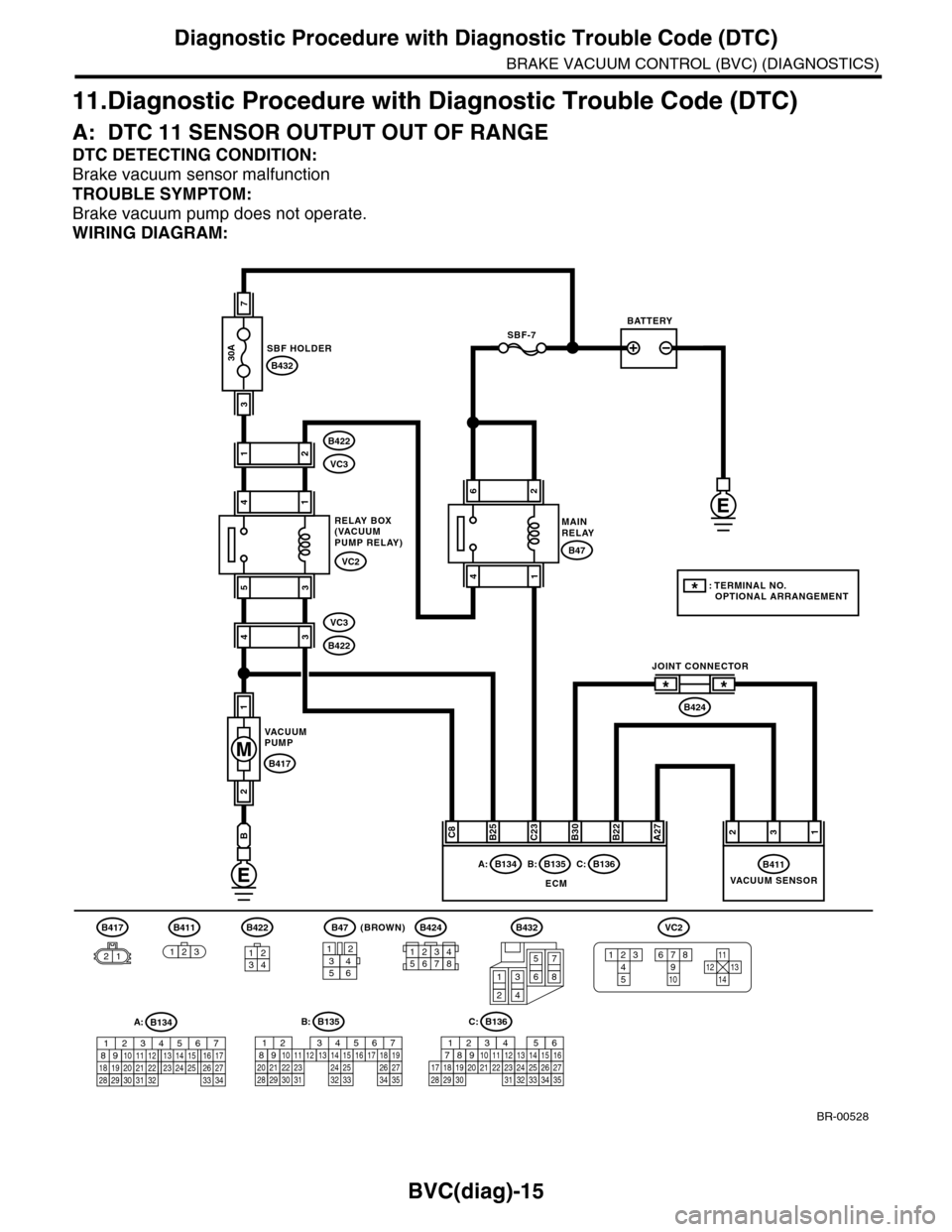
11.Diagnostic Procedure with Diagnostic Trouble Code (DTC)
A: DTC 11 SENSOR OUTPUT OUT OF RANGE
DTC DETECTING CONDITION:
Brake vacuum sensor malfunction
TROUBLE SYMPTOM:
Brake vacuum pump does not operate.
WIRING DIAGRAM:
BR-00528
2
1
B25B
B422
1234
B432
2
1
4
36
5
8
7
B432
SBF HOLDER
3
7
14
21
53
43
VC2
VC3
B422
B422
VC3
RELAY BOX(VACUUMPUMP RELAY)
B417
VAC U U MPUMP
26
41
B47
MAINRELAY
B411
VAC U U M S E N S O RECM
A: B134B: B135C: B136
C23B30B22A27C8312
JOINT CONNECTOR
B424
**
B417B411
213
B: C:B135
5672134
29
101112131415252416
30
98171819202821222332312627333435
B136
16101112131415252430
9871718192028212223293231
123456
2726333435
VC2
A:B134
85610 11 12 13 14 157213416
3019 20 2228 29
91718252123 24323126 2733 34
B424
34561278
(BROWN)
21
5436
B47
* : TERMINAL NO. OPTIONAL ARRANGEMENT
21
SBF-7BATTERY
30A
3412
5
8967
10131211
14
Page 771 of 2453
BVC(diag)-16
Diagnostic Procedure with Diagnostic Trouble Code (DTC)
BRAKE VACUUM CONTROL (BVC) (DIAGNOSTICS)
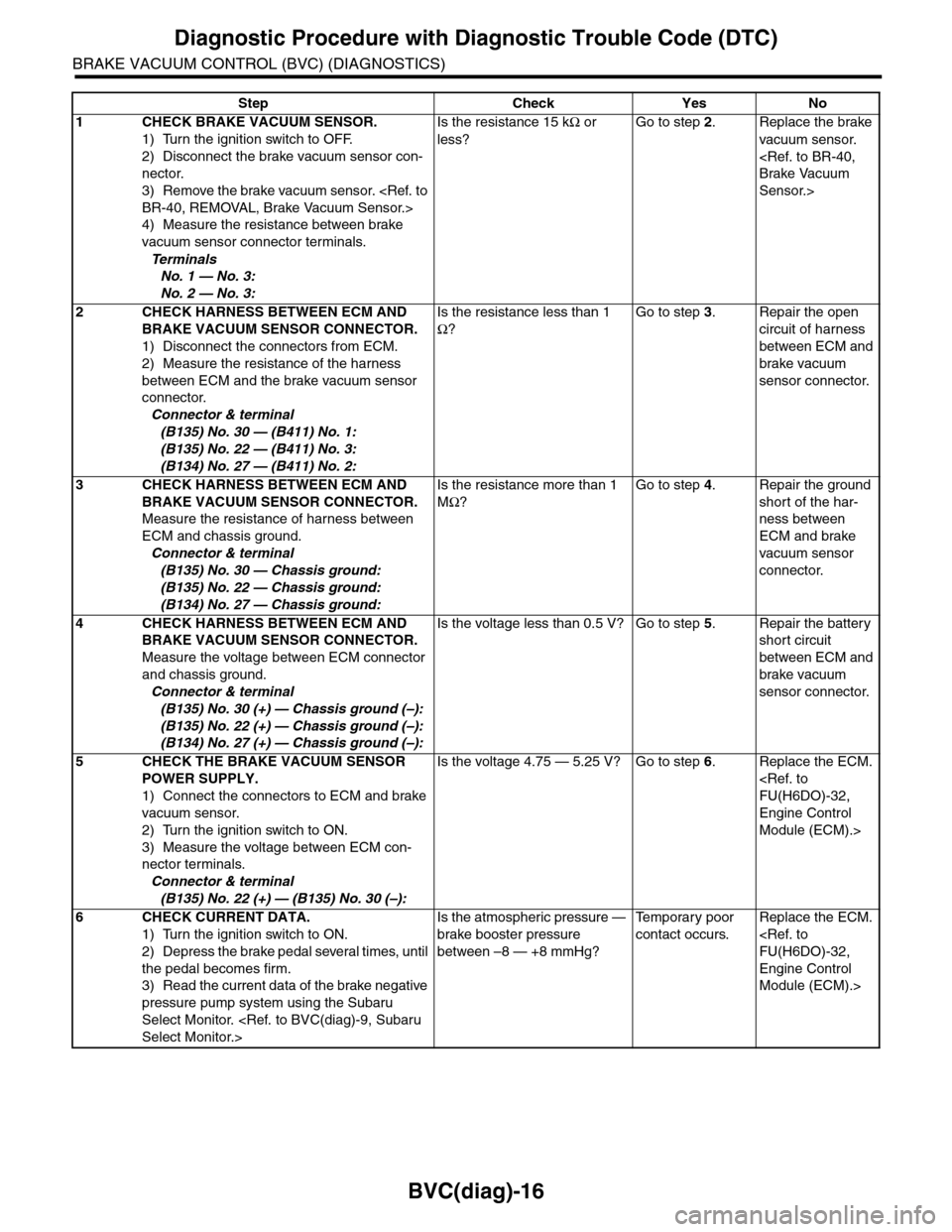
Step Check Yes No
1CHECK BRAKE VACUUM SENSOR.
1) Turn the ignition switch to OFF.
2) Disconnect the brake vacuum sensor con-
nector.
3) Remove the brake vacuum sensor.
4) Measure the resistance between brake
vacuum sensor connector terminals.
Te r m i n a l s
No. 1 — No. 3:
No. 2 — No. 3:
Is the resistance 15 kΩ or
less?
Go to step 2.Replace the brake
vacuum sensor.
Sensor.>
2CHECK HARNESS BETWEEN ECM AND
BRAKE VACUUM SENSOR CONNECTOR.
1) Disconnect the connectors from ECM.
2) Measure the resistance of the harness
between ECM and the brake vacuum sensor
connector.
Connector & terminal
(B135) No. 30 — (B411) No. 1:
(B135) No. 22 — (B411) No. 3:
(B134) No. 27 — (B411) No. 2:
Is the resistance less than 1
Ω?
Go to step 3.Repair the open
circuit of harness
between ECM and
brake vacuum
sensor connector.
3CHECK HARNESS BETWEEN ECM AND
BRAKE VACUUM SENSOR CONNECTOR.
Measure the resistance of harness between
ECM and chassis ground.
Connector & terminal
(B135) No. 30 — Chassis ground:
(B135) No. 22 — Chassis ground:
(B134) No. 27 — Chassis ground:
Is the resistance more than 1
MΩ?
Go to step 4.Repair the ground
short of the har-
ness between
ECM and brake
vacuum sensor
connector.
4CHECK HARNESS BETWEEN ECM AND
BRAKE VACUUM SENSOR CONNECTOR.
Measure the voltage between ECM connector
and chassis ground.
Connector & terminal
(B135) No. 30 (+) — Chassis ground (–):
(B135) No. 22 (+) — Chassis ground (–):
(B134) No. 27 (+) — Chassis ground (–):
Is the voltage less than 0.5 V? Go to step 5.Repair the battery
short circuit
between ECM and
brake vacuum
sensor connector.
5CHECK THE BRAKE VACUUM SENSOR
POWER SUPPLY.
1) Connect the connectors to ECM and brake
vacuum sensor.
2) Turn the ignition switch to ON.
3) Measure the voltage between ECM con-
nector terminals.
Connector & terminal
(B135) No. 22 (+) — (B135) No. 30 (–):
Is the voltage 4.75 — 5.25 V? Go to step 6.Replace the ECM.
Engine Control
Module (ECM).>
6CHECK CURRENT DATA.
1) Turn the ignition switch to ON.
2) Depress the brake pedal several times, until
the pedal becomes firm.
3) Read the current data of the brake negative
pressure pump system using the Subaru
Select Monitor.
Is the atmospheric pressure —
brake booster pressure
between –8 — +8 mmHg?
Te m p o r a r y p o o r
contact occurs.
Replace the ECM.
Engine Control
Module (ECM).>