cruise control SUBARU TRIBECA 2009 1.G Service Workshop Manual
[x] Cancel search | Manufacturer: SUBARU, Model Year: 2009, Model line: TRIBECA, Model: SUBARU TRIBECA 2009 1.GPages: 2453, PDF Size: 46.32 MB
Page 164 of 2453
CC-2
General Description
CRUISE CONTROL SYSTEM
1. General Description
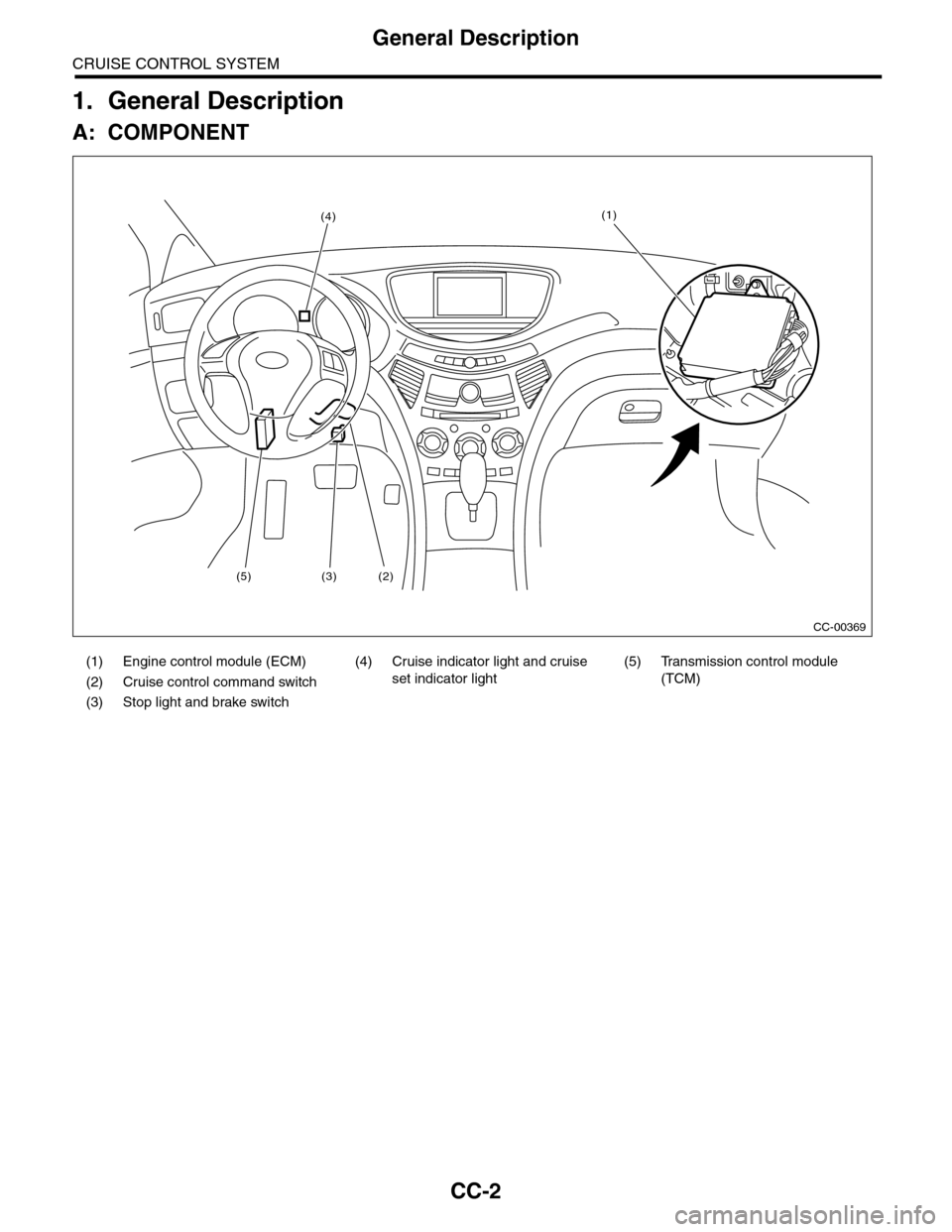
A: COMPONENT
(1) Engine control module (ECM) (4) Cruise indicator light and cruise
set indicator light
(5) Transmission control module
(TCM)(2) Cruise control command switch
(3) Stop light and brake switch
CC-00369
(1)(4)
(2)(3)(5)
Page 165 of 2453
CC-3
General Description
CRUISE CONTROL SYSTEM
B: CAUTION
•Before disassembling or reassembling parts, al-
ways disconnect the battery ground cable from bat-
tery. When repairing the audio, control module, etc.
which are provided with memory functions, record
the memory contents before disconnecting the
ground cable from battery. Otherwise, the memory
will be cleared.
•Reassemble the parts in the reverse order of dis-
assembly unless otherwise indicated.
•Adjust the parts to specifications specified in this
manual.
•Connect the connectors securely during reas-
sembly.
•After reassembly, ensure functional parts oper-
ate properly.
C: PREPARATION TOOL
TOOL NAME REMARKS
Circuit tester Used for measuring resis-
tance and voltage.
Page 166 of 2453
CC-4
Cruise Control Unit
CRUISE CONTROL SYSTEM
2. Cruise Control Unit
A: NOTE
The control of cruise control system is carried out in
Engine control module (ECM).
B: REMOVAL
C: INSTALLATION
Page 167 of 2453
CC-5
Cruise Control Command Switch
CRUISE CONTROL SYSTEM
3. Cruise Control Command
Switch
A: REMOVAL
CAUTION:
Before servicing, be sure to read the notes in
the “AB” section for proper handling of the
driver’s airbag module.
1) Set the front wheels in straight ahead position.
2) Turn the ignition switch to OFF.
3) Disconnect the ground cable from battery and
wait for at least 20 seconds before starting work.
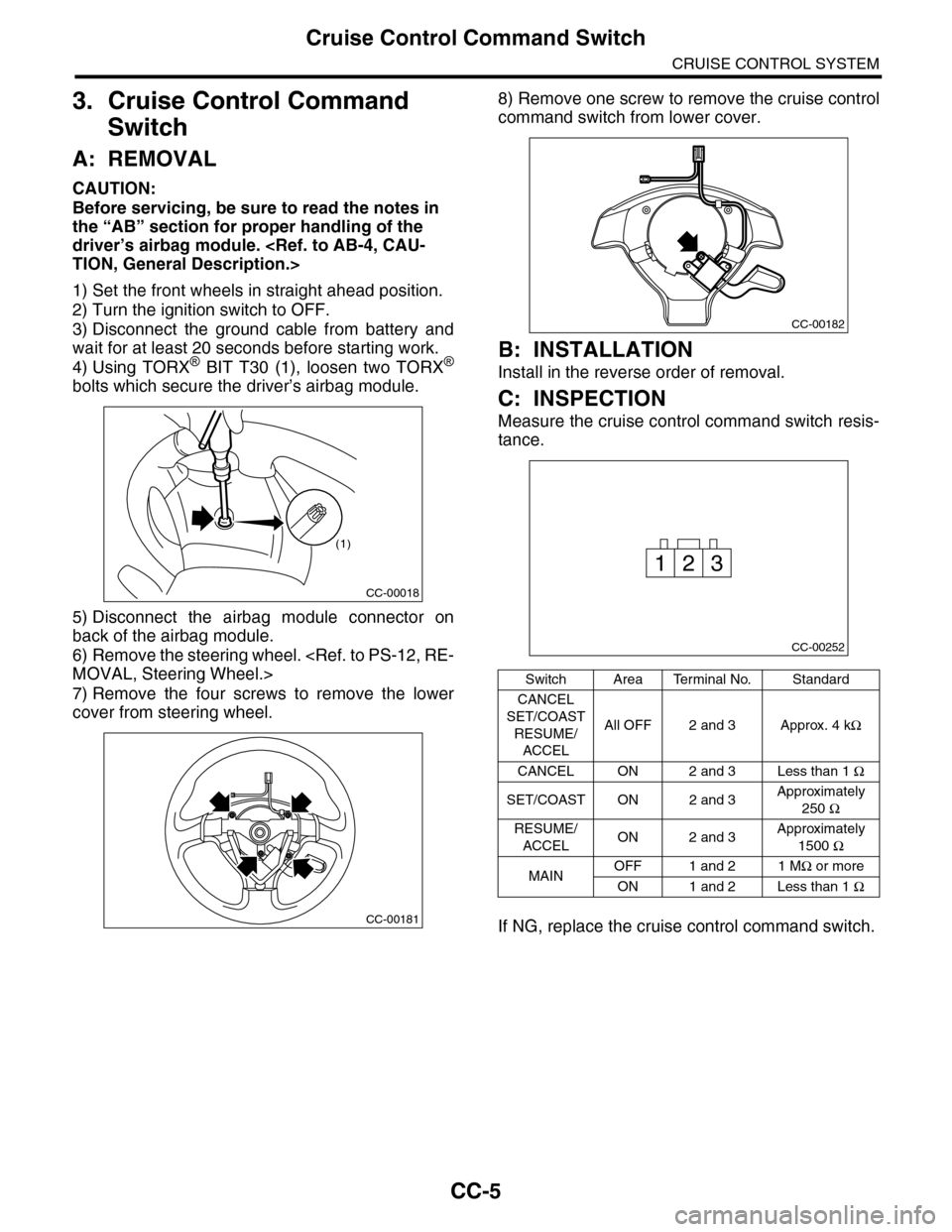
4) Using TORX® BIT T30 (1), loosen two TORX®
bolts which secure the driver’s airbag module.
5) Disconnect the airbag module connector on
back of the airbag module.
6) Remove the steering wheel.
7) Remove the four screws to remove the lower
cover from steering wheel.
8) Remove one screw to remove the cruise control
command switch from lower cover.
B: INSTALLATION
Install in the reverse order of removal.
C: INSPECTION
Measure the cruise control command switch resis-
tance.
If NG, replace the cruise control command switch.
CC-00018
(1)
CC-00181
Switch Area Terminal No. Standard
CANCEL
SET/COAST
RESUME/
ACCEL
All OFF 2 and 3 Approx. 4 kΩ
CANCEL ON 2 and 3 Less than 1 Ω
SET/COAST ON 2 and 3Approximately
250 Ω
RESUME/
ACCELON 2 and 3Approximately
1500 Ω
MAINOFF 1 and 2 1 MΩ or more
ON 1 and 2 Less than 1 Ω
CC-00182
CC-00252
231
Page 168 of 2453
CC-6
Stop Light and Brake Switch
CRUISE CONTROL SYSTEM
4. Stop Light and Brake Switch
A: REMOVAL
1) Disconnect the ground cable from battery.
2) Disconnect the connector from the stop light &
brake switch, and then remove the switch.
B: INSTALLATION
Install in the reverse order of removal.
C: INSPECTION
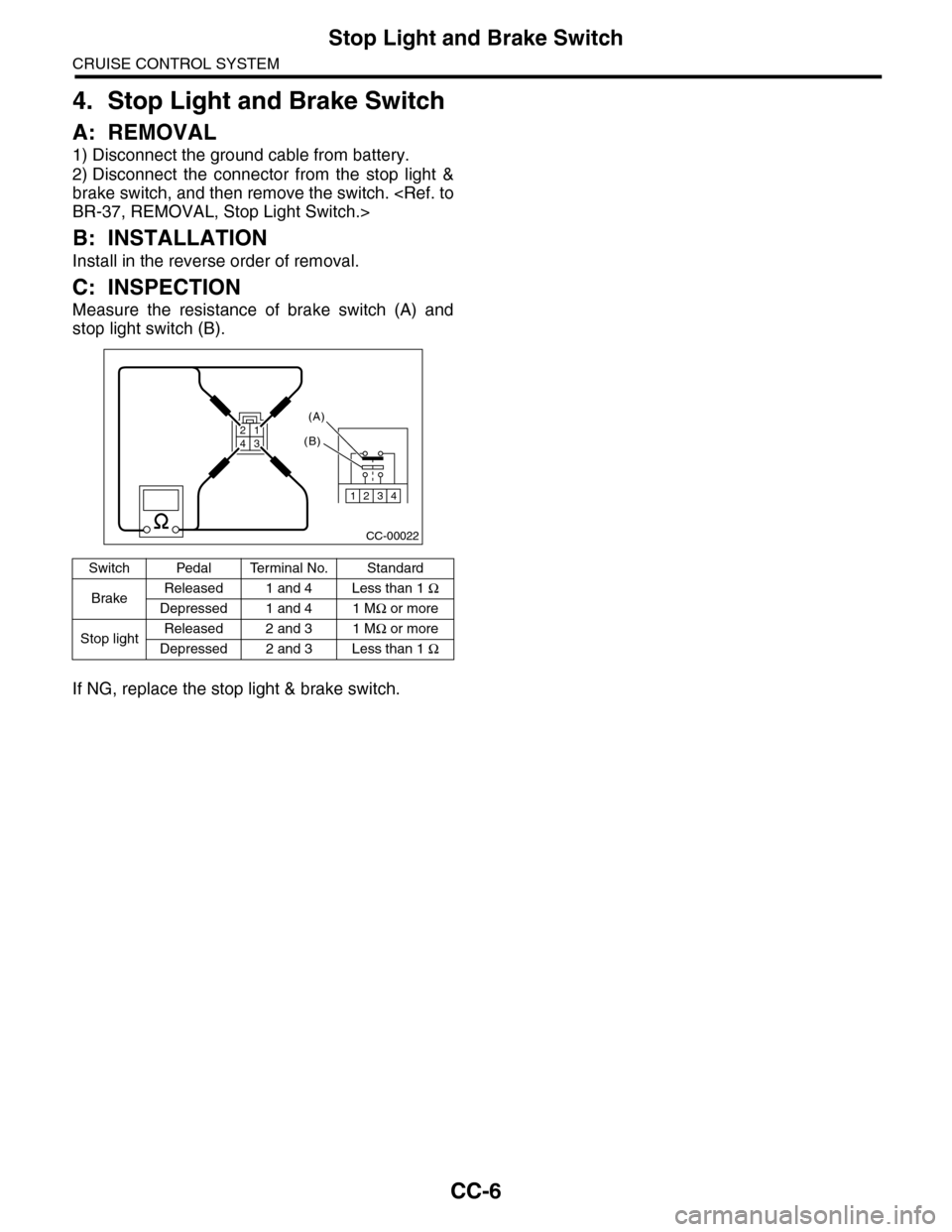
Measure the resistance of brake switch (A) and
stop light switch (B).
If NG, replace the stop light & brake switch.
Switch Pedal Terminal No. Standard
BrakeReleased 1 and 4 Less than 1 Ω
Depressed 1 and 4 1 MΩ or more
Stop lightReleased 2 and 3 1 MΩ or more
Depressed 2 and 3 Less than 1 Ω
CC-00022
1234
(A)
(B)
3214
Page 169 of 2453
CC(ETC)(diag)-2
Basic Diagnostic Procedure
CRUISE CONTROL SYSTEM (DIAGNOSTICS)
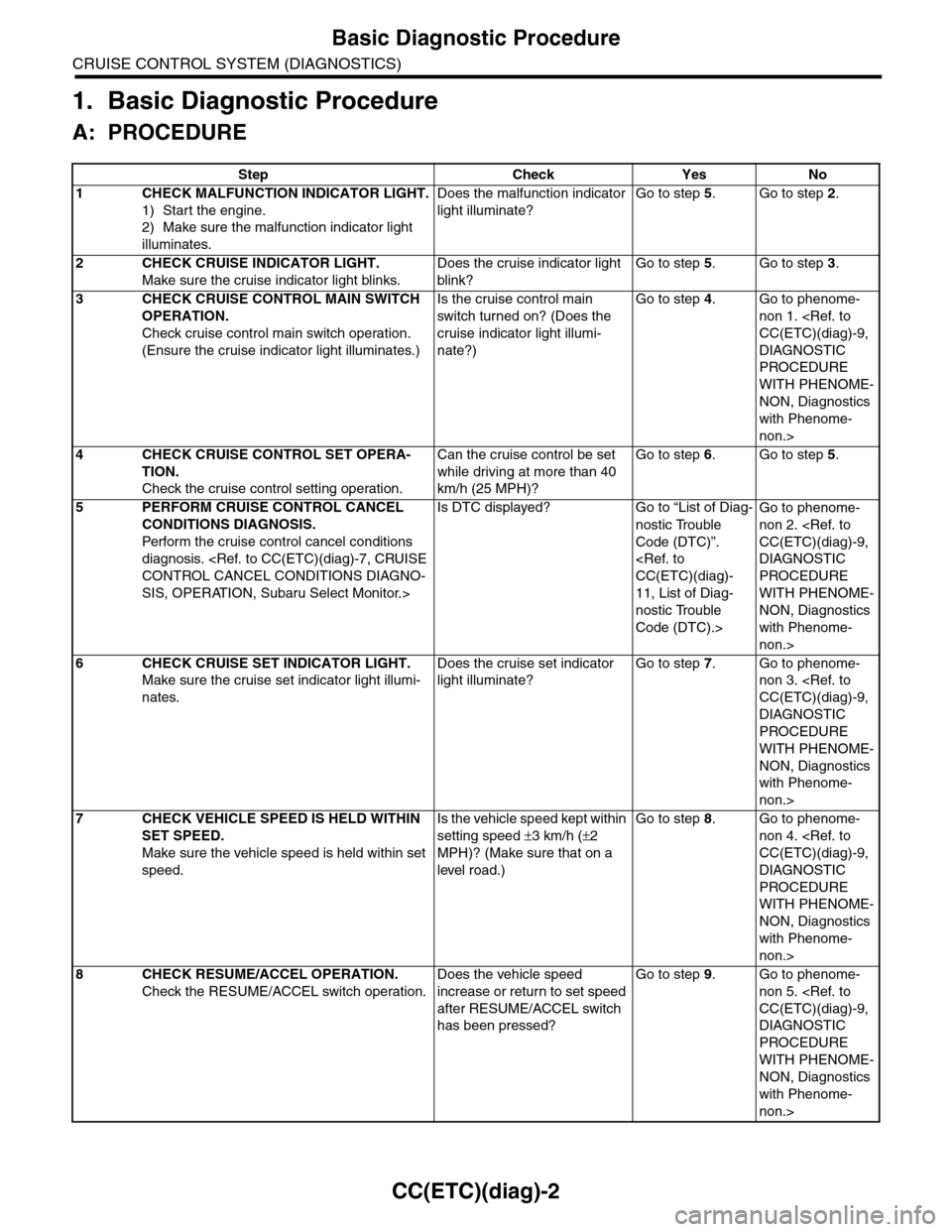
1. Basic Diagnostic Procedure
A: PROCEDURE
Step Check Yes No
1CHECK MALFUNCTION INDICATOR LIGHT.
1) Start the engine.
2) Make sure the malfunction indicator light
illuminates.
Does the malfunction indicator
light illuminate?
Go to step 5.Go to step 2.
2CHECK CRUISE INDICATOR LIGHT.
Make sure the cruise indicator light blinks.
Does the cruise indicator light
blink?
Go to step 5.Go to step 3.
3CHECK CRUISE CONTROL MAIN SWITCH
OPERATION.
Check cruise control main switch operation.
(Ensure the cruise indicator light illuminates.)
Is the cruise control main
switch tur ned on? (Does the
cruise indicator light illumi-
nate?)
Go to step 4.Go to phenome-
non 1.
DIAGNOSTIC
PROCEDURE
WITH PHENOME-
NON, Diagnostics
with Phenome-
non.>
4CHECK CRUISE CONTROL SET OPERA-
TION.
Check the cruise control setting operation.
Can the cruise control be set
while driving at more than 40
km/h (25 MPH)?
Go to step 6.Go to step 5.
5PERFORM CRUISE CONTROL CANCEL
CONDITIONS DIAGNOSIS.
Perfor m the cr uise control cancel conditions
diagnosis.
SIS, OPERATION, Subaru Select Monitor.>
Is DTC displayed? Go to “List of Diag-
nostic Trouble
Code (DTC)”.
11, List of Diag-
nostic Trouble
Code (DTC).>
Go to phenome-
non 2.
DIAGNOSTIC
PROCEDURE
WITH PHENOME-
NON, Diagnostics
with Phenome-
non.>
6CHECK CRUISE SET INDICATOR LIGHT.
Make sure the cruise set indicator light illumi-
nates.
Does the cruise set indicator
light illuminate?
Go to step 7.Go to phenome-
non 3.
DIAGNOSTIC
PROCEDURE
WITH PHENOME-
NON, Diagnostics
with Phenome-
non.>
7CHECK VEHICLE SPEED IS HELD WITHIN
SET SPEED.
Make sure the vehicle speed is held within set
speed.
Is the vehicle speed kept within
setting speed ±3 km/h (±2
MPH)? (Make sure that on a
level road.)
Go to step 8.Go to phenome-
non 4.
DIAGNOSTIC
PROCEDURE
WITH PHENOME-
NON, Diagnostics
with Phenome-
non.>
8CHECK RESUME/ACCEL OPERATION.
Check the RESUME/ACCEL switch operation.
Does the vehicle speed
increase or return to set speed
after RESUME/ACCEL switch
has been pressed?
Go to step 9.Go to phenome-
non 5.
DIAGNOSTIC
PROCEDURE
WITH PHENOME-
NON, Diagnostics
with Phenome-
non.>
Page 170 of 2453
CC(ETC)(diag)-3
Basic Diagnostic Procedure
CRUISE CONTROL SYSTEM (DIAGNOSTICS)
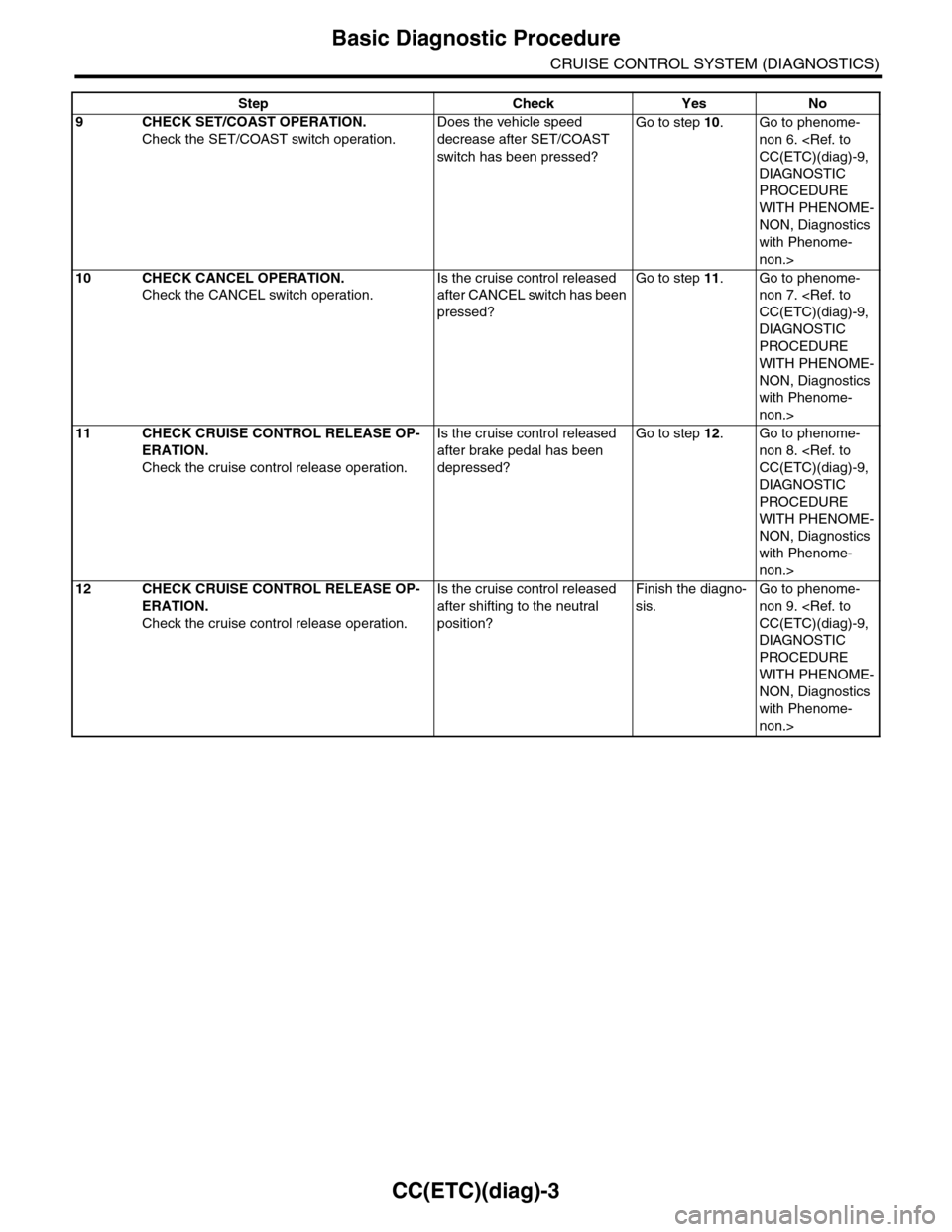
9CHECK SET/COAST OPERATION.
Check the SET/COAST switch operation.
Does the vehicle speed
decrease after SET/COAST
switch has been pressed?
Go to step 10.Go to phenome-
non 6.
DIAGNOSTIC
PROCEDURE
WITH PHENOME-
NON, Diagnostics
with Phenome-
non.>
10 CHECK CANCEL OPERATION.
Check the CANCEL switch operation.
Is the cruise control released
after CANCEL switch has been
pressed?
Go to step 11.Go to phenome-
non 7.
DIAGNOSTIC
PROCEDURE
WITH PHENOME-
NON, Diagnostics
with Phenome-
non.>
11 CHECK CRUISE CONTROL RELEASE OP-
ERATION.
Check the cruise control release operation.
Is the cruise control released
after brake pedal has been
depressed?
Go to step 12.Go to phenome-
non 8.
DIAGNOSTIC
PROCEDURE
WITH PHENOME-
NON, Diagnostics
with Phenome-
non.>
12 CHECK CRUISE CONTROL RELEASE OP-
ERATION.
Check the cruise control release operation.
Is the cruise control released
after shifting to the neutral
position?
Finish the diagno-
sis.
Go to phenome-
non 9.
DIAGNOSTIC
PROCEDURE
WITH PHENOME-
NON, Diagnostics
with Phenome-
non.>
Step Check Yes No
Page 171 of 2453
CC(ETC)(diag)-4
General Description
CRUISE CONTROL SYSTEM (DIAGNOSTICS)
2. General Description
A: CAUTION
Airbag system wiring harness is routed near the cruise control command switch.
CAUTION:
•All airbag system wiring harnesses and connectors are colored yellow. Do not use electrical test
equipment on these circuits.
•Be careful not to damage the airbag system wiring harness when servicing the cruise control com-
mand switch.
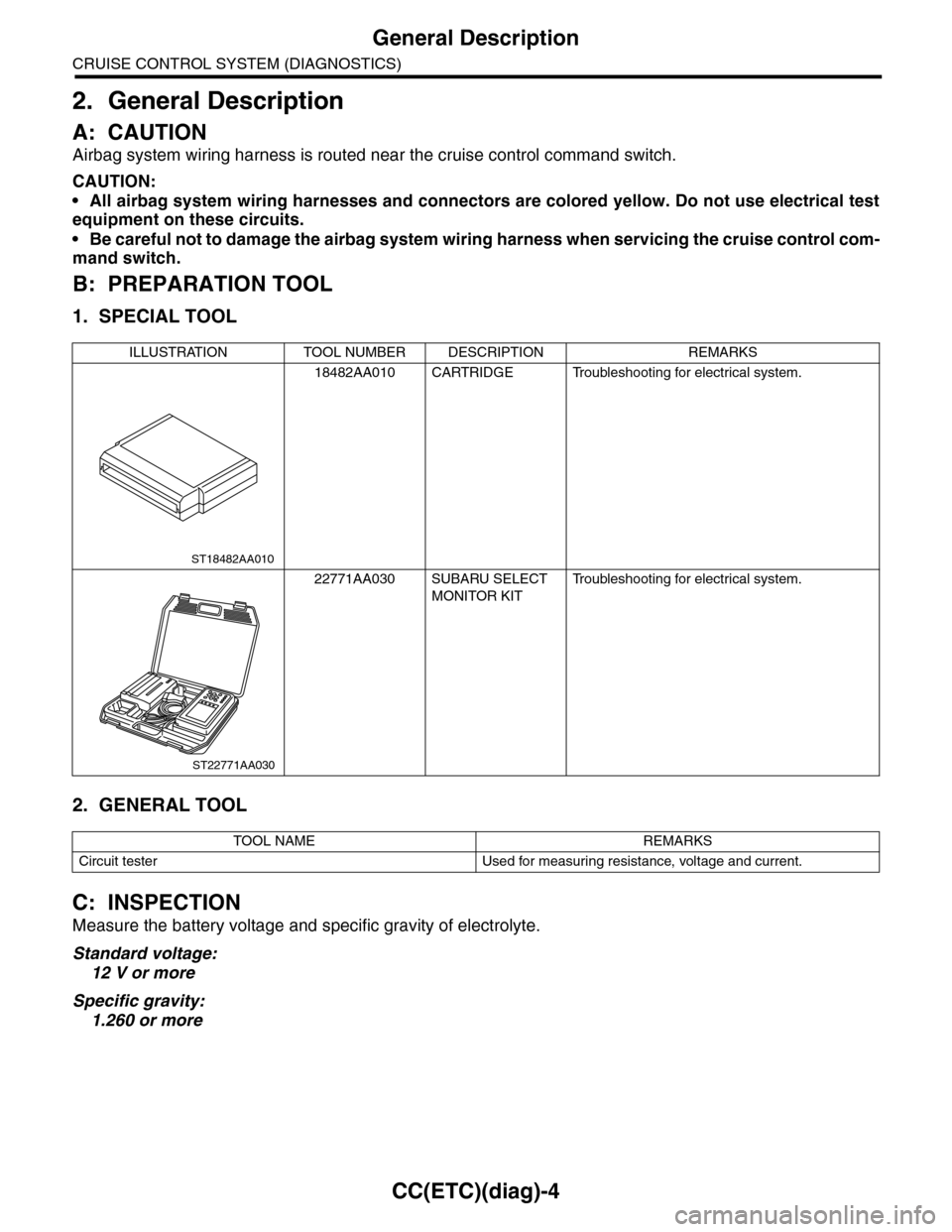
B: PREPARATION TOOL
1. SPECIAL TOOL
2. GENERAL TOOL
C: INSPECTION
Measure the battery voltage and specific gravity of electrolyte.
Standard voltage:
12 V or more
Specific gravity:
1.260 or more
ILLUSTRATION TOOL NUMBER DESCRIPTION REMARKS
18482AA010 CARTRIDGE Troubleshooting for electrical system.
22771AA030 SUBARU SELECT
MONITOR KIT
Tr o u b l e s h o o t i n g f o r e l e c t r i c a l s y s t e m .
TOOL NAME REMARKS
Circuit tester Used for measuring resistance, voltage and current.
ST18482AA010
ST22771AA030
Page 172 of 2453
CC(ETC)(diag)-5
Electrical Component Location
CRUISE CONTROL SYSTEM (DIAGNOSTICS)
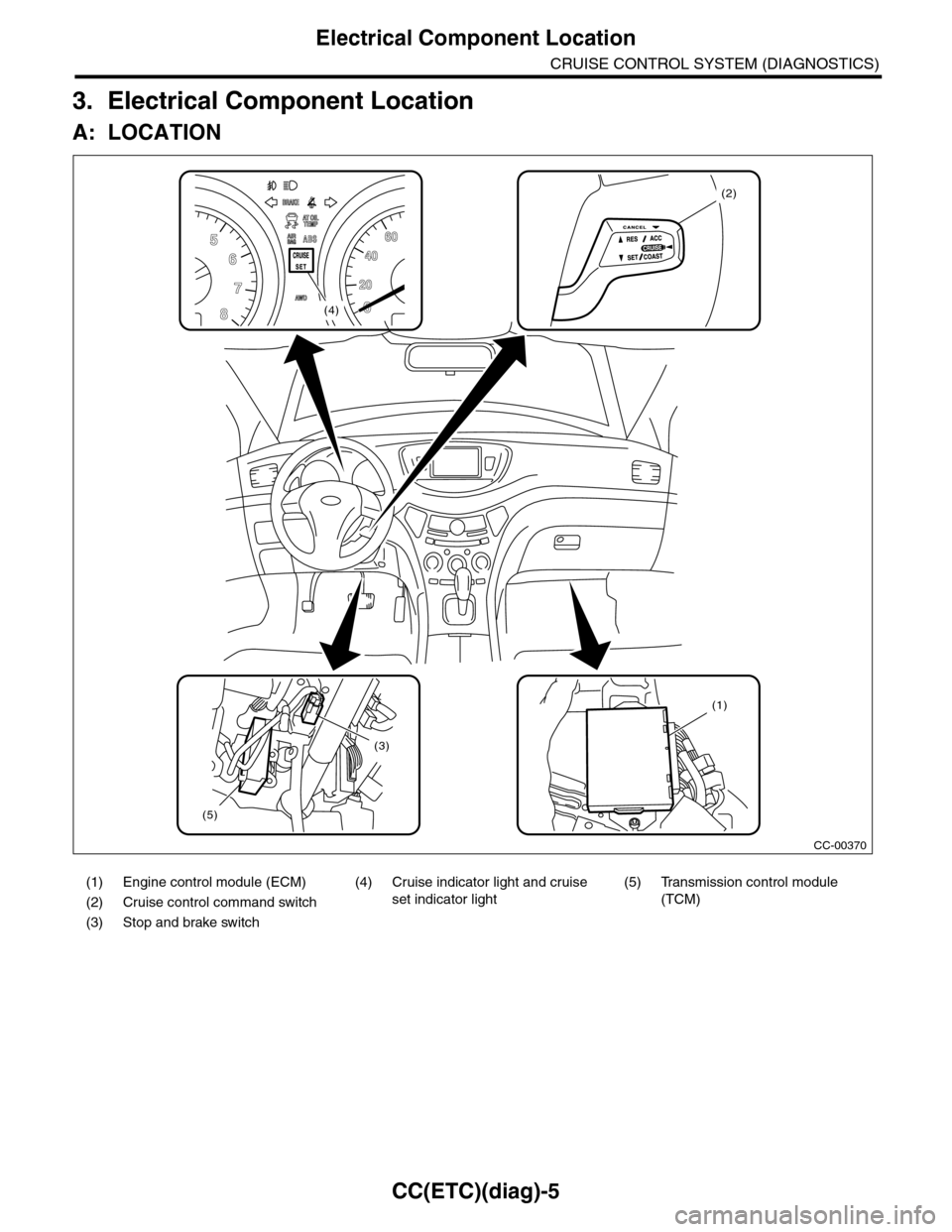
3. Electrical Component Location
A: LOCATION
(1) Engine control module (ECM) (4) Cruise indicator light and cruise
set indicator light
(5) Transmission control module
(TCM)(2) Cruise control command switch
(3) Stop and brake switch
CC-00370
(3)
(1)
(2)
(5)
(4)
Page 173 of 2453
CC(ETC)(diag)-6
Engine Control Module (ECM) I/O Signal
CRUISE CONTROL SYSTEM (DIAGNOSTICS)
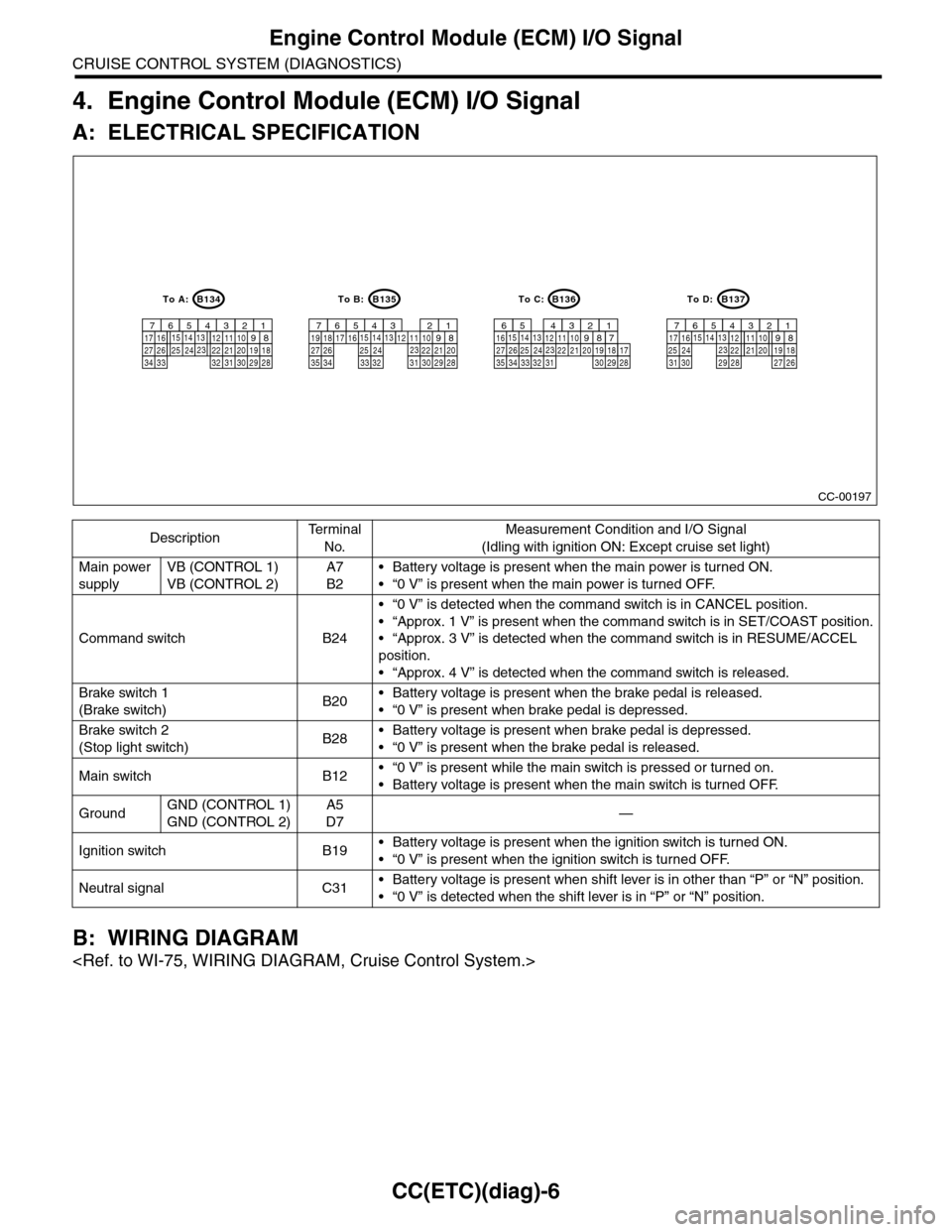
4. Engine Control Module (ECM) I/O Signal
A: ELECTRICAL SPECIFICATION
B: WIRING DIAGRAM
DescriptionTe r m i n a l
No.
Measurement Condition and I/O Signal
(Idling with ignition ON: Except cruise set light)
Main power
supply
VB (CONTROL 1)
VB (CONTROL 2)
A7
B2
•Battery voltage is present when the main power is turned ON.
•“0 V” is present when the main power is turned OFF.
Command switch B24
•“0 V” is detected when the command switch is in CANCEL position.
•“Approx. 1 V” is present when the command switch is in SET/COAST position.
•“Approx. 3 V” is detected when the command switch is in RESUME/ACCEL
position.
•“Approx. 4 V” is detected when the command switch is released.
Brake switch 1
(Brake switch)B20•Battery voltage is present when the brake pedal is released.
•“0 V” is present when brake pedal is depressed.
Brake switch 2
(Stop light switch)B28•Battery voltage is present when brake pedal is depressed.
•“0 V” is present when the brake pedal is released.
Main switch B12•“0 V” is present while the main switch is pressed or turned on.
•Battery voltage is present when the main switch is turned OFF.
GroundGND (CONTROL 1)
GND (CONTROL 2)
A5
D7—
Ignition switch B19•Battery voltage is present when the ignition switch is turned ON.
•“0 V” is present when the ignition switch is turned OFF.
Neutral signal C31•Battery voltage is present when shift lever is in other than “P” or “N” position.
•“0 V” is detected when the shift lever is in “P” or “N” position.
CC-00197
B134
9
30 29 2832 3120 19 1822 211012 11142434 3327 2617 161234567132315258
B135
9
30 29 2832312022 211012 111424353327 2617 161234567132315258
B136
9
30 29 2832 3120 19 1822 211012 11142434 3327 2616123456132315258
B137
9
29 2820 19 182221101211142417 1612345671323152581819
34
71735303127 26
To D:To C:To B:To A: