warning SUBARU TRIBECA 2014 1.G Owners Manual
[x] Cancel search | Manufacturer: SUBARU, Model Year: 2014, Model line: TRIBECA, Model: SUBARU TRIBECA 2014 1.GPages: 426, PDF Size: 6.37 MB
Page 270 of 426
warning light illuminate simultaneously,take the following steps.
1. Stop the vehicle in the nearest safe,flat location.
2. Shut down the engine, apply theparking brake, and then restart it.
3. Release the parking brake. If bothwarning lights turn off, the EBD systemmay be malfunctioning.
Drive carefully to the nearest SUBARUdealer and have the system inspected.
4. If both warning lights illuminate againand remain illuminated after the enginehas been restarted, shut down the engineagain, apply the parking brake, and checkthe brake fluid level. Refer to“Brake fluid”F11-17.
5. If the brake fluid level is not below the“MIN”mark, the EBD system may bemalfunctioning. Drive carefully to thenearest SUBARU dealer and have thesystem inspected.
6. If the brake fluid level is below the“MIN”mark, DO NOT drive the vehicle.Instead, have the vehicle towed to thenearest SUBARU dealer for repair.
WARNING
.Driving with the brake systemwarning light illuminated is dan-
gerous. This indicates your brakesystem may not be workingproperly. If the light remainsilluminated, have the brakes in-spected by a SUBARU dealerimmediately.
.If at all in doubt about whetherthe brakes are operating prop-erly, do not drive the vehicle.Have your vehicle towed to thenearest SUBARU dealer for re-pair.
Vehicle Dynamics Control
system
WARNING
Always use the utmost care indriving–overconfidence becauseyou are driving with a Vehicle Dy-namics Control system equippedvehicle could easily lead to a ser-ious accident.
CAUTION
.Even if your vehicle is equippedwith Vehicle Dynamics Controlsystem, winter tires should beused when driving on snow-cov-ered or icy roads; in addition,vehicle speed should be reducedconsiderably. Simply having aVehicle Dynamics Control sys-tem does not guarantee that thevehicle will be able to avoidaccidents in any situation.
.Activation of the Vehicle Dy-namics Control system is anindication that the road beingtravelled on has a slippery sur-face; since having Vehicle Dy-namics Control is no guarantee
Starting and operating7-23
–CONTINUED–
Page 274 of 426
Tire pressure monitoring
system (TPMS)
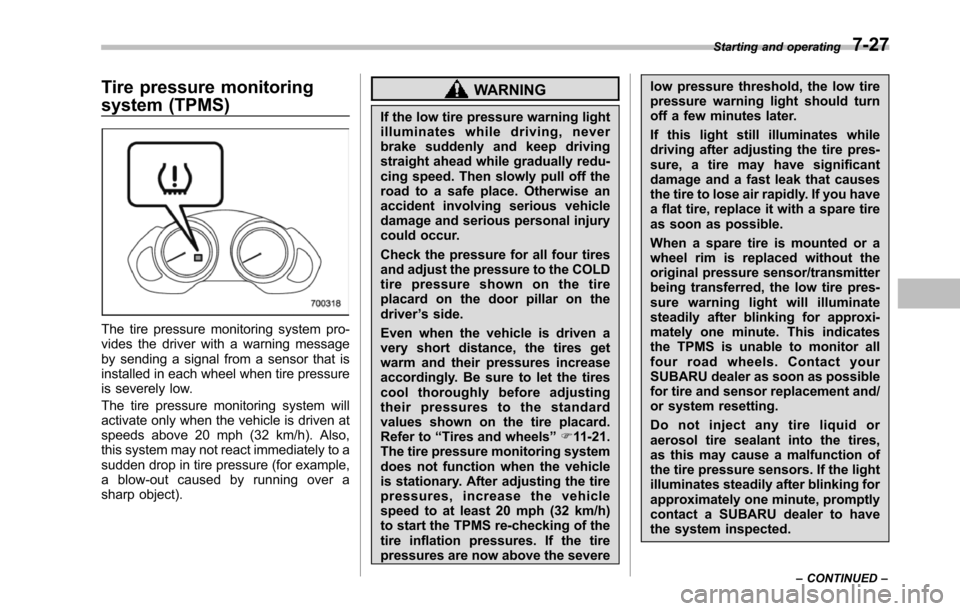
The tire pressure monitoring system pro-vides the driver with a warning messageby sending a signal from a sensor that isinstalled in each wheel when tire pressureis severely low.
The tire pressure monitoring system willactivate only when the vehicle is driven atspeeds above 20 mph (32 km/h). Also,this system may not react immediately to asudden drop in tire pressure (for example,a blow-out caused by running over asharp object).
WARNING
If the low tire pressure warning lightilluminates while driving, neverbrake suddenly and keep drivingstraight ahead while gradually redu-cing speed. Then slowly pull off theroad to a safe place. Otherwise anaccident involving serious vehicledamage and serious personal injurycould occur.
Check the pressure for all four tiresand adjust the pressure to the COLDtire pressure shown on the tireplacard on the door pillar on thedriver’s side.
Even when the vehicle is driven avery short distance, the tires getwarm and their pressures increaseaccordingly. Be sure to let the tirescool thoroughly before adjustingtheir pressures to the standardvalues shown on the tire placard.Refer to“Tires and wheels”F11-21.The tire pressure monitoring systemdoes not function when the vehicleis stationary. After adjusting the tirepressures, increase the vehiclespeed to at least 20 mph (32 km/h)to start the TPMS re-checking of thetire inflation pressures. If the tirepressures are now above the severe
low pressure threshold, the low tirepressure warning light should turnoff a few minutes later.
If this light still illuminates whiledriving after adjusting the tire pres-sure, a tire may have significantdamage and a fast leak that causesthe tire to lose air rapidly. If you havea flat tire, replace it with a spare tireas soon as possible.
When a spare tire is mounted or awheel rim is replaced without theoriginal pressure sensor/transmitterbeing transferred, the low tire pres-sure warning light will illuminatesteadily after blinking for approxi-mately one minute. This indicatesthe TPMS is unable to monitor allfour road wheels. Contact yourSUBARU dealeras soon as possiblefor tire and sensor replacement and/or system resetting.
Do not inject any tire liquid oraerosol tire sealant into the tires,as this may cause a malfunction ofthe tire pressure sensors. If the lightilluminates steadily after blinking forapproximately one minute, promptlycontact a SUBARU dealer to havethe system inspected.
Starting and operating7-27
–CONTINUED–
Page 275 of 426
7-28Starting and operating
CAUTION
Do not place metal film or any metalparts under the driver’s seat. Thismay cause poor reception of thesignals from the tire pressure sen-sors, and the tire pressure monitor-ing system will not function prop-erly.
NOTE
This device complies with Part 15 ofthe FCC Rules and with RSS-210 ofIndustry Canada. Operation is subjectto the following two conditions: (1) Thisdevice may not cause harmful inter-ference, and (2) this device mustaccept any interference received, in-cluding interference that may causeundesired operation.
Changes or modifications not ex-pressly approved by the party respon-sible for compliance could void theuser’s authority to operate the equip-ment.
Parking your vehicle
WARNING
.Never leave unattended childrenor pets in the vehicle. They couldaccidentally injure themselves orothersthrough inadvertent op-eration of the vehicle. Also, onhot or sunny days, the tempera-ture in a closed vehicle couldquickly become high enough tocausesevere or possibly fatalinjuries to them.
.Do not park the vehicle overflammable materials such as drygrass, waste paper or rags, asthey mayburn easily if they comenear hot engine or exhaust sys-tem parts.
.Be sure to stop the engine if youtake a nap in the vehicle. Ifengine exhaust gas enters thepassenger compartment, occu-pants in the vehicle could diefromcarbon monoxide (CO) con-tained in the exhaust gas.
&Parking brake
CAUTION
.Never drive while the parkingbrake is set because this willcause unnecessary wear on thebrake linings. Before starting todrive, always make sure that theparking brake has been fullyreleased.
.Never drive with your foot on theparking brake pedal.
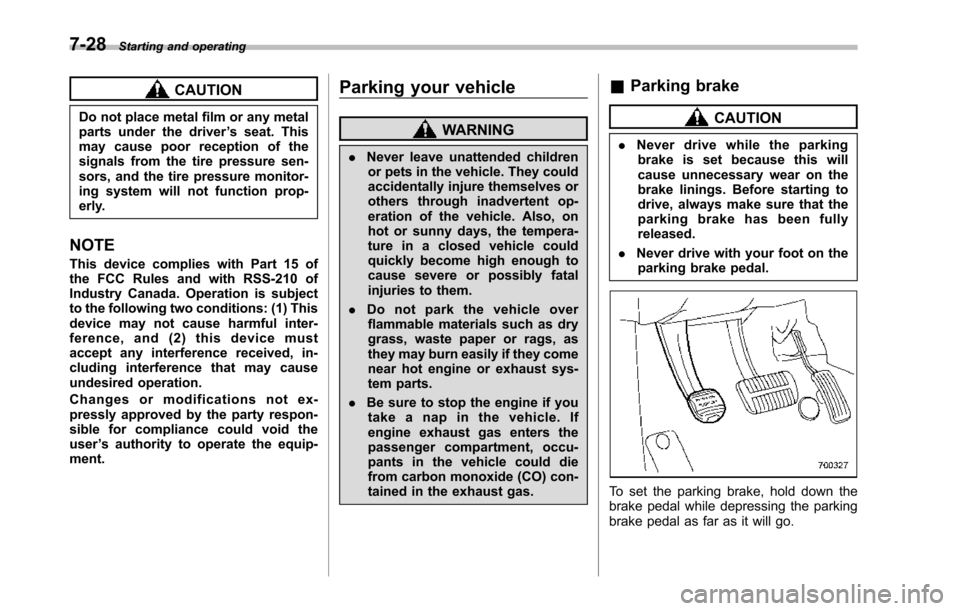
To set the parking brake, hold down thebrake pedal while depressing the parkingbrake pedal as far as it will go.
Page 276 of 426
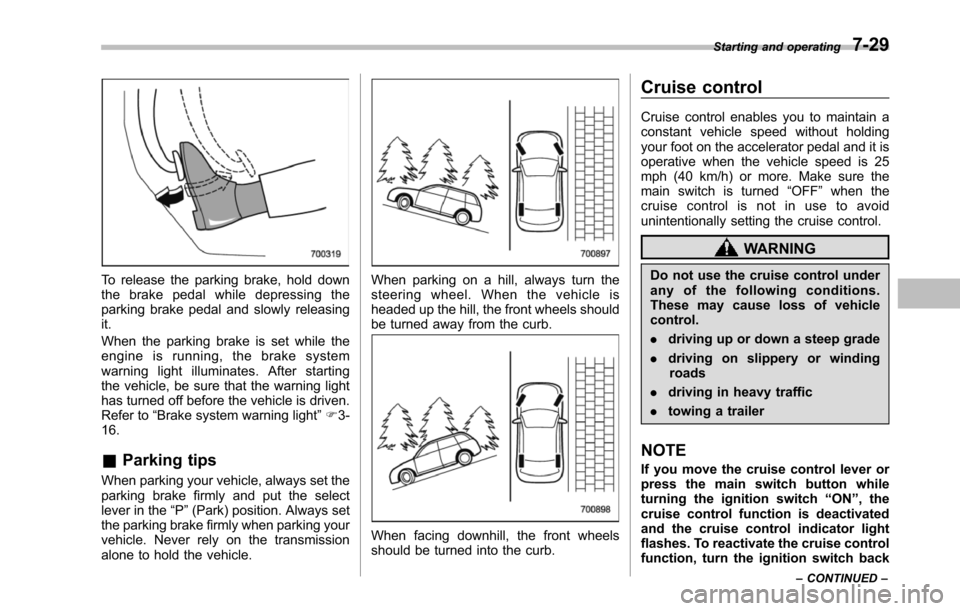
To release the parking brake, hold downthe brake pedal while depressing theparkingbrake pedal and slowly releasingit.
When the parking brake is set while theengine is running, the brake systemwarning light illuminates. After startingthe vehicle, be sure that the warning lighthas turned off before the vehicle is driven.Refer to“Brake system warning light”F3-16.
&Parking tips
When parking your vehicle, always set theparking brake firmly and put the selectlever in the“P”(Park) position. Always setthe parking brake firmly when parking yourvehicle. Never rely on the transmissionalone to hold the vehicle.
When parking on a hill, always turn thesteering wheel. When the vehicle isheadedup the hill, the front wheels shouldbe turned away from the curb.
When facing downhill, the front wheelsshould be turned into the curb.
Cruise control
Cruise control enables you to maintain aconstant vehicle speed without holdingyour foot on the accelerator pedal and it isoperative when the vehicle speed is 25mph (40 km/h) or more. Make sure themain switch is turned“OFF”whenthecruise control is not in use to avoidunintentionally setting the cruise control.
WARNING
Do not use the cruise control underany of the following conditions.These may cause loss of vehiclecontrol.
.driving up or down a steep grade
.driving on slippery or windingroads
.driving in heavy traffic
.towing a trailer
NOTE
If you move the cruise control lever orpress the main switch button whileturning the ignition switch“ON”, thecruise control function is deactivatedand the cruise control indicator lightflashes.To reactivate the cruise controlfunction, turn the ignition switch back
Starting and operating7-29
–CONTINUED–
Page 278 of 426
&To temporarily cancel the
cruise control
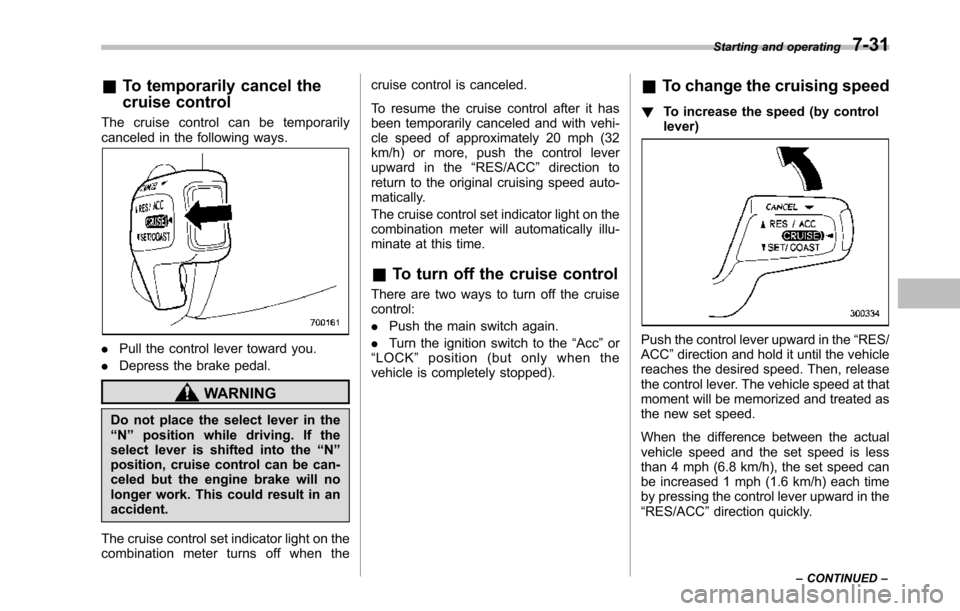
The cruise control can be temporarilycanceled in the following ways.
.Pull the control lever toward you.
.Depressthe brake pedal.
WARNING
Do not place the select lever in the“N”position while driving. If theselect lever is shifted into the“N”position, cruise control can be can-celed but the engine brake will nolonger work. This could result in anaccident.
The cruise control set indicator light on thecombination meter turns off when the
cruise control is canceled.
To resume the cruise control after it hasbeen temporarily canceled and with vehi-cle speed of approximately 20 mph (32km/h) or more, push the control leverupward in the“RES/ACC”direction toreturn to the original cruising speed auto-matically.
The cruise control set indicator light on thecombination meter will automatically illu-minate at this time.
&To turn off the cruise control
There are two ways to turn off the cruisecontrol:
.Push the main switch again.
.Turn the ignition switch to the“Acc”or“LOCK”position (but only when thevehicle is completely stopped).
&To change the cruising speed
!To increase the speed (by controllever)
Push the control lever upward in the“RES/ACC”direction and hold it until the vehiclereaches the desired speed. Then, releasethe control lever. The vehicle speed at thatmoment will be memorized and treated asthe new set speed.
When the difference between the actualvehicle speed and the set speed is lessthan 4 mph (6.8 km/h), the set speed canbe increased 1 mph (1.6 km/h) each timeby pressing the control lever upward in the“RES/ACC”direction quickly.
Starting and operating7-31
–CONTINUED–
Page 281 of 426
8-2Driving tips
New vehicle break-in driving
–the first 1,000 miles (1,600
km)
The performance and long life of yourvehicle are dependent on how you handleand care for your vehicle while it is new.Follow these instructions during the first1,000 miles (1,600 km):
.Do not race the engine. And do notallow engine speed to exceed 4,000 rpmexcept in an emergency.
.Do not drive at one constant engine orvehicle speed for a long time, either fast orslow.
.Avoid starting suddenly and rapidacceleration, except in an emergency.
.Avoid hard braking, except in anemergency.
The same break-in procedures should beapplied to a newly installed or overhauledengine or when brake pads or brakelinings are replaced with new ones.
Fuel economy hints
The following suggestions will help to saveyour fuel.
.Select the proper gear position for thespeed and road conditions.
.Avoid sudden acceleration or decelera-tion. Always accelerate gently until youreach the desired speed. Then try tomaintain that speed for as long aspossible.
.Do not pump the accelerator and avoidracing the engine.
.Avoid unnecessary engine idling.
.Keep the engine properly tuned.
.Keep the tires inflated to the correctpressureshown on the tire placard, whichis located under the door latch on thedriver’s side. Low pressure will increasetire wear and fuel consumption.
.Use the air conditioner only whennecessary.
.Keep the front and rear wheels inproper alignment.
.Avoid carrying unnecessary luggage orcargo.
Engine exhaust gas (carbon
monoxide)
WARNING
.Never inhale engine exhaust gas.Engine exhaust gas containscarbon monoxide, a colorlessand odorless gas which is dan-gerous, or even lethal, if inhaled.
.Always properly maintain the en-gine exhaust system to preventengine exhaust gas from enter-ing the vehicle.
.Never run theengine in a closedspace, such as a garage, exceptfor the brief time needed to drivethe vehicle in or out of it.
.Avoid remaining in a parkedvehicle for a lengthy time whilethe engine is running. If that isunavoidable, then use the venti-lation fan to force fresh air intothe vehicle.
.Always keep the front ventilatorinlet grille free from snow, leavesor other obstructions to ensurethat the ventilation system al-ways works properly.
.If at any time you suspect that
Page 282 of 426
exhaust fumes are entering thevehicle, have the problemchecked and corrected as soonas possible. If you must driveunder these conditions, driveonly with all windows fully open.
.Keep the rear gate closed whiledriving to prevent exhaust gasfrom entering the vehicle.
NOTE
Due to the expansion and contractionof the metals used in the manufactureof the exhaust system, you may hear acrackling sound coming from the ex-haust systemfor a short time after theengine has been shut off. This sound isnormal.
Catalytic converter
WARNING
.Avoid fire hazards. Do not driveor park the vehicle anywherenear flammable materials (e.g.grass, paper, rags or leaves),because the catalytic converteroperates at very high tempera-tures.
.Keep everyone and flammablematerials away from the exhaustpipe while the engine is running.The exhaust gas is very hot.
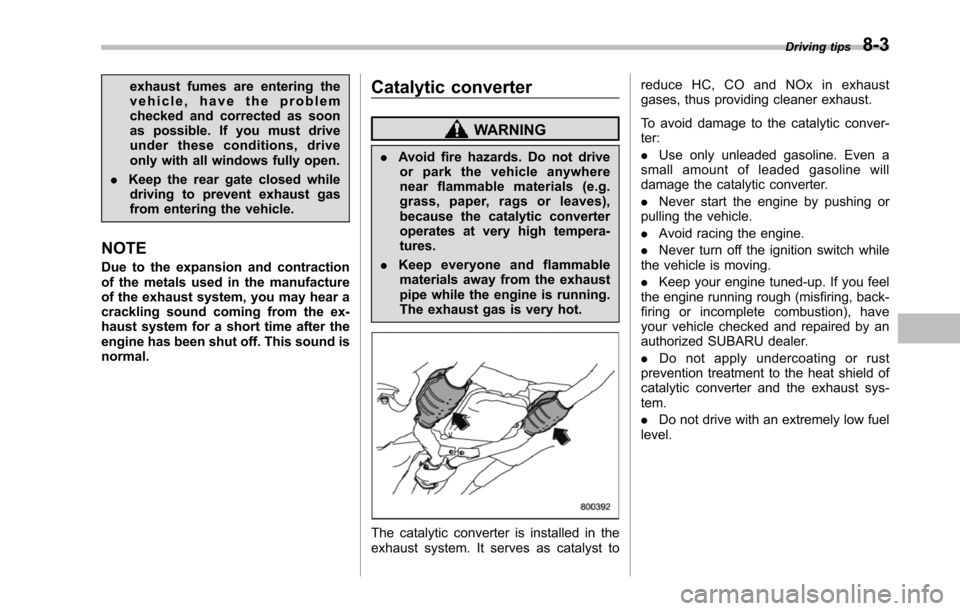
The catalytic converter is installed in theexhaust system. It serves as catalyst to
reduce HC, CO and NOx in exhaustgases, thus providing cleaner exhaust.
To avoid damage to the catalytic conver-ter:
.Use only unleaded gasoline. Even asmall amount of leaded gasoline willdamage the catalytic converter.
.Never start the engine by pushing orpulling the vehicle.
.Avoidracing the engine.
.Never turn off the ignition switch whilethe vehicle is moving.
.Keep your engine tuned-up. If you feelthe engine running rough (misfiring, back-firing or incomplete combustion), haveyour vehicle checked and repaired by anauthorized SUBARU dealer.
.Do not apply undercoating or rustprevention treatment to the heat shield ofcatalytic converter and the exhaust sys-tem.
.Do not drive with an extremely low fuellevel.
Driving tips8-3
Page 283 of 426
8-4Driving tips
Periodic inspections
To keep your vehicle in the best conditionat all times, always have the recom-mended maintenance services listed inthe maintenance schedule in the“War-ranty and Maintenance Booklet”per-formed at the specified time or mileageintervals.
Driving in foreign countries
When planning to use your vehicle inanother country:
.Confirm the availability of the correctfuel. Refer to“Fuel requirements”F7-2.
.Comply with all regulations and re-quirements of each country.
Driving tips for AWD models
WARNING
.Always maintain a safe drivingspeed according to the road andweather conditions in order toavoidhaving an accident on asharp turn, during sudden brak-ing or under other similar condi-tions.
.Always use the utmost care indriving–overconfidence be-cause you are driving an All-Wheel Drive model could easilylead to a serious accident.
.When replacing a tire, you mustuse a tire that is of the same size,circumference, speed symboland load index as the originaltires listed on the tire placard.Using tires of other sizes, cir-cumferences or constructionsmay result in severe mechanicaldamage to the drive train of yourvehicle and may affect ride,handling,braking, speedometer/odometer calibration, and clear-ance between the body and tires.It also may be dangerous andlead to loss of vehicle control.
Page 285 of 426
8-6Driving tips
On-road and off-road driving
WARNING
.In a rollover crash, an unbeltedperson is significantly morelikely to die than a person wear-ing a seatbelt. You the driver andall your passengers should fas-ten the seatbelts before startingto drive in order to minimize thechance of serious injury or death.
.Do not make sharp turns andquick maneuvers unless abso-lutely unavoidable. Such actionsare dangerous as you may losecontrol, possibly resulting in arolloverwhich could cause deathor serious injury.
.Always maintain a safe drivingspeed according to the road andweather conditions in order toavoid havingan accident on asharp turn, during sudden brak-ing or under other similar condi-tions.
.Whenever strong crosswinds arepresent, slow down sufficientlyto maintain control of your vehi-cle. Remember that your vehicle,with its higher profile and center
of gravity, is more likely to beaffected by crosswinds than or-dinary passenger cars.
.Always use the utmost care indriving–overconfidence be-cause you are driving an All-Wheel Drive model could easilylead to a serious accident.
Yo u r v e h i c l e i s c l a s s i f i e d a s a u t i l i t yvehicle. Utilityvehicles feature a higherground clearance which enables them tobe used for wide applications including off-road driving. But please keep in mind thatyour vehicle is neither a conventional off-road vehicle nor an all-terrain vehicle. Ahighercenter of gravity in relation to thetread width as compared with ordinarypassenger cars makes vehicles of thistype more likely to roll over. In reality, utilityvehicles have a significantly higher roll-over rate thanother types of vehicles. Thehigh ground clearance of this vehicle is areal advantage, giving you a better view ofthe road and allowing you to anticipateproblems earlier. However, remember thatyour utility vehicleis not designed for high-speed cornering comparable to ordinarypassenger cars and that your vehiclecould roll over if you make a sharp turnat high speed. If you do take yourSUBARU off-road, certain common sense
precautions such as those in the followinglist should be taken.
.Make certain that you and all of yourpassengers are wearing seatbelts.
.Carry some emergency equipment,such as a towing rope or chain, a shovel,wheel blocks, first aid kit and cell phone orcitizens band radio.
.Drive carefully. Do not take unneces-sary risks by driving in dangerous areas orover rough terrain.
.Slow down and employ extra caution atall times. When driving off-road, you willnot have the benefit of marked trafficlanes, banked curves, traffic signs andthe like.
.Do not drive across steep slopes.Instead, drive either straight up or straightdown the slopes. A vehicle can muchmore easily tip over sideways than it canend over end. Avoid driving straight up ordown slopes that are too steep.
.Avoid sharp turning maneuvers, espe-cially at higher speeds.
.Do not grip the inside or spokes of thesteering wheel. A bad bump could jerk thewheel andinjure your hands. Instead drivewith your fingers and thumbs on theoutside of the rim.
.If driving through water, such as whencrossing shallow streams, first check the
Page 288 of 426
could make the pedals slippery anddriving dangerous.
While warming up the vehicle beforedriving, check that the accelerator pedal,brake pedal, and all other controls operatesmoothly.
Clear away ice and snow that hasaccumulated under the fenders to avoidmaking steering difficult. During severewinter driving, stop when and where it issafe to do so and check under the fendersperiodically.
!Parking in cold weather
WARNING
Snow can trap dangerous exhaustgases under your vehicle. Keepsnow clear of the exhaust pipe andfrom around your vehicle if you parkthe vehicle in snow with the enginerunning.
Do not use the parking brake whenparking for long periods in cold weathersince it could freeze in that position.Instead, you should observe the followingtips.
1. Place the select lever in“P”position.
2. Use tire stops under the tires toprevent the vehicle from moving.
When the vehicle is parked in snow orwhen it snows, raise the wiper blades offthe glass to prevent damage to them.
When the vehicle has been left parkedafter use on roads heavily covered withsnow, or has been left parked during asnowstorm, icing may develop on thebrake system, which could cause poorbraking action.Check for snow or icebuildup on the suspension, disc brakesand brake hoses underneath the vehicle.
If there is caked snow or ice, remove it,being careful not to damage the discbrakes and brake hoses and ABS har-ness.
!Refueling in cold weather
To help prevent moisture from forming inthe fuel system and the risk of its freezing,use of an antifreeze additive in the fueltank is recommended during cold weather.
Use only additives that are specificallydesigned for this purpose. When anantifreeze additive is used, its effect lastslonger if the tank is refilled whenever thefuel level reaches half empty.
If your SUBARU is not going to be usedfor an extended period, it is best to havethe fuel tank filled to capacity.
&Driving on snowy and icy
roads
WARNING
Do not use the cruise control onslippery roads such as snowy or icyroads. This may cause loss ofvehicle control.
CAUTION
Avoid prolonged continuous drivingin snowstorms. Snow will enter theengine’sintakesystemandmayhinder the airflow, which could re-sult in engine shutdown or evenbreakdown.
To prevent skidding and slipping, avoidsudden braking, abrupt acceleration, high-speed driving, and sharp turning whendriving on snowy or icy roads.
Always maintain ample distance betweenyour vehicle and the vehicle ahead of youto avoid the need for sudden braking.
To supplement the foot brake, use theengine brake effectively to control thevehicle speed. (Shift into a lower gearwhen necessary.)
Avoid shifting down abruptly. Such beha-
Driving tips8-9
–CONTINUED–