warning SUBARU TRIBECA 2014 1.G Owners Manual
[x] Cancel search | Manufacturer: SUBARU, Model Year: 2014, Model line: TRIBECA, Model: SUBARU TRIBECA 2014 1.GPages: 426, PDF Size: 6.37 MB
Page 354 of 426
Tires and wheels
&Types of tires
You should be familiar with type of tirespresent on your vehicle.
!All season tires
The factory-installed tires on your newvehicle are all season tires.
All season tires are designed to providean adequate measure of traction, handlingand braking performance in year-rounddriving including snowy and icy roadconditions. However all season tires donot offer as much traction performance aswinter (snow) tires in heavy or loose snowor on icy roads.
All season tires are identified by“ALLSEASON”and/or“M+S”(Mud & Snow) onthe tire sidewall.
!Summer tires
Summer tires are high-speed capabilitytires best suited for highway driving underdry conditions.
Summer tires are inadequate for drivingon slippery roads such as on snow-covered or icy roads.
If you drive your vehicle on snow-coveredor icy roads, we strongly recommend theuse of winter (snow) tires.
When installing winter tires, be sure to
replace all four tires.
!Winter (snow) tires
Winter tires are best suited for driving onsnow-covered and icy roads. Howeverwinter tires do not perform as well assummer tires and all season tires on roadsother than snow-covered and icy roads.
&Tire pressure monitoring
system (TPMS)
The tire pressure monitoring system pro-vides the driver with a warning messageby sending a signal from a sensor that isinstalled in each wheel when tire pressureis severely low. The tire pressure monitor-ing system will activate only when thevehicle is driven. Also, this system maynot react immediately to a sudden drop intire pressure (for example, a blow-outcausedby running over a sharp object).
If you adjust the tire pressures in a warmgarage and will then drive the vehicle incold outside air, the resulting drop in tirepressures may cause the low tire pressurewarning light to illuminate. To avoid thisproblem when adjusting the tire pressuresin a warm garage, inflate the tires topressures higher than those shown on thetire placard. Specifically, inflate them by anextra 1 psi (6.9 kPa, 0.07 kgf/cm2) forevery difference of 108F (5.68C) between
the temperature in the garage and thetemperature outside. By way of example,the following table shows the required tirepressures that correspond to various out-side temperatures when the temperaturein the garage is 608F (15.68C).
Standard tire pressures:
Front: 33 psi (230 kPa, 2.3 kgf/cm2)
Rear: 32 psi (220 kPa, 2.2 kgf/cm2)
Garage temperature: 608F (15.68C)
OutsidetemperatureAdjusted pressure[psi (kPa, kgf/cm2)]
FrontRear
308F(!18C)36 (250, 2.5) 35 (240, 2.4)
108F(!128C)38(265, 2.65)37(255, 2.55)
!108F(!238C)40 (280, 2.8)39 (270, 2.7)
If the low tire pressure warning lightilluminates when you drive the vehicle incold outside air after adjusting the tirepressures in a warm garage, re-adjust thetire pressures using the method describedabove. Then, increase the vehicle speedto at least 20 mph (32 km/h) and check tosee that the low tire pressure warning lightturns off a few minutes later. If the low tirepressure warning light does not turn off,the tire pressure monitoring system may
Maintenance and service11-21
–CONTINUED–
Page 355 of 426
11-22Maintenance and service
not be functioning normally. In this event,go to a SUBARU dealer to have thesystem inspected as soon as possible.
While the vehicle is driven, friction be-tween tires and the road surface causesthe tires to warm up. After illumination ofthe low tire pressure warning light, anyincrease in the tire pressures caused byan increase in the outside air temperatureor by an increase in the temperature in thetires can cause the low tire pressurewarning light to turn off.
System resetting is necessary when thewheels are changed (for example, aswitch to snow tires) and new TPMSvalves are installed on the newly fittedwheels. Have this work performed by aSUBARU dealer following wheel replace-ment.
It may not be possible to install TPMSvalves on certain wheels that are on themarket. Therefore, if you change thewheels (for example, a switch to snowtires), use wheels that have the same partnumber as the standard-equipmentwheels. Without four operational TPMSvalve/sensors on the wheels, the TPMSwill not fully function and the warning lightin the instrument panel will illuminatesteadily after blinking for approximatelyone minute.
When a tire is replaced, adjustments arenecessary to ensure continued normaloperation of the tire pressure monitoringsystem. As with wheel replacement, there-fore, you should have the work performedby a SUBARU dealer.
WARNING
If the low tire pressure warning lightdoes not illuminate briefly after theignition switch is turned ON or thelight illuminates steadily after blink-ing for approximately one minute,you shouldhave your Tire PressureMonitoring System checked at aSUBARU dealer as soon as possi-ble.
If this light illuminates while driving,never brake suddenly and keepdriving straight ahead while gradu-ally reducing speed. Then slowlypull off the road to a safe place.Otherwise an accident involvingserious vehicle damage and seriouspersonal injury could occur.
If this light still illuminates whiledriving after adjusting the tire pres-sure, a tire may have significantdamage and a fast leak that causesthe tire to lose air rapidly. If you havea flat tire, replace it with a spare tire
as soon as possible.
When a spare tire is mounted or awheel rim is replaced without theoriginal pressure sensor/transmitterbeing transferred, the low tire pres-sure warning light will illuminatesteadily after blinking for approxi-mately one minute. This indicatesthe TPMS is unable to monitor allfour road wheels. Contact yourSUBARU dealer as soon as possiblefor tire and sensor replacement and/or system resetting. If the lightilluminates steadily after blinkingfor approximately one minute,promptly contact a SUBARU dealerto have the system inspected.
&Tire inspection
Checkon a daily basis that the tires arefree from serious damage, nails, andstones. At the same time, check the tiresfor abnormal wear.
Contact your SUBARU dealer immedi-ately if you find any problem.
NOTE
.When the wheels and tires strikecurbs or are subjected to harsh treat-ment as when the vehicle is driven on arough surface, they can suffer damage
Page 356 of 426
that cannot be seen with the naked eye.This type of damage does not becomeevident until time has passed. Try notto drive over curbs, potholes or onother rough surfaces. If doing so isunavoidable, keep the vehicle’s speeddown to a walking pace or less, andapproach the curbs as squarely aspossible. Also, make sure the tires arenot pressed against the curb when youpark the vehicle..If you feel unusual vibration whiledriving or find it difficult to steer thevehicle in a straight line, one of thetires and/or wheels may be damaged.Drive slowly to the nearest authorizedSUBARU dealer and have the vehicleinspected.
&Tire pressures and wear
Maintaining the correct tire pressureshelps to maximize the tires’service livesand is essential for good running perfor-mance. Check and, if necessary, adjustthe pressure of each tire (including thespare) at least once a month (for example,during a fuel stop) and before any longjourney.
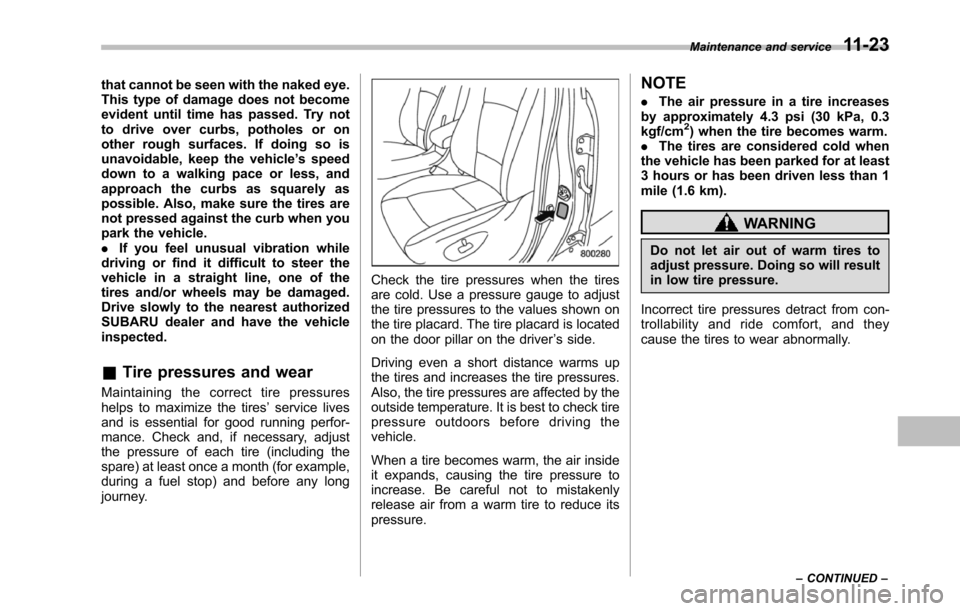
Check the tire pressures when the tiresare cold. Use a pressure gauge to adjustthe tirepressures to the values shown onthe tire placard. The tire placard is locatedon the door pillar on the driver’s side.
Driving even a short distance warms upthe tires and increases the tire pressures.Also, the tire pressures are affected by theoutside temperature. It is best to check tirepressure outdoors before driving thevehicle.
When a tire becomes warm, the air insideit expands, causing the tire pressure toincrease. Be careful not to mistakenlyreleaseair from a warm tire to reduce itspressure.
NOTE
.The air pressure in a tire increasesby approximately 4.3 psi (30 kPa, 0.3kgf/cm2) when the tire becomes warm..The tires are considered cold whenthe vehicle has been parked for at least3 hours or has been driven less than 1mile (1.6 km).
WARNING
Do not let air out of warm tires toadjust pressure. Doing so will resultin low tire pressure.
Incorrect tire pressures detract from con-trollability and ride comfort, and theycause the tires to wear abnormally.
Maintenance and service11-23
–CONTINUED–
Page 357 of 426
11-24Maintenance and service
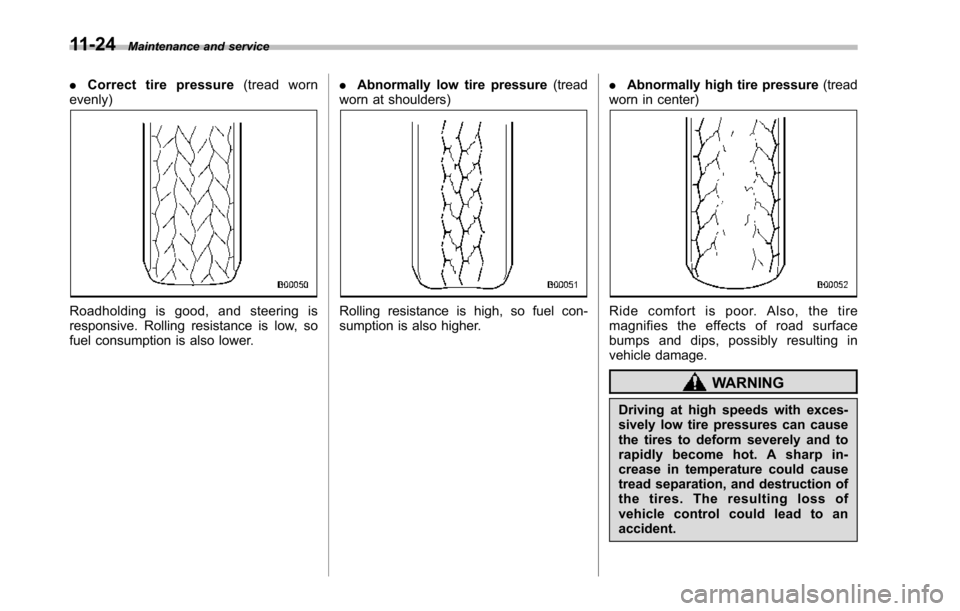
.Correct tire pressure(tread wornevenly)
Roadholding is good, and steering isresponsive.Rolling resistance is low, sofuel consumption is also lower.
.Abnormally low tire pressure(treadworn at shoulders)
Rolling resistance is high, so fuel con-sumption is also higher.
.Abnormally high tire pressure(treadworn in center)
Ride comfort is poor. Also, the tiremagnifies the effects of road surfacebumps and dips, possibly resulting invehicle damage.
WARNING
Driving at high speeds with exces-sively low tire pressures can causethe tires to deform severely and torapidly become hot. A sharp in-crease in temperature could causetread separation, and destruction ofthe tires. The resulting loss ofvehicle control could lead to anaccident.
Page 358 of 426
&Wheel balance
Each wheel was correctly balanced whenyour vehicle was new, but the wheels willbecome unbalanced as the tires becomeworn during use. Wheel imbalance causesthe steering wheel to vibrate slightly atcertain vehicle speeds and detracts fromthe vehicle’s straight-line stability. It canalso cause steering and suspension sys-tem problems and abnormal tire wear. Ifyou suspect that the wheels are notcorrectly balanced, have them checkedand adjusted by your SUBARU dealer.Also have themadjusted after tire repairsand after tire rotation.
CAUTION
Loss of correct wheel alignmentcauses the tires to wear on one sideand reduces the vehicle’s runningstability. Contact your SUBARUdealer if you notice abnormal tirewear.
NOTE
The suspension system is designed toholdeach wheel at a certain alignment(relative to the other wheels and to theroad) for optimum straight-line stabilityand cornering performance.
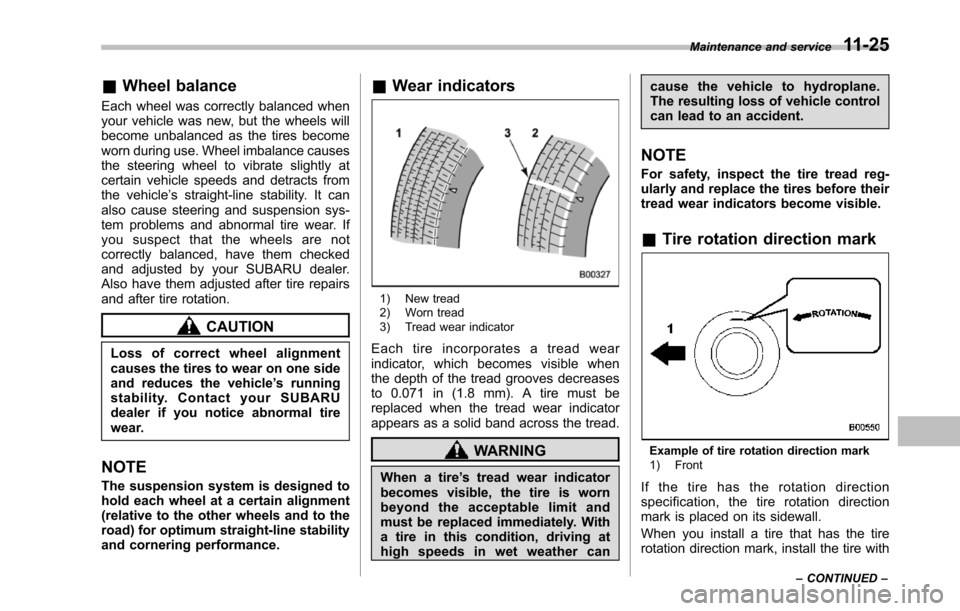
&Wear indicators
1) New tread2) Worn tread3) Tread wear indicator
Each tire incorporates a tread wearindicator, which becomes visible whenthe depth of the tread grooves decreasesto 0.071 in (1.8 mm). A tire must bereplaced when the tread wear indicatorappears as a solid band across the tread.
WARNING
When a tire’s tread wear indicatorbecomes visible, the tire is wornbeyond the acceptable limit andmust be replaced immediately. Witha tire in this condition, driving athigh speeds in wet weather can
cause the vehicle to hydroplane.The resulting loss of vehicle controlcan lead to an accident.
NOTE
For safety, inspect the tire tread reg-ularly and replace the tires before theirtread wear indicators become visible.
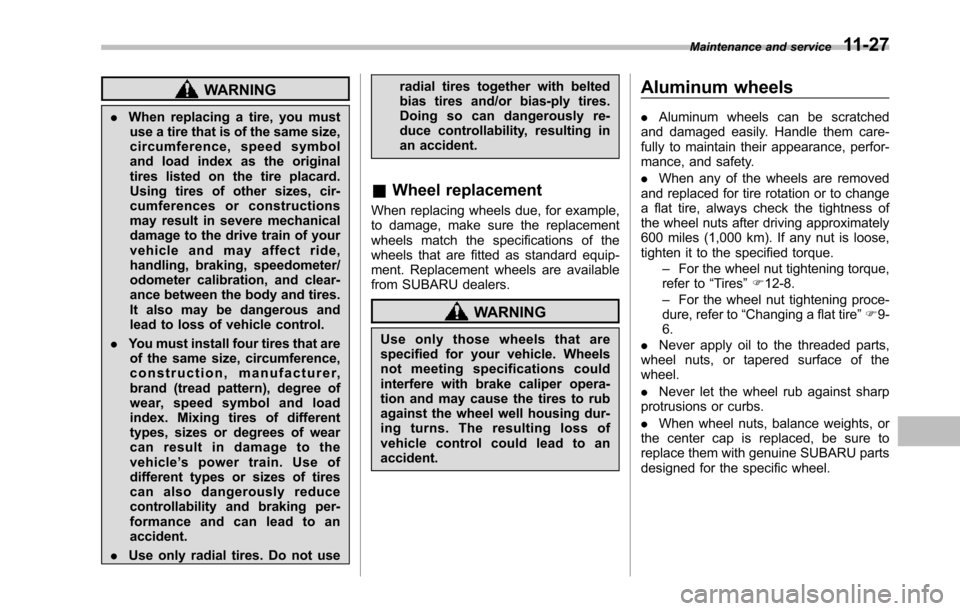
&Tire rotation direction mark
Example of tire rotation direction mark1) Front
If the tire has the rotation directionspecification, the tire rotation directionmark is placed on its sidewall.
When you install a tire that has the tirerotationdirection mark, install the tire with
Maintenance and service11-25
–CONTINUED–
Page 360 of 426
WARNING
.When replacing a tire, you mustuse a tire that is of the same size,circumference, speed symboland load index as the originaltires listed on the tire placard.Using tires of other sizes, cir-cumferences or constructionsmay result in severe mechanicaldamage to the drive train of yourvehicle and may affect ride,handling, braking, speedometer/odometer calibration, and clear-ance betweenthe body and tires.It also may be dangerous andlead to loss of vehicle control.
.You must install four tires that areof the same size, circumference,construction, manufacturer,brand(tread pattern), degree ofwear, speed symbol and loadindex. Mixing tires of differenttypes, sizes or degrees of wearcan result in damage to thevehicle’spowertrain.Useofdifferent types or sizes of tirescan also dangerously reducecontrollability and braking per-formance and can lead to anaccident.
.Use only radial tires. Do not use
radial tires together with beltedbias tires and/or bias-ply tires.Doing so can dangerously re-duce controllability, resulting inan accident.
&Wheel replacement
When replacing wheels due, for example,to damage, make sure the replacementwheels match the specifications of thewheels that are fitted as standard equip-ment. Replacement wheels are availablefrom SUBARUdealers.
WARNING
Use only those wheels that arespecified for your vehicle. Wheelsnot meeting specifications couldinterfere with brake caliper opera-tion and may cause the tires to rubagainst the wheel well housing dur-ing turns. The resulting loss ofvehicle control could lead to anaccident.
Aluminum wheels
.Aluminum wheels can be scratchedand damaged easily. Handle them care-fully to maintain their appearance, perfor-mance, and safety.
.When any of the wheels are removedand replaced for tire rotation or to changea flat tire, always check the tightness ofthe wheel nuts after driving approximately600 miles (1,000 km). If any nut is loose,tighten it to the specified torque.–For the wheel nut tightening torque,refer to“Tires”F12-8.–For the wheel nut tightening proce-dure, refer to“Changing a flat tire”F9-6..Never apply oil to the threaded parts,wheel nuts, or tapered surface of thewheel.
.Never let the wheel rub against sharpprotrusions or curbs.
.When wheel nuts, balance weights, orthe center cap is replaced, be sure toreplace them with genuine SUBARU partsdesigned for the specific wheel.
Maintenance and service11-27
Page 361 of 426
11-28Maintenance and service
Windshield washer fluid
CAUTION
Never use engine coolant as washerfluid because it could cause paintdamage.
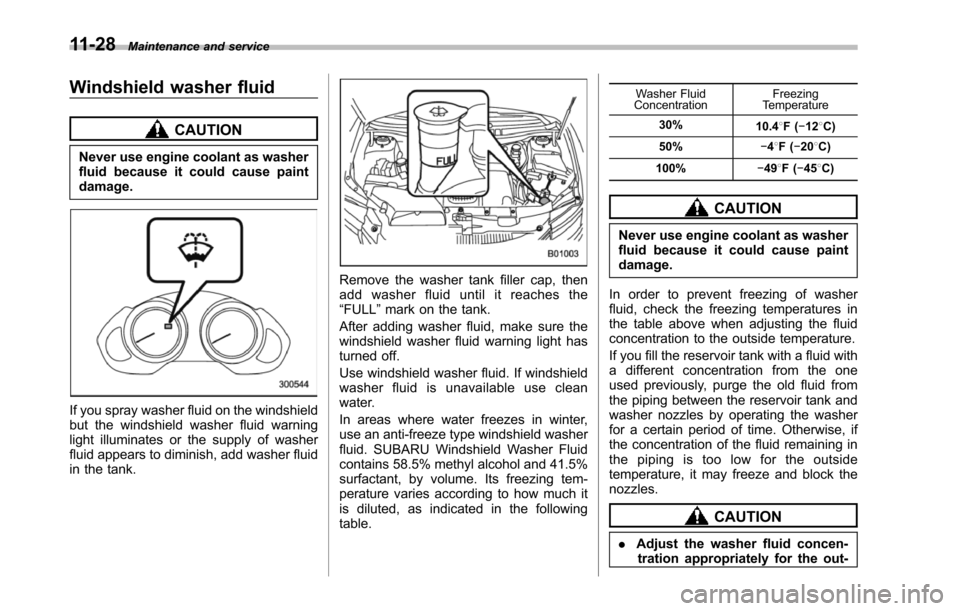
If you spray washer fluid on the windshieldbut thewindshield washer fluid warninglight illuminates or the supply of washerfluid appears to diminish, add washer fluidin the tank.
Remove the washer tank filler cap, thenadd washer fluid until it reaches the“FULL”mark on the tank.
After adding washer fluid, make sure thewindshieldwasher fluid warning light hasturned off.
Use windshield washer fluid. If windshieldwasher fluid is unavailable use cleanwater.
In areas where water freezes in winter,use an anti-freeze type windshield washerfluid. SUBARU Windshield Washer Fluidcontains 58.5% methyl alcohol and 41.5%surfactant, by volume. Its freezing tem-perature varies according to how much itis diluted, as indicated in the followingtable.
Washer FluidConcentrationFreezingTemperature
30%10.48F(!128C)
50%!48F(!208C)
100%!498F(!458C)
CAUTION
Never use engine coolant as washerfluid because it could cause paintdamage.
In order to prevent freezing of washerfluid, check the freezing temperatures inthe table above when adjusting the fluidconcentration to the outside temperature.
If you fill the reservoir tank with a fluid witha different concentration from the oneused previously, purge the old fluid fromthe piping between the reservoir tank andwasher nozzles by operating the washerfor a certain period of time. Otherwise, ifthe concentration of the fluid remaining inthe piping is too low for the outsidetemperature, it may freeze and block thenozzles.
CAUTION
.Adjust the washer fluid concen-tration appropriately for the out-
Page 366 of 426
Battery
WARNING
.Before beginning work on or nearany battery, be sure to extinguishall cigarettes, matches, and light-ers. Never exposea battery to anopen flame or electric sparks.Batteries give off a gas which ishighly flammable and explosive.
.For safety, in case an explosiondoes occur, wear eye protectionor shield your eyes when work-ing near any battery. Never leanover a battery.
.Do not let battery fluid contacteyes, skin, fabrics, or paint be-causebattery fluid is a corrosiveacid. If battery fluid gets on yourskin or in your eyes, immediatelyflush the area with water thor-oughly. Seek medical help imme-diately if acid has entered theeyes.
If battery fluid is accidentallyswallowed, immediately drink alarge amount of milk or water,and seek medical attention im-mediately.
.To l e s s e n t h e r i s k o f s p a r k s ,
remove rings, metal watchbands,and other metal jewelry. Neverallow metal tools to contact thepositive battery terminal and any-thing connected to it WHILE youare at the same time in contactwith any other metallic portion ofthe vehicle because a short cir-cuit willresult.
.Keep everyone including childrenaway from the battery.
.Charge the battery in a well-ventilated area.
.Battery posts, terminals, and re-lated accessories contain leadand lead compounds, chemicalsknown to the State of Californiato cause cancer and reproductiveharm. Batteries also containother chemicals known to theState of California to cause can-cer. Wash hands after handling.
CAUTION
Never use morethan 10 ampereswhen charging the battery becauseit will shorten battery life.
It is unnecessary to periodically check thebattery fluid level or periodically refill with
distilled water.
Maintenance and service11-33
Page 369 of 426
11-36Maintenance and service
Installation of accessories
Always consult your SUBARU dealerbefore installing fog lights or any otherelectrical equipment in your vehicle. Suchaccessories may cause the electronicsystem to malfunction if they are incor-rectly installedor if they are not suited forthe vehicle.
Replacing bulbs
WARNING
Bulbs may become very hot whileilluminated. Before replacing bulbs,turn off the bulbs and wait until thebulbs cooldown. Otherwise, there isa risk of sustaining a burn injury.
CAUTION
Replaceany bulb only with a newbulb of the specified wattage. Usinga bulb of different wattage couldresult in a fire. For the specifiedwattage of each bulb, refer to“Bulbchart”F12-12.
&Headlights (models with HID
headlights)
WARNING
High-intensity-discharge (HID) bulbsare used for the low beams of theheadlights. These HID bulbs use anextremelyhigh voltage. To avoid therisk of an electric shock that couldresult in serious injury, observe the
following precautions.
.Do not replace any headlightbulbs (both low beam and highbeam) by yourself.
.Do not remove/restore the head-light assemblies by yourself.
.Do not remove any headlight-assembly components by your-self.
For replacement, contact yourSUBARU dealer.
&Headlights (models without
HID headlights)
CAUTION
Halogen headlight bulbs becomevery hot while in use. If you touchthebulb surface with bare hands orgreasy gloves, fingerprints orgrease on the bulb surface willdevelop into hot spots, causing thebulb to break. If there are fingerprints or grease on the bulb surface,wipe them away with a soft clothmoistened with alcohol.
Page 388 of 426
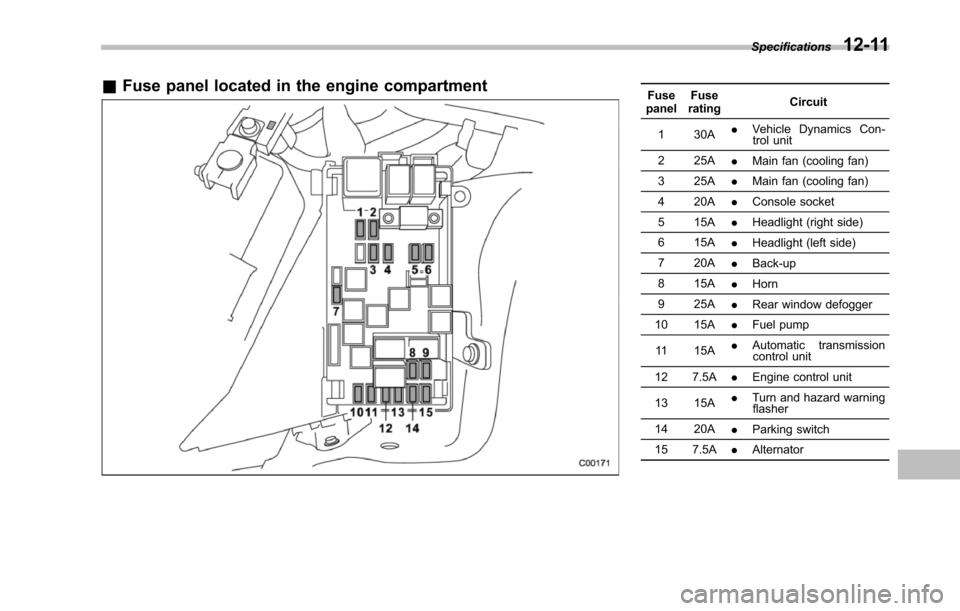
&Fuse panel located in the engine compartmentFusepanelFuseratingCircuit
1 30A.Vehicle Dynamics Con-trol unit
2 25A.Main fan (cooling fan)
3 25A.Main fan (cooling fan)
4 20A.Console socket
5 15A.Headlight (right side)
6 15A.Headlight (left side)
7 20A.Back-up
8 15A.Horn
9 25A.Rear window defogger
10 15A.Fuel pump
11 15A.Automatic transmissioncontrol unit
12 7.5A.Engine control unit
13 15A.Turn and hazard warningflasher
14 20A.Parking switch
15 7.5A.Alternator
Specifications12-11