warning SUBARU TRIBECA 2014 1.G Owners Manual
[x] Cancel search | Manufacturer: SUBARU, Model Year: 2014, Model line: TRIBECA, Model: SUBARU TRIBECA 2014 1.GPages: 426, PDF Size: 6.37 MB
Page 324 of 426
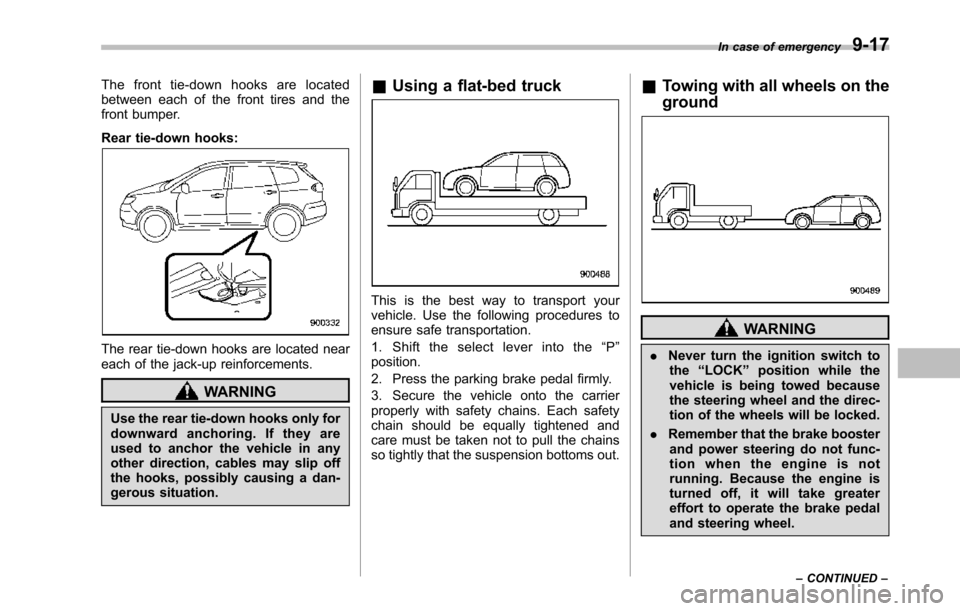
The front tie-down hooks are locatedbetween each of the front tires and thefront bumper.
Rear tie-down hooks:
The rear tie-down hooks are located neareach of the jack-up reinforcements.
WARNING
Use the rear tie-down hooks only fordownward anchoring. If they areused to anchor the vehicle in anyother direction, cables may slip offthe hooks,possibly causing a dan-gerous situation.
&Using a flat-bed truck
This is the best way to transport yourvehicle. Use the following procedures toensure safe transportation.
1. Shift the select lever into the“P”position.
2. Press the parking brake pedal firmly.
3. Secure the vehicle onto the carrierproperly with safety chains. Each safetychain should be equally tightened andcare must be taken not to pull the chainsso tightly that the suspension bottoms out.
&Towing with all wheels on the
ground
WARNING
.Never turn the ignition switch tothe“LOCK”position while thevehicle is being towed becausethe steeringwheel and the direc-tion of the wheels will be locked.
.Remember that the brake boosterand power steering do not func-tion when the engine is notrunning. Because the engine isturned off, it will take greatereffort to operate the brake pedaland steering wheel.
In case of emergency9-17
–CONTINUED–
Page 336 of 426
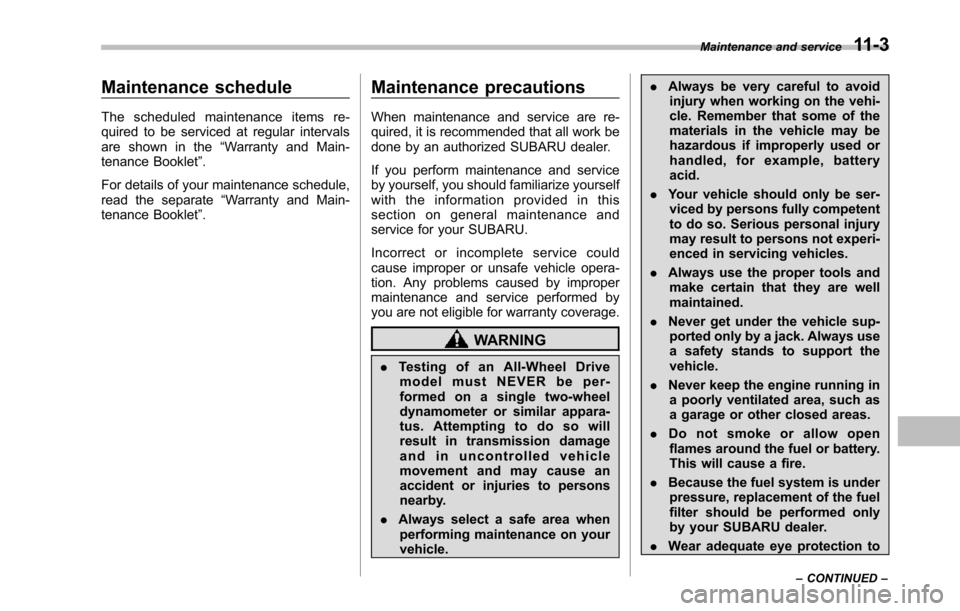
Maintenance schedule
The scheduled maintenance items re-quired to be serviced at regular intervalsare shown in the“Warranty and Main-tenance Booklet”.
For details of your maintenance schedule,read the separate“Warranty and Main-tenance Booklet”.
Maintenance precautions
When maintenance and service are re-quired, it is recommended that all work bedone by an authorized SUBARU dealer.
If you perform maintenance and serviceby yourself, you should familiarize yourselfwith the information provided in thissection on general maintenance andservice for yourSUBARU.
Incorrect or incomplete service couldcause improper or unsafe vehicle opera-tion. Any problems caused by impropermaintenance and service performed byyou are not eligible for warranty coverage.
WARNING
.Te s t i n g o f a n A l l - W h e e l D r i v emodel must NEVER be per-formed on a single two-wheeldynamometer or similar appara-tus. Attempting to do so willresult in transmission damageand in uncontrolled vehiclemovement and may cause anaccident or injuries to personsnearby.
.Always select a safe area whenperforming maintenance on yourvehicle.
.Always be very careful to avoidinjury when working on the vehi-cle. Remember that some of thematerials in the vehicle may behazardous if improperly used orhandled, for example, batteryacid.
.Your vehicle should only be ser-viced by persons fully competentto do so. Serious personal injurymay result to persons not experi-enced in servicing vehicles.
.Always use the proper tools andmake certain that they are wellmaintained.
.Never get under the vehicle sup-ported only by a jack. Always usea safety stands to support thevehicle.
.Never keep the engine running ina poorly ventilated area, such asa garage or other closed areas.
.Do not smoke or allow openflames around the fuel or battery.This will cause a fire.
.Because the fuel system is underpressure, replacement of the fuelfilter should be performed onlyby your SUBARU dealer.
.Wear adequate eye protection to
Maintenance and service11-3
–CONTINUED–
Page 337 of 426
11-4Maintenance and service
guard against getting oil or fluidsin your eyes. If something doesget in your eyes, thoroughlywash them out with clean water.
.Do not tamper with the wiring ofthe SRS airbag system or seat-belt pretensioner system, or at-tempt to take its connectorsapart, as that may activate thesystem or it can render it inop-erative. NEVER use a circuittester for these wiring. If yourSRS airbag or seatbelt preten-sioner needs service, consultyour nearest SUBARU dealer.
&Before checking or servicing
in the engine compartment
WARNING
.Always stop the engine and setthe parking brake firmly to pre-vent the vehicle from moving.
.Always let the engine cool down.Engine parts become very hotwhen the engine is running andremain hot for some time afterthe engine is stopped.
.Do not spill engine oil, enginecoolant, brake fluid or any other
fluid on hot engine components.This may cause a fire.
.Always remove the key from theignition switch. When the ignitionswitch is in the“ON”position,the cooling fan may operatesuddenly even when the engineis stopped.
&When you do checking or
servicing in the engine com-
partment while the engine is
running
WARNING
A running engine can be dangerous.Keep your fingers, hands, clothing,hair and tools away from the coolingfan, belts and any other movingengine parts. Removing rings,watches and ties is advisable.
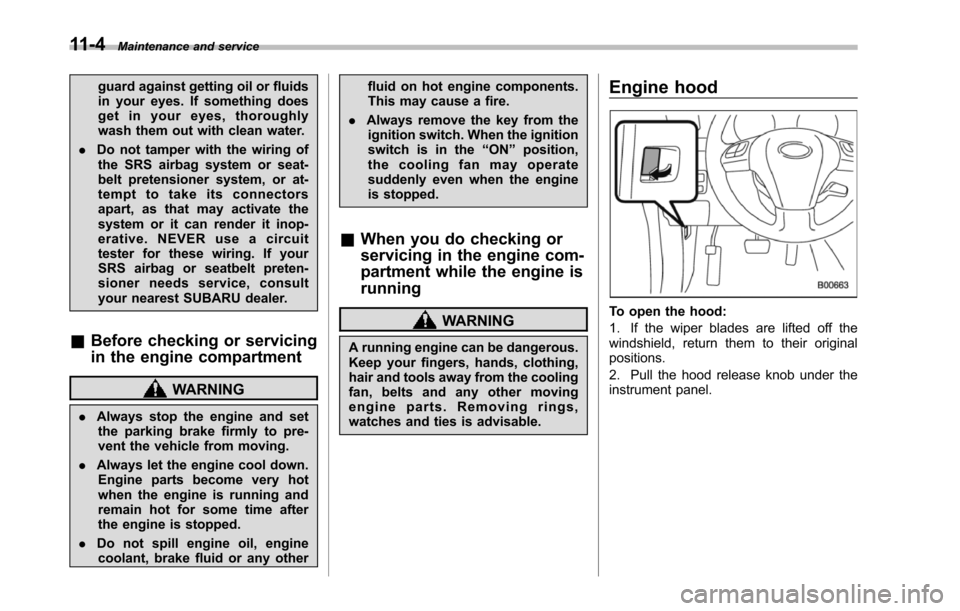
Engine hood
To open the hood:
1. If the wiper blades are lifted off thewindshield, return them to their originalpositions.
2. Pull the hood release knob under theinstrument panel.
Page 338 of 426
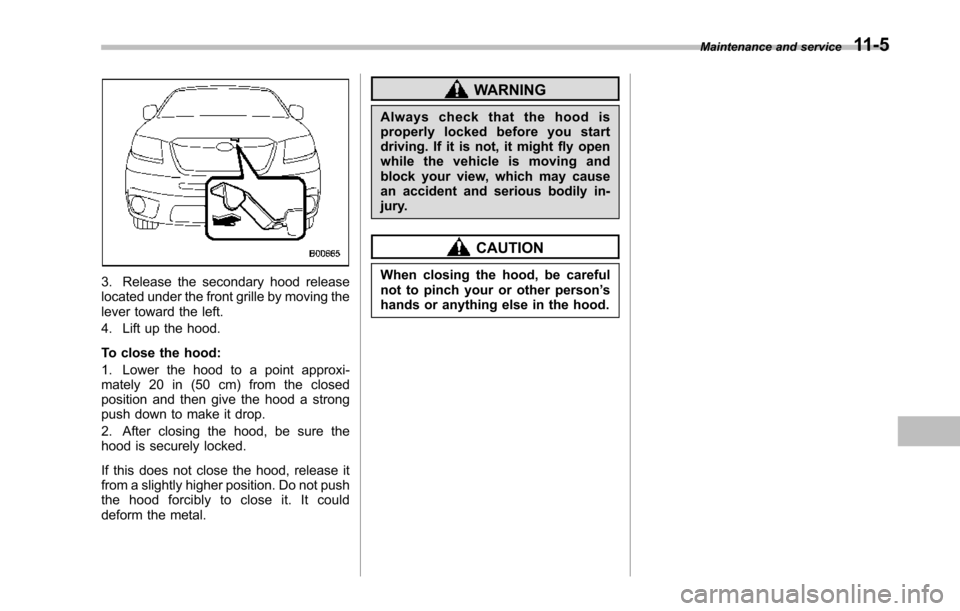
3. Release the secondary hood releaselocated under the front grille by moving thelever toward the left.
4. Lift up the hood.
To close the hood:
1. Lower the hood to a point approxi-mately 20 in (50 cm) from the closedposition and then give the hood a strongpush down to make it drop.
2. After closing the hood, be sure thehoodis securely locked.
If this does not close the hood, release itfrom a slightly higher position. Do not pushthe hood forcibly to close it. It coulddeform the metal.
WARNING
Always check that the hood isproperly locked before you startdriving. If it is not, it might fly openwhile the vehicle is moving andblock your view, which may causean accident and serious bodily in-jury.
CAUTION
When closing the hood, be carefulnot to pinch your or other person’shands or anything else in the hood.
Maintenance and service11-5
Page 341 of 426
11-8Maintenance and service
.Be careful not to spill engine oilwhen adding it. If oil touches theexhaust pipe, it may cause a badsmell, smoke, and/or a fire. Ifengine oil gets on the exhaustpipe, be sure to wipe it off.
If you check the oil level just after stoppingthe engine, wait a few minutes for the oil todrain back into the oil pan before checkingthe level.
To prevent overfilling the engine oil, do notadd any additional oil above the full levelwhen the engine is cold.
&Changing the oil and oil filter
CAUTION
.If you change your own oil, besure to drain all the oil from thefilter before disposal.
.Do not dispose of used engine oilby placing it in the trash, or bypouring it onto the ground, intosewers, or into any body of water.Check with your local govern-ment office for the proper dis-posal options available to you.
Change the oil and oil filter according tothe maintenance schedule in the“War-
ranty and Maintenance Booklet”.
The engine oil and oil filter must bechanged more frequently than listed inthe maintenance schedule when drivingon dusty roads, when short trips arefrequently made, or when driving inextremely cold weather.
1. Warm up the engine by letting theengine idle for approximately 10 minutesto ease draining the engine oil.
2. Park the vehicle on a level surface andstop the engine.
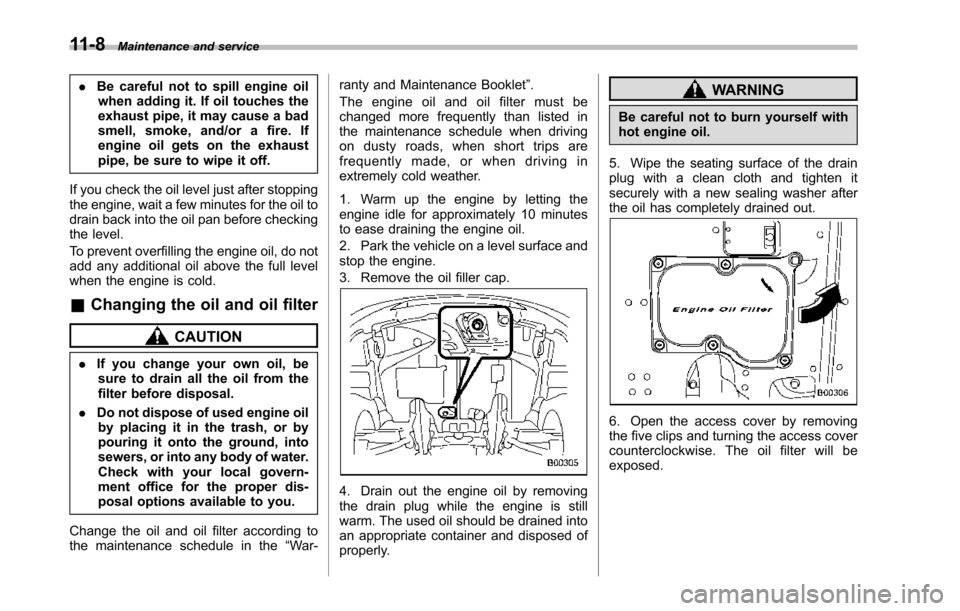
3. Remove the oil filler cap.
4. Drain out the engine oil by removingthe drain plug while the engine is stillwarm. The used oil should be drained intoan appropriate container and disposed ofproperly.
WARNING
Be careful not to burn yourself withhot engine oil.
5. Wipe the seating surface of the drainplug with a clean cloth and tighten itsecurely with a new sealing washer afterthe oil has completely drained out.
6. Open the access cover by removingthe five clips and turning the access covercounterclockwise. The oil filter will beexposed.
Page 343 of 426
11-10Maintenance and service
mended engine oil for optimum engineperformance. Conventional oil may beused if synthetic oil is unavailable.
Cooling system
WARNING
Never attempt to remove the radia-tor cap until the engine has beenshut off and has cooled downcompletely. Since the coolant isunder pressure, you may sufferserious burns from a spray of boil-ing hot coolant when the cap isremoved.
CAUTION
.Vehicles are filled at the factorywith SUBARU Super Coolant thatdoes not require the first changefor 11 years/137,500 miles (11years/220,000 km). This coolantshould not be mixed with anyother brand or type of coolantduring this period. Mixing with adifferent coolant will reduce thelife of the coolant. Should it benecessary to top off the coolantfor any reason, use onlySUBARU Super Coolant.
If the SUBARU Super Coolant isdiluted with another brand ortype, the maintenance interval is
shortened to that of the mixingcoolant.
.Do not splash the engine coolantover painted parts. The alcoholcontained in the engine coolantmay damage the paint surface.
&Hose and connections
Your vehicle employs an electric coolingfan which is thermostatically controlled tooperate when the engine coolant reachesa specific temperature.
If the radiator cooling fan does not operateeven when the engine coolant tempera-ture gauge exceeds the normal operatingrange, the cooling fan circuit may bedefective.Check the fuse and replace itif necessary. If the fuse is not blown, havethe cooling system checked by yourSUBARU dealer.
If frequent addition of coolant is neces-sary, there may be a leak in the enginecooling system. It is recommended thatthe cooling system and connections bechecked for leaks, damage, or looseness.
Page 345 of 426
11-12Maintenance and service
Air cleaner element
WARNING
Do not operate the engine with theair cleaner element removed. The aircleaner element not only filtersintake airbut also stops flames ifthe engine backfires. If the aircleaner element is not installedwhen the engine backfires, youcould be burned.
CAUTION
When replacing the air cleaner ele-ment, use a genuine SUBARU aircleaner element. If it is not used,there is the possibility of causing anegative effect to the engine.
The air cleaner element functions as afilter screen. When the element is perfo-rated or removed, engine wear will beexcessiveand engine life shortened.
It is unnecessary to clean or wash theelement.
&Replacing the air cleaner
element
Replace the air cleaner element accordingto the maintenance schedule in the“Warranty and Maintenance Booklet”. Un-der extremely dusty conditions, replace itmore frequently. It is recommended thatyou always use genuine SUBARU parts.
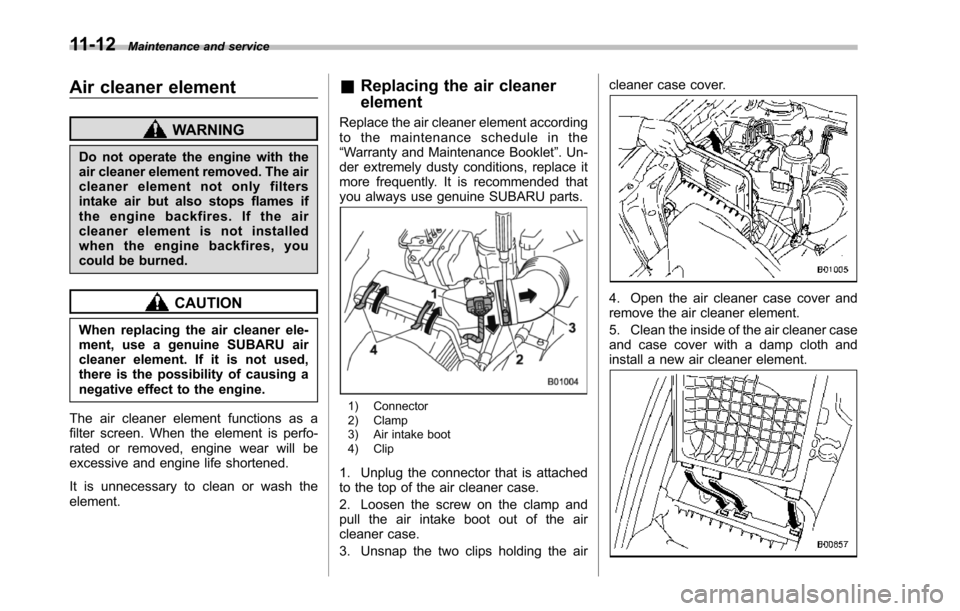
1) Connector2) Clamp3) Air intake boot4) Clip
1. Unplug the connector that is attachedto the top of the air cleaner case.
2. Loosen the screw on the clamp andpull theair intake boot out of the aircleaner case.
3. Unsnap the two clips holding the air
cleaner case cover.
4. Open the air cleaner case cover andremove the air cleaner element.
5. Clean the inside of the air cleaner caseand case cover with a damp cloth andinstall a new air cleaner element.
Page 349 of 426
11-16Maintenance and service
&Recommended grade and
viscosity
Each oil manufacturer has its own baseoils and additives. Never use differentbrands together. For details, refer to“Frontdifferential and rear differential gear oil”F12-6.
Rear differential gear oil
There is no oil level gauge. To check therear differential gear oil level, consult yourSUBARU dealer for inspection.
&Recommended grade and
viscosity
Each oil manufacturer has its own baseoils and additives. Never use differentbrands together. For details, refer to“Frontdifferential and rear differential gear oil”F12-6.
Power steering fluid
&Checking the fluid level
WARNING
Be careful not to burn yourselfbecause the fluid may be hot.
CAUTION
.When power steering fluid isbeing added, use only clean fluid,and be careful not to allow anydirt into the tank. And never usedifferent brands together.
.Be careful not to spill powersteering fluid when adding it. If
Page 350 of 426
power steering fluid touches theexhaust pipe, it may cause a badsmell, smoke, and/or a fire. Ifpower steering fluid gets on theexhaust pipe, be sure to wipe itoff.
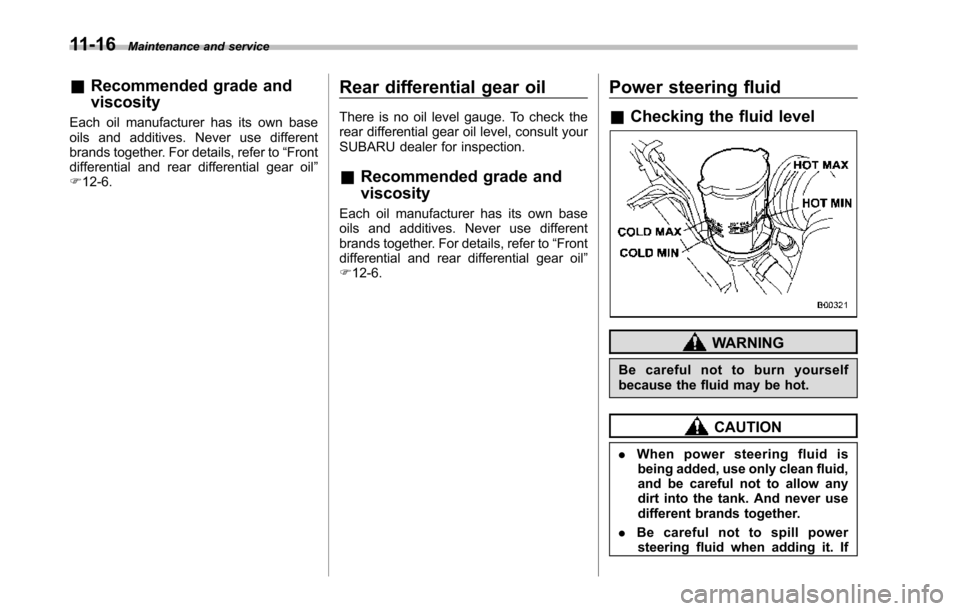
The power steering fluid expands greatlyas its temperature rises; the fluid leveldiffers according to fluid temperature.Therefore, the reservoir tank has twodifferent checking ranges for hot and coldfluids.
Check the power steering fluid levelmonthly.
1. Park the vehicle on a level surface,and stop the engine.
2. Check the fluid level of the reservoirtank.
When the fluid is hot after the vehicle hasbeen run: Check that the oil level isbetween“HOT MIN”and“HOT MAX”onthe surface of the reservoir tank.
When the fluid is cool before the vehicle isrun: Check that the oil level is between“COLD MIN”and“COLD MAX”on thesurface of the reservoir tank.
3. If the fluid level is lower than theapplicable“MIN”line, add the recom-mended fluid as necessary to bring thelevel between the“MIN”and“MAX”line.
If the fluid level is extreme low, it mayindicate possible leakage. Consult yourSUBARU dealer for inspection.
&Recommended fluid
Refer to“Fluids”F12-7.
Brake fluid
&Checking the fluid level
WARNING
.Never let brake fluid contact youreyes because brake fluid can beharmful to your eyes. If brakefluid gets in your eyes, immedi-ately flush them thoroughly withclean water. For safety, whenperforming this work, wearingeye protection is advisable.
.Brake fluid absorbs moisturefrom the air. Any absorbed moist-ure can cause a dangerous lossof braking performance.
.If the vehicle requires frequentrefilling, there may be a leak. Ifyou suspecta problem, have thevehicle checked at your SUBARUdealer.
CAUTION
.When adding brake fluid, be care-ful not to allow any dirt into thereservoir.
.Never splash the brake fluid overpainted surfaces or rubber parts.
Maintenance and service11-17
–CONTINUED–
Page 353 of 426
11-20Maintenance and service
you apply the brake pedal, have the brakepads serviced by your SUBARU dealer assoon as possible.
&Breaking-in of new brake
pads and linings
When replacing the brake pad or lining,use only genuine SUBARU parts. Afterreplacement, the new parts must bebroken in as follows.
!Brakepad and lining
While maintaining a speed of 30 to 40mph (50 to 65 km/h), step on the brakepedal lightly. Repeat this five or moretimes.
!Parking brake lining
WARNING
A safe location and situation shouldbe selected for break-in driving.
CAUTION
Pressing the parking brake pedaltoo forcefully may cause the rearwheels to lock. To avoid this, becertain to press the pedal slowlyand gently.
1. Drive the vehicle at a speed ofapproximately 22 mph (35 km/h).
2. Depress the parking brake pedalSLOWLY and GENTLY. (Pressing with aforce of approximately 34 lbf [150 N, 15kgf].)
3. Drive the vehicle for approximately220 yards (200 meters) in this condition.
4. Wait 5 to 10 minutes for the parkingbrake to cool down. Repeat this proce-dure.
5. Check the parking brake stroke. If theparking brake stroke is out of the specifiedrange, adjust it by turning the adjusting nutlocated on the parking brake pedal.
Parking brake stroke:
5–6 notches / 67 lbf (300 N, 30 kgf)
Parking brake stroke
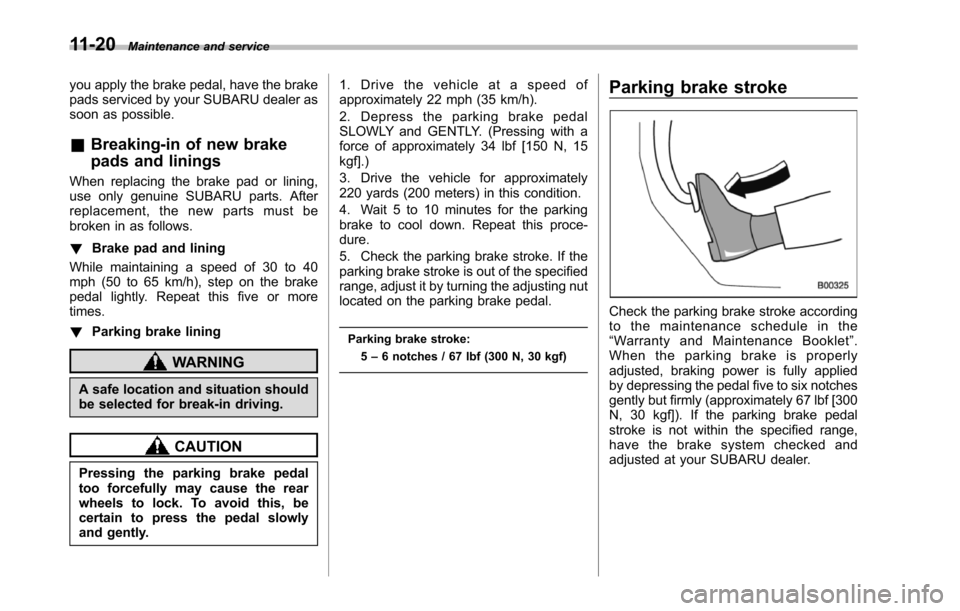
Check the parking brake stroke accordingto the maintenance schedule in the“Warranty and Maintenance Booklet”.When the parking brake is properlyadjusted, braking power is fully appliedby depressing the pedal five to six notchesgently but firmly (approximately 67 lbf [300N, 30 kgf]). If the parking brake pedalstroke is not within the specified range,have the brake system checked andadjusted at your SUBARU dealer.