engine SUBARU TRIBECA 2014 1.G User Guide
[x] Cancel search | Manufacturer: SUBARU, Model Year: 2014, Model line: TRIBECA, Model: SUBARU TRIBECA 2014 1.GPages: 426, PDF Size: 6.37 MB
Page 109 of 426
2-4Keys and doors
integrated unit, and combination meter.
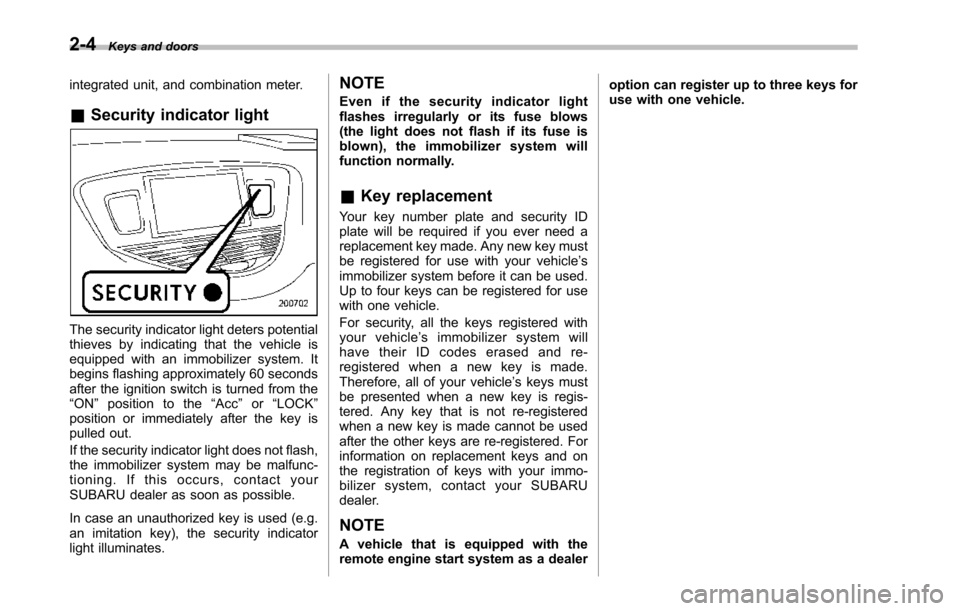
&Security indicator light
The security indicator light deters potentialthieves by indicating that the vehicle isequipped with an immobilizer system. Itbegins flashing approximately 60 secondsafter the ignition switch is turned from the“ON”position to the“Acc”or“LOCK”position or immediately after the key ispulled out.
If the security indicator light does not flash,the immobilizer system may be malfunc-tioning. If this occurs, contact yourSUBARUdealer as soon as possible.
In case an unauthorized key is used (e.g.an imitation key), the security indicatorlight illuminates.
NOTE
Even if the security indicator lightflashes irregularly or its fuse blows(the light does not flash if its fuse isblown), the immobilizer system willfunction normally.
&Key replacement
Your key number plate and security IDplate will be required if you ever need areplacement key made. Any new key mustbe registered for use with your vehicle’simmobilizer system before it can be used.Up to four keys can be registered for usewith one vehicle.
For security, all the keys registered withyour vehicle’simmobilizersystemwillhave their ID codes erased and re-registered when a new key is made.Therefore, all of your vehicle’s keys mustbe presented when a new key is regis-tered. Any key that is not re-registeredwhen a new key is made cannot be usedafter the other keys are re-registered. Forinformation on replacement keys and onthe registration of keys with your immo-bilizer system, contact your SUBARUdealer.
NOTE
A vehicle that is equipped with theremote engine start system as a dealer
option can register up to three keys foruse with one vehicle.
Page 122 of 426
&If you have accidentally trig-
gered the alarm system
!To stop the alarm
Do any of the following operations.
.Press any button on the remote trans-mitter.
.Turn the ignition switch to the“ON”position.
&Arming the system
!To arm the system using remotetransmitter
1. Close all windows and the moonroof.
2. Remove the key from the ignitionswitch.
3. Open the doors and get out of thevehicle.
4. Make sure that the engine hood islocked.
5. Close all doors and the rear gate.
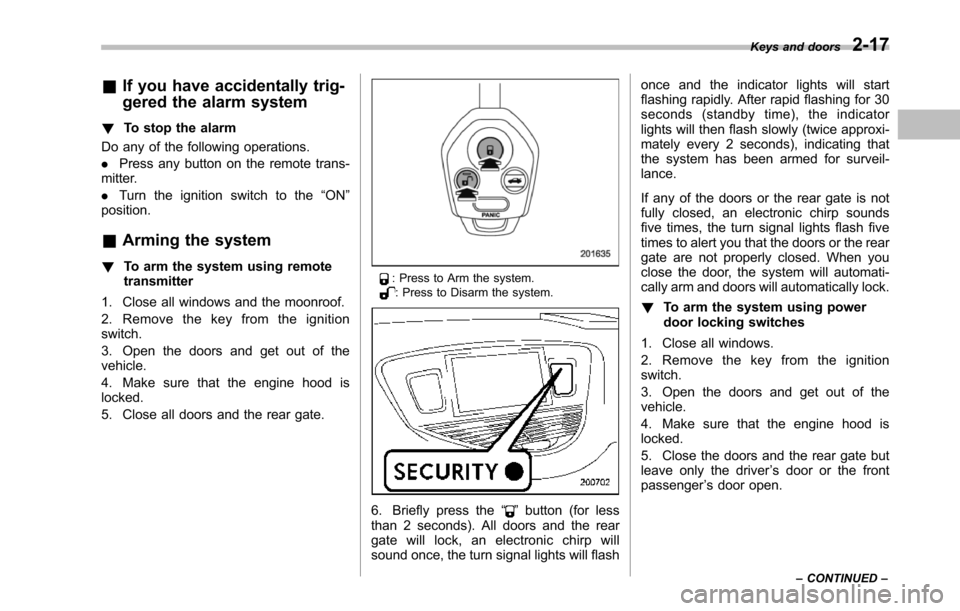
: Press to Arm the system.: Press to Disarm the system.
6. Briefly press the“”button (for lessthan 2 seconds). All doors and the reargate will lock, an electronic chirp willsound once, the turn signal lights will flash
once and the indicator lights will startflashing rapidly. After rapid flashing for 30seconds (standby time), the indicatorlights will then flash slowly (twice approxi-mately every 2 seconds), indicating thatthe system has been armed for surveil-lance.
If any of the doors or the rear gate is notfully closed, an electronic chirp soundsfive times, the turn signal lights flash fivetimes to alert you that the doors or the reargate are not properly closed. When youclose the door, the system will automati-cally arm and doors will automatically lock.
!To arm the system using powerdoor locking switches
1. Close all windows.
2. Remove the key from the ignitionswitch.
3. Open the doors and get out of thevehicle.
4. Make sure that the engine hood islocked.
5. Close the doors and the rear gate butleave only the driver’s door or the frontpassenger’s door open.
Keys and doors2-17
–CONTINUED–
Page 123 of 426
2-18Keys and doors
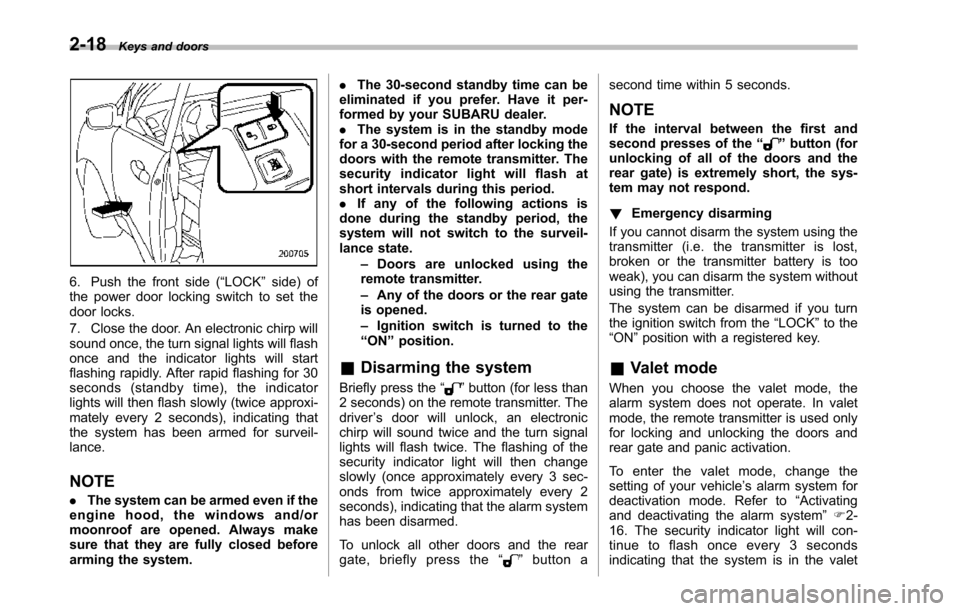
6. Push the front side (“LOCK”side) ofthe power door locking switch to set thedoor locks.
7. Close the door. An electronic chirp willsound once,the turn signal lights will flashonce and the indicator lights will startflashing rapidly. After rapid flashing for 30seconds (standby time), the indicatorlights will then flash slowly (twice approxi-mately every 2 seconds), indicating thatthe system has been armed for surveil-lance.
NOTE
.The system can be armed even if theengine hood, the windows and/ormoonroof are opened. Always makesure that they are fully closed beforearming the system.
.The 30-second standby time can beeliminated if you prefer. Have it per-formed by your SUBARU dealer..The system is in the standby modefor a 30-second period after locking thedoors with the remote transmitter. Thesecurity indicator light will flash atshort intervals during this period..If any of the following actions isdoneduring the standby period, thesystem will not switch to the surveil-lance state.–Doors are unlocked using theremote transmitter.–Any of the doors or the rear gateis opened.–Ignition switch is turned to the“ON”position.
&Disarming the system
Briefly press the“”button (for less than2 seconds) on the remote transmitter. Thedriver’s door will unlock, an electronicchirp will sound twice and the turn signallights willflash twice. The flashing of thesecurity indicator light will then changeslowly (once approximately every 3 sec-onds from twice approximately every 2seconds), indicating that the alarm systemhas been disarmed.
To unlock all other doors and the reargate, briefly press the“”button a
second time within 5 seconds.
NOTE
If the interval between the first andsecond presses of the“”button (forunlocking of all of the doors and therear gate) is extremely short, the sys-tem may not respond.
!Emergency disarming
If you cannot disarm the system using thetransmitter (i.e. the transmitter is lost,broken or the transmitter battery is tooweak), you can disarm the system withoutusing the transmitter.
The system can be disarmed if you turnthe ignition switch from the“LOCK”to the“ON”position with a registered key.
&Valet mode
When you choose the valet mode, thealarm system does not operate. In valetmode, the remote transmitter is used onlyfor locking and unlocking the doors andrear gate and panic activation.
To enter the valet mode, change thesetting of your vehicle’s alarm system fordeactivation mode. Refer to“Activatingand deactivatingthe alarm system”F2-16. The security indicator light will con-tinue to flash once every 3 secondsindicating that the system is in the valet
Page 134 of 426
Ignition switch..................................................... 3-3LOCK.................................................................. 3-3Acc ..................................................................... 3-4ON ...................................................................... 3-4START ................................................................ 3-4Key reminder chime............................................ 3-4Ignition switch light............................................. 3-4
Hazard warning flasher....................................... 3-5
Meters and gauges.............................................. 3-5Combination meter illumination........................... 3-5Canceling the function for meter needle/gaugemovement and combination meter sequentialillumination upon turning on the ignitionswitch............................................................... 3-5Speedometer....................................................... 3-6Odometer............................................................ 3-6Double trip meter................................................ 3-7Tachometer......................................................... 3-7Fuel gauge.......................................................... 3-8Temperature gauge............................................. 3-8
Warning and indicator lights.............................. 3-9Seatbelt warning light and chime........................ 3-10SRS airbag system warning light........................ 3-11Front passenger’s frontal airbag ON and OFFindicators......................................................... 3-12CHECK ENGINE warning light/Malfunctionindicator light................................................... 3-12Charge warning light.......................................... 3-13Oil pressure warning light.................................. 3-13AT OIL TEMP warning light................................. 3-13
Rear differential oil temperature warninglight................................................................ 3-13Low tire pressure warning light.......................... 3-14ABS warning light.............................................. 3-15Brake system warning light................................ 3-16Low fuel warning light....................................... 3-17Door open warning light.................................... 3-17Windshield washer fluid warning light................ 3-17All-Wheel Drive warning light ............................. 3-18Vehicle Dynamics Control warning light (U.S.-spec models and Canada-spec. models)/VehicleDynamics Control operation indicator light (allmodels)........................................................... 3-18Traction Control system OFF indicator light(U.S.-specmodels and Canada-spec.models)........................................................... 3-19Vehicle Dynamics Control warning light (LatinAmerica-spec. models)/Traction Control OFFindicator light (Latin America-spec. models)..... 3-19Security indicator light....................................... 3-21SPORT mode indicator light............................... 3-21Select lever/Gear position indicator.................... 3-21Turn signal indicator lights................................. 3-21High beam indicator light................................... 3-22Cruise control indicator light.............................. 3-22Cruise control set indicator light........................ 3-22Headlight indicator light..................................... 3-22Front fog lightindicator light.............................. 3-22
Clock.................................................................. 3-22
Outside temperature indicator.......................... 3-23Low outside temperature warning...................... 3-24
Instruments and controls
3
Page 136 of 426
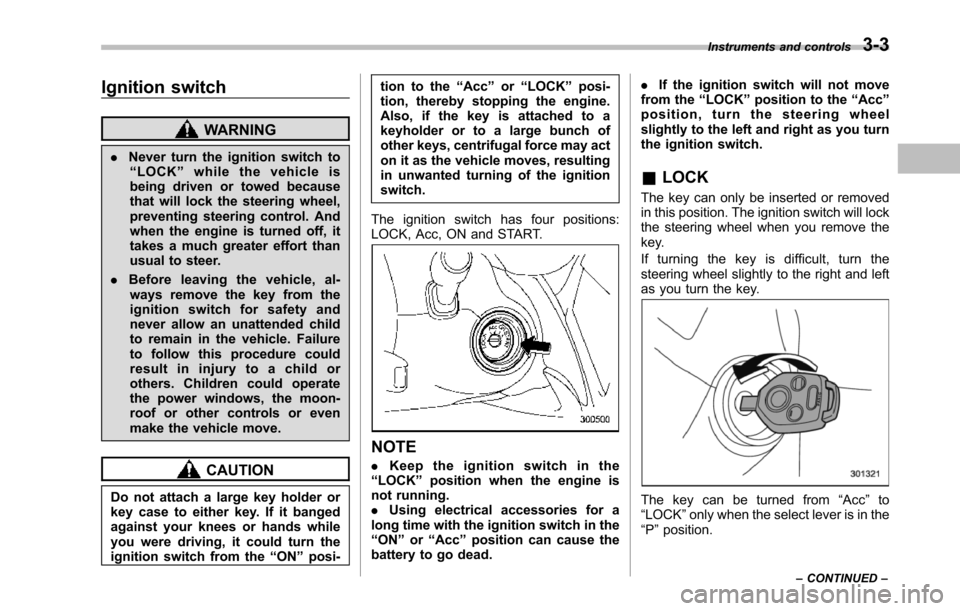
Ignition switch
WARNING
.Never turn the ignition switch to“LOCK”while the vehicle isbeing driven or towed becausethat will lock the steering wheel,preventing steering control. Andwhen the engine is turned off, ittakes a much greater effort thanusual to steer.
.Before leaving the vehicle, al-ways removethe key from theignition switch for safety andnever allow an unattended childto remain in the vehicle. Failureto follow this procedure couldresult in injury to a child orothers. Children could operatethe power windows, the moon-roof or other controls or evenmake the vehicle move.
CAUTION
Do not attach a large key holder orkey case to either key. If it bangedagainst your knees or hands whileyou were driving, it could turn theignition switch from the“ON”posi-
tion to the“Acc”or“LOCK”posi-tion, thereby stopping the engine.Also, if the key is attached to akeyholder or to a large bunch ofother keys, centrifugal force may acton it as the vehicle moves, resultingin unwanted turning of the ignitionswitch.
The ignition switch has four positions:LOCK, Acc, ON and START.
NOTE
.Keep the ignition switch in the“LOCK”position when the engine isnot running..Using electrical accessories for along time with the ignition switch in the“ON”or“Acc”position can cause thebattery to go dead.
.If the ignition switch will not movefrom the“LOCK”position to the“Acc”position, turn the steering wheelslightly to the left and right as you turnthe ignition switch.
&LOCK
The key can only be inserted or removedin this position. The ignition switch will lockthe steering wheel when you remove thekey.
If turning the key is difficult, turn thesteering wheel slightly to the right and leftas you turn the key.
The key can be turned from“Acc”to“LOCK”only when the select lever is in the“P”position.
Instruments and controls3-3
–CONTINUED–
Page 137 of 426
3-4Instruments and controls
&Acc
In this position the electrical accessories(radio, accessory power outlet, etc.) canbe used.
&ON
This is the normal operating position afterthe engine is started.
&START
CAUTION
Do not turn the ignition switch to the“START”position while the engineis running.
The engineis started in this position. Thestarter cranks the engine to start it. Whenthe key is released (after the engine hasstarted), the key automatically returns tothe“ON”position.
If your registered key fails to start theengine, pull out the key once (the securityindicator light will blink), and then insertthe key in the ignition switch and turn it tothe“START”position and again try to startthe engine.
NOTE
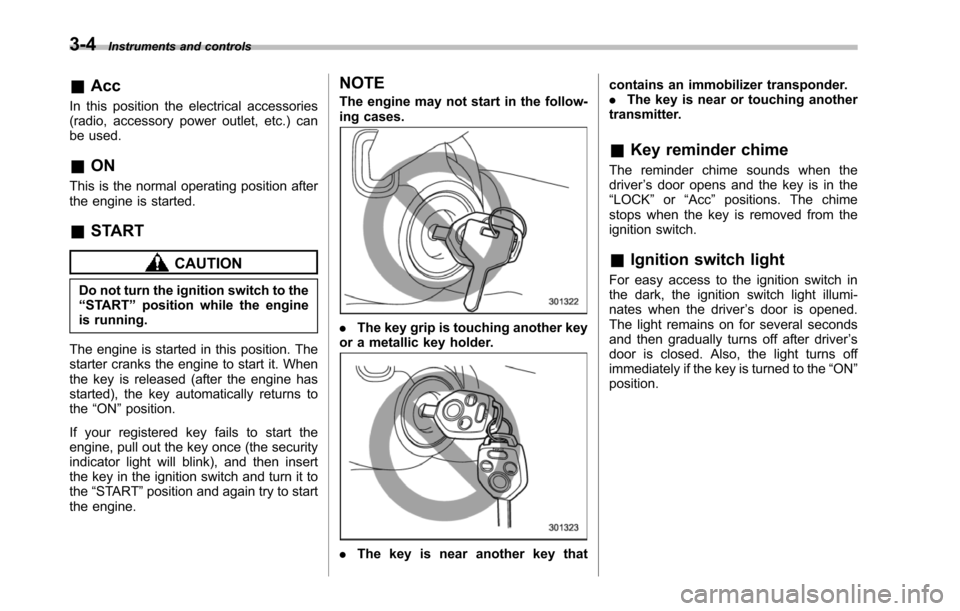
The engine may not start in the follow-ing cases.
.The key grip is touching another keyor a metallic key holder.
.Thekey is near another key that
contains an immobilizer transponder..The key is near or touching anothertransmitter.
&Key reminder chime
The reminder chime sounds when thedriver’s door opens and the key is in the“LOCK”or“Acc”positions. The chimestops when the key is removed from theignition switch.
&Ignition switch light
For easy access to the ignition switch inthe dark, the ignition switch light illumi-nates whenthe driver’s door is opened.The light remains on for several secondsand then gradually turns off after driver’sdoor is closed. Also, the light turns offimmediately if the key is turned to the“ON”position.
Page 138 of 426
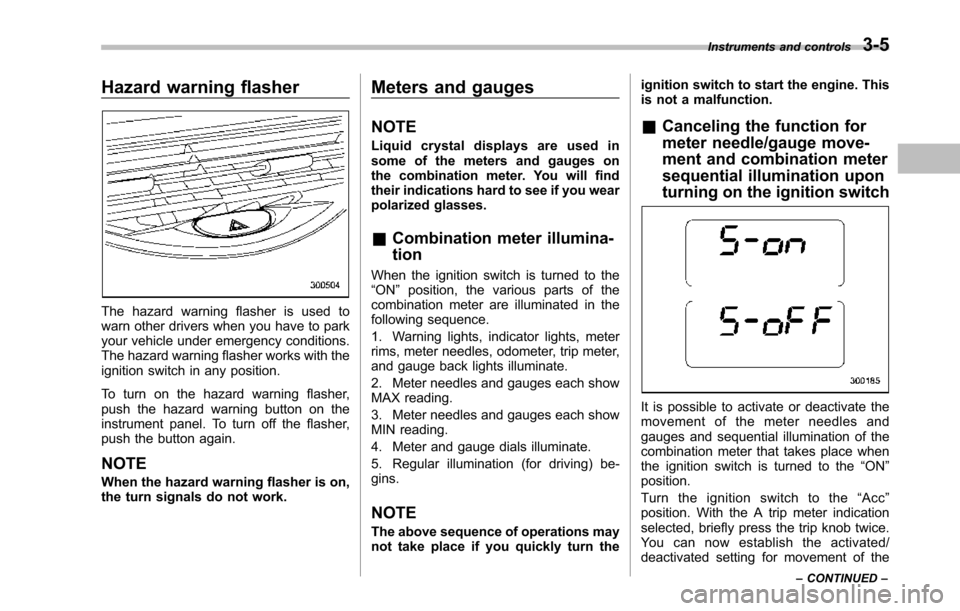
Hazard warning flasher
Thehazard warning flasher is used towarn other drivers when you have to parkyour vehicle under emergency conditions.The hazard warning flasher works with theignition switch in any position.
To turn on the hazard warning flasher,push the hazard warning button on theinstrumentpanel. To turn off the flasher,push the button again.
NOTE
When the hazard warning flasher is on,the turn signals do not work.
Meters and gauges
NOTE
Liquid crystal displays are used insome of the meters and gauges onthe combination meter. You will findtheir indications hard to see if you wearpolarized glasses.
&Combination meter illumina-
tion
When the ignition switch is turned to the“ON”position, the various parts of thecombinationmeter are illuminated in thefollowing sequence.
1. Warning lights, indicator lights, meterrims, meter needles, odometer, trip meter,and gauge back lights illuminate.
2. Meter needles and gauges each showMAX reading.
3. Meter needles and gauges each showMIN reading.
4. Meter and gauge dials illuminate.
5. Regular illumination (for driving) be-gins.
NOTE
The above sequence of operations maynot take place if you quickly turn the
ignition switch to start the engine. Thisis not a malfunction.
&Canceling the function for
meter needle/gauge move-
ment and combination meter
sequential illumination upon
turning on the ignition switch
It is possible to activate or deactivate themovement of the meter needles andgauges and sequential illumination of thecombination meter that takes place whenthe ignition switch is turned to the“ON”position.
Turn the ignition switch to the“Acc”position. With the A trip meter indicationselected, briefly press the trip knob twice.Yo u c a n n o w e s t a b l i s h t h e a c t i v a t e d /deactivated setting for movement of the
Instruments and controls3-5
–CONTINUED–
Page 140 of 426
The odometer/trip meter will also turn off ifyou open and close the driver’sdoorwithin 10 seconds of illumination of theodometer/trip meter.
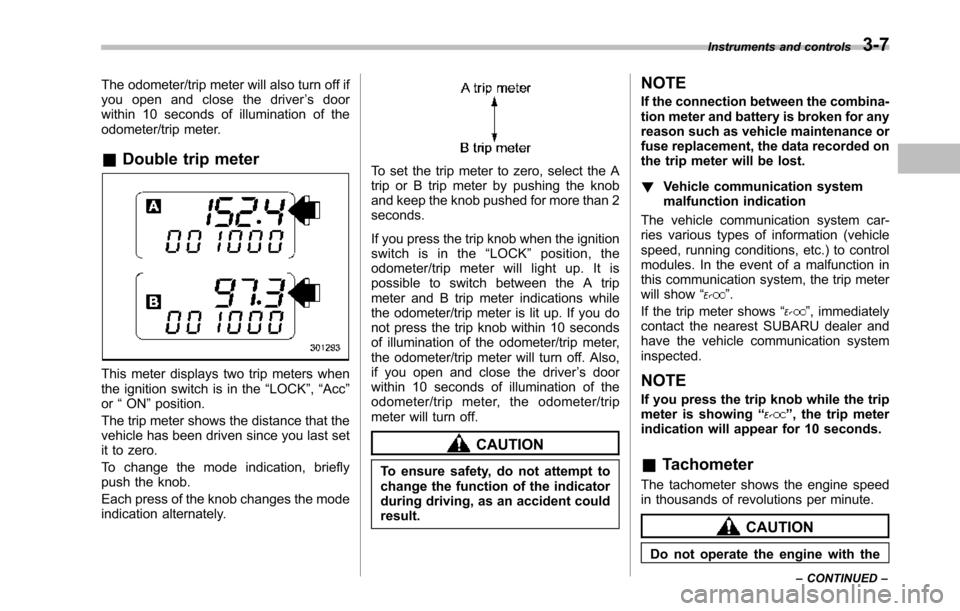
&Double trip meter
This meter displays two trip meters whenthe ignition switch is in the“LOCK”,“Acc”or“ON”position.
The trip metershows the distance that thevehicle has been driven since you last setit to zero.
To change the mode indication, brieflypush the knob.
Each press of the knob changes the modeindication alternately.
To set the trip meter to zero, select the Atrip or B trip meter by pushing the knoband keep the knob pushed for more than 2seconds.
If you press the trip knob when the ignitionswitch is in the“LOCK”position, theodometer/trip meter will light up. It ispossible to switch between the A tripmeter and B trip meter indications whilethe odometer/trip meter is lit up. If you donot press the trip knob within 10 secondsof illumination of the odometer/trip meter,the odometer/trip meter will turn off. Also,if you open and close the driver’s doorwithin 10 seconds of illumination of theodometer/trip meter, the odometer/tripmeter will turn off.
CAUTION
To ensure safety, do not attempt tochange thefunction of the indicatorduring driving, as an accident couldresult.
NOTE
If the connection between the combina-tion meter and battery is broken for anyreason such as vehicle maintenance orfuse replacement, the data recorded onthe trip meter will be lost.
!Vehicle communication systemmalfunction indication
The vehicle communication system car-ries various types of information (vehiclespeed, running conditions, etc.) to controlmodules. In the event of a malfunction inthis communication system, the trip meterwill show“”.
If the trip meter shows“”, immediatelycontact the nearest SUBARU dealer andhavethe vehicle communication systeminspected.
NOTE
If you press the trip knob while the tripmeter is showing“”, the trip meterindication will appear for 10 seconds.
&Tachometer
The tachometer shows the engine speedin thousands of revolutions per minute.
CAUTION
Do not operate the engine with the
Instruments and controls3-7
–CONTINUED–
Page 141 of 426
3-8Instruments and controls
pointer of the tachometer in the redzone. This may cause severe da-mage to the engine.
NOTE
To protect the engine while the selectlever is in the“P”or“N”position, theengineis controlled so that the enginespeed may not become too high even ifthe accelerator pedal is depressedhard.
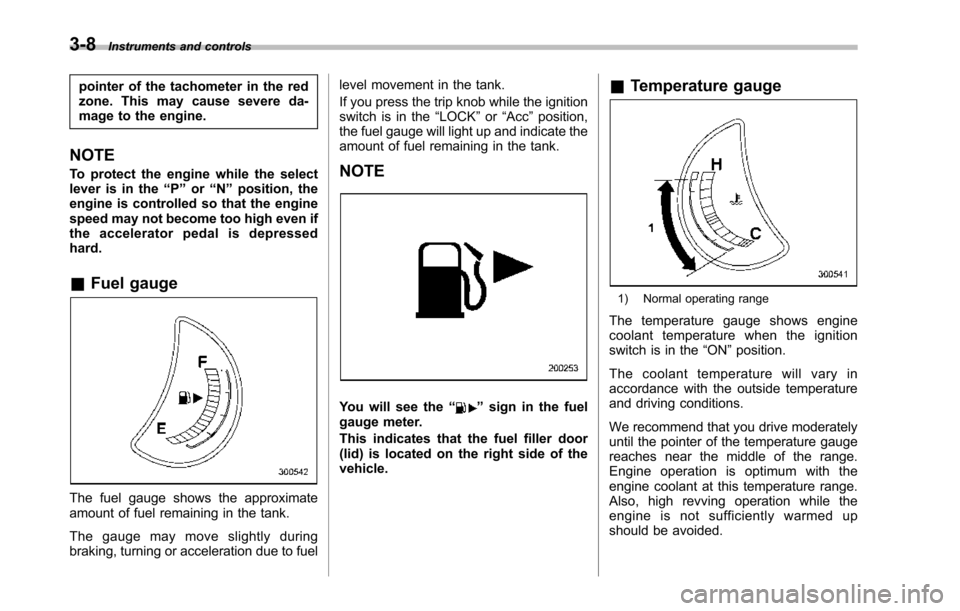
&Fuel gauge
The fuel gauge shows the approximateamount of fuel remaining in the tank.
The gauge may move slightly duringbraking, turning or acceleration due to fuel
level movement in the tank.
If you press the trip knob while the ignitionswitch is in the“LOCK”or“Acc”position,the fuel gauge will light up and indicate theamount of fuel remaining in the tank.
NOTE
You will see the“”signin the fuelgauge meter.
This indicates that the fuel filler door(lid) is located on the right side of thevehicle.
&Temperature gauge
1) Normal operating range
The temperature gauge shows enginecoolant temperature when the ignitionswitch is in the“ON”position.
The coolant temperature will vary inaccordance with the outside temperatureand driving conditions.
We recommend that you drive moderatelyuntil the pointer of the temperature gaugereaches near the middle of the range.Engine operation is optimum with theengine coolant at this temperature range.Also, high revving operation while theengine is not sufficiently warmed upshould be avoided.
Page 142 of 426
CAUTION
If the pointer exceeds the normaloperating range, safely stop thevehicle as soon as possible.
Refer to“Engine overheating”F9-14.
Warning and indicator lights
Several of the warning and indicator lightsilluminate momentarily and then turn offwhen the ignition switch is initially turnedto the“ON”position. This permits check-ing the operation of the bulbs.
Apply the parking brake and turn theignition switch to the“ON”position. Forthe system check, the following lightsilluminate and turn off after several sec-onds or after the engine has started:
: Driver’s seatbelt warning light(The seatbelt warning light turns offonly when the driver fastens theseatbelt.)
: Front passenger’s seatbelt warninglight(The seatbelt warning light turns offonly when the front seat passengerfastens the seatbelt.)
: SRS airbag system warning light
: CHECK ENGINE warning light/Mal-function indicator light
: Charge warning light
: Oil pressure warning light
: AT OIL TEMP warning light
/: ABS warning light
: Vehicle Dynamics Control warning light(U.S.-spec. models and Canada-spec.models)/Vehicle Dynamics Control op-eration indicator light (all models)
: Traction Control system OFF indicatorlight (U.S.-spec. models and Canada-spec. models)
: Vehicle Dynamics Control warning light(Latin America-spec. models)/TractionControl system OFF indicator light(Latin America-spec. models)
/: Brake system warning light
: AWD warning light
: Low tire pressure warning light
: SPORT mode indicator light
: Front passenger’s frontal airbag ONindicator light
: Front passenger’s frontal airbag OFFindicator light
: Low fuel warning light
: Cruise control indicator light
: Cruise control set indicator light
: Rear differential oil temperature warn-ing light
: Windshield washer fluid warning light
Instruments and controls3-9
–CONTINUED–