run flat SUBARU WRX 2016 User Guide
[x] Cancel search | Manufacturer: SUBARU, Model Year: 2016, Model line: WRX, Model: SUBARU WRX 2016Pages: 594, PDF Size: 19.43 MB
Page 480 of 594
position for CVT models. Shift the shift
lever into the “ 1st ” position for MT models.
2. Apply the parking brake firmly.
3. Secure the vehicle onto the carrier
properly with safety chains. Each safety
chain should be equally tightened and
care must be taken not to pull the chains
so tightly that the suspension bottoms out.
CAUTIONIf your vehicle has a front under-
spoiler and rear underspoiler (both
optional), be careful not to scrape
them when placing the vehicle on
the carrier and when removing the
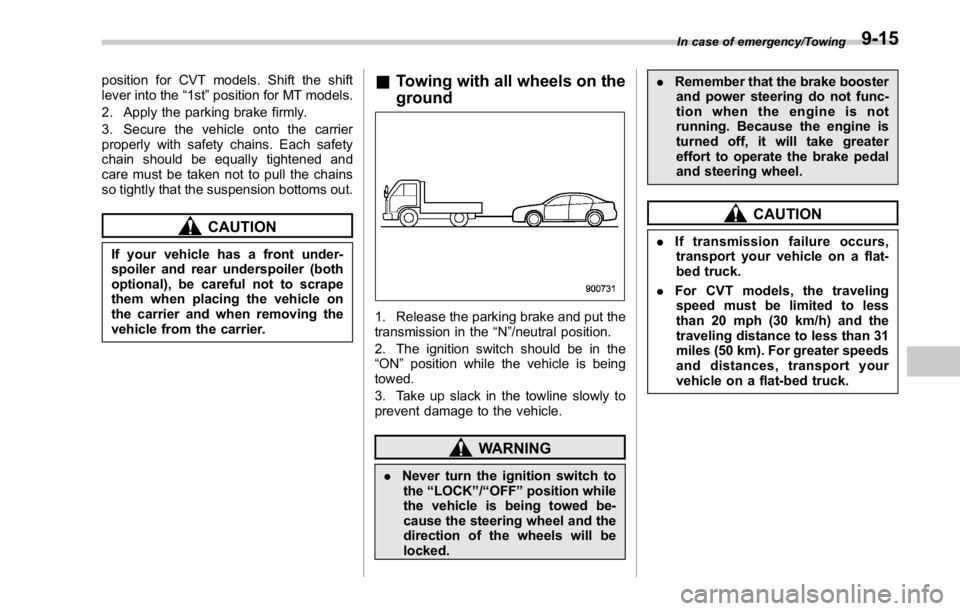
vehicle from the carrier. & Towing with all wheels on the
ground
1. Release the parking brake and put the
transmission in the “ N ” /neutral position.
2. The ignition switch should be in the
“ ON ” position while the vehicle is being
towed.
3. Take up slack in the towline slowly to
prevent damage to the vehicle.
WARNING
. Never turn the ignition switch to
the “ LOCK ” / “ OFF ” position while
the vehicle is being towed be-
cause the steering wheel and the
direction of the wheels will be
locked. . Remember that the brake booster
and power steering do not func-
tion when the engine is not
running. Because the engine is
turned off, it will take greater
effort to operate the brake pedal
and steering wheel.
CAUTION. If transmission failure occurs,
transport your vehicle on a flat-
bed truck.
. For CVT models, the traveling
speed must be limited to less
than 20 mph (30 km/h) and the
traveling distance to less than 31
miles (50 km). For greater speeds
and distances, transport your
vehicle on a flat-bed truck. In case of emergency/Towing
9-15
Page 520 of 594

Tires and wheels & Types of tires You should be familiar with type of tires
present on your vehicle.
! All season tires
All season tires are designed to provide
an adequate measure of traction, handling
and braking performance in year-round
driving including snowy and icy road
conditions. However all season tires do
not offer as much traction performance as
winter (snow) tires in heavy or loose snow
or on icy roads.
All season tires are identified by “ ALL
SEASON ” and/or “ M+S ” (Mud & Snow) on
the tire sidewall.
! Summer tires
Summer tires are high-speed capability
tires best suited for highway driving under
dry conditions.
Summer tires are inadequate for driving
on slippery roads such as on snow-
covered or icy roads.
If you drive your vehicle on snow-covered
or icy roads, we strongly recommend the
use of winter (snow) tires.
When installing winter tires, be sure to
replace all four tires. ! Winter (snow) tires
Winter tires are best suited for driving on
snow-covered and icy roads. However
winter tires do not perform as well as
summer tires and all season tires on roads
other than snow-covered and icy roads.
& Tire pressure monitoring
system (TPMS) (if equipped) The tire pressure monitoring system pro-
vides the driver with a warning message
by sending a signal from a sensor that is
installed in each wheel when tire pressure
is severely low. The tire pressure monitor-
ing system will activate only when the
vehicle is driven. Also, this system may
not react immediately to a sudden drop in
tire pressure (for example, a blow-out
caused by running over a sharp object).
If you adjust the tire pressures in a warm
garage and will then drive the vehicle in
cold outside air, the resulting drop in tire
pressures may cause the low tire pressure
warning light to illuminate. To avoid this
problem when adjusting the tire pressures
in a warm garage, inflate the tires to
pressures higher than those shown on the
tire placard. Specifically, inflate them by an
extra 1 psi (6.9 kPa, 0.07 kgf/cm 2
) for
every difference of 10 8 F (5.6 8 C) between
the temperature in the garage and the temperature outside. By way of example,
the following table shows the required tire
pressures that correspond to various out-
side temperatures when the temperature
in the garage is 60 8 F (15.6 8 C).
Example:
Tire size: 245/40R18 97W
Standard tire pressures:
Front: 33 psi (230 kPa, 2.3 kgf/cm 2
)
Rear: 32 psi (220 kPa, 2.2 kgf/cm 2
)
Garage temperature: 60 8 F (15.6 8 C)Outside
temperature Adjusted pressure
[psi (kPa, kgf/cm 2
)]
Front Rear
30 8 F( − 1 8 C) 36 (250, 2.5) 35 (240, 2.4)
10 8 F( − 12 8 C) 38 (260, 2.6) 37 (255, 2.55)
− 10 8 F( − 23 8 C) 40 (275, 2.75) 39 (270, 2.7)
If the low tire pressure warning light
illuminates when you drive the vehicle in
cold outside air after adjusting the tire
pressures in a warm garage, re-adjust the
tire pressures using the method described
above. Then, increase the vehicle speed
to at least 20 mph (32 km/h) and check to
see that the low tire pressure warning light
turns off a few minutes later. If the low tire
pressure warning light does not turn off,
the tire pressure monitoring system may
not be functioning normally. In this event, Maintenance and service/Tires and wheels
– CONTINUED –11-31
Page 537 of 594
Maintenance and service/Replacing bulbs
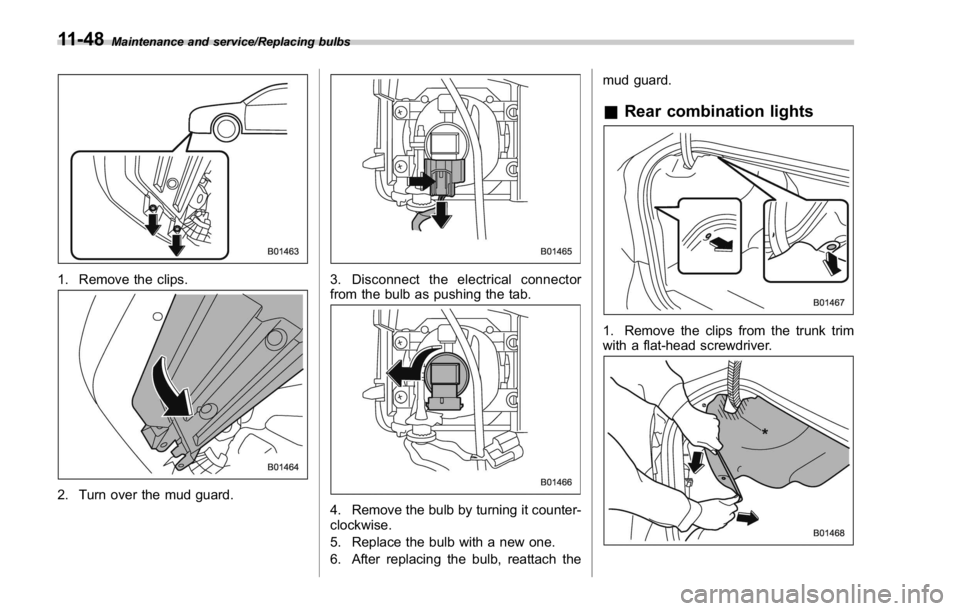
1. Remove the clips.
2. Turn over the mud guard. 3. Disconnect the electrical connector
from the bulb as pushing the tab.
4. Remove the bulb by turning it counter-
clockwise.
5. Replace the bulb with a new one.
6. After replacing the bulb, reattach the mud guard.
& Rear combination lights
1. Remove the clips from the trunk trim
with a flat-head screwdriver.11-48
Page 538 of 594
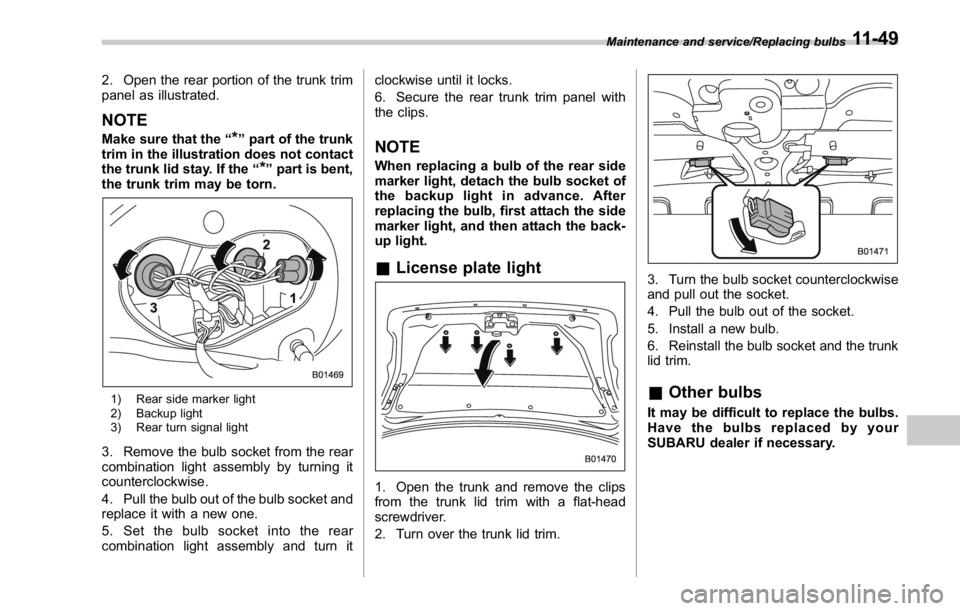
2. Open the rear portion of the trunk trim
panel as illustrated.
NOTE Make sure that the “
* ” part of the trunk
trim in the illustration does not contact
the trunk lid stay. If the “
* ” part is bent,
the trunk trim may be torn.
1) Rear side marker light
2) Backup light
3) Rear turn signal light
3. Remove the bulb socket from the rear
combination light assembly by turning it
counterclockwise.
4. Pull the bulb out of the bulb socket and
replace it with a new one.
5. Set the bulb socket into the rear
combination light assembly and turn it clockwise until it locks.
6. Secure the rear trunk trim panel with
the clips.
NOTE When replacing a bulb of the rear side
marker light, detach the bulb socket of
the backup light in advance. After
replacing the bulb, first attach the side
marker light, and then attach the back-
up light.
& License plate light
1. Open the trunk and remove the clips
from the trunk lid trim with a flat-head
screwdriver.
2. Turn over the trunk lid trim. 3. Turn the bulb socket counterclockwise
and pull out the socket.
4. Pull the bulb out of the socket.
5. Install a new bulb.
6. Reinstall the bulb socket and the trunk
lid trim.
& Other bulbs It may be difficult to replace the bulbs.
Have the bulbs replaced by your
SUBARU dealer if necessary. Maintenance and service/Replacing bulbs
11-49
Page 586 of 594

Tires and wheels. ...................................................... 11-31
Tools .......................................................................... 9-3
Top tether anchorages ........................................ 1-29, 1-32
Towing ...................................................................... 9-12
All wheels on the ground ........................................ 9-15
Flat-bed truck ........................................................ 9-14
Hooks ................................................................... 9-12
Trailer
Towing .................................................................. 8-12
Trip meter ................................................................... 3-9
Trunk lid ................................................................... 2-36
Release handle ..................................................... 2-37
Turn signal
Indicator lights ....................................................... 3-35
Lever .................................................................... 3-97
U
Under-floor storage compartment ................................. 6-12
Useful information ...................................................... 5-28
STARLINK ............................................................ 5-30
V
Valet mode ................................................................ 2-30
Vanity mirror ................................................................ 6-4
Vehicle
Capacity weight ..................................................... 8-11
Identification ........................................................ 12-18
Symbols .................................................................... 3
Vehicle Dynamics Control
OFF indicator light .................................................. 3-27
OFF switch ........................................................... 7-40 Operation indicator light ........................................... 3-26
System .................................................................. 7-38
Warning light .......................................................... 3-26
Ventilator .................................................................... 4-2
Voice command system operation ... ........................... 5-107
Voice command system ........................................ 5-107
W
Warning and indicator lights ......................................... 3-13
Warning chimes
Keyless access with push-button start system .... ........ 3-28
Warning light
ABS...................................................................... 3-20
Access key .................................................... 3-28, 3-29
All-Wheel Drive ...................................................... 3-25
AT OIL TEMP ......................................................... 3-18
Automatic headlight beam leveler ............................. 3-35
Brake system ......................................................... 3-21
Charge .................................................................. 3-17
CHECK ENGINE .................................................... 3-16
Door open ............................................................. 3-25
Driver ’ s Control Center Differential ............................ 3-36
Engine low oil level ................................................. 3-17
Hill start assist ....................................................... 3-24
Keyless access with push-button start system .... ........ 3-28
Low fuel ................................................................ 3-24
Low tire pressure .................................................... 3-19
Oil pressure ...........................................................
3-17
Power steering ....................................................... 3-25
Rear differential oil temperature ................................ 3-18
Seatbelt. ................................................................ 3-14 Index
14-11