service SUBARU WRX 2016 Workshop Manual
[x] Cancel search | Manufacturer: SUBARU, Model Year: 2016, Model line: WRX, Model: SUBARU WRX 2016Pages: 594, PDF Size: 19.43 MB
Page 507 of 594
Maintenance and service/Cooling system
Check the fuse and replace it if necessary.
Refer to “ Fuses ” F 11-42 and “ Fuses and
circuits ” F 12-10.
If the fuse is not blown, have the cooling
system checked by your SUBARU dealer.
If frequent addition of coolant is neces-
sary, there may be a leak in the engine
cooling system. It is recommended that
the cooling system and connections be
checked for leaks, damage, or looseness.
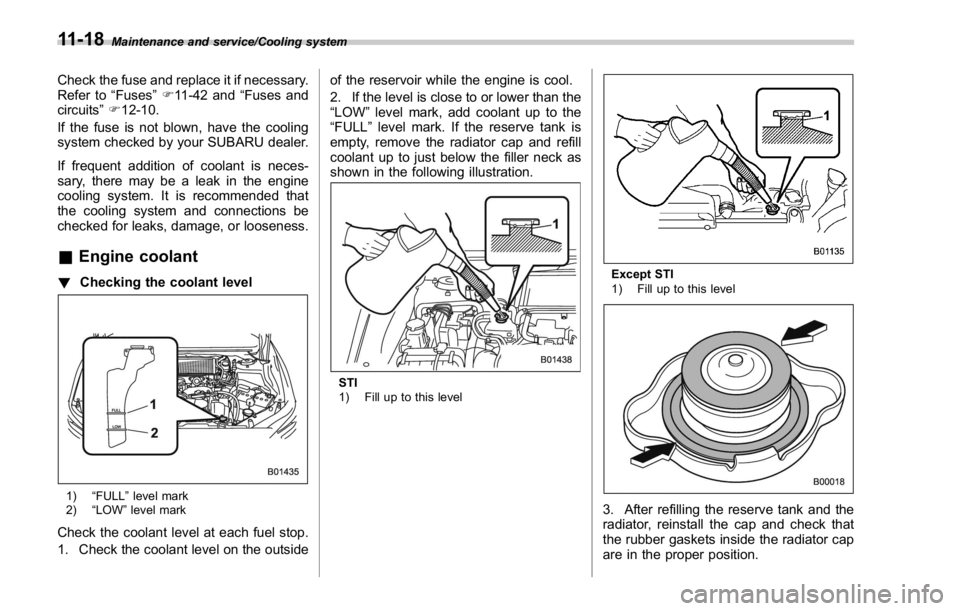
& Engine coolant! Checking the coolant level
1) “ FULL ” level mark
2) “ LOW ” level mark
Check the coolant level at each fuel stop.
1. Check the coolant level on the outside of the reservoir while the engine is cool.
2. If the level is close to or lower than the
“ LOW ” level mark, add coolant up to the
“ FULL ” level mark. If the reserve tank is
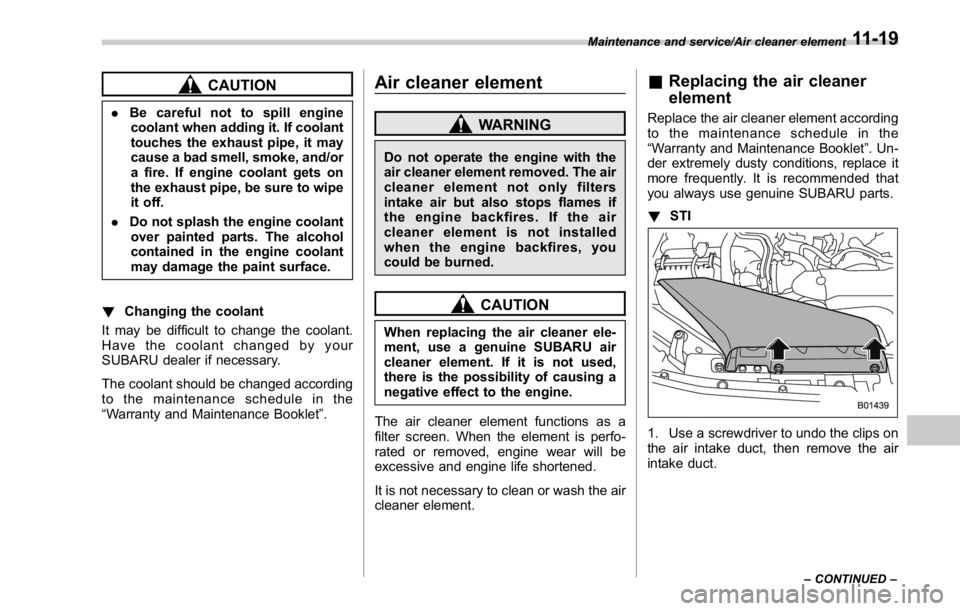
empty, remove the radiator cap and refill
coolant up to just below the filler neck as
shown in the following illustration.
STI
1) Fill up to this level Except STI
1) Fill up to this level
3. After refilling the reserve tank and the
radiator, reinstall the cap and check that
the rubber gaskets inside the radiator cap
are in the proper position.11-18
Page 508 of 594
CAUTION. Be careful not to spill engine
coolant when adding it. If coolant
touches the exhaust pipe, it may
cause a bad smell, smoke, and/or
a fire. If engine coolant gets on
the exhaust pipe, be sure to wipe
it off.
. Do not splash the engine coolant
over painted parts. The alcohol
contained in the engine coolant
may damage the paint surface.
! Changing the coolant
It may be difficult to change the coolant.
Have the coolant changed by your
SUBARU dealer if necessary.
The coolant should be changed according
to the maintenance schedule in the
“ Warranty and Maintenance Booklet ” .Air cleaner element WARNINGDo not operate the engine with the
air cleaner element removed. The air
cleaner element not only filters
intake air but also stops flames if
the engine backfires. If the air
cleaner element is not installed
when the engine backfires, you
could be burned.
CAUTIONWhen replacing the air cleaner ele-
ment, use a genuine SUBARU air
cleaner element. If it is not used,
there is the possibility of causing a
negative effect to the engine.
The air cleaner element functions as a
filter screen. When the element is perfo-
rated or removed, engine wear will be
excessive and engine life shortened.
It is not necessary to clean or wash the air
cleaner element. & Replacing the air cleaner
element Replace the air cleaner element according
to the maintenance schedule in the
“ Warranty and Maintenance Booklet ” . Un-
der extremely dusty conditions, replace it
more frequently. It is recommended that
you always use genuine SUBARU parts.
! STI
1. Use a screwdriver to undo the clips on
the air intake duct, then remove the air
intake duct. Maintenance and service/Air cleaner element
– CONTINUED –11-19
Page 509 of 594
Maintenance and service/Air cleaner element
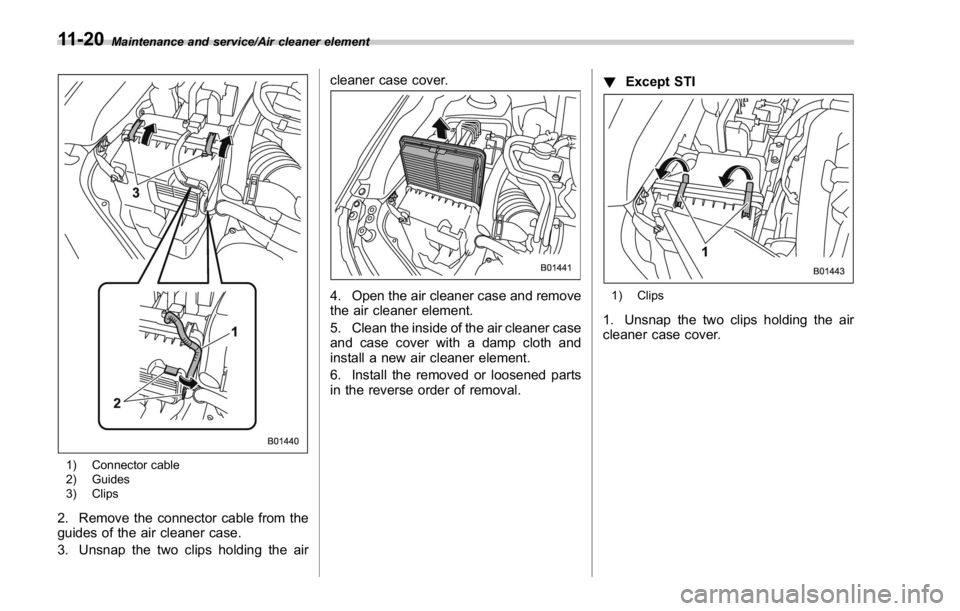
1) Connector cable
2) Guides
3) Clips
2. Remove the connector cable from the
guides of the air cleaner case.
3. Unsnap the two clips holding the air cleaner case cover.
4. Open the air cleaner case and remove
the air cleaner element.
5. Clean the inside of the air cleaner case
and case cover with a damp cloth and
install a new air cleaner element.
6. Install the removed or loosened parts
in the reverse order of removal. ! Except STI
1) Clips
1. Unsnap the two clips holding the air
cleaner case cover.11-20
Page 510 of 594
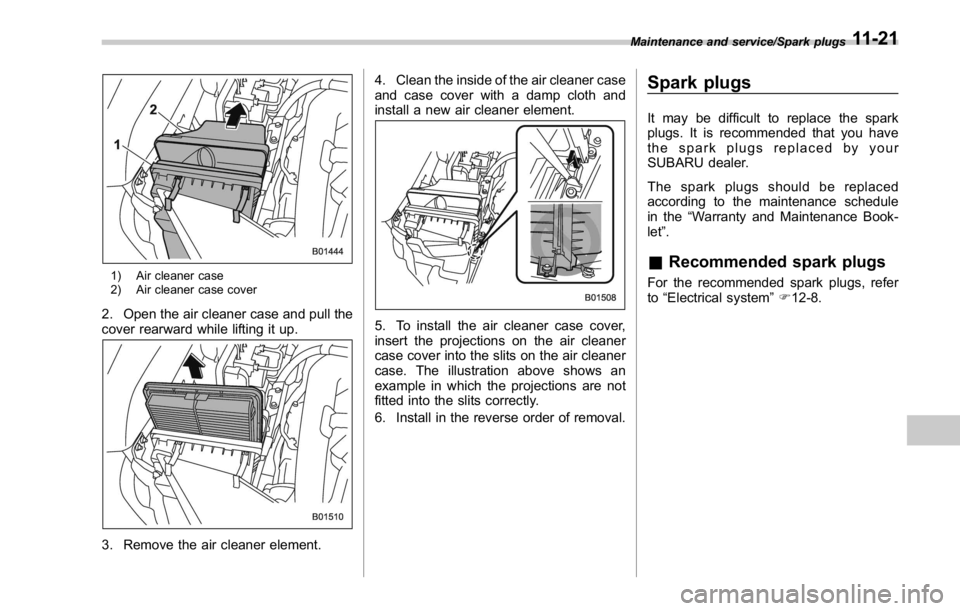
1) Air cleaner case
2) Air cleaner case cover
2. Open the air cleaner case and pull the
cover rearward while lifting it up.
3. Remove the air cleaner element. 4. Clean the inside of the air cleaner case
and case cover with a damp cloth and
install a new air cleaner element.
5. To install the air cleaner case cover,
insert the projections on the air cleaner
case cover into the slits on the air cleaner
case. The illustration above shows an
example in which the projections are not
fitted into the slits correctly.
6. Install in the reverse order of removal. Spark plugs It may be difficult to replace the spark
plugs. It is recommended that you have
the spark plugs replaced by your
SUBARU dealer.
The spark plugs should be replaced
according to the maintenance schedule
in the “ Warranty and Maintenance Book-
let ” .
& Recommended spark plugs For the recommended spark plugs, refer
to “ Electrical system ” F 12-8.Maintenance and service/Spark plugs
11-21
Page 511 of 594
Maintenance and service/Drive belts
Drive belts NOTE For models except STI, it is unneces-
sary to check the deflection of the drive
belt periodically because this engine is
equipped with an automatic belt ten-
sion adjuster. However, replacement of
the belt should be done according to
the maintenance schedule in the “ War-
ranty and Maintenance Booklet ” . Con-
sult your SUBARU dealer for replace-
ment.
If the drive belt is loose, cracked or
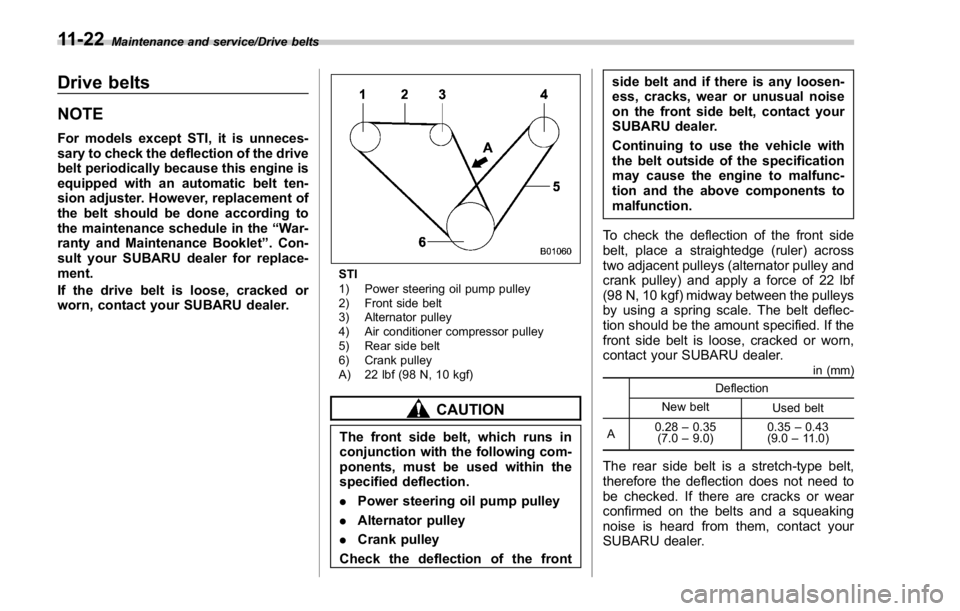
worn, contact your SUBARU dealer. STI
1) Power steering oil pump pulley
2) Front side belt
3) Alternator pulley
4) Air conditioner compressor pulley
5) Rear side belt
6) Crank pulley
A) 22 lbf (98 N, 10 kgf)
CAUTION
The front side belt, which runs in
conjunction with the following com-
ponents, must be used within the
specified deflection.
. Power steering oil pump pulley
. Alternator pulley
. Crank pulley
Check the deflection of the front side belt and if there is any loosen-
ess, cracks, wear or unusual noise
on the front side belt, contact your
SUBARU dealer.
Continuing to use the vehicle with
the belt outside of the specification
may cause the engine to malfunc-
tion and the above components to
malfunction.
To check the deflection of the front side
belt, place a straightedge (ruler) across
two adjacent pulleys (alternator pulley and
crank pulley) and apply a force of 22 lbf
(98 N, 10 kgf) midway between the pulleys
by using a spring scale. The belt deflec-
tion should be the amount specified. If the
front side belt is loose, cracked or worn,
contact your SUBARU dealer. in (mm)
Deflection
New belt
Used belt
A 0.28 – 0.35
(7.0 – 9.0) 0.35 – 0.43
(9.0 – 11.0)
The rear side belt is a stretch-type belt,
therefore the deflection does not need to
be checked. If there are cracks or wear
confirmed on the belts and a squeaking
noise is heard from them, contact your
SUBARU dealer.11-22
Page 512 of 594
Manual transmission oil It is not necessary to check the transmis-
sion oil level. Check that there are no
cracks, damage or leakage. However, the
oil inspection should be performed ac-
cording to the maintenance schedule in
the “ Warranty and Maintenance Booklet ” .
Consult your SUBARU dealer for details.
& Recommended grade and
viscosity Each oil manufacturer has its own base
oils and additives. Never use different
brands together. For details, refer to
“ Manual transmission, f ront differential
and rear differential gear oil ” F 12-6.Continuously variable trans-
mission fluid It is not necessary to check the transmis-
sion fluid level. Check that there are no
cracks, damage or leakage. However, the
fluid inspection should be performed
according to the maintenance schedule
in the “ Warranty and Maintenance Book-
let ” . Consult your SUBARU dealer for
details. Front differential gear oil
(CVT models) and rear differ-
ential gear oil It is not necessary to check the gear oil
level. Check that there are no cracks,
damage or leakage. However, the oil
inspection should be performed according
to the maintenance schedule in the
“ Warranty and Maintenance Booklet ” .
Consult your SUBARU dealer for details.
& Recommended grade and
viscosity Each oil manufacturer has its own base
oils and additives. Never use different
brands together. For details, refer to
“ Manual transmission, front differential
and rear differential gear oil ” F 12-6.
CAUTION
Using a differential gear oil other
than the specified oil may cause a
decline in vehicle performance.Maintenance and service/Manual transmission oil
11-23
Page 513 of 594
Maintenance and service/Power steering fluid (STI)
Power steering fluid (STI) & Checking the fluid level
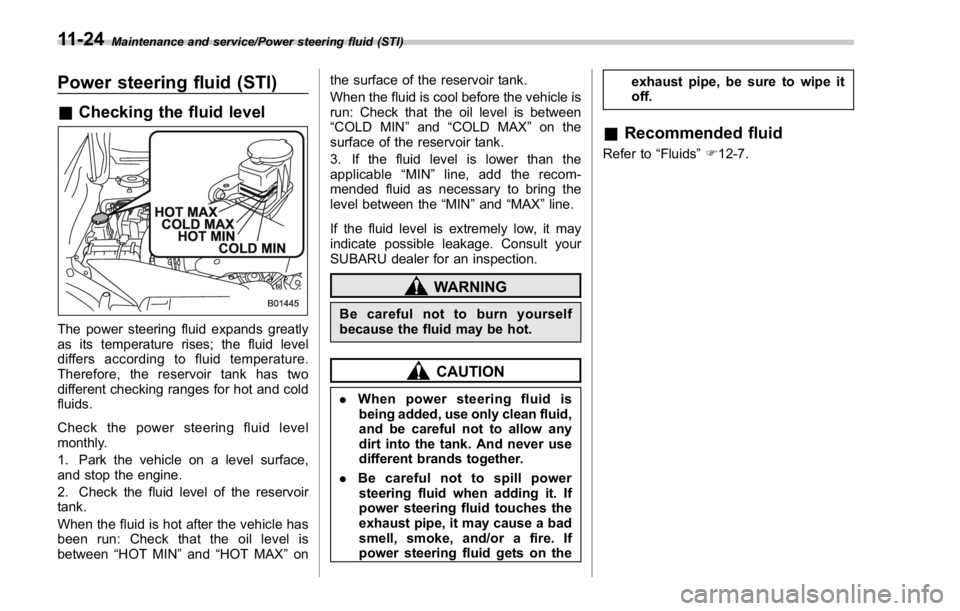
The power steering fluid expands greatly
as its temperature rises; the fluid level
differs according to fluid temperature.
Therefore, the reservoir tank has two
different checking ranges for hot and cold
fluids.
Check the power steering fluid level
monthly.
1. Park the vehicle on a level surface,
and stop the engine.
2. Check the fluid level of the reservoir
tank.
When the fluid is hot after the vehicle has
been run: Check that the oil level is
between “ HOT MIN ” and “ HOT MAX ” on the surface of the reservoir tank.
When the fluid is cool before the vehicle is
run: Check that the oil level is between
“ COLD MIN ” and “ COLD MAX ” on the
surface of the reservoir tank.
3. If the fluid level is lower than the
applicable “ MIN ” line, add the recom-
mended fluid as necessary to bring the
level between the “ MIN ” and “ MAX ” line.
If the fluid level is extremely low, it may
indicate possible leakage. Consult your
SUBARU dealer for an inspection.
WARNINGBe careful not to burn yourself
because the fluid may be hot.
CAUTION
. When power steering fluid is
being added, use only clean fluid,
and be careful not to allow any
dirt into the tank. And never use
different brands together.
. Be careful not to spill power
steering fluid when adding it. If
power steering fluid touches the
exhaust pipe, it may cause a bad
smell, smoke, and/or a fire. If
power steering fluid gets on the exhaust pipe, be sure to wipe it
off.
& Recommended fluid Refer to “ Fluids ” F 12-7.
11-24
Page 514 of 594
Brake fluid & Checking the fluid level WARNING. Never let brake fluid contact your
eyes because brake fluid can be
harmful to your eyes. If brake
fluid gets in your eyes, immedi-
ately flush them thoroughly with
clean water. For safety, when
performing this work, wearing
eye protection is advisable.
. Brake fluid absorbs moisture
from the air. Any absorbed moist-
ure can cause a dangerous loss
of braking performance.
. If the vehicle requires frequent
refilling, there may be a leak. If
you suspect a problem, have the
vehicle checked at your SUBARU
dealer.
CAUTION
. When adding brake fluid, be care-
ful not to allow any dirt into the
reservoir.
. Never splash the brake fluid over
painted surfaces or rubber parts. Alcohol contained in the brake
fluid may damage them.
. Be careful not to spill brake fluid
when adding it. If brake fluid
touches the exhaust pipe, it may
cause a bad smell, smoke, and/or
a fire. If brake fluid gets on the
exhaust pipe, be sure to wipe it
off.
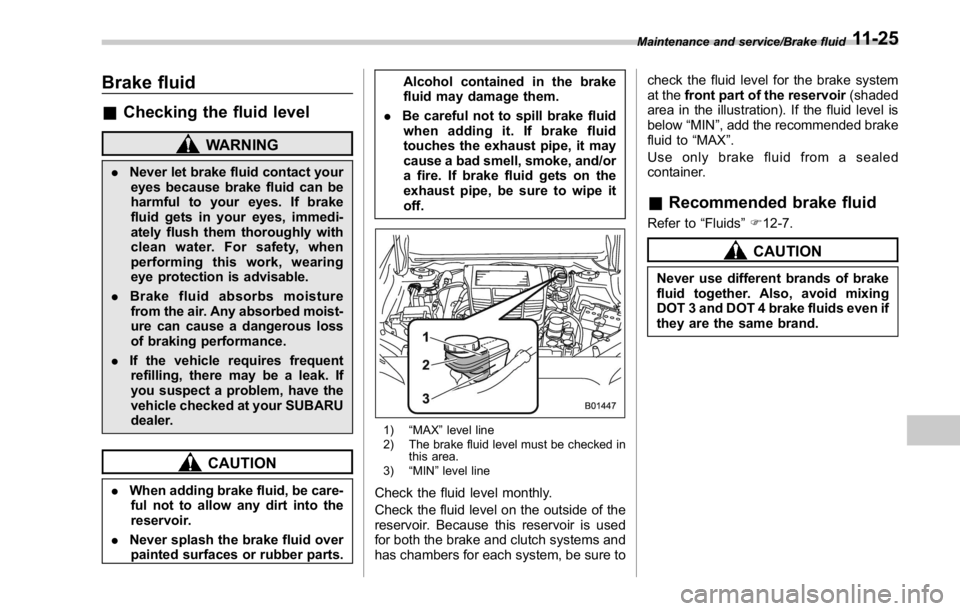
1) “ MAX ” level line
2) The brake fluid level must be checked in
this area.
3) “ MIN ” level line
Check the fluid level monthly.
Check the fluid level on the outside of the
reservoir. Because this reservoir is used
for both the brake and clutch systems and
has chambers for each system, be sure to check the fluid level for the brake system
at the front part of the reservoir (shaded
area in the illustration). If the fluid level is
below “ MIN ” , add the recommended brake
fluid to “ MAX ” .
Use only brake fluid from a sealed
container.
& Recommended brake fluid Refer to “ Fluids ” F 12-7.
CAUTIONNever use different brands of brake
fluid together. Also, avoid mixing
DOT 3 and DOT 4 brake fluids even if
they are the same brand. Maintenance and service/Brake fluid
11-25
Page 515 of 594
Maintenance and service/Clutch fluid (MT models)
Clutch fluid (MT models) & Checking the fluid level WARNINGNever let clutch fluid contact your
eyes because clutch fluid can be
harmful to your eyes. If clutch fluid
gets in your eyes, immediately flush
them thoroughly with clean water.
For safety, when performing this
work, wearing eye protection is
advisable.
CAUTION. Clutch fluid absorbs moisture
from the air. Any absorbed moist-
ure can cause improper clutch
operation.
. If the vehicle requires frequent
refilling, there may be a leak. If
you suspect a problem, have the
vehicle checked at your SUBARU
dealer.
. When clutch fluid is added, be
careful not to allow any dirt into
the tank.
. Never splash the clutch fluid over
painted surfaces or rubber parts. Alcohol contained in the clutch
fluid may damage them.
. Be careful not to spill clutch fluid
when adding it. If clutch fluid
touches the exhaust pipe, it may
cause a bad smell, smoke, and/or
a fire. If clutch fluid gets on the
exhaust pipe, be sure to wipe it
off.
. The fluid level for the clutch
system must be checked at the
inboard side of the reservoir. It
cannot be checked at the out-
board side of the reservoir.
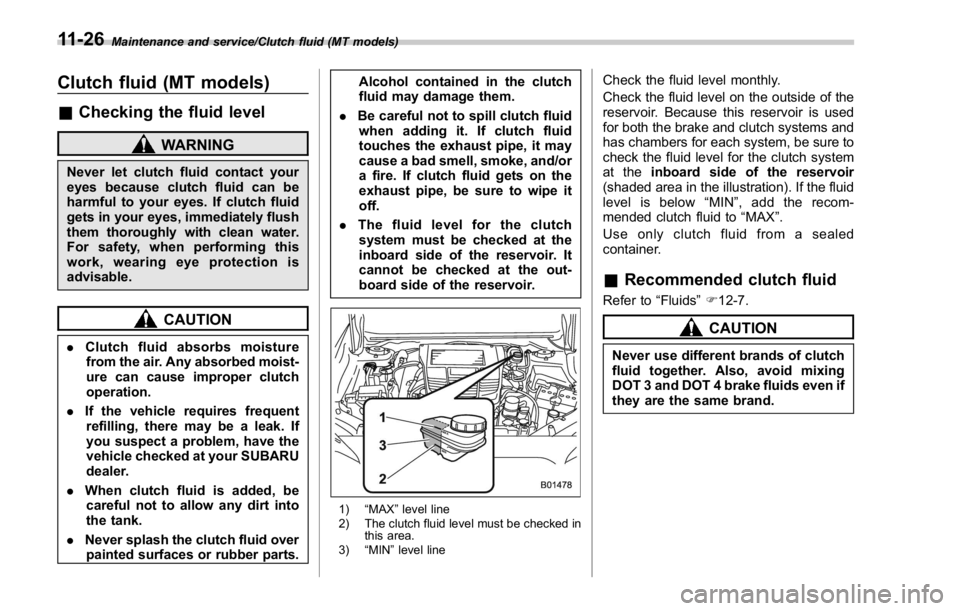
1) “ MAX ” level line
2) The clutch fluid level must be checked in
this area.
3) “ MIN ” level line Check the fluid level monthly.
Check the fluid level on the outside of the
reservoir. Because this reservoir is used
for both the brake and clutch systems and
has chambers for each system, be sure to
check the fluid level for the clutch system
at the inboard side of the reservoir
(shaded area in the illustration). If the fluid
level is below “ MIN ” ,addtherecom-
mended clutch fluid to “ MAX ” .
Use only clutch fluid from a sealed
container.
& Recommended clutch fluid Refer to “ Fluids ” F 12-7.
CAUTIONNever use different brands of clutch
fluid together. Also, avoid mixing
DOT 3 and DOT 4 brake fluids even if
they are the same brand.11-26
Page 516 of 594
Brake booster If the brake booster does not operate as
described in the following, have it checked
by your SUBARU dealer.
1. With the engine off, depress the brake
pedal several times, applying the same
pedal force each time. The distance the
pedal travels should not vary.
2. With the brake pedal depressed, start
the engine. The pedal should move
slightly down to the floor.
3. With the brake pedal depressed, stop
the engine and keep the pedal depressed
for 30 seconds. The pedal height should
not change.
4. Start the engine again and run for
approximately one minute then turn it off.
Depress the brake pedal several times to
check the brake booster. The brake
booster operates properly if the pedal
stroke decreases with each depression.
NOTE When you depress the brake pedal
strongly or suddenly, you might feel
that lighter depression of the brake
pedal generates a greater braking
force. However, even though these
occur, they do not indicate any mal-
functions, and the brake assist system is operating properly.
Brake assist is not a system that brings
more braking ability to the vehicle
beyond its breaking capability.
Brake pedal Check the brake pedal free play and
reserve distance according to the main-
tenance schedule in the “ Warranty and
Maintenance Booklet ” .
& Checking the brake pedal
free play
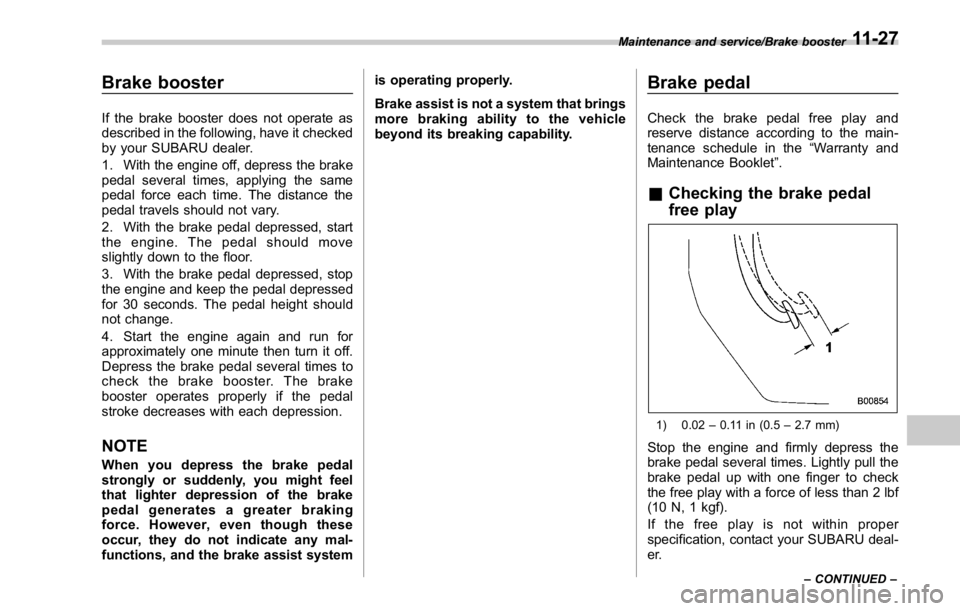
1) 0.02 – 0.11 in (0.5 – 2.7 mm)
Stop the engine and firmly depress the
brake pedal several times. Lightly pull the
brake pedal up with one finger to check
the free play with a force of less than 2 lbf
(10 N, 1 kgf).
If the free play is not within proper
specification, contact your SUBARU deal-
er. Maintenance and service/Brake booster
– CONTINUED –11-27