service SUBARU WRX 2016 Manual Online
[x] Cancel search | Manufacturer: SUBARU, Model Year: 2016, Model line: WRX, Model: SUBARU WRX 2016Pages: 594, PDF Size: 19.43 MB
Page 537 of 594
Maintenance and service/Replacing bulbs
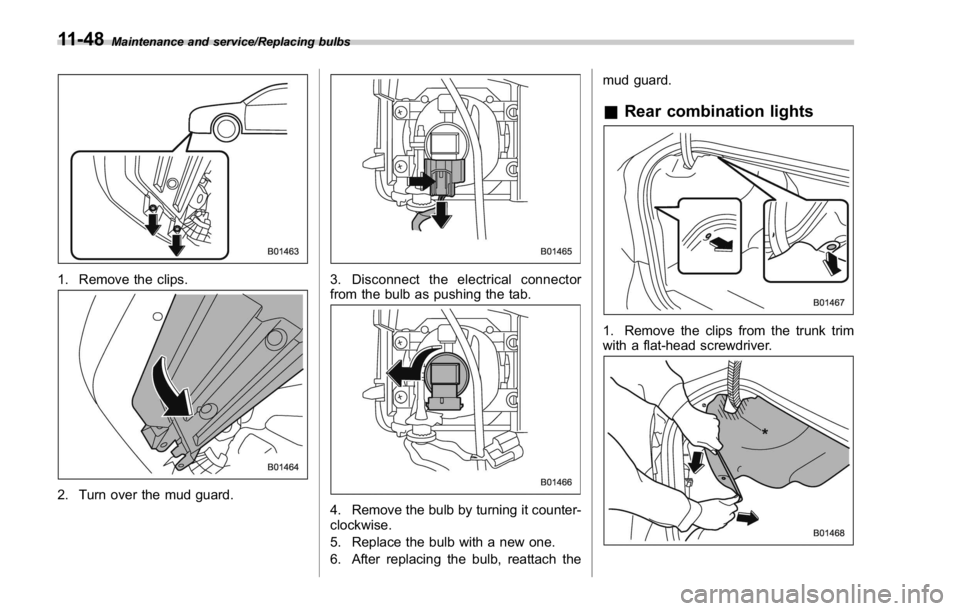
1. Remove the clips.
2. Turn over the mud guard. 3. Disconnect the electrical connector
from the bulb as pushing the tab.
4. Remove the bulb by turning it counter-
clockwise.
5. Replace the bulb with a new one.
6. After replacing the bulb, reattach the mud guard.
& Rear combination lights
1. Remove the clips from the trunk trim
with a flat-head screwdriver.11-48
Page 538 of 594
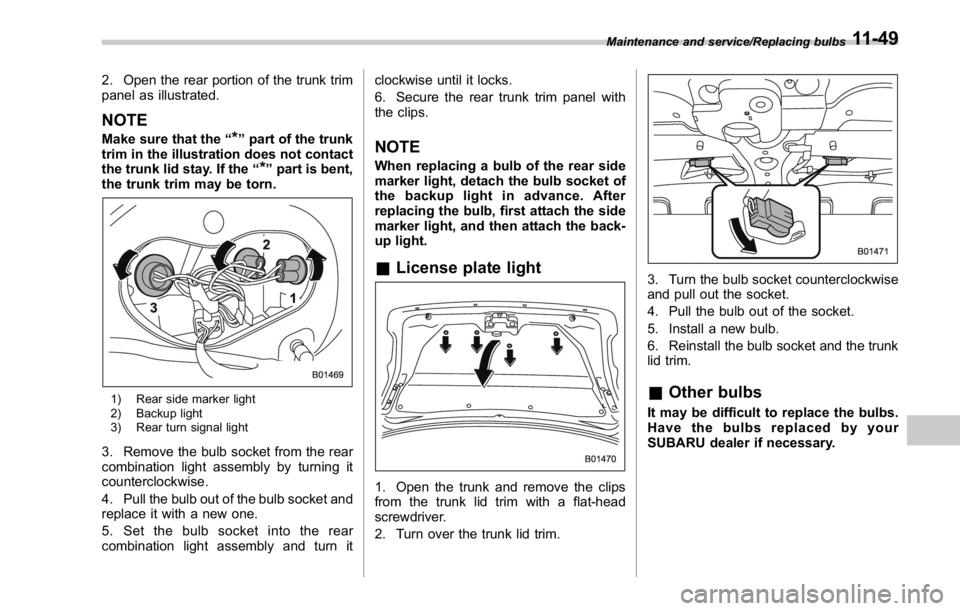
2. Open the rear portion of the trunk trim
panel as illustrated.
NOTE Make sure that the “
* ” part of the trunk
trim in the illustration does not contact
the trunk lid stay. If the “
* ” part is bent,
the trunk trim may be torn.
1) Rear side marker light
2) Backup light
3) Rear turn signal light
3. Remove the bulb socket from the rear
combination light assembly by turning it
counterclockwise.
4. Pull the bulb out of the bulb socket and
replace it with a new one.
5. Set the bulb socket into the rear
combination light assembly and turn it clockwise until it locks.
6. Secure the rear trunk trim panel with
the clips.
NOTE When replacing a bulb of the rear side
marker light, detach the bulb socket of
the backup light in advance. After
replacing the bulb, first attach the side
marker light, and then attach the back-
up light.
& License plate light
1. Open the trunk and remove the clips
from the trunk lid trim with a flat-head
screwdriver.
2. Turn over the trunk lid trim. 3. Turn the bulb socket counterclockwise
and pull out the socket.
4. Pull the bulb out of the socket.
5. Install a new bulb.
6. Reinstall the bulb socket and the trunk
lid trim.
& Other bulbs It may be difficult to replace the bulbs.
Have the bulbs replaced by your
SUBARU dealer if necessary. Maintenance and service/Replacing bulbs
11-49
Page 539 of 594
Maintenance and service/Replacing battery
Replacing battery The access key / transmitter battery may
be discharged under the following condi-
tions.
. The operation of the keyless access
function is unstable
. The operating distance of the remote
keyless entry system is unstable
. The transmitter does not operate prop-
erly when used within the standard dis-
tance
Replace the battery with a new one.
CAUTION. Do not let dust, oil or water get on
or in the access key/transmitter
when replacing battery.
. Be careful not to touch or da-
mage the printed circuit board in
the access key/transmitter when
replacing the battery.
. Be careful not to allow children to
touch the battery and any re-
moved parts; children could
swallow them.
. There is a danger of an explosion
if the battery is incorrectly re-
placed. Replace only with the same or equivalent type of the
battery.
. Do not expose batteries to ex-
cessive heat such as bright sun-
light, fire or the like.
NOTE . Replace only with the same or
equivalent type of battery recom-
mended by the manufacturer.
. Dispose of used batteries according
to local laws.
. Mount the battery in the correct
orientation to prevent fluid leakage.
Be careful not to bend the terminals. It
may result in a malfunction.
. It is recommended that the battery
should be replaced by a SUBARU
dealer.
. Use a new battery.
. After replacing the battery, confirm
that the access key/transmitter func-
tions properly. & Replacing battery of access
key CAUTIONWhen removing or reinstalling the
access key cover, make sure that
the plastic part does not come off or
become misaligned.
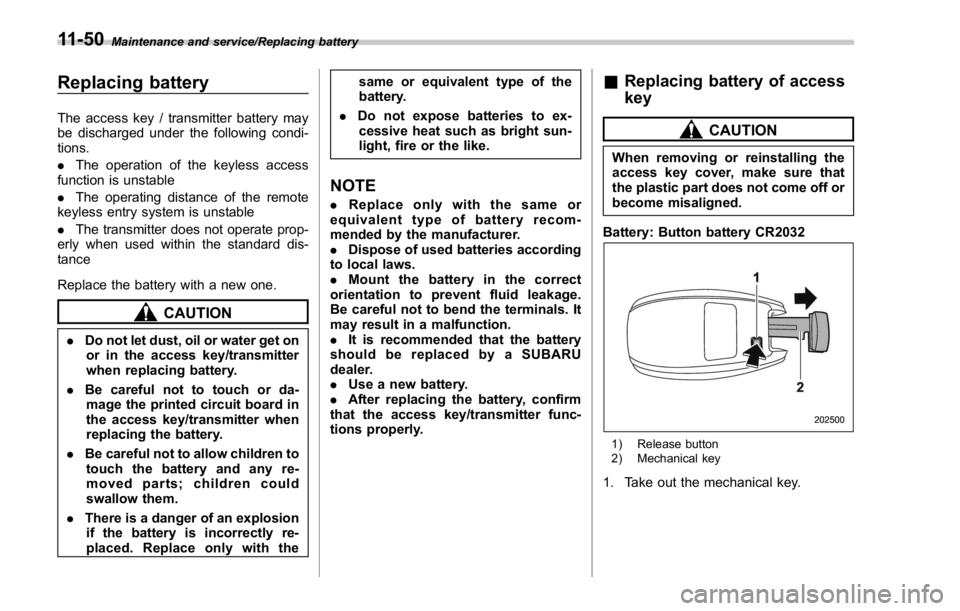
Battery: Button battery CR2032
1) Release button
2) Mechanical key
1. Take out the mechanical key.11-50
Page 540 of 594
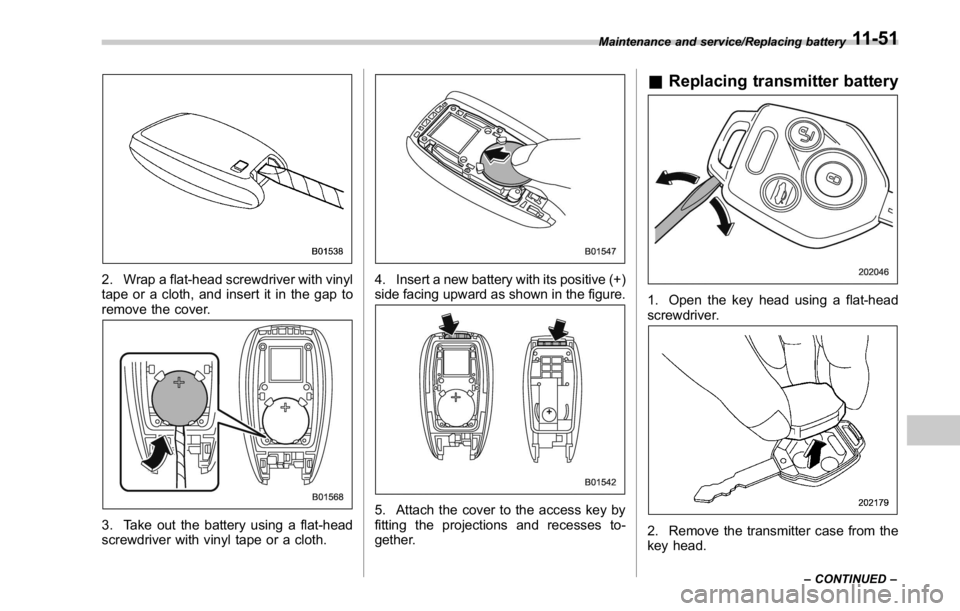
2. Wrap a flat-head screwdriver with vinyl
tape or a cloth, and insert it in the gap to
remove the cover.
3. Take out the battery using a flat-head
screwdriver with vinyl tape or a cloth. 4. Insert a new battery with its positive (+)
side facing upward as shown in the figure.
5. Attach the cover to the access key by
fitting the projections and recesses to-
gether. & Replacing transmitter battery
1. Open the key head using a flat-head
screwdriver.
2. Remove the transmitter case from the
key head. Maintenance and service/Replacing battery
– CONTINUED –11-51
Page 541 of 594
Maintenance and service/Replacing battery
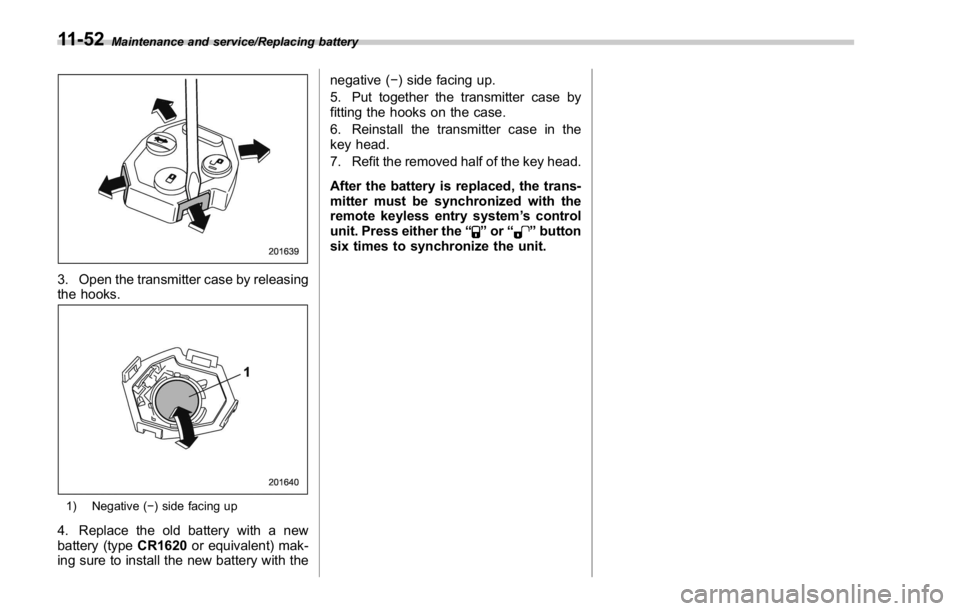
3. Open the transmitter case by releasing
the hooks.
1) Negative ( − ) side facing up
4. Replace the old battery with a new
battery (type CR1620 or equivalent) mak-
ing sure to install the new battery with the negative ( − ) side facing up.
5. Put together the transmitter case by
fitting the hooks on the case.
6. Reinstall the transmitter case in the
key head.
7. Refit the removed half of the key head.
After the battery is replaced, the trans-
mitter must be synchronized with the
remote keyless entry system ’ s control
unit. Press either the “
” or “ ” button
six times to synchronize the unit.11-52
Page 545 of 594

Specifications/Specifications
& Engine oilFor the checking, adding and replacing procedure or other details, refer to “ Engine oil ” F 11-13.
NOTE The procedure for changing the engine oil and oil filter should be performed by a properly-trained expert. It is recommended
that you have this service performed by your SUBARU dealer.
! Oil filterModel STI Except STI
Oil filter color Black Black
Part number 15208AA100 15208AA170
Amount of rotation 1 rotation 3/4 rotation
! Approved engine oil
Always use the SUBARU approved engine oil. For further details, please contact your SUBARU dealer.
If the approved engine oil is unavailable, use the alternative engine oil described on the next page.12-4
Page 547 of 594
Specifications/Specifications
& Manual transmission, front differential and rear differential gear oil Oil Manual transmission oil Front differential gear oil (CVT
models) Rear differential gear oil
Oil grade STI . API classification GL-5
(75W-90)* 3
—
API classification GL-5
Except
STI . SUBARU Extra MT* 3
. API classification GL-5
(75W-90)* 4
. SUBARU Extra MT* 3
. API classification GL-5
(75W-90)
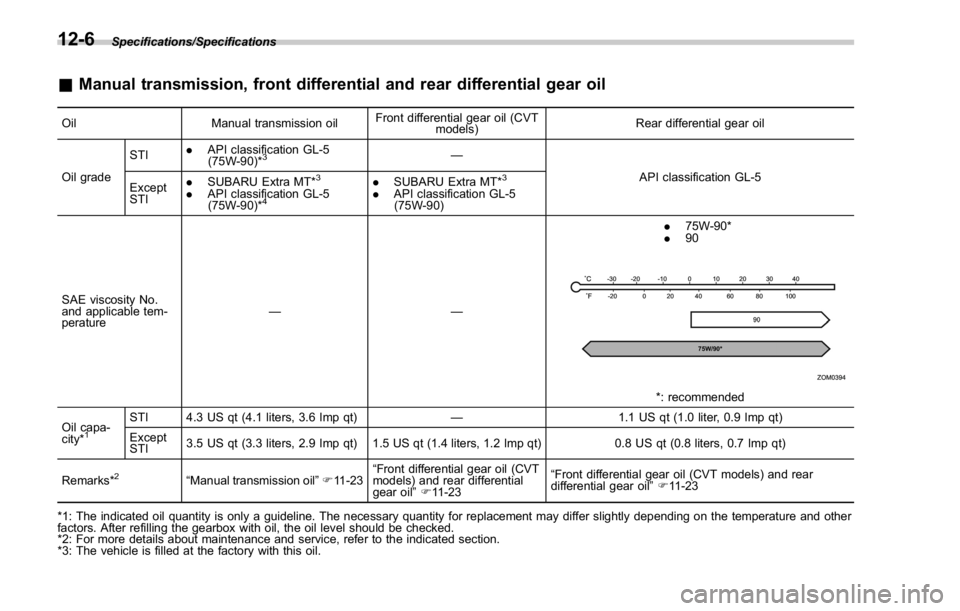
SAE viscosity No.
and applicable tem-
perature —— . 75W-90*
. 90
*: recommended
Oil capa-
city* 1
STI 4.3 US qt (4.1 liters, 3.6 Imp qt) — 1.1 US qt (1.0 liter, 0.9 Imp qt)
Except
STI 3.5 US qt (3.3 liters, 2.9 Imp qt) 1.5 US qt (1.4 liters, 1.2 Imp qt) 0.8 US qt (0.8 liters, 0.7 Imp qt)
Remarks* 2
“ Manual transmission oil ” F 11-23 “ Front differential gear oil (CVT
models) and rear differential
gear oil ” F 11-23 “ Front differential gear oil (CVT models) and rear
differential gear oil ” F 11-23
*1: The indicated oil quantity is only a guideline. The necessary quantity for replacement may differ slightly depending on the temperature and other
factors. After refilling the gearbox with oil, the oil level should be checked.
*2: For more details about maintenance and service, refer to the indicated section.
*3: The vehicle is filled at the factory with this oil.12-6
Page 548 of 594

*4: You may use this type of manual transmission oil. However, using this type of oil will detract from driveability and fuel efficiency.
& Fluids Fluid
Fluid type* 1
Fluid capacity* 2
Remarks* 3
Continuously variable transmission
fluid (CVT models) Consult your SUBARU dealer. 13.1 US qt (12.4 liters, 10.9 Imp qt) “ Continuously variable trans-
mission fluid ” F 11-23
Brake fluid FMVSS No. 116, fresh DOT 3 or DOT 4
brake fluid –“ Brake fluid ” F 11-25
Clutch fluid (MT models) FMVSS No. 116, fresh DOT 3 or DOT 4
brake fluid – “ Clutch fluid (MT models) ” F 11 -
26
Power steering fluid (STI) · SUBARU ATF
· “ Dexron III ” Type Automatic Transmis-
sion Fluid
· IDEMITSU ATF HP 0.7 US qt (0.7 liter, 0.6 Imp qt) “ Power steering fluid (STI) ”
F 11-24
*1: Use one of the indicated types of fluid.
*2: The indicated fluid quantity is only a guideline. The necessary quantity for replacement may differ slightly depending on the temperature and other
factors.
*3: For more details about maintenance and service, refer to the indicated section.
& Engine coolant Vehicle model Coolant capacity Coolant type
STI 8.2 US qt (7.7 liters, 6.8 Imp qt)
SUBARU Super Coolant
Except STI MT models 8.7 US qt (8.2 liters, 7.2 Imp qt)
CVT models 8.9 US qt (8.4 liters, 7.4 Imp qt)
The indicated coolant quantity is only a guideline. The necessary quantity for replacement may differ slightly depending on the temperature and other
factors. For more details about maintenance and service, refer to “ Cooling system ” F 11-17. Specifications/Specifications
– CONTINUED –12-7
Page 549 of 594

Specifications/Specifications
& Electrical system Battery type and capacity (5HR) 55D23L
Alternator STI 12V-110A
Except STI 12V-130A
Spark plugs STI SILFR6A (NGK)
Except STI ILKAR8H6 (NGK)
& Tires Tire size 235/45R17 94W 245/40R18 97W
Wheel size
17 6 8J 18 6 8 1/2J
Pressure Front
33 psi (230 kPa, 2.3 kgf/cm 2
) 33 psi (230 kPa, 2.3 kgf/cm 2
)
Rear
32 psi (220 kPa, 2.2 kgf/cm 2
) 32 psi (220 kPa, 2.2 kgf/cm 2
)
Wheel nut tightening torque
89 lbf·ft (120 N·m, 12 kgf·m)* 1
*1: This torque is equivalent to applying approximately 88 to 110 lbf (40 to 50 kgf) at the end of the wheel nut wrench. If you have tightened the wheel
nuts by yourself, have the tightening torque checked at the nearest automotive service facility as soon as possible. For the wheel nut tightening
procedure, refer to “ Changing a flat tire ” F 9-4.
& Temporary spare tires Temporary spare tire size T145/70D17 205/50R17
Temporary spare tire inflation pressure
(recommended cold tire inflation pressure) 60 psi (420 kPa, 4.2 kgf/cm 2
) 33 psi (230 kPa, 2.3 kgf/cm 2
)
Wheel nut tightening torque
89 lbf·ft (120 N·m, 12 kgf·m)* 1
* 2
*1: This torque is equivalent to applying approximately 88 to 110 lbf (40 to 50 kgf) at the end of the wheel nut wrench. If you have tightened the wheel
nuts by yourself, have the tightening torque checked at the nearest automotive service facility as soon as possible.
*2: For the wheel nut tightening procedure, refer to “ Changing a flat tire ” F 9-4.12-8
Page 574 of 594
form to Federal Safety Require-
ments in addition to these grades.
& Treadwear
The treadwear grade is a compara-
tive rating based on the wear rate of
the tire when tested under con-
trolled conditions on a specified
government test course.
For example, a tire graded 150
would wear one and one-half (1-
1/2) times as well on the govern-
ment course as a tire graded 100.
The relative performance of tires
depends upon the actual conditions
of their use, however, and may
depart significantly from the norm
due to variations in driving habits,
service practices and differences in
road characteristics and climate.
& Traction AA, A, B, C
The traction grades, from highest to
lowest, are AA, A, B and C. Those
grades represent the tire ’ s ability to
stop on wet pavement as measured
under controlled conditions on spe- cified government test surfaces of
asphalt and concrete. A tire marked
C may have poor traction perfor-
mance. WARNING
The traction grade assigned to
this tire is based on straight-
ahead braking traction tests,
and does not include accel-
eration, cornering, hydroplan-
ing, or peak traction charac-
teristics.
& Temperature A, B, C
The temperature grades are A (the
highest), B, and C, representing the
tire ’ s resistance to the generation of
heat and its ability to dissipate heat
when tested under controlled con-
ditions on a specified indoor labora-
tory test wheel. Sustained high
temperature can cause the material
of the tire to degenerate and reduce
tire life, and excessive temperature
can lead to sudden tire failure. The grade C corresponds to a level of
performance which all passenger
car tires must meet under the
Federal Motor Vehicle Safety Stan-
dards No. 109. Grades B and A
represent higher levels of perfor-
mance on the laboratory test wheel
than the minimum required by law.
WARNING
The temperature grade for this
tire is established for a tire
that is properly inflated and
not overloaded. Excessive
speed, underinflation, or ex-
cessive loading, either sepa-
rately or in combination, can
cause heat buildup and possi-
ble tire failure.Consumer information and Reporting safety defects/Uniform tire quality grading standards
13-15