battery SUBARU WRX 2016 Repair Manual
[x] Cancel search | Manufacturer: SUBARU, Model Year: 2016, Model line: WRX, Model: SUBARU WRX 2016Pages: 594, PDF Size: 19.43 MB
Page 500 of 594
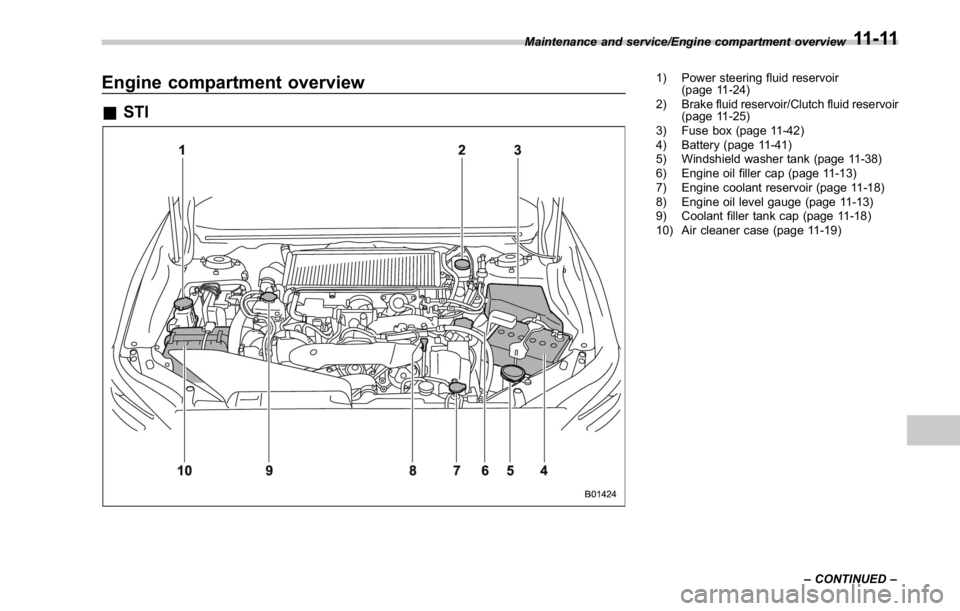
Engine compartment overview & STI 1) Power steering fluid reservoir
(page 11-24)
2) Brake fluid reservoir/Clutch fluid reservoir
(page 11-25)
3) Fuse box (page 11-42)
4) Battery (page 11-41)
5) Windshield washer tank (page 11-38)
6) Engine oil filler cap (page 11-13)
7) Engine coolant reservoir (page 11-18)
8) Engine oil level gauge (page 11-13)
9) Coolant filler tank cap (page 11-18)
10) Air cleaner case (page 11-19)Maintenance and service/Engine compartment overview
– CONTINUED –11-11
Page 501 of 594
Maintenance and service/Engine compartment overview
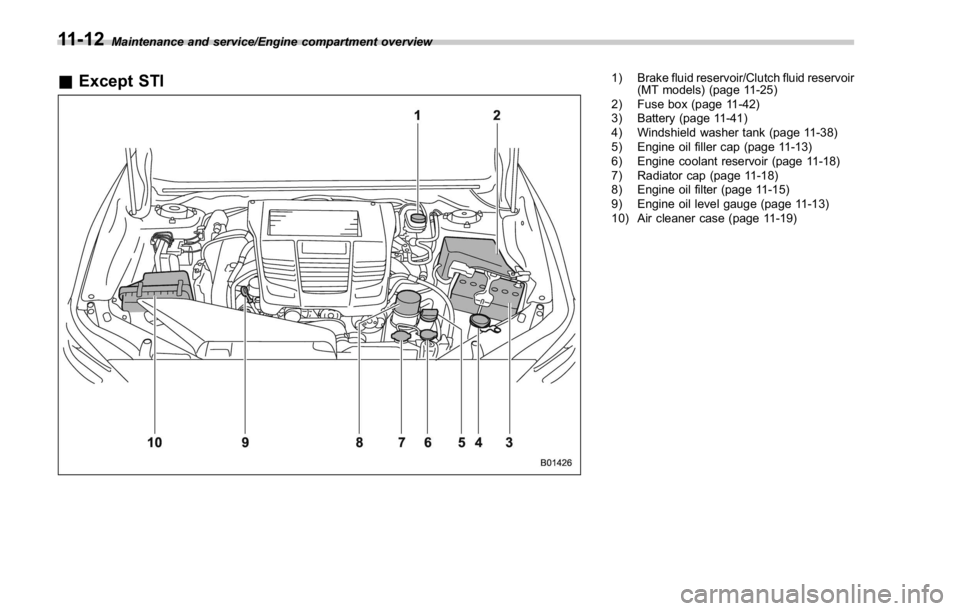
& Except STI 1) Brake fluid reservoir/Clutch fluid reservoir
(MT models) (page 11-25)
2) Fuse box (page 11-42)
3) Battery (page 11-41)
4) Windshield washer tank (page 11-38)
5) Engine oil filler cap (page 11-13)
6) Engine coolant reservoir (page 11-18)
7) Radiator cap (page 11-18)
8) Engine oil filter (page 11-15)
9) Engine oil level gauge (page 11-13)
10) Air cleaner case (page 11-19)
11-12
Page 518 of 594
Hill start assist system Ensure that the Hill start assist system
operates properly under the following
circumstances.
1. Stop the vehicle on an uphill grade by
depressing the brake pedal (all models)
and clutch pedal (MT models only), with
the engine running.
2. Make sure that the vehicle does not
move backward for several seconds after
the brake pedal is released.
3. Then make sure the vehicle starts
climbing the grade by following the normal
starting procedures.
If the Hill start assist system does not
operate as described above, contact your
SUBARU dealer. Replacement of brake pad
and lining
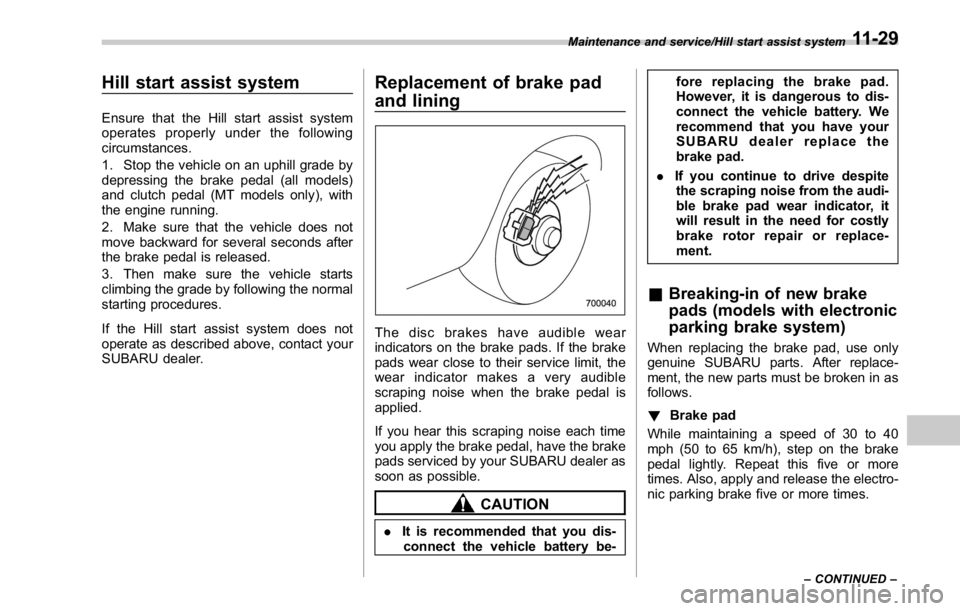
The disc brakes have audible wear
indicators on the brake pads. If the brake
pads wear close to their service limit, the
wear indicator makes a very audible
scraping noise when the brake pedal is
applied.
If you hear this scraping noise each time
you apply the brake pedal, have the brake
pads serviced by your SUBARU dealer as
soon as possible.
CAUTION
. It is recommended that you dis-
connect the vehicle battery be- fore replacing the brake pad.
However, it is dangerous to dis-
connect the vehicle battery. We
recommend that you have your
SUBARU dealer replace the
brake pad.
. If you continue to drive despite
the scraping noise from the audi-
ble brake pad wear indicator, it
will result in the need for costly
brake rotor repair or replace-
ment.
& Breaking-in of new brake
pads (models with electronic
parking brake system) When replacing the brake pad, use only
genuine SUBARU parts. After replace-
ment, the new parts must be broken in as
follows.
! Brake pad
While maintaining a speed of 30 to 40
mph (50 to 65 km/h), step on the brake
pedal lightly. Repeat this five or more
times. Also, apply and release the electro-
nic parking brake five or more times.Maintenance and service/Hill start assist system
– CONTINUED –11-29
Page 530 of 594
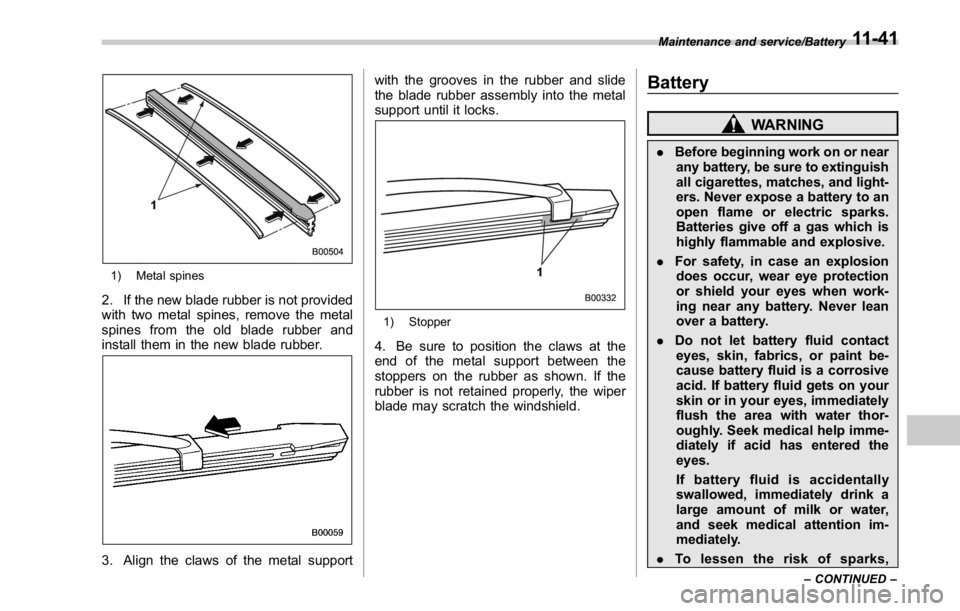
1) Metal spines
2. If the new blade rubber is not provided
with two metal spines, remove the metal
spines from the old blade rubber and
install them in the new blade rubber.
3. Align the claws of the metal support with the grooves in the rubber and slide
the blade rubber assembly into the metal
support until it locks.
1) Stopper
4. Be sure to position the claws at the
end of the metal support between the
stoppers on the rubber as shown. If the
rubber is not retained properly, the wiper
blade may scratch the windshield. Battery WARNING. Before beginning work on or near
any battery, be sure to extinguish
all cigarettes, matches, and light-
ers. Never expose a battery to an
open flame or electric sparks.
Batteries give off a gas which is
highly flammable and explosive.
. For safety, in case an explosion
does occur, wear eye protection
or shield your eyes when work-
ing near any battery. Never lean
over a battery.
. Do not let battery fluid contact
eyes, skin, fabrics, or paint be-
cause battery fluid is a corrosive
acid. If battery fluid gets on your
skin or in your eyes, immediately
flush the area with water thor-
oughly. Seek medical help imme-
diately if acid has entered the
eyes.
If battery fluid is accidentally
swallowed, immediately drink a
large amount of milk or water,
and seek medical attention im-
mediately.
. To lessen the risk of sparks, Maintenance and service/Battery
– CONTINUED –11-41
Page 531 of 594
Maintenance and service/Fuses
remove rings, metal watchbands,
and other metal jewelry. Never
allow metal tools to contact the
positive battery terminal and any-
thing connected to it WHILE you
are at the same time in contact
with any other metallic portion of
the vehicle because a short cir-
cuit will result.
. Keep everyone including children
away from the battery.
. Charge the battery in a well-
ventilated area.
. Battery posts, terminals and re-
lated accessories contain lead
and lead compounds, chemicals
known to the State of California
to cause cancer and reproductive
harm. Batteries also contain
other chemicals known to the
State of California to cause can-
cer.
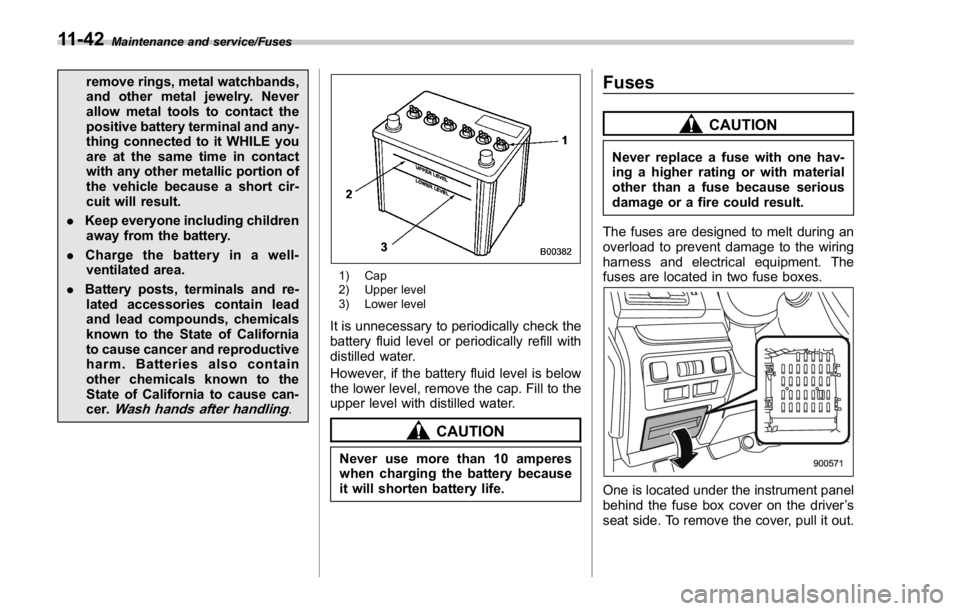
Wash hands after handling . 1) Cap
2) Upper level
3) Lower level
It is unnecessary to periodically check the
battery fluid level or periodically refill with
distilled water.
However, if the battery fluid level is below
the lower level, remove the cap. Fill to the
upper level with distilled water.
CAUTION
Never use more than 10 amperes
when charging the battery because
it will shorten battery life. Fuses CAUTIONNever replace a fuse with one hav-
ing a higher rating or with material
other than a fuse because serious
damage or a fire could result.
The fuses are designed to melt during an
overload to prevent damage to the wiring
harness and electrical equipment. The
fuses are located in two fuse boxes.
One is located under the instrument panel
behind the fuse box cover on the driver ’ s
seat side. To remove the cover, pull it out.11-42
Page 539 of 594
Maintenance and service/Replacing battery
Replacing battery The access key / transmitter battery may
be discharged under the following condi-
tions.
. The operation of the keyless access
function is unstable
. The operating distance of the remote
keyless entry system is unstable
. The transmitter does not operate prop-
erly when used within the standard dis-
tance
Replace the battery with a new one.
CAUTION. Do not let dust, oil or water get on
or in the access key/transmitter
when replacing battery.
. Be careful not to touch or da-
mage the printed circuit board in
the access key/transmitter when
replacing the battery.
. Be careful not to allow children to
touch the battery and any re-
moved parts; children could
swallow them.
. There is a danger of an explosion
if the battery is incorrectly re-
placed. Replace only with the same or equivalent type of the
battery.
. Do not expose batteries to ex-
cessive heat such as bright sun-
light, fire or the like.
NOTE . Replace only with the same or
equivalent type of battery recom-
mended by the manufacturer.
. Dispose of used batteries according
to local laws.
. Mount the battery in the correct
orientation to prevent fluid leakage.
Be careful not to bend the terminals. It
may result in a malfunction.
. It is recommended that the battery
should be replaced by a SUBARU
dealer.
. Use a new battery.
. After replacing the battery, confirm
that the access key/transmitter func-
tions properly. & Replacing battery of access
key CAUTIONWhen removing or reinstalling the
access key cover, make sure that
the plastic part does not come off or
become misaligned.
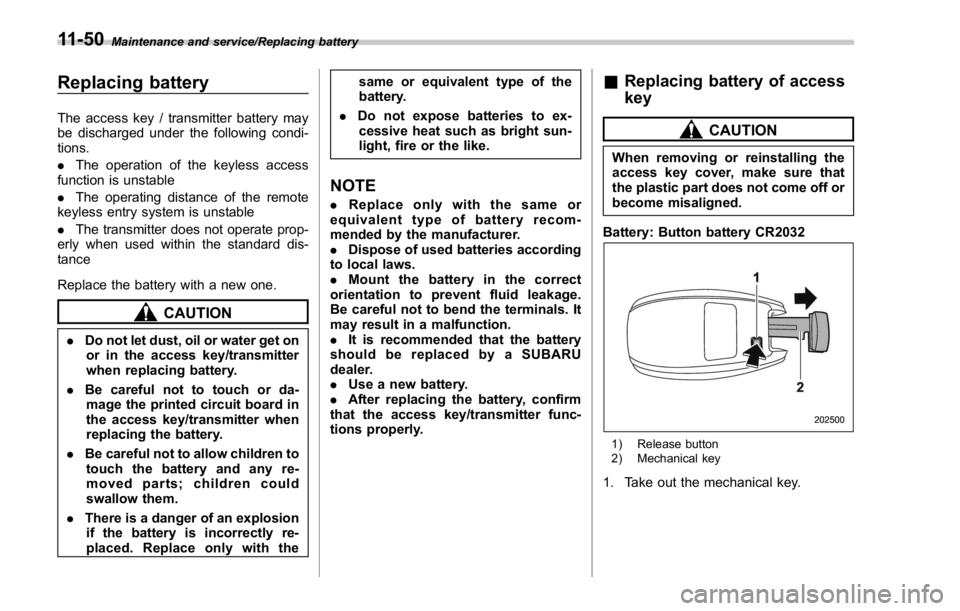
Battery: Button battery CR2032
1) Release button
2) Mechanical key
1. Take out the mechanical key.11-50
Page 540 of 594
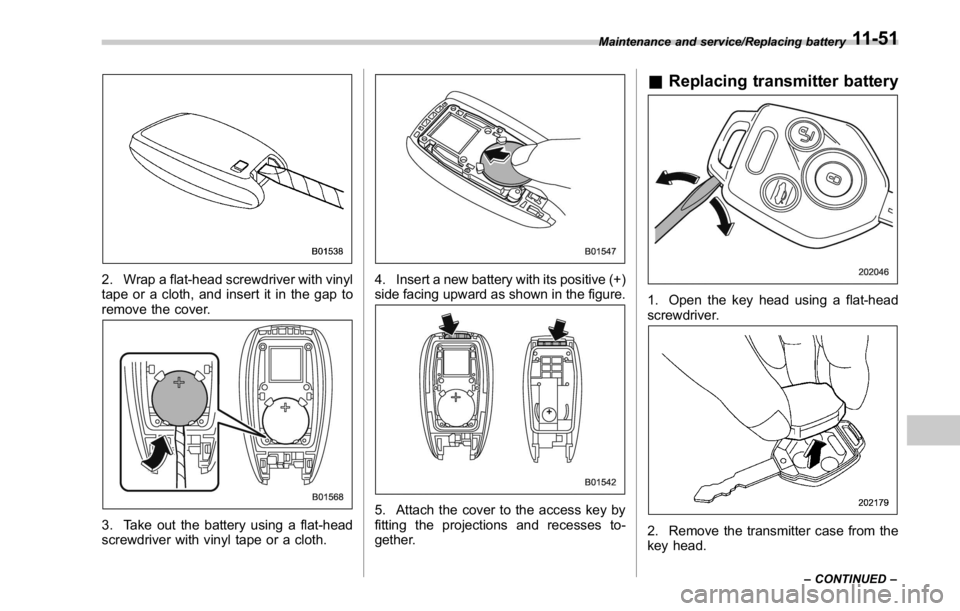
2. Wrap a flat-head screwdriver with vinyl
tape or a cloth, and insert it in the gap to
remove the cover.
3. Take out the battery using a flat-head
screwdriver with vinyl tape or a cloth. 4. Insert a new battery with its positive (+)
side facing upward as shown in the figure.
5. Attach the cover to the access key by
fitting the projections and recesses to-
gether. & Replacing transmitter battery
1. Open the key head using a flat-head
screwdriver.
2. Remove the transmitter case from the
key head. Maintenance and service/Replacing battery
– CONTINUED –11-51
Page 541 of 594
Maintenance and service/Replacing battery
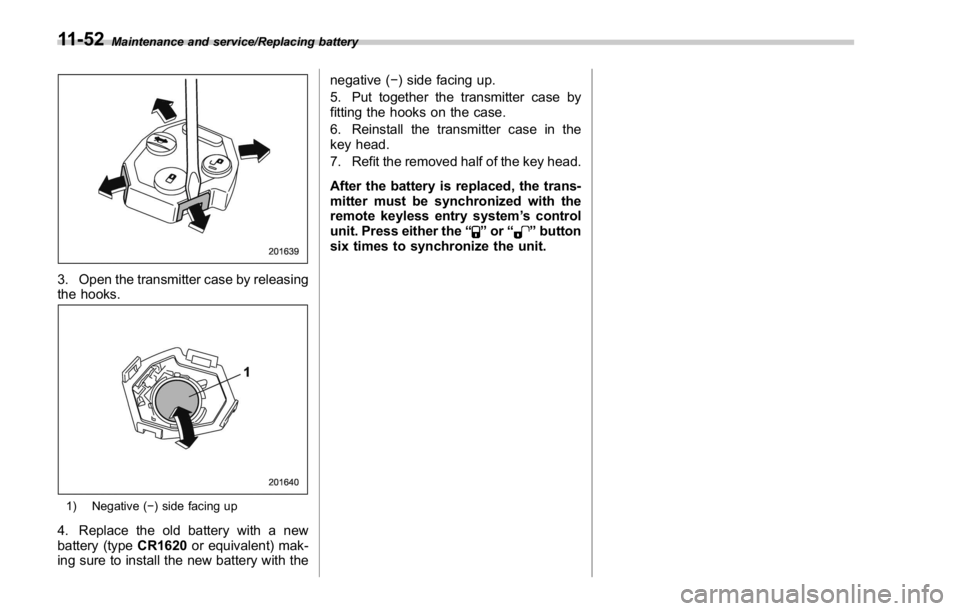
3. Open the transmitter case by releasing
the hooks.
1) Negative ( − ) side facing up
4. Replace the old battery with a new
battery (type CR1620 or equivalent) mak-
ing sure to install the new battery with the negative ( − ) side facing up.
5. Put together the transmitter case by
fitting the hooks on the case.
6. Reinstall the transmitter case in the
key head.
7. Refit the removed half of the key head.
After the battery is replaced, the trans-
mitter must be synchronized with the
remote keyless entry system ’ s control
unit. Press either the “
” or “ ” button
six times to synchronize the unit.11-52
Page 549 of 594

Specifications/Specifications
& Electrical system Battery type and capacity (5HR) 55D23L
Alternator STI 12V-110A
Except STI 12V-130A
Spark plugs STI SILFR6A (NGK)
Except STI ILKAR8H6 (NGK)
& Tires Tire size 235/45R17 94W 245/40R18 97W
Wheel size
17 6 8J 18 6 8 1/2J
Pressure Front
33 psi (230 kPa, 2.3 kgf/cm 2
) 33 psi (230 kPa, 2.3 kgf/cm 2
)
Rear
32 psi (220 kPa, 2.2 kgf/cm 2
) 32 psi (220 kPa, 2.2 kgf/cm 2
)
Wheel nut tightening torque
89 lbf·ft (120 N·m, 12 kgf·m)* 1
*1: This torque is equivalent to applying approximately 88 to 110 lbf (40 to 50 kgf) at the end of the wheel nut wrench. If you have tightened the wheel
nuts by yourself, have the tightening torque checked at the nearest automotive service facility as soon as possible. For the wheel nut tightening
procedure, refer to “ Changing a flat tire ” F 9-4.
& Temporary spare tires Temporary spare tire size T145/70D17 205/50R17
Temporary spare tire inflation pressure
(recommended cold tire inflation pressure) 60 psi (420 kPa, 4.2 kgf/cm 2
) 33 psi (230 kPa, 2.3 kgf/cm 2
)
Wheel nut tightening torque
89 lbf·ft (120 N·m, 12 kgf·m)* 1
* 2
*1: This torque is equivalent to applying approximately 88 to 110 lbf (40 to 50 kgf) at the end of the wheel nut wrench. If you have tightened the wheel
nuts by yourself, have the tightening torque checked at the nearest automotive service facility as soon as possible.
*2: For the wheel nut tightening procedure, refer to “ Changing a flat tire ” F 9-4.12-8
Page 551 of 594
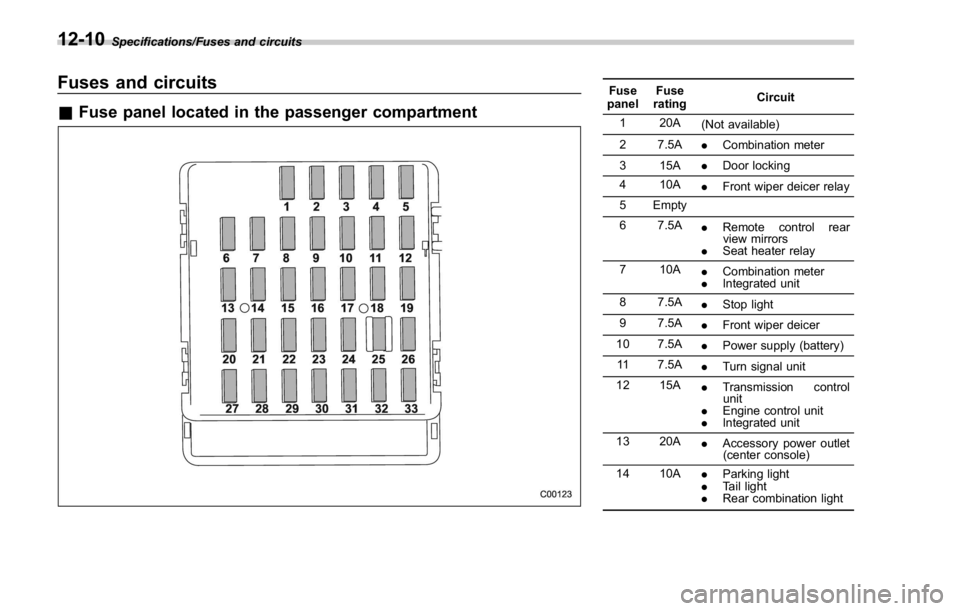
Specifications/Fuses and circuits
Fuses and circuits & Fuse panel located in the passenger compartment Fuse
panel Fuse
rating Circuit
1 20A
(Not available)
2 7.5A
. Combination meter
3 15A
. Door locking
4 10A
. Front wiper deicer relay
5 Empty
6 7.5A
. Remote control rear
view mirrors
. Seat heater relay
7 10A
. Combination meter
. Integrated unit
8 7.5A
. Stop light
9 7.5A
. Front wiper deicer
10 7.5A
. Power supply (battery)
11 7.5A
. Turn signal unit
12 15A
. Transmission control
unit
. Engine control unit
. Integrated unit
13 20A
. Accessory power outlet
(center console)
14 10A
. Parking light
. Tail light
. Rear combination light12-10