fuel SUBARU WRX 2016 Repair Manual
[x] Cancel search | Manufacturer: SUBARU, Model Year: 2016, Model line: WRX, Model: SUBARU WRX 2016Pages: 594, PDF Size: 19.43 MB
Page 507 of 594
Maintenance and service/Cooling system
Check the fuse and replace it if necessary.
Refer to “ Fuses ” F 11-42 and “ Fuses and
circuits ” F 12-10.
If the fuse is not blown, have the cooling
system checked by your SUBARU dealer.
If frequent addition of coolant is neces-
sary, there may be a leak in the engine
cooling system. It is recommended that
the cooling system and connections be
checked for leaks, damage, or looseness.
& Engine coolant! Checking the coolant level
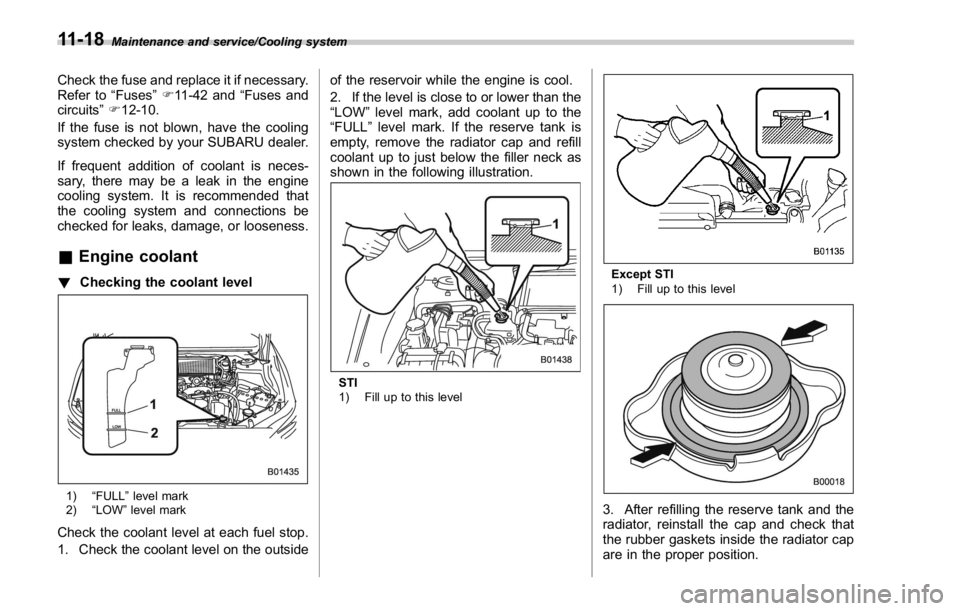
1) “ FULL ” level mark
2) “ LOW ” level mark
Check the coolant level at each fuel stop.
1. Check the coolant level on the outside of the reservoir while the engine is cool.
2. If the level is close to or lower than the
“ LOW ” level mark, add coolant up to the
“ FULL ” level mark. If the reserve tank is
empty, remove the radiator cap and refill
coolant up to just below the filler neck as
shown in the following illustration.
STI
1) Fill up to this level Except STI
1) Fill up to this level
3. After refilling the reserve tank and the
radiator, reinstall the cap and check that
the rubber gaskets inside the radiator cap
are in the proper position.11-18
Page 522 of 594
that cannot be seen with the naked eye.
This type of damage does not become
evident until time has passed. Try not
to drive over curbs, potholes or on
other rough surfaces. If doing so is
unavoidable, keep the vehicle ’ s speed
down to a walking pace or less, and
approach the curbs as squarely as
possible. Also, make sure the tires are
not pressed against the curb when you
park the vehicle.
. If you feel unusual vibration while
driving or find it difficult to steer the
vehicle in a straight line, one of the
tires and/or wheels may be damaged.
Drive slowly to the nearest authorized
SUBARU dealer and have the vehicle
inspected.
& Tire pressures and wear Maintaining the correct tire pressures
helps to maximize the tires ’ service lives
and is essential for good running perfor-
mance. Check and, if necessary, adjust
the pressure of each tire (including the
spare) at least once a month (for example,
during a fuel stop) and before any long
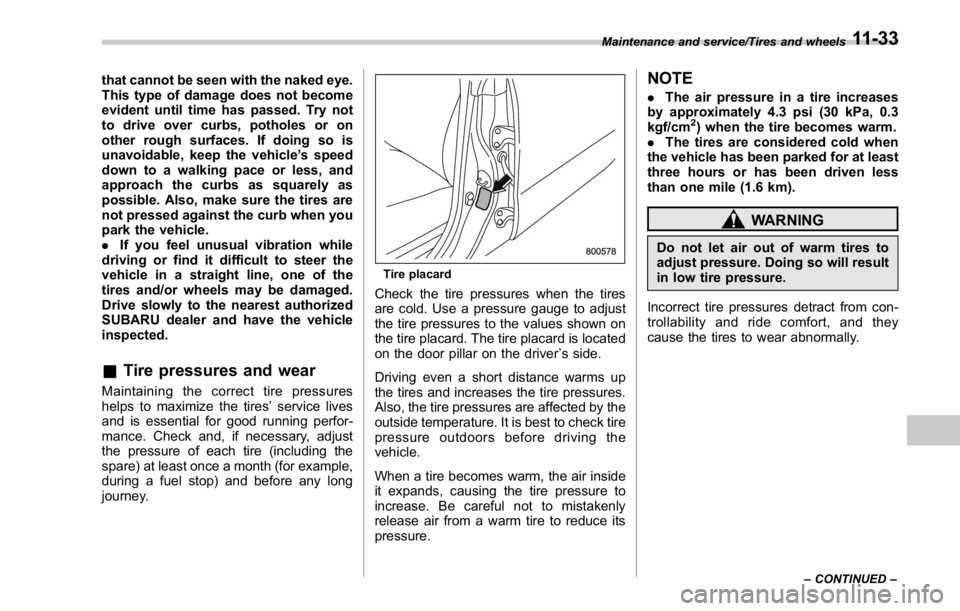
journey. Tire placard
Check the tire pressures when the tires
are cold. Use a pressure gauge to adjust
the tire pressures to the values shown on
the tire placard. The tire placard is located
on the door pillar on the driver ’ s side.
Driving even a short distance warms up
the tires and increases the tire pressures.
Also, the tire pressures are affected by the
outside temperature. It is best to check tire
pressure outdoors before driving the
vehicle.
When a tire becomes warm, the air inside
it expands, causing the tire pressure to
increase. Be careful not to mistakenly
release air from a warm tire to reduce its
pressure. NOTE . The air pressure in a tire increases
by approximately 4.3 psi (30 kPa, 0.3
kgf/cm 2
) when the tire becomes warm.
. The tires are considered cold when
the vehicle has been parked for at least
three hours or has been driven less
than one mile (1.6 km).
WARNINGDo not let air out of warm tires to
adjust pressure. Doing so will result
in low tire pressure.
Incorrect tire pressures detract from con-
trollability and ride comfort, and they
cause the tires to wear abnormally. Maintenance and service/Tires and wheels
– CONTINUED –11-33
Page 523 of 594
Maintenance and service/Tires and wheels
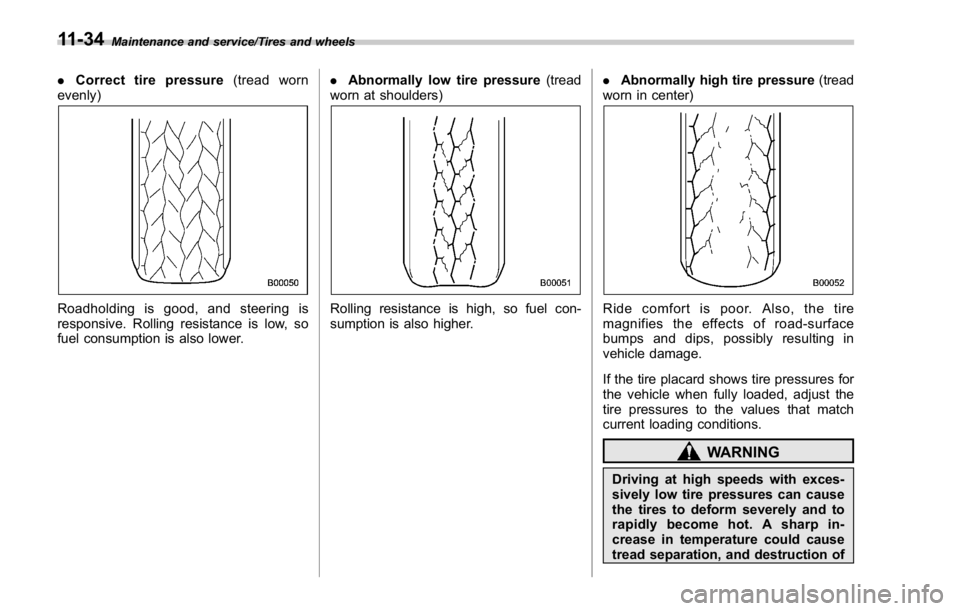
. Correct tire pressure (tread worn
evenly)
Roadholding is good, and steering is
responsive. Rolling resistance is low, so
fuel consumption is also lower. . Abnormally low tire pressure (tread
worn at shoulders)
Rolling resistance is high, so fuel con-
sumption is also higher. . Abnormally high tire pressure (tread
worn in center)
Ride comfort is poor. Also, the tire
magnifies the effects of road-surface
bumps and dips, possibly resulting in
vehicle damage.
If the tire placard shows tire pressures for
the vehicle when fully loaded, adjust the
tire pressures to the values that match
current loading conditions.
WARNING
Driving at high speeds with exces-
sively low tire pressures can cause
the tires to deform severely and to
rapidly become hot. A sharp in-
crease in temperature could cause
tread separation, and destruction of11-34
Page 542 of 594

Specifications ..................................................... 12-2Dimensions ........................................................ 12-2
Engine ............................................................... 12-3
Fuel ................................................................... 12-3
Engine oil .......................................................... 12-4
Manual transmission, front differential and rear
differential gear oil ........................................... 12-6
Fluids ................................................................ 12-7
Engine coolant ................................................... 12-7
Electrical system ................................................ 12-8
Tires .................................................................. 12-8 Temporary spare tires ........................................ 12-8
Brake disc ......................................................... 12-9
Fuses and circuits ........................................... 12-10Fuse panel located in the passenger
compartment ................................................. 12-10
Fuse panel located in the engine
compartment ................................................. 12-12
Bulb chart ......................................................... 12-16
Vehicle identification ....................................... 12-18
Specifications
12
Page 544 of 594

& Engine Model
STI Except STI
Engine model EJ257
(2.5 L, DOHC, turbo) FA20
(2.0 L, DOHC, turbo)
Engine type Horizontally opposed, liquid cooled 4 cylinder, 4-stroke petrol engine
Displacement cu-in (cc) 150 (2,457) 122 (1,998)
Bore 6 Stroke in (mm) 3.92 6 3.11 (99.5 6 79.0) 3.39 6 3.39 (86.0 6 86.0)
Compression ratio 8.2 : 1 10.6 : 1
Firing order 1 – 3 – 2 – 4
& Fuel
NOTE The engine is designed to operate using unleaded gasoline.
Model Fuel Fuel tank capacity
STI
93 AKI (98 RON) or higher * 1
15.9 US gal (60 liters, 13.2 Imp gal)
Except STI
91 AKI (95 RON) or higher * 2
*1: If unleaded gasoline with an octane rating of 93 AKI (98 RON) is not available, unleaded gasoline with an octane rating of 91 AKI (95 RON) may be
used with no detriment to engine durability or driveability.
*2: If unleaded gasoline with an octane rating of 91 AKI (95 RON) is not available, unleaded gasoline with an octane rating of 87 AKI (90 RON) or higher
may be used. Specifications/Specifications
– CONTINUED –12-3
Page 546 of 594
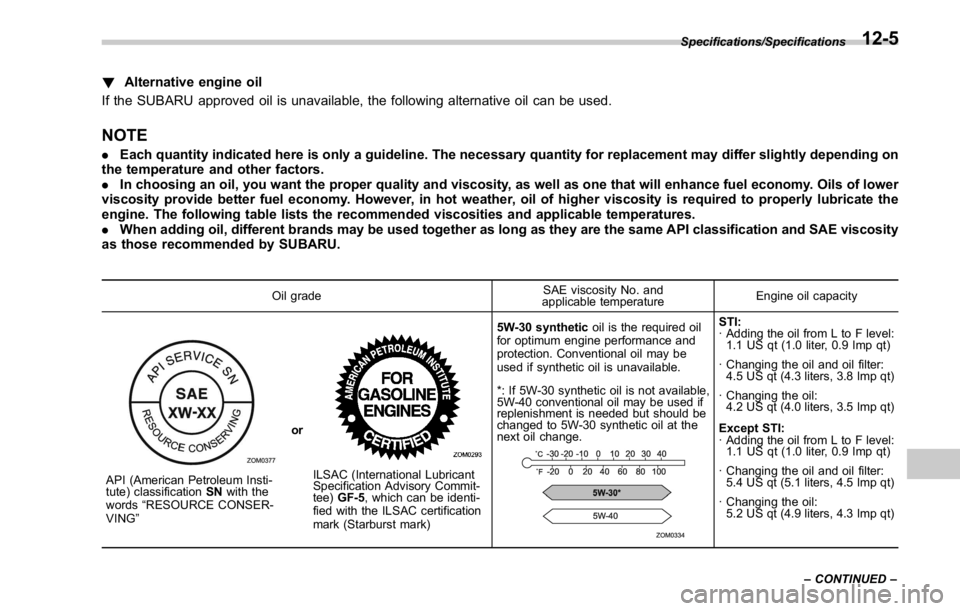
! Alternative engine oil
If the SUBARU approved oil is unavailable, the following alternative oil can be used.
NOTE . Each quantity indicated here is only a guideline. The necessary quantity for replacement may differ slightly depending on
the temperature and other factors.
. In choosing an oil, you want the proper quality and viscosity, as well as one that will enhance fuel economy. Oils of lower
viscosity provide better fuel economy. However, in hot weather, oil of higher viscosity is required to properly lubricate the
engine. The following table lists the recommended viscosities and applicable temperatures.
. When adding oil, different brands may be used together as long as they are the same API classification and SAE viscosity
as those recommended by SUBARU.
Oil grade SAE viscosity No. and
applicable temperature Engine oil capacity
API (American Petroleum Insti-
tute) classification SN with the
words “ RESOURCE CONSER-
VING ” or
ILSAC (International Lubricant
Specification Advisory Commit-
tee) GF-5 , which can be identi-
fied with the ILSAC certification
mark (Starburst mark) 5W-30 synthetic oil is the required oil
for optimum engine performance and
protection. Conventional oil may be
used if synthetic oil is unavailable.
*: If 5W-30 synthetic oil is not available,
5W-40 conventional oil may be used if
replenishment is needed but should be
changed to 5W-30 synthetic oil at the
next oil change. STI:
· Adding the oil from L to F level:
1.1 US qt (1.0 liter, 0.9 Imp qt)
· Changing the oil and oil filter:
4.5 US qt (4.3 liters, 3.8 Imp qt)
· Changing the oil:
4.2 US qt (4.0 liters, 3.5 Imp qt)
Except STI:
· Adding the oil from L to F level:
1.1 US qt (1.0 liter, 0.9 Imp qt)
· Changing the oil and oil filter:
5.4 US qt (5.1 liters, 4.5 Imp qt)
· Changing the oil:
5.2 US qt (4.9 liters, 4.3 Imp qt)Specifications/Specifications
– CONTINUED –12-5
Page 548 of 594

*4: You may use this type of manual transmission oil. However, using this type of oil will detract from driveability and fuel efficiency.
& Fluids Fluid
Fluid type* 1
Fluid capacity* 2
Remarks* 3
Continuously variable transmission
fluid (CVT models) Consult your SUBARU dealer. 13.1 US qt (12.4 liters, 10.9 Imp qt) “ Continuously variable trans-
mission fluid ” F 11-23
Brake fluid FMVSS No. 116, fresh DOT 3 or DOT 4
brake fluid –“ Brake fluid ” F 11-25
Clutch fluid (MT models) FMVSS No. 116, fresh DOT 3 or DOT 4
brake fluid – “ Clutch fluid (MT models) ” F 11 -
26
Power steering fluid (STI) · SUBARU ATF
· “ Dexron III ” Type Automatic Transmis-
sion Fluid
· IDEMITSU ATF HP 0.7 US qt (0.7 liter, 0.6 Imp qt) “ Power steering fluid (STI) ”
F 11-24
*1: Use one of the indicated types of fluid.
*2: The indicated fluid quantity is only a guideline. The necessary quantity for replacement may differ slightly depending on the temperature and other
factors.
*3: For more details about maintenance and service, refer to the indicated section.
& Engine coolant Vehicle model Coolant capacity Coolant type
STI 8.2 US qt (7.7 liters, 6.8 Imp qt)
SUBARU Super Coolant
Except STI MT models 8.7 US qt (8.2 liters, 7.2 Imp qt)
CVT models 8.9 US qt (8.4 liters, 7.4 Imp qt)
The indicated coolant quantity is only a guideline. The necessary quantity for replacement may differ slightly depending on the temperature and other
factors. For more details about maintenance and service, refer to “ Cooling system ” F 11-17. Specifications/Specifications
– CONTINUED –12-7
Page 553 of 594
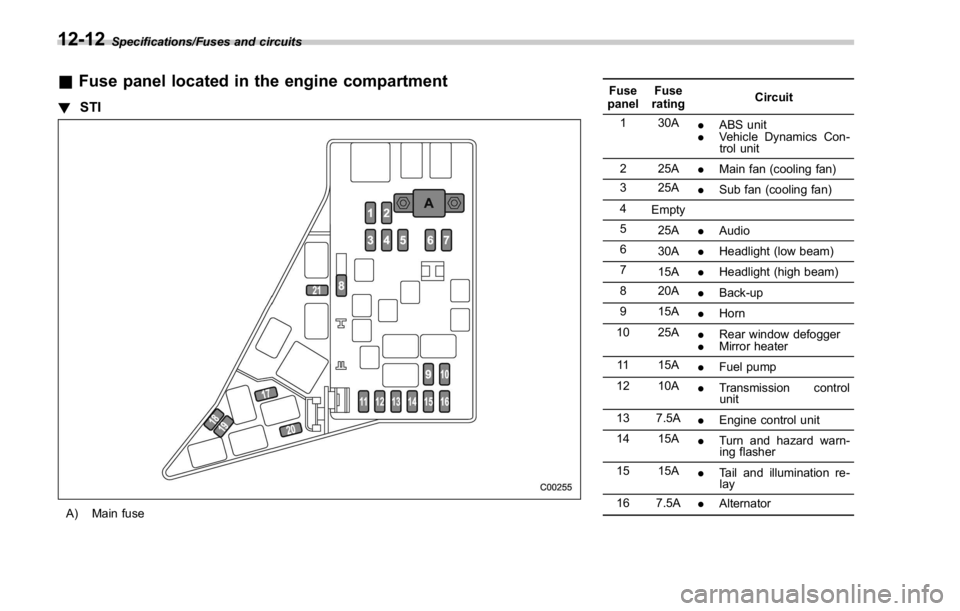
Specifications/Fuses and circuits
& Fuse panel located in the engine compartment! STI
A) Main fuse Fuse
panel Fuse
rating Circuit
1 30A
. ABS unit
. Vehicle Dynamics Con-
trol unit
2 25A
. Main fan (cooling fan)
3 25A
. Sub fan (cooling fan)
4
Empty
5
25A
. Audio
6
30A
. Headlight (low beam)
7
15A
. Headlight (high beam)
8 20A
. Back-up
9 15A
. Horn
10 25A
. Rear window defogger
. Mirror heater
11 15A
. Fuel pump
12 10A
. Transmission control
unit
13 7.5A
. Engine control unit
14 15A
. Turn and hazard warn-
ing flasher
15 15A
. Tail and illumination re-
lay
16 7.5A
. Alternator12-12
Page 555 of 594
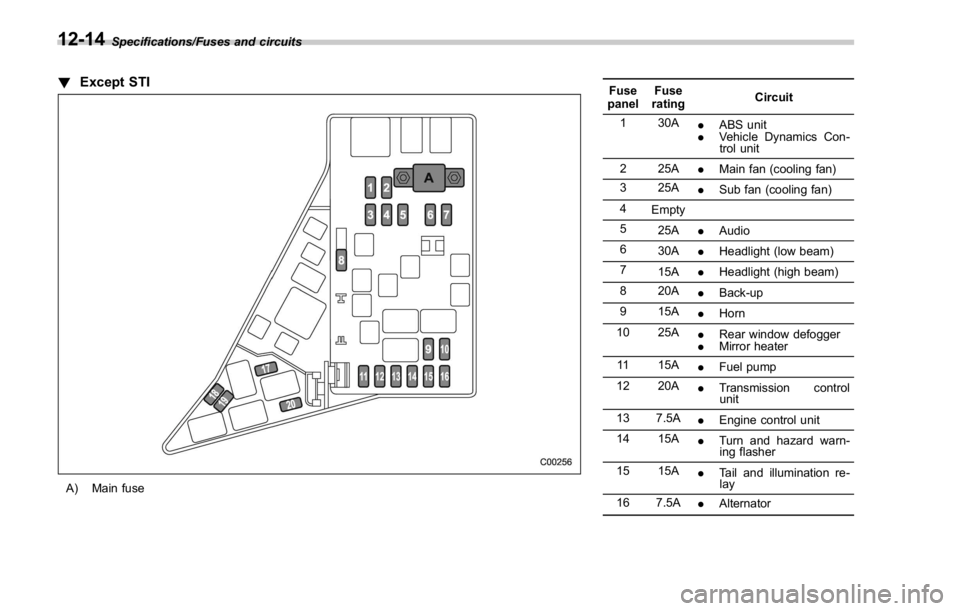
Specifications/Fuses and circuits
! Except STI
A) Main fuse Fuse
panel Fuse
rating Circuit
1 30A
. ABS unit
. Vehicle Dynamics Con-
trol unit
2 25A
. Main fan (cooling fan)
3 25A
. Sub fan (cooling fan)
4
Empty
5
25A
. Audio
6
30A
. Headlight (low beam)
7
15A
. Headlight (high beam)
8 20A
. Back-up
9 15A
. Horn
10 25A
. Rear window defogger
. Mirror heater
11 15A
. Fuel pump
12 20A
. Transmission control
unit
13 7.5A
. Engine control unit
14 15A
. Turn and hazard warn-
ing flasher
15 15A
. Tail and illumination re-
lay
16 7.5A
. Alternator12-14
Page 559 of 594
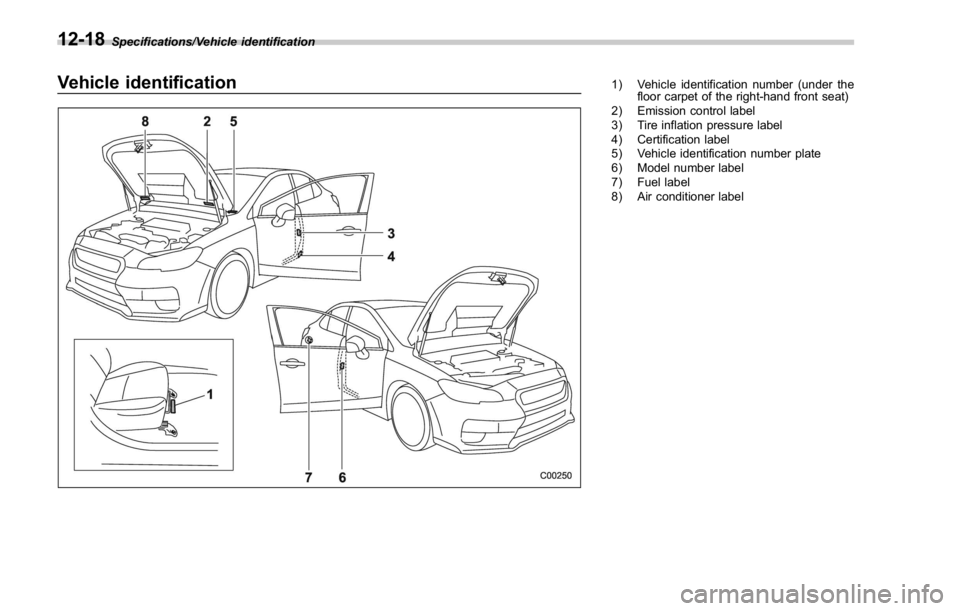
Specifications/Vehicle identification
Vehicle identification 1) Vehicle identification number (under the
floor carpet of the right-hand front seat)
2) Emission control label
3) Tire inflation pressure label
4) Certification label
5) Vehicle identification number plate
6) Model number label
7) Fuel label
8) Air conditioner label
12-18