power steering SUBARU WRX 2018 Owner's Manual
[x] Cancel search | Manufacturer: SUBARU, Model Year: 2018, Model line: WRX, Model: SUBARU WRX 2018Pages: 578, PDF Size: 33.21 MB
Page 466 of 578
(483,1)
北米Model "A1700BE-B" EDITED: 2017/ 10/ 11
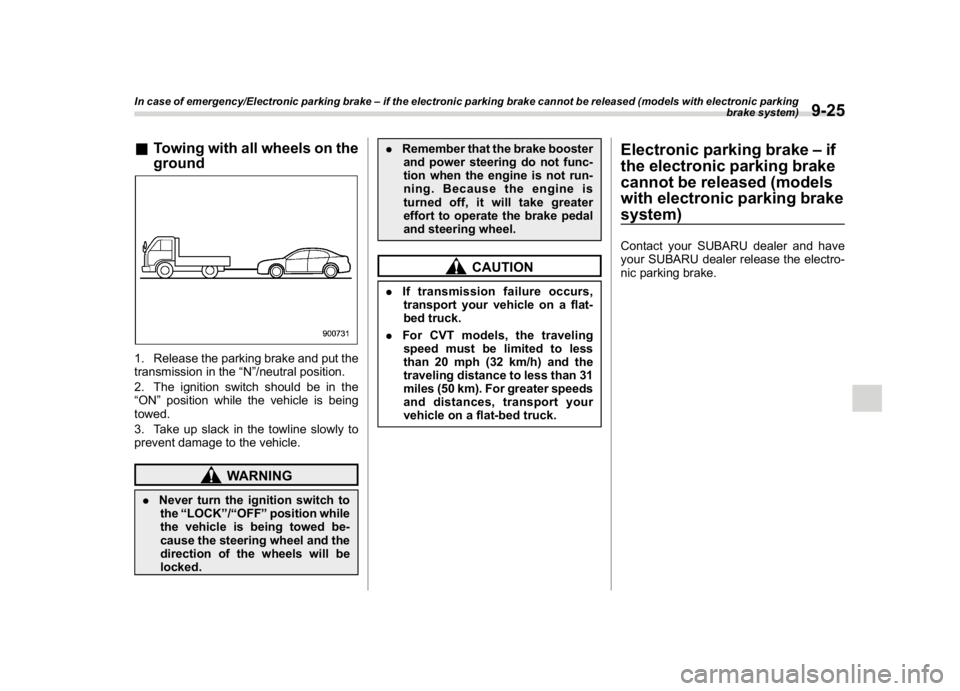
&Towing with all wheels on the
ground1. Release the parking brake and put the
transmission in the“N”/neutral position.
2. The ignition switch should be in the
“ON”position while the vehicle is being
towed.
3. Take up slack in the towline slowly to
prevent damage to the vehicle.
WARNING
.Never turn the ignition switch to
the“LOCK”/“OFF”position while
the vehicle is being towed be-
cause the steering wheel and the
direction of the wheels will be
locked..Remember that the brake booster
and power steering do not func-
tion when the engine is not run-
ning. Because the engine is
turned off, it will take greater
effort to operate the brake pedal
and steering wheel.
CAUTION
.If transmission failure occurs,
transport your vehicle on a flat-
bed truck.
.For CVT models, the traveling
speed must be limited to less
than 20 mph (32 km/h) and the
traveling distance to less than 31
miles (50 km). For greater speeds
and distances, transport your
vehicle on a flat-bed truck.
Electronic parking brake–if
the electronic parking brake
cannot be released (models
with electronic parking brake
system)Contact your SUBARU dealer and have
your SUBARU dealer release the electro-
nic parking brake.
In case of emergency/Electronic parking brake–if the electronic parking brake cannot be released (models with electronic parking
brake system)
9-25
9
Page 478 of 578

(499,1)
北米Model "A1700BE-B" EDITED: 2017/ 10/ 11
Maintenance schedule.......................................... 11-3
Maintenance precautions..................................... 11-3
Before checking or servicing in the engine
compartment...................................................... 11-4
When checking or servicing in the engine
compartment...................................................... 11-5
When checking or servicing in the engine
compartment while the engine is running............ 11-5
Maintenance tips................................................... 11-6
Removing and reinstalling clips............................ 11-6
Engine hood.......................................................... 11-9
Engine compartment overview.......................... 11-11
STI...................................................................... 11-11
Except STI.......................................................... 11-12
Engine oil............................................................. 11-13
Engine oil consumption...................................... 11-13
Checking the oil level.......................................... 11-13
Changing the oil and oil filter.............................. 11-15
Recommended grade and viscosity..................... 11-15
Synthetic oil........................................................ 11-16
Cooling system................................................... 11-16
Cooling fan, hose and connections..................... 11-17
Engine coolant.................................................... 11-17
Air cleaner element............................................. 11-18
Replacing the air cleaner element........................ 11-19
Spark plugs......................................................... 11-21
Recommended spark plugs................................. 11-21
Drive belts........................................................... 11-21Manual transmission oil......................................11-22
Recommended grade and viscosity..................... 11-22
Continuously variable transmission fluid..........11-22
Front differential gear oil (CVT models) and
rear differential gear oil....................................11-23
Recommended grade and viscosity..................... 11-23
Power steering fluid (STI)...................................11-23
Checking the fluid level...................................... 11-23
Recommended fluid............................................ 11-24
Brake fluid............................................................11-24
Checking the fluid level...................................... 11-24
Recommended brake fluid.................................. 11-25
Clutch fluid (MT models).....................................11-25
Checking the fluid level...................................... 11-25
Recommended clutch fluid................................. 11-26
Brake booster......................................................11-26
Brake pedal..........................................................11-27
Checking the brake pedal free play..................... 11-27
Checking the brake pedal reserve distance ......... 11-27
Clutch pedal (MT models)...................................11-27
Checking the clutch function .............................. 11-27
Checking the clutch pedal free play.................... 11-28
Hill start assist system.......................................11-28
Replacement of brake pad andlining................11-28
Breaking-in of new brake pads (models with
electronic parking brake system)..................... 11-29
Breaking-in of new brake pads and linings
(models without electronic parking brake
system)........................................................... 11-29
Maintenance and service
11
Page 488 of 578
(509,1)
北米Model "A1700BE-B" EDITED: 2017/ 10/ 11
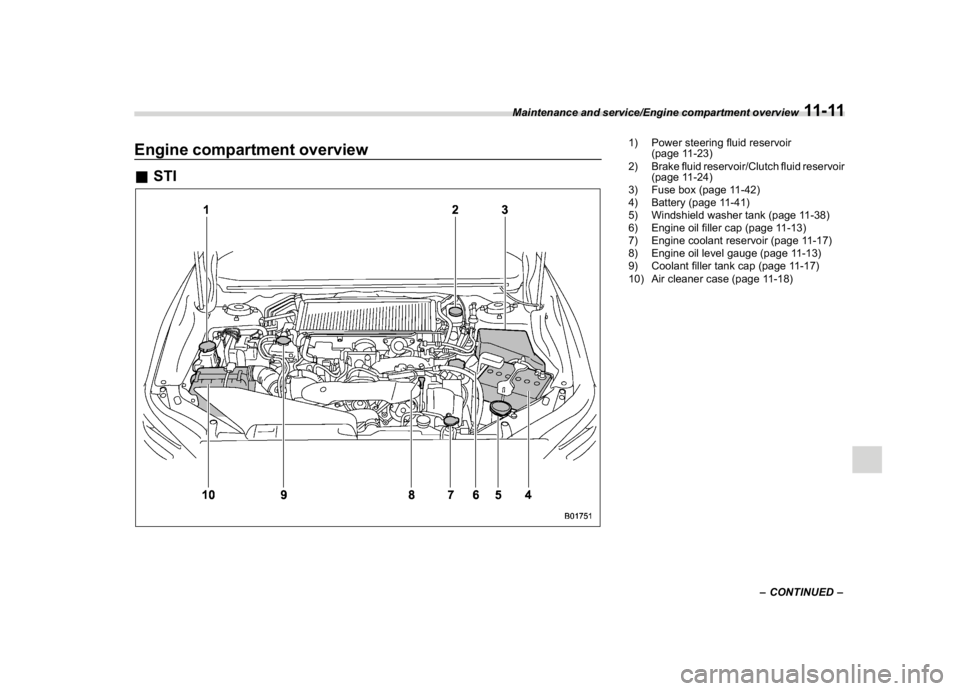
Engine compartment overview&STI
1) Power steering fluid reservoir
(page 11-23)
2) Brake fluid reservoir/Clutch fluid reservoir
(page 11-24)
3) Fuse box (page 11-42)
4) Battery (page 11-41)
5) Windshield washer tank (page 11-38)
6) Engine oil filler cap (page 11-13)
7) Engine coolant reservoir (page 11-17)
8) Engine oil level gauge (page 11-13)
9) Coolant filler tank cap (page 11-17)
10) Air cleaner case (page 11-18)
–CONTINUED–
Maintenance and service/Engine compartment overview
11-11
11
Page 498 of 578

(519,1)
北米Model "A1700BE-B" EDITED: 2017/ 10/ 11
Spark plugsIt may be difficult to replace the spark
plugs. It is recommended that you have the
spark plugs replaced by your SUBARU
dealer.
Have the spark plugs replaced according
to the maintenance schedule in the“War-
ranty and Maintenance Booklet”.&Recommended spark plugsFor the recommended spark plugs, refer to
“Electrical system”F12-8.
Drive beltsNOTEFor models except STI, it is unneces-
sary to check the deflection of the drive
belt periodically because this engine is
equipped with an automatic belt ten-
sion adjuster. However, have the belt
replaced according to the maintenance
schedule in the“Warranty and Main-
tenance Booklet”. Consult your
SUBARU dealer for replacement.
If the drive belt is loose, cracked or
worn, contact your SUBARU dealer.
STI
1) Power steering oil pump pulley
2) Front side belt
3) Alternator pulley
4) Air conditioner compressor pulley
5) Rear side belt
6) Crank pulley
A) 22 lbf (98 N, 10 kgf)
CAUTION
The front side belt, which runs in
conjunction with the following com-
ponents, must be used within the
specified deflection.
.Power steering oil pump pulley
.Alternator pulley
.Crank pulley
Check the deflection of the front side
–CONTINUED–
Maintenance and service/Spark plugs
11-21
11
Page 500 of 578
(521,1)
北米Model "A1700BE-B" EDITED: 2017/ 10/ 11
Front differential gear oil
(CVT models) and rear differ-
ential gear oilIt is not necessary to check the gear oil
level. Check that there are no cracks,
damage or leakage. However, have the oil
inspected by your SUBARU dealer ac-
cording to the maintenance schedule in
the“Warranty and Maintenance Booklet”.
Consult your SUBARU dealer for details.&Recommended grade and
viscosityEach oil manufacturer has its own base
oils and additives. Never use different
brands together. For details, refer to
“Manual transmission, front differential
and rear differential gear oil”F12-6.
CAUTION
Using a differential gear oil other
than the specified oil may cause a
decline in vehicle performance.
Power steering fluid (STI)&Checking the fluid levelThe power steering fluid expands greatly
as its temperature rises; the fluid level
differs according to fluid temperature.
Therefore, the reservoir tank has two
different checking ranges for hot and cold
fluids.
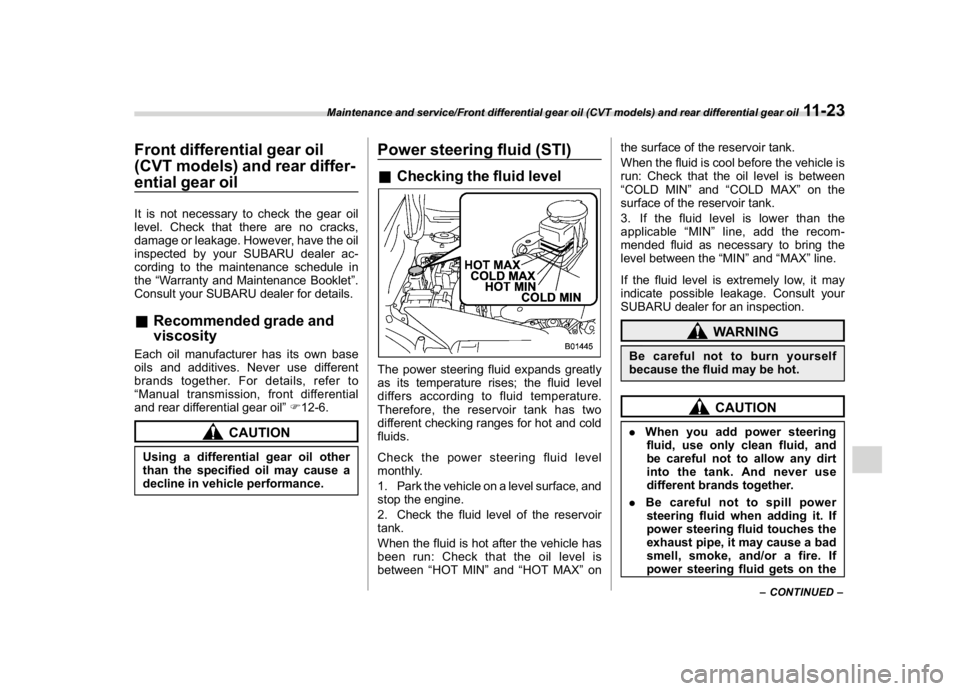
Check the power steering fluid level
monthly.
1. Park the vehicle on a level surface, and
stop the engine.
2. Check the fluid level of the reservoir
tank.
When the fluid is hot after the vehicle has
been run: Check that the oil level is
between“HOT MIN”and“HOT MAX”onthe surface of the reservoir tank.
When the fluid is cool before the vehicle is
run: Check that the oil level is between
“COLD MIN”and“COLD MAX”on the
surface of the reservoir tank.
3. If the fluid level is lower than the
applicable“MIN”line, add the recom-
mended fluid as necessary to bring the
level between the“MIN”and“MAX”line.
If the fluid level is extremely low, it may
indicate possible leakage. Consult your
SUBARU dealer for an inspection.
WARNING
Be careful not to burn yourself
because the fluid may be hot.
CAUTION
.When you add power steering
fluid, use only clean fluid, and
be careful not to allow any dirt
into the tank. And never use
different brands together.
.Be careful not to spill power
steering fluid when adding it. If
power steering fluid touches the
exhaust pipe, it may cause a bad
smell, smoke, and/or a fire. If
power steering fluid gets on the
–CONTINUED–
Maintenance and service/Front differential gear oil (CVT models) and rear differential gear oil
11-23
11
Page 538 of 578

(561,1)
北米Model "A1700BE-B" EDITED: 2017/ 10/ 11
&Fluids
Fluid
Fluid type*
1
Fluid capacity*
2
Remarks*
3
Continuously variable transmission
fluid (CVT models)Consult your SUBARU dealer. 13.1 US qt (12.4 liters, 10.9 Imp qt)“
Continuously variable transmis-
sion fluid”F11-22
Brake fluidFMVSS No. 116, DOT 3 or DOT 4 brake
fluid—“
Brake fluid”F11-24
Clutch fluid (MT models)FMVSS No. 116, DOT 3 or DOT 4 brake
fluid—“
Clutch fluid (MT models)”F11-25
Power steering fluid (STI)· SUBARU ATF
·“Dexron III”Type Automatic Transmis-
sion Fluid
· IDEMITSU ATF HP0.7 US qt (0.7 liter, 0.6 Imp qt)“
Power steering fluid (STI)”F11 -
23
*1: Use one of the indicated types of fluid.
*2: The indicated fluid quantity is only a guideline. The necessary quantity for replacement may differ slightly depending on the temperature and other
factors.
*3: For more details about maintenance and service, refer to the indicated section.&Engine coolant
Vehicle model Coolant capacity Coolant type
STI 8.2 US qt (7.7 liters, 6.8 Imp qt)
SUBARU Super Coolant
Except STIMT models 8.6 US qt (8.1 liters, 7.2 Imp qt)
CVT models8.8 US qt (8.3 liters, 7.3 Imp qt)
The indicated coolant quantity is only a guideline. The necessary quantity for replacement may differ slightly depending on the temperature and other
factors. For more details about maintenance and service, refer to“
Cooling system”F11-16.
–CONTINUED–
Specifications/Specifications
12-7
12
Page 552 of 578

(577,1)
北米Model "A1700BE-B" EDITED: 2017/ 10/ 11
crease in temperature could cause
tread separation, and failure of the
tire(s). Possible resulting loss of
vehicle control could lead to an
accident.!Measuring and adjusting air
pressure to achieve proper in-
flationCheck and, if necessary, adjust the
pressure of each tire (including the
spare) at least once a month and
before any long journey. Check the
tire pressures when the tires are
cold. Use a pressure gauge to
adjust the tire pressures to the
specific values. Driving even a short
distance warms up the tires and
increases the tire pressures. Also,
the tire pressures are affected by
the outside temperature. It is best to
check tire pressure outdoors before
driving the vehicle. When a tire
becomes warm, the air inside it
expands, causing the tire pressure
to increase. Be careful not to mis-
takenly release air from a warm tire
to reduce its pressure.
&Glossary of tire terminology.
Accessory weight
The combined weight (in excess of
those standard items which may be
replaced) of automatic transmis-
sion, power steering, power brakes,
power windows, power seats, radio,
and heater, to the extent that these
items are available as factory-in-
stalled equipment (whether in-
stalled or not)..
Bead
The part of the tire that is made of
steel wires, wrapped or reinforced
by ply cords and that is shaped to fit
the rim..
Bead separation
A breakdown of the bond between
components in the bead..
Bias ply tire
A pneumatic tire in which the ply
cords that extend to the beads are
laid at alternate angles substantially
less than 90 degrees to the center-
line of the tread..
Carcass
The tire structure, except tread andsidewall rubber which, when in-
flated, bears the load.
.
Chunking
The breaking away of pieces of the
tread or sidewall..
Cold tire pressure
The pressure in a tire that has been
driven less than 1 mile or has been
standing for three hours or more..
Cord
The strands forming the plies in the
tire..
Cord separation
The parting of cords from adjacent
rubber compounds..
Cracking
Any parting within the tread, side-
wall, or inner liner of the tire
extending to cord material..
Curb weight
The weight of a motor vehicle with
standard equipment including the
maximum capacity of fuel, oil and
coolant, and if so equipped, air
conditioning and additional weight
optional engine.
–CONTINUED–
Consumer information and Reporting safety defects/Tire information
13-5
13