fuel SUBARU WRX 2018 Service Manual
[x] Cancel search | Manufacturer: SUBARU, Model Year: 2018, Model line: WRX, Model: SUBARU WRX 2018Pages: 578, PDF Size: 33.21 MB
Page 436 of 578
(451,1)
北米Model "A1700BE-B" EDITED: 2017/ 10/ 11
Loading your vehicle
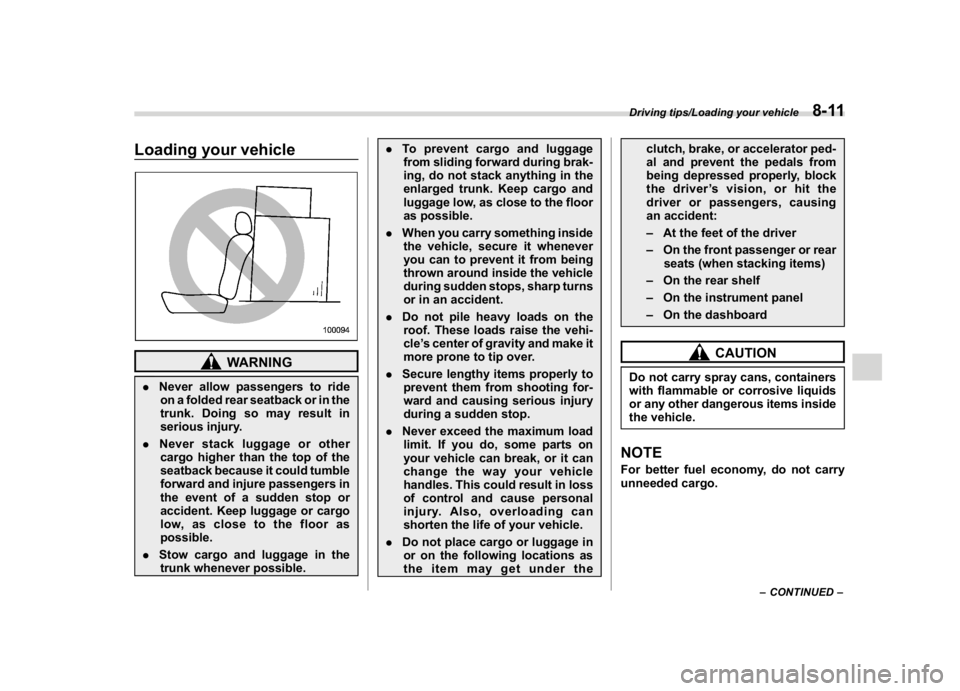
WARNING
.Never allow passengers to ride
on a folded rear seatback or in the
trunk. Doing so may result in
serious injury.
.Never stack luggage or other
cargo higher than the top of the
seatback because it could tumble
forward and injure passengers in
the event of a sudden stop or
accident. Keep luggage or cargo
low, as close to the floor as
possible.
.Stow cargo and luggage in the
trunk whenever possible..To prevent cargo and luggage
from sliding forward during brak-
ing, do not stack anything in the
enlarged trunk. Keep cargo and
luggage low, as close to the floor
as possible.
.When you carry something inside
the vehicle, secure it whenever
you can to prevent it from being
thrown around inside the vehicle
during sudden stops, sharp turns
or in an accident.
.Do not pile heavy loads on the
roof. These loads raise the vehi-
cle’s center of gravity and make it
more prone to tip over.
.Secure lengthy items properly to
prevent them from shooting for-
ward and causing serious injury
during a sudden stop.
.Never exceed the maximum load
limit. If you do, some parts on
your vehicle can break, or it can
change the way your vehicle
handles. This could result in loss
of control and cause personal
injury. Also, overloading can
shorten the life of your vehicle.
.Do not place cargo or luggage in
or on the following locations as
the item may get under theclutch, brake, or accelerator ped-
al and prevent the pedals from
being depressed properly, block
the driver’s vision, or hit the
driver or passengers, causing
an accident:
–At the feet of the driver
–On the front passenger or rear
seats (when stacking items)
–On the rear shelf
–On the instrument panel
–On the dashboard
CAUTION
Do not carry spray cans, containers
with flammable or corrosive liquids
or any other dangerous items inside
the vehicle.NOTEFor better fuel economy, do not carry
unneeded cargo.
–CONTINUED–
Driving tips/Loading your vehicle
8-11
8
Page 437 of 578
(452,1)
北米Model "A1700BE-B" EDITED: 2017/ 10/ 11
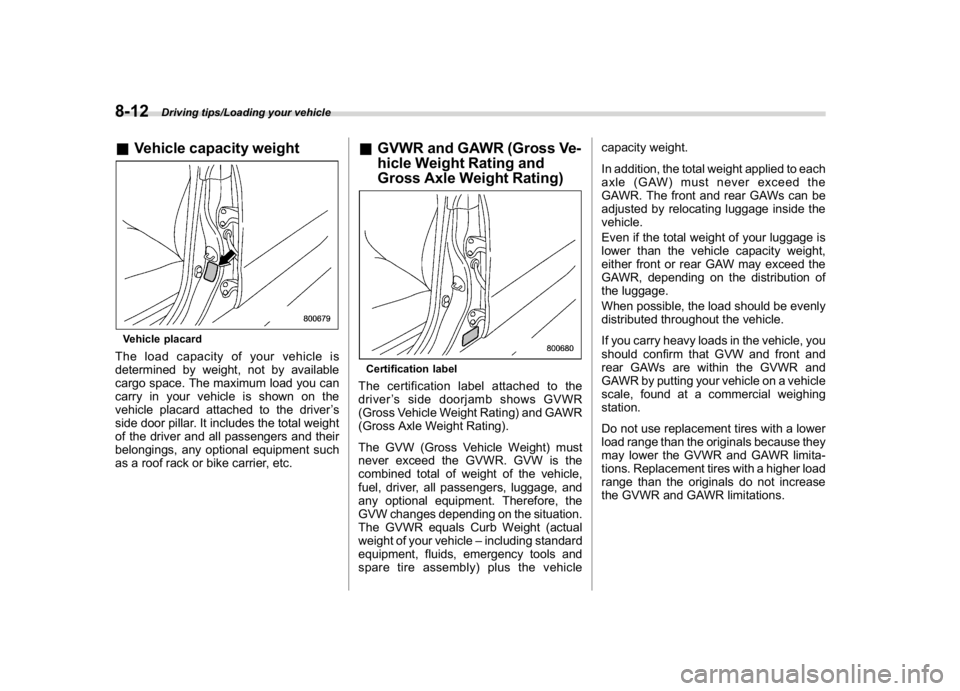
&Vehicle capacity weightVehicle placardThe load capacity of your vehicle is
determined by weight, not by available
cargo space. The maximum load you can
carry in your vehicle is shown on the
vehicle placard attached to the driver’s
side door pillar. It includes the total weight
of the driver and all passengers and their
belongings, any optional equipment such
as a roof rack or bike carrier, etc.
&GVWR and GAWR (Gross Ve-
hicle Weight Rating and
Gross Axle Weight Rating)Certification labelThe certification label attached to the
driver’s side doorjamb shows GVWR
(Gross Vehicle Weight Rating) and GAWR
(Gross Axle Weight Rating).
The GVW (Gross Vehicle Weight) must
never exceed the GVWR. GVW is the
combined total of weight of the vehicle,
fuel, driver, all passengers, luggage, and
any optional equipment. Therefore, the
GVW changes depending on the situation.
The GVWR equals Curb Weight (actual
weight of your vehicle–including standard
equipment, fluids, emergency tools and
spare tire assembly) plus the vehiclecapacity weight.
In addition, the total weight applied to each
axle (GAW) must never exceed the
GAWR. The front and rear GAWs can be
adjusted by relocating luggage inside the
vehicle.
Even if the total weight of your luggage is
lower than the vehicle capacity weight,
either front or rear GAW may exceed the
GAWR, depending on the distribution of
the luggage.
When possible, the load should be evenly
distributed throughout the vehicle.
If you carry heavy loads in the vehicle, you
should confirm that GVW and front and
rear GAWs are within the GVWR and
GAWR by putting your vehicle on a vehicle
scale, found at a commercial weighing
station.
Do not use replacement tires with a lower
load range than the originals because they
may lower the GVWR and GAWR limita-
tions. Replacement tires with a higher load
range than the originals do not increase
the GVWR and GAWR limitations.
Driving tips/Loading your vehicle
8-12
Page 464 of 578
(481,1)
北米Model "A1700BE-B" EDITED: 2017/ 10/ 11
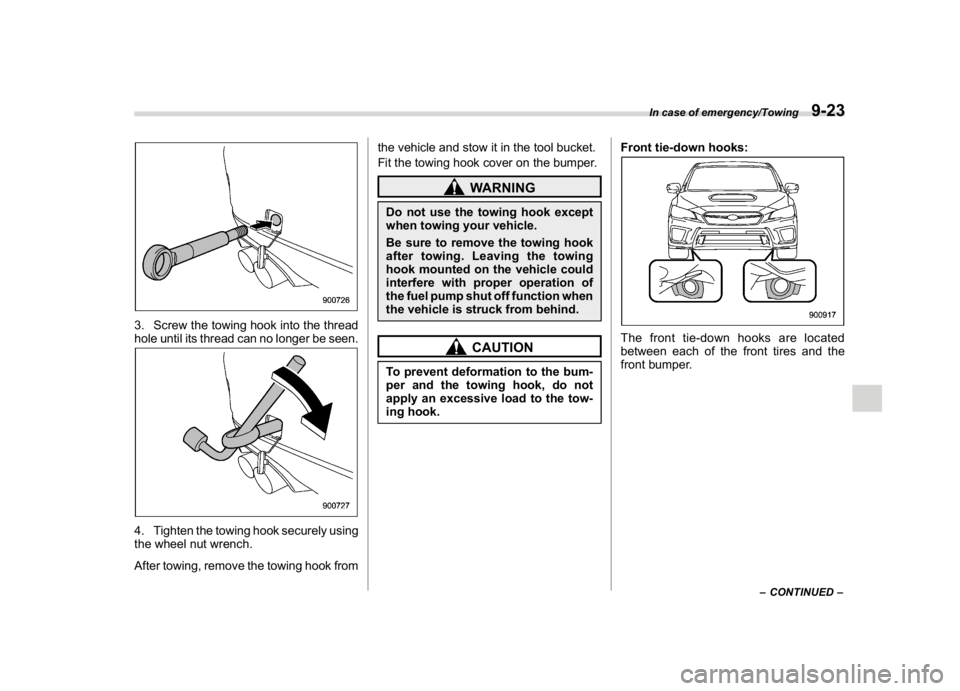
3. Screw the towing hook into the thread
hole until its thread can no longer be seen.4. Tighten the towing hook securely using
the wheel nut wrench.
After towing, remove the towing hook fromthe vehicle and stow it in the tool bucket.
Fit the towing hook cover on the bumper.
WARNING
Do not use the towing hook except
when towing your vehicle.
Be sure to remove the towing hook
after towing. Leaving the towing
hook mounted on the vehicle could
interfere with proper operation of
the fuel pump shut off function when
the vehicle is struck from behind.
CAUTION
To prevent deformation to the bum-
per and the towing hook, do not
apply an excessive load to the tow-
ing hook.Front tie-down hooks:
The front tie-down hooks are located
between each of the front tires and the
front bumper.
–CONTINUED–
In case of emergency/Towing
9-23
9
Page 469 of 578

(486,1)
北米Model "A1700BE-B" EDITED: 2017/ 10/ 11
Moonroof (if equipped)–if the
moonroof does not closeIf the moonroof does not close, we
recommend that you have the system
checked by a SUBARU dealer.
If your vehicle is involved in
an accident
CAUTION
If your vehicle is involved in an
accident, be sure to inspect the
ground under the vehicle before
restarting the engine. If you find that
fuel has leaked on the ground, do
not try to restart the engine. The fuel
system has been damaged and is in
need of repair. Immediately contact
the nearest automotive service facil-
ity. We recommend that you consult
your SUBARU dealer.
Your vehicle has a fuel pump shut off
system. To minimize the risk of fire due to
fuel leakage when your vehicle is subject
to impact from an accident or another
factor, the system stops supplying fuel.
However, depending on the impact condi-
tions at the time of collision, the fuel pump
shut-off system may not operate.
Perform the following procedures to restart
the engine after the system is activated.Models without“keyless access with
push-button start system”:
1. Turn the ignition switch to the“LOCK”
or“ACC”position.
2. Restart the engine.
Models with“keyless access with
push-button start system”:
1. Turn the push-button ignition switch to
the“ACC”or“OFF”position.
2. Restart the engine.
In case of emergency/Moonroof–if the moonroof does not close
9-28
Page 471 of 578

(490,1)
北米Model "A1700BE-B" EDITED: 2017/ 10/ 11
Exterior care&Washing
CAUTION
TYPE RA: Do not use automatic car
washes. Doing so may damage the
rear wing or its finish.
CAUTION
.When washing the vehicle, the
brakes may get wet. As a result,
the brake stopping distance will
be longer. To dry the brakes, drive
the vehicle at a safe speed while
lightly depressing the brake ped-
al to heat up the brakes.
.Do not wash the engine compart-
ment and area adjacent to it. If
water enters the engine air intake
or electrical parts, it will cause
engine trouble or a malfunction
of electrical equipment.
.When washing the inner fenders,
underbody, bumpers and pro-
truding objects such as exhaust
pipes and exhaust finishers, be
careful to prevent injuries from
contacting sharp ends..Do not use any organic solvents
when washing the surface of the
bulb assembly cover. However, if
a detergent with organic solvents
is used to wash the cover sur-
face, completely rinse off the
detergent with water. Otherwise,
the cover surface may be da-
maged.
NOTEWhen having your vehicle washed in an
automatic car wash, make sure before-
hand that the car wash is of suitable
type.
The best way to preserve your vehicle’s
beauty is frequent washing. Wash the
vehicle at least once a month to avoid
contamination by road grime.
Wash dirt off with a wet sponge and plenty
of lukewarm or cold water. Do not wash the
vehicle with hot water and in direct sun-
light.
Salt, chemicals, insects, tar, soot, tree sap,
and bird droppings should be washed off
by using a light detergent, as required. If
you use a light detergent, make certain
that it is a neutral detergent. Do not use
strong soap or chemical detergents. All
cleaning agents should be promptly rinsedoff the surface and not allowed to dry there.
Rinse the vehicle thoroughly with plenty of
lukewarm water. Wipe the remaining water
off with a chamois or soft cloth. Wear
rubber gloves and use a hand brush when
washing down underbody, inner fenders
and suspension to effectively remove mud
and dirt off.
!Washing the underbody
Chemicals, salts and gravel used for
deicing road surfaces are extremely cor-
rosive, accelerating the corrosion of un-
derbody components, such as the exhaust
system, fuel and brake lines, brake cables,
floor pan and fenders, and suspension.
Thoroughly flush the underbody and inside
of the fenders with lukewarm or cold water
at frequent intervals to reduce the harmful
effects of such agents.
Mud and sand adhering to the underbody
components may accelerate their corro-
sion.
After driving off-road or on muddy or sandy
roads, wash the mud and sand off the
underbody. Carefully flush the suspension
and axle parts, as they are particularly
prone to mud and sand buildup. Do not use
a sharp-edged tool to remove caked mud.
Appearance care/Exterior care
10-2
Page 474 of 578

(493,1)
北米Model "A1700BE-B" EDITED: 2017/ 10/ 11
Corrosion protectionYour SUBARU has been designed and
built to resist corrosion. Special materials
and protective finishes have been used on
most parts of the vehicle to help maintain
fine appearance, strength, and reliable
operation.&Most common causes of cor-
rosionThe most common causes of corrosion
are:
.The accumulation of moisture retaining
dirt and debris in body panel sections,
cavities, and other areas.
.Damage to paint and other protective
coatings caused by gravel and stone chips
or minor accidents.
Corrosion is accelerated on the vehicle
when:
.It is exposed to road salt or dust control
chemicals, or used in coastal areas where
there is more salt in the air, or in areas
where there is considerable industrial
pollution.
.It is driven in areas of high humidity,
especially when temperatures range just
above freezing.
.Dampness in certain parts of thevehicle remains for a long time, even
though other parts of the vehicle may be
dry.
.High temperatures will cause corrosion
to parts of the vehicle which cannot dry
quickly due to lack of proper ventilation.
&To help prevent corrosionWash the vehicle regularly to prevent
corrosion of the body and suspension
components. Also, wash the vehicle
promptly after driving on any of the
following surfaces.
.roads that have been salted to prevent
them from freezing in winter
.mud, sand, or gravel
.coastal roads
After the winter has ended, it is recom-
mended that the underbody be given a
very thorough washing.
Before the beginning of winter, check the
condition of underbody components, such
as the exhaust system, fuel and brake
lines, brake cables, suspension, steering
system, floor pan, and fenders. If any of
them are found to be rusted, they should
be given an appropriate rust prevention
treatment or should be replaced. Contact
your SUBARU dealer to perform this kind
of maintenance and treatment if you needassistance.
Repair chips and scratches in the paint as
soon as you find them.
Check the interior of the vehicle for water
and dirt accumulation under the floor mats
because that could cause corrosion. Oc-
casionally check under the mats to make
sure the area is dry.
Keep your garage dry. Do not park your
vehicle in a damp, poorly ventilated gar-
age. In such a garage, corrosion can be
caused by dampness. If you wash the
vehicle in the garage or put the vehicle into
the garage when wet or covered with
snow, that can cause dampness.
If your vehicle is operated in cold weather
and/or in areas where road salts and other
corrosive materials are used, the door
hinges and locks, and hood latch should
be inspected and lubricated periodically.
Appearance care/Corrosion protection
10-5
10
Page 475 of 578

(494,1)
北米Model "A1700BE-B" EDITED: 2017/ 10/ 11
Cleaning the interiorUse a soft, damp cloth to clean the climate
control panel, audio equipment, instru-
ment panel, center console, combination
meter panel, and switches. (Do not use
organic solvents.)&Seat fabricRemove loose dirt, dust or debris with a
vacuum cleaner. If the dirt is caked on the
fabric or hard to remove with a vacuum
cleaner, use a soft brush then vacuum it.
Wipe the fabric surface with a tightly wrung
cloth and dry the seat fabric thoroughly. If
the fabric is still dirty, wipe using a solution
of mild soap and lukewarm water then dry
thoroughly.
If the stain does not come out, try a
commercially-available fabric cleaner.
Use the cleaner on a hidden place and
make sure it does not affect the fabric
adversely. Use the cleaner according to its
instructions.
CAUTION
When cleaning the seat, do not use
benzine, paint thinner, or any similar
materials. Doing so could damage
the surface and cause the color todeteriorate.
&Leather seat materialsThe leather used by SUBARU is a high
quality natural product which will retain its
distinctive appearance and feel for many
years with proper care.
Allowing dust or road dirt to build up on the
surface can cause the material to become
brittle and to wear prematurely. Regular
cleaning with a soft, moist, natural fiber
cloth should be performed monthly, taking
care not to soak the leather or allow water
to penetrate the stitched seams.
A mild detergent suitable for cleaning
woolen fabrics may be used to remove
difficult dirt spots, rubbing with a soft, dry
cloth afterwards to restore the luster. If
your SUBARU is to be parked for a long
time in bright sunlight, it is recommended
that the seats and head restraints be
covered, or the windows shaded, to pre-
vent fading or shrinkage. Make sure to
remove any seat covers and head restraint
covers when operating the vehicle.
Minor surface blemishes or bald patches
may be treated with a commercial leather
spray lacquer. You will discover that each
leather seat section will develop soft folds
or wrinkles, which is characteristic of
genuine leather.
&Synthetic leather upholsteryThe synthetic leather material used on the
SUBARU may be cleaned using mild soap
or detergent and water, after first vacuum-
ing or brushing away loose dirt. Allow the
soap to soak in for a few minutes and wipe
off with a clean, damp cloth. Commercial
foam-type cleaners suitable for synthetic
leather materials may be used when
necessary.
CAUTION
Strong cleaning agents such as
solvents, paint thinners, window
cleaner or fuel must never be used
on leather or synthetic interior ma-
terials. Doing so could damage the
surface and cause the color to
deteriorate.
Appearance care/Cleaning the interior
10-6
Page 476 of 578

(495,1)
北米Model "A1700BE-B" EDITED: 2017/ 10/ 11
&Climate control panel, audio
panel, instrument panel, con-
sole panel, and switchesUse a soft, damp cloth to clean the climate
control panel, audio equipment, instru-
ment panel, center console, combination
meter panel, and switches.
CAUTION
.Do not use organic solvents such
as paint thinners or fuel, or
strong cleaning agents that con-
tain those solvents. Doing so
could damage the surface and
cause the color to deteriorate.
.Do not use chemical solvents that
contain silicone on the vehicle
audio system, electrical compo-
nents of the air-conditioner or
any switches. If silicone adheres
to these parts, it may cause
damage to electrical compo-
nents.
&MonitorTo clean the audio/navigation/multi-func-
tion display monitor, wipe it with a silicone
cloth or with a soft cloth. If the monitor is
extremely dirty, clean it with a soft cloth
moistened with neutral detergent then
carefully wipe off any remaining detergent.
CAUTION
.Do not spray neutral detergent
directly onto the monitor. Doing
so could damage the monitor’s
components.
.Do not wipe the monitor with a
hard cloth. Doing so could
scratch the monitor.
.Do not use cleaning fluid that
contains thinner, fuel, or any
other volatile substance. Such
cleaning fluid could erase the
lettering on the switches at the
bottom of the monitor.
Steering wheel with ultra-
suede covering (if equipped)In order to maintain the characteristic
texture and appearance of ultra-suede,
regular cleaning of the steering wheel is
recommended.NOTEIf the steering wheel is used continually
without cleaning, the surface will ap-
pear worn. This is due to dirt from
hands and other sources which causes
the ultra-suede fibers to harden. This is
not a defect.
Follow the procedure below and perform
cleaning.&Regular cleaningIt is recommended that regular cleaning
(approximately once a month) be per-
formed by following the procedure below.
1. Dampen a cloth or similar item with
warm water at approximately 1048F
(408C), then strongly wring it out and wipe
over the entire steering wheel.
2. When the surface of the ultra-suede is
dry, use a lint brush or similar means to
straighten the fibers.
–CONTINUED–
Appearance care/Steering wheel with ultra-suede covering
10-7
10
Page 480 of 578
(501,1)
北米Model "A1700BE-B" EDITED: 2017/ 10/ 11
Maintenance scheduleU.S. models
The scheduled maintenance items re-
quired to be serviced at regular intervals
are shown in the“Warranty and Mainte-
nance Booklet”. For details, read the
separate“Warranty and Maintenance
Booklet”.
Canada models
The scheduled maintenance items re-
quired to be serviced at regular intervals
are shown in the“Warranty and Service
Booklet”. For details, read the separate
“Warranty and Service Booklet”.
Other models
Some items of your vehicle are required to
be serviced at scheduled intervals. For
details about your maintenance schedule,
read the separate“Warranty and Main-
tenance Booklet”.NOTEYou can set a reminder to be displayed
when a scheduled maintenance item is
almost due. For details, refer to“Main-
tenance settings”F3-59.
Maintenance precautionsWhen maintenance and service are re-
quired, it is recommended that all work be
done by an authorized SUBARU dealer.
If you perform maintenance and service by
yourself, you should familiarize yourself
with the information provided in this sec-
tion on general maintenance and service
for your SUBARU.
Incorrect or incomplete service could
cause improper or unsafe vehicle opera-
tion. Any problems caused by improper
maintenance and service performed by
you are not eligible for warranty coverage.
WARNING
.Testing of an All-Wheel Drive
model must NEVER be performed
on a single two-wheel dynam-
ometer or similar apparatus. At-
tempting to do so will result in
transmission damage and in un-
controlled vehicle movement and
may cause an accident or injuries
to persons nearby.
.Always select a safe area when
performing maintenance on your
vehicle.
.Always be very careful to avoidinjury when working on the vehi-
cle. Remember that some of the
materials in the vehicle may be
hazardous if improperly used or
handled, for example, battery
acid.
.Your vehicle should only be ser-
viced by persons fully competent
to do so. Serious personal injury
may result to persons not experi-
enced in servicing vehicles.
.Always use the proper tools and
make certain that they are well
maintained.
.Never get under the vehicle sup-
ported only by a jack. Always use
safety stands to support the
vehicle.
.Never keep the engine running in
a poorly ventilated area, such as
a garage or other closed areas.
.Do not smoke or allow open
flames around the fuel or battery.
This will cause a fire.
.Because the fuel system is under
pressure, replacement of the fuel
filter should be performed only
by your SUBARU dealer.
.Wear adequate eye protection to
guard against getting oil or fluids
–CONTINUED–
Maintenance and service/Maintenance schedule
11-3
11
Page 490 of 578
(511,1)
北米Model "A1700BE-B" EDITED: 2017/ 10/ 11
Engine oil
CAUTION
.If the level gauge is not pulled out
easily, twist the level gauge right
and left, then pull it out. Other-
wise, you may be injured acci-
dentally straining yourself.
.Use only engine oil with the
recommended grade and vis-
cosity.
.Be careful not to spill engine oil
when adding it. If oil touches the
exhaust pipe, it may cause a bad
smell, smoke, and/or a fire. If
engine oil gets on the exhaust
pipe, be sure to wipe it off.&Engine oil consumptionSome engine oil will be consumed while
driving. The rate of consumption can be
affected by such factors as transmission
type, driving style, terrain and tempera-
ture. Under the following conditions, oil
consumption can be increased and thus
require refilling between maintenance in-
tervals:
.When the engine is new and within the
break-in period.When the engine oil is of lower quality
.When the incorrect oil viscosity is used
.When engine braking is employed
(repeatedly)
.When the engine is operated at high
engine speeds (for extended periods of
time)
.When the engine is operated under
heavy loads (for extended periods of time)
.When the engine idles for extended
periods of time
.When the vehicle is operated in stop
and go and/or heavy traffic situations
.When the vehicle is used under severe
thermal conditions
.When the vehicle accelerates and
decelerates frequently
Under these or similar conditions, you
should check your oil at least every 2nd
fuel fill-up and change your engine oil more
frequently. Different drivers in the same
car may experience different results. If
your oil consumption rate is greater than
expected, contact your authorized
SUBARU retailer who may perform a test
under controlled conditions.
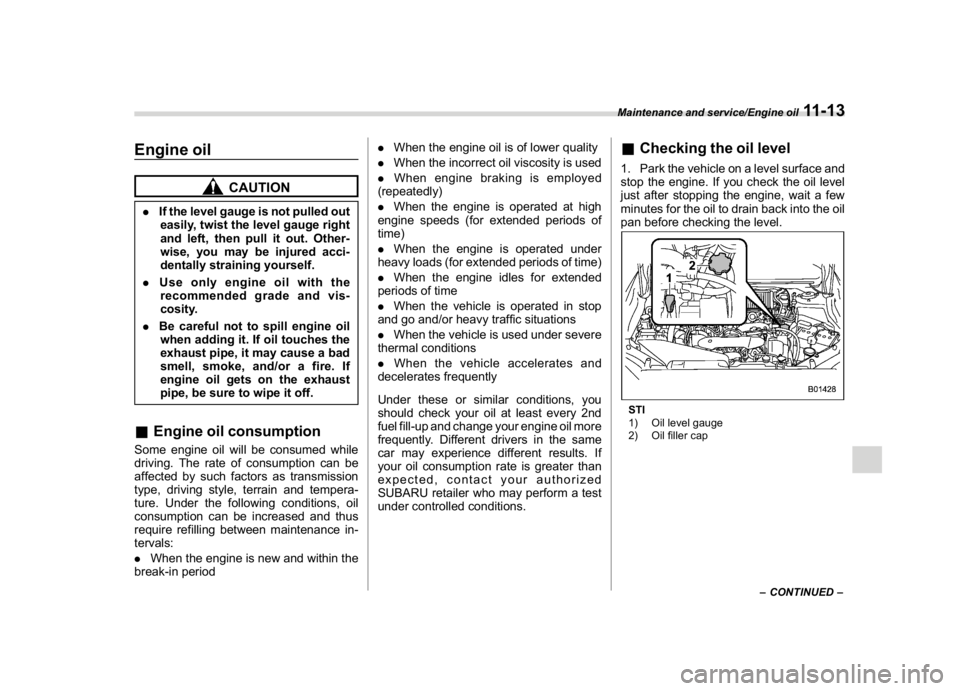
&Checking the oil level1. Park the vehicle on a level surface and
stop the engine. If you check the oil level
just after stopping the engine, wait a few
minutes for the oil to drain back into the oil
pan before checking the level.STI
1) Oil level gauge
2) Oil filler cap
–CONTINUED–Maintenance and service/Engine oil
11-13
11