fuel SUBARU WRX 2018 Workshop Manual
[x] Cancel search | Manufacturer: SUBARU, Model Year: 2018, Model line: WRX, Model: SUBARU WRX 2018Pages: 578, PDF Size: 33.21 MB
Page 492 of 578

(513,1)
北米Model "A1700BE-B" EDITED: 2017/ 10/ 11
CAUTION
.For models except STI, be careful
not to touch the engine oil filter
when removing the oil filler cap.
Doing so may result in a burn, a
pinched finger, or may cause
some other injury.
.Use only engine oil with the
recommended grade and vis-
cosity.
.Be careful not to spill engine oil
when adding it. If oil touches the
exhaust pipe, it may cause a bad
smell, smoke, and/or a fire. If
engine oil gets on the exhaust
pipe, be sure to wipe it off.
To add engine oil, remove the engine oil
filler cap and slowly pour engine oil
through the filler neck. After pouring oil
into the engine, you must use the level
gauge to confirm that the oil level is
correct.
For models STI, just after driving or while
the engine is warm, the engine oil level
reading may be in a range between the
upper level and the notch mark. This is
caused by thermal expansion of the
engine oil.
NOTETo prevent overfilling the engine oil, do
not add any additional oil above the
upper level when the engine is cold.&Changing the oil and oil filterChange the oil and oil filter according to
the maintenance schedule in the“War-
ranty and Maintenance Booklet”.
The engine oil and oil filter must be
changed more frequently than listed in
the maintenance schedule when driving
on dusty roads, when short trips are
frequently made, or when driving in ex-
tremely cold weather.NOTE.Changing the engine oil and oil filter
should be performed by a well-trained
expert. Contact your SUBARU dealer
for changing the engine oil and oil filter.
Fully trained mechanics are on standby
at a SUBARU dealer to utilize the
special tools, spare parts and recom-
mended oil for this work, and also, used
oils are properly disposed of.
.If performing oil replacement your-
self, observe the local regulations and
dispose of waste oil properly.
&Recommended grade and
viscosity
CAUTION
Use only engine oil with the recom-
mended grade and viscosity.
Refer to“Engine oil”F12-4.NOTEEngine oil viscosity (thickness) affects
fuel economy. Oils of lower viscosity
provide better fuel economy. However,
in hot weather, oil of higher viscosity is
required to properly lubricate the en-
gine.
–CONTINUED–
Maintenance and service/Engine oil
11-15
11
Page 494 of 578
(515,1)
北米Model "A1700BE-B" EDITED: 2017/ 10/ 11
&Cooling fan, hose and con-
nectionsYour vehicle employs an electric cooling
fan which is thermostatically controlled to
operate when the engine coolant reaches
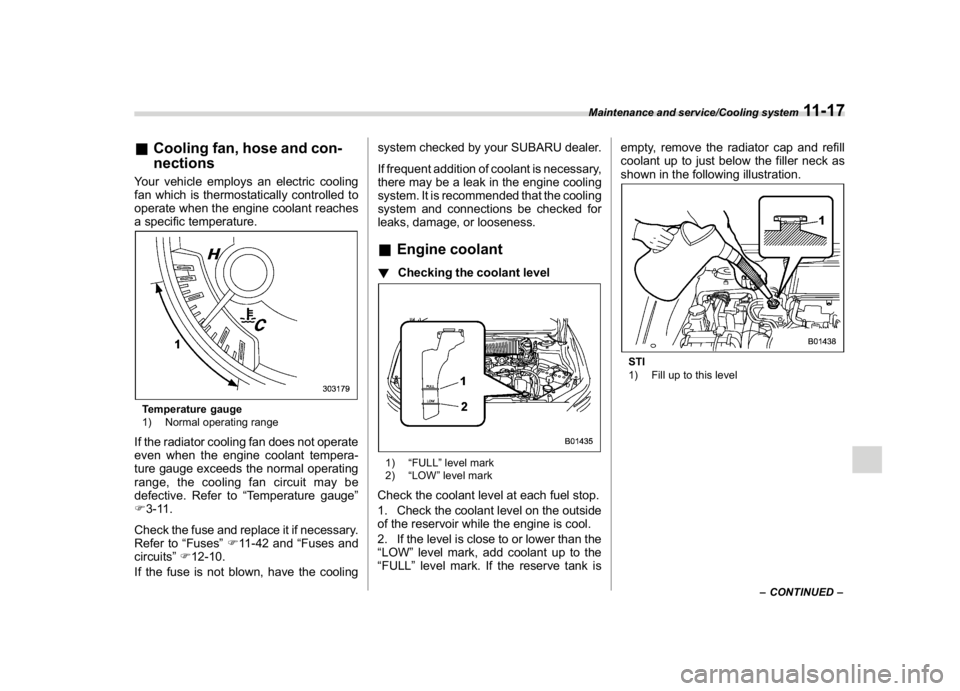
a specific temperature.Temperature gauge
1) Normal operating rangeIf the radiator cooling fan does not operate
even when the engine coolant tempera-
ture gauge exceeds the normal operating
range, the cooling fan circuit may be
defective. Refer to“Temperature gauge”
F3-11.
Check the fuse and replace it if necessary.
Refer to“Fuses”F11-42 and“Fuses and
circuits”F12-10.
If the fuse is not blown, have the coolingsystem checked by your SUBARU dealer.
If frequent addition of coolant is necessary,
there may be a leak in the engine cooling
system. It is recommended that the cooling
system and connections be checked for
leaks, damage, or looseness.
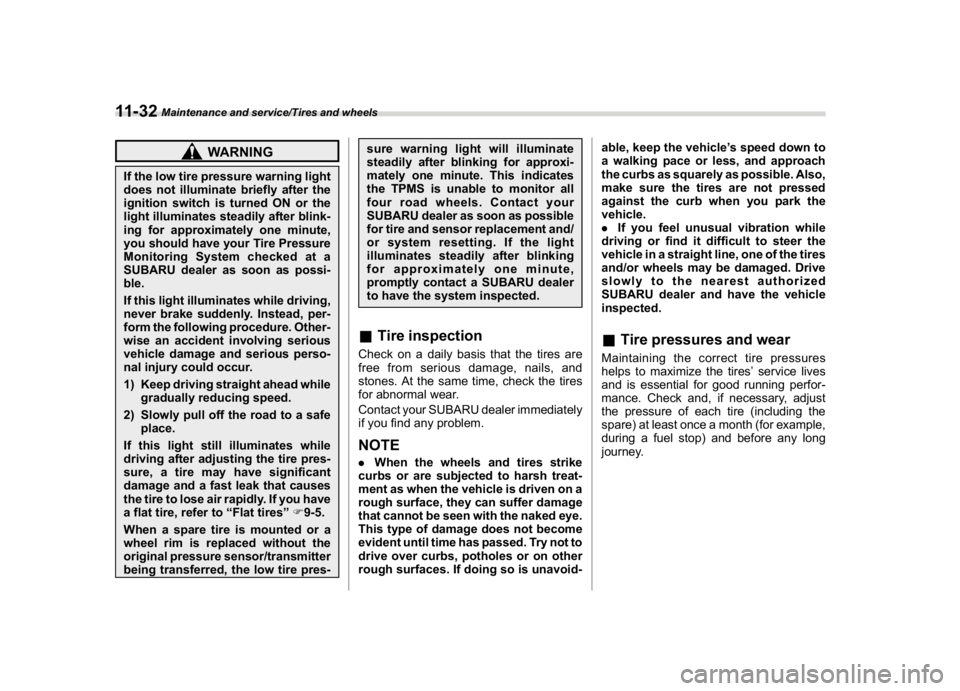
&Engine coolant!Checking the coolant level1)“FULL”level mark
2)“LOW”level markCheck the coolant level at each fuel stop.
1. Check the coolant level on the outside
of the reservoir while the engine is cool.
2. If the level is close to or lower than the
“LOW”level mark, add coolant up to the
“FULL”level mark. If the reserve tank isempty, remove the radiator cap and refill
coolant up to just below the filler neck as
shown in the following illustration.
STI
1) Fill up to this level
–CONTINUED–
Maintenance and service/Cooling system
11-17
11
Page 509 of 578
(530,1)
北米Model "A1700BE-B" EDITED: 2017/ 10/ 11
WARNING
If the low tire pressure warning light
does not illuminate briefly after the
ignition switch is turned ON or the
light illuminates steadily after blink-
ing for approximately one minute,
you should have your Tire Pressure
Monitoring System checked at a
SUBARU dealer as soon as possi-
ble.
If this light illuminates while driving,
never brake suddenly. Instead, per-
form the following procedure. Other-
wise an accident involving serious
vehicle damage and serious perso-
nal injury could occur.
1) Keep driving straight ahead while
gradually reducing speed.
2) Slowly pull off the road to a safe
place.
If this light still illuminates while
driving after adjusting the tire pres-
sure, a tire may have significant
damage and a fast leak that causes
the tire to lose air rapidly. If you have
a flat tire, refer to“Flat tires”F9-5.
When a spare tire is mounted or a
wheel rim is replaced without the
original pressure sensor/transmitter
being transferred, the low tire pres-sure warning light will illuminate
steadily after blinking for approxi-
mately one minute. This indicates
the TPMS is unable to monitor all
four road wheels. Contact your
SUBARU dealer as soon as possible
for tire and sensor replacement and/
or system resetting. If the light
illuminates steadily after blinking
for approximately one minute,
promptly contact a SUBARU dealer
to have the system inspected.
&Tire inspectionCheck on a daily basis that the tires are
free from serious damage, nails, and
stones. At the same time, check the tires
for abnormal wear.
Contact your SUBARU dealer immediately
if you find any problem.NOTE.When the wheels and tires strike
curbs or are subjected to harsh treat-
ment as when the vehicle is driven on a
rough surface, they can suffer damage
that cannot be seen with the naked eye.
This type of damage does not become
evident until time has passed. Try not to
drive over curbs, potholes or on other
rough surfaces. If doing so is unavoid-able, keep the vehicle’s speed down to
a walking pace or less, and approach
the curbs as squarely as possible. Also,
make sure the tires are not pressed
against the curb when you park the
vehicle.
.If you feel unusual vibration while
driving or find it difficult to steer the
vehicle in a straight line, one of the tires
and/or wheels may be damaged. Drive
slowly to the nearest authorized
SUBARU dealer and have the vehicle
inspected.
&Tire pressures and wearMaintaining the correct tire pressures
helps to maximize the tires’service lives
and is essential for good running perfor-
mance. Check and, if necessary, adjust
the pressure of each tire (including the
spare) at least once a month (for example,
during a fuel stop) and before any long
journey.
Maintenance and service/Tires and wheels
11-32
Page 510 of 578
(531,1)
北米Model "A1700BE-B" EDITED: 2017/ 10/ 11
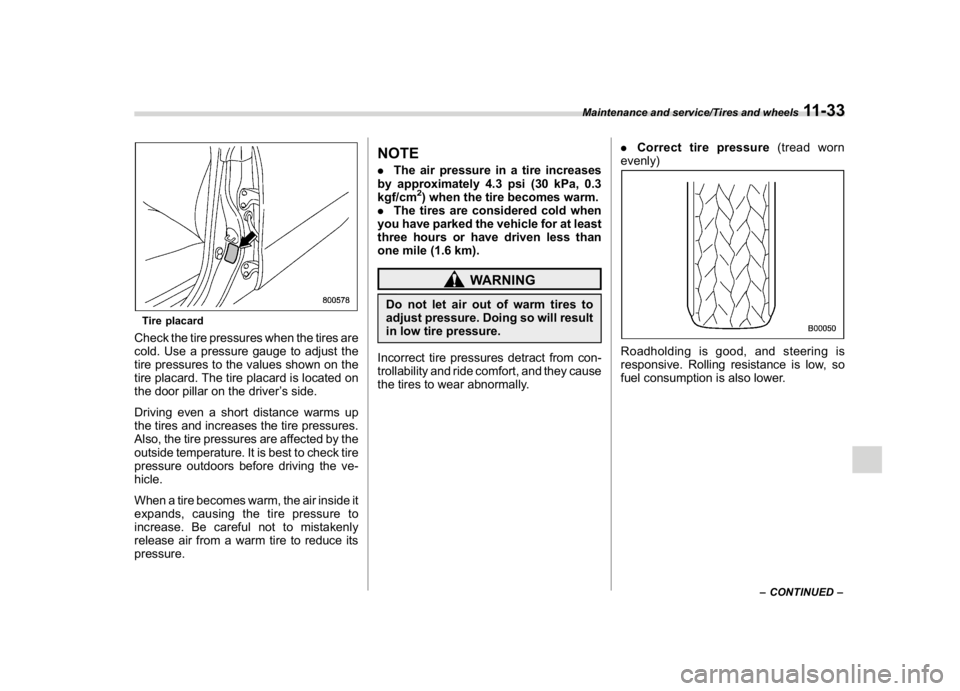
Tire placardCheck the tire pressures when the tires are
cold. Use a pressure gauge to adjust the
tire pressures to the values shown on the
tire placard. The tire placard is located on
the door pillar on the driver’s side.
Driving even a short distance warms up
the tires and increases the tire pressures.
Also, the tire pressures are affected by the
outside temperature. It is best to check tire
pressure outdoors before driving the ve-
hicle.
When a tire becomes warm, the air inside it
expands, causing the tire pressure to
increase. Be careful not to mistakenly
release air from a warm tire to reduce its
pressure.
NOTE.The air pressure in a tire increases
by approximately 4.3 psi (30 kPa, 0.3
kgf/cm
2) when the tire becomes warm.
.The tires are considered cold when
you have parked the vehicle for at least
three hours or have driven less than
one mile (1.6 km).
WARNING
Do not let air out of warm tires to
adjust pressure. Doing so will result
in low tire pressure.
Incorrect tire pressures detract from con-
trollability and ride comfort, and they cause
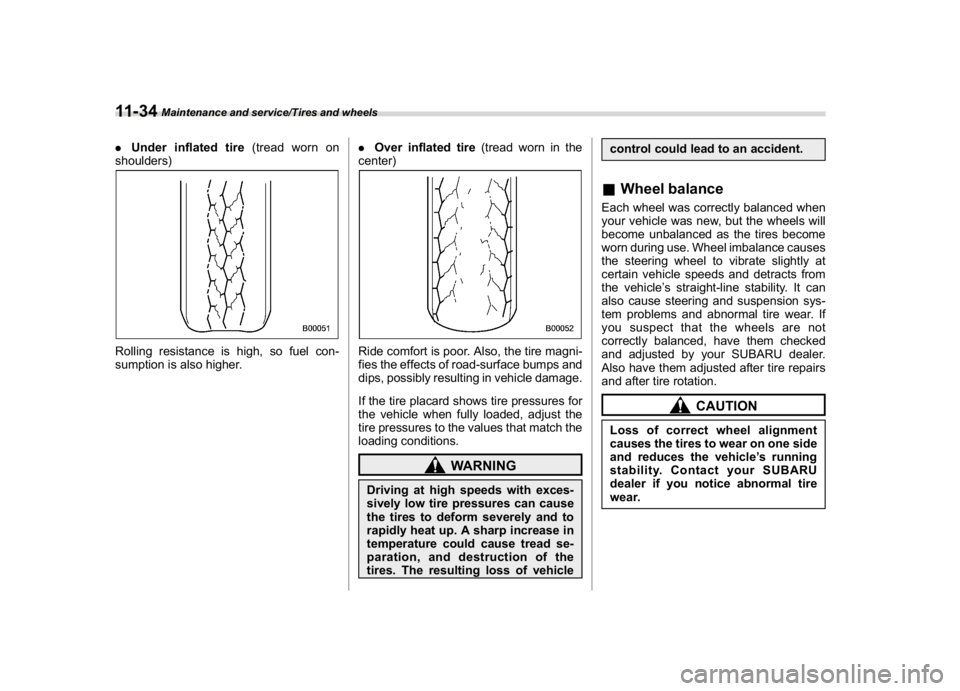
the tires to wear abnormally..Correct tire pressure(tread worn
evenly)
Roadholding is good, and steering is
responsive. Rolling resistance is low, so
fuel consumption is also lower.
–CONTINUED–
Maintenance and service/Tires and wheels
11-33
11
Page 511 of 578
(532,1)
北米Model "A1700BE-B" EDITED: 2017/ 10/ 11
.Under inflated tire(tread worn on
shoulders)Rolling resistance is high, so fuel con-
sumption is also higher..Over inflated tire(tread worn in the
center)
Ride comfort is poor. Also, the tire magni-
fies the effects of road-surface bumps and
dips, possibly resulting in vehicle damage.
If the tire placard shows tire pressures for
the vehicle when fully loaded, adjust the
tire pressures to the values that match the
loading conditions.
WARNING
Driving at high speeds with exces-
sively low tire pressures can cause
the tires to deform severely and to
rapidly heat up. A sharp increase in
temperature could cause tread se-
paration, and destruction of the
tires. The resulting loss of vehiclecontrol could lead to an accident.
&Wheel balanceEach wheel was correctly balanced when
your vehicle was new, but the wheels will
become unbalanced as the tires become
worn during use. Wheel imbalance causes
the steering wheel to vibrate slightly at
certain vehicle speeds and detracts from
the vehicle’s straight-line stability. It can
also cause steering and suspension sys-
tem problems and abnormal tire wear. If
you suspect that the wheels are not
correctly balanced, have them checked
and adjusted by your SUBARU dealer.
Also have them adjusted after tire repairs
and after tire rotation.
CAUTION
Loss of correct wheel alignment
causes the tires to wear on one side
and reduces the vehicle’s running
stability. Contact your SUBARU
dealer if you notice abnormal tire
wear.
Maintenance and service/Tires and wheels
11-34
Page 532 of 578

(555,1)
北米Model "A1700BE-B" EDITED: 2017/ 10/ 11
Specifications........................................................12-2
Dimensions...........................................................12-2
Engine..................................................................12-3
Fuel......................................................................12-3
Engine oil.............................................................12-4
Manual transmission, front differential and rear
differential gear oil..............................................12-6
Fluids...................................................................12-7
Engine coolant......................................................12-7
Electrical system..................................................12-8Tires.....................................................................12-8
Temporary spare tires...........................................12-9
Brake disc............................................................12-9
Fuses and circuits..............................................12-10
Fuse panel located in the passenger
compartment...................................................12-10
Fuse panel located in the engine compartment ... 12-12
Bulb chart............................................................12-14
Vehicle identification..........................................12-16
Specifications
12
Page 534 of 578

(557,1)
北米Model "A1700BE-B" EDITED: 2017/ 10/ 11
&EngineModel
STI Except STI
Engine modelEJ25
(2.5 L, DOHC, turbo)FA20
(2.0 L, DOHC, turbo)
Engine type Horizontally opposed, liquid cooled 4 cylinder, 4-stroke petrol engine
Displacement cu-in (cc) 150 (2,457) 122 (1,998)
Bore6Stroke in (mm) 3.9263.11 (99.5679.0) 3.3963.39 (86.0686.0)
Compression ratio 8.2 : 1 10.6 : 1
Firing order1–3–2–4&Fuel
NOTEThe engine is designed to operate using unleaded gasoline.
Model Fuel Fuel tank capacity
STI
93 AKI (98 RON) or higher*
1
15.9 US gal (60 liters, 13.2 Imp gal)
Except STI
91 AKI (95 RON) or higher*
2
*1: If unleaded gasoline with an octane rating of 93 AKI (98 RON) is not available, unleaded gasoline with an octane rating of 91 AKI (95 RON) may be
used with no detriment to engine durability or driveability.
*2: If unleaded gasoline with an octane rating of 91 AKI (95 RON) is not available, unleaded gasoline with an octane rating of 87 AKI (90 RON) or higher
may be used.
–CONTINUED–
Specifications/Specifications
12-3
12
Page 536 of 578
(559,1)
北米Model "A1700BE-B" EDITED: 2017/ 10/ 11
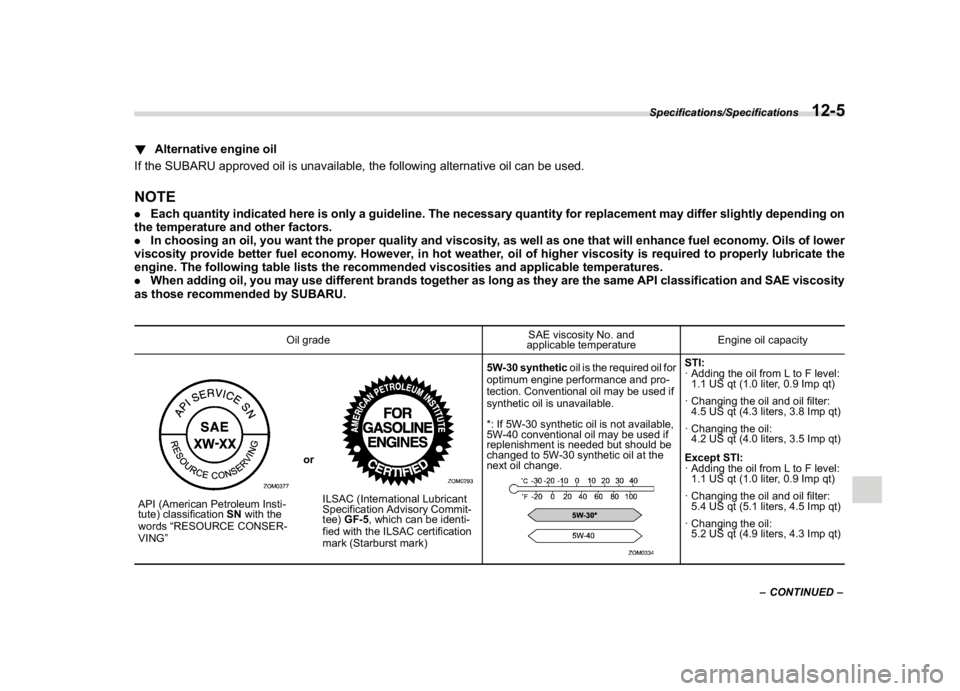
!Alternative engine oil
If the SUBARU approved oil is unavailable, the following alternative oil can be used.NOTE.Each quantity indicated here is only a guideline. The necessary quantity for replacement may differ slightly depending on
the temperature and other factors.
.In choosing an oil, you want the proper quality and viscosity, as well as one that will enhance fuel economy. Oils of lower
viscosity provide better fuel economy. However, in hot weather, oil of higher viscosity is required to properly lubricate the
engine. The following table lists the recommended viscosities and applicable temperatures.
.When adding oil, you may use different brands together as long as they are the same API classification and SAE viscosity
as those recommended by SUBARU.
Oil gradeSAE viscosity No. and
applicable temperatureEngine oil capacity
API (American Petroleum Insti-
tute) classificationSNwith the
words“RESOURCE CONSER-
VING”or
ILSAC (International Lubricant
Specification Advisory Commit-
tee)GF-5, which can be identi-
fied with the ILSAC certification
mark (Starburst mark)5W-30 syntheticoil is the required oil for
optimum engine performance and pro-
tection. Conventional oil may be used if
synthetic oil is unavailable.
*: If 5W-30 synthetic oil is not available,
5W-40 conventional oil may be used if
replenishment is needed but should be
changed to 5W-30 synthetic oil at the
next oil change.
STI:
· Adding the oil from L to F level:
1.1 US qt (1.0 liter, 0.9 Imp qt)
· Changing the oil and oil filter:
4.5 US qt (4.3 liters, 3.8 Imp qt)
· Changing the oil:
4.2 US qt (4.0 liters, 3.5 Imp qt)
Except STI:
· Adding the oil from L to F level:
1.1 US qt (1.0 liter, 0.9 Imp qt)
· Changing the oil and oil filter:
5.4 US qt (5.1 liters, 4.5 Imp qt)
· Changing the oil:
5.2 US qt (4.9 liters, 4.3 Imp qt)
–CONTINUED–
Specifications/Specifications
12-5
12
Page 537 of 578
(560,1)
北米Model "A1700BE-B" EDITED: 2017/ 10/ 11
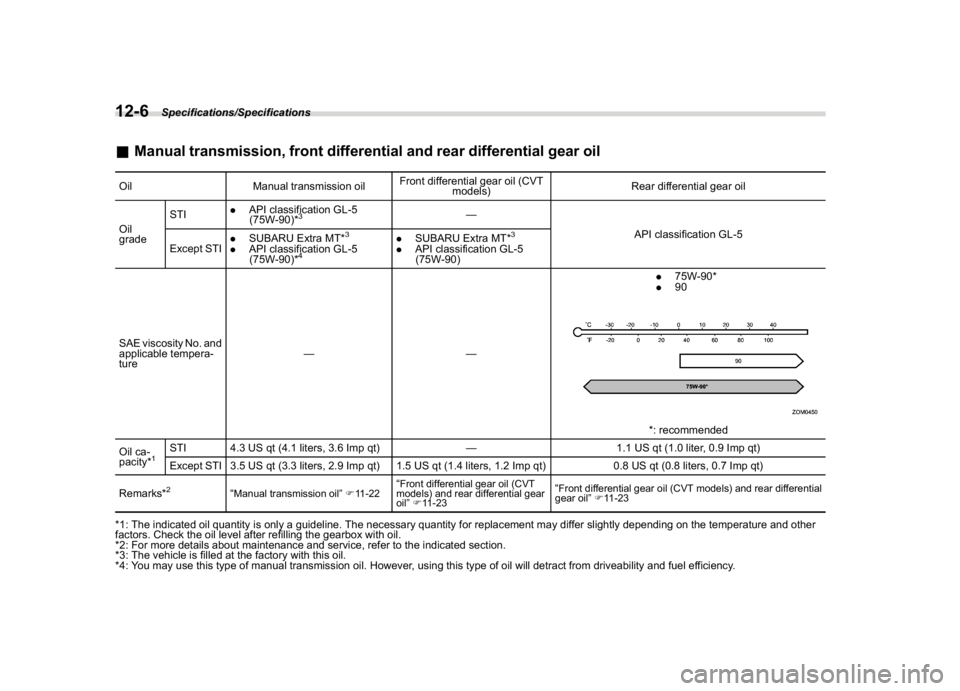
&Manual transmission, front differential and rear differential gear oilOil Manual transmission oilFront differential gear oil (CVT
models)Rear differential gear oil
Oil
gradeSTI.API classification GL-5
(75W-90)*
3
—
API classification GL-5
Except STI.SUBARU Extra MT*
3
.API classification GL-5
(75W-90)*
4
.SUBARU Extra MT*
3
.API classification GL-5
(75W-90)
SAE viscosity No. and
applicable tempera-
ture——.75W-90*
.90
*: recommended
Oil ca-
pacity*
1
STI 4.3 US qt (4.1 liters, 3.6 Imp qt)—1.1 US qt (1.0 liter, 0.9 Imp qt)
Except STI 3.5 US qt (3.3 liters, 2.9 Imp qt) 1.5 US qt (1.4 liters, 1.2 Imp qt) 0.8 US qt (0.8 liters, 0.7 Imp qt)
Remarks*2
“Manual transmission oil”F11-22
“Front differential gear oil (CVT
models) and rear differential gear
oil”F11-23
“Front differential gear oil (CVT models) and rear differential
gear oil”F11-23
*1: The indicated oil quantity is only a guideline. The necessary quantity for replacement may differ slightly depending on the temperature and other
factors. Check the oil level after refilling the gearbox with oil.
*2: For more details about maintenance and service, refer to the indicated section.
*3: The vehicle is filled at the factory with this oil.
*4: You may use this type of manual transmission oil. However, using this type of oil will detract from driveability and fuel efficiency.
Specifications/Specifications
12-6
Page 543 of 578
(566,1)
北米Model "A1700BE-B" EDITED: 2017/ 10/ 11
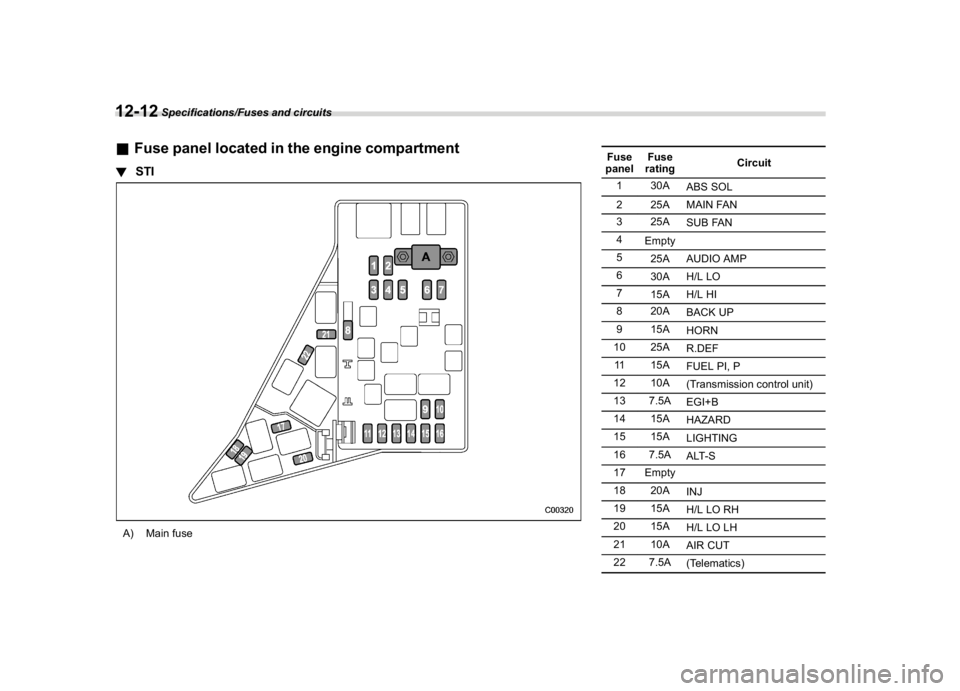
&Fuse panel located in the engine compartment!STIA) Main fuseFuse
panelFuse
ratingCircuit
1 30A
ABS SOL
2 25A MAIN FAN
3 25A
SUB FAN
4
Empty
5
25A AUDIO AMP
6
30A H/L LO
7
15A H/L HI
8 20A
BACK UP
9 15A
HORN
10 25A
R.DEF
11 15A
FUEL PI, P
12 10A
(Transmission control unit)
13 7.5A
EGI+B
14 15A
HAZARD
15 15A
LIGHTING
16 7.5A
ALT-S
17 Empty
18 20A
INJ
19 15A
H/L LO RH
20 15A
H/L LO LH
21 10A
AIR CUT
22 7.5A
(Telematics)
Specifications/Fuses and circuits
12-12