steering SUBARU WRX 2018 Repair Manual
[x] Cancel search | Manufacturer: SUBARU, Model Year: 2018, Model line: WRX, Model: SUBARU WRX 2018Pages: 578, PDF Size: 33.21 MB
Page 381 of 578
(394,1)
北米Model "A1700BE-B" EDITED: 2017/ 10/ 11
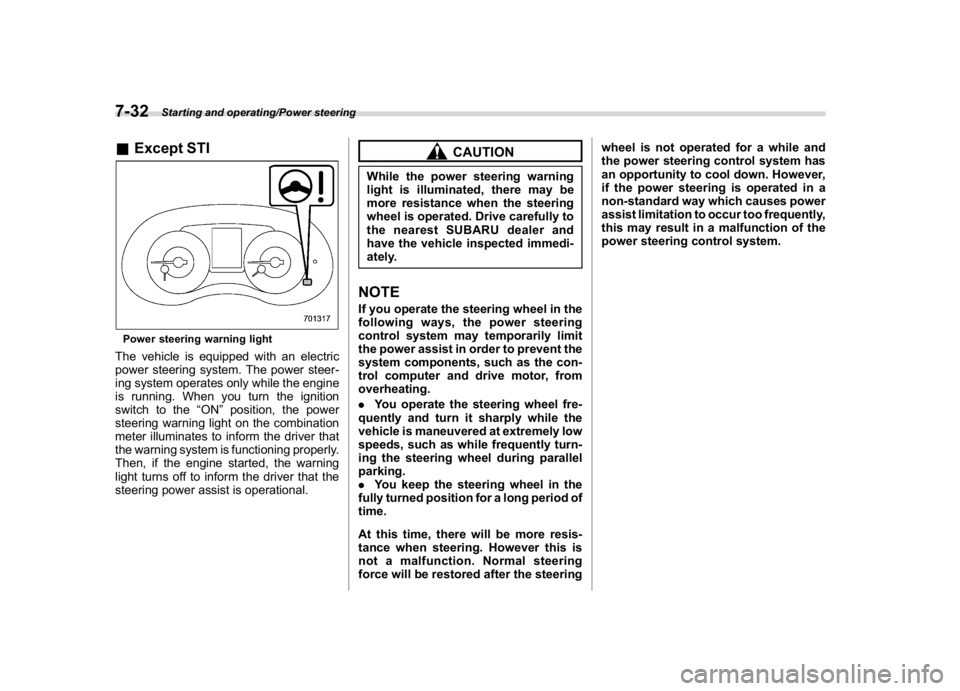
&Except STIPower steering warning lightThe vehicle is equipped with an electric
power steering system. The power steer-
ing system operates only while the engine
is running. When you turn the ignition
switch to the“ON”position, the power
steering warning light on the combination
meter illuminates to inform the driver that
the warning system is functioning properly.
Then, if the engine started, the warning
light turns off to inform the driver that the
steering power assist is operational.
CAUTION
While the power steering warning
light is illuminated, there may be
more resistance when the steering
wheel is operated. Drive carefully to
the nearest SUBARU dealer and
have the vehicle inspected immedi-
ately.NOTEIf you operate the steering wheel in the
following ways, the power steering
control system may temporarily limit
the power assist in order to prevent the
system components, such as the con-
trol computer and drive motor, from
overheating.
.You operate the steering wheel fre-
quently and turn it sharply while the
vehicle is maneuvered at extremely low
speeds, such as while frequently turn-
ing the steering wheel during parallel
parking.
.You keep the steering wheel in the
fully turned position for a long period of
time.
At this time, there will be more resis-
tance when steering. However this is
not a malfunction. Normal steering
force will be restored after the steeringwheel is not operated for a while and
the power steering control system has
an opportunity to cool down. However,
if the power steering is operated in a
non-standard way which causes power
assist limitation to occur too frequently,
this may result in a malfunction of the
power steering control system.
Starting and operating/Power steering
7-32
Page 384 of 578
(397,1)
北米Model "A1700BE-B" EDITED: 2017/ 10/ 11
ABS (Anti-lock Brake Sys-
tem)The ABS prevents the lock-up of wheels
which may occur during sudden braking or
braking on slippery road surfaces. This
helps prevent the loss of steering control
and directional stability caused by wheel
lock-up.
When the ABS is operating, you may hear
a chattering noise or feel a slight vibration
in the brake pedal. This is normal when the
ABS operates.
The ABS will not operate when the vehicle
speed is below approximately 6 mph (10
km/h).
WARNING
Always use the utmost care in driv-
ing–overconfidence because you
are driving a vehicle with the ABS
could easily lead to a serious acci-
dent.
CAUTION
.The ABS does not always de-
crease stopping distance. You
should always maintain a safe
following distance from other
vehicles.
.When driving on badly surfaced
roads, gravel roads, icy roads, or
over deep newly fallen snow,
stopping distances may be long-
er for a vehicle with the ABS than
one without. When driving under
these conditions, therefore, re-
duce your speed and leave ample
distance from other vehicles.
.When you feel the ABS operating,
you should maintain constant
brake pedal pressure. Do not
pump the brake pedal since
doing so may defeat the opera-
tion of the ABS system.
&ABS self-checkJust after the vehicle is started, you may
feel on the brake pedal a vibration similar
to when the ABS operates, and you may
also hear the sound of the ABS working
from the engine compartment. This is
caused by an automatic functional test of
the ABS being carried out and does not
indicate any abnormal condition.&ABS warning lightRefer to“ABS warning light”F3-20.
Starting and operating/ABS (Anti-lock Brake System)
7-35
7
Page 386 of 578
(399,1)
北米Model "A1700BE-B" EDITED: 2017/ 10/ 11
SUBARU dealer for repair.
WARNING
.Driving with the brake system
warning light illuminated is dan-
gerous. This indicates your brake
system may not be working prop-
erly. If the light remains illumi-
nated, have the brakes inspected
by a SUBARU dealer immedi-
ately.
.If at all in doubt about whether the
brakes are operating properly, do
not drive the vehicle. Have your
vehicle towed to the nearest
SUBARU dealer for repair.
Vehicle Dynamics Control
system
WARNING
Always use the utmost care in driv-
ing–overconfidence because you
are driving a vehicle with the Vehicle
Dynamics Control system could ea-
sily lead to a serious accident.
CAUTION
.Even if your vehicle is equipped
with Vehicle Dynamics Control
system, winter tires should be
used when driving on snow-cov-
ered or icy roads; in addition,
vehicle speed should be reduced
considerably. Simply having a
Vehicle Dynamics Control sys-
tem does not guarantee that the
vehicle will be able to avoid
accidents in any situation.
.Activation of the Vehicle Dy-
namics Control system is an
indication that the road being
travelled on has a slippery sur-
face; since having Vehicle Dy-
namics Control is no guaranteethat full vehicle control will be
maintained at all times and under
all conditions, its activation
should be seen as a sign that
the speed of the vehicle should
be reduced considerably.
.Whenever suspension compo-
nents, steering components, or
an axle are removed from a
vehicle, have an inspection of
that system performed by an
authorized SUBARU dealer.
.Observe the following precau-
tions in order to ensure that the
Vehicle Dynamics Control sys-
tem is operating properly:
–Fit all four wheels with tires of
the same size, type, and
brand. Furthermore, the
amount of wear should be the
same for all four tires.
–Keep the tire pressure at the
proper level as shown on the
vehicle placard attached to
the driver’s side door pillar.
–Use only the specified tempor-
ary spare tire to replace a flat
tire. With a temporary spare
tire, the effectiveness of the
Vehicle Dynamics Control
system is reduced and this
–CONTINUED–
Starting and operating/Vehicle Dynamics Control system
7-37
7
Page 387 of 578
(400,1)
北米Model "A1700BE-B" EDITED: 2017/ 10/ 11
should be taken into account
when driving the vehicle in
such a condition.
.If you use non-matching tires, the
Vehicle Dynamics Control sys-
tem may not operate correctly.
.The Vehicle Dynamics Control
system helps prevent unstable
vehicle motion such as skidding
using control of the brakes and
engine power. Do not turn off the
Vehicle Dynamics Control sys-
tem unless it is absolutely neces-
sary. If you must turn off the
Vehicle Dynamics Control sys-
tem, drive very carefully accord-
ing to the road surface condition.
In the event of wheelspin and/or skidding
on a slippery road surface and/or during
cornering and/or an evasive maneuver,
the Vehicle Dynamics Control system
adjusts the engine’s output and the
wheels’respective braking forces to help
maintain traction and directional control.
.Traction Control Function
The traction control function is designed to
prevent spinning of the driving wheels on
slippery road surfaces, thereby helping to
maintain traction and directional control.
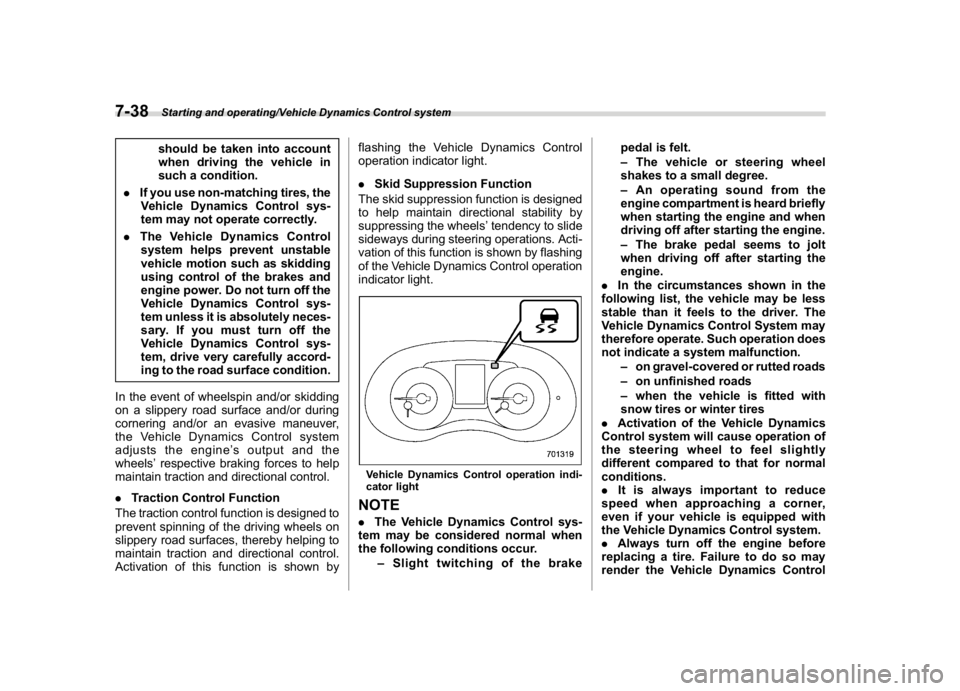
Activation of this function is shown byflashing the Vehicle Dynamics Control
operation indicator light.
.Skid Suppression Function
The skid suppression function is designed
to help maintain directional stability by
suppressing the wheels’tendency to slide
sideways during steering operations. Acti-
vation of this function is shown by flashing
of the Vehicle Dynamics Control operation
indicator light.
Vehicle Dynamics Control operation indi-
cator lightNOTE.The Vehicle Dynamics Control sys-
tem may be considered normal when
the following conditions occur.
–Slight twitching of the brakepedal is felt.
–The vehicle or steering wheel
shakes to a small degree.
–An operating sound from the
engine compartment is heard briefly
when starting the engine and when
driving off after starting the engine.
–The brake pedal seems to jolt
when driving off after starting the
engine.
.In the circumstances shown in the
following list, the vehicle may be less
stable than it feels to the driver. The
Vehicle Dynamics Control System may
therefore operate. Such operation does
not indicate a system malfunction.
–on gravel-covered or rutted roads
–on unfinished roads
–when the vehicle is fitted with
snow tires or winter tires
.Activation of the Vehicle Dynamics
Control system will cause operation of
the steering wheelto feel slightly
different compared to that for normal
conditions.
.It is always important to reduce
speed when approaching a corner,
even if your vehicle is equipped with
the Vehicle Dynamics Control system.
.Always turn off the engine before
replacing a tire. Failure to do so may
render the Vehicle Dynamics Control
Starting and operating/Vehicle Dynamics Control system
7-38
Page 395 of 578
(408,1)
北米Model "A1700BE-B" EDITED: 2017/ 10/ 11
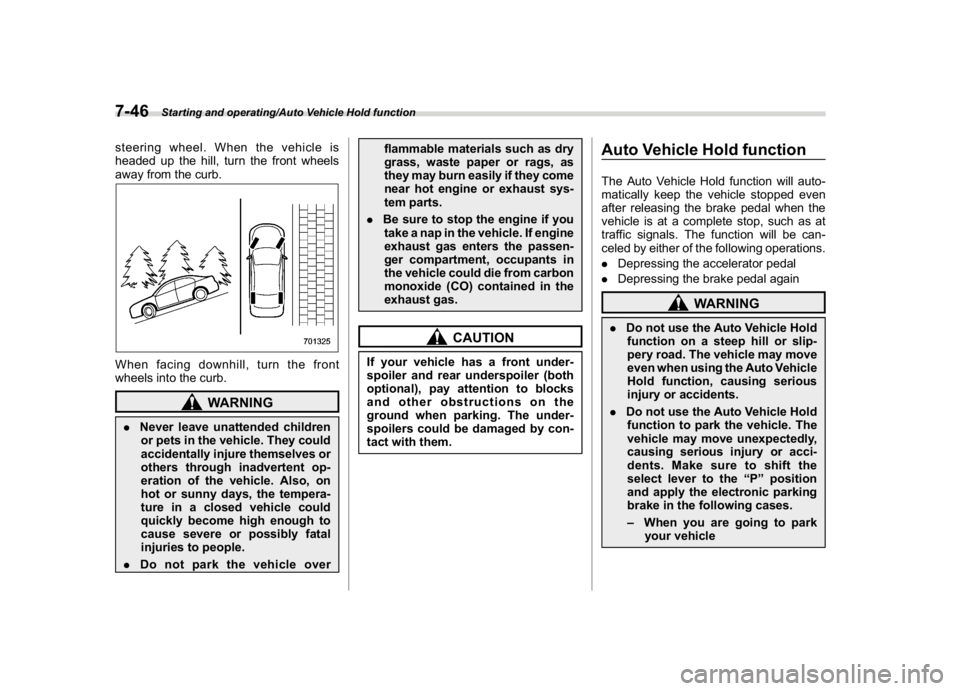
steering wheel. When the vehicle is
headed up the hill, turn the front wheels
away from the curb.When facing downhill, turn the front
wheels into the curb.
WARNING
.Never leave unattended children
or pets in the vehicle. They could
accidentally injure themselves or
others through inadvertent op-
eration of the vehicle. Also, on
hot or sunny days, the tempera-
ture in a closed vehicle could
quickly become high enough to
cause severe or possibly fatal
injuries to people.
.Do not park the vehicle overflammable materials such as dry
grass, waste paper or rags, as
they may burn easily if they come
near hot engine or exhaust sys-
tem parts.
.Be sure to stop the engine if you
take a nap in the vehicle. If engine
exhaust gas enters the passen-
ger compartment, occupants in
the vehicle could die from carbon
monoxide (CO) contained in the
exhaust gas.
CAUTION
If your vehicle has a front under-
spoiler and rear underspoiler (both
optional), pay attention to blocks
and other obstructions on the
ground when parking. The under-
spoilers could be damaged by con-
tact with them.
Auto Vehicle Hold functionThe Auto Vehicle Hold function will auto-
matically keep the vehicle stopped even
after releasing the brake pedal when the
vehicle is at a complete stop, such as at
traffic signals. The function will be can-
celed by either of the following operations.
.Depressing the accelerator pedal
.Depressing the brake pedal again
WARNING
.Do not use the Auto Vehicle Hold
function on a steep hill or slip-
pery road. The vehicle may move
even when using the Auto Vehicle
Hold function, causing serious
injury or accidents.
.Do not use the Auto Vehicle Hold
function to park the vehicle. The
vehicle may move unexpectedly,
causing serious injury or acci-
dents. Make sure to shift the
select lever to the“P”position
and apply the electronic parking
brake in the following cases.
–When you are going to park
your vehicle
Starting and operating/Auto Vehicle Hold function
7-46
Page 432 of 578
(447,1)
北米Model "A1700BE-B" EDITED: 2017/ 10/ 11
SUBARU Windshield Washer Fluid con-
tains 58.5% methyl alcohol and 41.5%
surfactant, by volume. Its freezing tem-
perature varies according to how much it is
diluted, as indicated in the following table.Washer Fluid Con-
centrationFreezing Temperature
30% 10.48F(128C)
50%48F(208C)
100%498F(458C)In order to prevent freezing of washer fluid,
check the freezing temperatures in the
table above when adjusting the fluid
concentration to the outside temperature.
If you fill the reservoir tank with a fluid with
a different concentration from the one
used previously, purge the old fluid from
the piping between the reservoir tank and
washer nozzles by operating the washer
for a certain period of time. Otherwise, if
the concentration of the fluid remaining in
the piping is too low for the outside
temperature, it may freeze and block the
nozzles.
CAUTION
.Adjust the washer fluid concen-
tration appropriately for the out-
side temperature. If the concen-tration is inappropriate, sprayed
washer fluid may freeze on the
windshield and obstruct your
view, and the fluid may freeze in
the reservoir tank.
.State or local regulations on
volatile organic compounds may
restrict the use of methanol, a
common windshield washer anti-
freeze additive. Washer fluids
containing non-methanol anti-
freeze agents should be used
only if they provide cold weather
protection without damaging
your vehicle’s paint, wiper blades
or washer system.
!Before driving your vehicle
Before entering the vehicle, remove any
snow or ice from your shoes because that
could make the pedals slippery and driving
dangerous.
While warming up the vehicle before
driving, check that the accelerator pedal,
brake pedal, and all other controls operate
smoothly.
Clear away ice and snow that has accu-
mulated under the fenders to avoid making
steering difficult. During severe winter
driving, stop when and where it is safe todo so and check under the fenders
periodically.
!Parking in cold weather
WARNING
Snow can trap dangerous exhaust
gases under your vehicle. Keep
snow clear of the exhaust pipe and
from around your vehicle if you park
the vehicle in snow with the engine
running.
CAUTION
.Do not use the parking brake
when parking for long periods in
cold weather since it could freeze
in that position.
.When you park the vehicle in
snow or when it snows, raise the
wiper blades off the glass to
prevent damage.
.Under either of the following
conditions, ice may form on the
brake system, which could cause
poor braking action.
–When the vehicle has been left
parked after use on roads
heavily covered with snow
–CONTINUED–
Driving tips/Winter driving
8-7
8
Page 450 of 578
(467,1)
北米Model "A1700BE-B" EDITED: 2017/ 10/ 11
some tires can only be partially sealed or
not sealed at all, and this condition may
cause a loss of tire pressure. A loss of tire
pressure can affect vehicle handling,
leading to the loss of vehicle control.
After sealing the flat tire temporarily,
change the tires with new ones as soon
as possible. We recommend that you have
the sealed tire changed by your nearest
SUBARU dealer. You may reuse the wheel
if the attached sealant is wiped off, but the
valve of the wheel must be replaced with a
new one. If you reuse the wheel without
replacing the valve, air may leak from the
valve.
For tire replacement, refer to“Tire replace-
ment”F11-36.!Safety precautions when sealing flat
tire
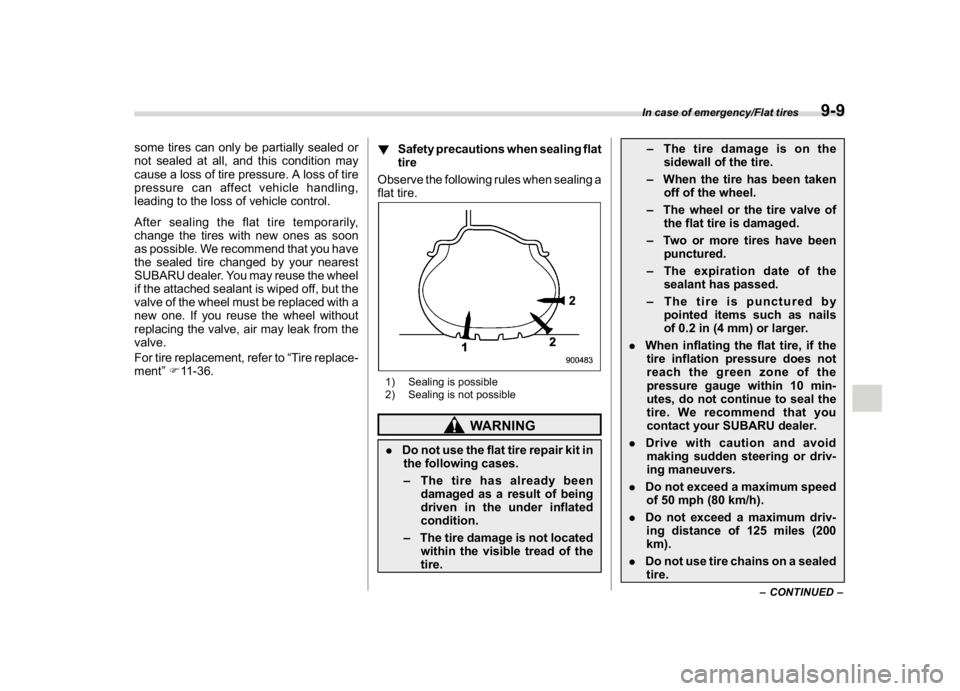
Observe the following rules when sealing a
flat tire.
1) Sealing is possible
2) Sealing is not possible
WARNING
.Do not use the flat tire repair kit in
the following cases.
–The tire has already been
damaged as a result of being
driven in the under inflated
condition.
–The tire damage is not located
within the visible tread of the
tire.–The tire damage is on the
sidewall of the tire.
–When the tire has been taken
off of the wheel.
–The wheel or the tire valve of
the flat tire is damaged.
–Two or more tires have been
punctured.
–The expiration date of the
sealant has passed.
–The tire is punctured by
pointed items such as nails
of 0.2 in (4 mm) or larger.
.When inflating the flat tire, if the
tire inflation pressure does not
reach the green zone of the
pressure gauge within 10 min-
utes, do not continue to seal the
tire. We recommend that you
contact your SUBARU dealer.
.Drive with caution and avoid
making sudden steering or driv-
ing maneuvers.
.Do not exceed a maximum speed
of 50 mph (80 km/h).
.Do not exceed a maximum driv-
ing distance of 125 miles (200
km).
.Do not use tire chains on a sealed
tire.
–CONTINUED–
In case of emergency/Flat tires
9-9
9
Page 455 of 578
(472,1)
北米Model "A1700BE-B" EDITED: 2017/ 10/ 11
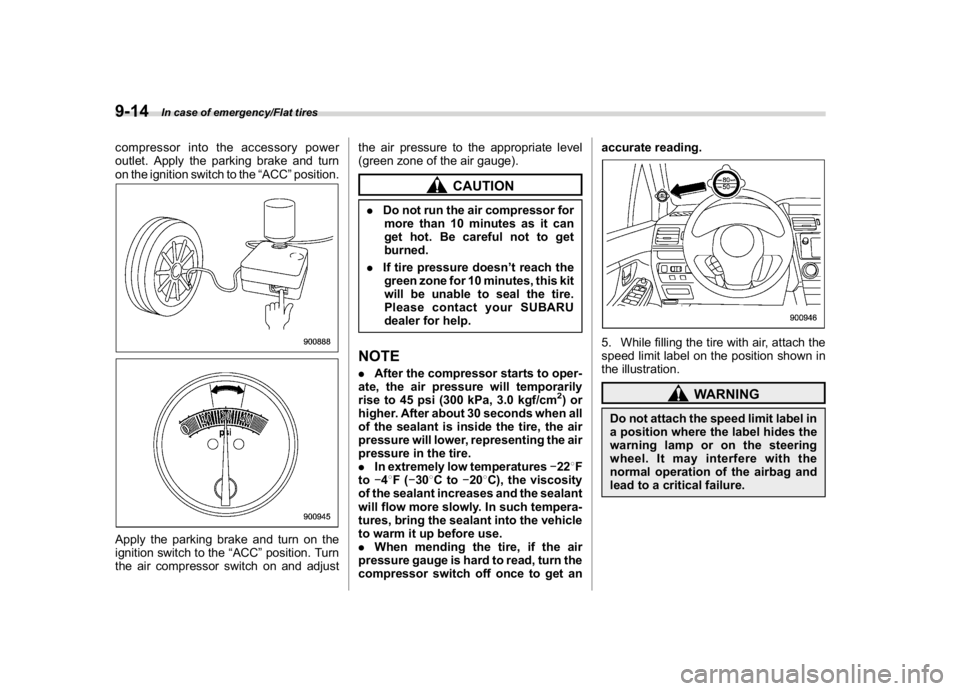
compressor into the accessory power
outlet. Apply the parking brake and turn
on the ignition switch to the“ACC”position.Apply the parking brake and turn on the
ignition switch to the“ACC”position. Turn
the air compressor switch on and adjustthe air pressure to the appropriate level
(green zone of the air gauge).
CAUTION
.Do not run the air compressor for
more than 10 minutes as it can
get hot. Be careful not to get
burned.
.If tire pressure doesn’t reach the
green zone for 10 minutes, this kit
will be unable to seal the tire.
Please contact your SUBARU
dealer for help.NOTE.After the compressor starts to oper-
ate, the air pressure will temporarily
rise to 45 psi (300 kPa, 3.0 kgf/cm
2)or
higher. After about 30 seconds when all
of the sealant is inside the tire, the air
pressure will lower, representing the air
pressure in the tire.
.In extremely low temperatures228F
to48F(308Cto208C), the viscosity
of the sealant increases and the sealant
will flow more slowly. In such tempera-
tures, bring the sealant into the vehicle
to warm it up before use.
.When mending the tire, if the air
pressure gauge is hard to read, turn the
compressor switch off once to get anaccurate reading.
5. While filling the tire with air, attach the
speed limit label on the position shown in
the illustration.
WARNING
Do not attach the speed limit label in
a position where the label hides the
warning lamp or on the steering
wheel. It may interfere with the
normal operation of the airbag and
lead to a critical failure.
In case of emergency/Flat tires
9-14
Page 456 of 578
(473,1)
北米Model "A1700BE-B" EDITED: 2017/ 10/ 11
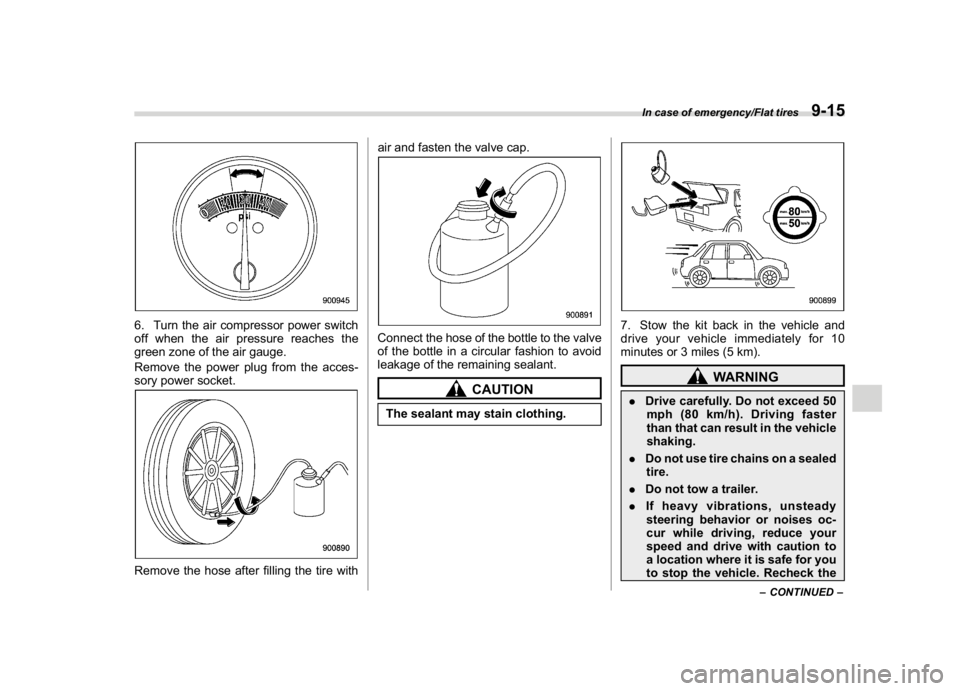
6. Turn the air compressor power switch
off when the air pressure reaches the
green zone of the air gauge.
Remove the power plug from the acces-
sory power socket.Remove the hose after filling the tire withair and fasten the valve cap.
Connect the hose of the bottle to the valve
of the bottle in a circular fashion to avoid
leakage of the remaining sealant.
CAUTION
The sealant may stain clothing.
7. Stow the kit back in the vehicle and
drive your vehicle immediately for 10
minutes or 3 miles (5 km).
WARNING
.Drive carefully. Do not exceed 50
mph (80 km/h). Driving faster
than that can result in the vehicle
shaking.
.Do not use tire chains on a sealed
tire.
.Do not tow a trailer.
.If heavy vibrations, unsteady
steering behavior or noises oc-
cur while driving, reduce your
speed and drive with caution to
a location where it is safe for you
to stop the vehicle. Recheck the
–CONTINUED–
In case of emergency/Flat tires
9-15
9
Page 466 of 578
(483,1)
北米Model "A1700BE-B" EDITED: 2017/ 10/ 11
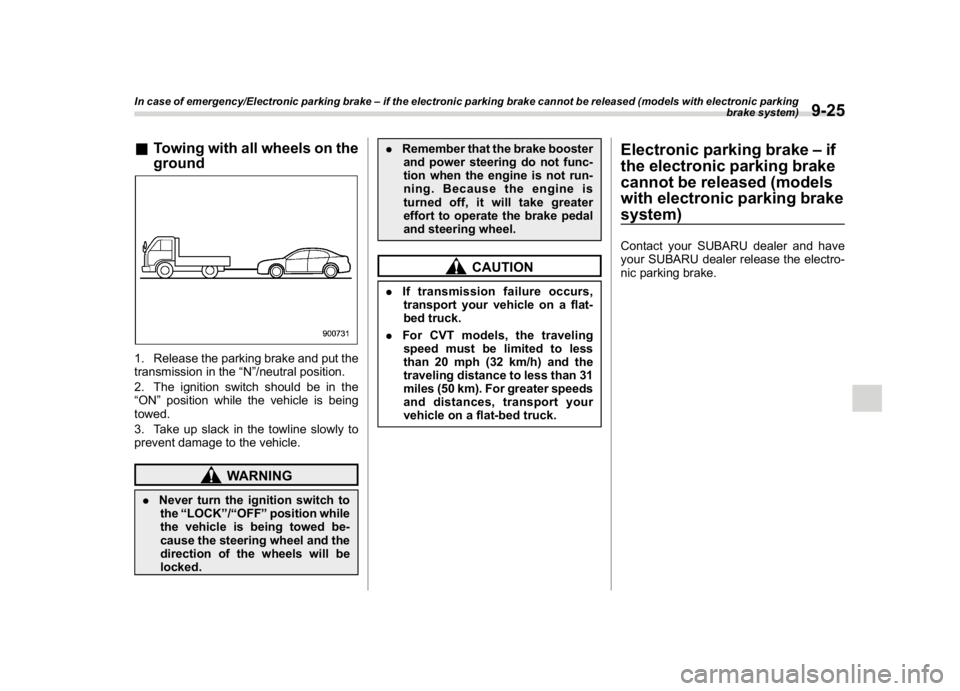
&Towing with all wheels on the
ground1. Release the parking brake and put the
transmission in the“N”/neutral position.
2. The ignition switch should be in the
“ON”position while the vehicle is being
towed.
3. Take up slack in the towline slowly to
prevent damage to the vehicle.
WARNING
.Never turn the ignition switch to
the“LOCK”/“OFF”position while
the vehicle is being towed be-
cause the steering wheel and the
direction of the wheels will be
locked..Remember that the brake booster
and power steering do not func-
tion when the engine is not run-
ning. Because the engine is
turned off, it will take greater
effort to operate the brake pedal
and steering wheel.
CAUTION
.If transmission failure occurs,
transport your vehicle on a flat-
bed truck.
.For CVT models, the traveling
speed must be limited to less
than 20 mph (32 km/h) and the
traveling distance to less than 31
miles (50 km). For greater speeds
and distances, transport your
vehicle on a flat-bed truck.
Electronic parking brake–if
the electronic parking brake
cannot be released (models
with electronic parking brake
system)Contact your SUBARU dealer and have
your SUBARU dealer release the electro-
nic parking brake.
In case of emergency/Electronic parking brake–if the electronic parking brake cannot be released (models with electronic parking
brake system)
9-25
9