check engine SUZUKI ALTO 2007 6.G Owner's Manual
[x] Cancel search | Manufacturer: SUZUKI, Model Year: 2007, Model line: ALTO, Model: SUZUKI ALTO 2007 6.GPages: 139, PDF Size: 2.63 MB
Page 104 of 139
Downloaded from www.Manualslib.com manuals search engine 10576G-74E
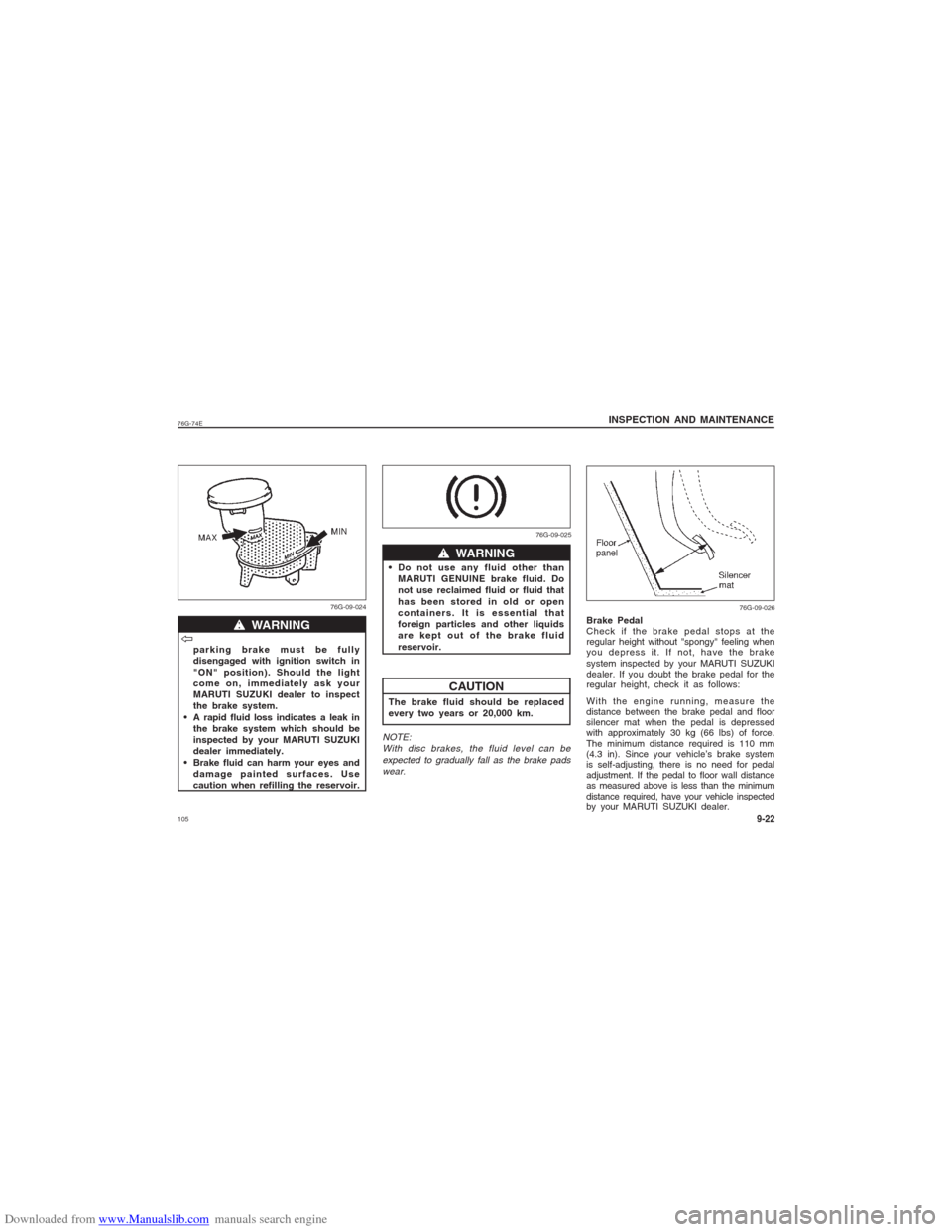
parking brake must be fully
disengaged with ignition switch in
"ON" position). Should the light
come on, immediately ask your
MARUTI SUZUKI dealer to inspect
the brake system.
A rapid fluid loss indicates a leak in
the brake system which should be
inspected by your MARUTI SUZUKI
dealer immediately.
Brake fluid can harm your eyes and
damage painted surfaces. Use
caution when refilling the reservoir.
w ww w
w WARNING
V VV V
V
76G-09-024
INSPECTION AND MAINTENANCE
9-22
Do not use any fluid other than
MARUTI GENUINE brake fluid. Do
not use reclaimed fluid or fluid that
has been stored in old or open
containers. It is essential that
foreign particles and other liquids
are kept out of the brake fluid
reservoir.
The brake fluid should be replaced
every two years or 20,000 km.NOTE:
With disc brakes, the fluid level can be
expected to gradually fall as the brake pads
wear.
w ww w
w WARNINGCAUTION
76G-09-025
Brake Pedal
Check if the brake pedal stops at the
regular height without "spongy" feeling when
you depress it. If not, have the brake
system inspected by your MARUTI SUZUKI
dealer. If you doubt the brake pedal for the
regular height, check it as follows:With the engine running, measure the
distance between the brake pedal and floor
silencer mat when the pedal is depressed
with approximately 30 kg (66 lbs) of force.
The minimum distance required is 110 mm
(4.3 in). Since your vehicle’s brake system
is self-adjusting, there is no need for pedal
adjustment. If the pedal to floor wall distance
as measured above is less than the minimum
distance required, have your vehicle inspected
by your MARUTI SUZUKI dealer.
76G-09-026
Page 105 of 139
Downloaded from www.Manualslib.com manuals search engine 106
76G-74E
INSPECTION AND MAINTENANCE9-23NOTE:
When measuring the distance between the
brake pedal and floor wall, be sure not to
include any floor covering other than
silencer mat in the measurement.If you experience any of the following
problems with your vehicle’s brake
system, have the vehicle inspected
immediately by your MARUTI SUZUKI
dealer.
Poor braking performance
Uneven braking (Brakes not working
uniformly on all wheels.)
Excessive pedal travel
Brake dragging
Excessive noise
Pedal pulsation (Pedal pulsates
when depressed.)
w ww w
w WARNING
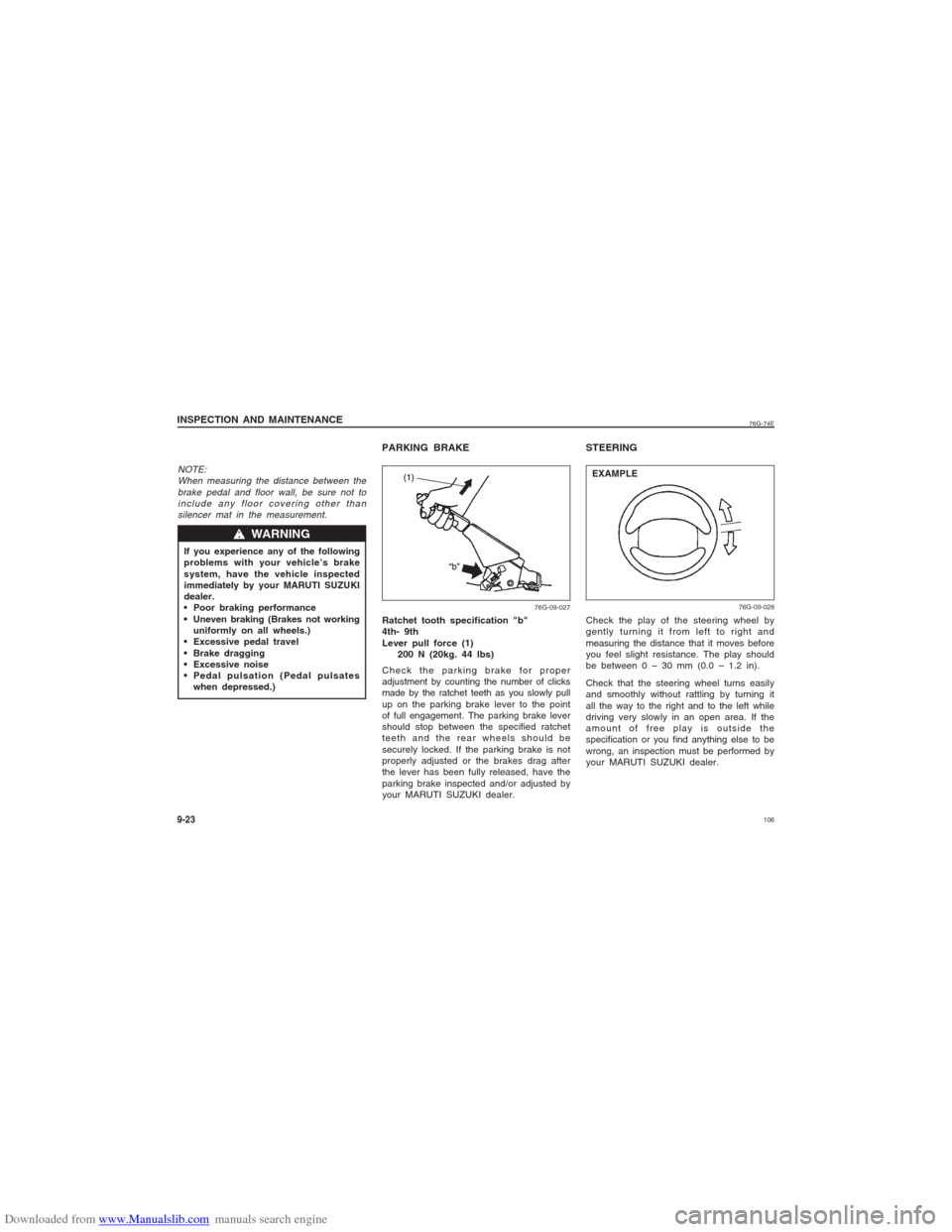
Ratchet tooth specification "b"
4th- 9th
Lever pull force (1)
200 N (20kg. 44 lbs)
Check the parking brake for proper
adjustment by counting the number of clicks
made by the ratchet teeth as you slowly pull
up on the parking brake lever to the point
of full engagement. The parking brake lever
should stop between the specified ratchet
teeth and the rear wheels should be
securely locked. If the parking brake is not
properly adjusted or the brakes drag after
the lever has been fully released, have the
parking brake inspected and/or adjusted by
your MARUTI SUZUKI dealer.
76G-09-027
STEERINGCheck the play of the steering wheel by
gently turning it from left to right and
measuring the distance that it moves before
you feel slight resistance. The play should
be between 0 – 30 mm (0.0 – 1.2 in).
Check that the steering wheel turns easily
and smoothly without rattling by turning it
all the way to the right and to the left while
driving very slowly in an open area. If the
amount of free play is outside the
specification or you find anything else to be
wrong, an inspection must be performed by
your MARUTI SUZUKI dealer.
76G-09-028
EXAMPLE
PARKING BRAKE
Page 106 of 139
Downloaded from www.Manualslib.com manuals search engine 10776G-74E
9-24
INSPECTION AND MAINTENANCE
CLUTCH PEDAL
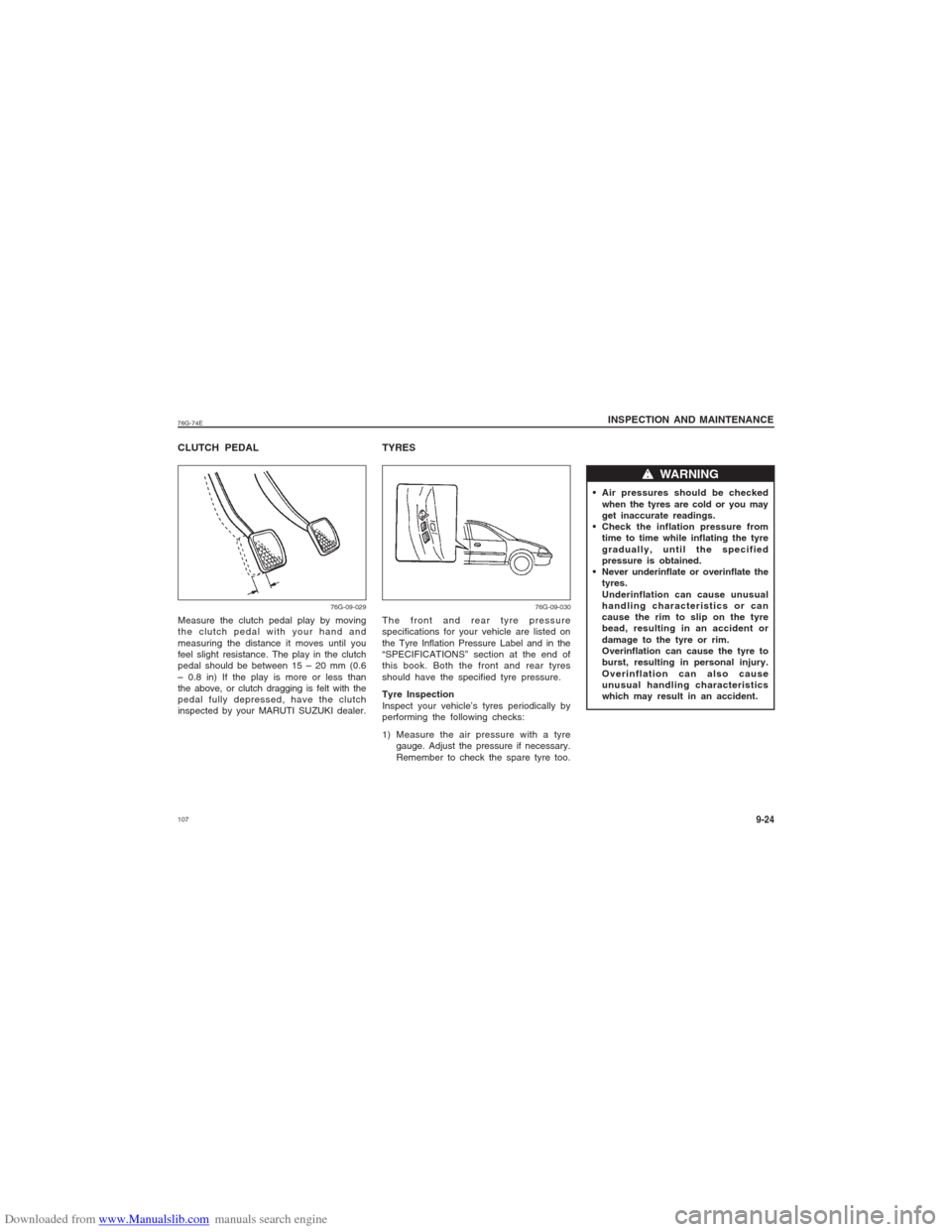
Measure the clutch pedal play by moving
the clutch pedal with your hand and
measuring the distance it moves until you
feel slight resistance. The play in the clutch
pedal should be between 15 – 20 mm (0.6
– 0.8 in) If the play is more or less than
the above, or clutch dragging is felt with the
pedal fully depressed, have the clutch
inspected by your MARUTI SUZUKI dealer.
76G-09-029
TYRESThe front and rear tyre pressure
specifications for your vehicle are listed on
the Tyre Inflation Pressure Label and in the
“SPECIFICATIONS” section at the end of
this book. Both the front and rear tyres
should have the specified tyre pressure.
Tyre Inspection
Inspect your vehicle’s tyres periodically by
performing the following checks:
1) Measure the air pressure with a tyre
gauge. Adjust the pressure if necessary.
Remember to check the spare tyre too.
76G-09-030
Air pressures should be checked
when the tyres are cold or you may
get inaccurate readings.
Check the inflation pressure from
time to time while inflating the tyre
gradually, until the specified
pressure is obtained.
Never underinflate or overinflate the
tyres.
Underinflation can cause unusual
handling characteristics or can
cause the rim to slip on the tyre
bead, resulting in an accident or
damage to the tyre or rim.
Overinflation can cause the tyre to
burst, resulting in personal injury.
Overinflation can also cause
unusual handling characteristics
which may result in an accident.
w ww w
w WARNING
Page 107 of 139
Downloaded from www.Manualslib.com manuals search engine 108
76G-74E
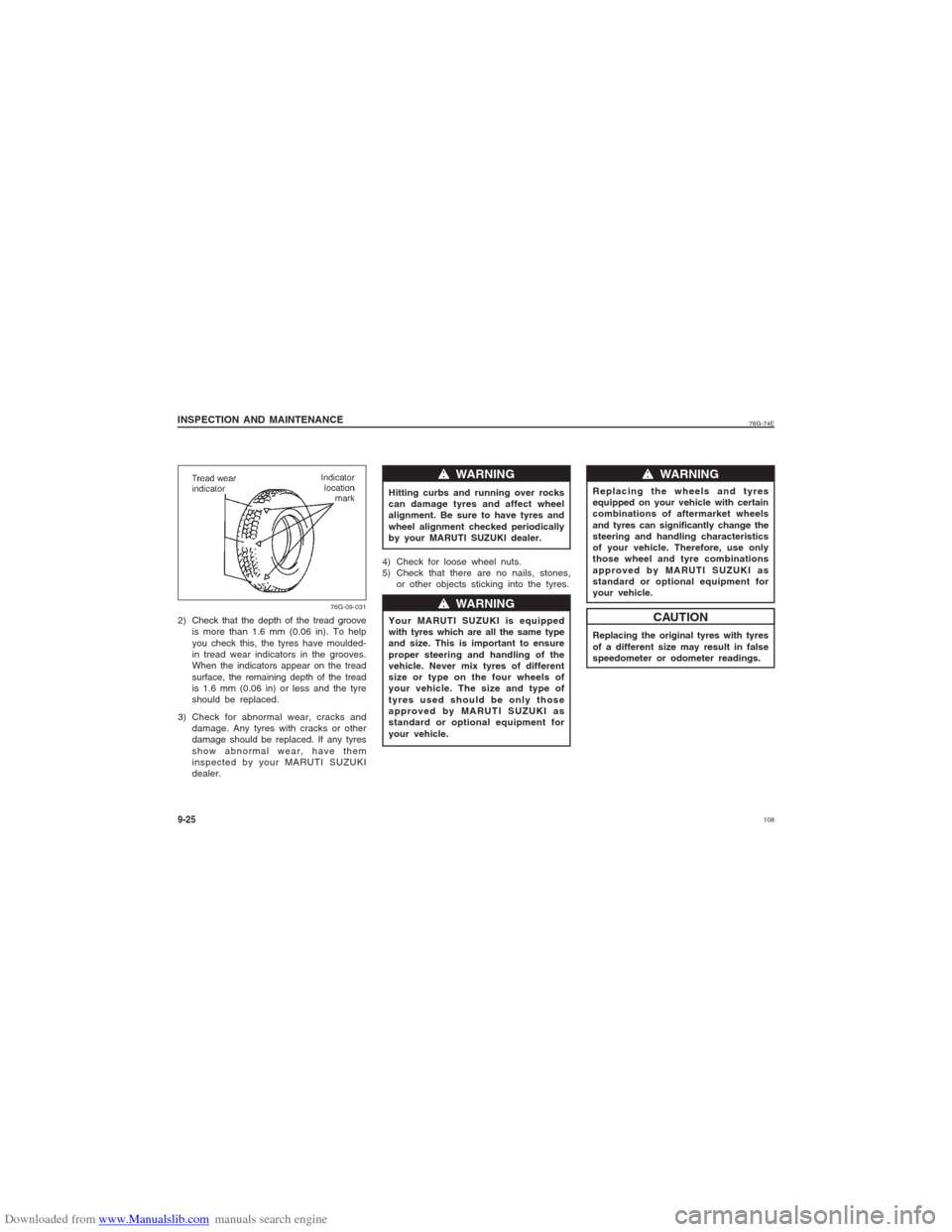
INSPECTION AND MAINTENANCE9-252) Check that the depth of the tread groove
is more than 1.6 mm (0.06 in). To help
you check this, the tyres have moulded-
in tread wear indicators in the grooves.
When the indicators appear on the tread
surface, the remaining depth of the tread
is 1.6 mm (0.06 in) or less and the tyre
should be replaced.
3) Check for abnormal wear, cracks and
damage. Any tyres with cracks or other
damage should be replaced. If any tyres
show abnormal wear, have them
inspected by your MARUTI SUZUKI
dealer.
76G-09-031
Hitting curbs and running over rocks
can damage tyres and affect wheel
alignment. Be sure to have tyres and
wheel alignment checked periodically
by your MARUTI SUZUKI dealer.
4) Check for loose wheel nuts.
5) Check that there are no nails, stones,
or other objects sticking into the tyres.
Your MARUTI SUZUKI is equipped
with tyres which are all the same type
and size. This is important to ensure
proper steering and handling of the
vehicle. Never mix tyres of different
size or type on the four wheels of
your vehicle. The size and type of
tyres used should be only those
approved by MARUTI SUZUKI as
standard or optional equipment for
your vehicle.
w ww w
w WARNINGw ww w
w WARNING
Replacing the wheels and tyres
equipped on your vehicle with certain
combinations of aftermarket wheels
and tyres can significantly change the
steering and handling characteristics
of your vehicle. Therefore, use only
those wheel and tyre combinations
approved by MARUTI SUZUKI as
standard or optional equipment for
your vehicle.
Replacing the original tyres with tyres
of a different size may result in false
speedometer or odometer readings.
w ww w
w WARNINGCAUTION
Page 109 of 139
Downloaded from www.Manualslib.com manuals search engine 110
76G-74E
INSPECTION AND MAINTENANCE9-27
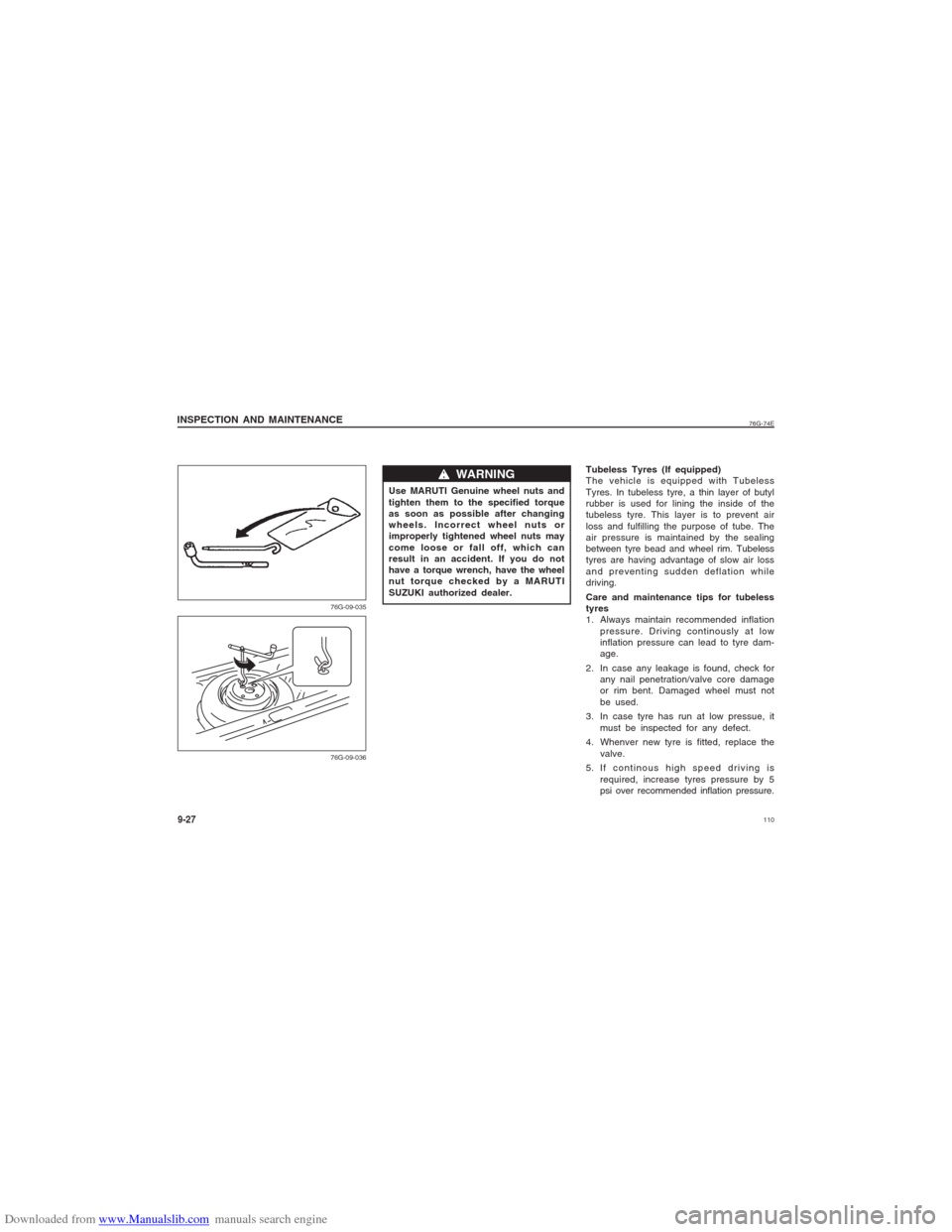
76G-09-035
76G-09-036
Use MARUTI Genuine wheel nuts and
tighten them to the specified torque
as soon as possible after changing
wheels. Incorrect wheel nuts or
improperly tightened wheel nuts may
come loose or fall off, which can
result in an accident. If you do not
have a torque wrench, have the wheel
nut torque checked by a MARUTI
SUZUKI authorized dealer.
w ww w
w WARNING
Tubeless Tyres (If equipped)
The vehicle is equipped with Tubeless
Tyres. In tubeless tyre, a thin layer of butyl
rubber is used for lining the inside of the
tubeless tyre. This layer is to prevent air
loss and fulfilling the purpose of tube. The
air pressure is maintained by the sealing
between tyre bead and wheel rim. Tubeless
tyres are having advantage of slow air loss
and preventing sudden deflation while
driving.
Care and maintenance tips for tubeless
tyres
1. Always maintain recommended inflation
pressure. Driving continously at low
inflation pressure can lead to tyre dam-
age.
2. In case any leakage is found, check for
any nail penetration/valve core damage
or rim bent. Damaged wheel must not
be used.
3. In case tyre has run at low pressue, it
must be inspected for any defect.
4. Whenver new tyre is fitted, replace the
valve.
5. If continous high speed driving is
required, increase tyres pressure by 5
psi over recommended inflation pressure.
Page 110 of 139
Downloaded from www.Manualslib.com manuals search engine 11176G-74E
INSPECTION AND MAINTENANCE
9-28
6. Never run the tyre beyond TWI (Tread
wear indicator). The tyre is recommen-
ded to be replaced when the remaining
tread has worn to this point. The indica-
tors are spaced across the tread around
the tyre marked by a triagular symbol
(TWI).
7. Always prefer tubeless tyre mounting
machine. In case of manual mounting-
tyre/wheel rim damage may occur.
8. In case of any problem, please get in
touch with MARUTI SUZUKI authorised
dealer.
76G-09-037
76G-09-038
Batteries produce flammable hydrogen
gas. Keep flames and sparks away
from the battery or an explosion may
occur. Never smoke when working in
the vicinity of the battery.
When checking or servicing the
battery, disconnect the negative cable.
Be careful not to cause a short circuit
by allowing metal objects to contact
the battery posts and the vehicle at
the same time.
w ww w
w WARNINGw ww w
w WARNING
EXAMPLE-1
EXAMPLE-2BATTERY
Page 111 of 139
Downloaded from www.Manualslib.com manuals search engine 112
76G-74E
INSPECTION AND MAINTENANCE9-29To avoid harm to yourself or damage
to your vehicle or battery, follow the
jump starting instructions in the
EMERGENCY SERVICE section of this
manual if it is necessary to jump start
your vehicle.
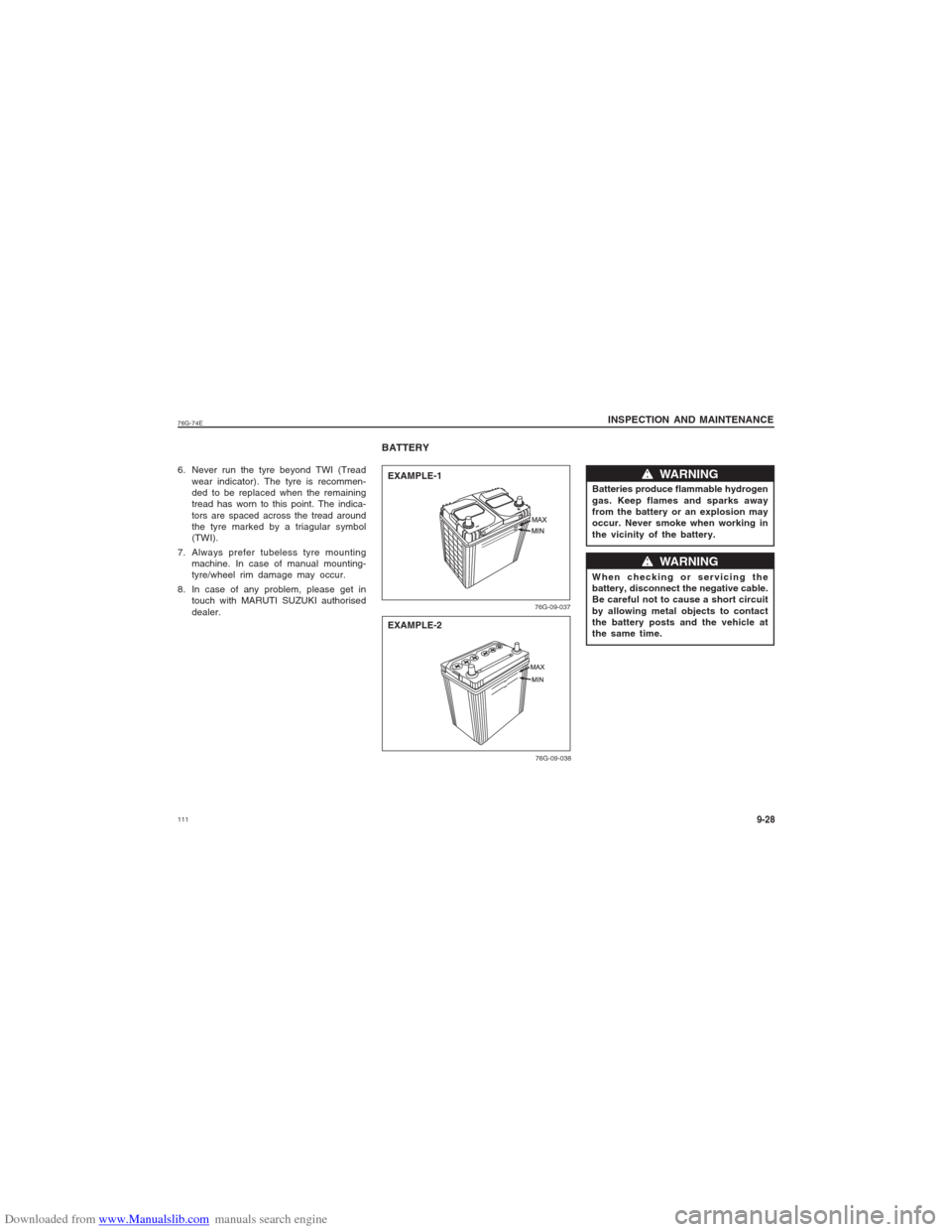
The level of the battery solution must be
kept between the “MAX” and the “MIN” level
lines at all times. If the level is found to be
below the “MIN” level line, add distilled
water to the “MAX” level line. You should
periodically check the battery, battery
terminals, and battery hold-down bracket for
corrosion. Remove corrosion using a stiff
brush and ammonia mixed with water, or
baking soda mixed with water. After
removing corrosion, rinse with clean water.
If your vehicle is not going to be driven for
a month or longer, disconnect the cable from
the negative terminal of the battery to help
prevent discharge.
w ww w
w WARNING
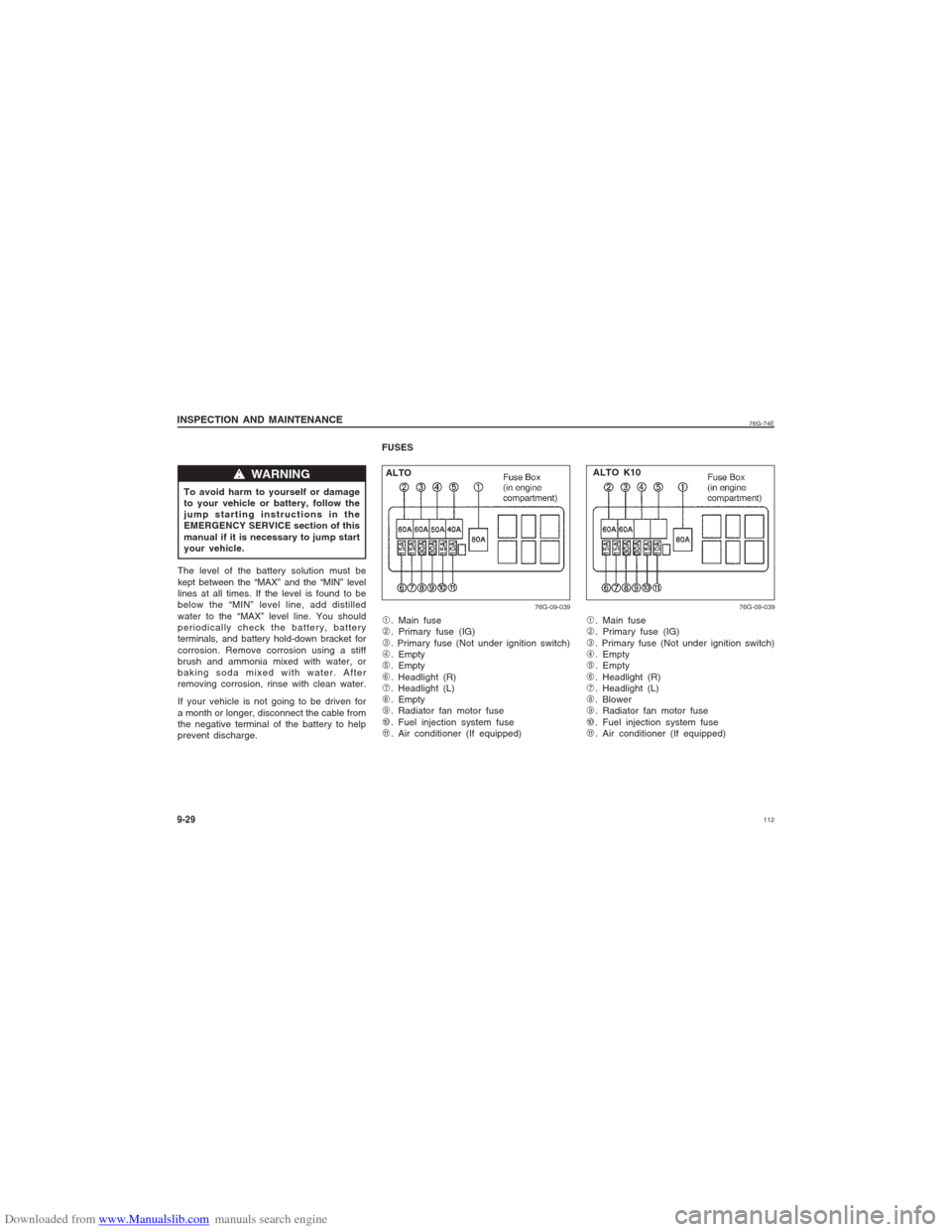
FUSES
1. Main fuse
2. Primary fuse (IG)
3. Primary fuse (Not under ignition switch)
4. Empty
5. Empty
6. Headlight (R)
7. Headlight (L)
8. Empty
9. Radiator fan motor fuse
0. Fuel injection system fuse
c. Air conditioner (If equipped)
76G-09-039
1. Main fuse
2. Primary fuse (IG)
3. Primary fuse (Not under ignition switch)
4. Empty
5. Empty
6. Headlight (R)
7. Headlight (L)
8. Blower
9. Radiator fan motor fuse
0. Fuel injection system fuse
c. Air conditioner (If equipped)
76G-09-039
ALTOALTO K10
Page 124 of 139
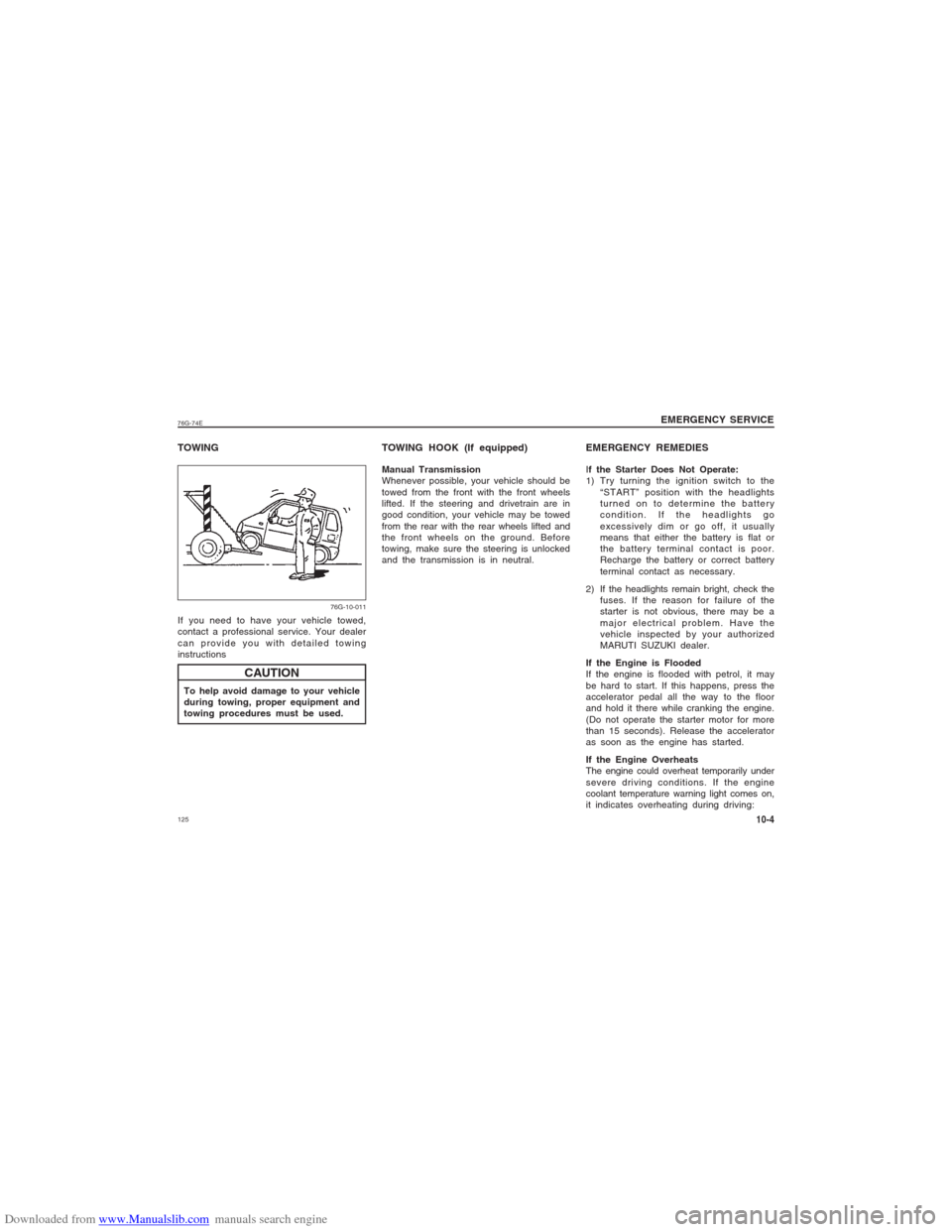
Downloaded from www.Manualslib.com manuals search engine 12576G-74ETOWINGIf you need to have your vehicle towed,
contact a professional service. Your dealer
can provide you with detailed towing
instructions
To help avoid damage to your vehicle
during towing, proper equipment and
towing procedures must be used.
EMERGENCY REMEDIESEMERGENCY SERVICE
10-4
CAUTION
Manual Transmission
Whenever possible, your vehicle should be
towed from the front with the front wheels
lifted. If the steering and drivetrain are in
good condition, your vehicle may be towed
from the rear with the rear wheels lifted and
the front wheels on the ground. Before
towing, make sure the steering is unlocked
and the transmission is in neutral.If the Starter Does Not Operate:
1) Try turning the ignition switch to the
“START” position with the headlights
turned on to determine the battery
condition. If the headlights go
excessively dim or go off, it usually
means that either the battery is flat or
the battery terminal contact is poor.
Recharge the battery or correct battery
terminal contact as necessary.
2) If the headlights remain bright, check the
fuses. If the reason for failure of the
starter is not obvious, there may be a
major electrical problem. Have the
vehicle inspected by your authorized
MARUTI SUZUKI dealer.
If the Engine is Flooded
If the engine is flooded with petrol, it may
be hard to start. If this happens, press the
accelerator pedal all the way to the floor
and hold it there while cranking the engine.
(Do not operate the starter motor for more
than 15 seconds). Release the accelerator
as soon as the engine has started.
If the Engine Overheats
The engine could overheat temporarily under
severe driving conditions. If the engine
coolant temperature warning light comes on,
it indicates overheating during driving:TOWING HOOK (If equipped)
76G-10-011
Page 125 of 139
Downloaded from www.Manualslib.com manuals search engine 126
76G-74E
engine until these problems have been
corrected.
3) If you do not find a leak, carefully add
coolant to the reservoir and then the
radiator, if necessary. (Refer to “ENGINE
COOLANT” in the “INSPECTION AND
MAINTENANCE” section.)
It is dangerous to remove the radiator
cap when the water temperature is
high, because scalding fluid and
steam may be blown out under
pressure. The cap should only be
taken off when the coolant
temperature has lowered.
To help prevent personal injury, keep
hands, tools and clothing away from
the engine cooling fan and air-
conditioner fan (if equipped). These
electric fans can automatically turn on
without warning.
EMERGENCY SERVICE10-5
w ww w
w WARNINGw ww w
w WARNING
1) Turn off the air conditioner, if equipped.
2) Take the vehicle to a safe place and
park.
3) Let the engine run at normal idle speed
for a few minutes until engine coolant
temperature warning light goes off.
If you see or hear escaping steam,
stop the vehicle in a safe place and
immediately turn off the engine to let
it cool. Do not open the bonnet when
steam is present. When the steam can
no longer be seen or heard, open the
hood to see if the coolant is still
boiling. If it is, you must wait until it
stops boiling before you proceed.
If the engine coolant temperature warning
light does not goes off:
1) Turn off the engine and check that the
water pump belt and pulleys are not
damaged or slipping. If any abnormality
is found, correct it.
2) Check the coolant level in the reservoir.
If it is found to be lower than the “LOW”
line, look for leaks at the radiator, water
pump, and radiator and heater hoses. If
you locate any leaks that may have
caused the overheating, do not run the
w ww w
w WARNING
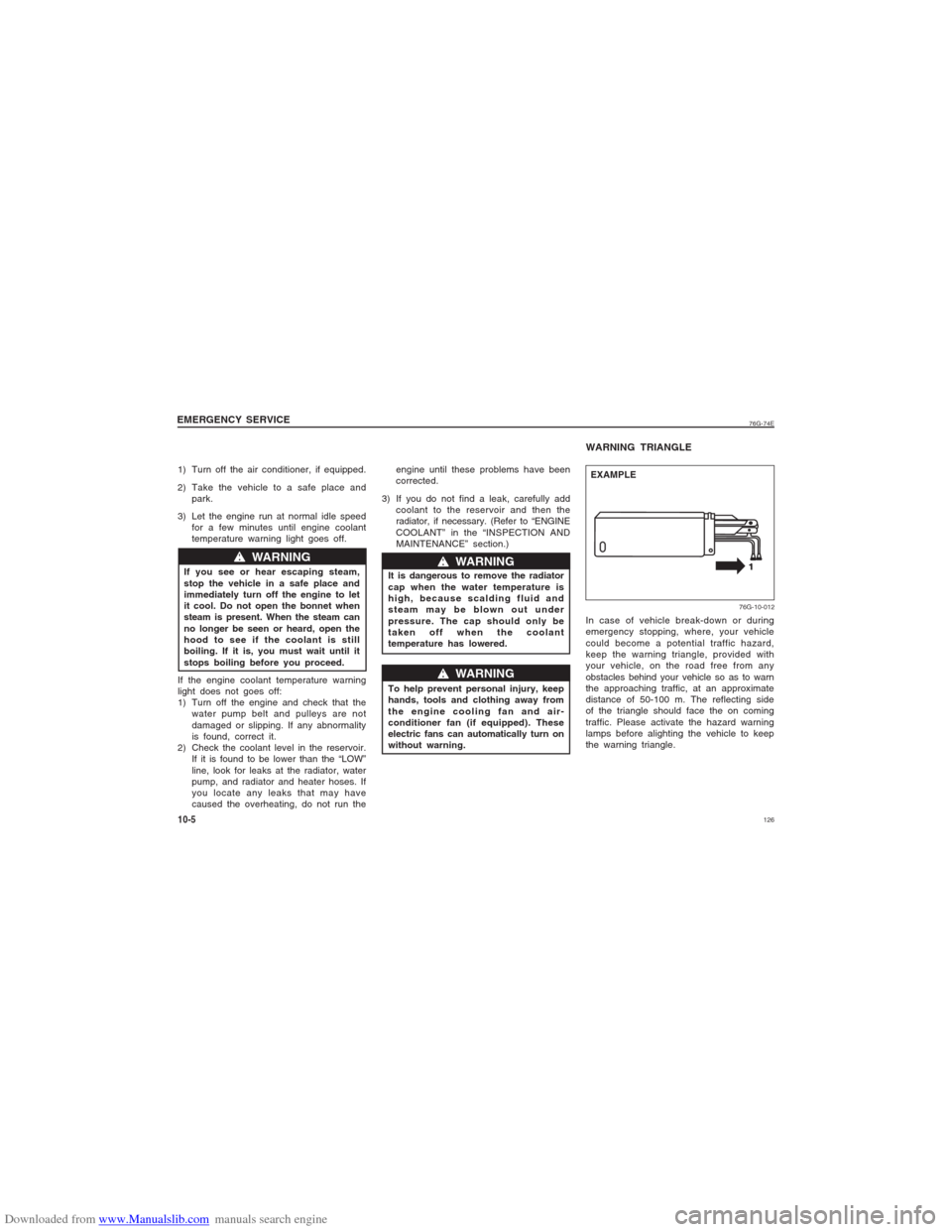
WARNING TRIANGLEIn case of vehicle break-down or during
emergency stopping, where, your vehicle
could become a potential traffic hazard,
keep the warning triangle, provided with
your vehicle, on the road free from any
obstacles behind your vehicle so as to warn
the approaching traffic, at an approximate
distance of 50-100 m. The reflecting side
of the triangle should face the on coming
traffic. Please activate the hazard warning
lamps before alighting the vehicle to keep
the warning triangle.
176G-10-012
EXAMPLE
Page 129 of 139
Downloaded from www.Manualslib.com manuals search engine 130
76G-74E
CORROSION PREVENTION
the vehicle which are not well ventilated
to permit quick drying.
This information illustrates the necessity of
keeping your vehicle (particularly the
underbody) as clean and dry as possible.
It is equally important to repair any damage
to the paint or protective coatings as soon
as possible.
How to Help Prevent Corrosion
Wash your vehicle frequently
The best way to preserve the finish on your
vehicle and to help avoid corrosion is to
keep it clean with frequent washing.
Wash your vehicle regularly during the
winter and immediately after the winter.
Keep your vehicle, particularly the
underside, as clean and dry as possible.
If you frequently drive on salted roads, your
vehicle should be washed at least once a
month during the winter. If you live near the
ocean, your vehicle should be washed at
least once a month throughout the year.
For washing instructions, refer to the
“VEHICLE CLEANING” section.
Remove foreign material deposits
Foreign material such as salts, chemicals,
road oil or tar, tree sap, bird droppings and
industrial fall-out may damage the finish of
your vehicle if it is left on painted surfaces.
Remove these types of deposits as quicklyas possible. If these deposits are difficult to
wash off, an additional cleaner may be
required. Be sure that any cleaner you use
is not harmful to painted surfaces and is
specifically intended for your purposes.
Follow the manufacturer’s directions when
using these special cleaners.
Repair finish damage
Carefully examine your vehicle for damage
to the painted surfaces. Should you find any
chips or scratches in the paint, touch them
up immediately to prevent corrosion from
starting. If the chips or scratches have gone
through to the bare metal, have a qualified
body shop make the repair.
Keep Passenger and luggage
compartments clean.
Moisture, dirt or mud can accumulate under
the floor mats and may cause corrosion.
Occasionally, check under these mats to
ensure that this area is clean and dry. More
frequent checks are necessary if the vehicle
is used off road or in wet weather.
Certain cargos such as chemicals, fertilizers,
cleaners, salts, etc., are extremely corrosive
by nature. These products should be
transported in sealed containers. If a spill
or leak does occur, clean and dry the area
immediately. It is important to take good care of your
vehicle to protect it from corrosion.
Listed below are instructions for how to
maintain your vehicle to prevent corrosion.
Please read and follow these instructions
carefully.
Important Information About Corrosion
Common causes of corrosion
1) Accumulation of road salt, dirt, moisture,
or chemicals in hard to reach areas of
the vehicle underbody or frame.
2) Chipping, scratches and any damage to
treated or painted metal surfaces
resulting from minor accidents or
abrasion by stones and gravel.
Environmental conditions which
accelerate corrosion
1) Road salt, dust control chemicals, sea
air or industrial pollution will all
accelerate the corrosion of metal.
2) High humidity will increase the rate of
corrosion particularly when the
temperature range is just above the
freezing point.
3) Moisture in certain areas of a vehicle for
an extended period of time may promote
corrosion even though other body
sections may be completely dry.
4) High temperatures will cause an
accelerated rate of corrosion to parts of
BODY WORK CARE11-1