Acc SUZUKI ALTO 2019 User Guide
[x] Cancel search | Manufacturer: SUZUKI, Model Year: 2019, Model line: ALTO, Model: SUZUKI ALTO 2019Pages: 139, PDF Size: 2.22 MB
Page 30 of 139
3176G-74E
Do not use the starter motor formore than 15 seconds at a time. If
the engine does not start; wait 15
seconds before trying again. If the
engine does not start after several
attempts, check the fuel and ignition
systems or consult your MARUTI
SUZUKI dealer.
Do not leave the ignition switch in the “ON” position if the engine is
not running as the battery will
discharge.
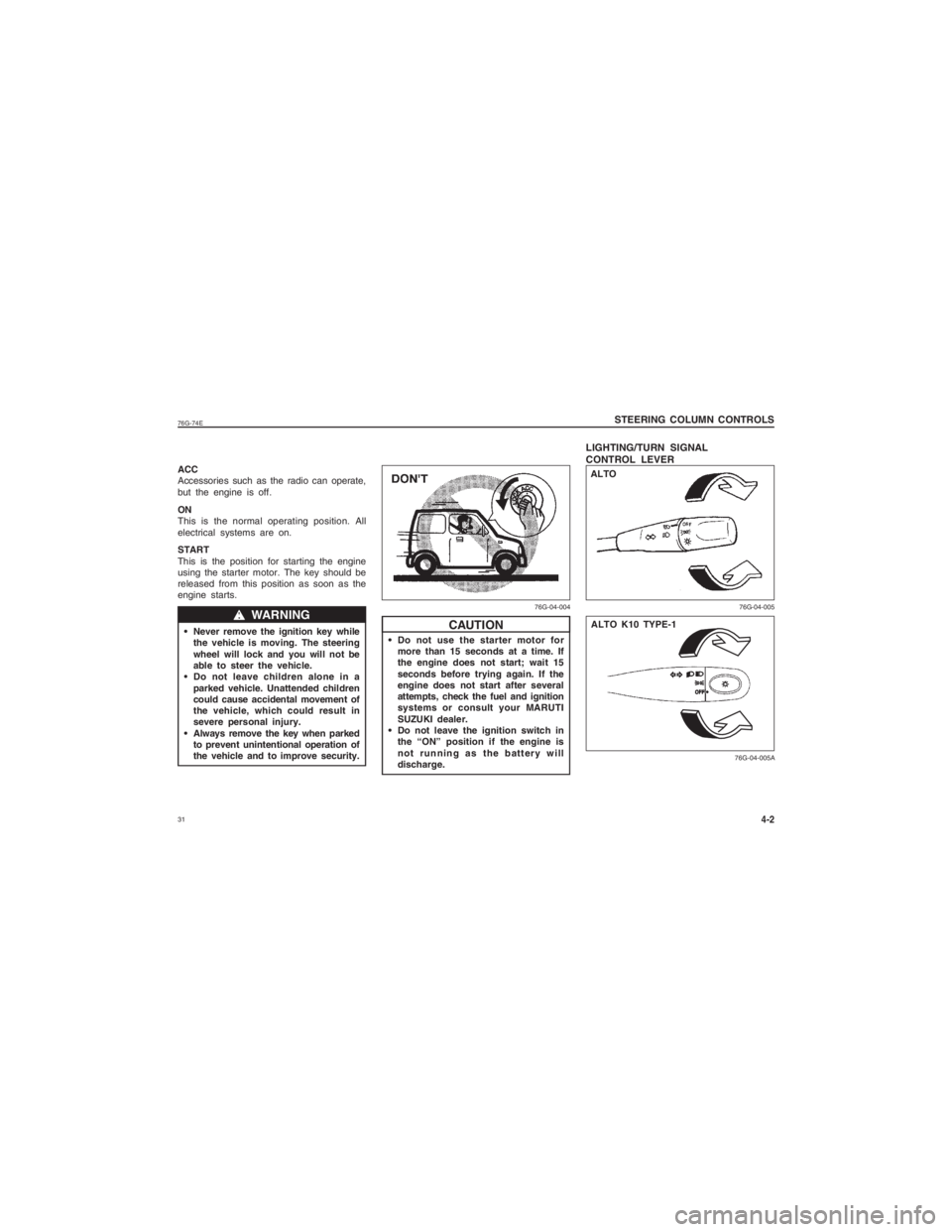
LIGHTING/TURN SIGNAL
CONTROL LEVER STEERING COLUMN CONTROLS
ACC
Accessories such as the radio can operate,
but the engine is off.
ON
This is the normal operating position. All
electrical systems are on.
START
This is the position for starting the engine
using the starter motor. The key should be
released from this position as soon as the
engine starts.
Never remove the ignition key while the vehicle is moving. The steering
wheel will lock and you will not be
able to steer the vehicle.
Do not leave children alone in a
parked vehicle. Unattended children
could cause accidental movement of
the vehicle, which could result in
severe personal injury.
Always remove the key when parked to prevent unintentional operation of
the vehicle and to improve security.
ww ww
w WARNING
CAUTION
4-2
76G-04-005
76G-04-004
ALTO
76G-04-005A
ALTO K10 TYPE-1
Page 46 of 139
4776G-74E
INSTRUMENT PANEL
5-10
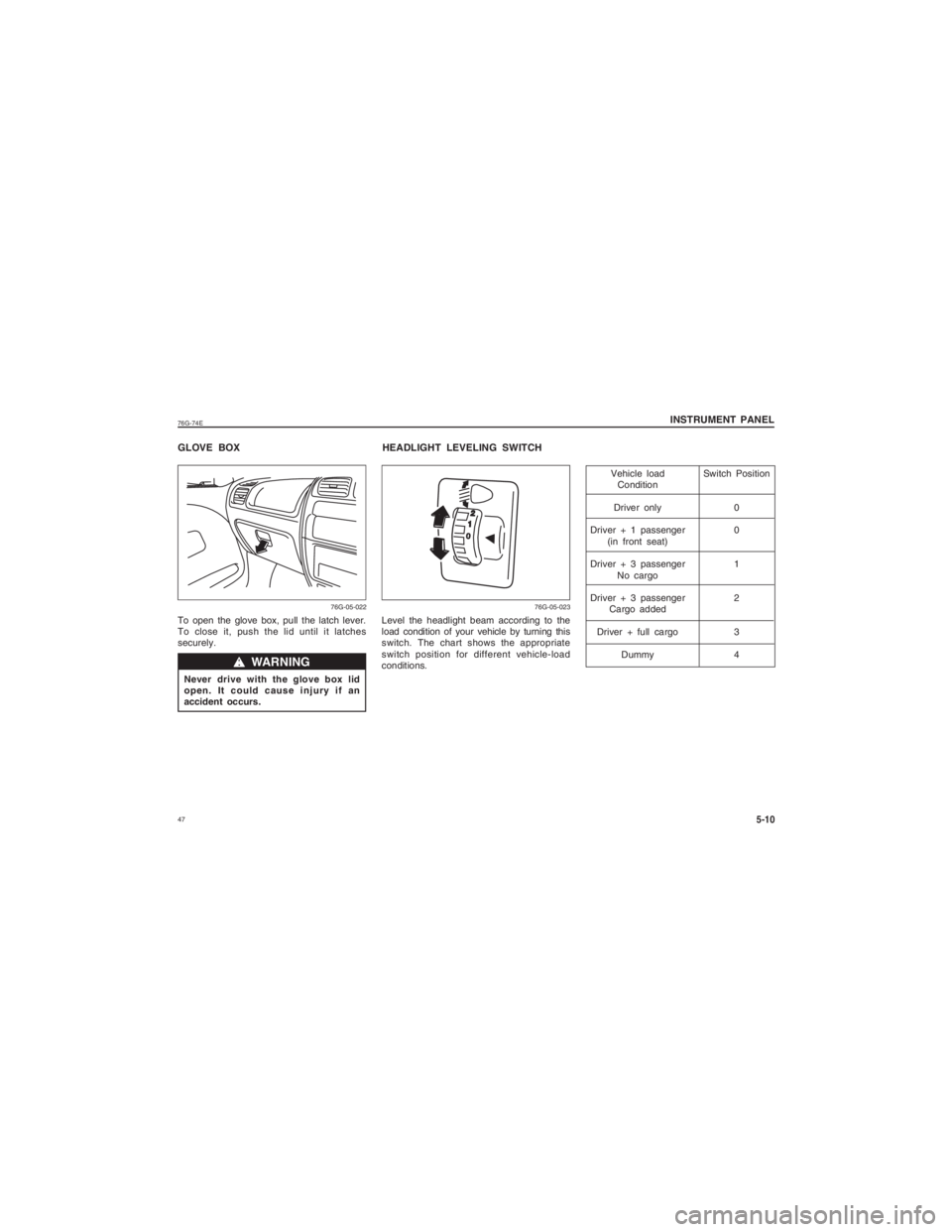
Vehicle load Switch PositionCondition
Driver only 0
Driver + 1 passenger 0 (in front seat)
Driver + 3 passenger 1 No cargo
Driver + 3 passenger 2 Cargo added
Driver + full cargo 3 Dummy 4
Level the headlight beam according to the
load condition of your vehicle by turning this
switch. The chart shows the appropriate
switch position for different vehicle-load
conditions.HEADLIGHT LEVELING SWITCH
76G-05-023
To open the glove box, pull the latch lever.
To close it, push the lid until it latches
securely.
Never drive with the glove box lid
open. It could cause injury if an
accident occurs.
ww ww
w WARNING
76G-05-022
GLOVE BOX
Page 58 of 139
5976G-74EPEDALS
6-2
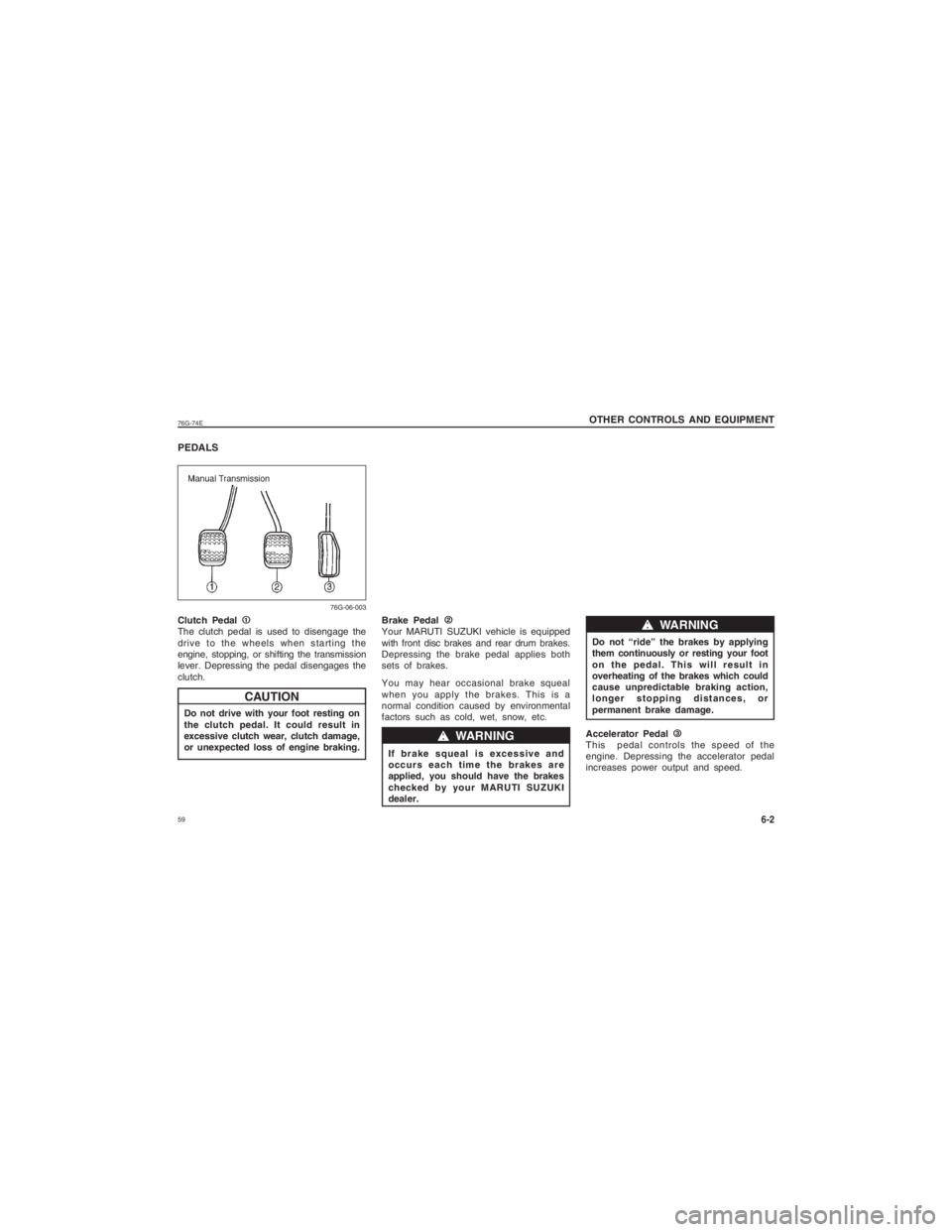
Clutch Pedal 11 11
1
The clutch pedal is used to disengage the
drive to the wheels when starting the
engine, stopping, or shifting the transmission
lever. Depressing the pedal disengages the
clutch.
Do not drive with your foot resting on
the clutch pedal. It could result in
excessive clutch wear, clutch damage,
or unexpected loss of engine braking. Brake Pedal
22 22
2
Your MARUTI SUZUKI vehicle is equipped
with front disc brakes and rear drum brakes.
Depressing the brake pedal applies both
sets of brakes.
You may hear occasional brake squeal
when you apply the brakes. This is a
normal condition caused by environmental
factors such as cold, wet, snow, etc.
If brake squeal is excessive and
occurs each time the brakes are
applied, you should have the brakes
checked by your MARUTI SUZUKI
dealer.
ww ww
w WARNING
CAUTION
ww
ww
w WARNING
OTHER CONTROLS AND EQUIPMENTDo not “ride” the brakes by applying
them continuously or resting your foot
on the pedal. This will result in
overheating of the brakes which could
cause unpredictable braking action,
longer stopping distances, or
permanent brake damage.
Accelerator Pedal 33 33
3
This pedal controls the speed of the
engine. Depressing the accelerator pedal
increases power output and speed.
76G-06-003
Page 62 of 139
6376G-74E
6-6
OTHER CONTROLS AND EQUIPMENT
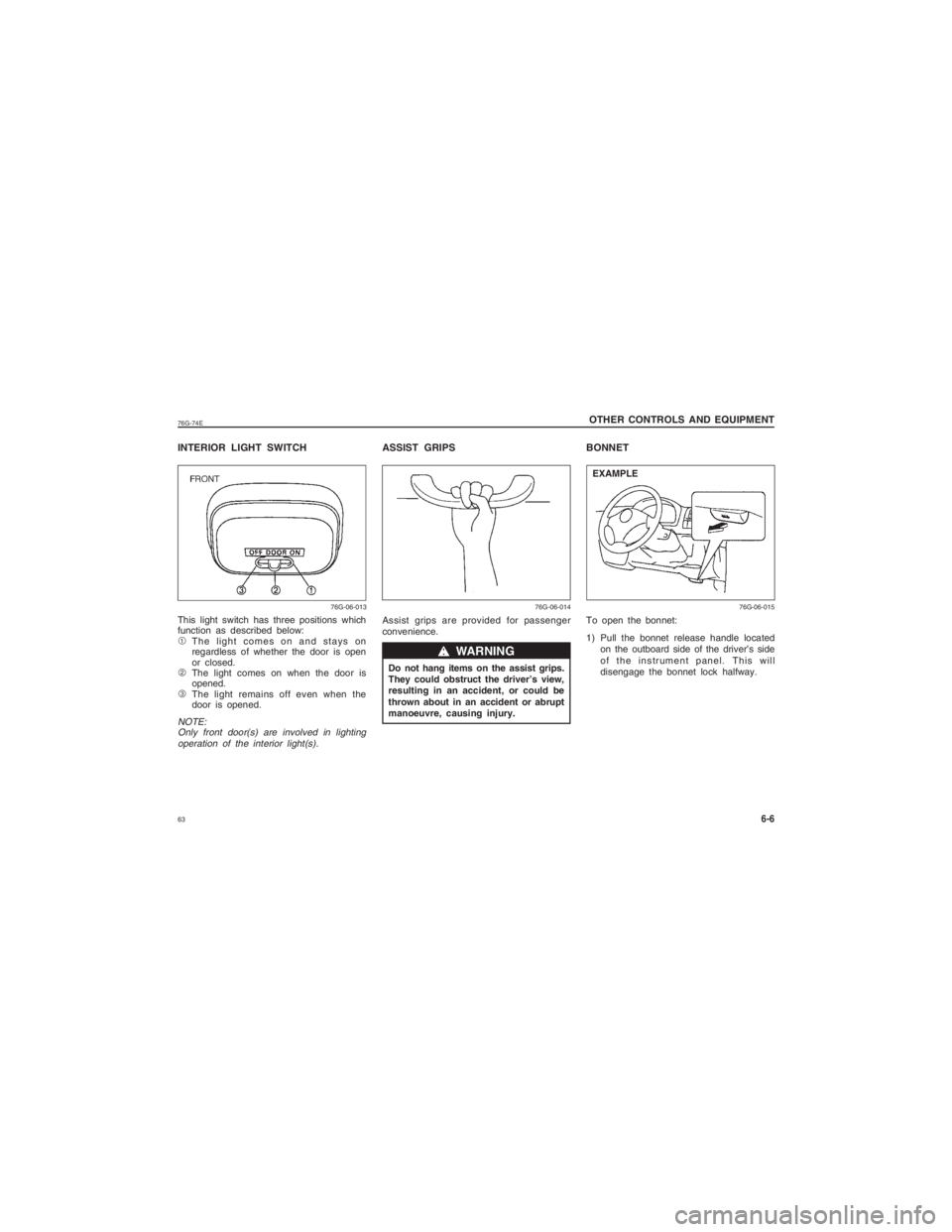
INTERIOR LIGHT SWITCH
This light switch has three positions which
function as described below:
1 The light comes on and stays on
regardless of whether the door is open
or closed.
2 The light comes on when the door is
opened.
3 The light remains off even when the
door is opened.NOTE:
Only front door(s) are involved in lighting
operation of the interior light(s).
76G-06-013
ASSIST GRIPSAssist grips are provided for passenger
convenience.
Do not hang items on the assist grips.
They could obstruct the driver’s view,
resulting in an accident, or could be
thrown about in an accident or abrupt
manoeuvre, causing injury.
ww ww
w WARNING
BONNETTo open the bonnet:
1) Pull the bonnet release handle located
on the outboard side of the driver’s side
of the instrument panel. This will
disengage the bonnet lock halfway.
76G-06-014 76G-06-015
EXAMPLE
Page 63 of 139
64
76G-74E
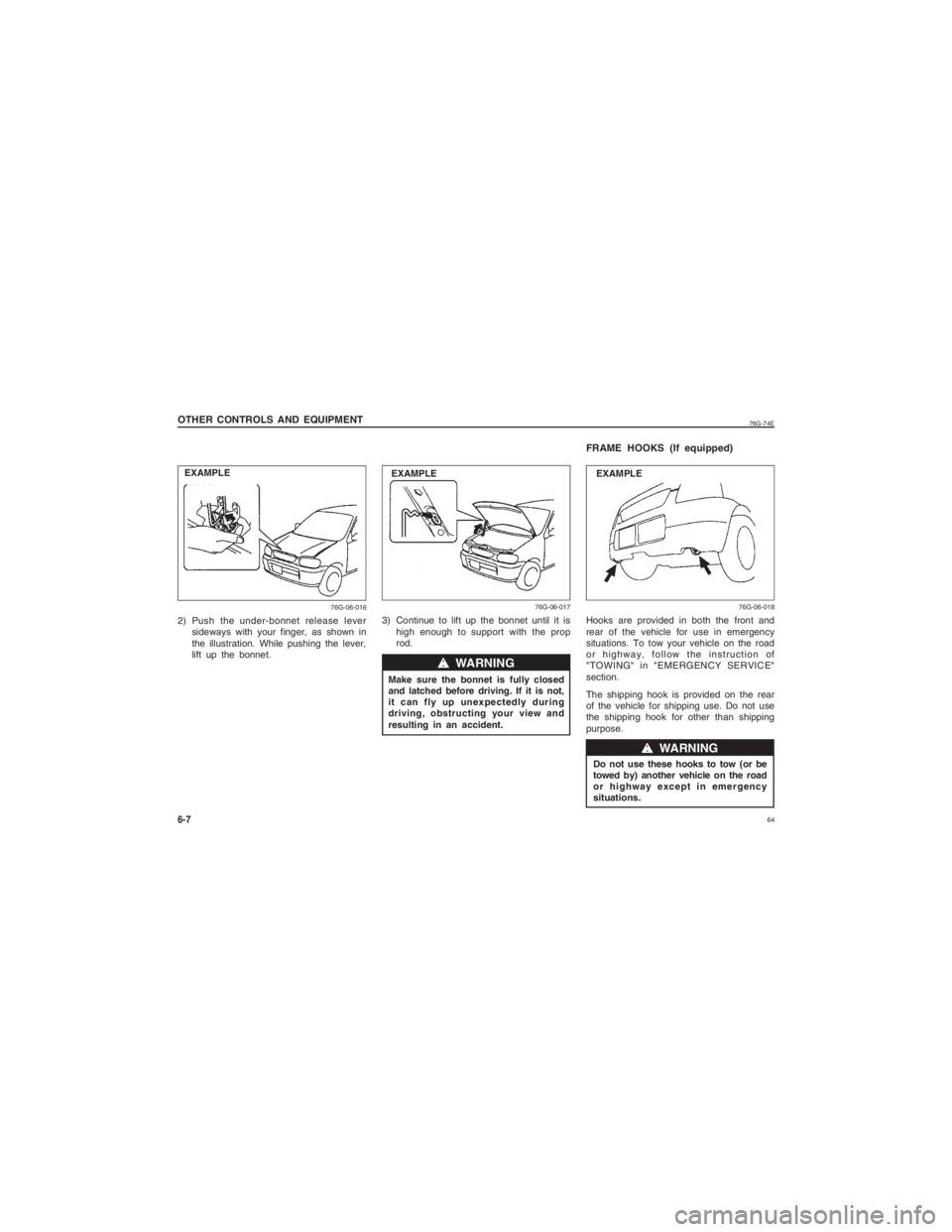
6-7OTHER CONTROLS AND EQUIPMENT2) Push the under-bonnet release leversideways with your finger, as shown in
the illustration. While pushing the lever,
lift up the bonnet.
76G-06-016
3) Continue to lift up the bonnet until it ishigh enough to support with the prop
rod.
Make sure the bonnet is fully closed
and latched before driving. If it is not,
it can fly up unexpectedly during
driving, obstructing your view and
resulting in an accident.
ww ww
w WARNING
FRAME HOOKS (If equipped)
ww
ww
w WARNING
Hooks are provided in both the front and
rear of the vehicle for use in emergency
situations. To tow your vehicle on the road
or highway, follow the instruction of
"TOWING" in "EMERGENCY SERVICE"
section.
The shipping hook is provided on the rear
of the vehicle for shipping use. Do not use
the shipping hook for other than shipping
purpose.
76G-06-017 76G-06-018
EXAMPLE
EXAMPLE EXAMPLE
Do not use these hooks to tow (or be
towed by) another vehicle on the road
or highway except in emergency
situations.
Page 65 of 139
66
76G-74E
6-9OTHER CONTROLS AND EQUIPMENT
76G-06-02276G-06-023
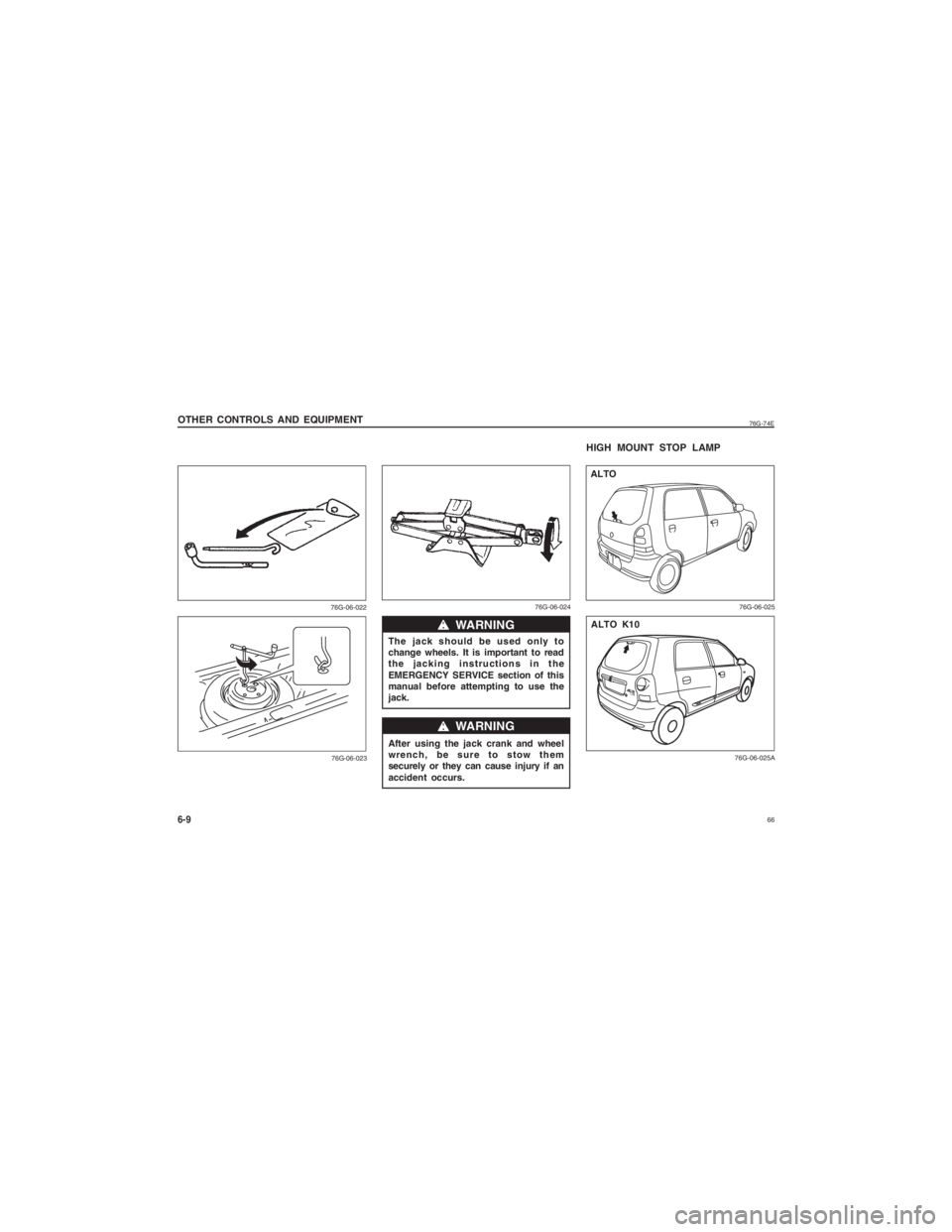
The jack should be used only to
change wheels. It is important to read
the jacking instructions in the
EMERGENCY SERVICE section of this
manual before attempting to use the
jack.
After using the jack crank and wheel
wrench, be sure to stow them
securely or they can cause injury if an
accident occurs.
ww ww
w WARNINGww
ww
w WARNING
HIGH MOUNT STOP LAMP
76G-06-024 76G-06-025
ALTO
76G-06-025A
ALTO K10
Page 70 of 139
7176G-74E
Before starting the engine:
1) Make sure the parking brake is appliedfully.
2) Manual Transmission - Shift into “N” (neutral) and depress the clutch pedal all
the way to the floor. Hold it while starting
the engine.
Make sure that the parking brake is
applied fully and the transmission is
in Neutral before attempting to start
the engine.
Stop turning the starter immediately after the engine has started or the
starter system can be damaged.
Do not crank the engine for more than 15 seconds at a time. If the
engine doesn’t start on the first try,
wait about 15 seconds before trying
again.
7-2
STARTING THE ENGINE
ww ww
w WARNING
OPERATING YOUR VEHICLE
Once a week, or each time you fill your fuel
tank, perform the following under-bonnet
checks:
1) Engine oil level.
2) Coolant level.
3) Brake fluid level.
4) Windscreen washer fluid level.
5) Battery solution level.
6) Bonnet latch operation.
Pull the bonnet release handle inside the
vehicle. Make sure that you can not
open the hood all the way without
releasing the secondary latch. Be sure
to close the hood securely after checking
for proper operation. See "All Latches,
Hinges & Locks" of "PERIODIC
MAINTENANCE SCHEDULE" in the
"INSPECTION AND MAINTENANCE"
section for lubrication schedule.
Make sure the bonnet is fully closed
and latched before driving. If it is not,
it can fly up unexpectedly during
driving, obstructing your view and
resulting in an accident.
ww ww
w WARNING
Starting a Cold Engine
Engine which is started after 6 hours should
be treated as cold engine.
For Electronic fuel injection models
With your foot off the accelerator pedal,
crank the engine by turning the ignition
key to “START”. Release the key when
the engine starts.
If the engine does not start after 15 seconds of cranking, wait about 15
seconds, then press down the
accelerator pedal to 1/3 of its travel and
try cranking the engine again. Release
the key and accelerator pedal when the
engine starts.
If the engine still does not start, try holding the accelerator pedal all the way
to the floor while cranking. This should
clear the engine if it is flooded.
Starting a Warm Engine
For Electronic fuel injection models:
Use the same procedure as for “Starting a
Cold Engine”.
CAUTION
Page 71 of 139
72
76G-74E
7-3OPERATING YOUR VEHICLE
ww ww
w WARNINGCAUTION
Starting off
To start off, depress and maintain pressure
upon the clutch pedal and change into 1st
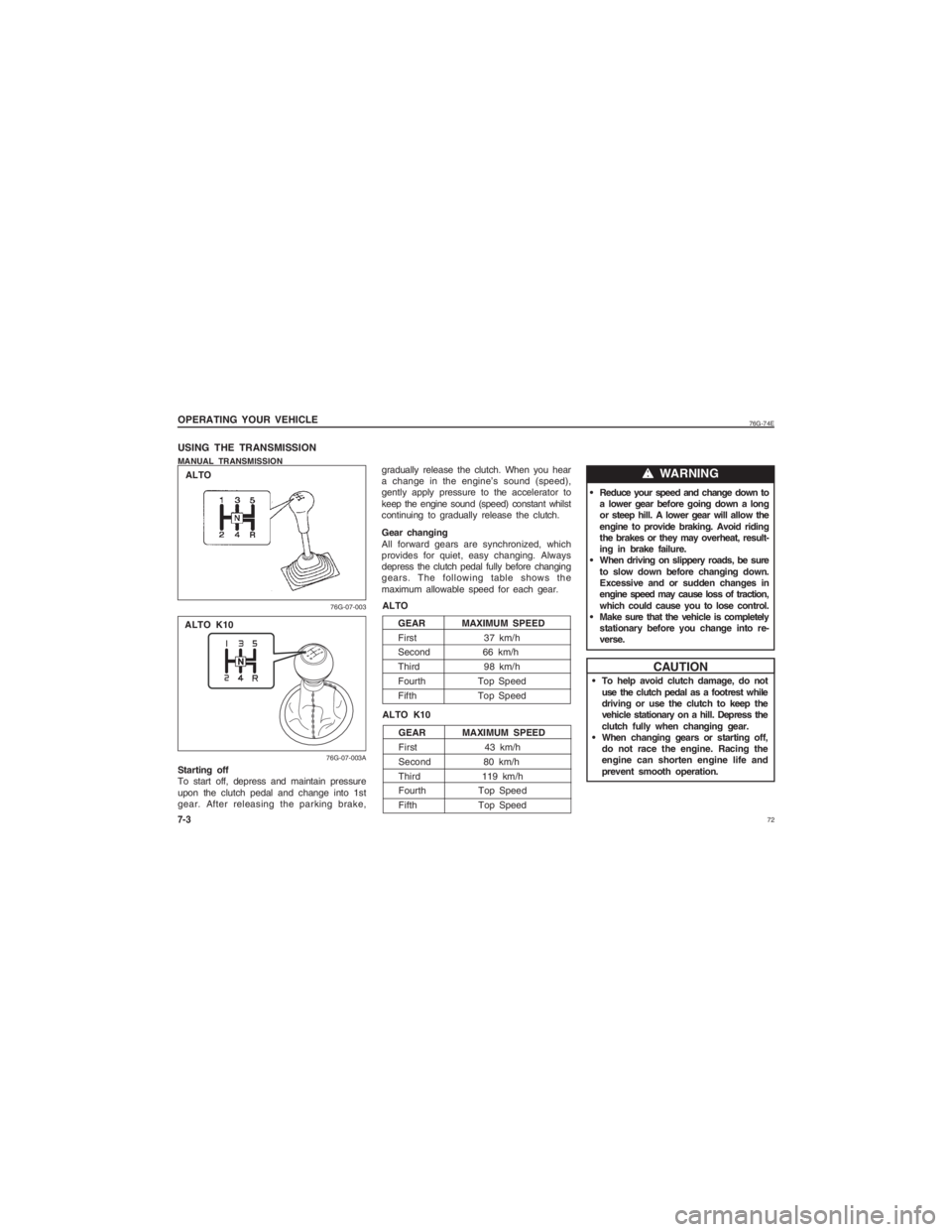
gear. After releasing the parking brake, GEAR MAXIMUM SPEED
First 37 km/h
Second 66 km/h
Third 98 km/h
Fourth Top Speed
Fifth
Top SpeedUSING THE TRANSMISSIONMANUAL TRANSMISSION
76G-07-00376G-07-003A
To help avoid clutch damage, do not
use the clutch pedal as a footrest while
driving or use the clutch to keep the
vehicle stationary on a hill. Depress the
clutch fully when changing gear.
When changing gears or starting off,
do not race the engine. Racing the
engine can shorten engine life and
prevent smooth operation.
Reduce your speed and change down to
a lower gear before going down a long
or steep hill. A lower gear will allow the
engine to provide braking. Avoid riding
the brakes or they may overheat, result-
ing in brake failure.
When driving on slippery roads, be sure to slow down before changing down.
Excessive and or sudden changes in
engine speed may cause loss of traction,
which could cause you to lose control.
Make sure that the vehicle is completely
stationary before you change into re-
verse.
gradually release the clutch. When you hear
a change in the engine’s sound (speed),
gently apply pressure to the accelerator to
keep the engine sound (speed) constant whilst
continuing to gradually release the clutch.
Gear changing
All forward gears are synchronized, which
provides for quiet, easy changing. Always
depress the clutch pedal fully before changing
gears. The following table shows the
maximum allowable speed for each gear.
ALTO
ALTO K10
GEAR MAXIMUM SPEED
First 43 km/h
Second 80 km/h
Third 119 km/h
Fourth Top Speed
Fifth Top Speed
ALTO
ALTO K10
Page 74 of 139
7576G-74E
7-6
OPERATING YOUR VEHICLE
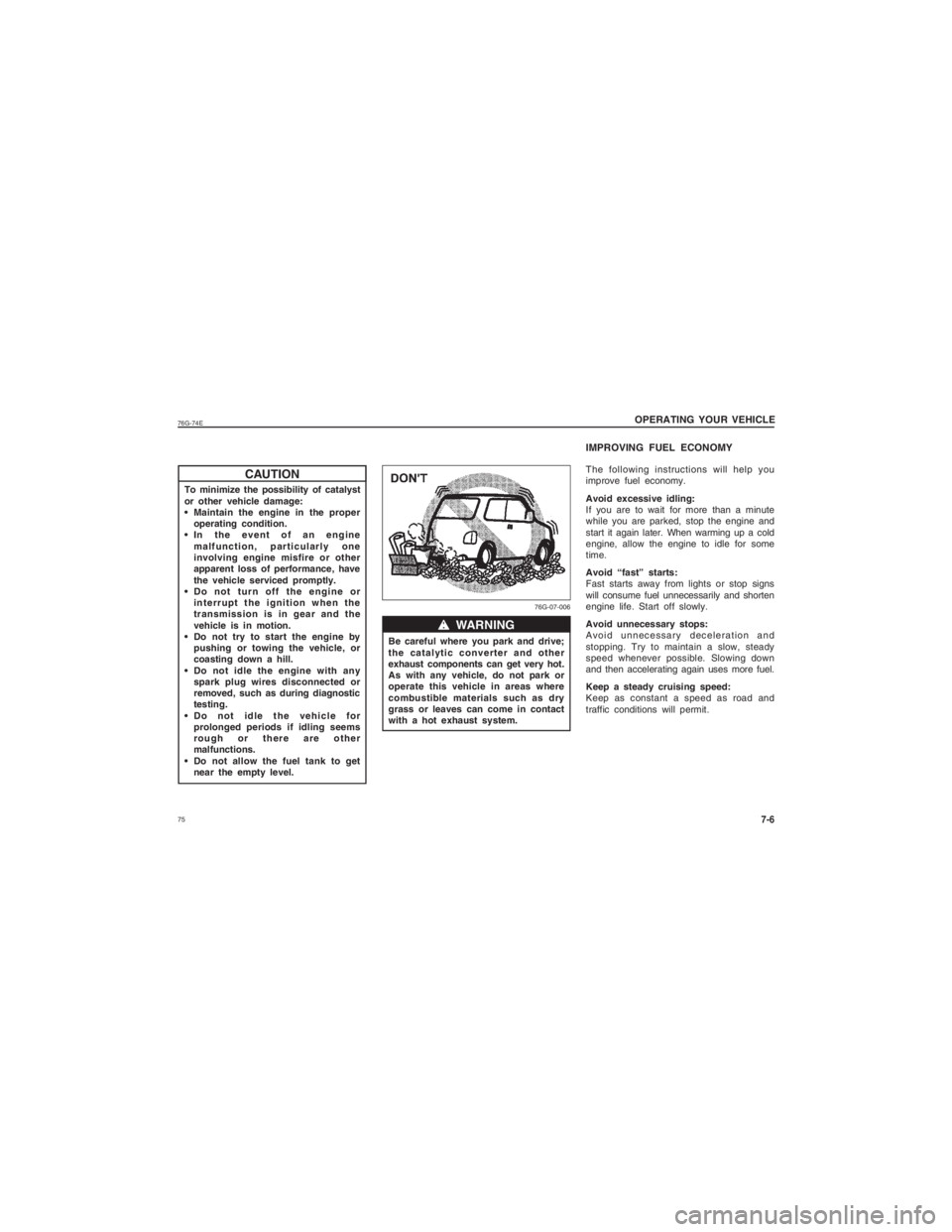
Be careful where you park and drive;
the catalytic converter and other
exhaust components can get very hot.
As with any vehicle, do not park or
operate this vehicle in areas where
combustible materials such as dry
grass or leaves can come in contact
with a hot exhaust system.
ww ww
w WARNING
To minimize the possibility of catalyst
or other vehicle damage:
Maintain the engine in the proper
operating condition.
In the event of an engine
malfunction, particularly one
involving engine misfire or other
apparent loss of performance, have
the vehicle serviced promptly.
Do not turn off the engine or interrupt the ignition when the
transmission is in gear and the
vehicle is in motion.
Do not try to start the engine by pushing or towing the vehicle, or
coasting down a hill.
Do not idle the engine with any spark plug wires disconnected or
removed, such as during diagnostic
testing.
Do not idle the vehicle for
prolonged periods if idling seems
rough or there are other
malfunctions.
Do not allow the fuel tank to get
near the empty level.
CAUTION
IMPROVING FUEL ECONOMYThe following instructions will help you
improve fuel economy.
Avoid excessive idling:
If you are to wait for more than a minute
while you are parked, stop the engine and
start it again later. When warming up a cold
engine, allow the engine to idle for some
time.
Avoid “fast” starts:
Fast starts away from lights or stop signs
will consume fuel unnecessarily and shorten
engine life. Start off slowly.
Avoid unnecessary stops:
Avoid unnecessary deceleration and
stopping. Try to maintain a slow, steady
speed whenever possible. Slowing down
and then accelerating again uses more fuel.
Keep a steady cruising speed:
Keep as constant a speed as road and
traffic conditions will permit.
76G-07-006
Page 77 of 139
78
76G-74E
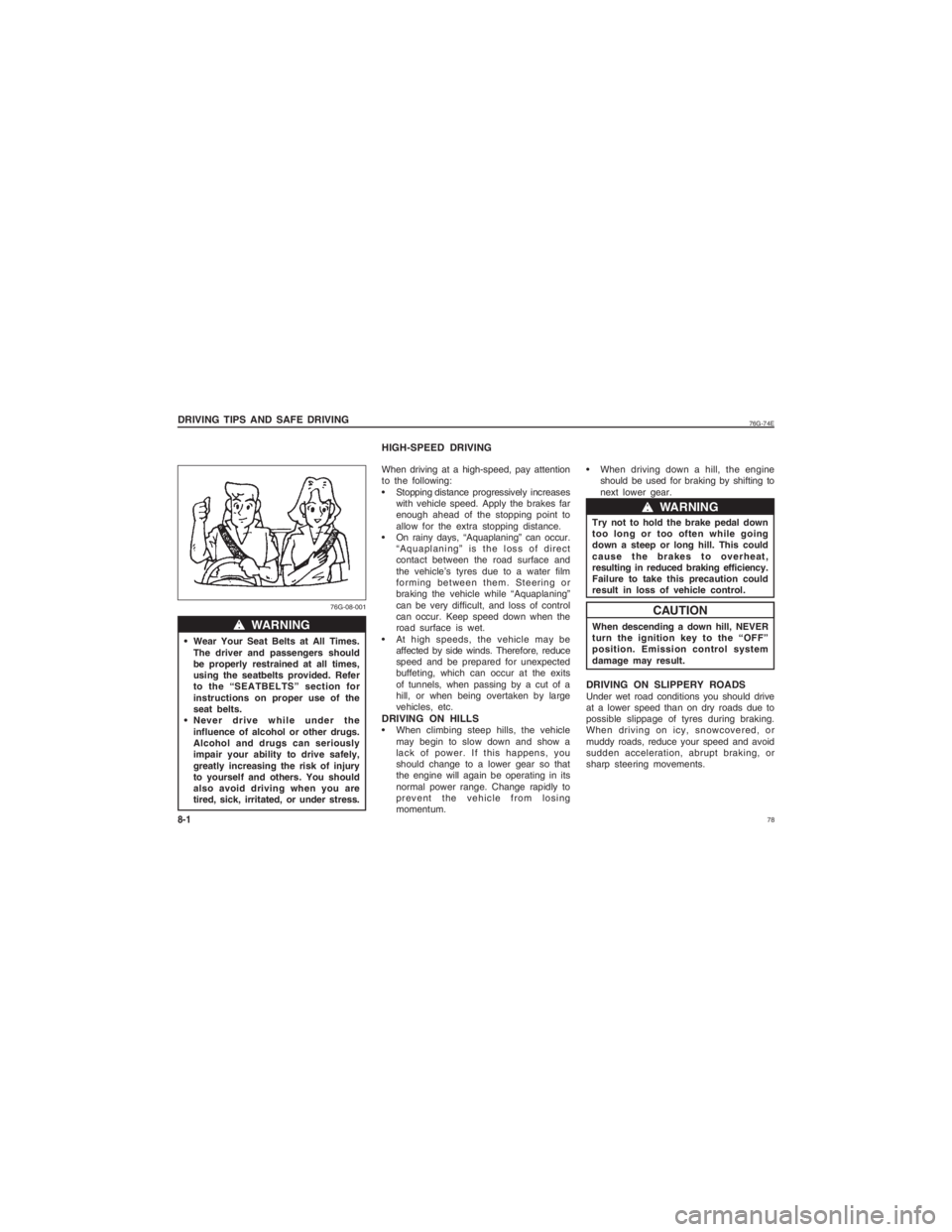
Wear Your Seat Belts at All Times.The driver and passengers should
be properly restrained at all times,
using the seatbelts provided. Refer
to the “SEATBELTS” section for
instructions on proper use of the
seat belts.
Never drive while under the
influence of alcohol or other drugs.
Alcohol and drugs can seriously
impair your ability to drive safely,
greatly increasing the risk of injury
to yourself and others. You should
also avoid driving when you are
tired, sick, irritated, or under stress.
HIGH-SPEED DRIVING
When driving down a hill, the engine should be used for braking by shifting to
next lower gear.
Try not to hold the brake pedal down
too long or too often while going
down a steep or long hill. This could
cause the brakes to overheat,
resulting in reduced braking efficiency.
Failure to take this precaution could
result in loss of vehicle control.
When descending a down hill, NEVER
turn the ignition key to the “OFF”
position. Emission control system
damage may result.DRIVING ON SLIPPERY ROADSUnder wet road conditions you should drive
at a lower speed than on dry roads due to
possible slippage of tyres during braking.
When driving on icy, snowcovered, or
muddy roads, reduce your speed and avoid
sudden acceleration, abrupt braking, or
sharp steering movements.
When driving at a high-speed, pay attention
to the following:
Stopping distance progressively increases
with vehicle speed. Apply the brakes far
enough ahead of the stopping point to
allow for the extra stopping distance.
On rainy days, “Aquaplaning” can occur. “Aquaplaning” is the loss of direct
contact between the road surface and
the vehicle’s tyres due to a water film
forming between them. Steering or
braking the vehicle while “Aquaplaning”
can be very difficult, and loss of control
can occur. Keep speed down when the
road surface is wet.
At high speeds, the vehicle may be affected by side winds. Therefore, reduce
speed and be prepared for unexpected
buffeting, which can occur at the exits
of tunnels, when passing by a cut of a
hill, or when being overtaken by large
vehicles, etc.
DRIVING ON HILLS When climbing steep hills, the vehiclemay begin to slow down and show a
lack of power. If this happens, you
should change to a lower gear so that
the engine will again be operating in its
normal power range. Change rapidly to
prevent the vehicle from losing
momentum.
ww ww
w WARNING
ww
ww
w WARNINGCAUTION
8-1DRIVING TIPS AND SAFE DRIVING
76G-08-001