Acc SUZUKI ALTO 2019 Owner's Guide
[x] Cancel search | Manufacturer: SUZUKI, Model Year: 2019, Model line: ALTO, Model: SUZUKI ALTO 2019Pages: 139, PDF Size: 2.22 MB
Page 102 of 139
10376G-74E
76G-09-020
ALTO K10EXAMPLE
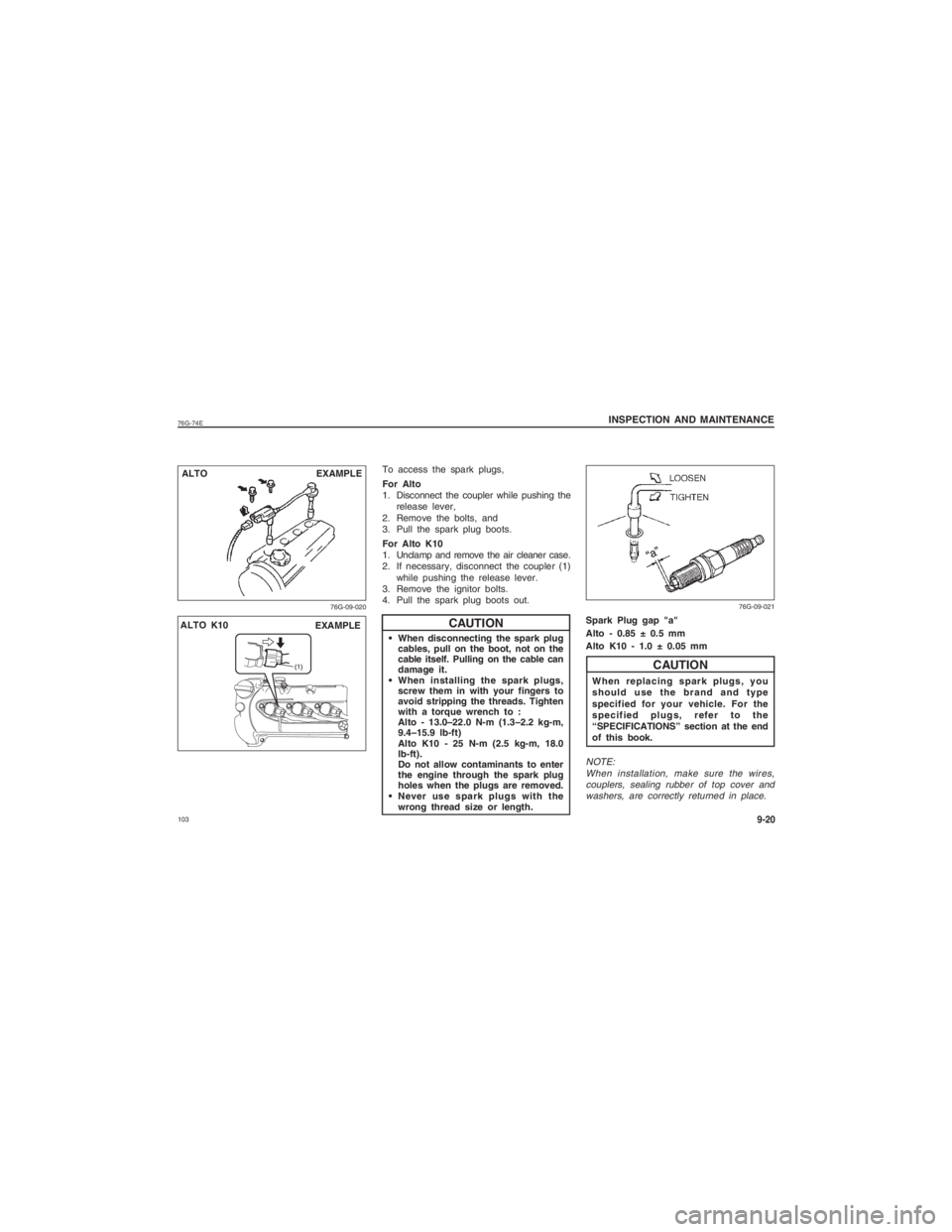
To access the spark plugs,
For Alto
1. Disconnect the coupler while pushing the
release lever,
2. Remove the bolts, and
3. Pull the spark plug boots.
For Alto K10
1. Unclamp and remove the air cleaner case.
2. If necessary, disconnect the coupler (1) while pushing the release lever.
3. Remove the ignitor bolts.
4. Pull the spark plug boots out.
CAUTION
76G-09-021
Spark Plug gap "a"
Alto - 0.85 ± 0.5 mm
Alto K10 - 1.0 ± 0.05 mm
INSPECTION AND MAINTENANCE
9-20
ALTO
EXAMPLE When disconnecting the spark plugcables, pull on the boot, not on the
cable itself. Pulling on the cable can
damage it.
When installing the spark plugs, screw them in with your fingers to
avoid stripping the threads. Tighten
with a torque wrench to :
Alto - 13.0–22.0 N-m (1.3–2.2 kg-m,
9.4–15.9 lb-ft)
Alto K10 - 25 N-m (2.5 kg-m, 18.0
lb-ft).
Do not allow contaminants to enter
the engine through the spark plug
holes when the plugs are removed.
Never use spark plugs with the
wrong thread size or length.
CAUTION
When replacing spark plugs, you
should use the brand and type
specified for your vehicle. For the
specified plugs, refer to the
“SPECIFICATIONS” section at the end
of this book.NOTE:
When installation, make sure the wires,couplers, sealing rubber of top cover and
washers, are correctly returned in place.
Page 106 of 139
10776G-74E
9-24
INSPECTION AND MAINTENANCE
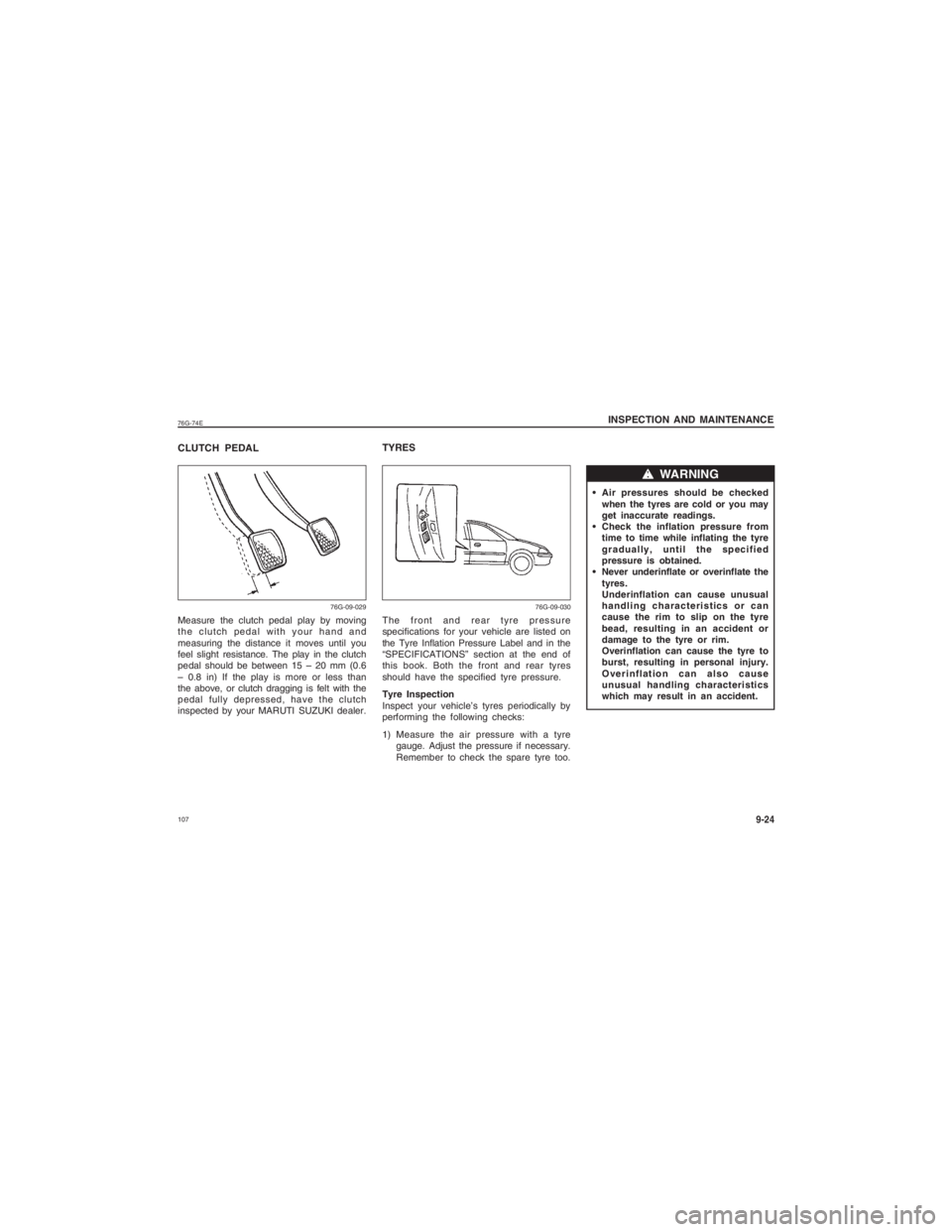
CLUTCH PEDAL
Measure the clutch pedal play by moving
the clutch pedal with your hand and
measuring the distance it moves until you
feel slight resistance. The play in the clutch
pedal should be between 15 – 20 mm (0.6
– 0.8 in) If the play is more or less than
the above, or clutch dragging is felt with the
pedal fully depressed, have the clutch
inspected by your MARUTI SUZUKI dealer.
76G-09-029
TYRESThe front and rear tyre pressure
specifications for your vehicle are listed on
the Tyre Inflation Pressure Label and in the
“SPECIFICATIONS” section at the end of
this book. Both the front and rear tyres
should have the specified tyre pressure.
Tyre Inspection
Inspect your vehicle’s tyres periodically by
performing the following checks:
1) Measure the air pressure with a tyre gauge. Adjust the pressure if necessary.
Remember to check the spare tyre too.
76G-09-030
Air pressures should be checkedwhen the tyres are cold or you may
get inaccurate readings.
Check the inflation pressure from time to time while inflating the tyre
gradually, until the specified
pressure is obtained.
Never underinflate or overinflate the tyres.
Underinflation can cause unusual
handling characteristics or can
cause the rim to slip on the tyre
bead, resulting in an accident or
damage to the tyre or rim.
Overinflation can cause the tyre to
burst, resulting in personal injury.
Overinflation can also cause
unusual handling characteristics
which may result in an accident.
ww ww
w WARNING
Page 109 of 139
110
76G-74E
INSPECTION AND MAINTENANCE9-27
76G-09-035
76G-09-036
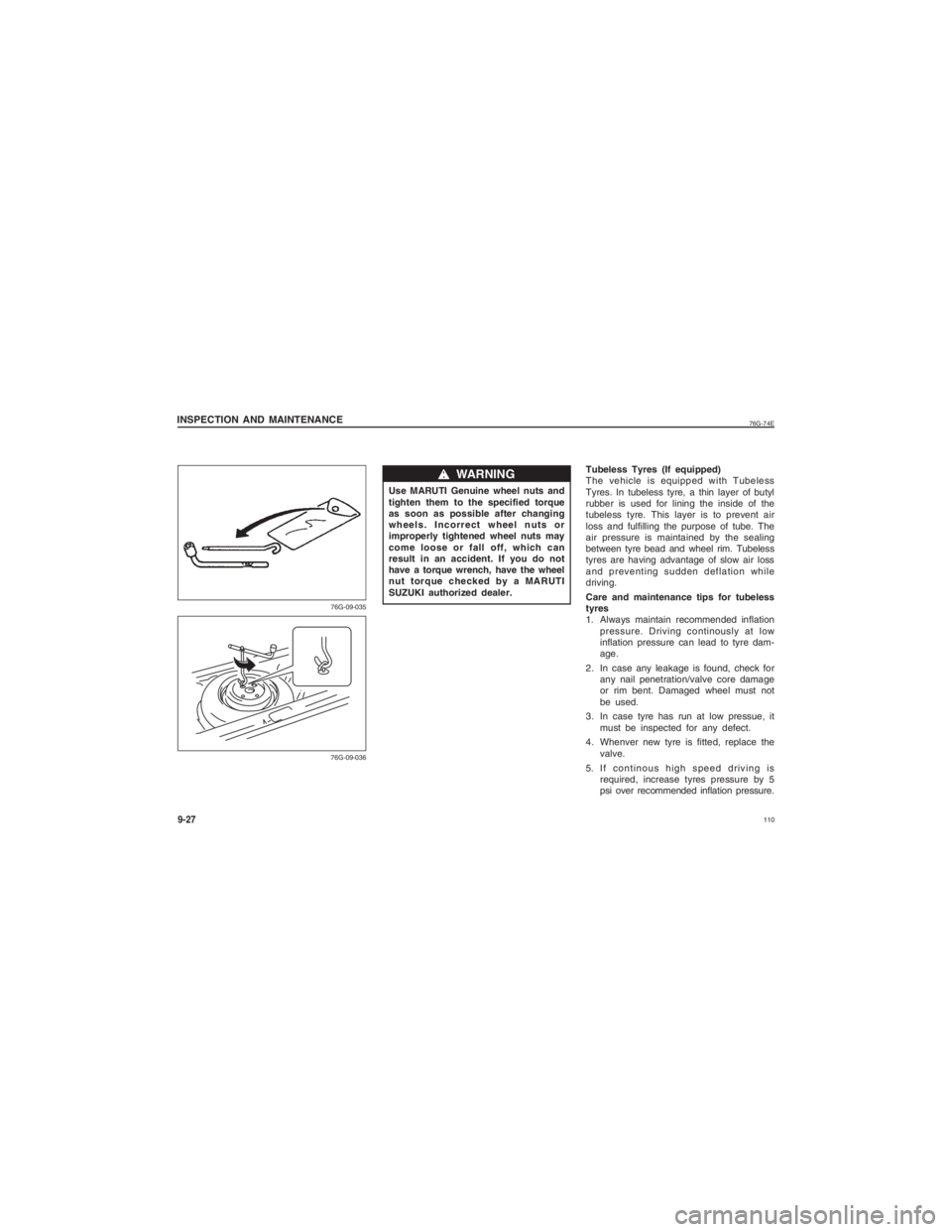
Use MARUTI Genuine wheel nuts and
tighten them to the specified torque
as soon as possible after changing
wheels. Incorrect wheel nuts or
improperly tightened wheel nuts may
come loose or fall off, which can
result in an accident. If you do not
have a torque wrench, have the wheel
nut torque checked by a MARUTI
SUZUKI authorized dealer.
ww ww
w WARNING
Tubeless Tyres (If equipped)
The vehicle is equipped with Tubeless
Tyres. In tubeless tyre, a thin layer of butyl
rubber is used for lining the inside of the
tubeless tyre. This layer is to prevent air
loss and fulfilling the purpose of tube. The
air pressure is maintained by the sealing
between tyre bead and wheel rim. Tubeless
tyres are having advantage of slow air loss
and preventing sudden deflation while
driving.
Care and maintenance tips for tubeless
tyres
1. Always maintain recommended inflation
pressure. Driving continously at low
inflation pressure can lead to tyre dam-
age.
2. In case any leakage is found, check for any nail penetration/valve core damage
or rim bent. Damaged wheel must not
be used.
3. In case tyre has run at low pressue, it must be inspected for any defect.
4. Whenver new tyre is fitted, replace the valve.
5. If continous high speed driving is required, increase tyres pressure by 5
psi over recommended inflation pressure.
Page 113 of 139
114
76G-74E
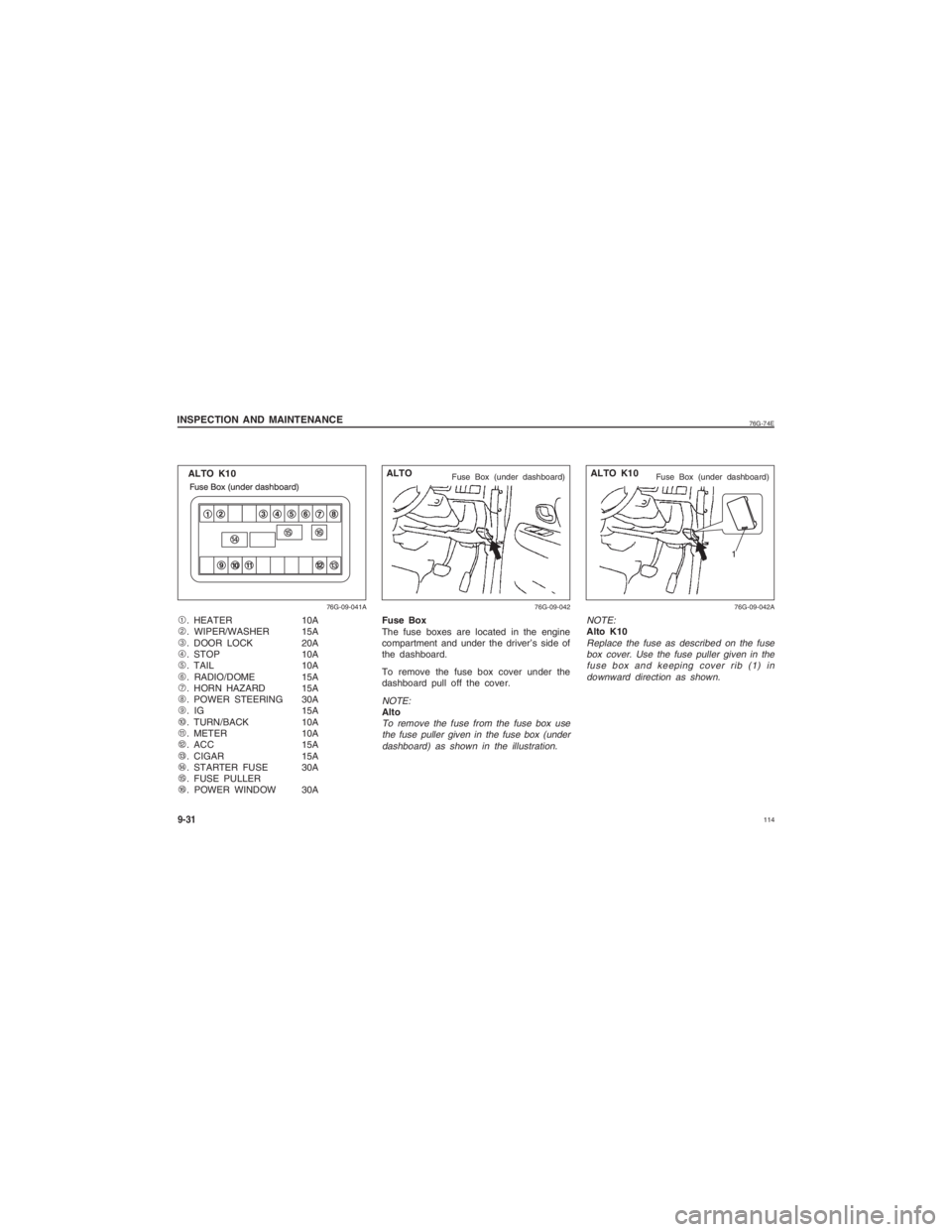
9-31INSPECTION AND MAINTENANCE1. HEATER 10A
2 . WIPER/WASHER 15A
3 . DOOR LOCK 20A
4 . STOP 10A
5 . TAIL 10A
6 . RADIO/DOME 15A
7 . HORN HAZARD 15A
8 . POWER STEERING 30A
9 . IG 15A
0 . TURN/BACK 10A
c . METER 10A
d . ACC 15A
e . CIGAR 15A
f . STARTER FUSE 30A
g . FUSE PULLER
h . POWER WINDOW 30A
76G-09-041A
ALTO K10
Fuse Box
The fuse boxes are located in the engine
compartment and under the driver’s side of
the dashboard.
To remove the fuse box cover under the
dashboard pull off the cover.
NOTE:AltoTo remove the fuse from the fuse box usethe fuse puller given in the fuse box (under
dashboard) as shown in the illustration.
76G-09-042
ALTO
Fuse Box (under dashboard)
76G-09-042A
ALTO K10
Fuse Box (under dashboard)
NOTE:Alto K10Replace the fuse as described on the fusebox cover. Use the fuse puller given in thefuse box and keeping cover rib (1) in
downward direction as shown.
Page 116 of 139
11776G-74E
INSPECTION AND MAINTENANCE
9-34
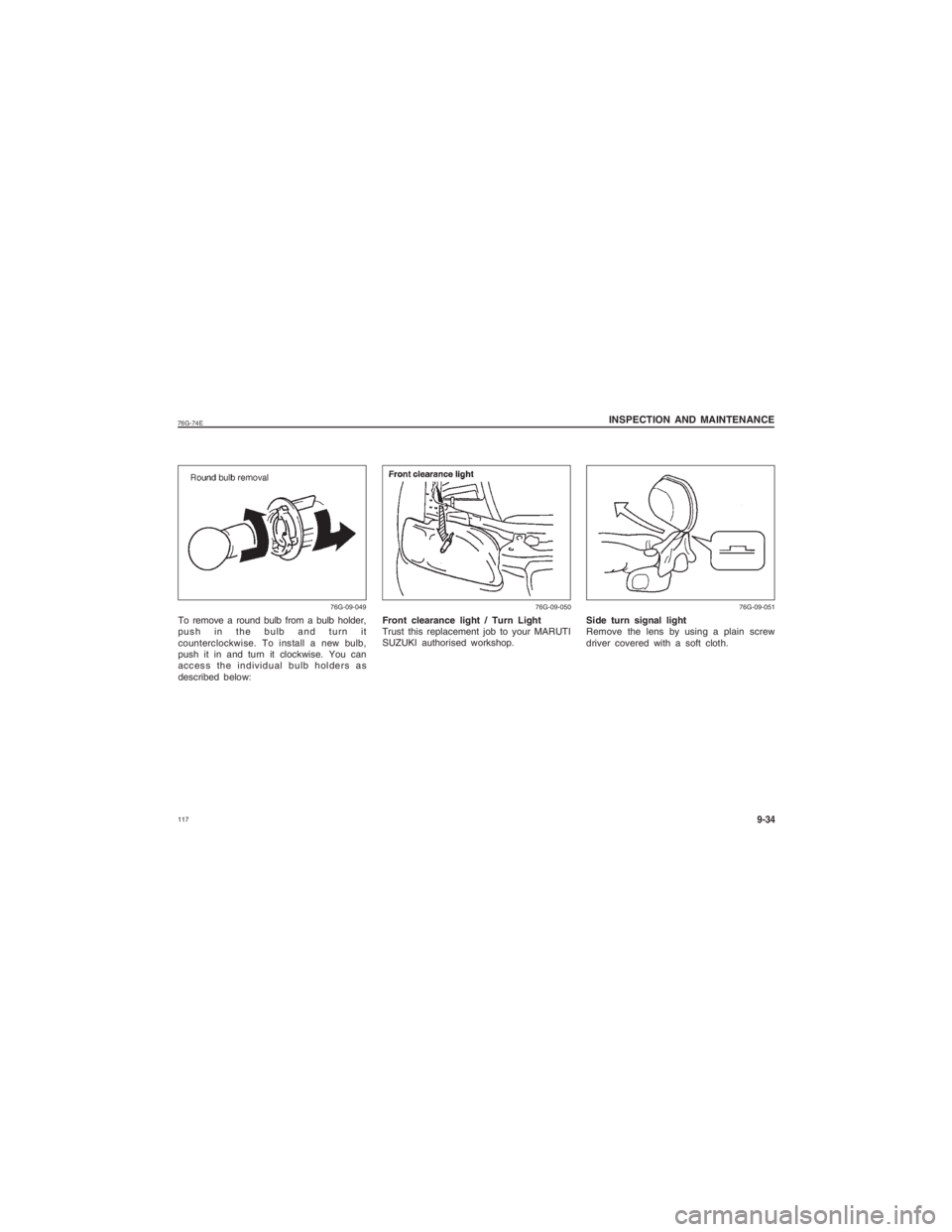
To remove a round bulb from a bulb holder,
push in the bulb and turn it
counterclockwise. To install a new bulb,
push it in and turn it clockwise. You can
access the individual bulb holders as
described below:
76G-09-049
Side turn signal light
Remove the lens by using a plain screw
driver covered with a soft cloth.
76G-09-051
Front clearance light / Turn Light
Trust this replacement job to your MARUTI
SUZUKI authorised workshop.
76G-09-050
Page 123 of 139
124
76G-74E
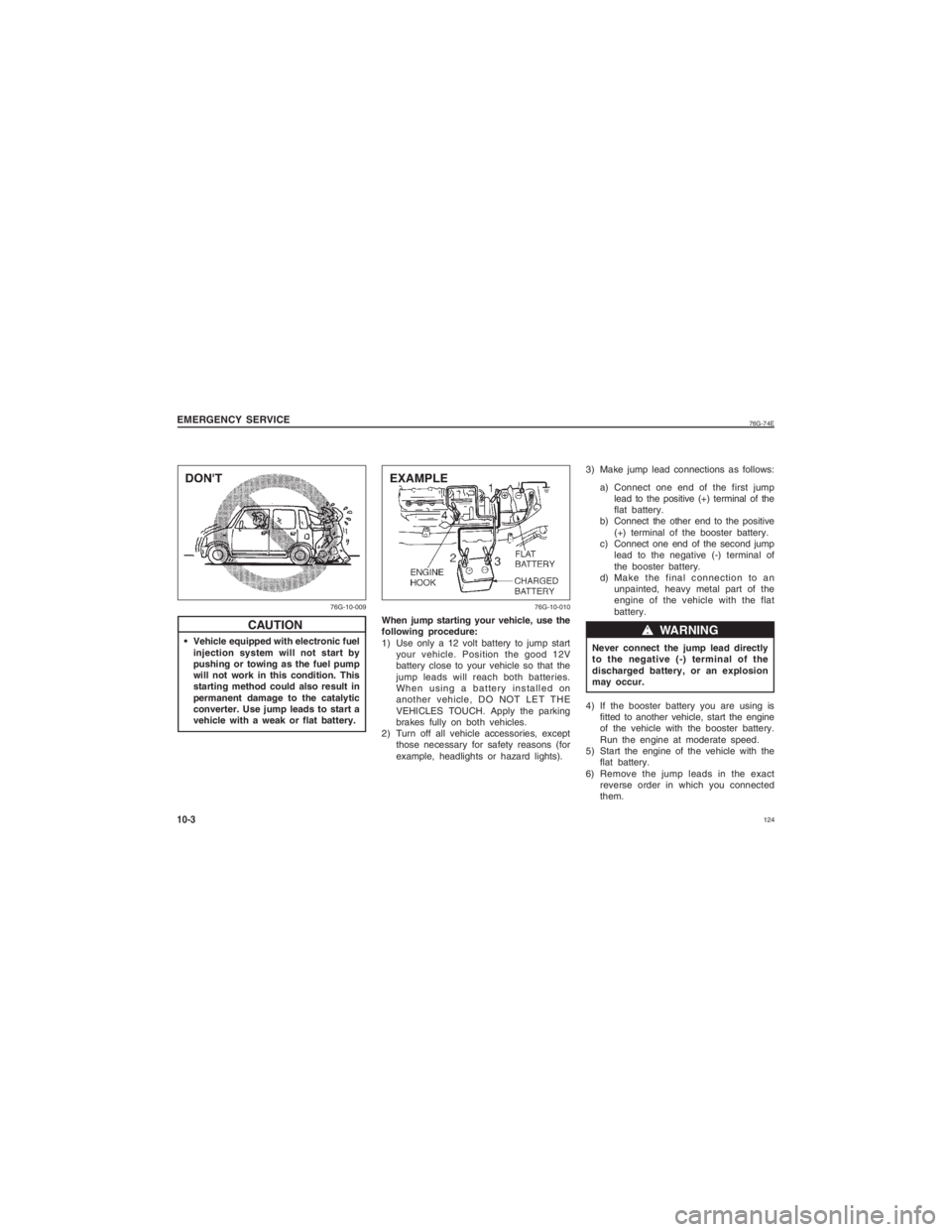
Vehicle equipped with electronic fuelinjection system will not start by
pushing or towing as the fuel pump
will not work in this condition. This
starting method could also result in
permanent damage to the catalytic
converter. Use jump leads to start a
vehicle with a weak or flat battery. When jump starting your vehicle, use the
following procedure:
1) Use only a 12 volt battery to jump start
your vehicle. Position the good 12V
battery close to your vehicle so that the
jump leads will reach both batteries.
When using a battery installed on
another vehicle, DO NOT LET THE
VEHICLES TOUCH. Apply the parking
brakes fully on both vehicles.
2) Turn off all vehicle accessories, except those necessary for safety reasons (for
example, headlights or hazard lights). 3) Make jump lead connections as follows:
a) Connect one end of the first jumplead to the positive (+) terminal of the
flat battery.
b) Connect the other end to the positive
(+) terminal of the booster battery.
c) Connect one end of the second jump lead to the negative (-) terminal of
the booster battery.
d) Make the final connection to an unpainted, heavy metal part of the
engine of the vehicle with the flat
battery.
Never connect the jump lead directly
to the negative (-) terminal of the
discharged battery, or an explosion
may occur.
4) If the booster battery you are using is fitted to another vehicle, start the engine
of the vehicle with the booster battery.
Run the engine at moderate speed.
5) Start the engine of the vehicle with the flat battery.
6) Remove the jump leads in the exact reverse order in which you connected
them.EMERGENCY SERVICE10-3
ww ww
w WARNING
CAUTION
76G-10-009 76G-10-010
Page 124 of 139
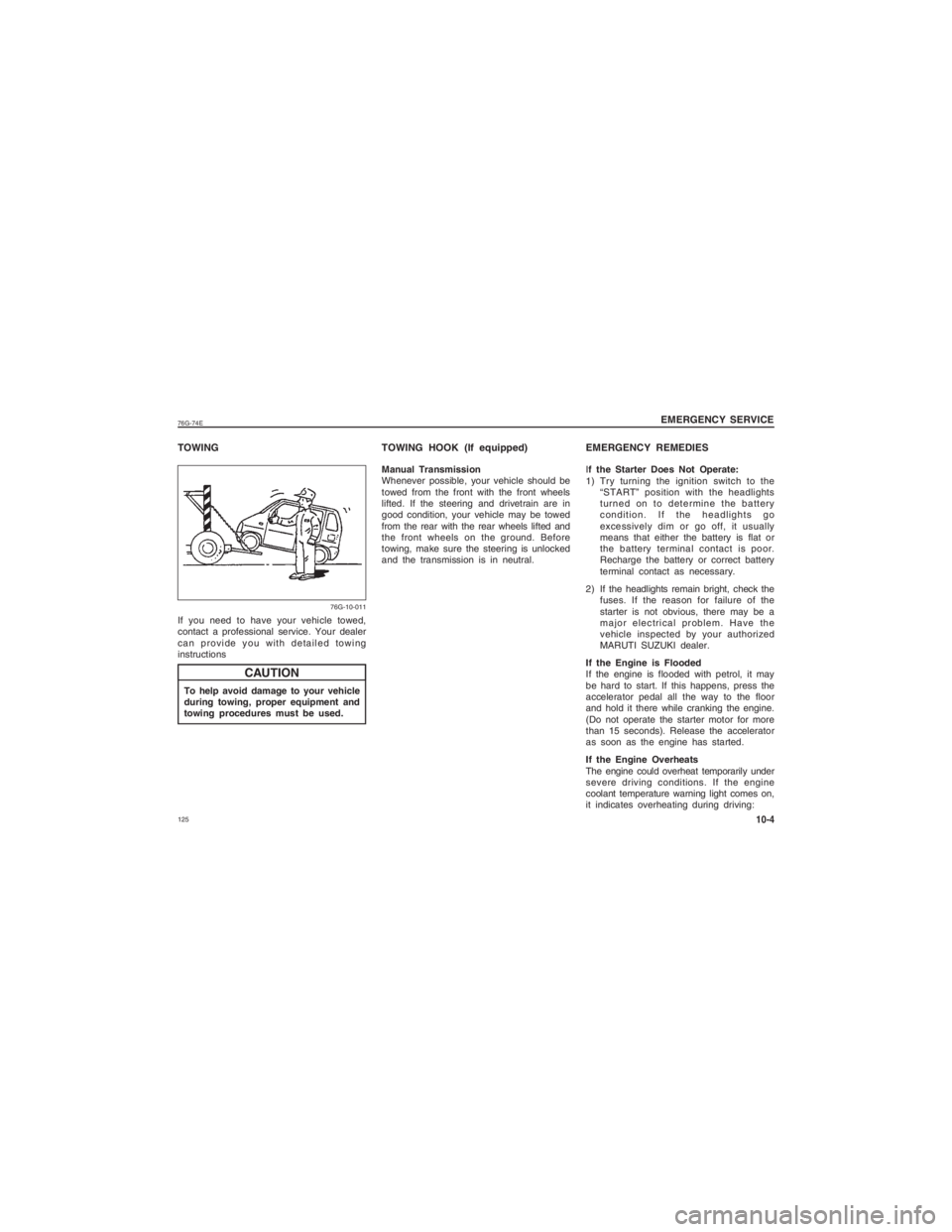
12576G-74ETOWINGIf you need to have your vehicle towed,
contact a professional service. Your dealer
can provide you with detailed towing
instructionsTo help avoid damage to your vehicle
during towing, proper equipment and
towing procedures must be used.
EMERGENCY REMEDIES EMERGENCY SERVICE
10-4
CAUTION
Manual Transmission
Whenever possible, your vehicle should be
towed from the front with the front wheels
lifted. If the steering and drivetrain are in
good condition, your vehicle may be towed
from the rear with the rear wheels lifted and
the front wheels on the ground. Before
towing, make sure the steering is unlocked
and the transmission is in neutral. I
f the Starter Does Not Operate:
1) Try turning the ignition switch to the
“START” position with the headlights
turned on to determine the battery
condition. If the headlights go
excessively dim or go off, it usually
means that either the battery is flat or
the battery terminal contact is poor.
Recharge the battery or correct battery
terminal contact as necessary.
2) If the headlights remain bright, check the fuses. If the reason for failure of the
starter is not obvious, there may be a
major electrical problem. Have the
vehicle inspected by your authorized
MARUTI SUZUKI dealer.
If the Engine is Flooded
If the engine is flooded with petrol, it may
be hard to start. If this happens, press the
accelerator pedal all the way to the floor
and hold it there while cranking the engine.
(Do not operate the starter motor for more
than 15 seconds). Release the accelerator
as soon as the engine has started.
If the Engine Overheats
The engine could overheat temporarily under
severe driving conditions. If the engine
coolant temperature warning light comes on,
it indicates overheating during driving:TOWING HOOK (If equipped)
76G-10-011
Page 129 of 139
130
76G-74E
CORROSION PREVENTION
the vehicle which are not well ventilated
to permit quick drying.
This information illustrates the necessity of
keeping your vehicle (particularly the
underbody) as clean and dry as possible.
It is equally important to repair any damage
to the paint or protective coatings as soon
as possible.
How to Help Prevent Corrosion
Wash your vehicle frequently
The best way to preserve the finish on your
vehicle and to help avoid corrosion is to
keep it clean with frequent washing.
Wash your vehicle regularly during the
winter and immediately after the winter.
Keep your vehicle, particularly the
underside, as clean and dry as possible.
If you frequently drive on salted roads, your
vehicle should be washed at least once a
month during the winter. If you live near the
ocean, your vehicle should be washed at
least once a month throughout the year.
For washing instructions, refer to the
“VEHICLE CLEANING” section.
Remove foreign material deposits
Foreign material such as salts, chemicals,
road oil or tar, tree sap, bird droppings and
industrial fall-out may damage the finish of
your vehicle if it is left on painted surfaces.
Remove these types of deposits as quickly as possible. If these deposits are difficult to
wash off, an additional cleaner may be
required. Be sure that any cleaner you use
is not harmful to painted surfaces and is
specifically intended for your purposes.
Follow the manufacturer’s directions when
using these special cleaners.
Repair finish damage
Carefully examine your vehicle for damage
to the painted surfaces. Should you find any
chips or scratches in the paint, touch them
up immediately to prevent corrosion from
starting. If the chips or scratches have gone
through to the bare metal, have a qualified
body shop make the repair.
Keep Passenger and luggage
compartments clean.
Moisture, dirt or mud can accumulate under
the floor mats and may cause corrosion.
Occasionally, check under these mats to
ensure that this area is clean and dry. More
frequent checks are necessary if the vehicle
is used off road or in wet weather.
Certain cargos such as chemicals, fertilizers,
cleaners, salts, etc., are extremely corrosive
by nature. These products should be
transported in sealed containers. If a spill
or leak does occur, clean and dry the area
immediately.
It is important to take good care of your
vehicle to protect it from corrosion.
Listed below are instructions for how to
maintain your vehicle to prevent corrosion.
Please read and follow these instructions
carefully.
Important Information About Corrosion
Common causes of corrosion
1) Accumulation of road salt, dirt, moisture,
or chemicals in hard to reach areas of
the vehicle underbody or frame.
2) Chipping, scratches and any damage to treated or painted metal surfaces
resulting from minor accidents or
abrasion by stones and gravel.
Environmental conditions which
accelerate corrosion
1) Road salt, dust control chemicals, sea air or industrial pollution will all
accelerate the corrosion of metal.
2) High humidity will increase the rate of corrosion particularly when the
temperature range is just above the
freezing point.
3) Moisture in certain areas of a vehicle for an extended period of time may promote
corrosion even though other body
sections may be completely dry.
4) High temperatures will cause an
accelerated rate of corrosion to parts of
BODY WORK CARE11-1
Page 130 of 139
13176G-74EStore your vehicle in a dry, well-
ventilated area.
Do not park your vehicle in a damp, poorly
ventilated area. If you often wash your
vehicle in the garage or if you frequently
drive it in when wet, your garage may be
damp. The high humidity in the garage may
cause or accelerate corrosion. A wet vehicle
may corrode even in a heated garage if the
ventilation is poor.Do not apply additional undercoating
or rust preventive coating on or
around exhaust system components
such as the exhaust pipes, etc. A fire
could be started if the undercoating
substance becomes overheated.
Cover your vehicle
If you cannot regularly park your vehicle in
a garage, we recommend you use a vehicle
cover.
VEHICLE CLEANING
cleaner for tougher stains. If you use a
fabric cleaner, carefully follow the
manufacturer’s instructions and precautions.
Seat Belts
Clean seat belts with a mild soap and
water. Do not use bleach or dye on the
belts. They may weaken the fabric in the
belts.
Vinyl floor mats
Ordinary dirt can be removed from vinyl with
water or mild soap. Use a brush to help
loosen dirt. After the dirt is loosened, rinse
the mat thoroughly with water and dry it in
the shade.
Carpets
Remove dirt and soil as much as possible
with a vacuum cleaner. Using a mild soap
solution, rub stained areas with a clean
damp cloth. To remove soap, rub the areas
again with a cloth dampened with water.
Repeat this until the stain is removed, or
use a commercial carpet cleaner for tougher
stains. If you use a carpet cleaner, carefully
follow the manufacturer’s instructions and
precautions.
ww ww
w WARNING
When cleaning the interior or exterior
of the vehicle, NEVER USE flammable
solvents such as lacquer thinners,
petrol, benzene or cleaning materials
such as bleach or strong household
detergents. The materials could cause
personal injury or damage to the
vehicle.
Cleaning the Interior
Vinyl upholstery
Prepare a solution of soap or mild detergent
mixed with warm water. Apply the solution
to the vinyl with a sponge or soft cloth and
let it soak for a few minutes to loosen dirt.
Rub the surface with a clean, damp cloth
to remove dirt and the soap solution. If
some dirt still remains on the surface,
repeat this procedure.
Fabric upholstery
Remove loose dirt with a vacuum cleaner.
Using a mild soap solution, rub stained
areas with a clean damp cloth. To remove
soap, rub the areas again with a cloth
dampened with water. Repeat this until the
stain is removed, or use a commercial fabric
ww ww
w WARNING
BODY WORK CARE
11-2