Acc SUZUKI ALTO 2019 Owner's Manual
[x] Cancel search | Manufacturer: SUZUKI, Model Year: 2019, Model line: ALTO, Model: SUZUKI ALTO 2019Pages: 139, PDF Size: 2.22 MB
Page 78 of 139
7976G-74ESnow Chains
If you must use snow chains to increase tyre
traction, observe the following precautions:
Use cable type chains.
Choose a safe place away from traffic to install the chains.
When installing the chains carefully follow the manufacturer’s instructions.
Install the chains on the front tyres.
With the chains on, drive only at slow and moderate speeds.
If the chain hits the vehicle body while
driving, stop at a safe place and
retighten it as soon as possible.
If snow and/or ice on the road disappear, remove the chains as soon
as possible.
If Your Vehicle Gets Stuck If your vehicle gets stuck in snow, mud,
or sand, follow the directions below:
1) Change back and forth between a forward range (or first gear for manual
transmission) and reverse. This will
create a rocking motion which may give
you enough momentum to free the
vehicle. Press gently on the accelerator
to keep wheel spin to a minimum.
Remove your foot from the accelerator
while changing gear.
Do not race the engine. Excessive wheel
spin will cause the tyres to dig deeper,
making it more difficult to free the
vehicle. 2) If your vehicle remains stuck after a few
minutes of rocking, get another vehicle
to pull you out.
Do not allow anyone to stand near the
vehicle when you are rocking it, and
do not spin the wheels faster than an
indicated 40 km/h on the speedometer.
Personal injury and/or vehicle damage
may result from spinning the wheels
too fast.
Do not continue rocking the vehicle
for more than a few minutes.
Prolonged rocking can cause engine
overheating or transmission damage. Make sure your tyres are in good
condition and always maintain the
specified tyre pressure. Refer to
“TYRES” in the “INSPECTION AND
MAINTENANCE” section for details.
Do not use tyres other than those specified by MARUTI SUZUKI. Never
use different sizes or types of tyres
on the front and rear wheels. For
information regarding the specified
tyres, refer to the “SPECI-
FICATIONS” section.
Never use oversized tyres or special
shock absorbers and springs to
raise (jack up) your vehicle. This will
change the handling characteristics.
After driving through water, test the
brakes while driving at a slow speed
to see if they have maintained their
normal effectiveness. If the brakes
are less effective than normal, dry
them by repeatedly applying the
brakes while driving slowly until the
brakes have regained their normal
effectiveness.
ww ww
w WARNINGCAUTION
8-2
ww
ww
w WARNING
DRIVING TIPS AND SAFE DRIVING
DRIVING ON WET ROADS
When driving on wet roads, avoid driving through large amount of
standing water on the road. Large
amount of water entering the engine
compartment may cause damage to
the engine and or electrical
components.
If stuck in deep water, do not start till water level drops.
Water is incompressible substance, water inside engine is harmful to the
engine.
CAUTION
Page 79 of 139
80
76G-74E
DO’S AND DON’TS FOR SAFE
DRIVINGExercise care in handling your vehicle. Be
conscious of not only your own safety but
also the safety of others on the road, and
thus enjoy the best and most comfortable
driving experience.
This section contains basic rules for safe
driving. Read it carefully for good
understanding of the content so that you
can enjoy safe and pleasant driving in your
Maruti Suzuki vehicle.Starting
1. Adjust the driver’s seat for the properdriving posture.
2. Adjust the rear view mirror so as to obtain the best possible rear view.
3. Before moving off, look forward and back to confirm safety.
4. Don’t start quickly, for it is dangerous and wastes fuel.
General driving
1. Be sure to stop before the stop light and stop sign. When moving into the
intersection without any traffic lights or
signs, drive slowly to confirm safety.8-3DRIVING TIPS AND SAFE DRIVING
2. Always follow other vehicles at a safedistance in order to prevent a rear-end
collision, should the vehicle ahead make
a sudden stop.
3. Turn ON the turn signal at least 30 meters before making a turn or changing
the lane so as not to be hit from behind.
4. Before entering a corner, decelerate to a safe speed. Don’t apply brakes during
cornering, or a cornering skid may occur.
5. When overtaking other vehicles, watch out for the oncoming vehicle and
carefully confirm the safety.
6. Don’t attempt zigzag driving which will hinder your control over the vehicle and
cause an accident.
76G-08-002 76G-08-003
Page 80 of 139
8176G-74E
especially dangerous when the tyres are
worn, for they allow a larger skid.
Use foot brake in three stages
(1) Warn the vehicle behind you
(2) Gradually apply the brake.
(3) Bring the vehicle to a halt.
3. When driving on a downhill, try not to apply the brake but use the engine
brake effectively. Overuse of the
footbrake may result in total brake
failure.
4. Avoid reckless high speed driving and try
to drive at a safe speed suitable for the
road conditions while maintaining a
constant speed. 5. The higher the speed, the narrower the
driver’s visual range becomes. In such
a state, it is difficult to anticipate any
hazard and the driver feels much
fatigued.
6. Never do sharp handling during high
speed driving. You will lose your control
over your vehicle.
7. When overtaking or changing the lane
while driving at a high speed, keep an
ample vehicle-to-vehicle distance.
Long distance driving
1. Be sure to perform safety checks before
starting a trip.
2. Take rest at certain intervals to prevent an accident which may occur when you
are sleepy or tired.
Braking
1. Use the parking brake when parking
your vehicle and shift the gear shift lever
into the first gear or reverse gear
position for the sake of safety.
2. Don’t use handbraking unless unavoidable. It causes the vehicle to skid
and a rearend collision occur. It is
8-4
DRIVING TIPS AND SAFE DRIVING
76G-08-004 76G-08-005 76G-08-006
Page 81 of 139
82
76G-74E
Night time driving
1. Drive more slowly at night than in thedaytime, for the visual range is restricted
at night.
2. Don’t overtake other vehicles at night. Darkness bothers your sense of speed
and hinders your judgement on the
vehicle-to-vehicle distance.
3. Don’t use the high headlight beam unless its use is inevitable. Its dazzle
may blitz the driver of the oncoming
vehicle, thus causing an accident.
4. Always keep the window glasses clean. Don’t operate the windshield wiper when
the windshield glass is dry or the wiper
blade and glass may get damaged.8-5DRIVING TIPS AND SAFE DRIVING
MARGIN FOR SAFETY
It is important to allow yourself a margin for
safety during driving so that you can cope
with erroneous or unexpected driving of
other drivers. For that, observe the
following.
Drive at a safe speed.
Maintain a sufficient distance between
your vehicle and the vehicle ahead.
Don’t force yourself to overtake other vehicles.
Don’t make quick start, hard steering or sudden stops.
Allow an ample time in the driving
schedule.
Observe traffic rules and regulations.
CONCLUSION
A perfect driver does not exist. The
endeavour of every motorist should be to
strive for perfection. Safety consciousness
not only ensures your safety and the safety
of other road users, it also helps reduce the
wear and tear on your vehicle, prolongs its
life, gives more mileage and ensures a
comfortable driving experience.
Follow the do’s and don’ts listed, and
driving will never be the same again.
76G-08-007 76G-08-008
76G-08-009
Page 83 of 139
84
76G-74E
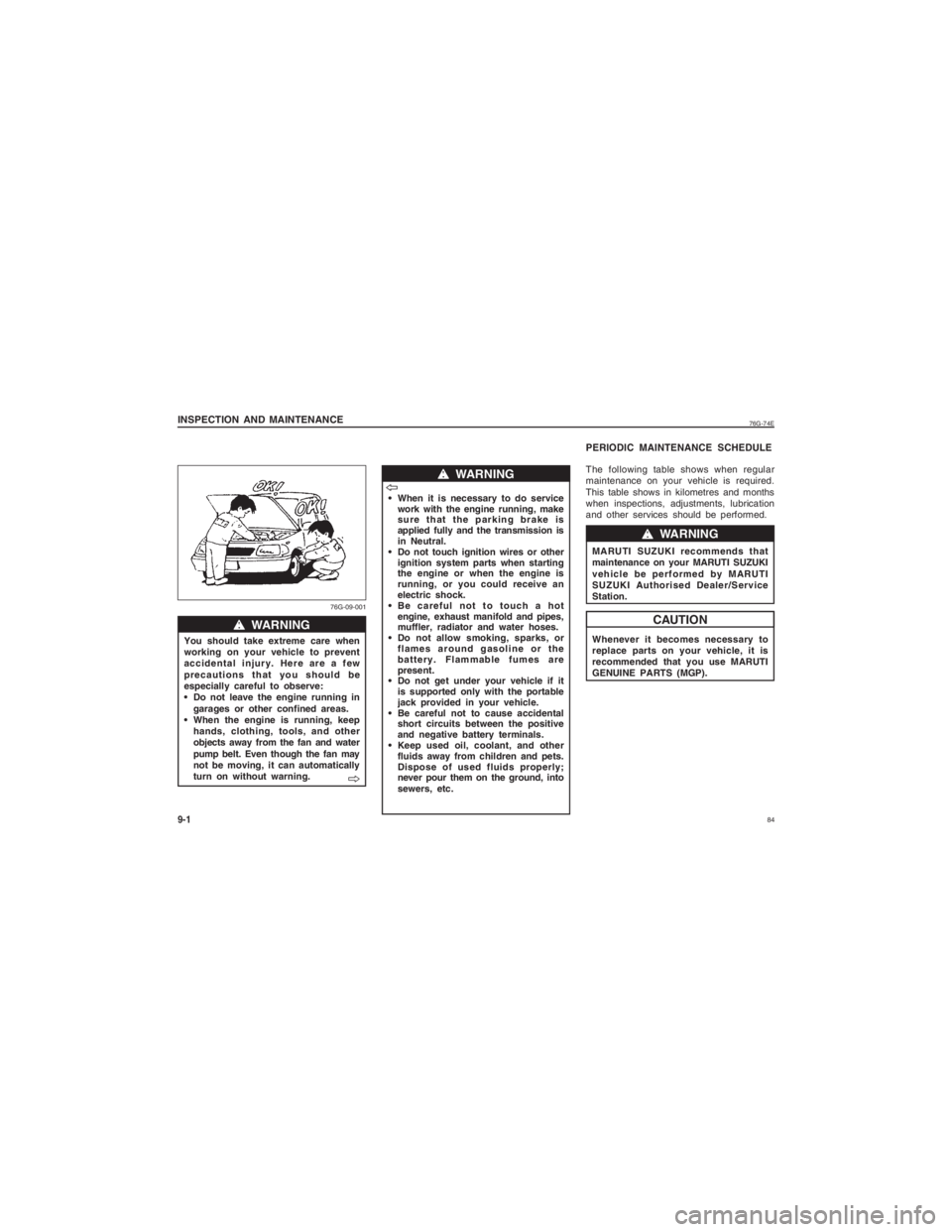
You should take extreme care when
working on your vehicle to prevent
accidental injury. Here are a few
precautions that you should be
especially careful to observe:
Do not leave the engine running ingarages or other confined areas.
When the engine is running, keep hands, clothing, tools, and other
objects away from the fan and water
pump belt. Even though the fan may
not be moving, it can automatically
turn on without warning. When it is necessary to do service
work with the engine running, make
sure that the parking brake is
applied fully and the transmission is
in Neutral.
Do not touch ignition wires or other
ignition system parts when starting
the engine or when the engine is
running, or you could receive an
electric shock.
Be careful not to touch a hot engine, exhaust manifold and pipes,
muffler, radiator and water hoses.
Do not allow smoking, sparks, or flames around gasoline or the
battery. Flammable fumes are
present.
Do not get under your vehicle if it is supported only with the portable
jack provided in your vehicle.
Be careful not to cause accidental short circuits between the positive
and negative battery terminals.
Keep used oil, coolant, and other
fluids away from children and pets.
Dispose of used fluids properly;
never pour them on the ground, into
sewers, etc.INSPECTION AND MAINTENANCE9-1
ww ww
w WARNING
ww
ww
w WARNING
VV
VV
V
VV
VV
V
PERIODIC MAINTENANCE SCHEDULEThe following table shows when regular
maintenance on your vehicle is required.
This table shows in kilometres and months
when inspections, adjustments, lubrication
and other services should be performed.
MARUTI SUZUKI recommends that
maintenance on your MARUTI SUZUKI
vehicle be performed by MARUTI
SUZUKI Authorised Dealer/Service
Station.
Whenever it becomes necessary to
replace parts on your vehicle, it is
recommended that you use MARUTI
GENUINE PARTS (MGP).
ww ww
w WARNINGCAUTION
76G-09-001
Page 85 of 139
86
76G-74E
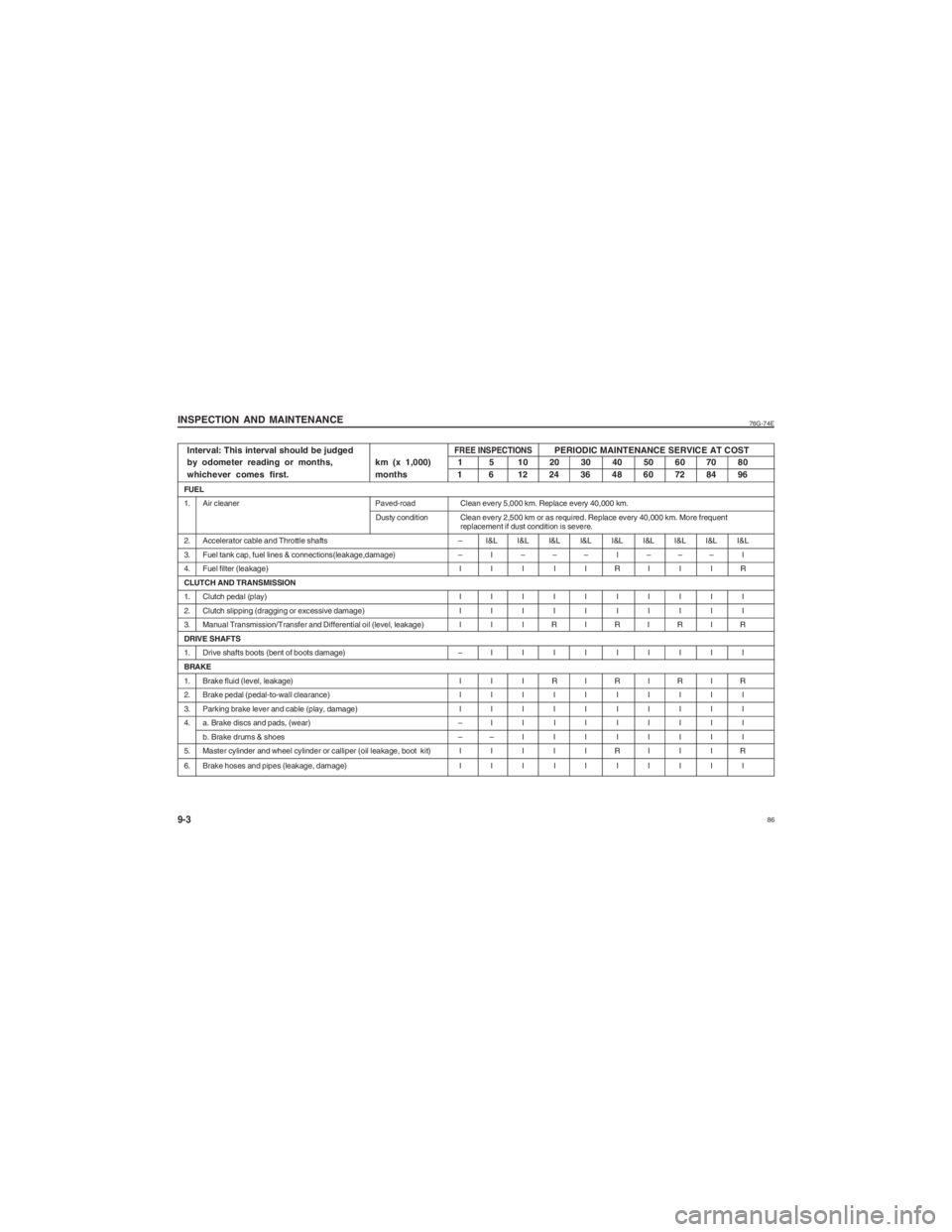
INSPECTION AND MAINTENANCE9-3Interval: This interval should be judged
FREE INSPECTIONS
PERIODIC MAINTENANCE SERVICE AT COST
by odometer reading or months, km (x 1,000) 1 5 10 20 30 40 50 60 70 80
whichever comes first. months 1 6 12 24 36 48 60 72 84 96
FUEL
1. Air cleaner Paved-roadClean every 5,000 km. Replace every 40,000 km.
Dusty condition Clean every 2,500 km or as required. Replace every 40,000 km. More frequ\
ent replacement if dust condition is severe.
2. Accelerator cable and Throttle shafts – I&L I&L I&L I&L I&L I&L I&L I&L I&L
3. Fuel tank cap, fuel lines & connections(leakage,damage) – I – – – I – – – I
4. Fuel filter (leakage) I I I I I R I I I R
CLUTCH AND TRANSMISSION
1. Clutch pedal (play) I I I I I I I I I I
2. Clutch slipping (dragging or excessive damage) I I I I I I I I I I
3. Manual Transmission/Transfer and Differential oil (level, leakage) I I I R I R I R I R
DRIVE SHAFTS
1. Drive shafts boots (bent of boots damage) – I I I I I I I I I
BRAKE
1. Brake fluid (level, leakage) I I I R I R I R I R
2. Brake pedal (pedal-to-wall clearance) I I I I I I I I I I
3. Parking brake lever and cable (play, damage) I I I I I I I I I I
4. a. Brake discs and pads, (wear) – I I I I I I I I I
b. Brake drums & shoes – – I I I I I I I I
5. Master cylinder and wheel cylinder or calliper (oil leakage, boot kit)\
I I I I I R I I I R
6. Brake hoses and pipes (leakage, damage) I I I I I I I I I I
Page 93 of 139
94
76G-74E
INSPECTION AND MAINTENANCE9-11ENGINE OIL AND FILTERSpecified oil
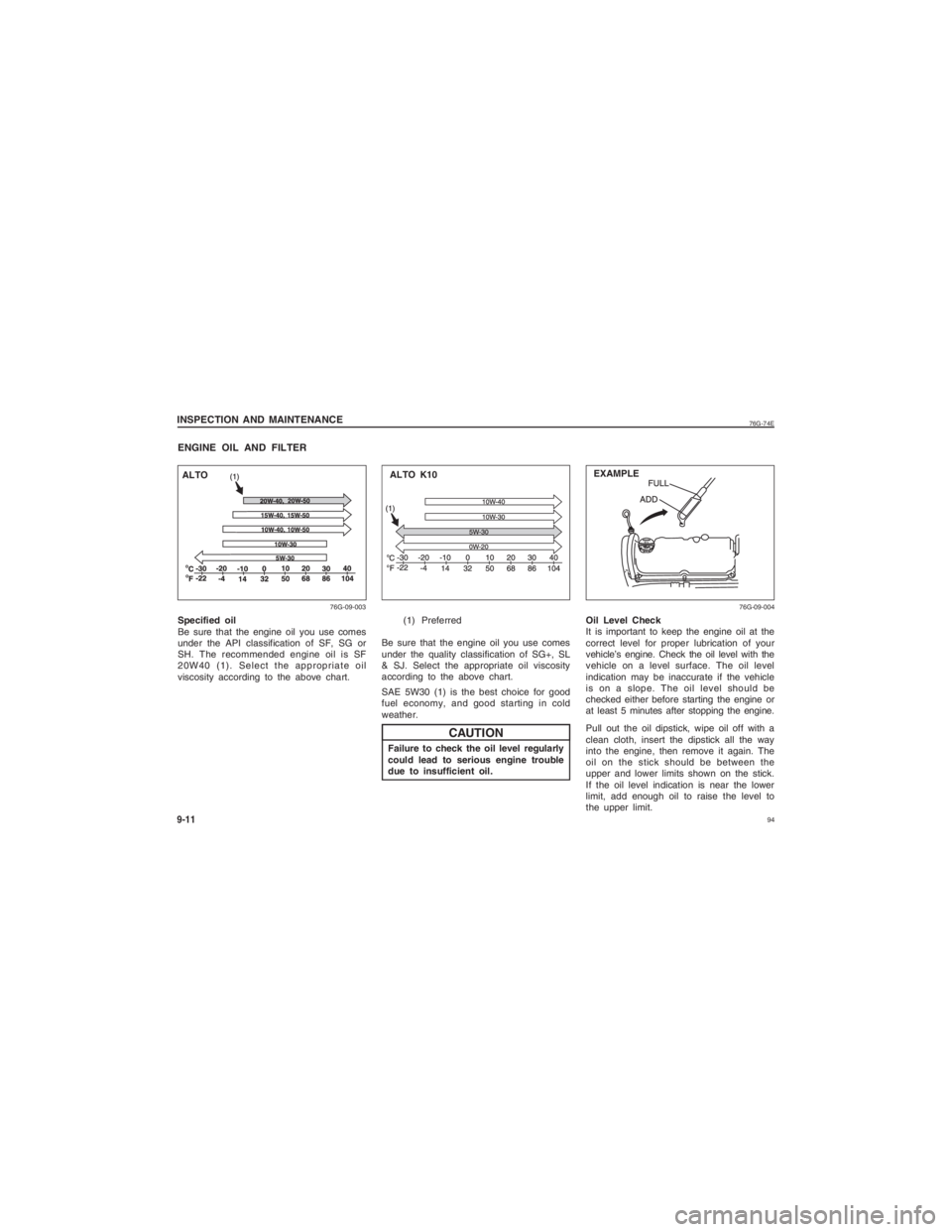
Be sure that the engine oil you use comes
under the API classification of SF, SG or
SH. The recommended engine oil is SF
20W40 (1). Select the appropriate oil
viscosity according to the above chart.
Oil Level Check
It is important to keep the engine oil at the
correct level for proper lubrication of your
vehicle’s engine. Check the oil level with the
vehicle on a level surface. The oil level
indication may be inaccurate if the vehicle
is on a slope. The oil level should be
checked either before starting the engine or
at least 5 minutes after stopping the engine.
Pull out the oil dipstick, wipe oil off with a
clean cloth, insert the dipstick all the way
into the engine, then remove it again. The
oil on the stick should be between the
upper and lower limits shown on the stick.
If the oil level indication is near the lower
limit, add enough oil to raise the level to
the upper limit.
76G-09-00376G-09-004
(1) Preferred
Be sure that the engine oil you use comes
under the quality classification of SG+, SL
& SJ. Select the appropriate oil viscosity
according to the above chart.
SAE 5W30 (1) is the best choice for good
fuel economy, and good starting in cold
weather.
Failure to check the oil level regularly
could lead to serious engine trouble
due to insufficient oil.
ALTO K10
ALTO EXAMPLE
CAUTION
Page 95 of 139
96
76G-74E
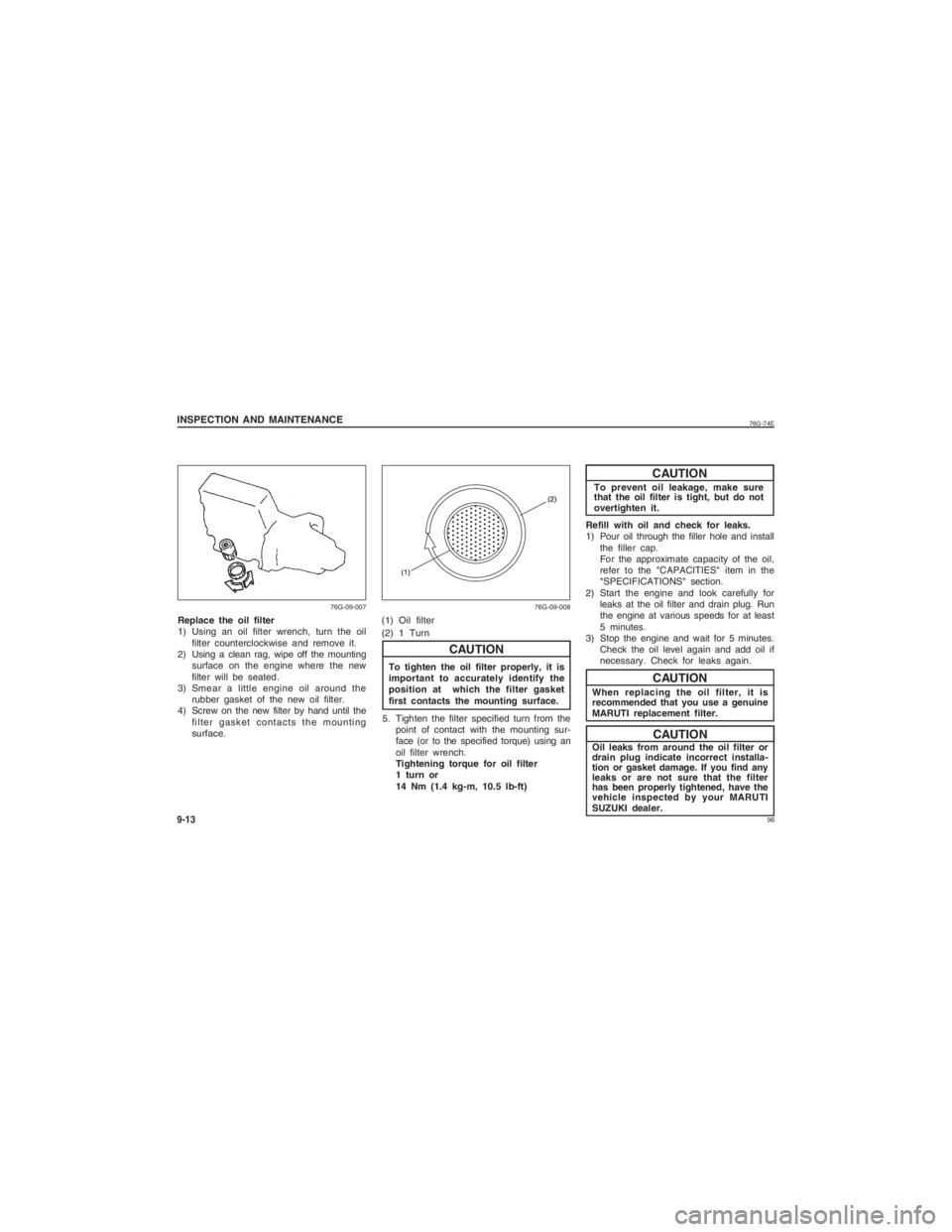
INSPECTION AND MAINTENANCE9-13Replace the oil filter
1) Using an oil filter wrench, turn the oilfilter counterclockwise and remove it.
2) Using a clean rag, wipe off the mounting surface on the engine where the new
filter will be seated.
3) Smear a little engine oil around the rubber gasket of the new oil filter.
4) Screw on the new filter by hand until the filter gasket contacts the mounting
surface.
To tighten the oil filter properly, it is
important to accurately identify the
position at which the filter gasket
first contacts the mounting surface.
5. Tighten the filter specified turn from the point of contact with the mounting sur-
face (or to the specified torque) using an
oil filter wrench.
Tightening torque for oil filter
1 turn or
14 Nm (1.4 kg-m, 10.5 lb-ft)
CAUTION
Refill with oil and check for leaks.
1) Pour oil through the filler hole and install the filler cap.
For the approximate capacity of the oil,
refer to the "CAPACITIES" item in the
"SPECIFICATIONS" section.
2) Start the engine and look carefully for leaks at the oil filter and drain plug. Run
the engine at various speeds for at least
5 minutes.
3) Stop the engine and wait for 5 minutes. Check the oil level again and add oil if
necessary. Check for leaks again.
When replacing the oil filter, it is
recommended that you use a genuine
MARUTI replacement filter.
Oil leaks from around the oil filter or
drain plug indicate incorrect installa-
tion or gasket damage. If you find any
leaks or are not sure that the filter
has been properly tightened, have the
vehicle inspected by your MARUTI
SUZUKI dealer.
CAUTIONCAUTIONCAUTION
76G-09-007 76G-09-008
To prevent oil leakage, make sure
that the oil filter is tight, but do not
overtighten it.
(1) Oil filter
(2) 1 Turn
Page 98 of 139
9976G-74E
INSPECTION AND MAINTENANCE
9-16
CAUTION
To avoid damaging your cooling sys-
tem:
Always use a high quality ethyleneglycol base non-silicate type cool-
ant diluted with distilled water at
the correct mixture concentration.
Make sure that the proper mix is 30/ 70 coolant to distilled water.
Concentrations greater than 70/30
coolant to distilled water will cause
over heating conditions.
Do not use straight coolant nor plain water.
Do not add extra inhibitors or addi-
tives. They may not be compatible
with your cooling system.
Do not mix different types of base coolants. Doing so may result in
accelerated seal wear and/or the
possibility of severe overheating
and extensive engine damage. Coolant Level Check
Check the coolant level at the reservoir
tank, not at the radiator. With the engine
cool, the coolant level should be between
the “FULL” and “LOW” marks.
Adding Coolant
If the coolant level is below the “LOW”
mark, more coolant should be added.
Remove the reservoir tank cap and add
coolant until the reservoir tank level reaches
the “FULL” mark. Never fill the reservoir
tank above the “FULL” mark.
CAUTION
The mixture you use should con-
tain 50% concentration of anti-
freeze.
If the lowest ambient temperature
in your area is expected to be –
35°C (–31°F) or below, use higher
concentrations up to 60% following
the instructions on the antifreeze
container.
When putting the cap on the reser- voir tank, line up the arrow on the
cap and the arrow on the tank. Fail-
ure to follow this can result in cool-
ant leakage.
Page 101 of 139
102
76G-74E
The air cleaner element should be
replaced every 40,000 km. More
frequent replacement is necessary
when you drive under dusty
conditions.
CAUTION
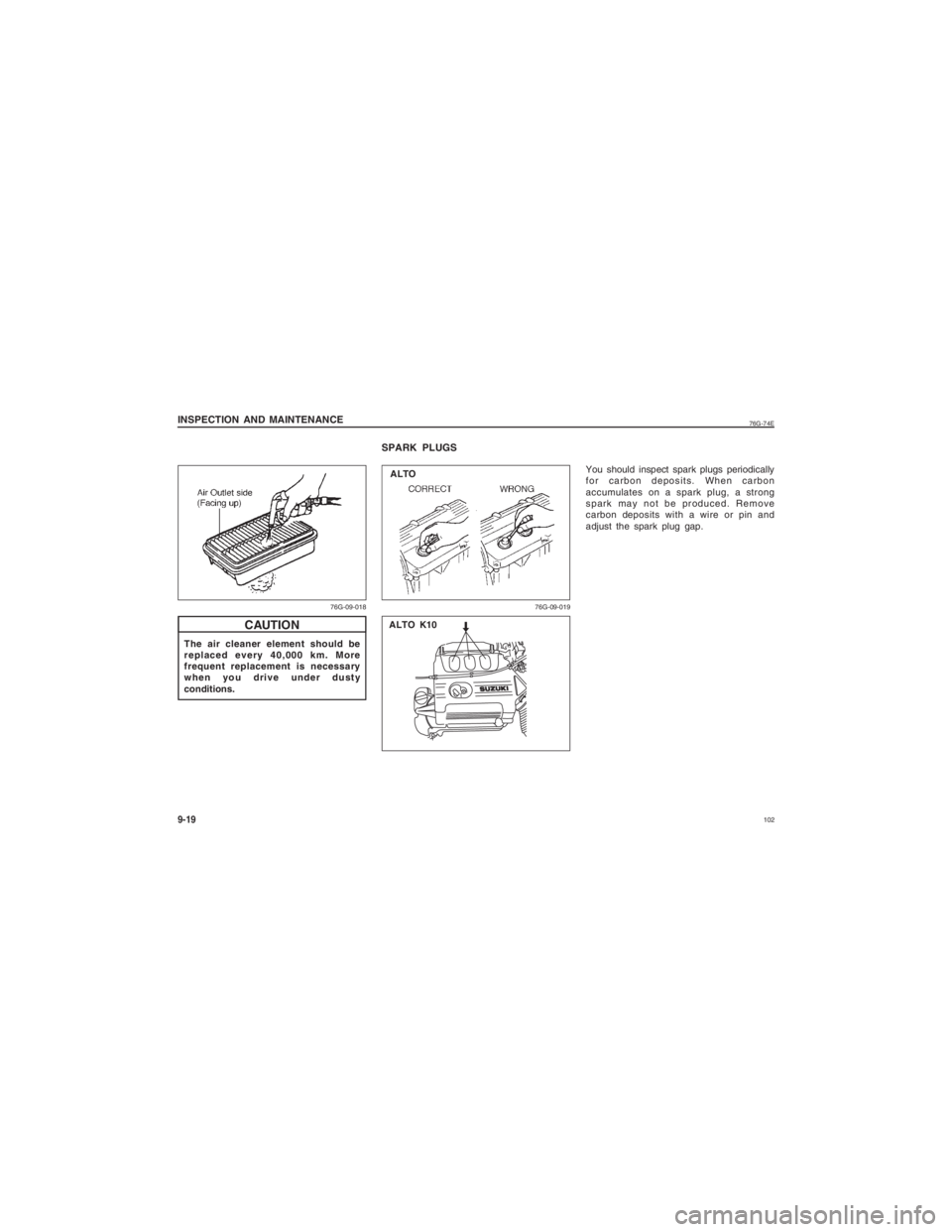
SPARK PLUGS
You should inspect spark plugs periodically
for carbon deposits. When carbon
accumulates on a spark plug, a strong
spark may not be produced. Remove
carbon deposits with a wire or pin and
adjust the spark plug gap.
76G-09-01876G-09-019
ALTO K10
INSPECTION AND MAINTENANCE9-19
ALTO