check engine SUZUKI GRAND VITARA 1987 Service Manual PDF
[x] Cancel search | Manufacturer: SUZUKI, Model Year: 1987, Model line: GRAND VITARA, Model: SUZUKI GRAND VITARA 1987Pages: 962, PDF Size: 27.87 MB
Page 202 of 962
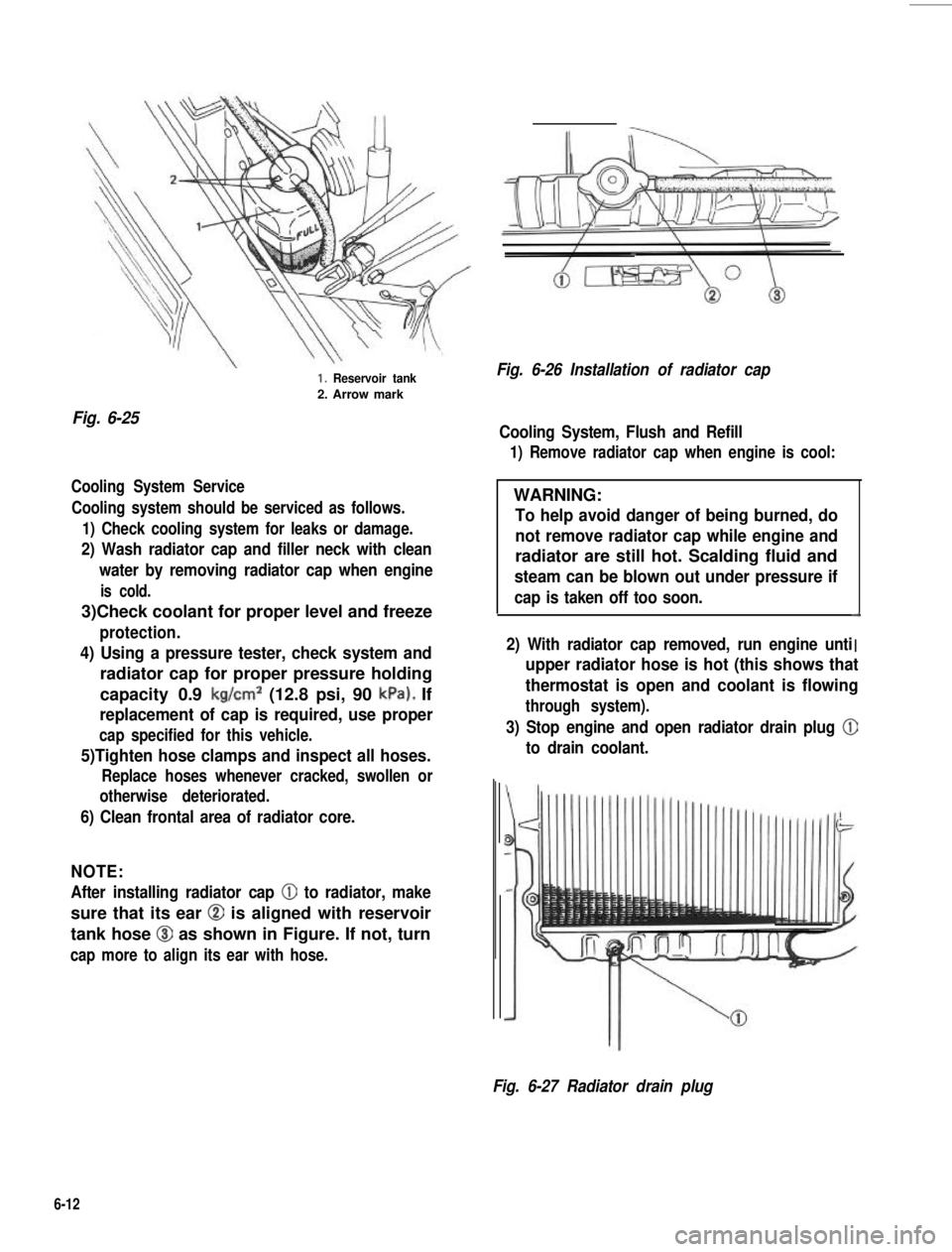
Fig. 6-25
1. Reservoir tank
2. Arrow mark
Cooling System Service
Cooling system should be serviced as follows.
1) Check cooling system for leaks or damage.
2) Wash radiator cap and filler neck with clean
water by removing radiator cap when engine
is cold.
3)Check coolant for proper level and freeze
protection.
4) Using a pressure tester, check system and
radiator cap for proper pressure holding
capacity 0.9 kg/cm2 (12.8 psi, 90 kPa). If
replacement of cap is required, use proper
cap specified for this vehicle.
5)Tighten hose clamps and inspect all hoses.
Replace hoses whenever cracked, swollen or
otherwise deteriorated.
6) Clean frontal area of radiator core.
NOTE:
After installing radiator cap 0 to radiator, make
sure that its ear @ is aligned with reservoir
tank hose @I as shown in Figure. If not, turn
cap more to align its ear with hose.
Fig. 6-26 Installation of radiator cap
Cooling System, Flush and Refill
1) Remove radiator cap when engine is cool:
WARNING:
To help avoid danger of being burned, do
not remove radiator cap while engine and
radiator are still hot. Scalding fluid and
steam can be blown out under pressure if
cap is taken off too soon.d
I2) With radiator cap removed, run engine unti. .upper radiator hose is hot (this shows that
thermostat is open and coolant is flowing
through system).
3) Stop engine and open radiator drain plug @
to drain coolant.
Fig. 6-27 Radiator drain plug
6-12
Page 208 of 962
![SUZUKI GRAND VITARA 1987 Service Manual PDF 7-4. REMOVAL AND INSTALLATION
Removal
[Heater and blower motor]
1. Disconnect battery negative cable.
2. Drain cooling system.
WARNING:
To help avoid the danger of being burned, do
not remove the drai](/img/20/57437/w960_57437-207.png "SUZUKI GRAND VITARA 1987 Service Manual PDF 7-4. REMOVAL AND INSTALLATION
Removal
[Heater and blower motor]
1. Disconnect battery negative cable.
2. Drain cooling system.
WARNING:
To help avoid the danger of being burned, do
not remove the drai")
7-4. REMOVAL AND INSTALLATION
Removal
[Heater and blower motor]
1. Disconnect battery negative cable.
2. Drain cooling system.
WARNING:
To help avoid the danger of being burned, do
not remove the drain plug and the radiator
cap while the engine and radiator are still hot.
Scalding fluid and steam can be blown out
under pressure if the plug and cap are taken
off too soon.
Fig 7-51. Drain plug2. Radiator
3. Disconnect heater inlet and outlet hoses
from heater unit pipes.
4. Remove instrument panel ass’y with speedo-
meter ass’y as follows.
1) Take off horn pad and remove steering
wheel using special tool @.
2) If equipped with radio and cigarette lighter,
disconnect radio and cigarette lighter lead
wires, and pull out radio case with radio
and cigarette lighter after loosening case
stay screw, and remove radio case bracket.
3) Pull out ashtray and loosen ashtray plate
screws.
4) Disconnect front food opening cable from
lock ass’y.
5) Loosen panel box stay screw and hood
opening cable lock nut on back side of
panel box cover.
6) Disconnect lead wires to control lever at
the coupler and heater control cables.
7) Pull out lever knobs and plate, and loosen
lever case screws.
8) Remove defroster and side ventilator hoses.
9) Disconnect lead wires to speedometer and
switches installed instrument panel at the
couplers.
10) Disconnect speedometer cable from speedo-
meter.
11) Release wire harness clamps installed to
instrument panel.
12) Loosen screws securing instrument panel.
13) Remove instrument panel.
NOTE:
l Before removing, recheck to ascertain all
hoses, wire harness, cables and screws are
disconnected from instrument paneL
l When removing heater lever case which is
fitted in steering column holder, be very
careful not to damage it
5. Remove steering column holder after loosen-
ing front door open stopper screws.
Fig. 7-7Fig. 7-6@ Special tool (Steering wheel
remover 09944-360 10)
7-5
Page 215 of 962
8-2. MAINTENANCE SERVICEIgnition Coil
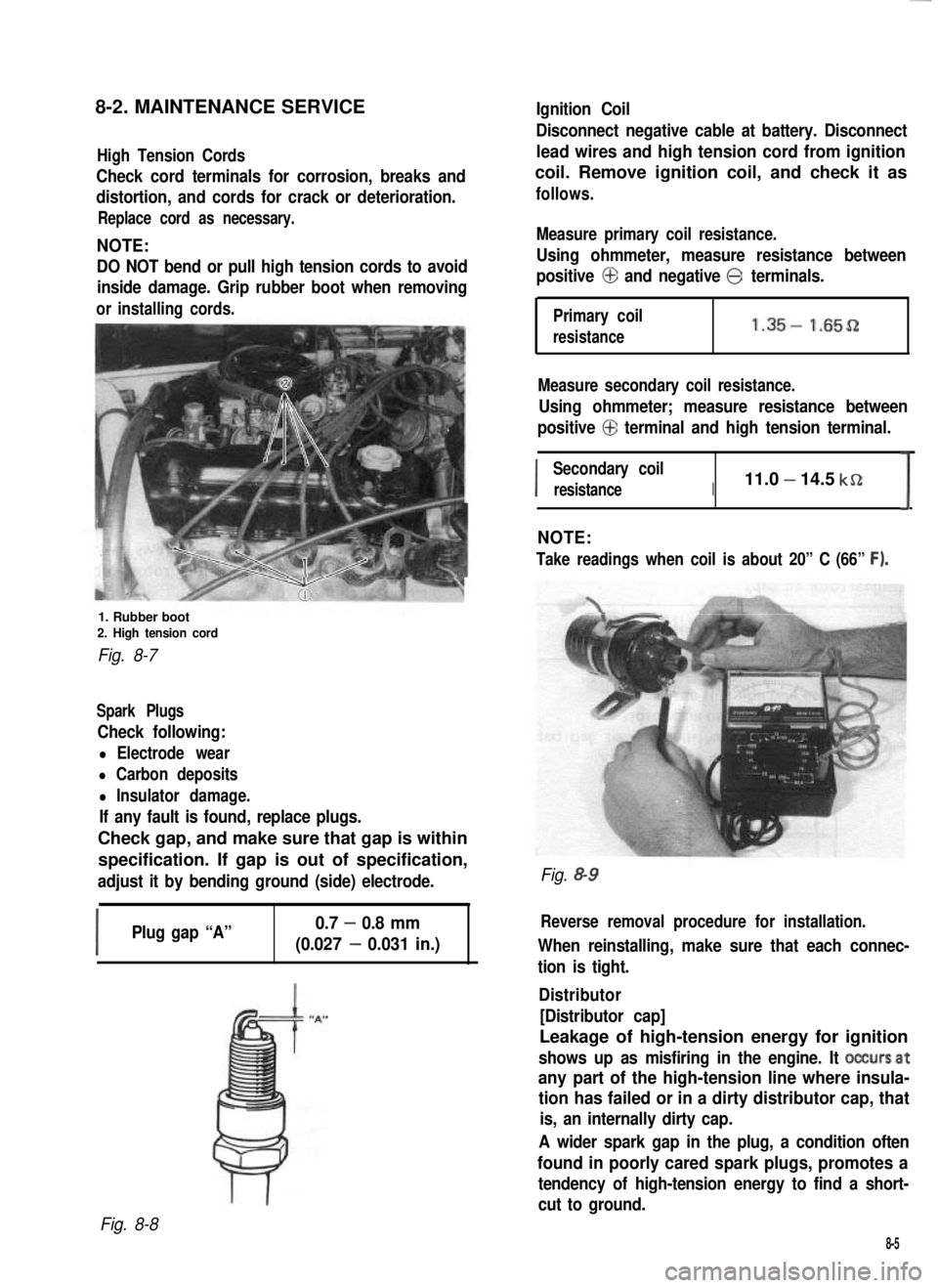
High Tension Cords
Check cord terminals for corrosion, breaks and
distortion, and cords for crack or deterioration.
Replace cord as necessary.
NOTE:
DO NOT bend or pull high tension cords to avoid
inside damage. Grip rubber boot when removing
orinstalling cords.
1. Rubber boot2. High tension cord
Fig. 8-7
Spark Plugs
Check following:
l Electrode wear
l Carbon deposits
l Insulator damage.
If any fault is found, replace plugs.
Check gap, and make sure that gap is within
specification. If gap is out of specification,
adjust it by bending ground (side) electrode.
I
Plug gap “A”0.7 - 0.8 mm
(0.027 - 0.031 in.)
Disconnect negative cable at battery. Disconnect
lead wires and high tension cord from ignition
coil. Remove ignition coil, and check it as
follows.
Measure primary coil resistance.
Using ohmmeter, measure resistance between
positive @ and negative @ terminals.
Primary coil
resistance1.35- 1.65D
Measure secondary coil resistance.
Using ohmmeter; measure resistance between
positive @ terminal and high tension terminal.
I
Secondary coil
resistanceI11.0 - 14.5 kSZ
I
NOTE:
Take readings when coil is about 20” C (66” F).
Fig. &9
Reverse removal procedure for installation.
When reinstalling, make sure that each connec-
tion is tight.
Distributor
[Distributor cap]
Leakage of high-tension energy for ignition
shows up as misfiring in the engine. It occursat
any part of the high-tension line where insula-
tion has failed or in a dirty distributor cap, that
is, an internally dirty cap.
A wider spark gap in the plug, a condition often
found in poorly cared spark plugs, promotes a
tendency of high-tension energy to find a short-
cut to ground.
Fig. 8-8
8-5
Page 219 of 962
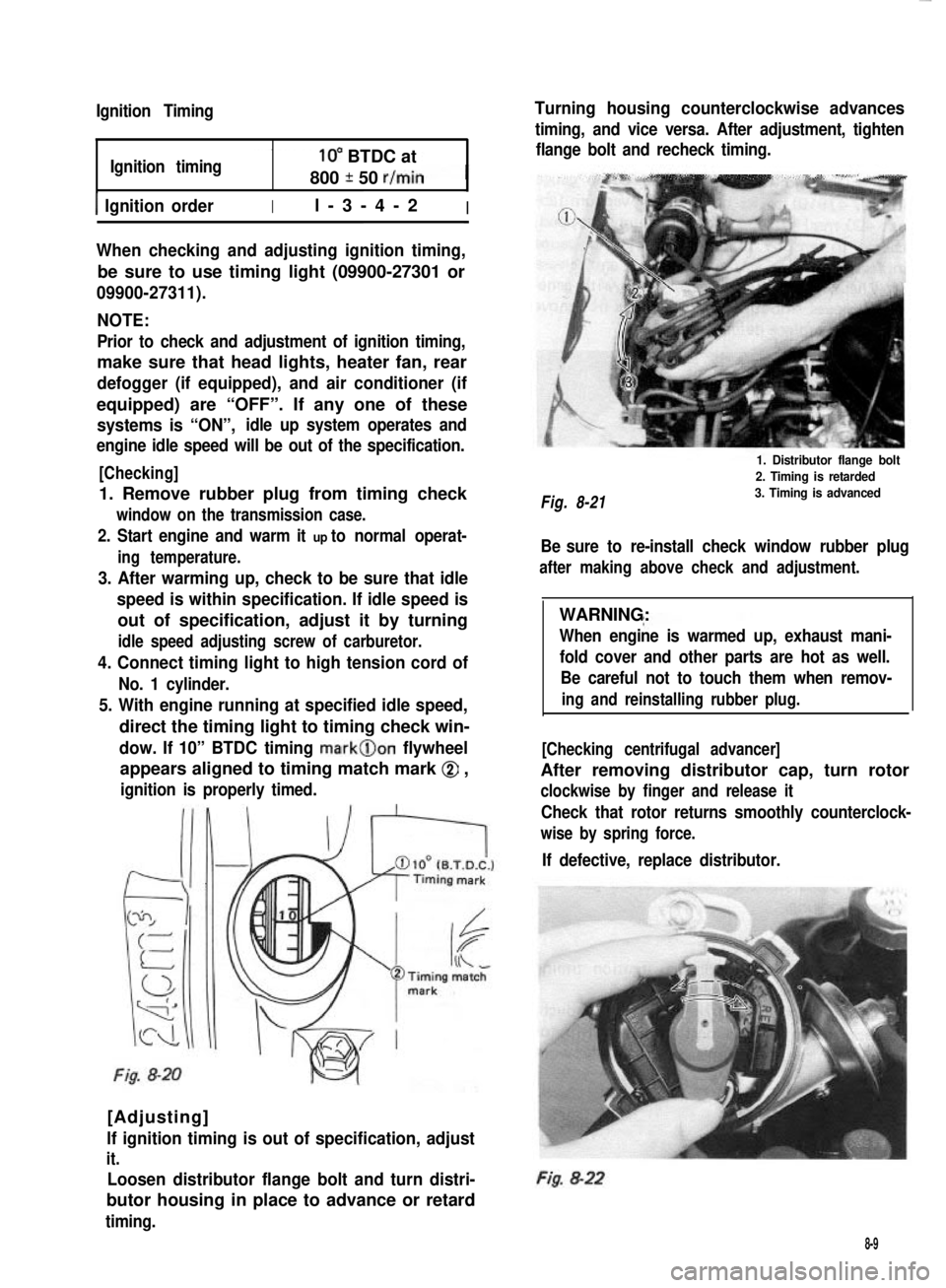
Ignition Timing
Ignition timing10” BTDC at
800 * 50 r/min
1 Ignition orderIl-3-4-2I
When checking and adjusting ignition timing,
be sure to use timing light (09900-27301 or
09900-27311).
NOTE:
Prior to check and adjustment of ignition timing,
make sure that head lights, heater fan, rear
defogger (if equipped), and air conditioner (if
equipped) are “OFF”. If any one of these
systems is “ON”,idle up system operates and
engine idle speed will be out of the specification.
[Checking]
1. Remove rubber plug from timing check
window on the transmission case.
2. Start engine and warm it up to normal operat-
ing temperature.
3. After warming up, check to be sure that idle
speed is within specification. If idle speed is
out of specification, adjust it by turning
idle speed adjusting screw of carburetor.
4. Connect timing light to high tension cord of
No. 1 cylinder.
5. With engine running at specified idle speed,
direct the timing light to timing check win-
dow. If 10” BTDC timing mark@on flywheel
appears aligned to timing match mark @ ,
ignition is properly timed.
Fig. 8-20
[Adjusting]
lf ignition timing is out of specification, adjust
it.
Loosen distributor flange bolt and turn distri-
butor housing in place to advance or retard
timing.
Turning housing counterclockwise advances
timing, and vice versa. After adjustment, tighten
flange bolt and recheck timing.
Fig. 8-21
1. Distributor flange bolt
2. Timing is retarded
3. Timing is advanced
Be sure to re-install check window rubber plug
after making above check and adjustment.
WARNING:
When engine is warmed up, exhaust mani-
fold cover and other parts are hot as well.
Be careful not to touch them when remov-
ing and reinstalling rubber plug.
[Checking centrifugal advancer]
After removing distributor cap, turn rotor
clockwise by finger and release it
Check that rotor returns smoothly counterclock-
wise by spring force.
If defective, replace distributor.
Fig. 8-22
8-9
Page 220 of 962
![SUZUKI GRAND VITARA 1987 Service Manual PDF [Checking vacuum advancer]
Remove distributor cap.
Disconnect vacuum hose from vacuum hose 3
way joint, and connect vacuum pump gauge
(0991747910) to its hose. Apply vacuum (ab-
out 400 mmHg). And the](/img/20/57437/w960_57437-219.png "SUZUKI GRAND VITARA 1987 Service Manual PDF [Checking vacuum advancer]
Remove distributor cap.
Disconnect vacuum hose from vacuum hose 3
way joint, and connect vacuum pump gauge
(0991747910) to its hose. Apply vacuum (ab-
out 400 mmHg). And the")
[Checking vacuum advancer]
Remove distributor cap.
Disconnect vacuum hose from vacuum hose 3
way joint, and connect vacuum pump gauge
(0991747910) to its hose. Apply vacuum (ab-
out 400 mmHg). And then with pump stopped,
check to ensure that vacuum pump gauge
indicator remains at the same level, and release
it. Check that generator base plate with gene-
rator moves smoothly. If plate does not move
smoothly, replace defective parts.
Fig. 8-24
1. Distributor drive gear
2. Camshaft3. Cylinder head
Fig. 8-23
@I Vacuum pump gauge (a991 7-47910)
1. Generator base plate
2. Vacuum controller
Distributor Drive Gear
NOTE:
When removing distributor gear case from cylin-
der head, engine oil in cylinder head may come
out. So place waste or receiver under gear case
when removing.
Inspect drive gear for wear.
Worn gear is likely to disturb ignition timing
and therefore must be replaced.
Replacing worn-down drive gear is not enough.
Inspect driven gear (a part of the distributor
assembly), too, and replace it if badly worn
down.
[Important reminders for removal and installa-
tion]
Before removing drive gear from camshaft,
scribe a match mark on this shaft to root
center line of drive gear as shown in Fig.
B-25 and, when mounting replacement drive
gear, refer to this mark.
When pressing replacement drive gear onto
camshaft, be sure to position gear angularly
as shown in Fig. B-25. (align mark on Cam-
shaft scribed in removal with root center of
drive gear)
NOTE:
There is no need to discriminate between two
end faces of drive gear.
Distributor side view
1. Drive gear
2. Camshaft
3. Center line of
45mmhole
4. Center line ofroot5. @5mm hole(Provided on pulleyside of camshaft)
6. Scribed matchmark
7. 5O
Fig. 8-25
l About 30 cc(1.01/l .05 US/Imp 02) of
engine oil must be fed into distributor gear
case after servicing this case, that is, removing
and putting it back. Be sure to add this much
oil before starting engine for the first time
after servicing.
8-11
Page 237 of 962
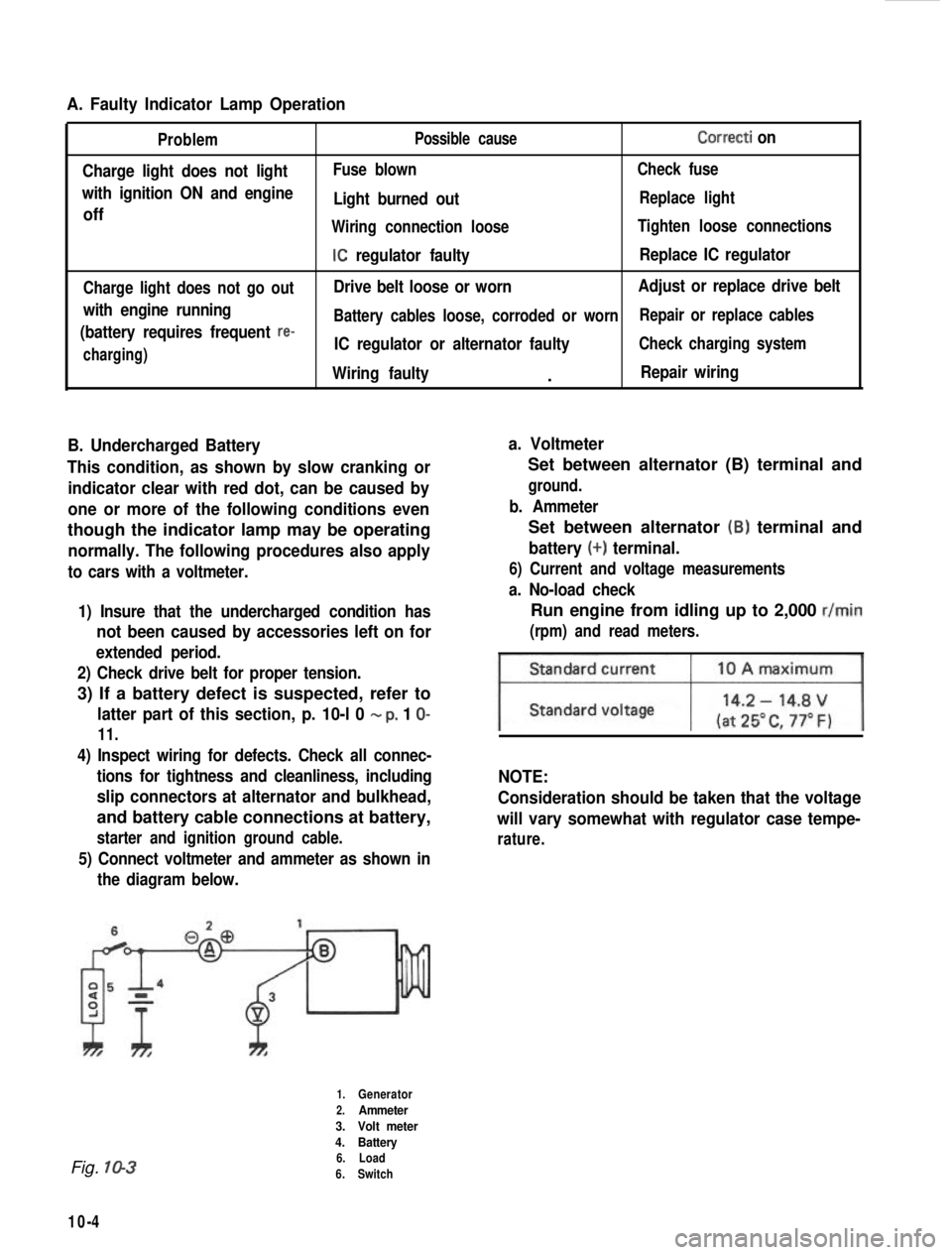
A. Faulty Indicator Lamp Operation
Problem
Charge light does not light
with ignition ON and engine
off
Charge light does not go out
with engine running
(battery requires frequent
re-
charging) Possible cause
Correcti on
Fuse blown
Check fuse
Light burned outReplace light
Wiring connection loose Tighten loose connections
IC regulator faultyReplace IC regulator
Drive belt loose or worn Adjust or replace drive belt
Battery cables loose, corroded or worn Repair or replace cables
IC regulator or alternator faultyCheck charging system
Wiring faulty.Repair wiring
B. Undercharged Battery a. Voltmeter
This condition, as shown by slow cranking or indicator clear with red dot, can be caused by
one or more of the following conditions even
though the indicator lamp may be operating
normally. The following procedures also apply
to cars with a voltmeter.
1) Insure that the undercharged condition has
not been caused by accessories left on for
extended period.
2) Check drive belt for proper tension.
3) If a battery defect is suspected, refer to
latter part of this section, p. 10-l 0 - p, 1 O-
11.
4) Inspect wiring for defects. Check all connec- tions for tightness and cleanliness, including
slip connectors at alternator and bulkhead,
and battery cable connections at battery,
starter and ignition ground cable.
5) Connect voltmeter and ammeter as shown inthe diagram below.
Set between alternator (B) terminal and
ground.
b. Ammeter
Set between alternator (B) terminal and
battery (+) terminal.
6) Current and voltage measurements
a. No-load check
Run engine from idling up to 2,000 r/min
(rpm) and read meters.
NOTE:
Consideration should be taken that the voltage
will vary somewhat with regulator case tempe-
rature.
Fig. 10-3
10-4
1.Generator
2.Ammeter
3. Volt meter
4. Battery
6. Load
6. Switch
Page 238 of 962
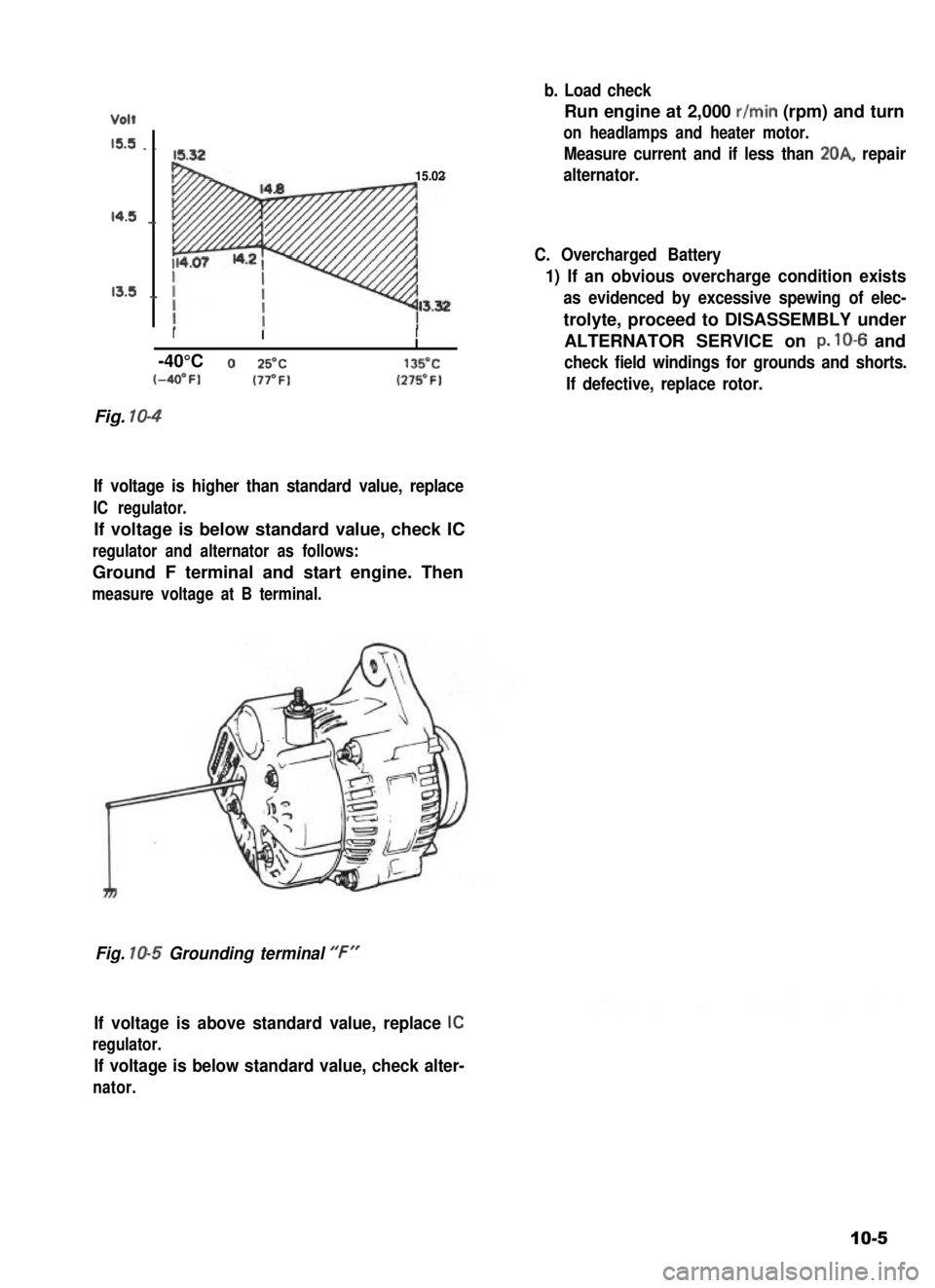
Volt
15.5 . .
14.5 _,
13.5 .,
15.32
15.02
Run engine at 2,000 r/min (rpm) and turn
on headlamps and heater motor.
Measure current and if less than 20A, repair
alternator.
C. Overcharged Battery
1) If an obvious overcharge condition exists
as evidenced by excessive spewing of elec-
trolyte, proceed to DISASSEMBLY underIIIIALTERNATOR SERVICE on p. 10-6 and
-40°C 025Oc135Occheck field windings for grounds and shorts.!-4O“FI(77’F)(275*F)If defective, replace rotor.
b. Load check
Fig. 10-4
If voltage is higher than standard value, replace
IC regulator.
If voltage is below standard value, check IC
regulator and alternator as follows:
Ground F terminal and start engine. Then
measure voltage at B terminal.
Fig. 105 Grounding terminal ‘F”
If voltage is above standard value, replace IC
regulator.
If voltage is below standard value, check alter-
nator.
10-5
Page 244 of 962
![SUZUKI GRAND VITARA 1987 Service Manual PDF [Carrier and hold-down]
The battery carrier and hold-down clamp should
be clean and free from corrosion before instal-
ling the battery. The carrier should be in good
condition so that it will support](/img/20/57437/w960_57437-243.png "SUZUKI GRAND VITARA 1987 Service Manual PDF [Carrier and hold-down]
The battery carrier and hold-down clamp should
be clean and free from corrosion before instal-
ling the battery. The carrier should be in good
condition so that it will support")
[Carrier and hold-down]
The battery carrier and hold-down clamp should
be clean and free from corrosion before instal-
ling the battery. The carrier should be in good
condition so that it will support the battery
securely and keep it level.
Make certain there are no parts in carrier before
installing the battery.
To prevent the battery from shaking in its
carrier, the hold-down bolts should be tight but
not over tightened.
[Visual inspection]
Check for obvious damage, such as cracked or
broken case or cover, that could permit loss of
electrolyte. If obvious damage is noted, replace
the battery. Determine cause of damage and
correct as needed.
Check the battery terminal and cords for corro-
sion. If any, it should be cleaned.
[Built-in indicator]
This sealed battery has a built-in temperature
compensated indicator in the top of the battery.
This indicator is to be used with the following
diagnostic procedure. When observing the
indicator, make sure that the battery has a clean
top. A light may be needed in some poorly-lit
areas.
Under normal operation, two indications can
be seen
2
Clear
RedCHARGING
NECESSARY
Fig. lo-23
l Clear with Red Dot
This means the discharging battery. In this case,
charge the battery until the indicator will be
blue with red dot. The charging and electrical
systems should also be checked at this time. If
any defective is found, correct it. While charging
it, if the battery feels hot 52°C (125” F), or if
violent gassing or spewing of electrolyte through
the vent hole occurs, discontinue charging or
reduce charging rate.
[Jump starting in case of emergency with
auxiliary (booster) battery]
NOTE:
l Do not push or tow the vehicle to start.
Damage to the emission system and/or to
other parts of the vehicle may result.
8 Both booster and discharged battery should
be treated carefully when using jumper cables.
Follow the procedure outlined below, being
careful not to cause sparks:
CAUTION:
l Departure from these conditions or the
procedure below could result in: (1)
Serious personal injury (particularly to
eyes) or property damage from such
causes as battery explosion, battery acid,
or electrical burns; and/or (2) damage to
electronic components of either vehicle.
l Never expose battery to open flame or
electric spark-batteries generate a gas
which is flammable and explosive.
l Remove rings,watches,and other
jewelry. Wear approved eye protection.
l Do not allow battery fluid to contact
eyes, skin, fabrics, or painted surfaces -
fluid is a corrosive acid. Flush any con-
tacted area with water immediately and
thoroughly. Be careful that metal tools
or jumper cables do not contact the
positive battery terminal (or metal in
contact with it) and any other metal on
the car, because a short circuit could
occur. Batteries should always be kept
out of the reach of children.
1) Set parking brake and place transmission in
neutral. Turn off the ignition, turn off lights
and all other electrical loads.
2) Check electrolyte level. If level is below low
level line, replace battery.
NOTE:
When jump starting an engine with charging
equipment, be sure equipment used is 12volt
and negative ground. Do not use 24volt charging
equipment. Using each equipment can cause
serious damage to the electrical system or
electronic parts.
10-11
Page 265 of 962
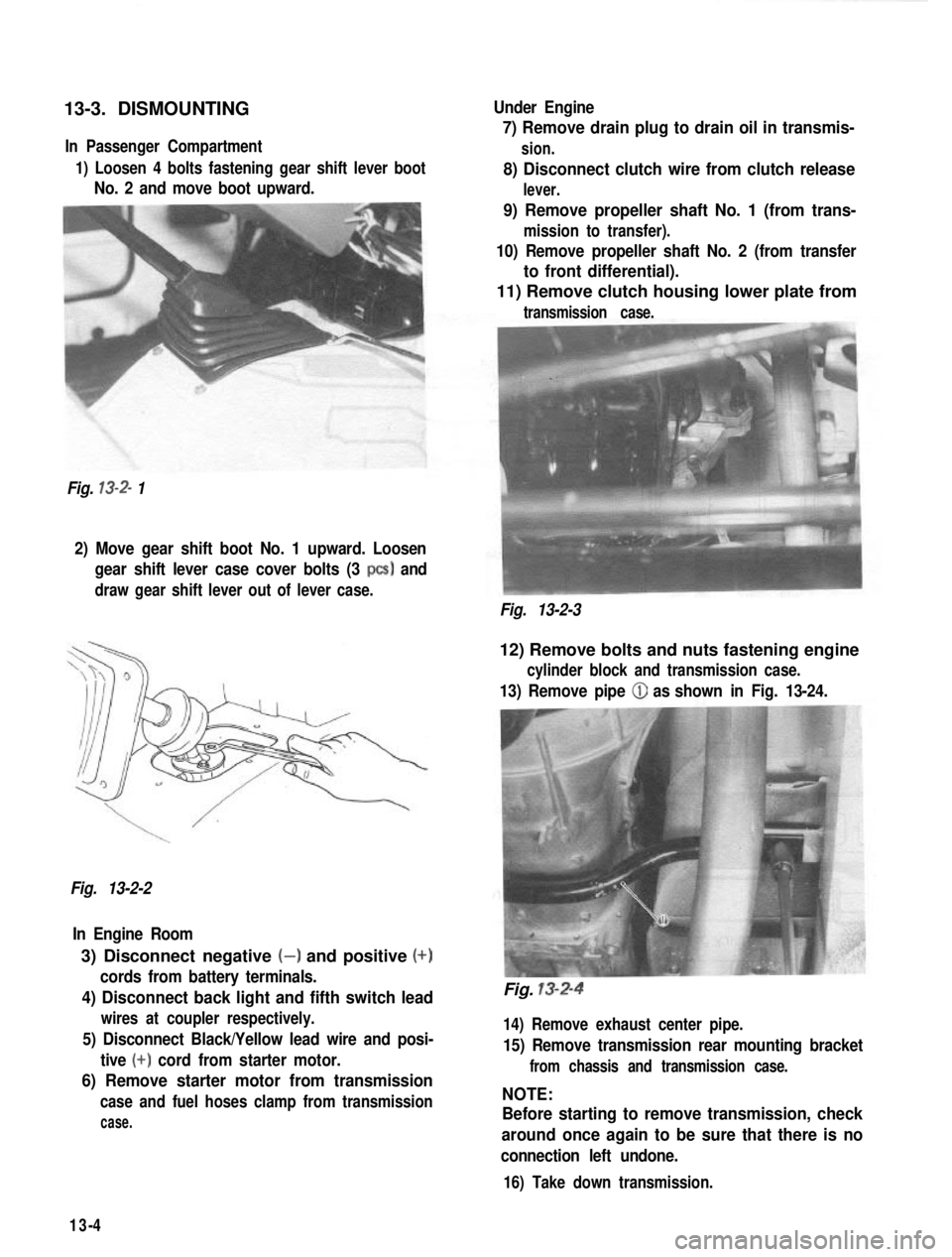
13-3. DISMOUNTINGIn Passenger Compartment
1) Loosen 4 bolts fastening gear shift lever boot
No. 2 and move boot upward.
Fig.
13-2- 1 Under Engine
7) Remove drain plug to drain oil in transmis-
sion.
8) Disconnect clutch wire from clutch release
lever.
9) Remove propeller shaft No. 1 (from trans-
mission to transfer).
10) Remove propeller shaft No. 2 (from transfer
to front differential).
11) Remove clutch housing lower plate from
transmission case.
2) Move gear shift boot No. 1 upward. Loosen
gear shift lever case cover bolts (3
PCS) and
draw gear shift lever out of lever case.
Fig. 13-2-3
Fig. 13-2-2 In Engine Room
3) Disconnect negative (-) and positive (+)
cords from battery terminals.
4) Disconnect back light and fifth switch lead
wires at coupler respectively.
5) Disconnect Black/Yellow lead wire and posi- tive
(+) cord from starter motor.
6) Remove starter motor from transmission
case and fuel hoses clamp from transmission
case.
12) Remove bolts and nuts fastening engine
cylinder block and transmission case.
13) Remove pipe (iJ as shown in Fig. 13-24.
Fig. 13-2-4
14) Remove exhaust center pipe.
15) Remove transmission rear mounting bracket
from chassis and transmission case.
NOTE:
Before starting to remove transmission, check
around once again to be sure that there is no
connection left undone.
16) Take down transmission.
13-4
Page 285 of 962
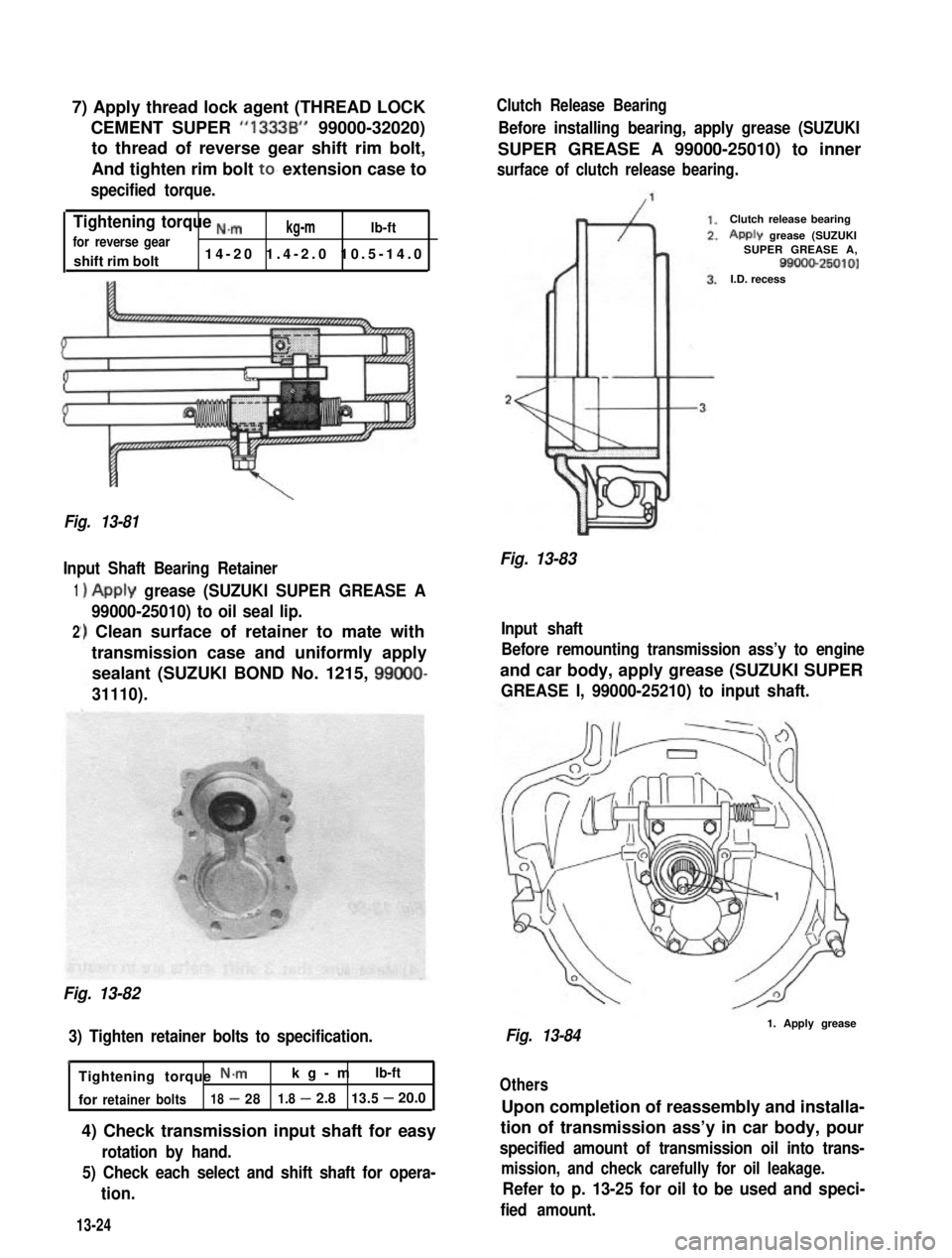
7) Apply thread lock agent (THREAD LOCK
CEMENT SUPER “1333B” 99000-32020)
to thread of reverse gear shift rim bolt,
And tighten rim bolt to. extension case to
specified torque.
Tightening torque ,,,”kg-mlb-ftfor reverse gear
shift rim bolt14-20 1.4-2.0 10.5-14.0
\
Fig. 13-81
Input Shaft Bearing Retainer
1
2
)Apply grease (SUZUKI SUPER GREASE A
99000-25010) to oil seal lip.
‘) Clean surface of retainer to mate with
transmission case and uniformly apply
sealant (SUZUKI BOND No. 1215, 99000-
31110).
Fig. 13-82
3) Tighten retainer bolts to specification.
h
Tightening torque N*mkg-mlb-ft
forretainerbolts18-281.8-2.813.5-20.0
4) Check transmission input shaft for easy
rotation by hand.
5) Check each select and shift shaft for opera-
tion.
Clutch Release Bearing
Before installing bearing, apply grease (SUZUKI
SUPER GREASE A 99000-25010) to inner
surface of clutch release bearing.
Fig. 13-83
Clutch release bearing
Apply grease (SUZUKISUPER GREASE A,99000-25010)I.D. recess
Input shaft
Before remounting transmission ass’y to engine
and car body, apply grease (SUZUKI SUPER
GREASE I, 99000-25210) to input shaft.
Fig. 13-841. Apply grease
Others
Upon completion of reassembly and installa-
tion of transmission ass’y in car body, pour
specified amount of transmission oil into trans-
mission, and check carefully for oil leakage.
Refer to p. 13-25 for oil to be used and speci-
fied amount.13-24