check engine SUZUKI GRAND VITARA 1987 Service Manual PDF
[x] Cancel search | Manufacturer: SUZUKI, Model Year: 1987, Model line: GRAND VITARA, Model: SUZUKI GRAND VITARA 1987Pages: 962, PDF Size: 27.87 MB
Page 184 of 962
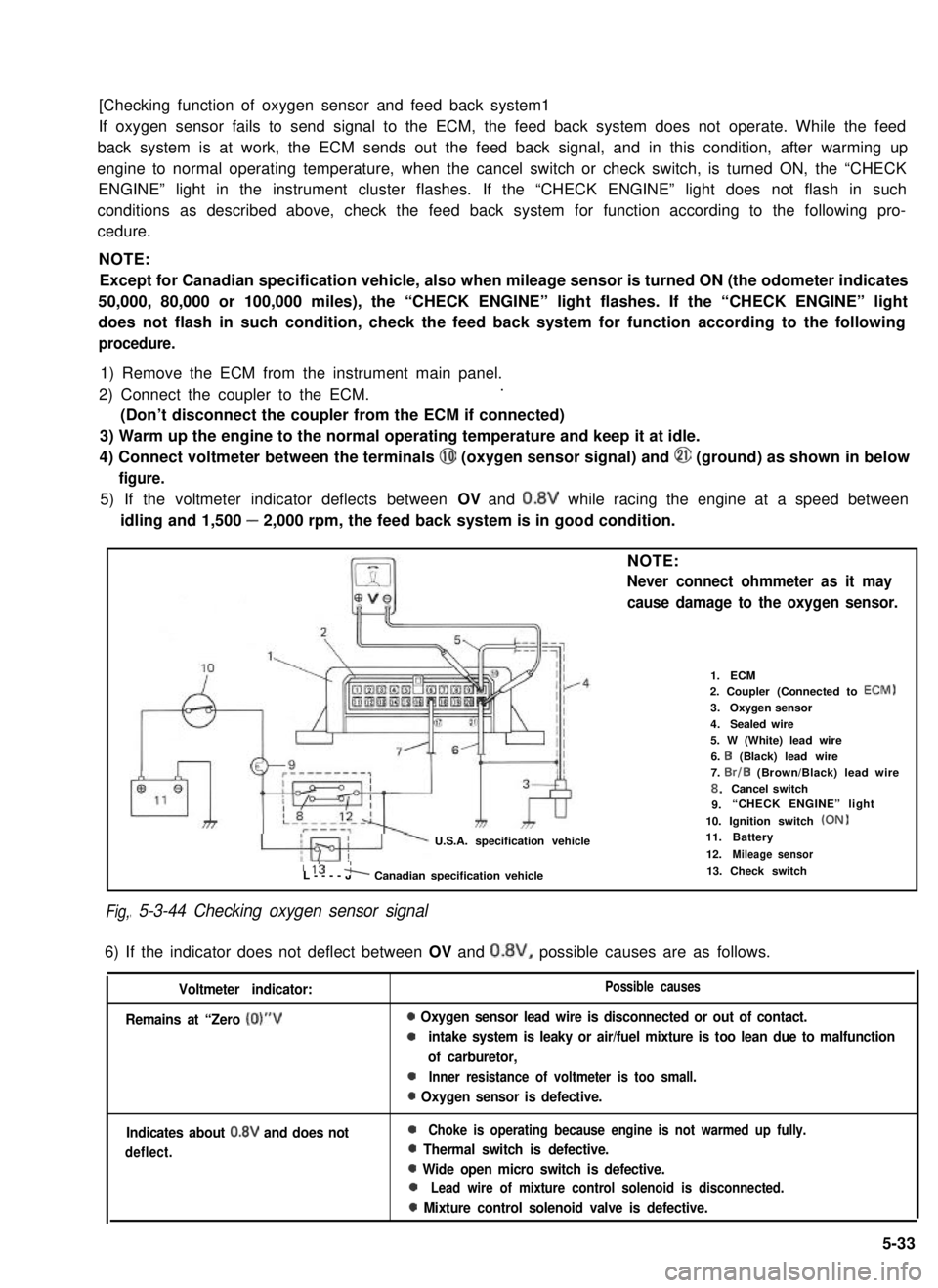
[Checking function of oxygen sensor and feed back system1
If oxygen sensor fails to send signal to the ECM, the feed back system does not operate. While the feed
back system is at work, the ECM sends out the feed back signal, and in this condition, after warming up
engine to normal operating temperature, when the cancel switch or check switch, is turned ON, the “CHECK
ENGINE” light in the instrument cluster flashes. If the “CHECK ENGINE” light does not flash in such
conditions as described above, check the feed back system for function according to the following pro-
cedure.
NOTE:
Except for Canadian specification vehicle, also when mileage sensor is turned ON (the odometer indicates
50,000, 80,000 or 100,000 miles), the “CHECK ENGINE” light flashes. If the “CHECK ENGINE” light
does not flash in such condition, check the feed back system for function according to the following
procedure.
1) Remove the ECM from the instrument main panel.
2) Connect the coupler to the ECM..
(Don’t disconnect the coupler from the ECM if connected)
3) Warm up the engine to the normal operating temperature and keep it at idle.
4) Connect voltmeter between the terminals @I (oxygen sensor signal) and @ (ground) as shown in below
figure.
5) If the voltmeter indicator deflects between OV and 0.8V while racing the engine at a speed between
idling and 1,500 - 2,000 rpm, the feed back system is in good condition.
Fig,
NOTE:
Never connect ohmmeter as it may
cause damage to the oxygen sensor.
U.S.A. specification vehicle
1.ECM2. Coupler (Connected to ECM)
3.Oxygen sensor
4.Sealed wire5. W (White) lead wire
6. I3 (Black) lead wire7. Br/B (Brown/Black) lead wire8.Cancel switch9.“CHECK ENGINE” light
10. Ignition switch (ON)11.Battery
12.Mileage sensor115 'L----JA Canadian specification vehicle
I 5-3-44 Checking oxygen sensor signal
13. Check switch
6) If the indicator does not deflect between OV and 0.8V, possible causes are as follows.
Voltmeter indicator:
Remains at “Zero (0)“V
Possible causes
0 Oxygen sensor lead wire is disconnected or out of contact.
0intake system is leaky or air/fuel mixture is too lean due to malfunction
of carburetor,
0Inner resistance of voltmeter is too small.
0 Oxygen sensor is defective.
Indicates about 0.8V and does not
deflect.
0Choke is operating because engine is not warmed up fully.
0 Thermal switch is defective.
0 Wide open micro switch is defective.
0Lead wire of mixture control solenoid is disconnected.
0 Mixture control solenoid valve is defective.
5-33
Page 185 of 962
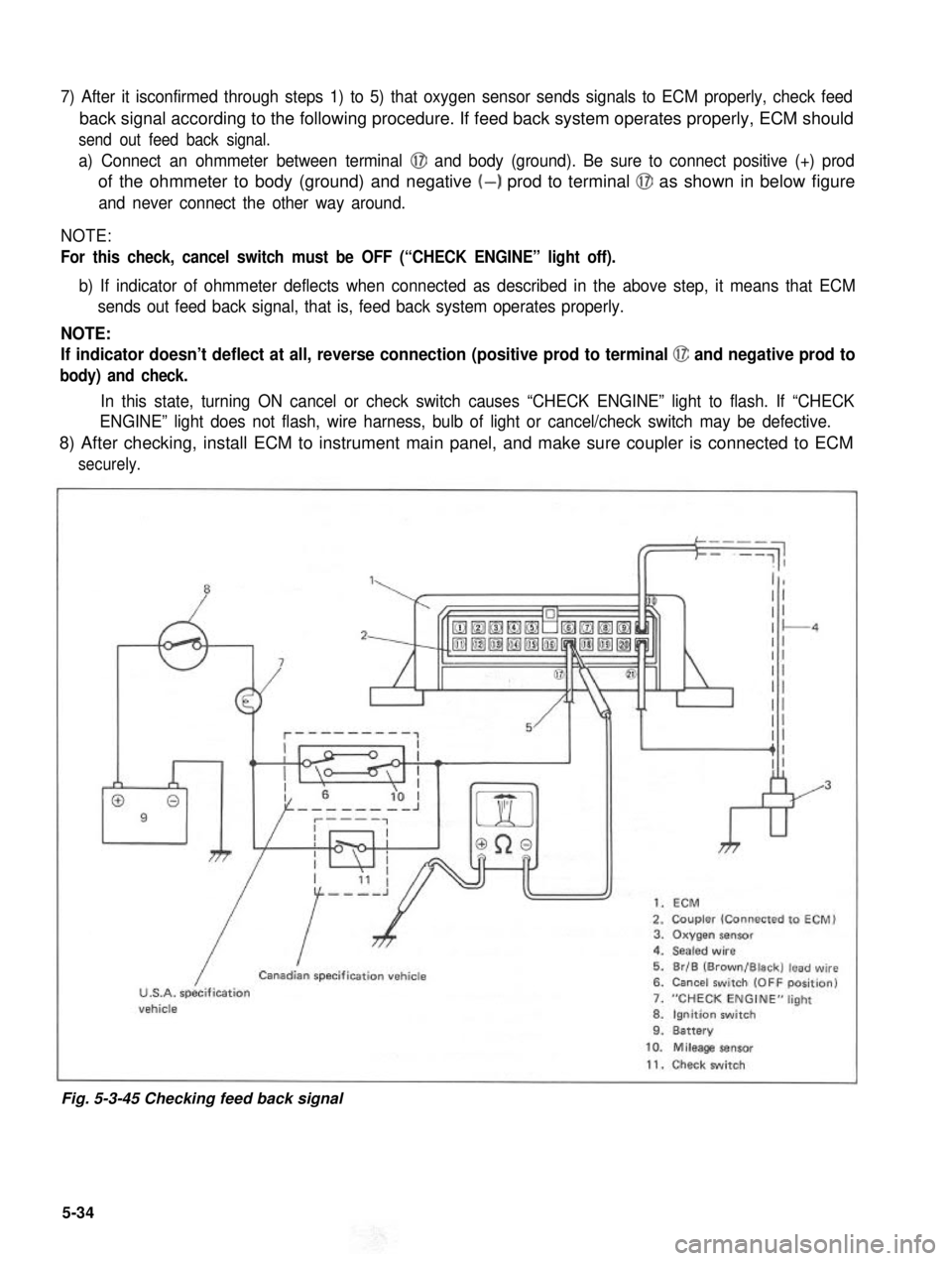
7) After it isconfirmed through steps 1) to 5) that oxygen sensor sends signals to ECM properly, check feed
back signal according to the following procedure. If feed back system operates properly, ECM should
send out feed back signal.
a) Connect an ohmmeter between terminal @I and body (ground). Be sure to connect positive (+) prod
of the ohmmeter to body (ground) and negative (-) prod to terminal @J as shown in below figure
and never connect the other way around.
NOTE:
For this check, cancel switch must be OFF (“CHECK ENGINE” light off).
b) If indicator of ohmmeter deflects when connected as described in the above step, it means that ECM
sends out feed back signal, that is, feed back system operates properly.
NOTE:
If indicator doesn’t deflect at all, reverse connection (positive prod to terminal @ and negative prod to
body) and check.
In this state, turning ON cancel or check switch causes “CHECK ENGINE” light to flash. If “CHECK
ENGINE” light does not flash, wire harness, bulb of light or cancel/check switch may be defective.
8) After checking, install ECM to instrument main panel, and make sure coupler is connected to ECM
securely.
”1,
009
7
kr
1. ECM
2. Coupler (Connected to ECM)3. Oxygen sensor4. Sealed wire
5. Br/B (Brown/Black) lead wire6. Cancel switch (OFF position)
7. “CHECK ENGINE” light
8. Ignition switch9. Battery
/
ICanadian specification vehicle
U.S.A. specificationvehicle
10. Mileage sensor
11. Check switch
Fig. 5-3-45 Checking feed back signal
5-34
Page 186 of 962
![SUZUKI GRAND VITARA 1987 Service Manual PDF [Checking idle-up signal]
The idle-up system operates when any of the small lights (such as tail light, side marker light and license
light), heater fan and rear defogger is put in operation. If the i](/img/20/57437/w960_57437-185.png "SUZUKI GRAND VITARA 1987 Service Manual PDF [Checking idle-up signal]
The idle-up system operates when any of the small lights (such as tail light, side marker light and license
light), heater fan and rear defogger is put in operation. If the i")
[Checking idle-up signal]
The idle-up system operates when any of the small lights (such as tail light, side marker light and license
light), heater fan and rear defogger is put in operation. If the idle-up actuator fails to operate even when
any of such equipments is put in operation, check if signal is sent to the ECM according to the following
procedure.
1) Disconnect the coupler from the ECM.
2) Turn ON the ignition switch but don’t run the engine.
3) Connect a voltmeter between the @ terminal and the body (ground) as shown in below figure. If the
voltmeter indicates 11 - 14V when each equipment is operated individually, it means that idle-up
signal is sent to the ECM.
If the voltmeter does not indicate 11- 14V, the particular circuit is disconnected or in poor contact.
Check the circuit for such conditions.
4) After checking, connect the coupler to ECM securely.
1.Coupler
2. 3.Small Heater lights fan
4. Rear defogger (if equipped)5. Ignition switch (ON)6. Battery
7. Br/Y (Brown/Yellow)
4
&
lead wire
Fig. 5-3-46 Checking idle-up signal
5-35
Page 187 of 962
[Replacing ECMIFUEL CUT SYSTEM
If a malcondition such as those listed below still
occurs even after confirming proper function
and condition of the sensors of the feed back
system and their circuits through the above
checks, a trouble may exist within the ECM. In
such a cause, replace the ECM.
l Fuel consumption increases even in normal
Checking fuel cut system
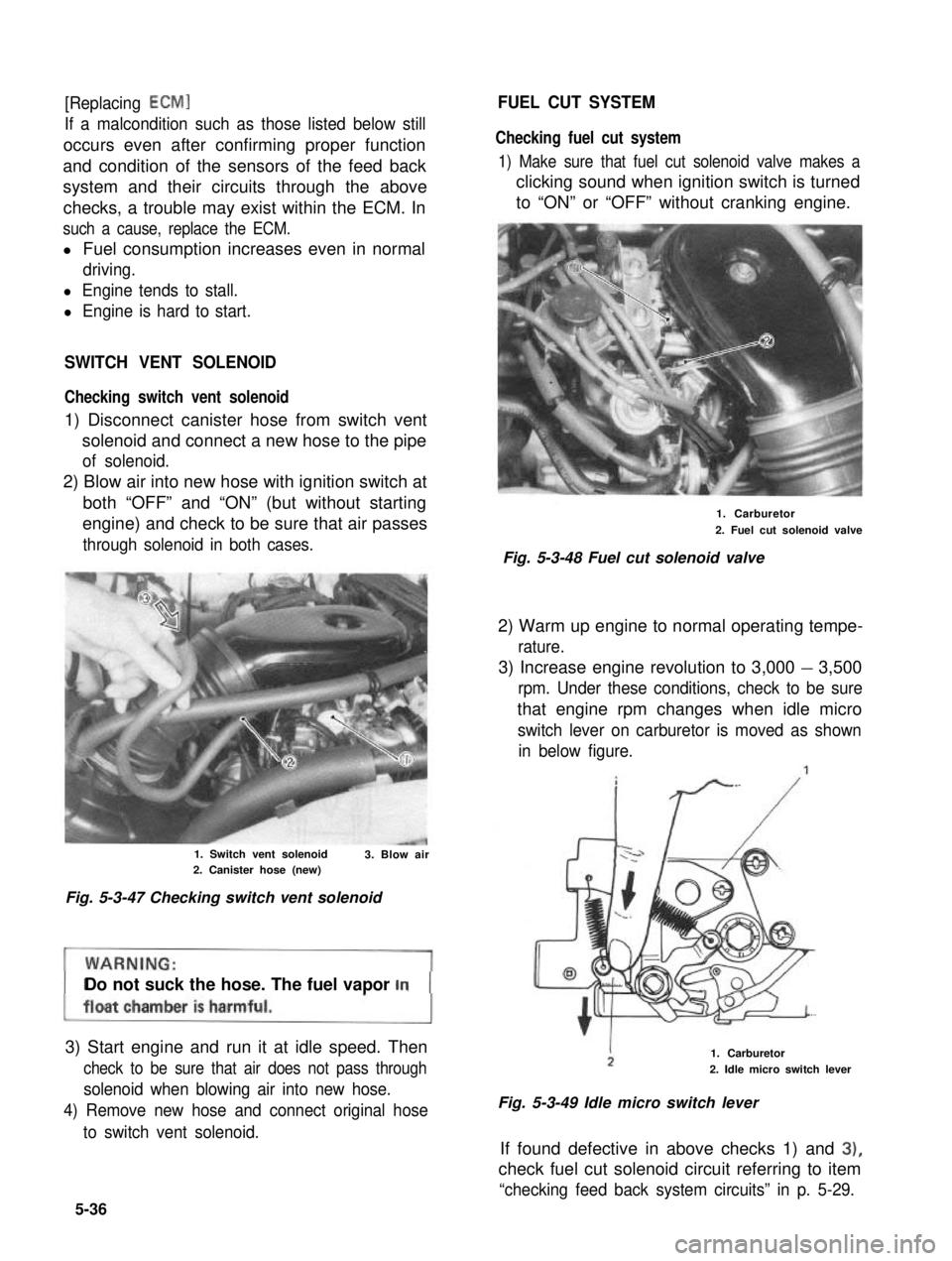
1) Make sure that fuel cut solenoid valve makes a
clicking sound when ignition switch is turned
to “ON” or “OFF” without cranking engine.
driving.
l Engine tends to stall.
l Engine is hard to start.
SWITCH VENT SOLENOID
Checking switch vent solenoid
1) Disconnect canister hose from switch vent
solenoid and connect a new hose to the pipe
of solenoid.
2) Blow air into new hose with ignition switch at
both “OFF” and “ON” (but without starting
engine) and check to be sure that air passes
through solenoid in both cases.
1. Carburetor
2. Fuel cut solenoid valve
Fig. 5-3-48 Fuel cut solenoid valve
2) Warm up engine to normal operating tempe-
rature.
3) Increase engine revolution to 3,000 - 3,500
rpm. Under these conditions, check to be sure
that engine rpm changes when idle micro
switch lever on carburetor is moved as shown
in below figure.
1. Switch vent solenoid2. Canister hose (new)3. Blow air
Fig. 5-3-47 Checking switch vent solenoid
Do not suck the hose. The fuel vapor m
3) Start engine and run it at idle speed. Then
check to be sure that air does not pass through
solenoid when blowing air into new hose.
4) Remove new hose and connect original hose
to switch vent solenoid.
1. Carburetor
2. Idle micro switch lever
Fig. 5-3-49 Idle micro switch lever
If found defective in above checks 1) and 3),
check fuel cut solenoid circuit referring to item
“checking feed back system circuits” in p. 5-29.
5-36
Page 188 of 962
EXHAUST GAS RECIRCULATION (EGR)
SYSTEM
Checking EGR system
NOTE:
1)
Before checking, confirm that altitude is not
higher than 1,220 m (4,000 ft) (atmospheric
pressure is below 680mmHg) and gear shift
lever is at neutral position.
When performing this check at higher than
1,220 m (4,000 ft) altitude, be sure to dis-
connect HAC coupler.
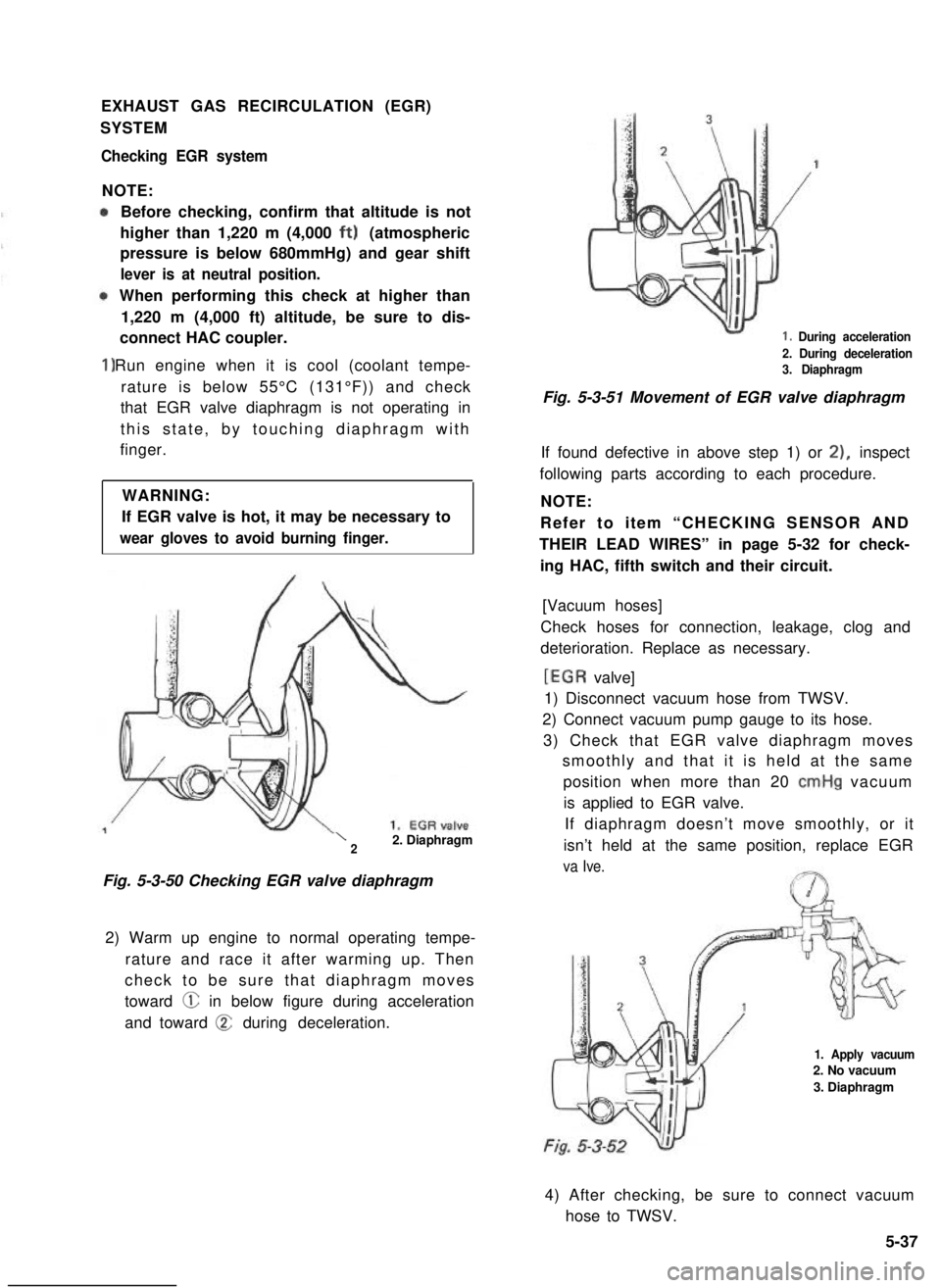
Run engine when it is cool (coolant tempe-
rature is below 55°C (131°F)) and check
that EGR valve diaphragm is not operating in
this state, by touching diaphragm with
finger.
WARNING:
If EGR valve is hot, it may be necessary to
wear gloves to avoid burning finger.
\22. Diaphragm
Fig. 5-3-50 Checking EGR valve diaphragm
2) Warm up engine to normal operating tempe-
rature and race it after warming up. Then
check to be sure that diaphragm moves
toward @ in below figure during acceleration
and toward @ during deceleration.
1. During acceleration
2. During deceleration3. Diaphragm
Fig. 5-3-51 Movement of EGR valve diaphragm
If found defective in above step 1) or 21, inspect
following parts according to each procedure.
NOTE:
Refer to item “CHECKING SENSOR AND
THEIR LEAD WIRES” in page 5-32 for check-
ing HAC, fifth switch and their circuit.
[Vacuum hoses]
Check hoses for connection, leakage, clog and
deterioration. Replace as necessary.
[EGR valve]
1) Disconnect vacuum hose from TWSV.
2) Connect vacuum pump gauge to its hose.
3) Check that EGR valve diaphragm moves
smoothly and that it is held at the same
position when more than 20 cmHg vacuum
is applied to EGR valve.
If diaphragm doesn’t move smoothly, or it
isn’t held at the same position, replace EGR
va Ive.
1. Apply vacuum2. No vacuum
3. Diaphragm
4) After checking, be sure to connect vacuum
hose to TWSV.
5-37
Page 189 of 962
![SUZUKI GRAND VITARA 1987 Service Manual PDF [Bi-metal vacuum switching valve (BVSV)]
NOTE:
For the rough check of the operation, BVSV
can be checked by warming up or cooling down
the engine without being removed from the
intake manifold.
The ch](/img/20/57437/w960_57437-188.png "SUZUKI GRAND VITARA 1987 Service Manual PDF [Bi-metal vacuum switching valve (BVSV)]
NOTE:
For the rough check of the operation, BVSV
can be checked by warming up or cooling down
the engine without being removed from the
intake manifold.
The ch")
[Bi-metal vacuum switching valve (BVSV)]
NOTE:
For the rough check of the operation, BVSV
can be checked by warming up or cooling down
the engine without being removed from the
intake manifold.
The check procedure is the same as the follow-
ing except item 11, 2) and 5).
1) Drain cooling system when engine is cold.
2) Disconnect vacuum hoses and remove BVSV
from intake manifold.
3) While keeping BVSV cool (below 53°C
(127” F)), blow nozzle “3”. Air should not
come out of nozzle “4”.
1
2
I
JlrII
Fig. 5-3-53 Checking B VSV 11)
4)‘While keeping BVSV warm
1. BVSV
2. Cool water3. Blow air(nozzle)4. “No air”(nozzle)
5. Thermometer
(above 65” C
(149°F)) in hot water, blow nozzle “3”.
Air should come out of nozzle “4”.
6
Fig. 5-3-54 Checking B VSV (2)
[ EG R modu latorl
1) Check filter for contamination and damage.
Using compressed air, clean filter.
1. EGR modulator
2. Filter
Fig. 5-3-55 Filter of EGR modulator
2) Remove EGR modulator and plug nozzle
with your finger. Blow air into another nozzle
and check that air passes through to air
filter side freely.
1. EGR modulator2. Blow air3. Air filter
Fig. 5-3-56 Checking EGR modulator (1)
1.BVSV
2.Hot water3.Blow air(nozzle)4.Air (nozzle)
5.Thermometer6.Heater
5) Reinstall BVSV to intake manifold. Before
installing, wind sealing tape on its thread.
6) Connect vacuum hoses.
5-38
Page 193 of 962
Radiator Cap
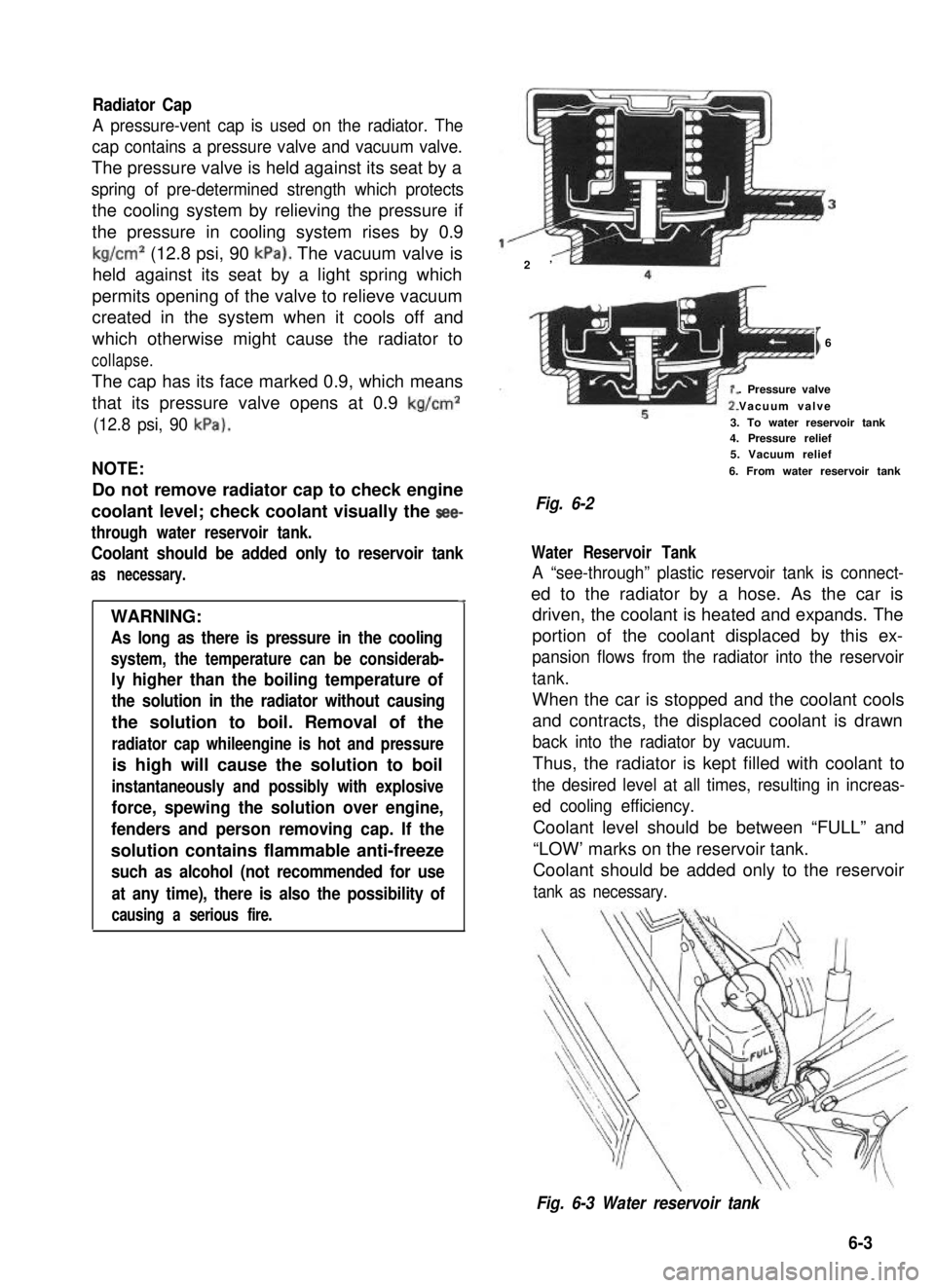
A pressure-vent cap is used on the radiator. The
cap contains a pressure valve and vacuum valve.
The pressure valve is held against its seat by a
spring of pre-determined strength which protects
the cooling system by relieving the pressure if
the pressure in cooling system rises by 0.9
kg/cm2 (12.8 psi, 90 kPa). The vacuum valve is
held against its seat by a light spring which
permits opening of the valve to relieve vacuum
created in the system when it cools off and
which otherwise might cause the radiator to
collapse.
The cap has its face marked 0.9, which means
that its pressure valve opens at 0.9 kg/cm2
(12.8 psi, 90 kPa).
NOTE:
Do not remove radiator cap to check engine
coolant level; check coolant visually the see-
through water reservoir tank.
Coolant should be added only to reservoir tank
as necessary.
4
WARNING:
As long as there is pressure in the cooling
system, the temperature can be considerab-
ly higher than the boiling temperature of
the solution in the radiator without causing
the solution to boil. Removal of the
radiator cap whileengine is hot and pressure
is high will cause the solution to boil
instantaneously and possibly with explosive
force, spewing the solution over engine,
fenders and person removing cap. If the
solution contains flammable anti-freeze
such as alcohol (not recommended for use
at any time), there is also the possibility of
causing a serious fire.
2’
I6
. Pressure valve
Vacuum valve
3. To water reservoir tank4. Pressure relief5. Vacuum relief
6. From water reservoir tank
Fig. 6-2
Water Reservoir Tank
A “see-through” plastic reservoir tank is connect-
ed to the radiator by a hose. As the car is
driven, the coolant is heated and expands. The
portion of the coolant displaced by this ex-
pansion flows from the radiator into the reservoir
tank.
When the car is stopped and the coolant cools
and contracts, the displaced coolant is drawn
back into the radiator by vacuum.
Thus, the radiator is kept filled with coolant to
the desired level at all times, resulting in increas-
ed cooling efficiency.
Coolant level should be between “FULL” and
“LOW’ marks on the reservoir tank.
Coolant should be added only to the reservoir
tank as necessary.
Fig. 6-3 Water reservoir tank
6-3
Page 197 of 962
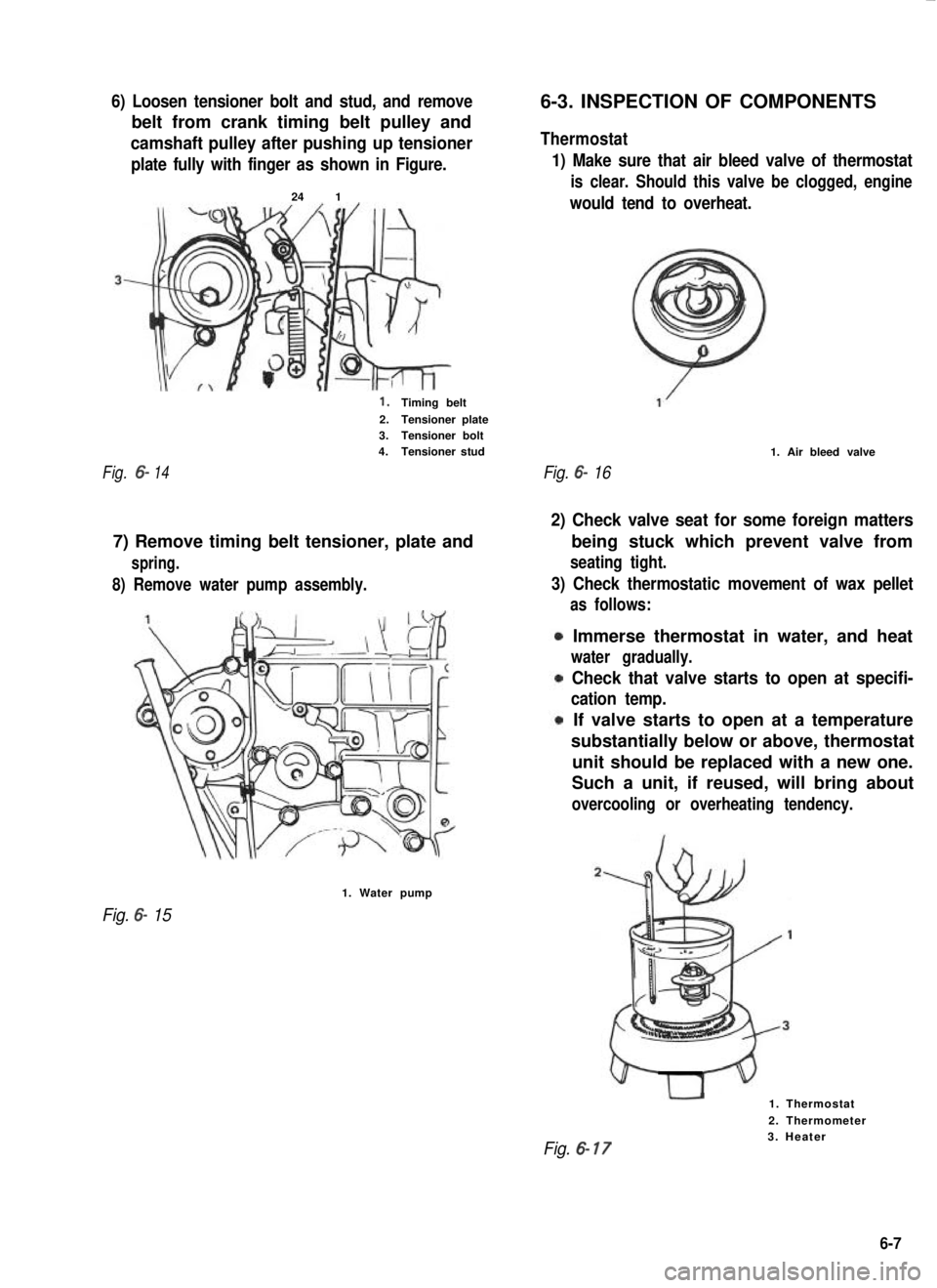
6) Loosen tensioner bolt and stud, and remove
belt from crank timing belt pulley and
camshaft pulley after pushing up tensioner
plate fully with finger as shown in Figure.
24 1
1.Timing belt
2.Tensioner plate3.Tensioner bolt4.Tensioner stud
Fig.6-14
8) Remove water pump assembly.
7) Remove timing belt tensioner, plate and
spring.
1. Water pump
Fig. 6- 15
6-3. INSPECTION OF COMPONENTS
Thermostat
1) Make sure that air bleed valve of thermostat
is clear. Should this valve be clogged, engine
would tend to overheat.
Fig. 6- 16
1. Air bleed valve
2) Check valve seat for some foreign matters
3) Check thermostatic movement of wax pellet
being stuck which prevent valve from
seating tight.
as follows:
Immerse thermostat in water, and heat
water gradually.
Check that valve starts to open at specifi-
cation temp.
If valve starts to open at a temperature
substantially below or above, thermostat
unit should be replaced with a new one.
Such a unit, if reused, will bring about
overcooling or overheating tendency.
1. Thermostat
2. Thermometer
Fig. 6- 173. Heater
6-7
Page 200 of 962
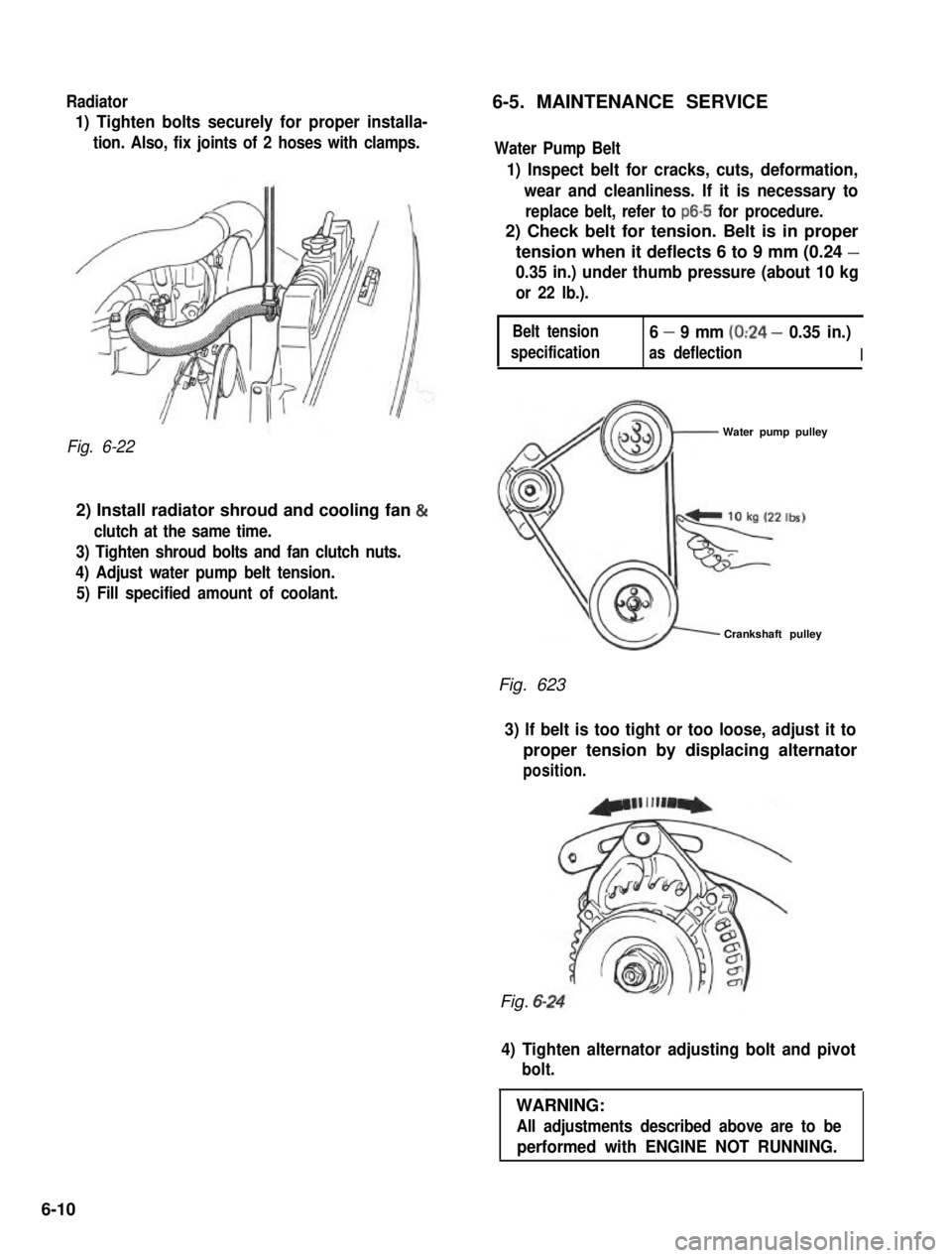
Radiator6-5. MAINTENANCE SERVICE
1) Tighten bolts securely for proper installa-
tion. Also, fix joints of 2 hoses with clamps.
Fig. 6-22
2) Install radiator shroud and cooling fan &
clutch at the same time.
3) Tighten shroud bolts and fan clutch nuts.
4) Adjust water pump belt tension.
5) Fill specified amount of coolant.
Water Pump Belt
1) Inspect belt for cracks, cuts, deformation,
wear and cleanliness. If it is necessary to
replace belt, refer to ~6-5 for procedure.
2) Check belt for tension. Belt is in proper
tension when it deflects 6 to 9 mm (0.24 -
0.35 in.) under thumb pressure (about 10 kg
or 22 lb.).
Belt tension
specification
6 - 9 mm (0:24 - 0.35 in.)
as deflectionI
Water pump pulley
Crankshaft pulley
Fig. 623
3) If belt is too tight or too loose, adjust it to
proper tension by displacing alternator
position.
Fig. 6-
4) Tighten alternator adjusting bolt and pivot
bolt.
WARNING:
All adjustments described above are to be
performed with ENGINE NOT RUNNING.
6-10
Page 201 of 962
Coolant
The coolant recovery system is standard. The
coolant in the radiator expands with heat, and
the overflow is collected in the reservoir tank.
When the system cools down, the coolant is
drawn back into the radiator.
The cooling system has been filled at the factory
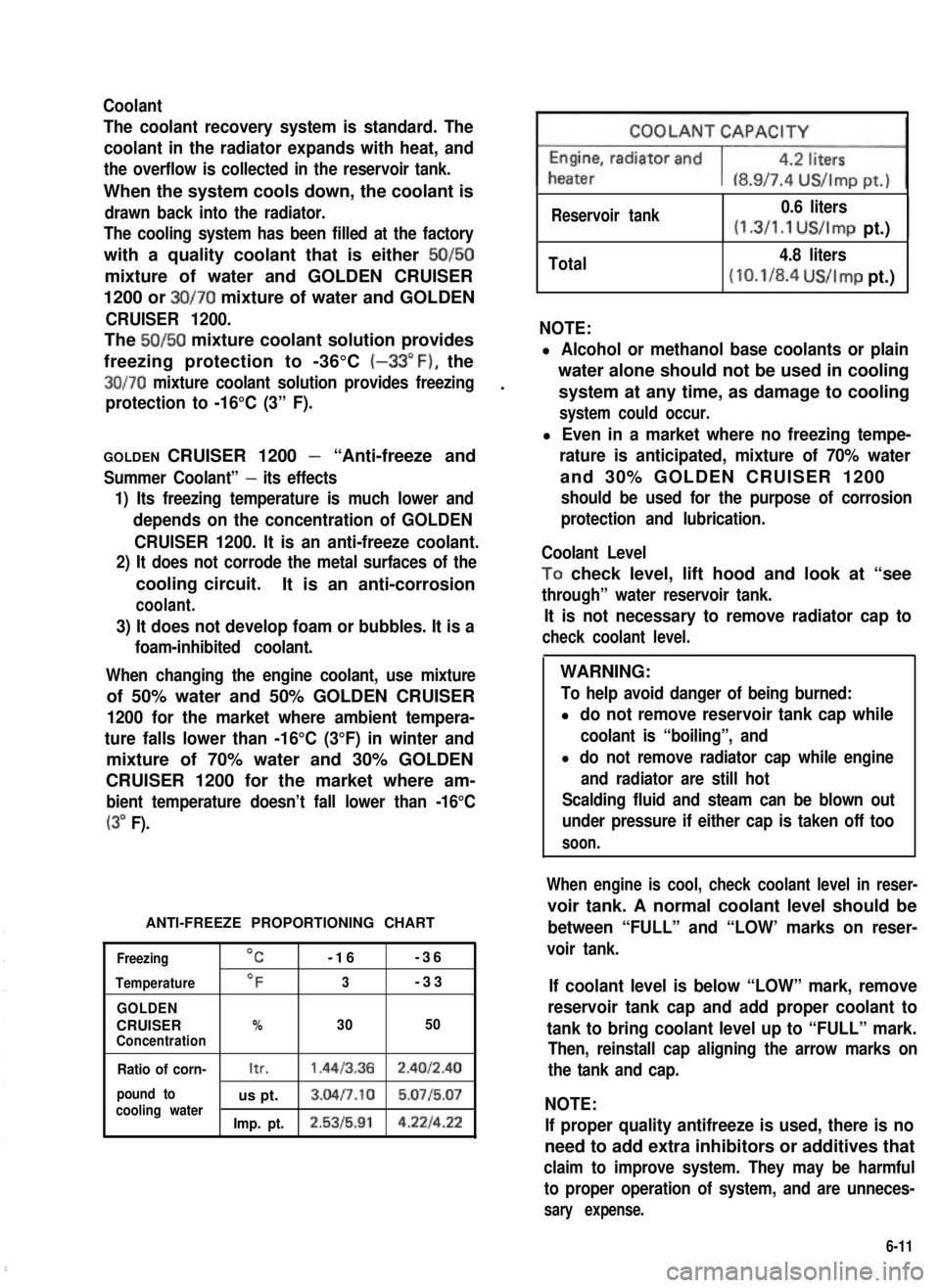
with a quality coolant that is either 50/50
mixture of water and GOLDEN CRUISER
1200 or 30/70 mixture of water and GOLDEN
CRUISER 1200.
The 50/50 mixture coolant solution provides
freezing protection to -36°C (-33”F), the
30/70 mixture coolant solution provides freezing.
protection to -16°C (3” F).
GOLDEN CRUISER 1200 - “Anti-freeze and
Summer Coolant” - its effects
1) Its freezing temperature is much lower and
depends on the concentration of GOLDEN
CRUISER 1200. It is an anti-freeze coolant.
2) It does not corrode the metal surfaces of the
cooling circuit.It is an anti-corrosion
coolant.
3) It does not develop foam or bubbles. It is a
foam-inhibited coolant.
When changing the engine coolant, use mixture
of 50% water and 50% GOLDEN CRUISER
1200 for the market where ambient tempera-
ture falls lower than -16°C (3°F) in winter and
mixture of 70% water and 30% GOLDEN
CRUISER 1200 for the market where am-
bient temperature doesn’t fall lower than -16°C
(3” F).
ANTI-FREEZE PROPORTIONING CHART
Freezing
Temperature
GOLDEN
CRUISERConcentration
OC-16-36
OF3-33
%3050
Ratio of corn-Itr.1.4413.362.4012.40
pound tous pt.3.04l7.10 5.0715.07cooling waterImp. pt.2.5315.914.221422
Reservoir tank0.6 liters
(1.3/1.1 US/Imp pt.)I
Total4.8 liters
(10.1/8.4 US/Imp pt.)
NOTE:
l Alcohol or methanol base coolants or plain
water alone should not be used in cooling
system at any time, as damage to cooling
system could occur.
l Even in a market where no freezing tempe-
rature is anticipated, mixture of 70% water
and 30% GOLDEN CRUISER 1200
should be used for the purpose of corrosion
protection and lubrication.
Coolant Level
,To check level, lift hood and look at “see
through” water reservoir tank.
It is not necessary to remove radiator cap to
check coolant level.
WARNING:
To help avoid danger of being burned:
l do not remove reservoir tank cap while
coolant is “boiling”, and
l do not remove radiator cap while engine
and radiator are still hot
Scalding fluid and steam can be blown out
under pressure if either cap is taken off too
soon.
When engine is cool, check coolant level in reser-
voir tank. A normal coolant level should be
between “FULL” and “LOW’ marks on reser-
voir tank.
If coolant level is below “LOW” mark, remove
reservoir tank cap and add proper coolant to
tank to bring coolant level up to “FULL” mark.
Then, reinstall cap aligning the arrow marks on
the tank and cap.
NOTE:
If proper quality antifreeze is used, there is no
need to add extra inhibitors or additives that
claim to improve system. They may be harmful
to proper operation of system, and are unneces-
sary expense.
6-11