clock SUZUKI GRAND VITARA 1987 Service Repair Manual
[x] Cancel search | Manufacturer: SUZUKI, Model Year: 1987, Model line: GRAND VITARA, Model: SUZUKI GRAND VITARA 1987Pages: 962, PDF Size: 27.87 MB
Page 22 of 962
5) Remove timing belt outside cover. Inspect
the belt for damage or wear. When any
damage or wear is found on the belt, replace
it.
If belt replacement is necessary, be sure to
install the belt properly.
6) Remove cylinder head cover and loosen all
valve adjusting screws all the way to permit
free rotation of camshaft.
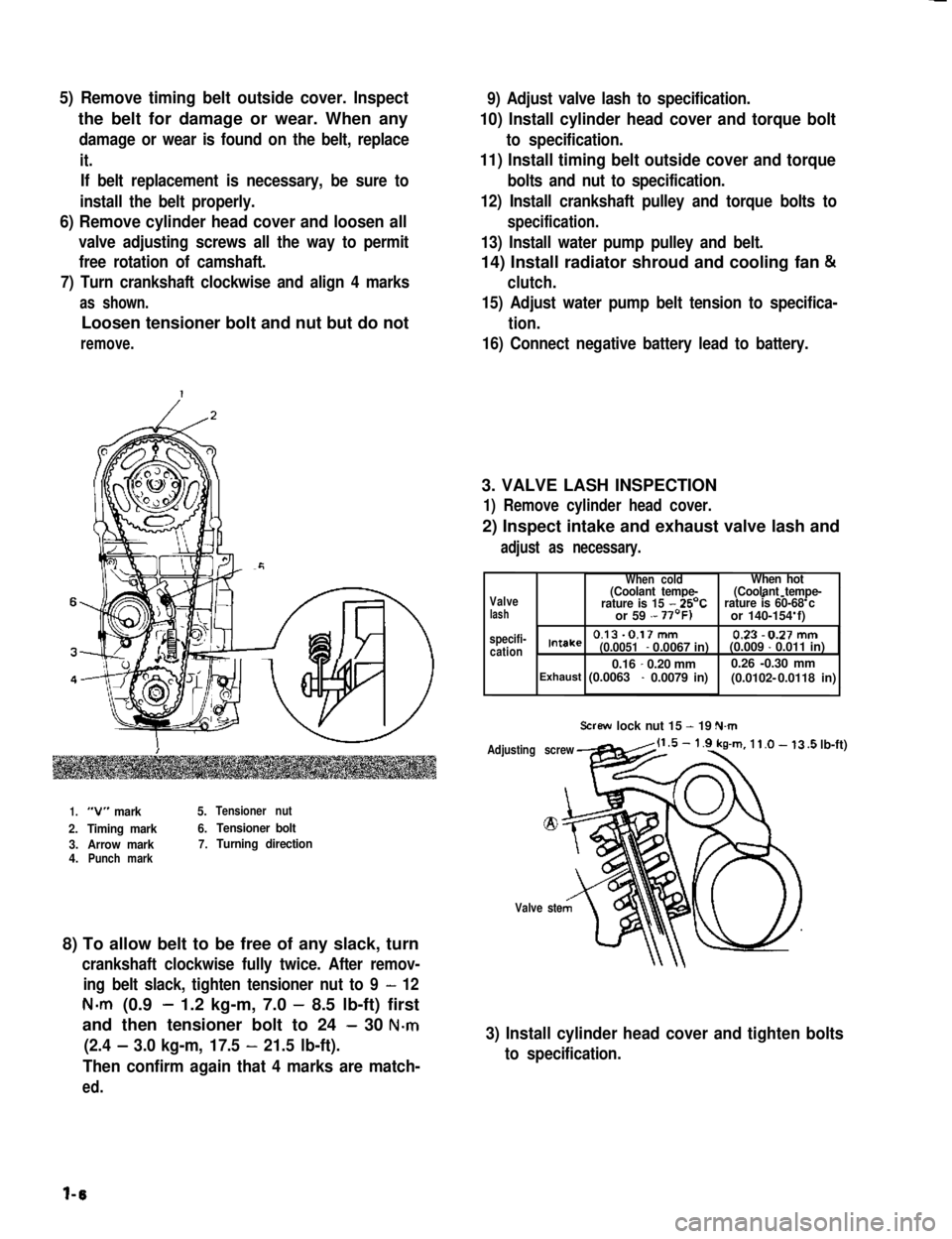
7) Turn crankshaft clockwise and align 4 marks
as shown.
Loosen tensioner bolt and nut but do not
remove.
9) Adjust valve lash to specification.
10) Install cylinder head cover and torque bolt
to specification.
11) Install timing belt outside cover and torque
bolts and nut to specification.
12) Install crankshaft pulley and torque bolts to
specification.
13) Install water pump pulley and belt.
14) Install radiator shroud and cooling fan &
clutch.
15) Adjust water pump belt tension to specifica-
tion.
16) Connect negative battery lead to battery.
3. VALVE LASH INSPECTION
1) Remove cylinder head cover.
2) Inspect intake and exhaust valve lash and
adjust as necessary.
1.“V” mark5.Tensioner nut
2.Timing mark6.Tensioner bolt
3.Arrow mark7.Turning direction4.Punch mark
8) To allow belt to be free of any slack, turn
crankshaft clockwise fully twice. After remov-
ing belt slack, tighten tensioner nut to 9 - 12
N-m (0.9- 1.2 kg-m, 7.0 - 8.5 lb-ft) first
and then tensioner bolt to 24 - 30 N-m
(2.4 - 3.0 kg-m, 17.5 - 21.5 lb-ft).
Then confirm again that 4 marks are match-
ed.
Valvelash specifi-cation
When coldWhen hot(Coolant tempe-(Coolant tempe---rature is 15 - 25’Crature is 60-68 c or 59 - or 140-154 f)
0.13-0.17mm 0.23-0.27mmIntake(0.0051- 0.0067 in)(0.009 - 0.011 in)
0.16-0.20 mm0.26 -0.30 mm(0.0102- Exhaust (0.0063 - 0.0079 in) 0.0118 in)
Screw lock nut 15 - 19 N.m
Adjusting screw
Valve ste
.5 lb-ft)
3) Install cylinder head cover and tighten bolts
to specification.
l-6
Page 106 of 962
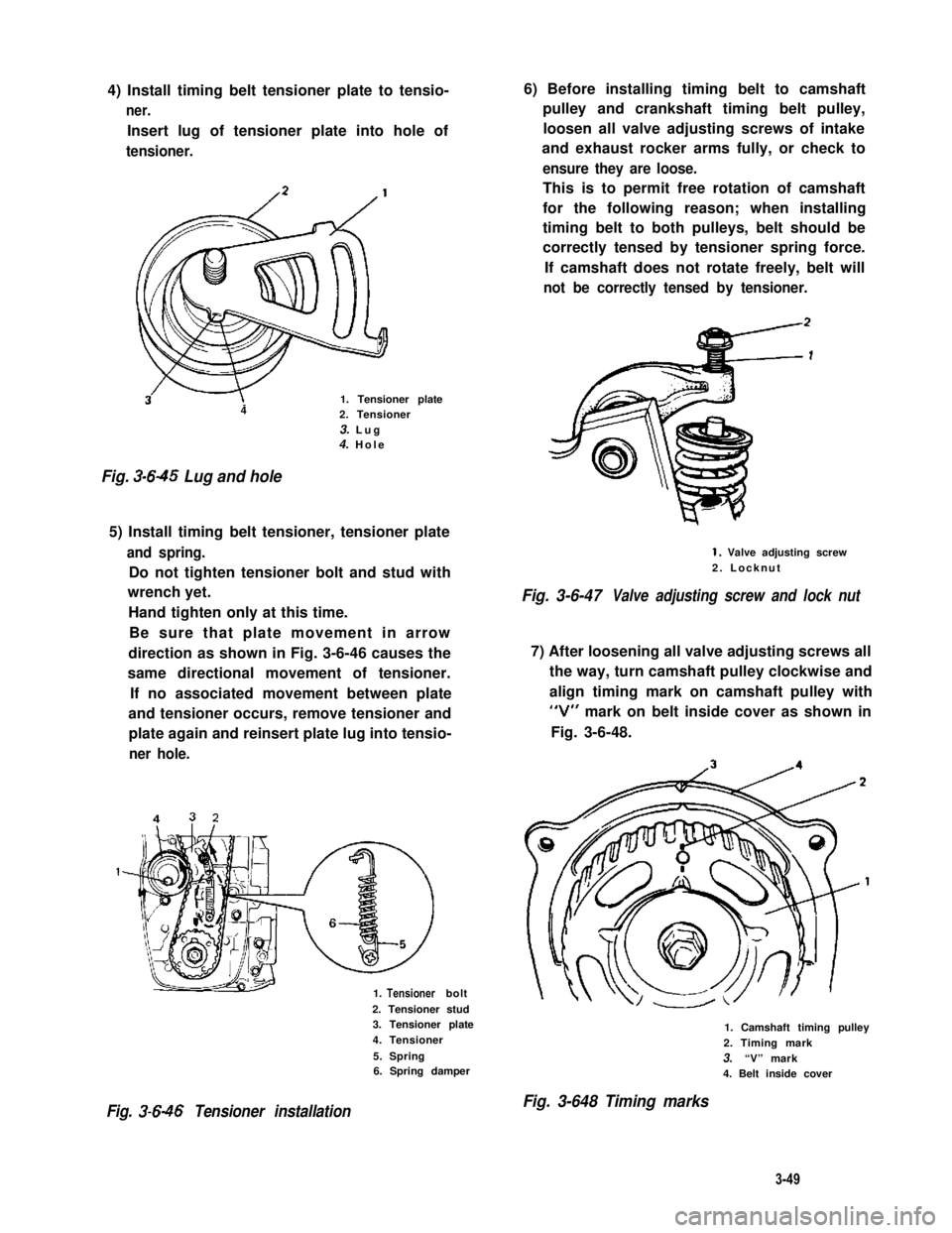
4) Install timing belt tensioner plate to tensio-
ner.
Insert lug of tensioner plate into hole of
tensioner.
3w1. Tensioner plate42. Tensioner
3. Lug4. Hole
Fig. 3-645 Lug and hole
5) Install timing belt tensioner, tensioner plate
and spring.
Do not tighten tensioner bolt and stud with
wrench yet.
Hand tighten only at this time.
Be sure that plate movement in arrow
direction as shown in Fig. 3-6-46 causes the
same directional movement of tensioner.
If no associated movement between plate
and tensioner occurs, remove tensioner and
plate again and reinsert plate lug into tensio-
ner hole.
1. bolt
2. Tensioner stud3. Tensioner plate
4. Tensioner
5. Spring6. Spring damper
Fig. 3-646 Tensioner installation
6) Before installing timing belt to camshaft
pulley and crankshaft timing belt pulley,
loosen all valve adjusting screws of intake
and exhaust rocker arms fully, or check to
ensure they are loose.
This is to permit free rotation of camshaft
for the following reason; when installing
timing belt to both pulleys, belt should be
correctly tensed by tensioner spring force.
If camshaft does not rotate freely, belt will
not be correctly tensed by tensioner.
1. Valve adjusting screw
2. Locknut
Fig. 3-6-47Valve adjusting screw and lock nut
7) After loosening all valve adjusting screws all
the way, turn camshaft pulley clockwise and
align timing mark on camshaft pulley with
“V” mark on belt inside cover as shown in
Fig. 3-6-48.
1. Camshaft timing pulley
2. Timing mark
3.“V” mark4. Belt inside cover
Fig. 3-648 Timing marks
3-49
Tensioner
Page 107 of 962
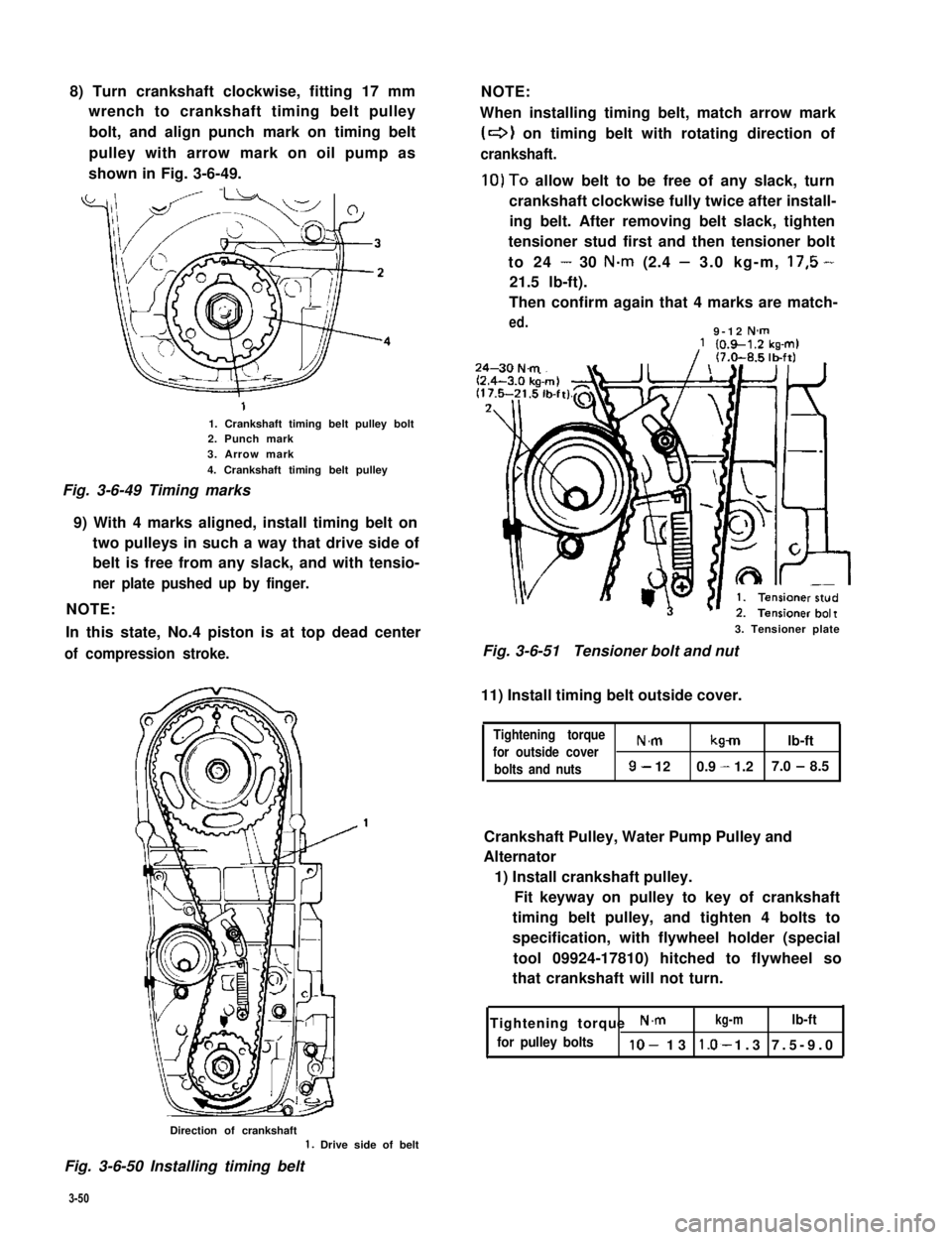
8) Turn crankshaft clockwise, fitting 17 mm
wrench to crankshaft timing belt pulley
bolt, and align punch mark on timing belt
pulley with arrow mark on oil pump as
shown in Fig. 3-6-49.
1. Crankshaft timing belt pulley bolt2. Punch mark3. Arrow mark
4. Crankshaft timing belt pulley
Fig. 3-6-49 Timing marks
9) With 4 marks aligned, install timing belt on
two pulleys in such a way that drive side of
belt is free from any slack, and with tensio-
ner plate pushed up by finger.
NOTE:
In this state, No.4 piston is at top dead center
of compression stroke.
NOTE:
When installing timing belt, match arrow mark
(+I on timing belt with rotating direction of
crankshaft.
10)To allow belt to be free of any slack, turn
crankshaft clockwise fully twice after install-
ing belt. After removing belt slack, tighten
tensioner stud first and then tensioner bolt
to 24 - 30 N.m (2.4 - 3.0 kg-m, 17,5 -
21.5 lb-ft).
Then confirm again that 4 marks are match-
ed.9-12 N-m
3. Tensioner plate
Fig. 3-6-51Tensioner bolt and nut
11) Install timing belt outside cover.
Tightening torque
for outside coverN.mkmlb-ft
bolts and nuts9- 120.9 - 1.27.0 - 8.5
Crankshaft Pulley, Water Pump Pulley and
Alternator
1) Install crankshaft pulley.
Fit keyway on pulley to key of crankshaft
timing belt pulley, and tighten 4 bolts to
specification, with flywheel holder (special
tool 09924-17810) hitched to flywheel so
that crankshaft will not turn.
Tightening torque N.mkg-mlb-ft
for pulley boltslo- 13 1.3 7.5-9.0*
Direction of crankshaft1. Drive side of belt
Fig. 3-6-50 Installing timing belt
3-50
Page 111 of 962
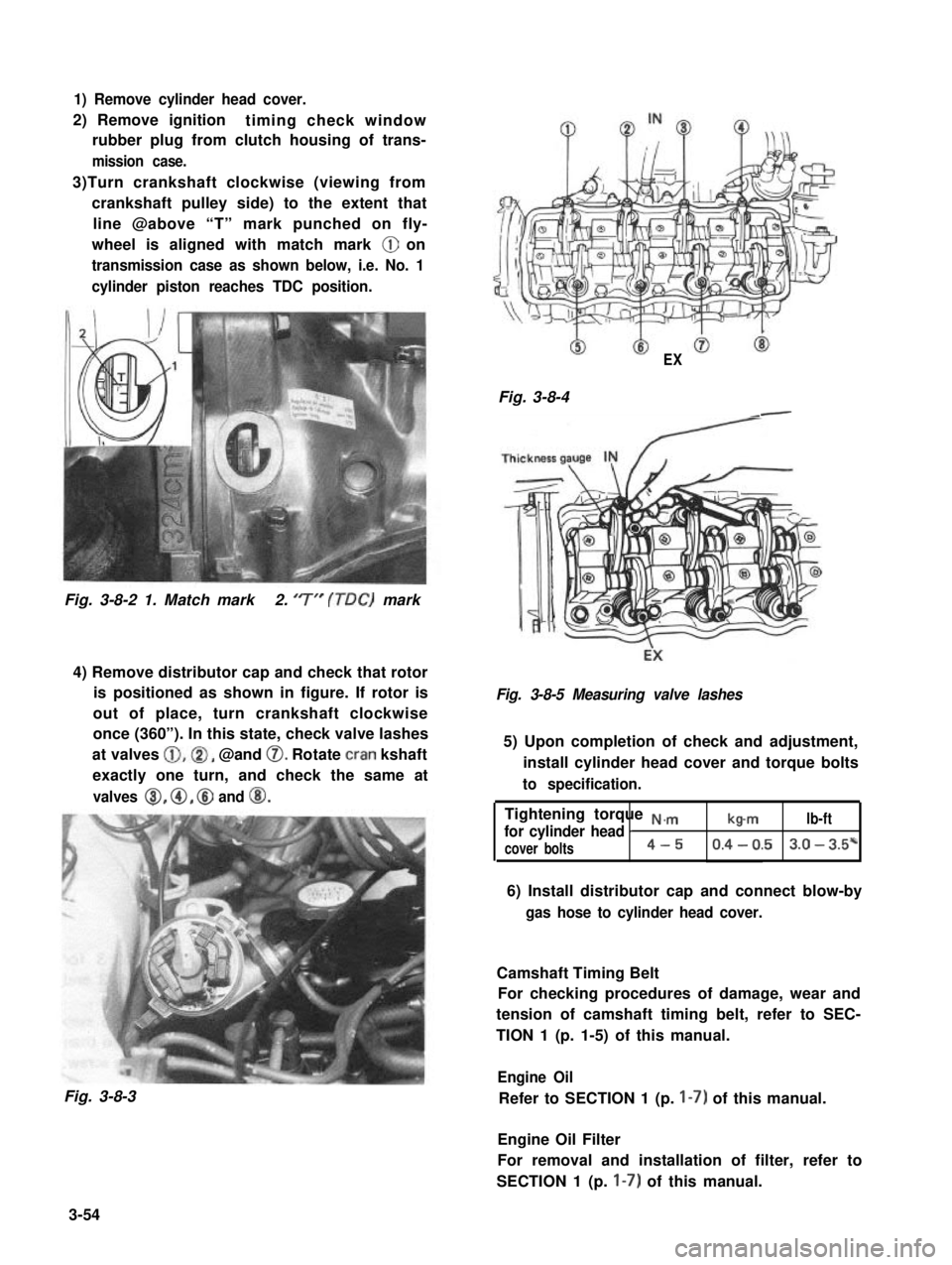
1) Remove cylinder head cover.
2) Remove ignitiontiming check window
rubber plug from clutch housing of trans-
mission case.
3)Turn crankshaft clockwise (viewing from
crankshaft pulley side) to the extent that
line @above “T” mark punched on fly-
wheel is aligned with match mark @ on
transmission case as shown below, i.e. No. 1
cylinder piston reaches TDC position.
Fig. 3-8-2 1. Match mark2. ‘7” (TDC) mark
4) Remove distributor cap and check that rotor
is positioned as shown in figure. If rotor is
out of place, turn crankshaft clockwise
once (360”). In this state, check valve lashes
at valves @,@I, @and 0. Rotate cran kshaft
exactly one turn, and check the same at
valves 8, @, @ and @I.
Fig. 3-8-3
EX
Fig. 3-8-4-
Fig. 3-8-5 Measuring valve lashes
5) Upon completion of check and adjustment,
install cylinder head cover and torque bolts
to specification.
Tightening torque N.,.,.,
for cylinder head Ib-mlb-ft
cover bolts4-50.4 - 0.53.0 - 3.5*
6) Install distributor cap and connect blow-by
gas hose to cylinder head cover.
Camshaft Timing Belt
For checking procedures of damage, wear and
tension of camshaft timing belt, refer to SEC-
TION 1 (p. 1-5) of this manual.
Engine Oil
Refer to SECTION 1 (p. I-7) of this manual.
Engine Oil Filter
For removal and installation of filter, refer to
SECTION 1 (p. I-7) of this manual.
3-54
Page 125 of 962

Choke System1) When coolant temperature is low:
This choke system is provided with a thermo-
wax which operates according to the heat from
the engine coolant, causing the choke valve to
open and close as well as the fast idle system to
operate automatically.
As the thermo-wax is contracted and the
plunger is retracted, the choke valve linked
with the fast idle cam is closed. When the
engine is started in this state, the intake
manifold vacuum pulls the diaphragm of the
choke piston to the left (below figure). The
choke piston rod also moves to the left and
acts on the choke valve to open. However,
the choke valve is restricted by the plunger of
the thermo-wax through the choke lever.
Therefore, the rod cannot move to the left
far enough to open the choke valve wide and
has .to stop at a position where the choke
valve opening is small as shown in the figure.
In this state, the diaphragm contracts the
bucking spring.
8
6
1.Choke piston2.Vacuum3.Therms wax
4.Plunger5. Fast idle cam
6.Cam follower7.Throttle valve8.Choke valve
Fig. 4- I- 11Choke system
[Operation of choke system]
As the thermo-wax is contracted at the low
coolant temperature, the plunger of the thermo-
wax is retracted (at the up position) and the fast
idle cam rotates clockwise by the spring force.
As a result, the cam follower pushed down by
the cam causes the primary throttle valve to
open and brings about the fast idle state.
The thermo-wax expands as the coolant tempe-
rature rises and the plunger position lowers,
causing the fast idle cam to rotate counterclock-
wise. As a result, the throttle valve starts moving
to close. In this way, the throttle valve closes
gradually as the coolant temperature rises until
it reaches the idling position at the normal
temperature. Refer to Fig. 4-l -11.
1.Choke piston
2.Intake manifoldvacuum
3.Diaphragm
4. Choke piston rod
5.Choke valve
6.Choke lever
7.Bucking spring
Fig. 4- I- 12 When coolant temp. is low
2) When the coolant temperature rises:
The plunger lowers due to the expansion of
the thermo-wax. Then the fast idle cam rotates
counterclockwise and consequently the choke
lever clockwise. This allow the rod to move
further to the left by the bucking spring force
(below figure). Thus a wide opening of the
choke valve is obtained.
Hereafter, the plunger of the thermo-wax
moves futher down in accordance with the
coolant temperature rise. The lower the
plunger moves, the wider the choke valve
opening becomes, and it becomes fully open
at the normal coolant temperature.
4-10
Page 128 of 962

0 Connect electric couplers securely.
l Connect accelerator cable to carburetor. With
the accelerator pedal released, adjust the cable
play to specification. This adjustment can be
made by turning the adjusting nut. After
adjustment, tighten the lock nut. Refer to
p. 4-19.
l Connect vacuum hoses securely.
l Refill cooling system.
l Connect negative cable at battery.
NOTE:
Upon completion of installation, be sure to
check each part for evidence of fuel leakage and
for proper operation. If defective, correct..
UNIT REPAIR OVERHAUL
This section outlines procedure to be used for
overhauling carburetor as removed from engine.
For removal and installation of carburetor from
and to engine, refer to the previous page.
NOTE:
l Be sure to replace gaskets as well as worn or
damaged parts.
l While disassembling and assembling carbure-
tor, use special care not to deform levers on
throttle valve shaft or cause damage to any
other parts.
l Don’t disassemble mixture control solenoid
valve and accelerator pump piston.
l Don’t remove idle and wide open micro
switches from the bracket where they are
installed.
Disassembly
1) Turn fast idle cam counterclockwise and
insert a pin avialable into holes on cam and
bracket to lock the cam.
Fig. 4- I- 19
1. Fast idle cam
2. Bracket3. Pin
4-13
Page 138 of 962
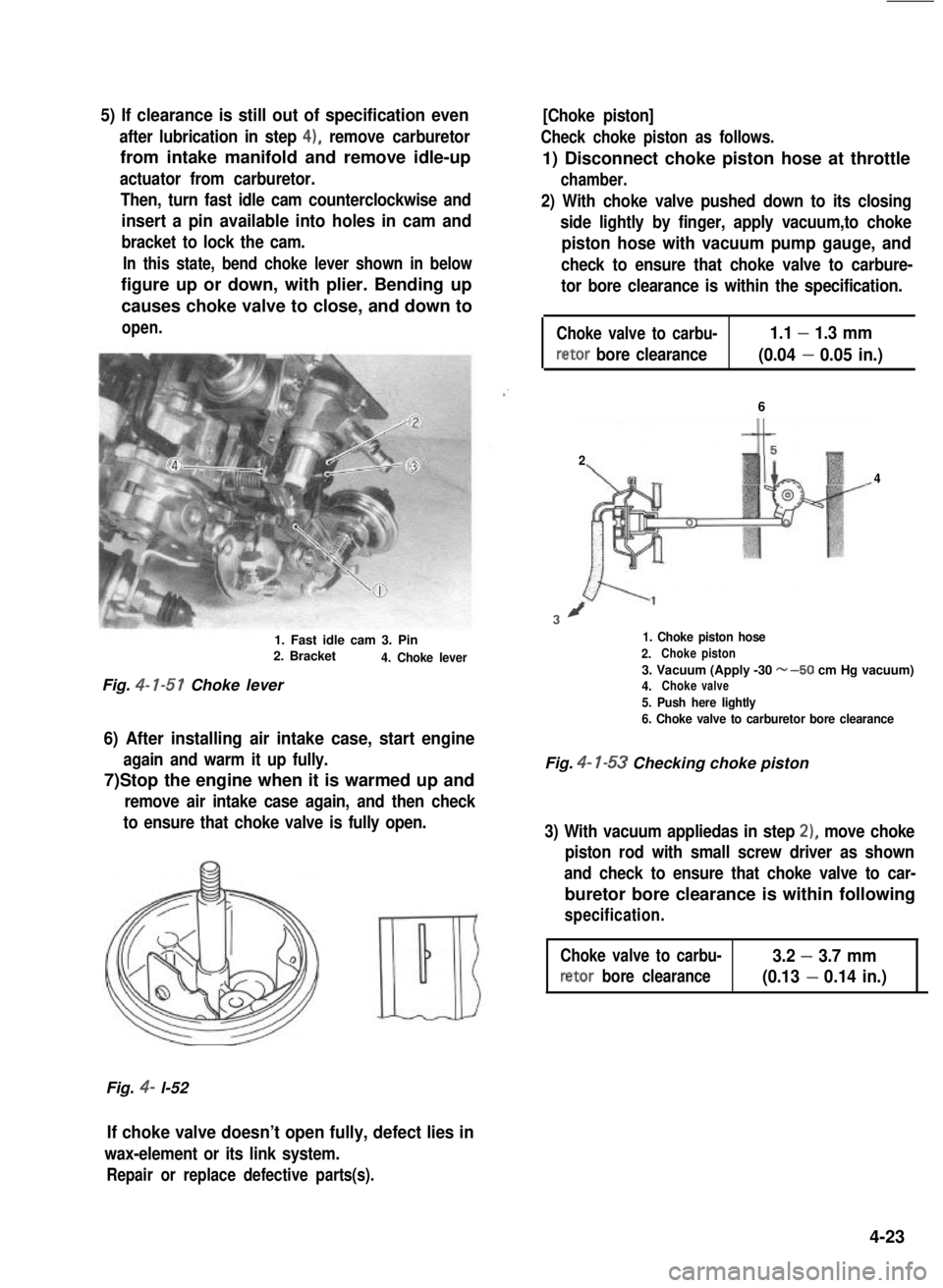
5) If clearance is still out of specification even
after lubrication in step 4), remove carburetor
from intake manifold and remove idle-up
actuator from carburetor.
Then, turn fast idle cam counterclockwise and
insert a pin available into holes in cam and
bracket to lock the cam.
In this state, bend choke lever shown in below
figure up or down, with plier. Bending up
causes choke valve to close, and down to
open.
1. Fast idle cam 3. Pin2. Bracket4. Choke lever
Fig. 4- l-51 Choke lever
6) After installing air intake case, start engine
again and warm it up fully.
7)Stop the engine when it is warmed up and
remove air intake case again, and then check
to ensure that choke valve is fully open.
Fig. 4- l-52
[Choke piston]
Check choke piston as follows.
1) Disconnect choke piston hose at throttle
chamber.
2) With choke valve pushed down to its closing
side lightly by finger, apply vacuum,to choke
piston hose with vacuum pump gauge, and
check to ensure that choke valve to carbure-
tor bore clearance is within the specification.
Choke valve to carbu-1.1 - 1.3 mm
retor bore clearance(0.04 - 0.05 in.)
6
2
4
3/
1. Choke piston hose
2.Chokepiston
3. Vacuum (Apply -30 w-50 cm Hg vacuum)4.Chokevalve
5. Push here lightly
6. Choke valve to carburetor bore clearance
Fig. 4- l-53 Checking choke piston
3) With vacuum appliedas in step 2), move choke
piston rod with small screw driver as shown
and check to ensure that choke valve to car-
buretor bore clearance is within following
specification.
Choke valve to carbu-3.2 - 3.7 mm
retor bore clearance(0.13 - 0.14 in.)
If choke valve doesn’t open fully, defect lies in
wax-element or its link system.
Repair or replace defective parts(s).
4-23
Page 175 of 962
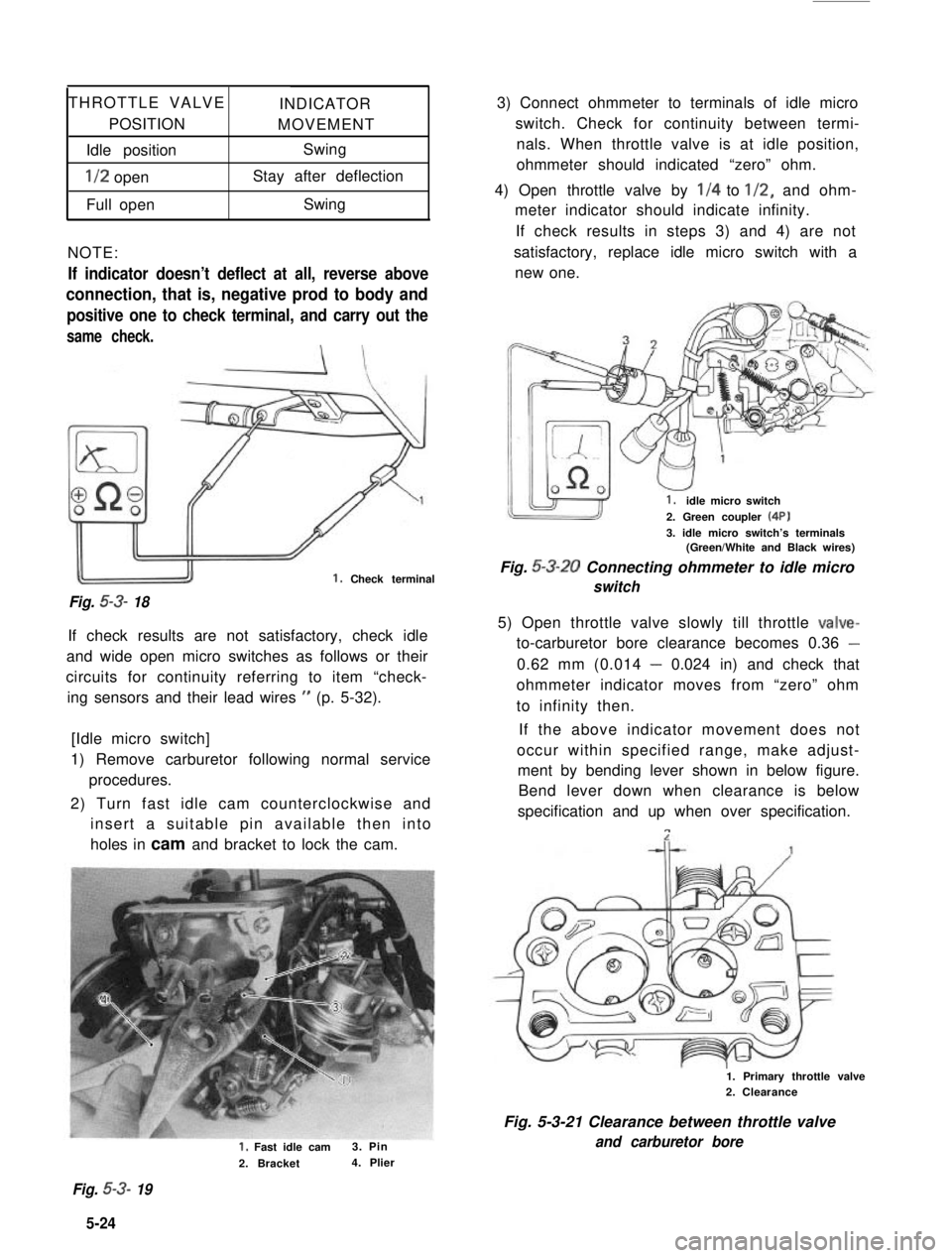
THROTTLE VALVEINDICATOR
POSITIONMOVEMENT
Idle positionSwing
l/2 openStay after deflection
Full openSwing
NOTE:
If indicator doesn’t deflect at all, reverse above
connection, that is, negative prod to body and
positive one to check terminal, and carry out the
same check.
Fig. 53- 18
1. Check terminal
If check results are not satisfactory, check idle
and wide open micro switches as follows or their
circuits for continuity referring to item “check-
ing sensors and their lead wires ” (p. 5-32).
[Idle micro switch]
1) Remove carburetor following normal service
procedures.
2) Turn fast idle cam counterclockwise and
insert a suitable pin available then into
holes in cam and bracket to lock the cam.
1, Fast idle cam3. Pin
2. Bracket4. Plier
3) Connect ohmmeter to terminals of idle micro
switch. Check for continuity between termi-
nals. When throttle valve is at idle position,
ohmmeter should indicated “zero” ohm.
4) Open throttle valve by l/4 to l/2, and ohm-
meter indicator should indicate infinity.
If check results in steps 3) and 4) are not
satisfactory, replace idle micro switch with a
new one.
1.idle micro switch
2. Green coupler (4P)
3. idle micro switch’s terminals(Green/White and Black wires)
Fig. 5-3-20 Connecting ohmmeter to idle micro
switch
5) Open throttle valve slowly till throttle valve-
to-carburetor bore clearance becomes 0.36 -
0.62 mm (0.014 - 0.024 in) and check that
ohmmeter indicator moves from “zero” ohm
to infinity then.
If the above indicator movement does not
occur within specified range, make adjust-
ment by bending lever shown in below figure.
Bend lever down when clearance is below
specification and up when over specification.
n
1. Primary throttle valve2. Clearance
Fig. 5-3-21 Clearance between throttle valve
and carburetor bore
Fig. 5-3- 19
5-24 4
Page 213 of 962
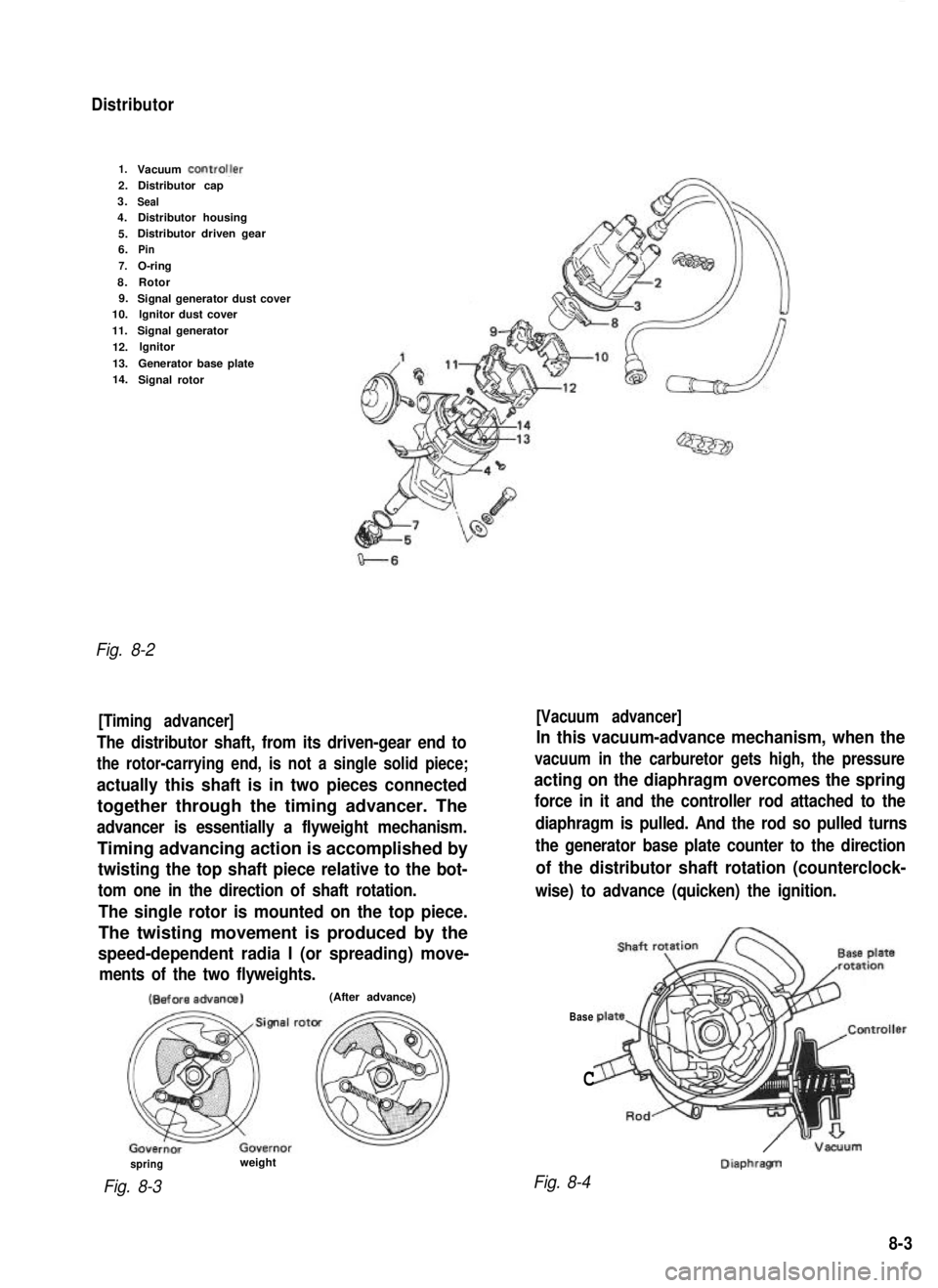
Distributor
1.Vacuum ControlJer2.Distributor cap
3.
Seal4. Distributor housing
5. Distributor driven gear
6.
Pin
7.
O-ring
8. Rotor
9. Signal generator dust cover
10. lgnitor dust cover
11. Signal generator
12. lgnitor
13. Generator base plate
14. Signal rotor
Fig. 8-2
[Timing advancer] [Vacuum advancer]
The distributor shaft, from its driven-gear end to
the rotor-carrying end, is not a single solid piece;
actually this shaft is in two pieces connected
together through the timing advancer. The
advancer is essentially a flyweight mechanism.
Timing advancing action is accomplished by
twisting the top shaft piece relative to the bot-
tom one in the direction of shaft rotation.
The single rotor is mounted on the top piece.
The twisting movement is produced by the
speed-dependent radia I (or spreading) move-
ments of the two flyweights.
In this vacuum-advance mechanism, when the
vacuum in the carburetor gets high, the pressure
acting on the diaphragm overcomes the spring
force in it and the controller rod attached to the
diaphragm is pulled. And the rod so pulled turns
the generator base plate counter to the direction
of the distributor shaft rotation (counterclock-
wise) to advance (quicken) the ignition. (Before
advanca)
(After advance)
Base
C
/ -Vacuum DiaphragTI
spring
Fig. 8-3
weight
Fig. 8-4
8-3
Page 219 of 962
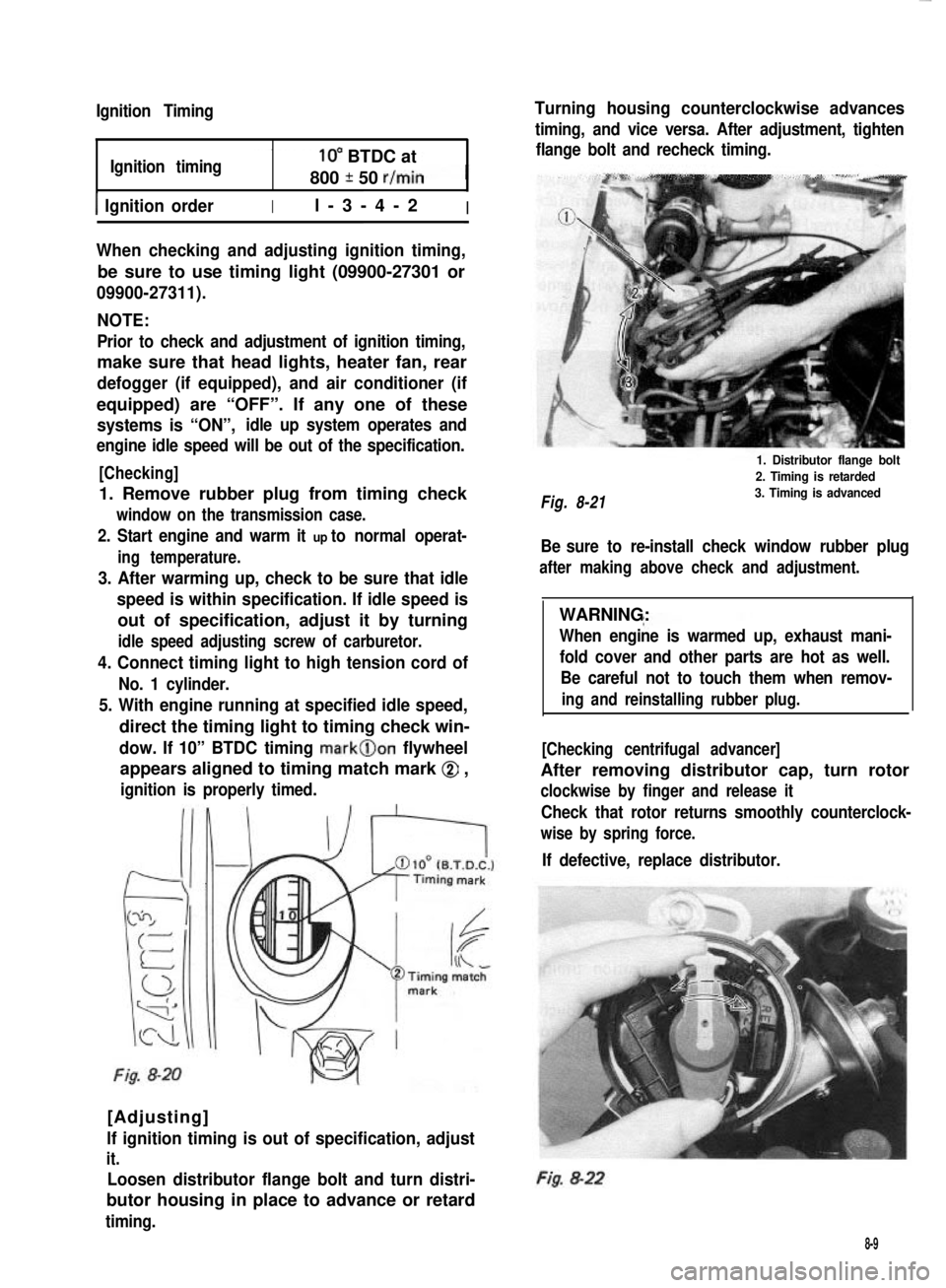
Ignition Timing
Ignition timing10” BTDC at
800 * 50 r/min
1 Ignition orderIl-3-4-2I
When checking and adjusting ignition timing,
be sure to use timing light (09900-27301 or
09900-27311).
NOTE:
Prior to check and adjustment of ignition timing,
make sure that head lights, heater fan, rear
defogger (if equipped), and air conditioner (if
equipped) are “OFF”. If any one of these
systems is “ON”,idle up system operates and
engine idle speed will be out of the specification.
[Checking]
1. Remove rubber plug from timing check
window on the transmission case.
2. Start engine and warm it up to normal operat-
ing temperature.
3. After warming up, check to be sure that idle
speed is within specification. If idle speed is
out of specification, adjust it by turning
idle speed adjusting screw of carburetor.
4. Connect timing light to high tension cord of
No. 1 cylinder.
5. With engine running at specified idle speed,
direct the timing light to timing check win-
dow. If 10” BTDC timing mark@on flywheel
appears aligned to timing match mark @ ,
ignition is properly timed.
Fig. 8-20
[Adjusting]
lf ignition timing is out of specification, adjust
it.
Loosen distributor flange bolt and turn distri-
butor housing in place to advance or retard
timing.
Turning housing counterclockwise advances
timing, and vice versa. After adjustment, tighten
flange bolt and recheck timing.
Fig. 8-21
1. Distributor flange bolt
2. Timing is retarded
3. Timing is advanced
Be sure to re-install check window rubber plug
after making above check and adjustment.
WARNING:
When engine is warmed up, exhaust mani-
fold cover and other parts are hot as well.
Be careful not to touch them when remov-
ing and reinstalling rubber plug.
[Checking centrifugal advancer]
After removing distributor cap, turn rotor
clockwise by finger and release it
Check that rotor returns smoothly counterclock-
wise by spring force.
If defective, replace distributor.
Fig. 8-22
8-9