front SUZUKI GRAND VITARA 1999 2.G User Guide
[x] Cancel search | Manufacturer: SUZUKI, Model Year: 1999, Model line: GRAND VITARA, Model: SUZUKI GRAND VITARA 1999 2.GPages: 656, PDF Size: 14.31 MB
Page 39 of 656
1B-14 AIR CONDITIONING (OPTIONAL)
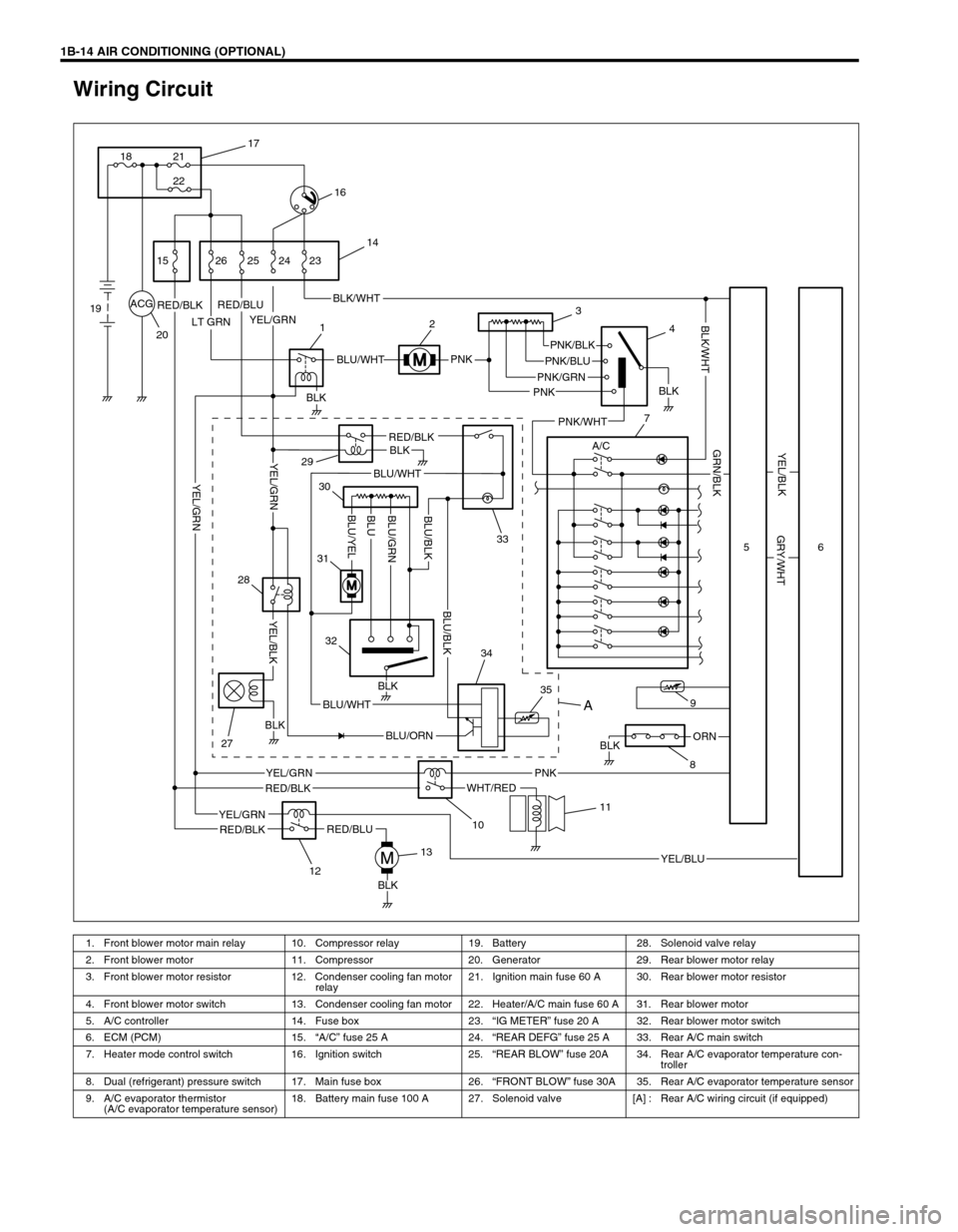
Wiring Circuit
ACG
LT GRN
PNK
PNK
BLKORN
BLK
YEL/GRNRED/BLKBLK/WHT
BLU/WHTPNK/BLK
PNK/GRN
RED/BLK
WHT/RED
YEL/GRN
YEL/BLU
A/C
RED/BLU
RED/BLU
RED/BLKBLK
BLU/ORN
BLU/WHT
BLU/WHT
PNK
PNK/BLU
BLK
PNK/WHT
YEL/BLK
GRY/WHT
GRN/BLK
BLK/WHT
RED/BLK
YEL/GRN
BLK
BLK
BLK
YEL/BLK
YEL/GRN
YEL/GRNBLU/GRN
BLU/YELBLUBLU/BLK
BLU/BLK
17
21
22 18
16
15
19
2026 25 24 23
14
12
29
3
4
7
33 30
31
32
28
27
1213
10
11
35 349
856
A
1. Front blower motor main relay 10. Compressor relay 19. Battery 28. Solenoid valve relay
2. Front blower motor 11. Compressor 20. Generator 29. Rear blower motor relay
3. Front blower motor resistor 12. Condenser cooling fan motor
relay21. Ignition main fuse 60 A 30. Rear blower motor resistor
4. Front blower motor switch 13. Condenser cooling fan motor 22. Heater/A/C main fuse 60 A 31. Rear blower motor
5. A/C controller 14. Fuse box 23.“IG METER” fuse 20 A 32. Rear blower motor switch
6. ECM (PCM) 15.“A/C” fuse 25 A 24.“REAR DEFG” fuse 25 A 33. Rear A/C main switch
7. Heater mode control switch 16. Ignition switch 25.“REAR BLOW” fuse 20A 34. Rear A/C evaporator temperature con-
troller
8. Dual (refrigerant) pressure switch 17. Main fuse box 26.“FRONT BLOW” fuse 30A 35. Rear A/C evaporator temperature sensor
9. A/C evaporator thermistor
(A/C evaporator temperature sensor)18. Battery main fuse 100 A 27. Solenoid valve [A] : Rear A/C wiring circuit (if equipped)
Page 41 of 656
1B-16 AIR CONDITIONING (OPTIONAL)
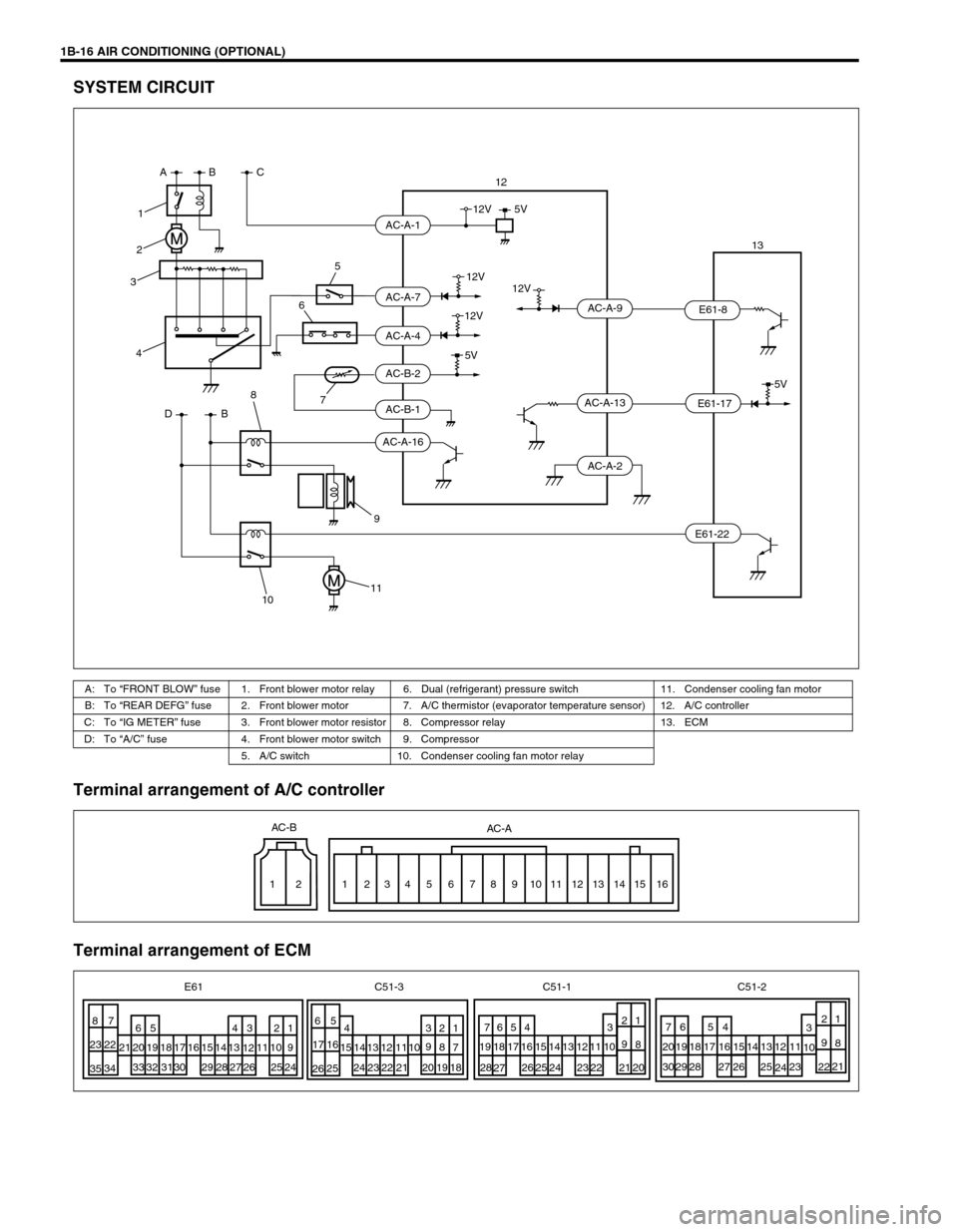
SYSTEM CIRCUIT
Terminal arrangement of A/C controller
Terminal arrangement of ECM
A: To “FRONT BLOW” fuse 1. Front blower motor relay 6. Dual (refrigerant) pressure switch 11. Condenser cooling fan motor
B: To “REAR DEFG” fuse 2. Front blower motor 7. A/C thermistor (evaporator temperature sensor) 12. A/C controller
C: To “IG METER” fuse 3. Front blower motor resistor 8. Compressor relay 13. ECM
D: To “A/C” fuse 4. Front blower motor switch 9. Compressor
5. A/C switch 10. Condenser cooling fan motor relay
5V
12V12V
12V5V
12V
5V
AC-A-1
AC-A-7
AC-A-4
AC-B-2
AC-B-1
AC-A-16AC-A-9
AC-A-2 AC-A-13
E61-8
E61-17
E61-22
A
DBBC
1
2
3
4
7 865
1011912
13
12 12
3
45 6 7 8 9 101112131415 16 AC-B
AC-A
87
22 23
34
3565
16 17
25
262
1
8 9
20
212
1
8 9
21
22 1 2 3 4 5 6
9
24 25 26 27 28 29 30 31 32 3310 11
12 13 14 15 16 17 18 19 20 211 2 3 4
7 8 9
10 11 12 13 14 15
18 19 20 21 22 23 243 4 5 6 7
10 11 12 13 14 15 16 17 18 19
22 23 24 25 26
27 283 4 5 6 7
10 11 12 13 14 15 16 19 18 2017
23
24 25 26 27 29 28 30 E61 C51-3 C51-1 C51-2
Page 50 of 656
AIR CONDITIONING (OPTIONAL) 1B-25
On-Vehicle Service
Precaution
When servicing air conditioning system, the following rules must be observed.
Piping
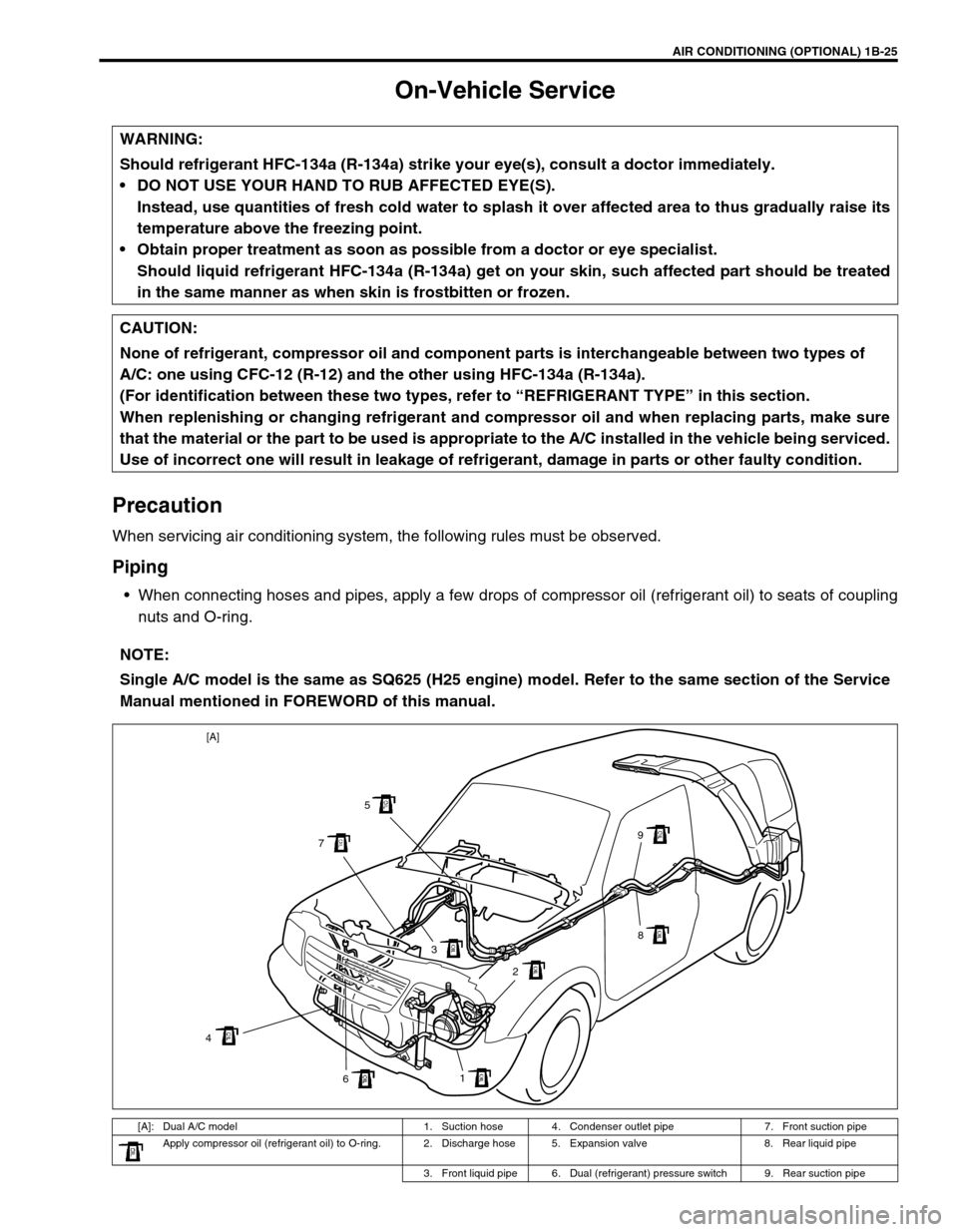
When connecting hoses and pipes, apply a few drops of compressor oil (refrigerant oil) to seats of coupling
nuts and O-ring. WARNING:
Should refrigerant HFC-134a (R-134a) strike your eye(s), consult a doctor immediately.
DO NOT USE YOUR HAND TO RUB AFFECTED EYE(S).
Instead, use quantities of fresh cold water to splash it over affected area to thus gradually raise its
temperature above the freezing point.
Obtain proper treatment as soon as possible from a doctor or eye specialist.
Should liquid refrigerant HFC-134a (R-134a) get on your skin, such affected part should be treated
in the same manner as when skin is frostbitten or frozen.
CAUTION:
None of refrigerant, compressor oil and component parts is interchangeable between two types of
A/C: one using CFC-12 (R-12) and the other using HFC-134a (R-134a).
(For identification between these two types, refer to “REFRIGERANT TYPE” in this section.
When replenishing or changing refrigerant and compressor oil and when replacing parts, make sure
that the material or the part to be used is appropriate to the A/C installed in the vehicle being serviced.
Use of incorrect one will result in leakage of refrigerant, damage in parts or other faulty condition.
NOTE:
Single A/C model is the same as SQ625 (H25 engine) model. Refer to the same section of the Service
Manual mentioned in FOREWORD of this manual.
[A]: Dual A/C model 1. Suction hose 4. Condenser outlet pipe 7. Front suction pipe
Apply compressor oil (refrigerant oil) to O-ring. 2. Discharge hose 5. Expansion valve 8. Rear liquid pipe
3. Front liquid pipe 6. Dual (refrigerant) pressure switch 9. Rear suction pipe
1
6 43 75
9
8
2 [A]
Page 59 of 656
1B-34 AIR CONDITIONING (OPTIONAL)
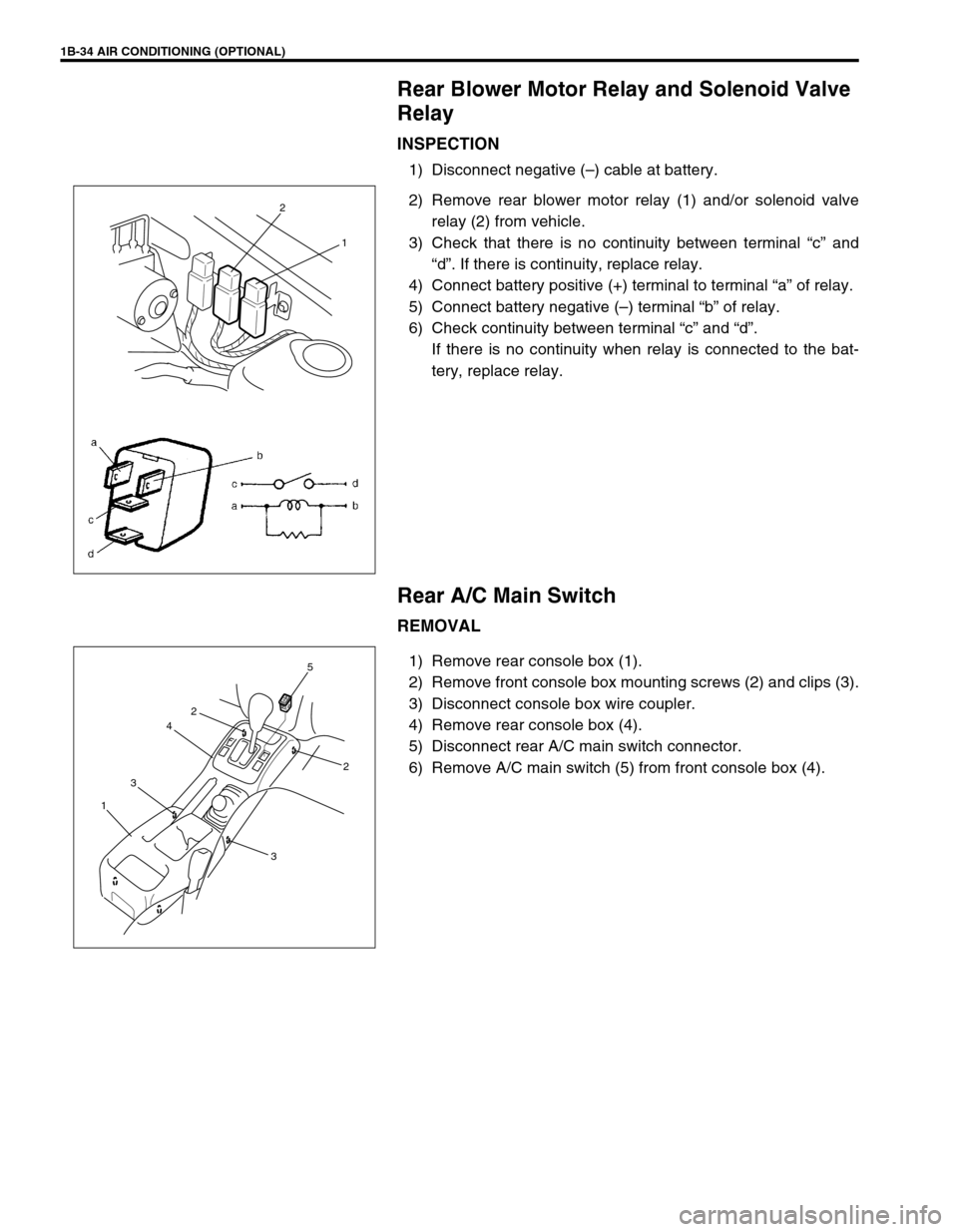
Rear Blower Motor Relay and Solenoid Valve
Relay
INSPECTION
1) Disconnect negative (–) cable at battery.
2) Remove rear blower motor relay (1) and/or solenoid valve
relay (2) from vehicle.
3) Check that there is no continuity between terminal “c” and
“d”. If there is continuity, replace relay.
4) Connect battery positive (+) terminal to terminal “a” of relay.
5) Connect battery negative (–) terminal “b” of relay.
6) Check continuity between terminal “c” and “d”.
If there is no continuity when relay is connected to the bat-
tery, replace relay.
Rear A/C Main Switch
REMOVAL
1) Remove rear console box (1).
2) Remove front console box mounting screws (2) and clips (3).
3) Disconnect console box wire coupler.
4) Remove rear console box (4).
5) Disconnect rear A/C main switch connector.
6) Remove A/C main switch (5) from front console box (4).
2
1
2
4
3
15
2
3
Page 70 of 656
FRONT END ALIGNMENT 3A-1
3A
SECTION 3A
FRONT END ALIGNMENT
CONTENTS
General Information ........................................3A-1
Alignment Service Data (without Load) ......... 3A-1On-Vehicle Service ......................................... 3A-1
Reference Information .................................. 3A-1
General Information
Alignment Service Data (without Load)
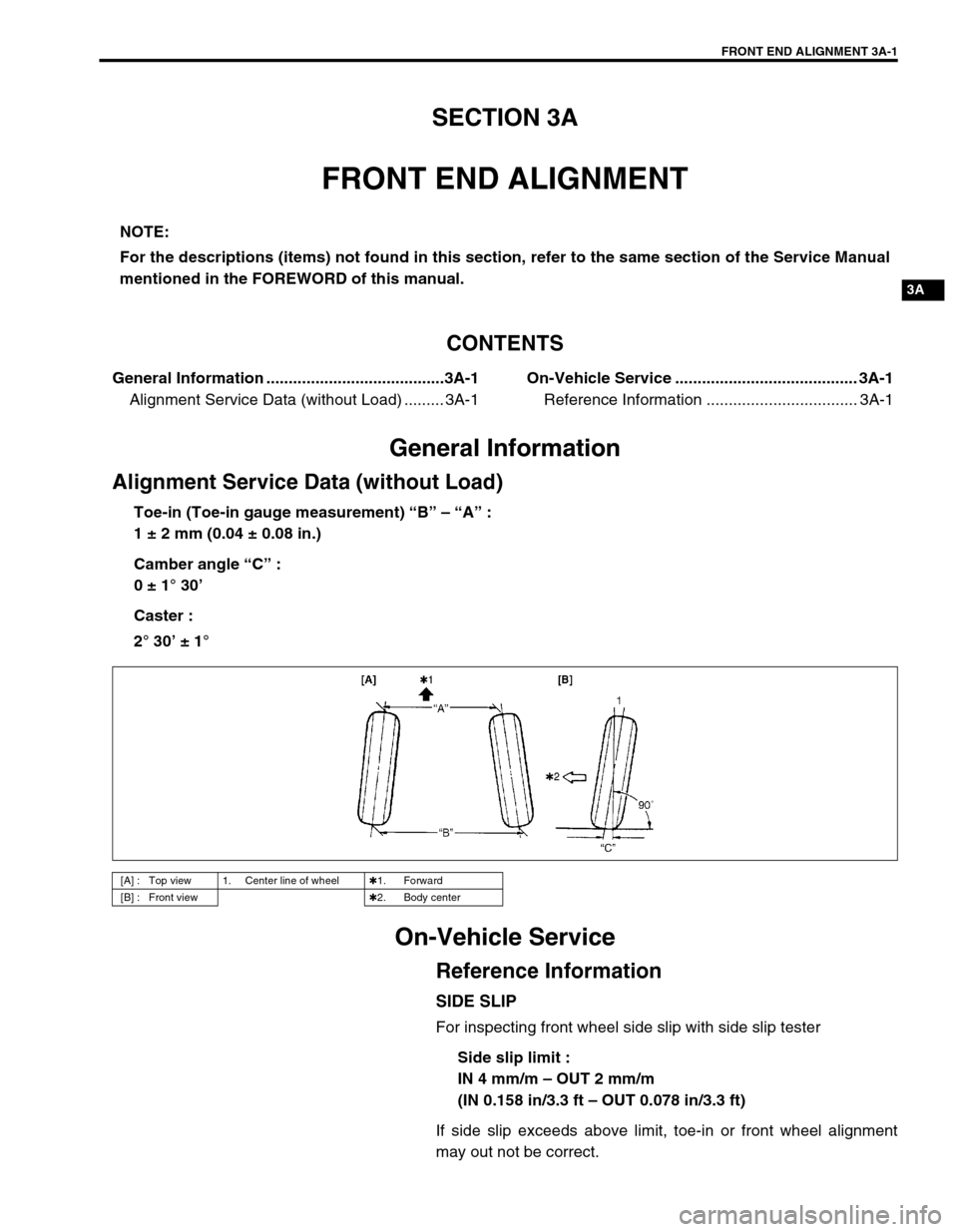
Toe-in (Toe-in gauge measurement) “B” – “A” :
1 ± 2 mm (0.04 ± 0.08 in.)
Camber angle “C” :
0 ± 1° 30’
Caster :
2° 30’ ± 1°
On-Vehicle Service
Reference Information
SIDE SLIP
For inspecting front wheel side slip with side slip tester
Side slip limit :
IN 4 mm/m – OUT 2 mm/m
(IN 0.158 in/3.3 ft – OUT 0.078 in/3.3 ft)
If side slip exceeds above limit, toe-in or front wheel alignment
may out not be correct. NOTE:
For the descriptions (items) not found in this section, refer to the same section of the Service Manual
mentioned in the FOREWORD of this manual.
[A] : Top view 1. Center line of wheel✱1. Forward
[B] : Front view✱2. Body center
Page 71 of 656
3A-2 FRONT END ALIGNMENT
Page 77 of 656
3C1-2 AIR BAG STEERING WHEEL AND COLUMN
General Description
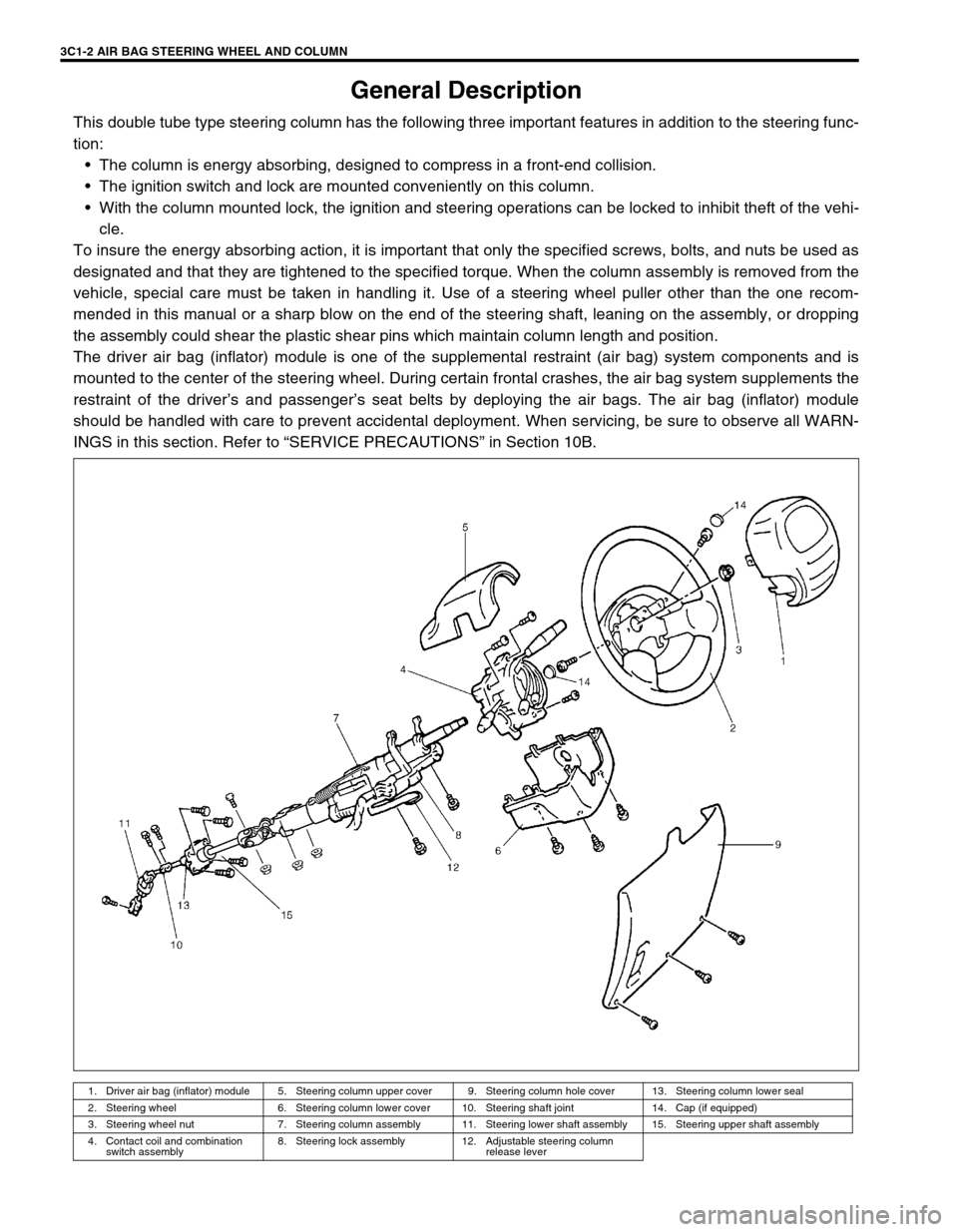
This double tube type steering column has the following three important features in addition to the steering func-
tion:
The column is energy absorbing, designed to compress in a front-end collision.
The ignition switch and lock are mounted conveniently on this column.
With the column mounted lock, the ignition and steering operations can be locked to inhibit theft of the vehi-
cle.
To insure the energy absorbing action, it is important that only the specified screws, bolts, and nuts be used as
designated and that they are tightened to the specified torque. When the column assembly is removed from the
vehicle, special care must be taken in handling it. Use of a steering wheel puller other than the one recom-
mended in this manual or a sharp blow on the end of the steering shaft, leaning on the assembly, or dropping
the assembly could shear the plastic shear pins which maintain column length and position.
The driver air bag (inflator) module is one of the supplemental restraint (air bag) system components and is
mounted to the center of the steering wheel. During certain frontal crashes, the air bag system supplements the
restraint of the driver’s and passenger’s seat belts by deploying the air bags. The air bag (inflator) module
should be handled with care to prevent accidental deployment. When servicing, be sure to observe all WARN-
INGS in this section. Refer to “SERVICE PRECAUTIONS” in Section 10B.
1. Driver air bag (inflator) module 5. Steering column upper cover 9. Steering column hole cover 13. Steering column lower seal
2. Steering wheel 6. Steering column lower cover 10. Steering shaft joint 14. Cap (if equipped)
3. Steering wheel nut 7. Steering column assembly 11. Steering lower shaft assembly 15. Steering upper shaft assembly
4. Contact coil and combination
switch assembly8. Steering lock assembly 12. Adjustable steering column
release lever
Page 79 of 656
3C1-4 AIR BAG STEERING WHEEL AND COLUMN
Steering Column
REMOVAL
1) Disconnect negative (–) cable at battery.
2) Disable air bag system. Refer to “DISABLING AIR BAG SYSTEM” under “SERVICE PRECAUTIONS” in
Section 10B.
3) Remove steering wheel and contact coil and combination switch assembly, if necessary. Refer to “STEER-
ING WHEEL” and “CONTACT COIL AND COMBINATION SWITCH ASSEMBLY” in this section.
Perform the following procedure if not removing steering wheel and/or combination switch.
a) Turn steering wheel so that vehicle’s front tires are at straight-ahead position.
b) Turn ignition switch to “LOCK” position and remove key.
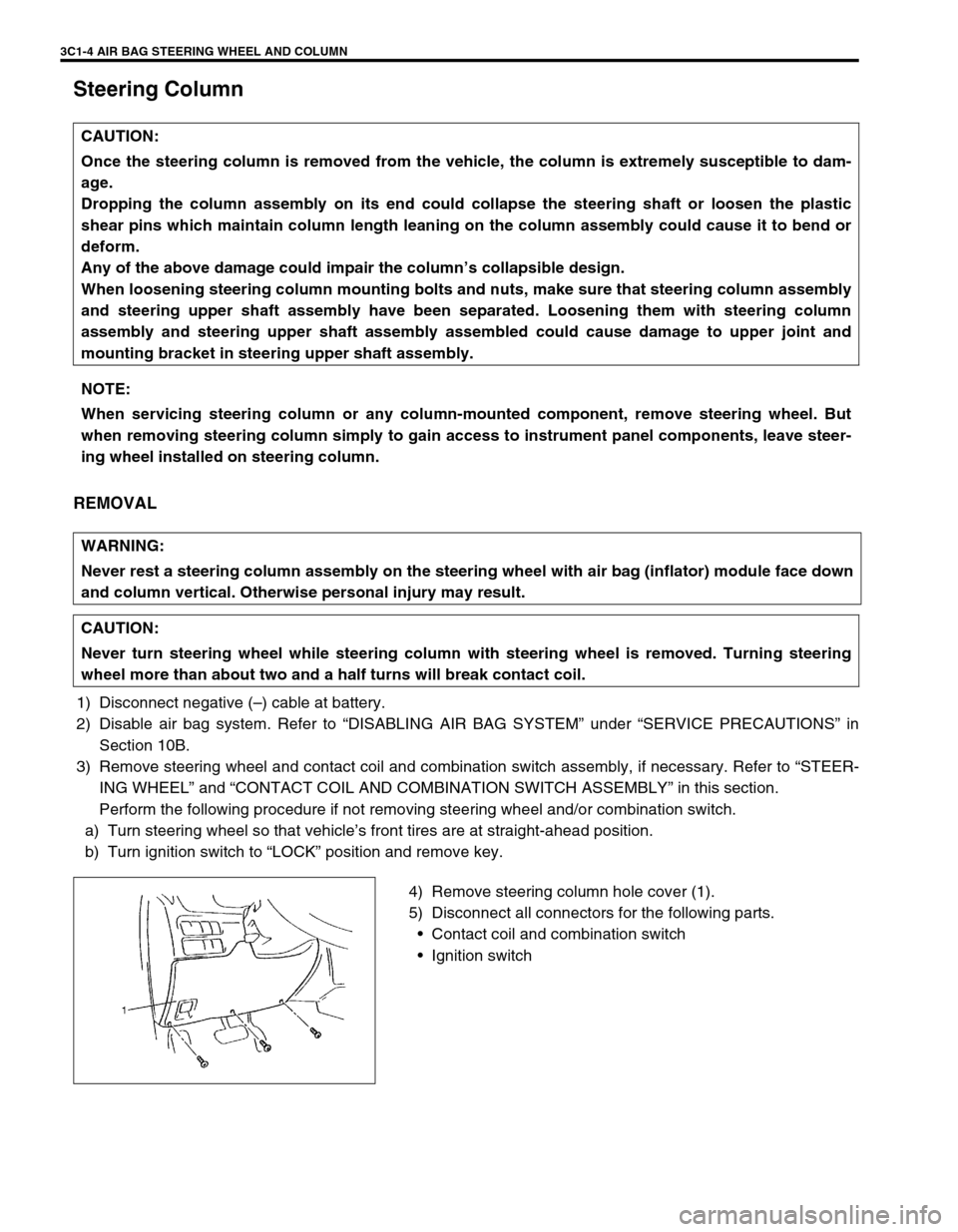
4) Remove steering column hole cover (1).
5) Disconnect all connectors for the following parts.
Contact coil and combination switch
Ignition switch CAUTION:
Once the steering column is removed from the vehicle, the column is extremely susceptible to dam-
age.
Dropping the column assembly on its end could collapse the steering shaft or loosen the plastic
shear pins which maintain column length leaning on the column assembly could cause it to bend or
deform.
Any of the above damage could impair the column’s collapsible design.
When loosening steering column mounting bolts and nuts, make sure that steering column assembly
and steering upper shaft assembly have been separated. Loosening them with steering column
assembly and steering upper shaft assembly assembled could cause damage to upper joint and
mounting bracket in steering upper shaft assembly.
NOTE:
When servicing steering column or any column-mounted component, remove steering wheel. But
when removing steering column simply to gain access to instrument panel components, leave steer-
ing wheel installed on steering column.
WARNING:
Never rest a steering column assembly on the steering wheel with air bag (inflator) module face down
and column vertical. Otherwise personal injury may result.
CAUTION:
Never turn steering wheel while steering column with steering wheel is removed. Turning steering
wheel more than about two and a half turns will break contact coil.
Page 80 of 656
AIR BAG STEERING WHEEL AND COLUMN 3C1-5
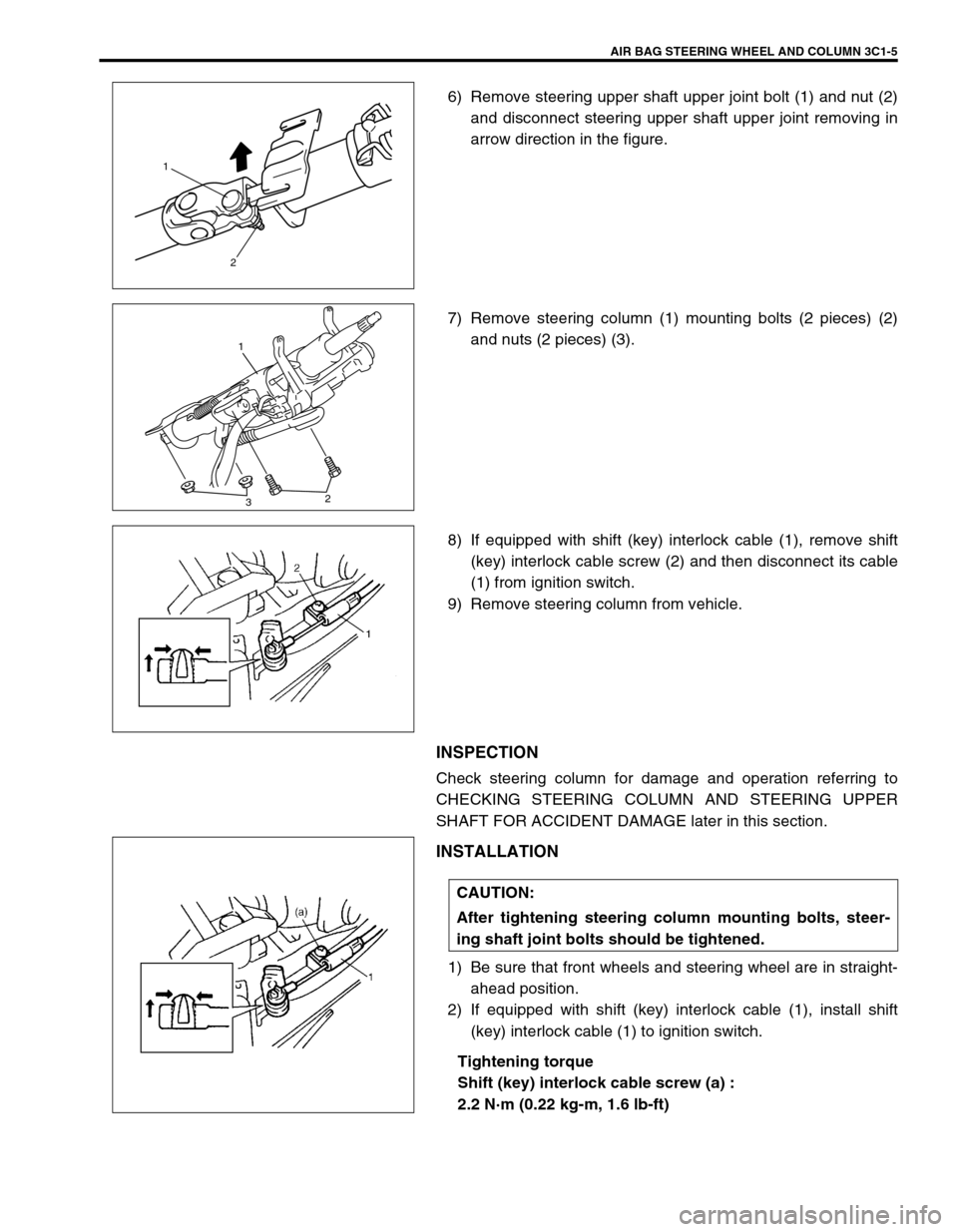
6) Remove steering upper shaft upper joint bolt (1) and nut (2)
and disconnect steering upper shaft upper joint removing in
arrow direction in the figure.
7) Remove steering column (1) mounting bolts (2 pieces) (2)
and nuts (2 pieces) (3).
8) If equipped with shift (key) interlock cable (1), remove shift
(key) interlock cable screw (2) and then disconnect its cable
(1) from ignition switch.
9) Remove steering column from vehicle.
INSPECTION
Check steering column for damage and operation referring to
CHECKING STEERING COLUMN AND STEERING UPPER
SHAFT FOR ACCIDENT DAMAGE later in this section.
INSTALLATION
1) Be sure that front wheels and steering wheel are in straight-
ahead position.
2) If equipped with shift (key) interlock cable (1), install shift
(key) interlock cable (1) to ignition switch.
Tightening torque
Shift (key) interlock cable screw (a) :
2.2 N·m (0.22 kg-m, 1.6 lb-ft)
1
2
1
32
CAUTION:
After tightening steering column mounting bolts, steer-
ing shaft joint bolts should be tightened.
Page 82 of 656
AIR BAG STEERING WHEEL AND COLUMN 3C1-7
Steering Upper Shaft Assembly
REMOVAL
1) Turn steering wheel so that vehicle’s front tires are at
straight-ahead position.
2) Turn ignition switch to “LOCK” position and remove key.
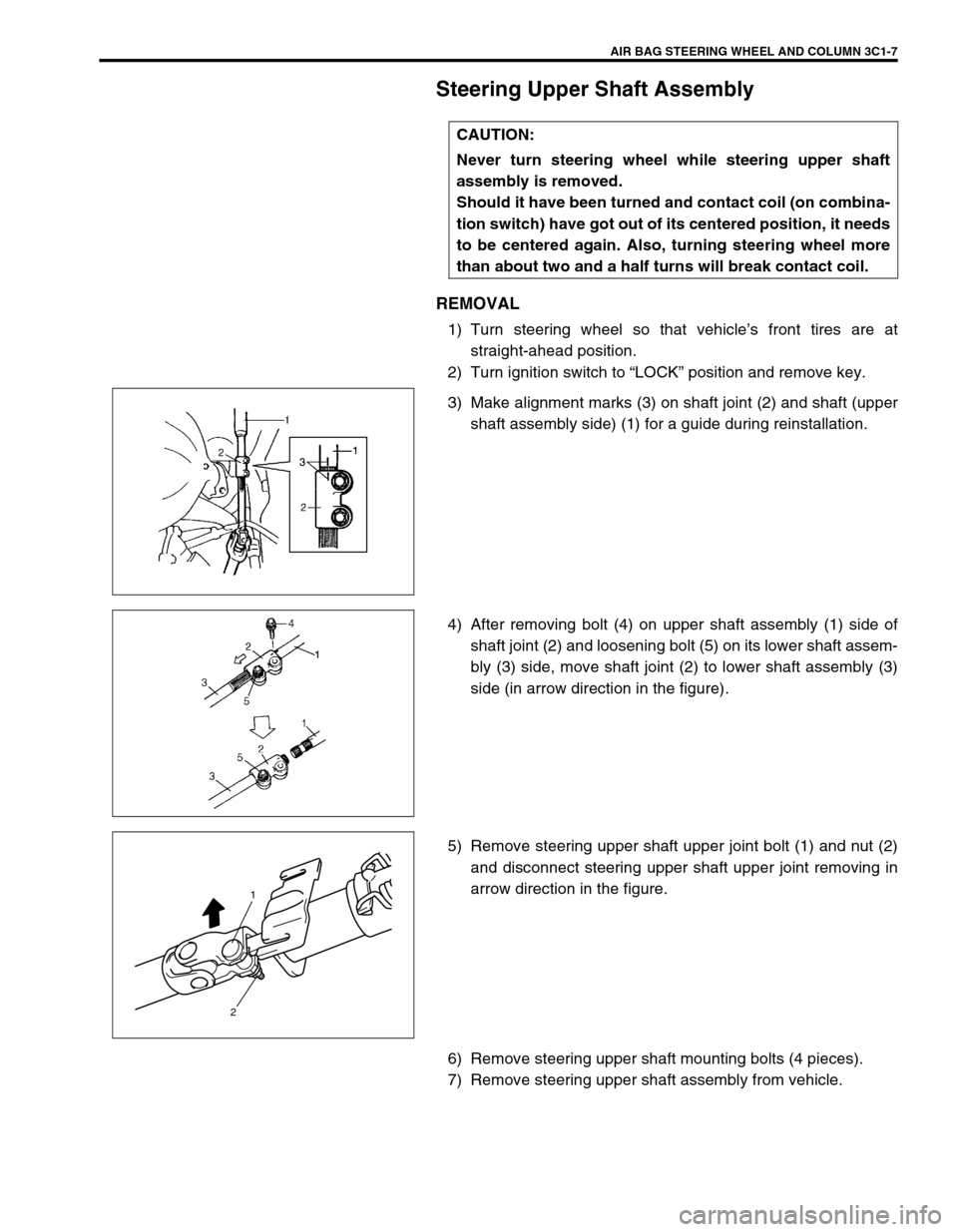
3) Make alignment marks (3) on shaft joint (2) and shaft (upper
shaft assembly side) (1) for a guide during reinstallation.
4) After removing bolt (4) on upper shaft assembly (1) side of
shaft joint (2) and loosening bolt (5) on its lower shaft assem-
bly (3) side, move shaft joint (2) to lower shaft assembly (3)
side (in arrow direction in the figure).
5) Remove steering upper shaft upper joint bolt (1) and nut (2)
and disconnect steering upper shaft upper joint removing in
arrow direction in the figure.
6) Remove steering upper shaft mounting bolts (4 pieces).
7) Remove steering upper shaft assembly from vehicle.CAUTION:
Never turn steering wheel while steering upper shaft
assembly is removed.
Should it have been turned and contact coil (on combina-
tion switch) have got out of its centered position, it needs
to be centered again. Also, turning steering wheel more
than about two and a half turns will break contact coil.
1
2