front SUZUKI GRAND VITARA 1999 2.G Workshop Manual
[x] Cancel search | Manufacturer: SUZUKI, Model Year: 1999, Model line: GRAND VITARA, Model: SUZUKI GRAND VITARA 1999 2.GPages: 656, PDF Size: 14.31 MB
Page 314 of 656
ENGINE MECHANICAL (H27 ENGINE) 6A2-27
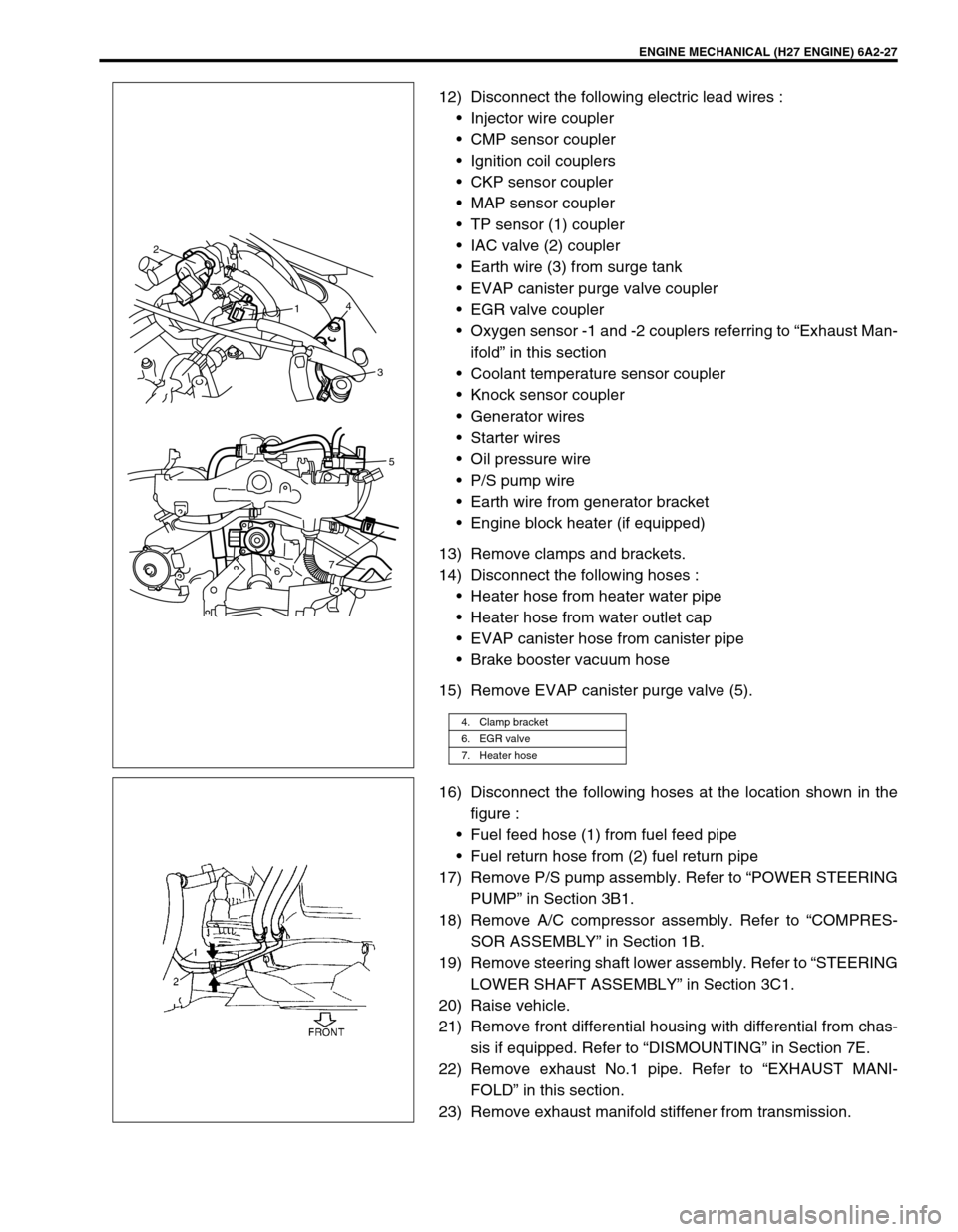
12) Disconnect the following electric lead wires :
•Injector wire coupler
•CMP sensor coupler
•Ignition coil couplers
•CKP sensor coupler
•MAP sensor coupler
•TP sensor (1) coupler
•IAC valve (2) coupler
•Earth wire (3) from surge tank
•EVAP canister purge valve coupler
•EGR valve coupler
•Oxygen sensor -1 and -2 couplers referring to “Exhaust Man-
ifold” in this section
•Coolant temperature sensor coupler
•Knock sensor coupler
•Generator wires
•Starter wires
•Oil pressure wire
•P/S pump wire
•Earth wire from generator bracket
•Engine block heater (if equipped)
13) Remove clamps and brackets.
14) Disconnect the following hoses :
•Heater hose from heater water pipe
•Heater hose from water outlet cap
•EVAP canister hose from canister pipe
•Brake booster vacuum hose
15) Remove EVAP canister purge valve (5).
16) Disconnect the following hoses at the location shown in the
figure :
•Fuel feed hose (1) from fuel feed pipe
•Fuel return hose from (2) fuel return pipe
17) Remove P/S pump assembly. Refer to “POWER STEERING
PUMP” in Section 3B1.
18) Remove A/C compressor assembly. Refer to “COMPRES-
SOR ASSEMBLY” in Section 1B.
19) Remove steering shaft lower assembly. Refer to “STEERING
LOWER SHAFT ASSEMBLY” in Section 3C1.
20) Raise vehicle.
21) Remove front differential housing with differential from chas-
sis if equipped. Refer to “DISMOUNTING” in Section 7E.
22) Remove exhaust No.1 pipe. Refer to “EXHAUST MANI-
FOLD” in this section.
23) Remove exhaust manifold stiffener from transmission.
4. Clamp bracket
6. EGR valve
7. Heater hose
2
14
3
75
6
Page 315 of 656
6A2-28 ENGINE MECHANICAL (H27 ENGINE)
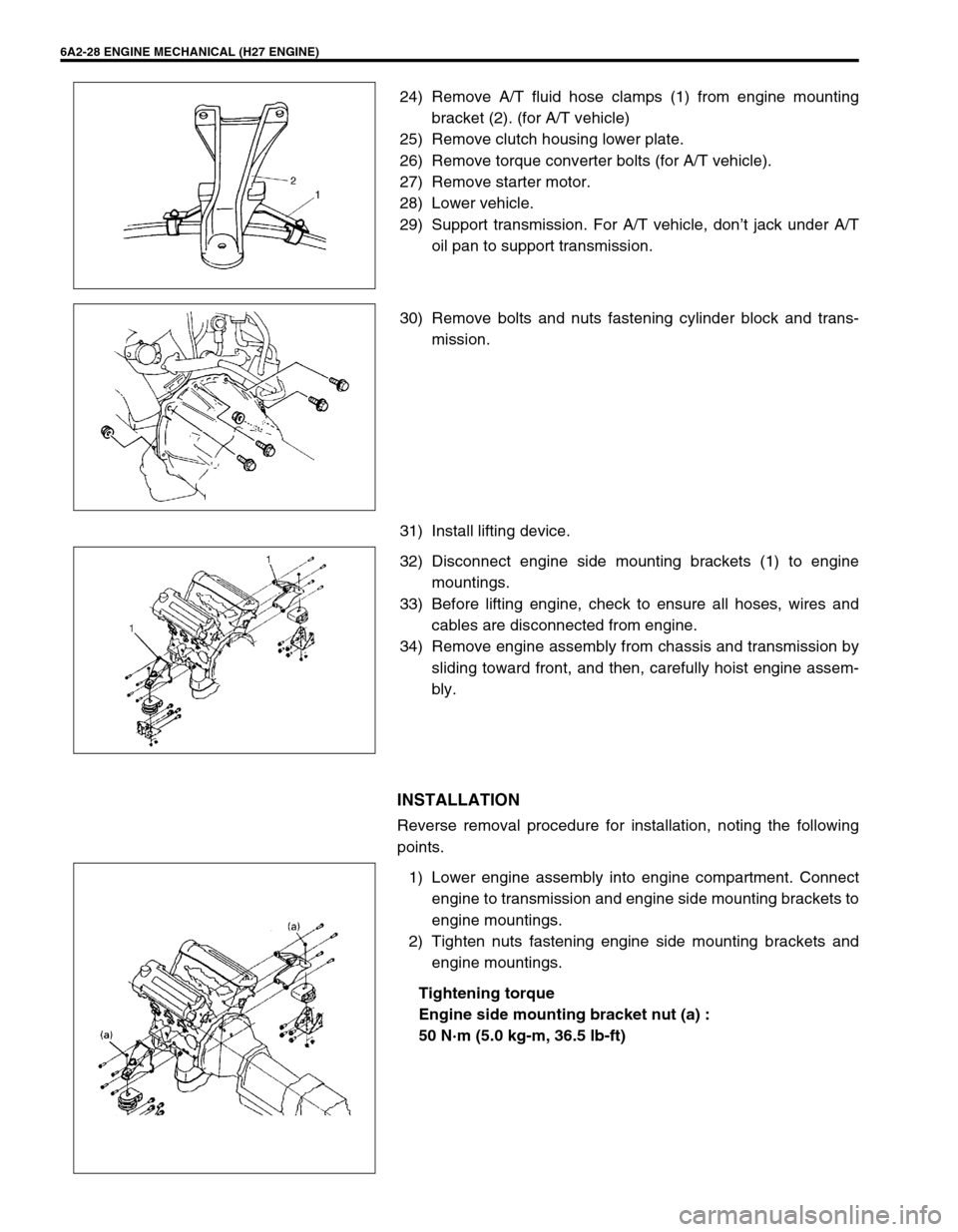
24) Remove A/T fluid hose clamps (1) from engine mounting
bracket (2). (for A/T vehicle)
25) Remove clutch housing lower plate.
26) Remove torque converter bolts (for A/T vehicle).
27) Remove starter motor.
28) Lower vehicle.
29) Support transmission. For A/T vehicle, don’t jack under A/T
oil pan to support transmission.
30) Remove bolts and nuts fastening cylinder block and trans-
mission.
31) Install lifting device.
32) Disconnect engine side mounting brackets (1) to engine
mountings.
33) Before lifting engine, check to ensure all hoses, wires and
cables are disconnected from engine.
34) Remove engine assembly from chassis and transmission by
sliding toward front, and then, carefully hoist engine assem-
bly.
INSTALLATION
Reverse removal procedure for installation, noting the following
points.
1) Lower engine assembly into engine compartment. Connect
engine to transmission and engine side mounting brackets to
engine mountings.
2) Tighten nuts fastening engine side mounting brackets and
engine mountings.
Tightening torque
Engine side mounting bracket nut (a) :
50 N·m (5.0 kg-m, 36.5 lb-ft)
Page 316 of 656
ENGINE MECHANICAL (H27 ENGINE) 6A2-29
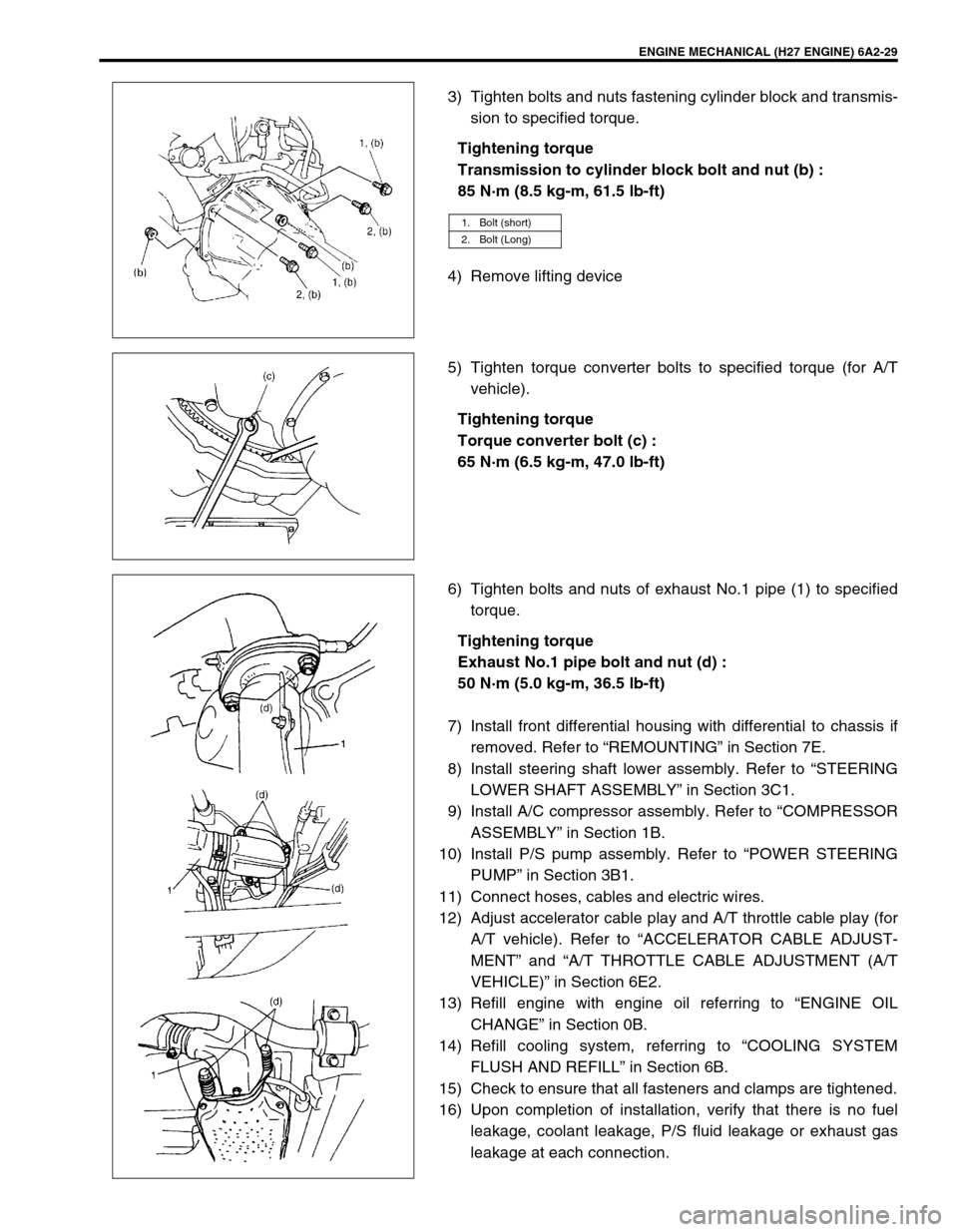
3) Tighten bolts and nuts fastening cylinder block and transmis-
sion to specified torque.
Tightening torque
Transmission to cylinder block bolt and nut (b) :
85 N·m (8.5 kg-m, 61.5 lb-ft)
4) Remove lifting device
5) Tighten torque converter bolts to specified torque (for A/T
vehicle).
Tightening torque
Torque converter bolt (c) :
65 N·m (6.5 kg-m, 47.0 lb-ft)
6) Tighten bolts and nuts of exhaust No.1 pipe (1) to specified
torque.
Tightening torque
Exhaust No.1 pipe bolt and nut (d) :
50 N·m (5.0 kg-m, 36.5 lb-ft)
7) Install front differential housing with differential to chassis if
removed. Refer to “REMOUNTING” in Section 7E.
8) Install steering shaft lower assembly. Refer to “STEERING
LOWER SHAFT ASSEMBLY” in Section 3C1.
9) Install A/C compressor assembly. Refer to “COMPRESSOR
ASSEMBLY” in Section 1B.
10) Install P/S pump assembly. Refer to “POWER STEERING
PUMP” in Section 3B1.
11) Connect hoses, cables and electric wires.
12) Adjust accelerator cable play and A/T throttle cable play (for
A/T vehicle). Refer to “ACCELERATOR CABLE ADJUST-
MENT” and “A/T THROTTLE CABLE ADJUSTMENT (A/T
VEHICLE)” in Section 6E2.
13) Refill engine with engine oil referring to “ENGINE OIL
CHANGE” in Section 0B.
14) Refill cooling system, referring to “COOLING SYSTEM
FLUSH AND REFILL” in Section 6B.
15) Check to ensure that all fasteners and clamps are tightened.
16) Upon completion of installation, verify that there is no fuel
leakage, coolant leakage, P/S fluid leakage or exhaust gas
leakage at each connection.
1. Bolt (short)
2. Bolt (Long)
Page 405 of 656
6K-2 EXHAUST SYSTEM
On-Vehicle Service
Components
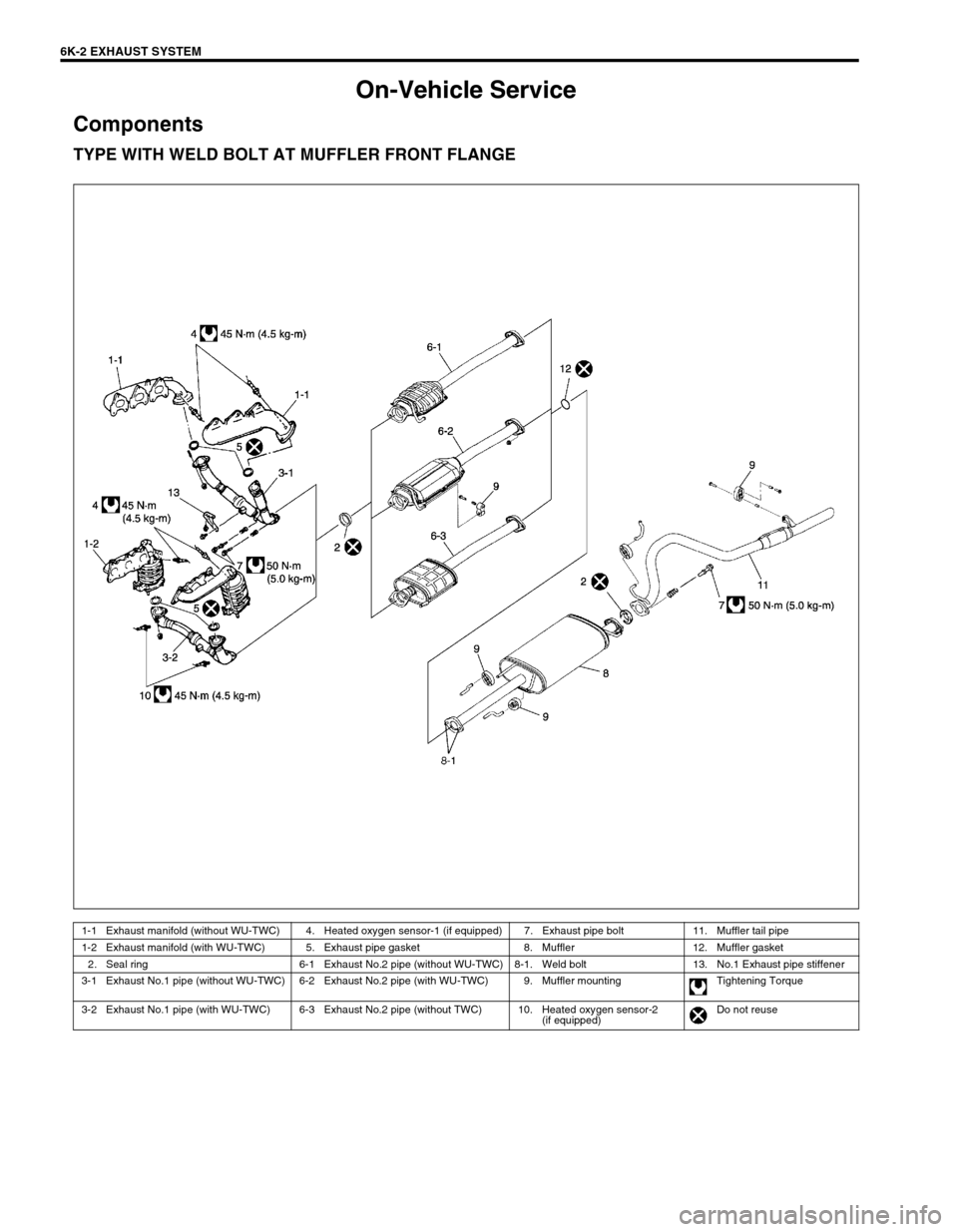
TYPE WITH WELD BOLT AT MUFFLER FRONT FLANGE
1-1 Exhaust manifold (without WU-TWC) 4. Heated oxygen sensor-1 (if equipped) 7. Exhaust pipe bolt 11. Muffler tail pipe
1-2 Exhaust manifold (with WU-TWC) 5. Exhaust pipe gasket 8. Muffler 12. Muffler gasket
2. Seal ring 6-1 Exhaust No.2 pipe (without WU-TWC) 8-1. Weld bolt 13. No.1 Exhaust pipe stiffener
3-1 Exhaust No.1 pipe (without WU-TWC) 6-2 Exhaust No.2 pipe (with WU-TWC) 9. Muffler mounting Tightening Torque
3-2 Exhaust No.1 pipe (with WU-TWC) 6-3 Exhaust No.2 pipe (without TWC) 10. Heated oxygen sensor-2
(if equipped)Do not reuse
Page 406 of 656
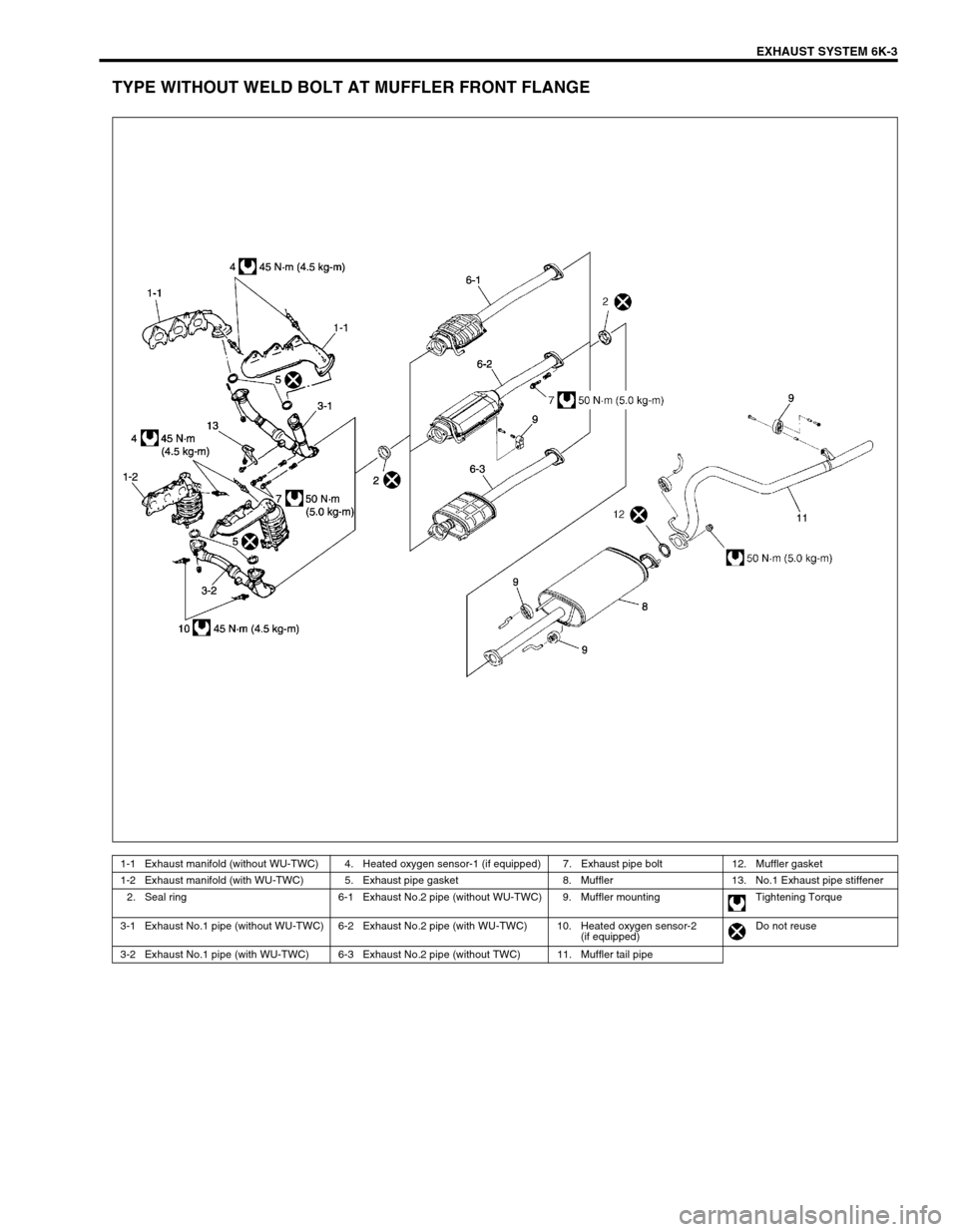
EXHAUST SYSTEM 6K-3
TYPE WITHOUT WELD BOLT AT MUFFLER FRONT FLANGE
1-1 Exhaust manifold (without WU-TWC) 4. Heated oxygen sensor-1 (if equipped) 7. Exhaust pipe bolt 12. Muffler gasket
1-2 Exhaust manifold (with WU-TWC) 5. Exhaust pipe gasket 8. Muffler 13. No.1 Exhaust pipe stiffener
2. Seal ring 6-1 Exhaust No.2 pipe (without WU-TWC) 9. Muffler mounting Tightening Torque
3-1 Exhaust No.1 pipe (without WU-TWC) 6-2 Exhaust No.2 pipe (with WU-TWC) 10. Heated oxygen sensor-2
(if equipped)Do not reuse
3-2 Exhaust No.1 pipe (with WU-TWC) 6-3 Exhaust No.2 pipe (without TWC) 11. Muffler tail pipe
Page 411 of 656
7B1-2 AUTOMATIC TRANSMISSION (4 A/T)
Stall Test ................................................... 7B1-38
Line Pressure Test .................................... 7B1-39
Road Test ................................................. 7B1-40
Manual Road Test..................................... 7B1-41
Time Lag Test ........................................... 7B1-41
Engine Brake Test .................................... 7B1-42
“P” Range Test.......................................... 7B1-42
On-Vehicle Service ..................................... 7B1-43
Maintenance Service ................................ 7B1-43
Fluid level .............................................. 7B1-43
Fluid change.......................................... 7B1-44
A/T Throttle Cable ..................................... 7B1-45Solenoid Valves (Shift Solenoid Valves
and TCC Solenoid Valve) ......................... 7B1-45
MANUAL SELECTOR ASSEMBLY .......... 7B1-46
SELECT CABLE ....................................... 7B1-48
Unit Repair .................................................. 7B1-49
Sub-Assembly Repair ............................... 7B1-49
Overdrive (case side) ............................ 7B1-49
Forward clutch ...................................... 7B1-50
Front upper valve body ......................... 7B1-54
Unit Assembly ........................................... 7B1-59
Tightening Torque Specification............... 7B1-60
Special Tool ................................................ 7B1-61
Page 450 of 656
AUTOMATIC TRANSMISSION (4 A/T) 7B1-41
Manual Road Test
This test check the gear being used in “L”, “2” or “D” range when
driven with unoperated gear shift control system. Test drive vehi-
cle on a level road.
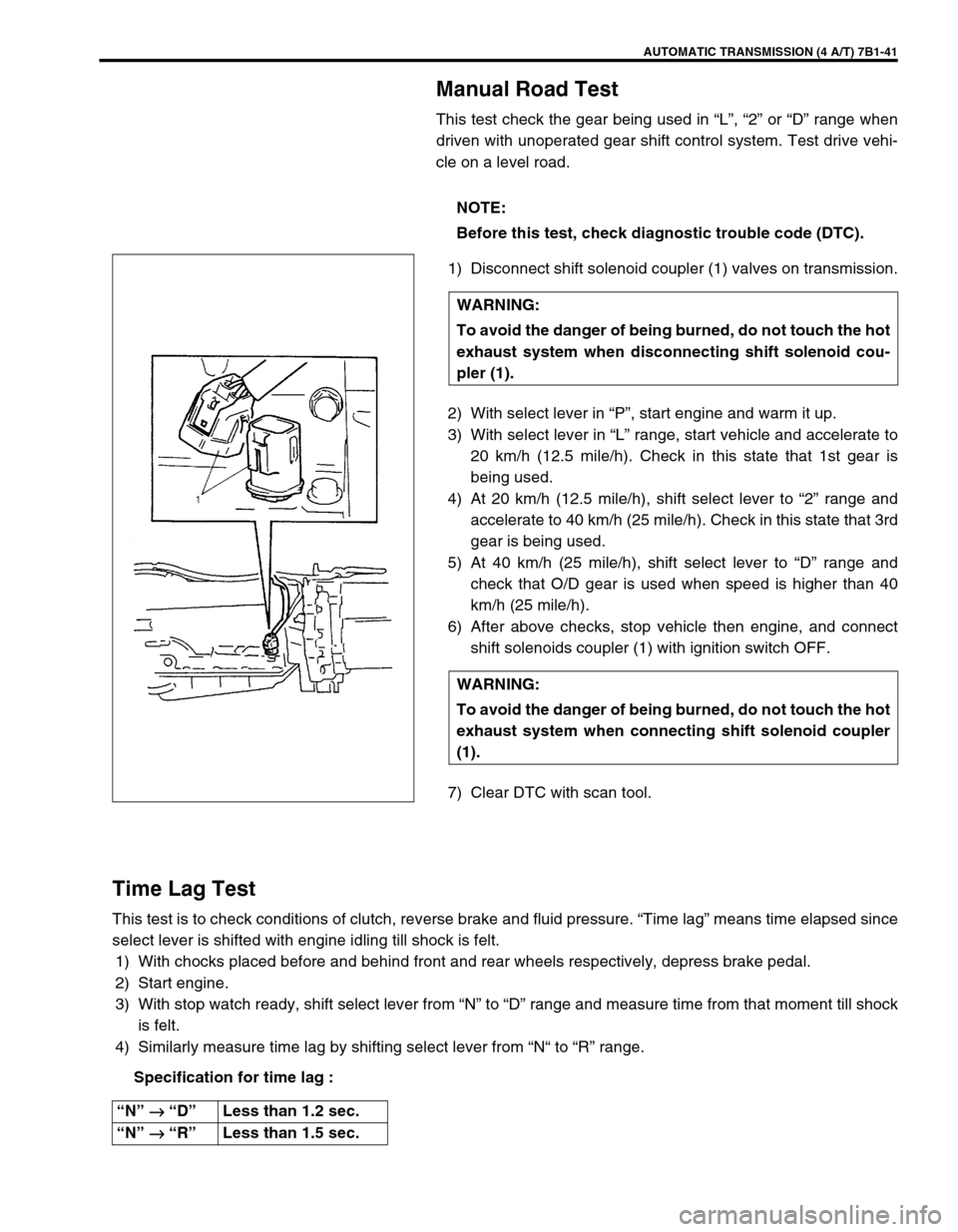
1) Disconnect shift solenoid coupler (1) valves on transmission.
2) With select lever in “P”, start engine and warm it up.
3) With select lever in “L” range, start vehicle and accelerate to
20 km/h (12.5 mile/h). Check in this state that 1st gear is
being used.
4) At 20 km/h (12.5 mile/h), shift select lever to “2” range and
accelerate to 40 km/h (25 mile/h). Check in this state that 3rd
gear is being used.
5) At 40 km/h (25 mile/h), shift select lever to “D” range and
check that O/D gear is used when speed is higher than 40
km/h (25 mile/h).
6) After above checks, stop vehicle then engine, and connect
shift solenoids coupler (1) with ignition switch OFF.
7) Clear DTC with scan tool.
Time Lag Test
This test is to check conditions of clutch, reverse brake and fluid pressure. “Time lag” means time elapsed since
select lever is shifted with engine idling till shock is felt.
1) With chocks placed before and behind front and rear wheels respectively, depress brake pedal.
2) Start engine.
3) With stop watch ready, shift select lever from “N” to “D” range and measure time from that moment till shock
is felt.
4) Similarly measure time lag by shifting select lever from “N“ to “R” range.
Specification for time lag :NOTE:
Before this test, check diagnostic trouble code (DTC).
WARNING:
To avoid the danger of being burned, do not touch the hot
exhaust system when disconnecting shift solenoid cou-
pler (1).
WARNING:
To avoid the danger of being burned, do not touch the hot
exhaust system when connecting shift solenoid coupler
(1).
“N” →
→→ → “D”Less than 1.2 sec.
“N” →
→→ → “R”Less than 1.5 sec.
Page 463 of 656
7B1-54 AUTOMATIC TRANSMISSION (4 A/T)
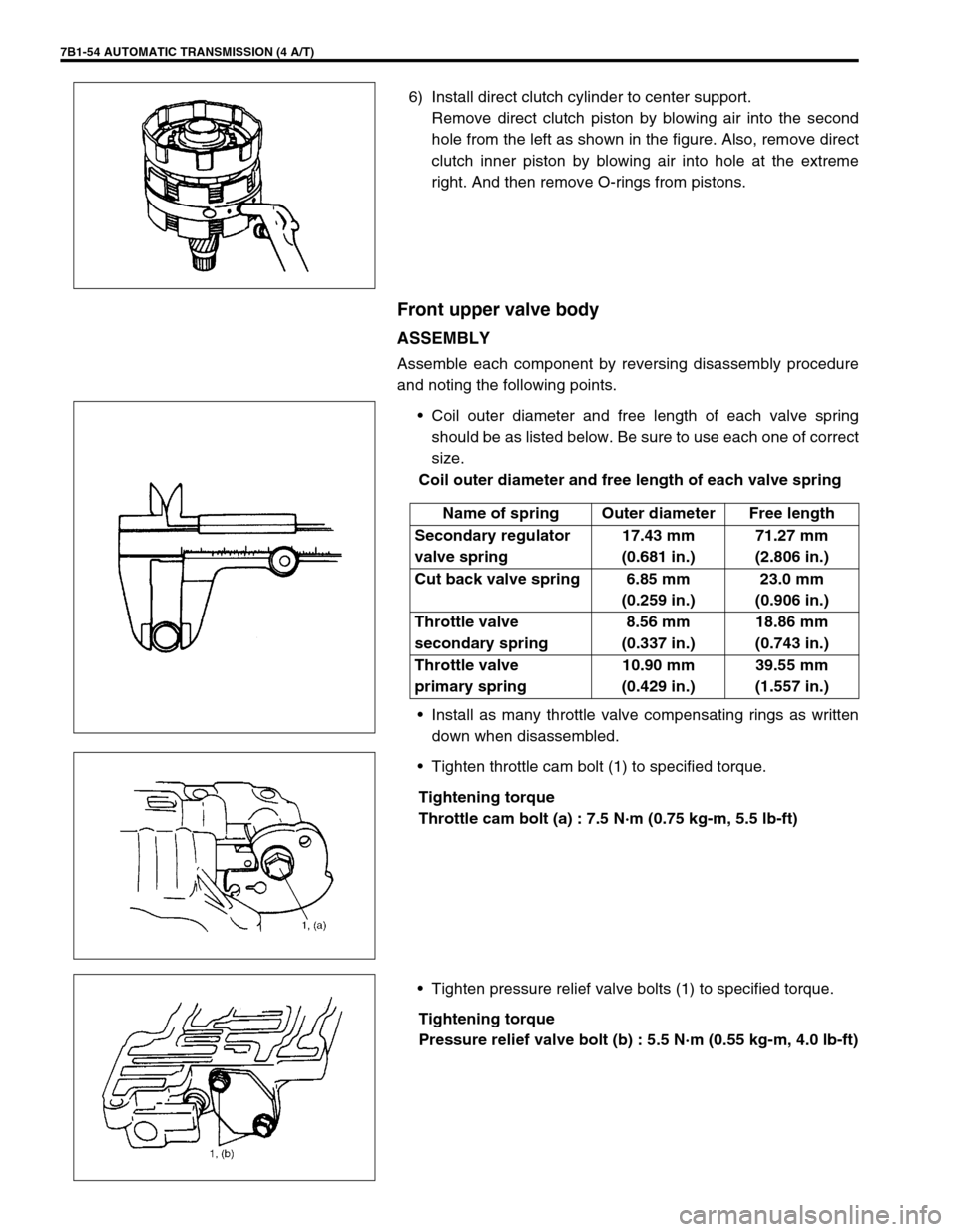
6) Install direct clutch cylinder to center support.
Remove direct clutch piston by blowing air into the second
hole from the left as shown in the figure. Also, remove direct
clutch inner piston by blowing air into hole at the extreme
right. And then remove O-rings from pistons.
Front upper valve body
ASSEMBLY
Assemble each component by reversing disassembly procedure
and noting the following points.
•Coil outer diameter and free length of each valve spring
should be as listed below. Be sure to use each one of correct
size.
Coil outer diameter and free length of each valve spring
•Install as many throttle valve compensating rings as written
down when disassembled.
•Tighten throttle cam bolt (1) to specified torque.
Tightening torque
Throttle cam bolt (a) : 7.5 N·m (0.75 kg-m, 5.5 lb-ft)
•Tighten pressure relief valve bolts (1) to specified torque.
Tightening torque
Pressure relief valve bolt (b) : 5.5 N·m (0.55 kg-m, 4.0 lb-ft)
Name of spring Outer diameter Free length
Secondary regulator
valve spring17.43 mm
(0.681 in.)71.27 mm
(2.806 in.)
Cut back valve spring 6.85 mm
(0.259 in.)23.0 mm
(0.906 in.)
Throttle valve
secondary spring8.56 mm
(0.337 in.)18.86 mm
(0.743 in.)
Throttle valve
primary spring10.90 mm
(0.429 in.)39.55 mm
(1.557 in.)
Page 474 of 656
DIFFERENTIAL (FRONT) 7E-1
7E
SECTION 7E
DIFFERENTIAL (FRONT)
CONTENTS
General Description ........................................ 7E-2
4WD Control System ..................................... 7E-2
System circuit ............................................ 7E-2
Diagnosis ......................................................... 7E-3
Differential Assembly Diagnosis Table .......... 7E-3
4WD Control System Diagnostic Flow Table 7E-3
Notes on system circuit inspection ............ 7E-3
Flow table .................................................. 7E-4
4WD Control System Circuit Inspection ........ 7E-5
Voltage check ............................................ 7E-54WD Control System Inspection ................... 7E-6
On-Vehicle Service ......................................... 7E-7
Differential Mountings ................................... 7E-7
Rear Mounting for Front Differential Carrier.. 7E-8
Front Differential Assembly ........................... 7E-9
Unit Repair ..................................................... 7E-11
Tightening Torque Specification ................. 7E-11
Special Tool ................................................... 7E-11
NOTE:
For the descriptions (items) not found in this section, refer to the same section of the Service Manual
mentioned in the FOREWORD of this manual.
Page 475 of 656
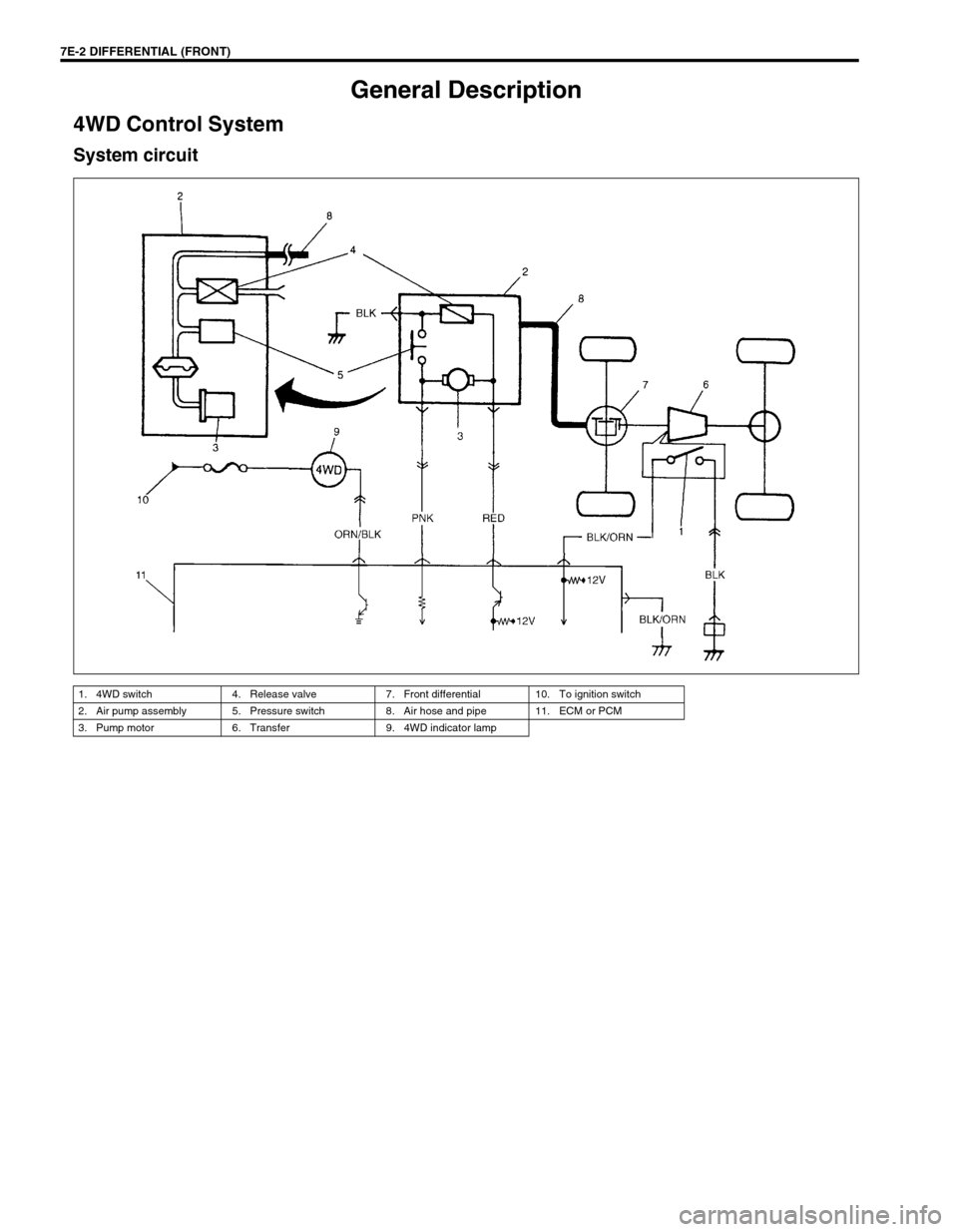
7E-2 DIFFERENTIAL (FRONT)
General Description
4WD Control System
System circuit
1. 4WD switch 4. Release valve 7. Front differential 10. To ignition switch
2. Air pump assembly 5. Pressure switch 8. Air hose and pipe 11. ECM or PCM
3. Pump motor 6. Transfer 9. 4WD indicator lamp