Operation SUZUKI GRAND VITARA 2001 2.G User Guide
[x] Cancel search | Manufacturer: SUZUKI, Model Year: 2001, Model line: GRAND VITARA, Model: SUZUKI GRAND VITARA 2001 2.GPages: 656, PDF Size: 14.31 MB
Page 77 of 656
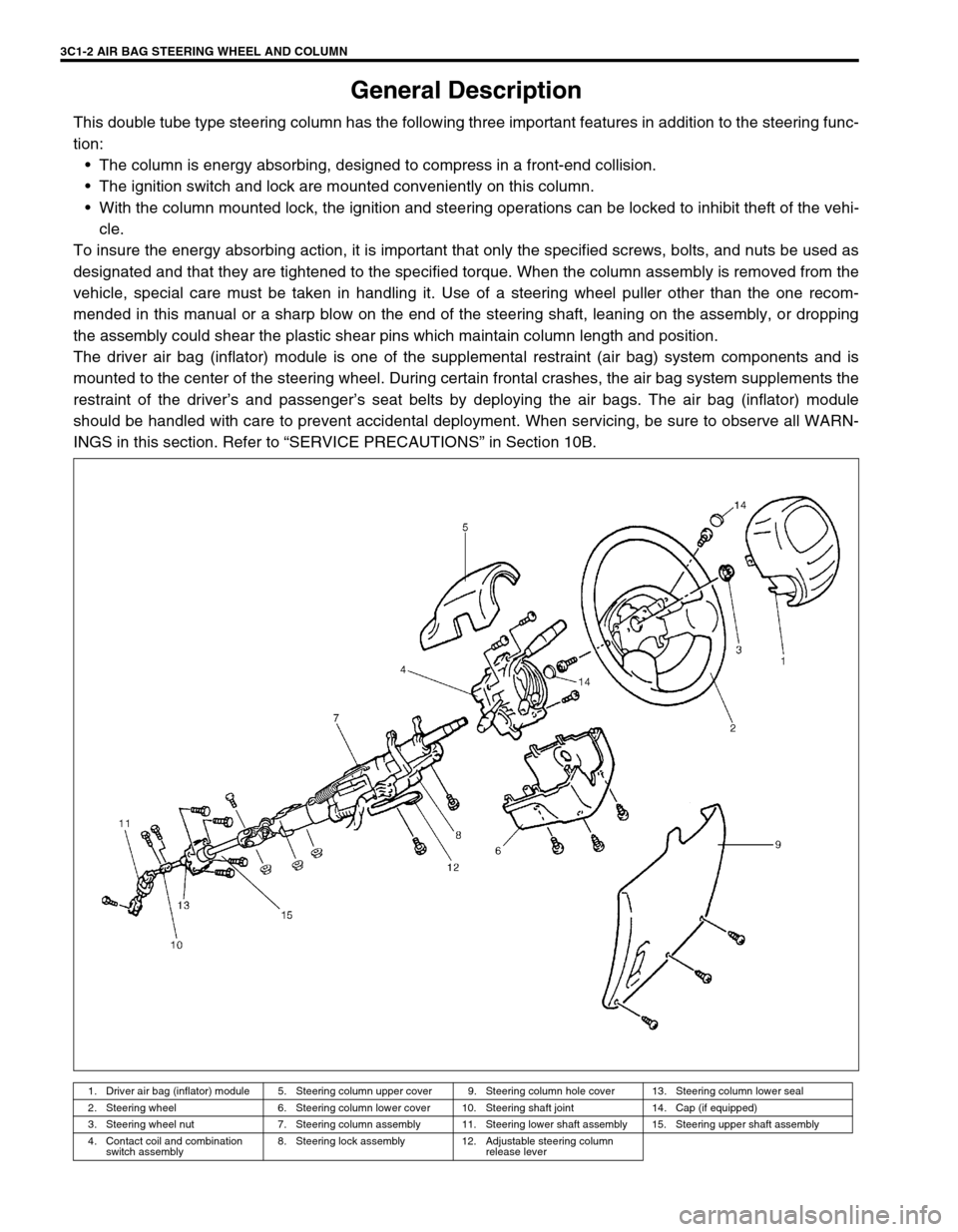
3C1-2 AIR BAG STEERING WHEEL AND COLUMN
General Description
This double tube type steering column has the following three important features in addition to the steering func-
tion:
The column is energy absorbing, designed to compress in a front-end collision.
The ignition switch and lock are mounted conveniently on this column.
With the column mounted lock, the ignition and steering operations can be locked to inhibit theft of the vehi-
cle.
To insure the energy absorbing action, it is important that only the specified screws, bolts, and nuts be used as
designated and that they are tightened to the specified torque. When the column assembly is removed from the
vehicle, special care must be taken in handling it. Use of a steering wheel puller other than the one recom-
mended in this manual or a sharp blow on the end of the steering shaft, leaning on the assembly, or dropping
the assembly could shear the plastic shear pins which maintain column length and position.
The driver air bag (inflator) module is one of the supplemental restraint (air bag) system components and is
mounted to the center of the steering wheel. During certain frontal crashes, the air bag system supplements the
restraint of the driver’s and passenger’s seat belts by deploying the air bags. The air bag (inflator) module
should be handled with care to prevent accidental deployment. When servicing, be sure to observe all WARN-
INGS in this section. Refer to “SERVICE PRECAUTIONS” in Section 10B.
1. Driver air bag (inflator) module 5. Steering column upper cover 9. Steering column hole cover 13. Steering column lower seal
2. Steering wheel 6. Steering column lower cover 10. Steering shaft joint 14. Cap (if equipped)
3. Steering wheel nut 7. Steering column assembly 11. Steering lower shaft assembly 15. Steering upper shaft assembly
4. Contact coil and combination
switch assembly8. Steering lock assembly 12. Adjustable steering column
release lever
Page 80 of 656
AIR BAG STEERING WHEEL AND COLUMN 3C1-5
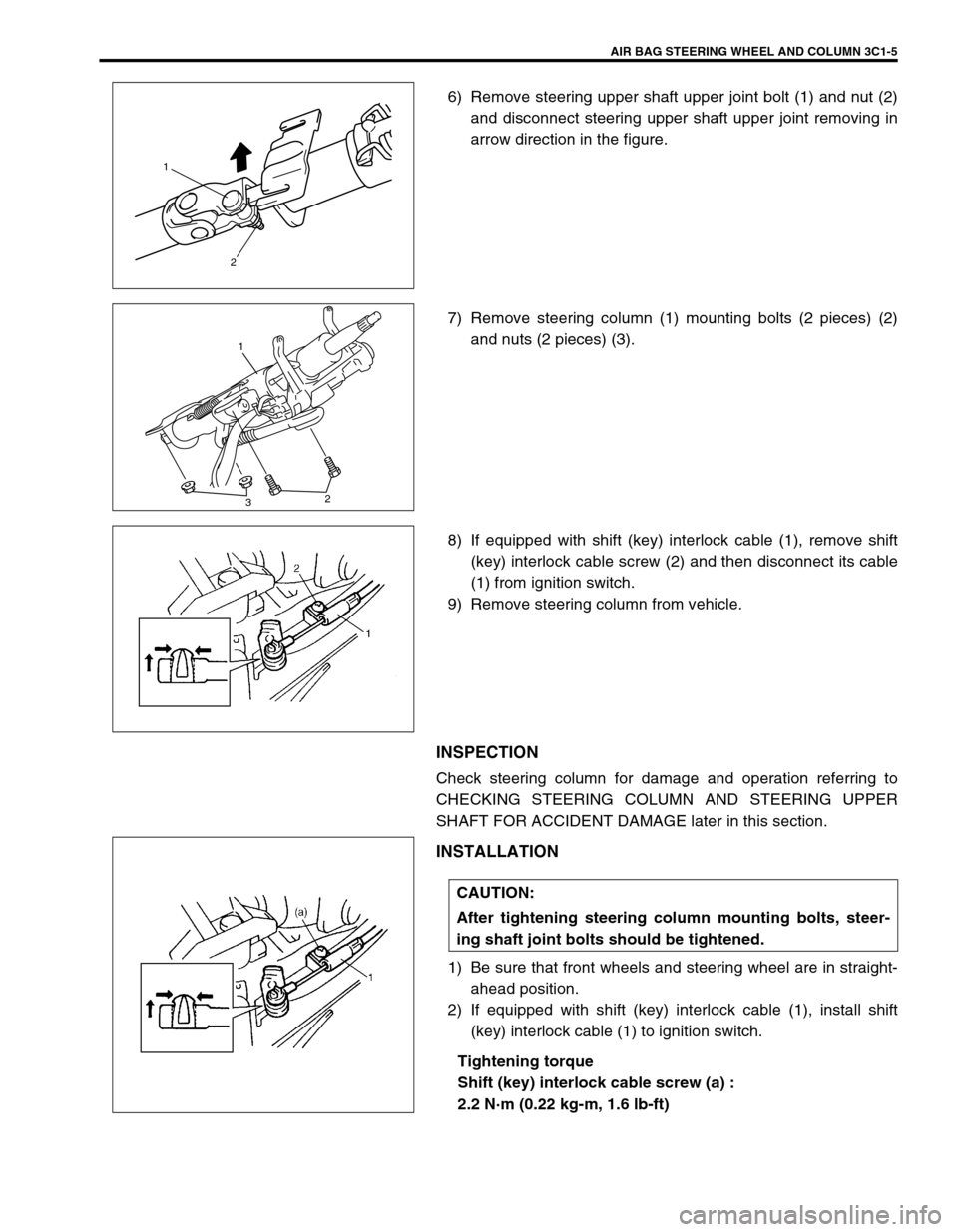
6) Remove steering upper shaft upper joint bolt (1) and nut (2)
and disconnect steering upper shaft upper joint removing in
arrow direction in the figure.
7) Remove steering column (1) mounting bolts (2 pieces) (2)
and nuts (2 pieces) (3).
8) If equipped with shift (key) interlock cable (1), remove shift
(key) interlock cable screw (2) and then disconnect its cable
(1) from ignition switch.
9) Remove steering column from vehicle.
INSPECTION
Check steering column for damage and operation referring to
CHECKING STEERING COLUMN AND STEERING UPPER
SHAFT FOR ACCIDENT DAMAGE later in this section.
INSTALLATION
1) Be sure that front wheels and steering wheel are in straight-
ahead position.
2) If equipped with shift (key) interlock cable (1), install shift
(key) interlock cable (1) to ignition switch.
Tightening torque
Shift (key) interlock cable screw (a) :
2.2 N·m (0.22 kg-m, 1.6 lb-ft)
1
2
1
32
CAUTION:
After tightening steering column mounting bolts, steer-
ing shaft joint bolts should be tightened.
Page 83 of 656
3C1-8 AIR BAG STEERING WHEEL AND COLUMN
INSPECTION
Check steering shaft damage and operation referring to CHECK
STEERING COLUMN AND STEERING UPPER SHAFT FOR
ACCIDENT DAMAGE later in this section.
INSTALLATION
1) Be sure that front tires and steering wheel are in straight
ahead position.
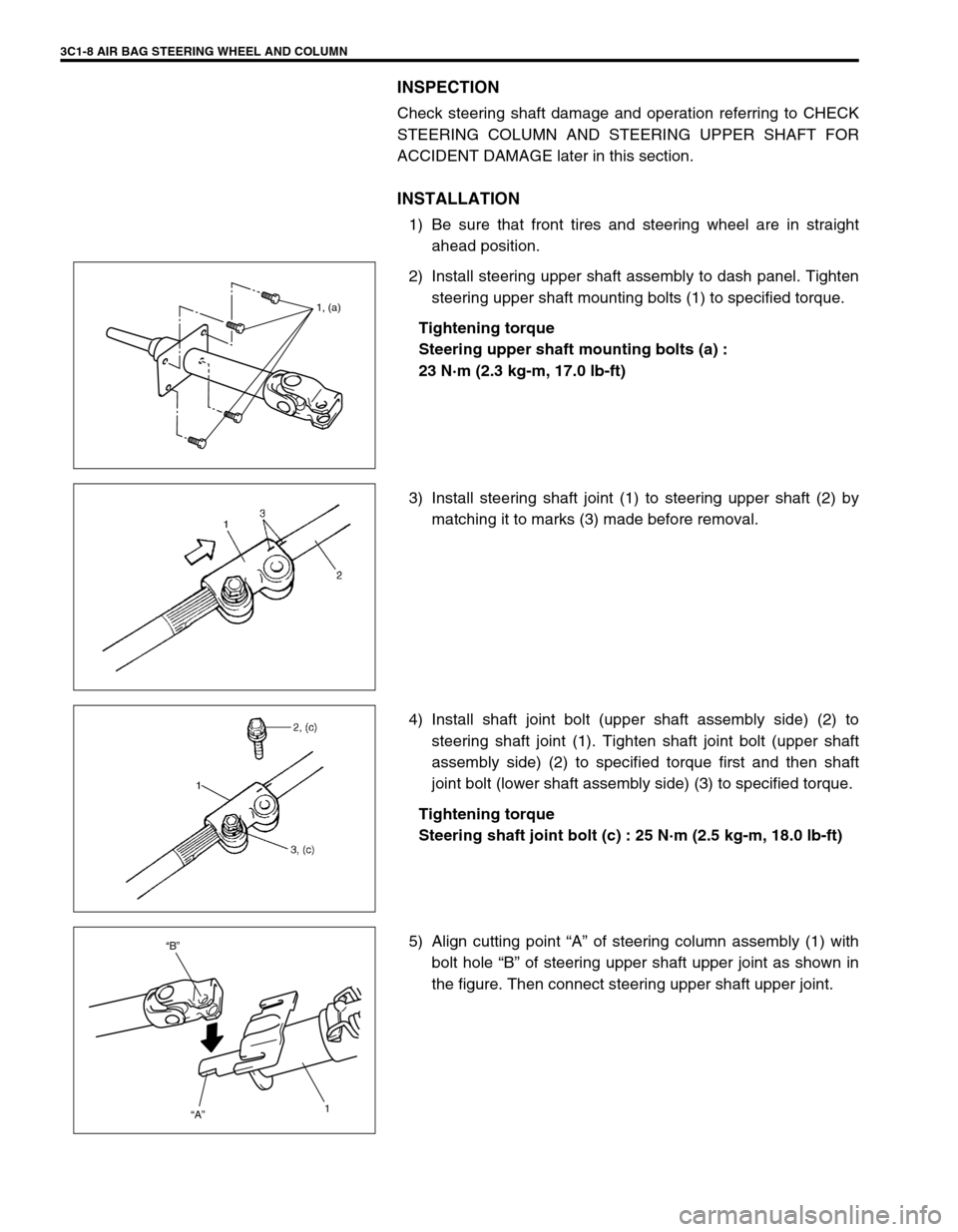
2) Install steering upper shaft assembly to dash panel. Tighten
steering upper shaft mounting bolts (1) to specified torque.
Tightening torque
Steering upper shaft mounting bolts (a) :
23 N·m (2.3 kg-m, 17.0 lb-ft)
3) Install steering shaft joint (1) to steering upper shaft (2) by
matching it to marks (3) made before removal.
4) Install shaft joint bolt (upper shaft assembly side) (2) to
steering shaft joint (1). Tighten shaft joint bolt (upper shaft
assembly side) (2) to specified torque first and then shaft
joint bolt (lower shaft assembly side) (3) to specified torque.
Tightening torque
Steering shaft joint bolt (c) : 25 N·m (2.5 kg-m, 18.0 lb-ft)
5) Align cutting point “A” of steering column assembly (1) with
bolt hole “B” of steering upper shaft upper joint as shown in
the figure. Then connect steering upper shaft upper joint.
1, (a)
“B”
“A”
1
Page 110 of 656
BRAKES PIPE/HOSE/MASTER CYLINDER 5A-3
On-Vehicle Service
Front Brake Hose/Pipe
REMOVAL
1) Raise and suitably support vehicle. Remove tire and wheel.
This operation is not necessary when removing pipes connecting master cylinder and flexible hose.
2) Clean dirt and foreign material from both hose end or pipe end fittings. Remove brake hose or pipe.
INSTALLATION
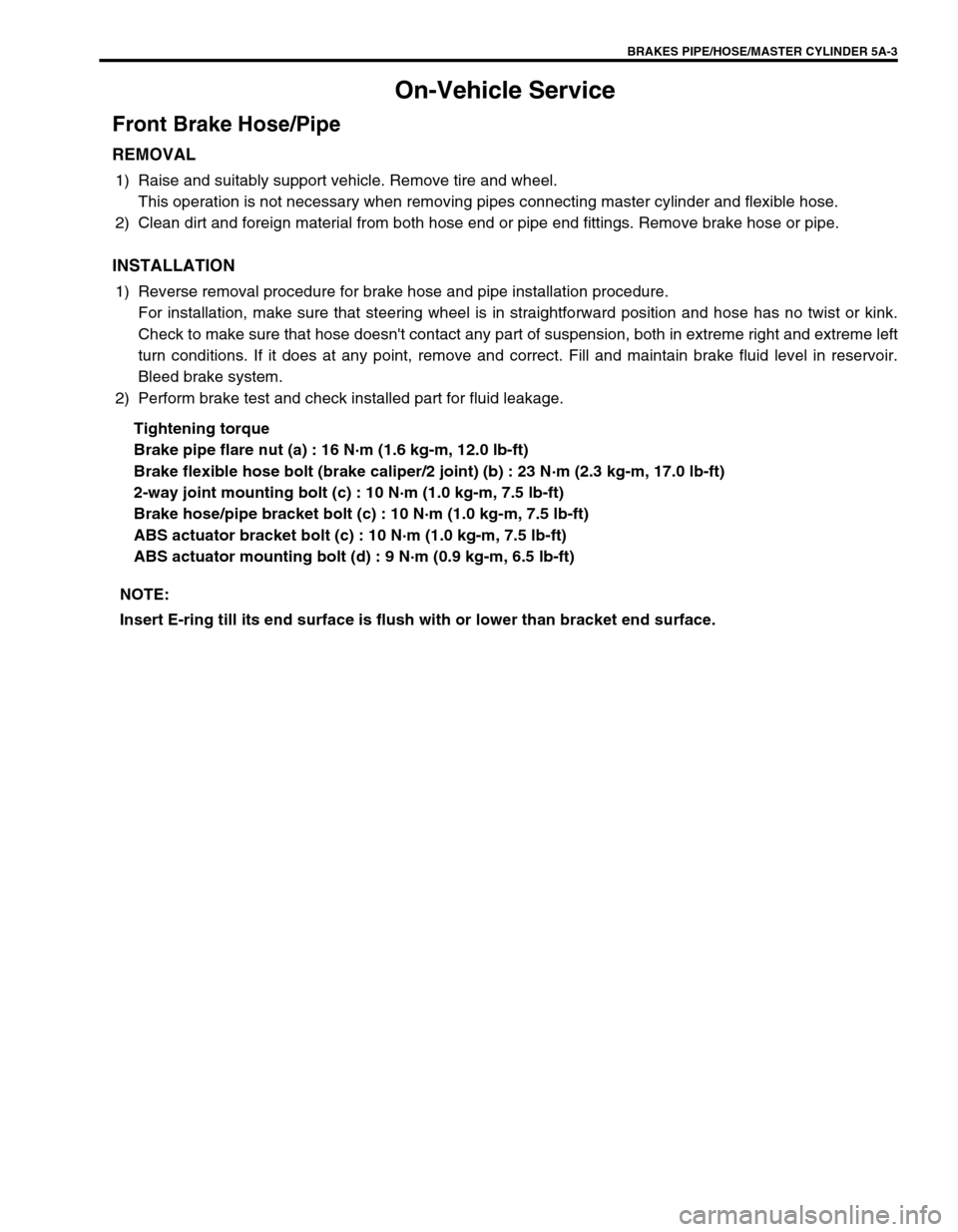
1) Reverse removal procedure for brake hose and pipe installation procedure.
For installation, make sure that steering wheel is in straightforward position and hose has no twist or kink.
Check to make sure that hose doesn't contact any part of suspension, both in extreme right and extreme left
turn conditions. If it does at any point, remove and correct. Fill and maintain brake fluid level in reservoir.
Bleed brake system.
2) Perform brake test and check installed part for fluid leakage.
Tightening torque
Brake pipe flare nut (a) : 16 N·m (1.6 kg-m, 12.0 lb-ft)
Brake flexible hose bolt (brake caliper/2 joint) (b) : 23 N·m (2.3 kg-m, 17.0 lb-ft)
2-way joint mounting bolt (c) : 10 N·m (1.0 kg-m, 7.5 lb-ft)
Brake hose/pipe bracket bolt (c) : 10 N·m (1.0 kg-m, 7.5 lb-ft)
ABS actuator bracket bolt (c) : 10 N·m (1.0 kg-m, 7.5 lb-ft)
ABS actuator mounting bolt (d) : 9 N·m (0.9 kg-m, 6.5 lb-ft)
NOTE:
Insert E-ring till its end surface is flush with or lower than bracket end surface.
Page 119 of 656
5C-2 PARKING AND REAR BRAKE
General Description
Drum Brake Assembly
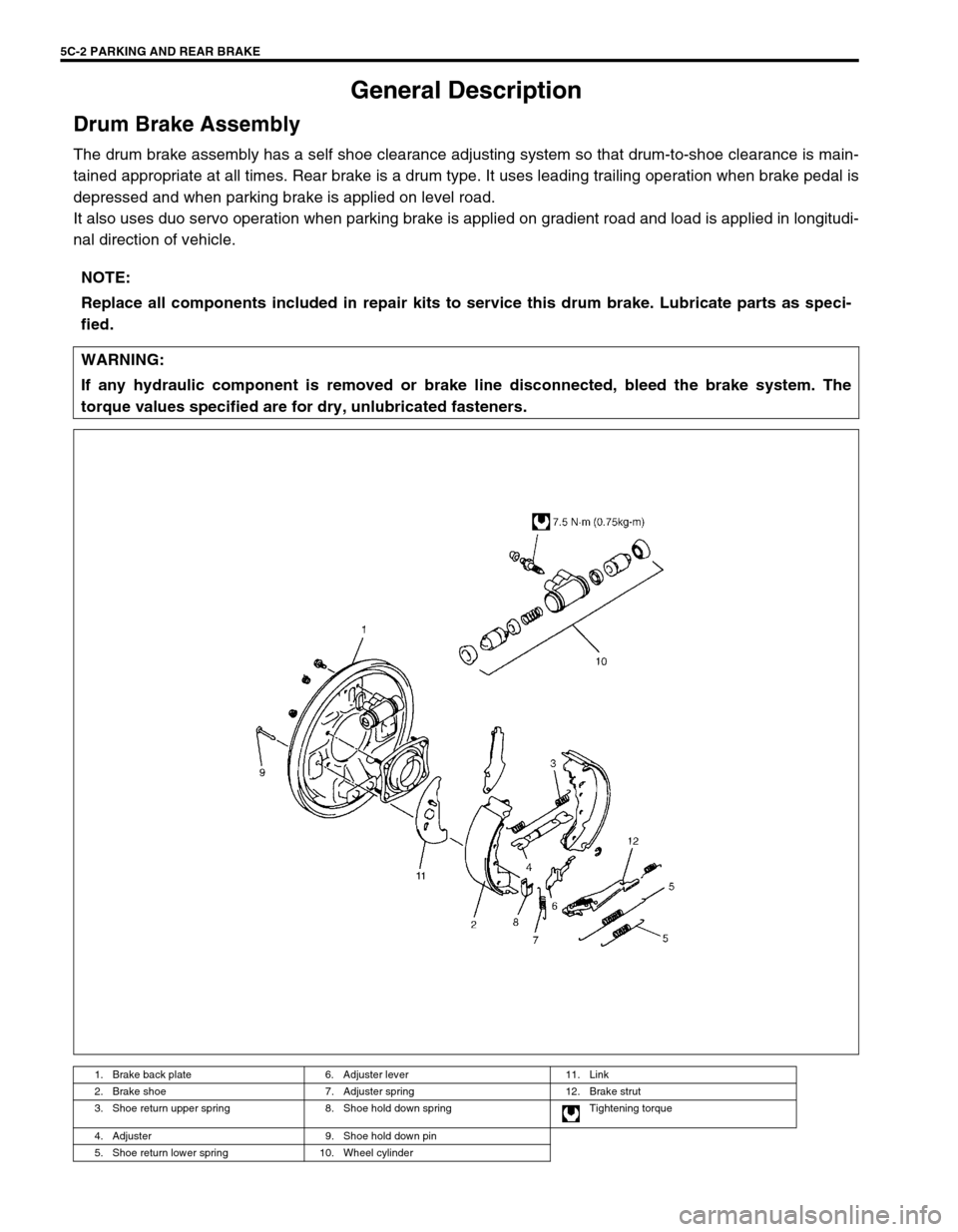
The drum brake assembly has a self shoe clearance adjusting system so that drum-to-shoe clearance is main-
tained appropriate at all times. Rear brake is a drum type. It uses leading trailing operation when brake pedal is
depressed and when parking brake is applied on level road.
It also uses duo servo operation when parking brake is applied on gradient road and load is applied in longitudi-
nal direction of vehicle.
NOTE:
Replace all components included in repair kits to service this drum brake. Lubricate parts as speci-
fied.
WARNING:
If any hydraulic component is removed or brake line disconnected, bleed the brake system. The
torque values specified are for dry, unlubricated fasteners.
1. Brake back plate 6. Adjuster lever 11. Link
2. Brake shoe 7. Adjuster spring 12. Brake strut
3. Shoe return upper spring 8. Shoe hold down spring Tightening torque
4. Adjuster 9. Shoe hold down pin
5. Shoe return lower spring 10. Wheel cylinder
Page 123 of 656
5C-6 PARKING AND REAR BRAKE
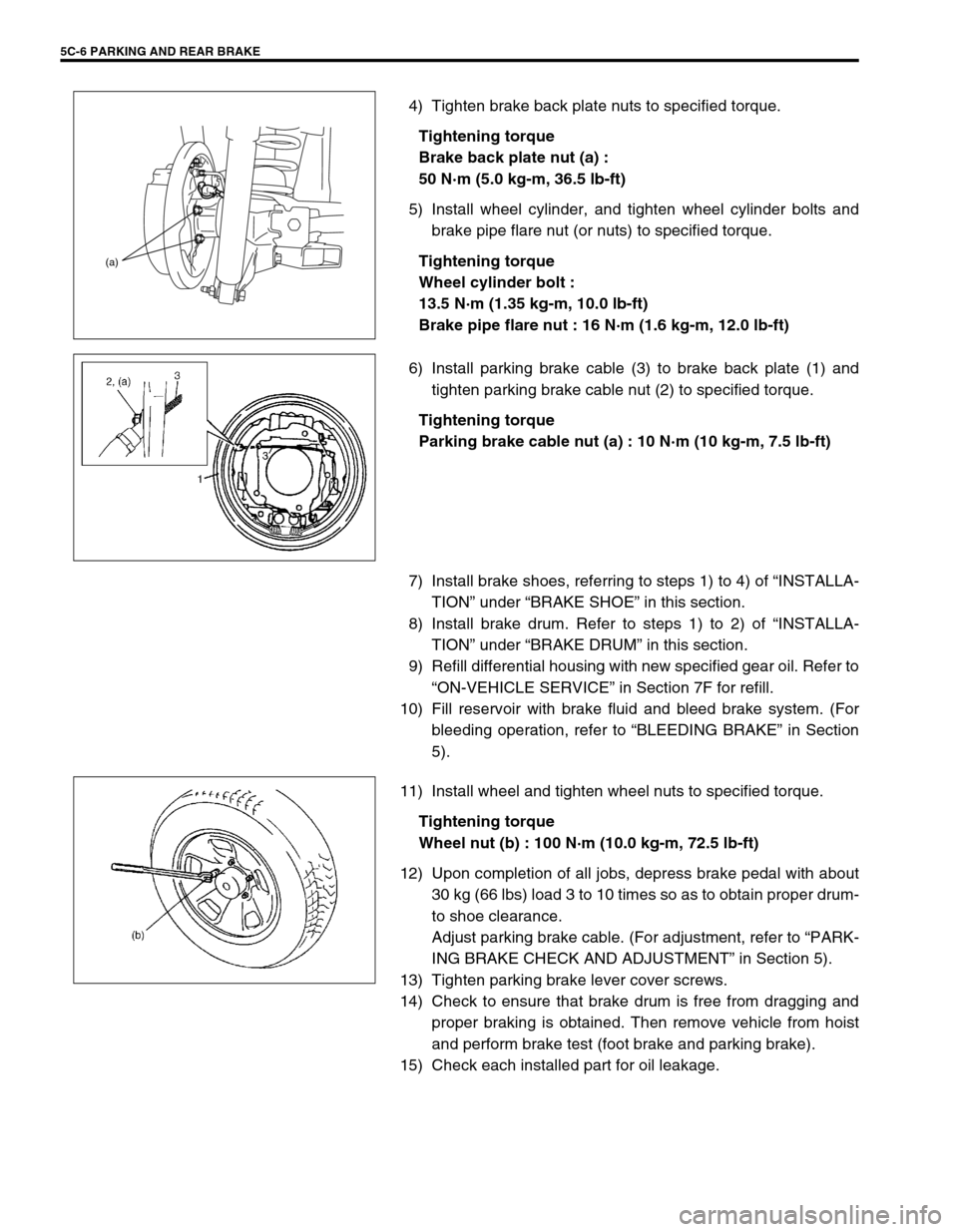
4) Tighten brake back plate nuts to specified torque.
Tightening torque
Brake back plate nut (a) :
50 N·m (5.0 kg-m, 36.5 lb-ft)
5) Install wheel cylinder, and tighten wheel cylinder bolts and
brake pipe flare nut (or nuts) to specified torque.
Tightening torque
Wheel cylinder bolt :
13.5 N·m (1.35 kg-m, 10.0 lb-ft)
Brake pipe flare nut : 16 N·m (1.6 kg-m, 12.0 lb-ft)
6) Install parking brake cable (3) to brake back plate (1) and
tighten parking brake cable nut (2) to specified torque.
Tightening torque
Parking brake cable nut (a) : 10 N·m (10 kg-m, 7.5 lb-ft)
7) Install brake shoes, referring to steps 1) to 4) of “INSTALLA-
TION” under “BRAKE SHOE” in this section.
8) Install brake drum. Refer to steps 1) to 2) of “INSTALLA-
TION” under “BRAKE DRUM” in this section.
9) Refill differential housing with new specified gear oil. Refer to
“ON-VEHICLE SERVICE” in Section 7F for refill.
10) Fill reservoir with brake fluid and bleed brake system. (For
bleeding operation, refer to “BLEEDING BRAKE” in Section
5).
11) Install wheel and tighten wheel nuts to specified torque.
Tightening torque
Wheel nut (b) : 100 N·m (10.0 kg-m, 72.5 lb-ft)
12) Upon completion of all jobs, depress brake pedal with about
30 kg (66 lbs) load 3 to 10 times so as to obtain proper drum-
to shoe clearance.
Adjust parking brake cable. (For adjustment, refer to “PARK-
ING BRAKE CHECK AND ADJUSTMENT” in Section 5).
13) Tighten parking brake lever cover screws.
14) Check to ensure that brake drum is free from dragging and
proper braking is obtained. Then remove vehicle from hoist
and perform brake test (foot brake and parking brake).
15) Check each installed part for oil leakage.
(a)
Page 127 of 656
5E2-2 ANTILOCK BRAKE SYSTEM (ABS)
Sensor Circuit or Sensor Ring ................. 5E2-22
DTC C1031 (DTC 31), DTC C1032
(DTC 32) – Right-Rear Wheel Speed
Sensor Circuit or Sensor Ring ................. 5E2-22
DTC C1035 (DTC 35), DTC C1036
(DTC 36) – Left-Rear Wheel Speed
Sensor Circuit or Sensor Ring ................. 5E2-22
DTC C1041 (DTC 41) – Right-Front Inlet
Solenoid Circuit ........................................ 5E2-24
DTC C1045 (DTC 45) – Left-Front Inlet
Solenoid Circuit ........................................ 5E2-24
DTC C1055 (DTC 55) – Rear Inlet
Solenoid Circuit ........................................ 5E2-24
DTC C1042 (DTC 42) – Right-Front
Outlet Solenoid Circuit ............................. 5E2-24
DTC C1046 (DTC 46) – Left-Front Outlet
Solenoid Circuit ........................................ 5E2-24
DTC C1056 (DTC 56) – Rear Outlet
Solenoid Circuit ........................................ 5E2-24
DTC C1057 (DTC 57) – Power Source Circuit....................................................... 5E2-25
DTC C1061 (DTC 61) – ABS Pump Motor
Circuit....................................................... 5E2-26
DTC C1063 (DTC 63) – ABS Fail-Safe
Relay Circuit ............................................ 5E2-27
DTC C1071 (DTC 71) – ABS Control
Module ..................................................... 5E2-28
On-Vehicle Service .................................... 5E2-29
Precautions .............................................. 5E2-29
ABS Hydraulic Unit Operation Check
(Using SUZUKI Scan Tool) ...................... 5E2-29
ABS Hydraulic Unit Operation Check
(Not Using Suzuki Scan Tool).................. 5E2-29
ABS Hydraulic Unit/Control Module
Assembly ................................................. 5E2-31
Rear Sensor Rotor (Retainer Ring) ......... 5E2-33
Tightening Torque Specification.............. 5E2-34
Special Tool ............................................... 5E2-34
Page 128 of 656
ANTILOCK BRAKE SYSTEM (ABS) 5E2-3
General Description
Components/Parts Location
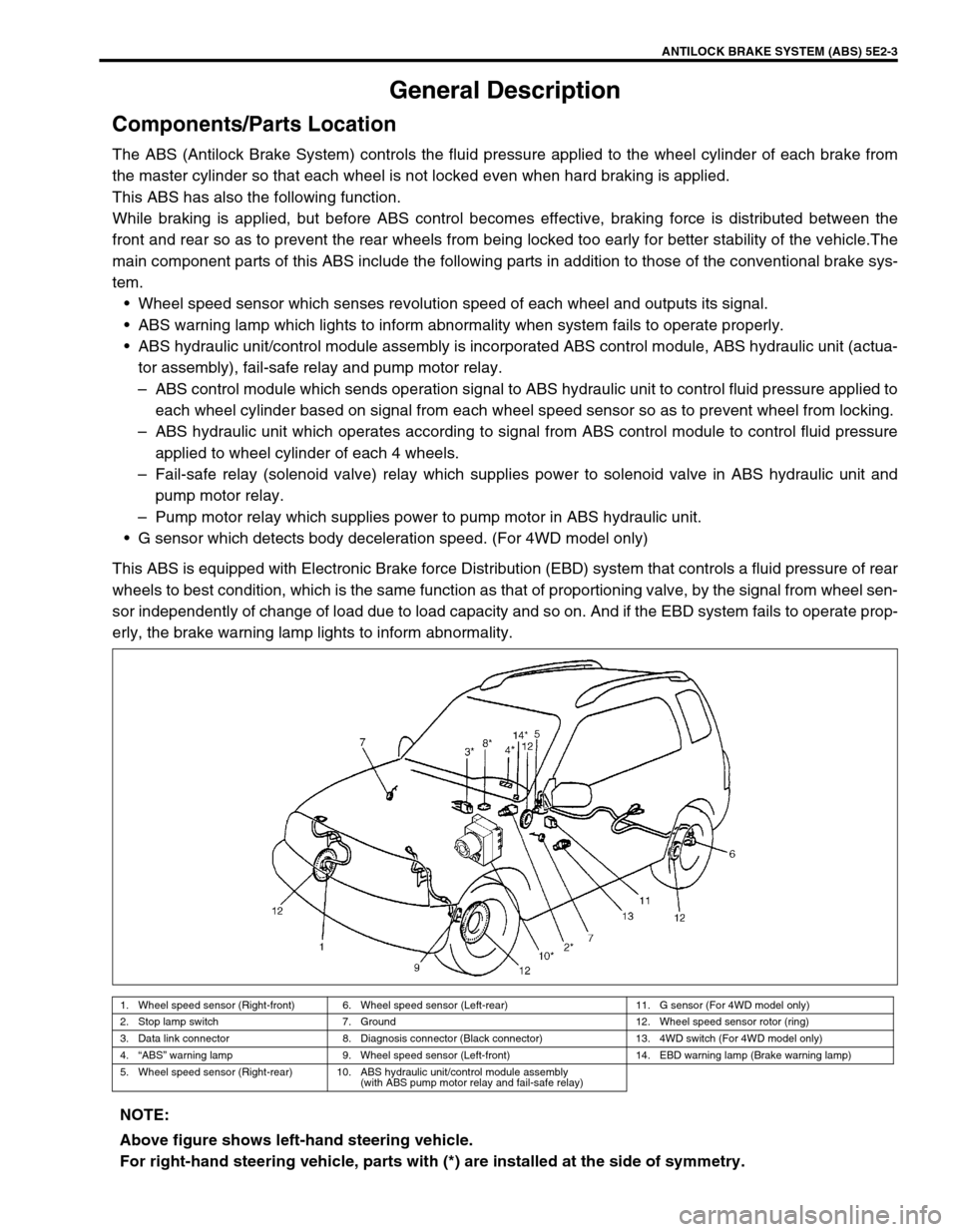
The ABS (Antilock Brake System) controls the fluid pressure applied to the wheel cylinder of each brake from
the master cylinder so that each wheel is not locked even when hard braking is applied.
This ABS has also the following function.
While braking is applied, but before ABS control becomes effective, braking force is distributed between the
front and rear so as to prevent the rear wheels from being locked too early for better stability of the vehicle.The
main component parts of this ABS include the following parts in addition to those of the conventional brake sys-
tem.
Wheel speed sensor which senses revolution speed of each wheel and outputs its signal.
ABS warning lamp which lights to inform abnormality when system fails to operate properly.
ABS hydraulic unit/control module assembly is incorporated ABS control module, ABS hydraulic unit (actua-
tor assembly), fail-safe relay and pump motor relay.
–ABS control module which sends operation signal to ABS hydraulic unit to control fluid pressure applied to
each wheel cylinder based on signal from each wheel speed sensor so as to prevent wheel from locking.
–ABS hydraulic unit which operates according to signal from ABS control module to control fluid pressure
applied to wheel cylinder of each 4 wheels.
–Fail-safe relay (solenoid valve) relay which supplies power to solenoid valve in ABS hydraulic unit and
pump motor relay.
–Pump motor relay which supplies power to pump motor in ABS hydraulic unit.
G sensor which detects body deceleration speed. (For 4WD model only)
This ABS is equipped with Electronic Brake force Distribution (EBD) system that controls a fluid pressure of rear
wheels to best condition, which is the same function as that of proportioning valve, by the signal from wheel sen-
sor independently of change of load due to load capacity and so on. And if the EBD system fails to operate prop-
erly, the brake warning lamp lights to inform abnormality.
1. Wheel speed sensor (Right-front) 6. Wheel speed sensor (Left-rear) 11. G sensor (For 4WD model only)
2. Stop lamp switch 7. Ground 12. Wheel speed sensor rotor (ring)
3. Data link connector 8. Diagnosis connector (Black connector) 13. 4WD switch (For 4WD model only)
4.“ABS” warning lamp 9. Wheel speed sensor (Left-front) 14. EBD warning lamp (Brake warning lamp)
5. Wheel speed sensor (Right-rear) 10. ABS hydraulic unit/control module assembly
(with ABS pump motor relay and fail-safe relay)
NOTE:
Above figure shows left-hand steering vehicle.
For right-hand steering vehicle, parts with (*) are installed at the side of symmetry.
Page 140 of 656
ANTILOCK BRAKE SYSTEM (ABS) 5E2-15
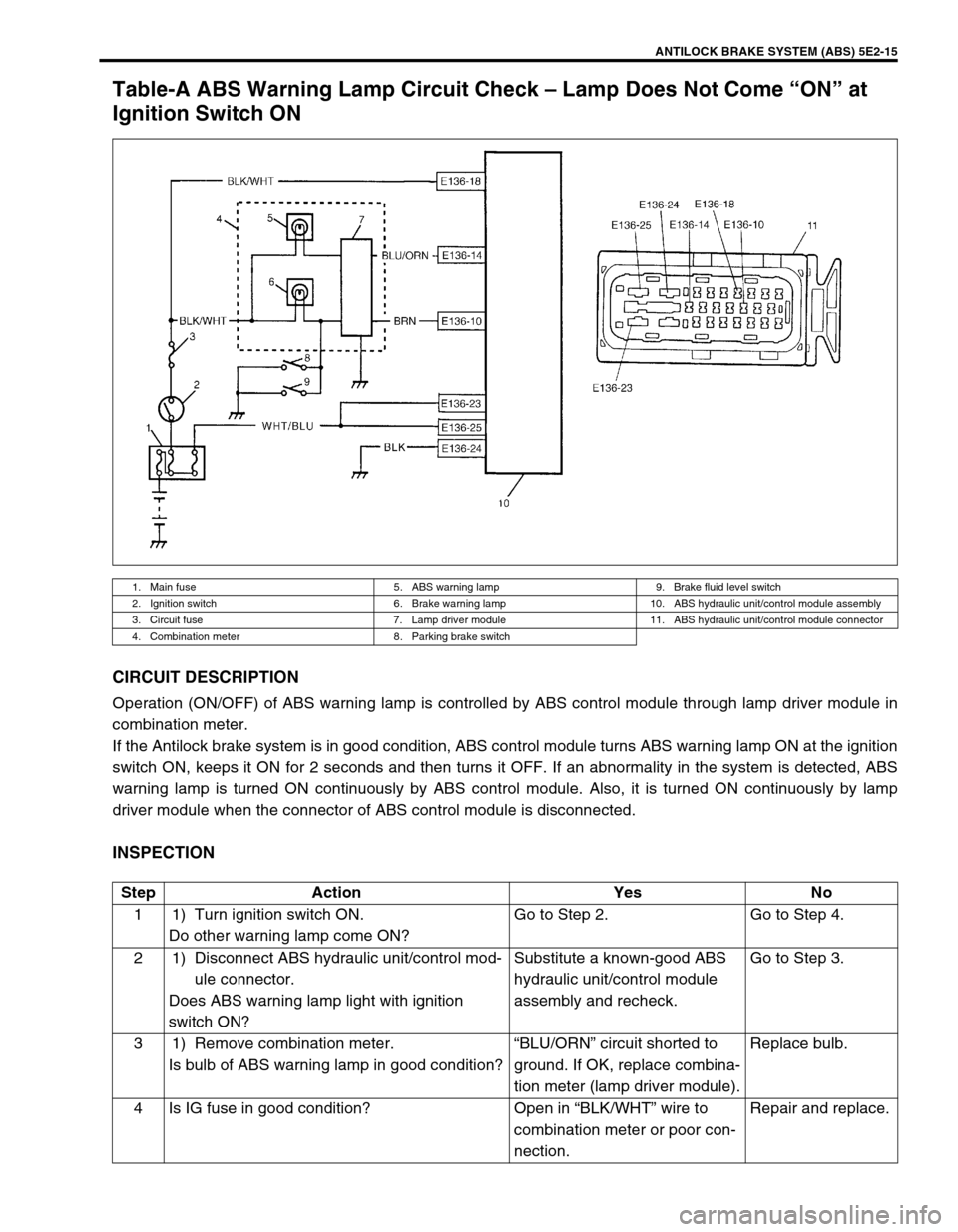
Table-A ABS Warning Lamp Circuit Check – Lamp Does Not Come “ON” at
Ignition Switch ON
CIRCUIT DESCRIPTION
Operation (ON/OFF) of ABS warning lamp is controlled by ABS control module through lamp driver module in
combination meter.
If the Antilock brake system is in good condition, ABS control module turns ABS warning lamp ON at the ignition
switch ON, keeps it ON for 2 seconds and then turns it OFF. If an abnormality in the system is detected, ABS
warning lamp is turned ON continuously by ABS control module. Also, it is turned ON continuously by lamp
driver module when the connector of ABS control module is disconnected.
INSPECTION
1. Main fuse 5. ABS warning lamp 9. Brake fluid level switch
2. Ignition switch 6. Brake warning lamp 10. ABS hydraulic unit/control module assembly
3. Circuit fuse 7. Lamp driver module 11. ABS hydraulic unit/control module connector
4. Combination meter 8. Parking brake switch
Step Action Yes No
1 1) Turn ignition switch ON.
Do other warning lamp come ON?Go to Step 2. Go to Step 4.
2 1) Disconnect ABS hydraulic unit/control mod-
ule connector.
Does ABS warning lamp light with ignition
switch ON?Substitute a known-good ABS
hydraulic unit/control module
assembly and recheck.Go to Step 3.
3 1) Remove combination meter.
Is bulb of ABS warning lamp in good condition?“BLU/ORN” circuit shorted to
ground. If OK, replace combina-
tion meter (lamp driver module).Replace bulb.
4 Is IG fuse in good condition? Open in “BLK/WHT” wire to
combination meter or poor con-
nection.Repair and replace.
Page 149 of 656
5E2-24 ANTILOCK BRAKE SYSTEM (ABS)
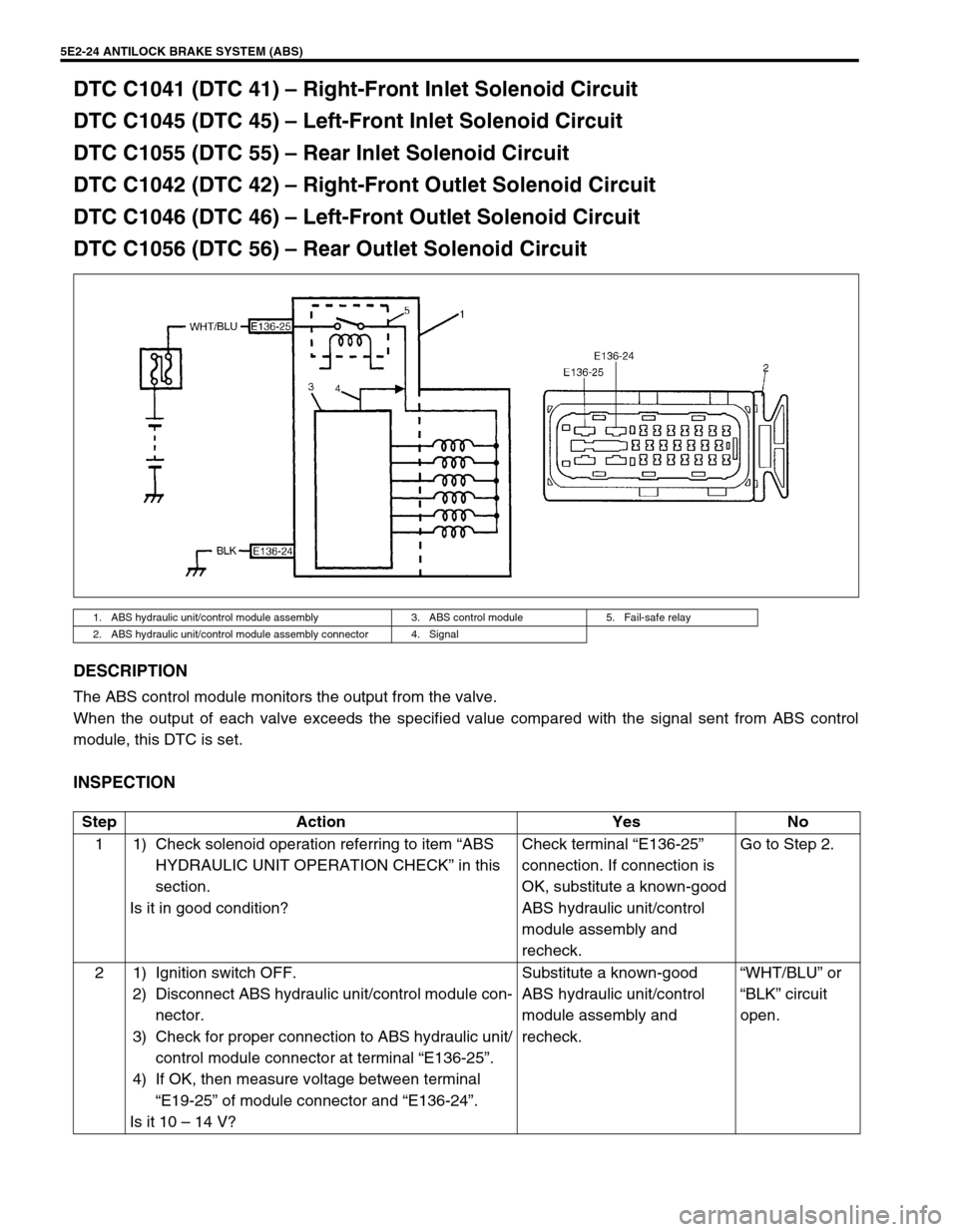
DTC C1041 (DTC 41) – Right-Front Inlet Solenoid Circuit
DTC C1045 (DTC 45) – Left-Front Inlet Solenoid Circuit
DTC C1055 (DTC 55) – Rear Inlet Solenoid Circuit
DTC C1042 (DTC 42) – Right-Front Outlet Solenoid Circuit
DTC C1046 (DTC 46) – Left-Front Outlet Solenoid Circuit
DTC C1056 (DTC 56) – Rear Outlet Solenoid Circuit
DESCRIPTION
The ABS control module monitors the output from the valve.
When the output of each valve exceeds the specified value compared with the signal sent from ABS control
module, this DTC is set.
INSPECTION
1. ABS hydraulic unit/control module assembly 3. ABS control module 5. Fail-safe relay
2. ABS hydraulic unit/control module assembly connector 4. Signal
Step Action Yes No
1 1) Check solenoid operation referring to item “ABS
HYDRAULIC UNIT OPERATION CHECK” in this
section.
Is it in good condition?Check terminal “E136-25”
connection. If connection is
OK, substitute a known-good
ABS hydraulic unit/control
module assembly and
recheck.Go to Step 2.
2 1) Ignition switch OFF.
2) Disconnect ABS hydraulic unit/control module con-
nector.
3) Check for proper connection to ABS hydraulic unit/
control module connector at terminal “E136-25”.
4) If OK, then measure voltage between terminal
“E19-25” of module connector and “E136-24”.
Is it 10 – 14 V?Substitute a known-good
ABS hydraulic unit/control
module assembly and
recheck.“WHT/BLU” or
“BLK” circuit
open.