Section 8a SUZUKI GRAND VITARA 2001 2.G User Guide
[x] Cancel search | Manufacturer: SUZUKI, Model Year: 2001, Model line: GRAND VITARA, Model: SUZUKI GRAND VITARA 2001 2.GPages: 656, PDF Size: 14.31 MB
Page 18 of 656
MAINTENANCE AND LUBRICATION 0B-5
Maintenance Service
Engine and Emission Control
ITEM 1-1
Drive belt inspection and replacement
WATER PUMP AND GENERATOR DRIVE BELT INSPEC-
TION
1) Disconnect negative (–) cable at battery.
2) Inspect belt for cracks, cuts, deformation, wear and cleanli-
ness. If any defect exists, replace.
Check belt for tension.
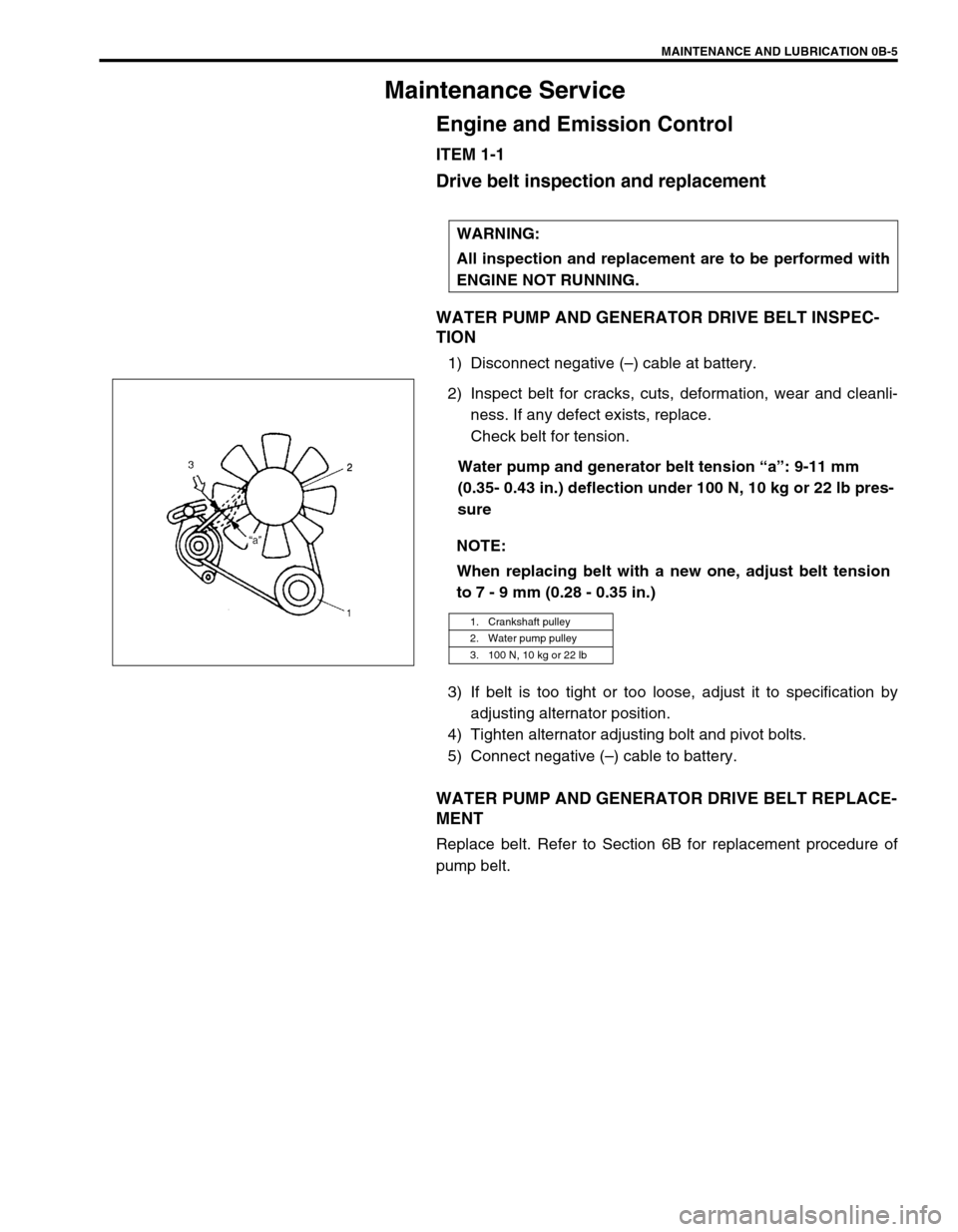
Water pump and generator belt tension “a”: 9-11 mm
(0.35- 0.43 in.) deflection under 100 N, 10 kg or 22 lb pres-
sure
3) If belt is too tight or too loose, adjust it to specification by
adjusting alternator position.
4) Tighten alternator adjusting bolt and pivot bolts.
5) Connect negative (–) cable to battery.
WATER PUMP AND GENERATOR DRIVE BELT REPLACE-
MENT
Replace belt. Refer to Section 6B for replacement procedure of
pump belt.WARNING:
All inspection and replacement are to be performed with
ENGINE NOT RUNNING.
NOTE:
When replacing belt with a new one, adjust belt tension
to 7 - 9 mm (0.28 - 0.35 in.)
1. Crankshaft pulley
2. Water pump pulley
3. 100 N, 10 kg or 22 lb
Page 19 of 656
0B-6 MAINTENANCE AND LUBRICATION
POWER STEERING PUMP AND/OR A/C COMPRESSOR
DRIVE BELTS (IF EQUIPPED) INSPECTION
1) Disconnect negative (–) cable at battery.
2) Inspect belt for cracks, cuts, deformation, wear and cleanli-
ness. If any defect exists, replace.
Check belt for tension.
If belt tension is out of above specification, adjust it referring
to Section 1B or 3B1.
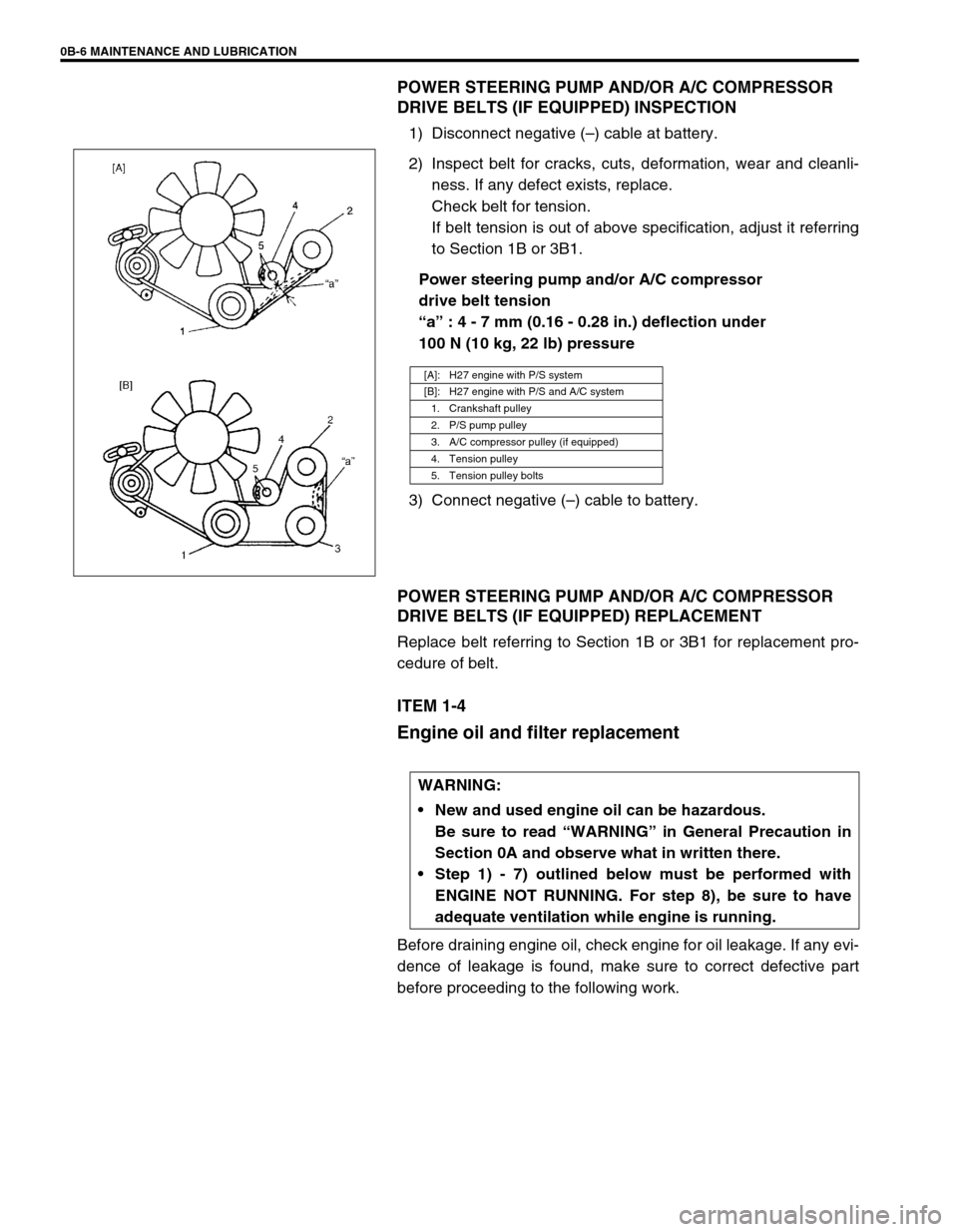
Power steering pump and/or A/C compressor
drive belt tension
“a” : 4 - 7 mm (0.16 - 0.28 in.) deflection under
100 N (10 kg, 22 lb) pressure
3) Connect negative (–) cable to battery.
POWER STEERING PUMP AND/OR A/C COMPRESSOR
DRIVE BELTS (IF EQUIPPED) REPLACEMENT
Replace belt referring to Section 1B or 3B1 for replacement pro-
cedure of belt.
ITEM 1-4
Engine oil and filter replacement
Before draining engine oil, check engine for oil leakage. If any evi-
dence of leakage is found, make sure to correct defective part
before proceeding to the following work.
[A]: H27 engine with P/S system
[B]: H27 engine with P/S and A/C system
1. Crankshaft pulley
2. P/S pump pulley
3. A/C compressor pulley (if equipped)
4. Tension pulley
5. Tension pulley bolts
WARNING:
New and used engine oil can be hazardous.
Be sure to read “WARNING” in General Precaution in
Section 0A and observe what in written there.
Step 1) - 7) outlined below must be performed with
ENGINE NOT RUNNING. For step 8), be sure to have
adequate ventilation while engine is running.
Page 22 of 656
HEATER AND VENTILATION 1A-1
1A
SECTION 1A
HEATER AND VENTILATION
CONTENTS
General Description ....................................... 1A-2
Rear Duct ..................................................... 1A-3
WARNING:
For vehicles equipped with Supplement Restraint (Air Bag) System:
Service on and around the air bag system components or wiring must be performed only by an
authorized SUZUKI dealer. Refer to “Air Bag System Components and Wiring Location View” under
“General Description” in Section 10B in order to confirm whether you are performing service on or
near the air bag system components or wiring. Please observe all WARNINGS and “Service Precau-
tions” under “On-Vehicle Service” in Section 10B before performing service on or around the air
bag system components or wiring. Failure to follow WARNINGS could result in unintentional activa-
tion of the system or could render the system inoperative. Either or these two conditions may result
in severe injury.
Technical service work must be started at least 90 seconds after the ignition switch is turned to the
“LOCK” position and the negative cable is disconnected from the battery. Otherwise, the system
may be activated by reserve energy in the Sensing and Diagnostic Module (SDM).
NOTE:
For the descriptions (items) not found in this section, refer to the same section of the Service Manual
mentioned in FOREWORD of this manual.
Page 26 of 656
AIR CONDITIONING (OPTIONAL) 1B-1
1B
SECTION 1B
AIR CONDITIONING (OPTIONAL)
CONTENTS
General Description ....................................... 1B-3
Refrigerant Type .......................................... 1B-3
Refrigerant Flow of Air Conditioning System 1B-3
Major Components And Location ................. 1B-4
Diagnosis ........................................................ 1B-6
General ........................................................ 1B-6
Main A/C system (front A/C system) ........ 1B-6
Rear A/C system ...................................... 1B-8
Quickly Checking of Refrigerant Charge
(If Equipped with Sight Glass) ...................... 1B-9
Performance Diagnosis .............................. 1B-10
Performance diagnosis table .................. 1B-12
Detail diagnosis table (at ambient temperature within 30 - 35 °C
(85 - 95 °F)) ............................................ 1B-13
Wiring Circuit.............................................. 1B-14
Inspection of A/C Controller and Its
Circuits ....................................................... 1B-15
Voltage check......................................... 1B-15
Refrigerant Recovery, Evacuation and
Charging ....................................................... 1B-19
Operation Procedure for Charging A/C with
Refrigerant ................................................. 1B-19
Recovery .................................................... 1B-20
Evacuating ................................................. 1B-21
Evacuating procedure ............................ 1B-21
Checking system for pressure leaks ...... 1B-22 WARNING:
For vehicles equipped with Supplemental Restraint (Air Bag) System:
Service on and around the air bag system components or wiring must be performed only by an
authorized SUZUKI dealer. Refer to “Air Bag System Components and Wiring Location View” under
“General Description” in air bag system section in order to confirm whether you are performing ser-
vice on or near the air bag system components or wiring. Please observe all WARNINGS and “Ser-
vice Precautions” under “On-Vehicle Service” in air bag system section before performing service
on or around the air bag system components or wiring. Failure to follow WARNINGS could result in
unintentional activation of the system or could render the system inoperative. Either of these two
conditions may result in severe injury.
Technical service work must be started at least 90 seconds after the ignition switch is turned to the
“LOCK” position and the negative cable is disconnected from the battery. Otherwise, the system
may be activated by reserve energy in the Sensing and Diagnostic Module (SDM).
CAUTION:
The air conditioning system of this vehicle uses refrigerant HFC-134a (R-134a).
None of refrigerant, compressor oil and component parts is interchangeable between two types of
A/C: one using refrigerant CFC-12 (R-12) and the other using refrigerant HFC-134a (R-134a).
Be sure to check which refrigerant is used before any service work including inspection and mainte-
nance. For identification between these two types, refer to “REFRIGERANT TYPE” in this section.
When replenishing or changing refrigerant and compressor oil and when replacing parts, make sure
that the material or the part to be used is appropriate to the A/C installed in the vehicle being serviced.
Use of incorrect one will result in leakage of refrigerant, damage in parts or other faulty condition.
NOTE:
For the descriptions (items) not found in this section, refer to the same section of the Service Man-
ual mentioned in FOREWORD of this manual.
For basic servicing method of the air conditioning system that is not described in this section, refer
to “AIR CONDITIONING BASIC MANUAL (99520-02130)”.
Page 28 of 656
AIR CONDITIONING (OPTIONAL) 1B-3
General Description
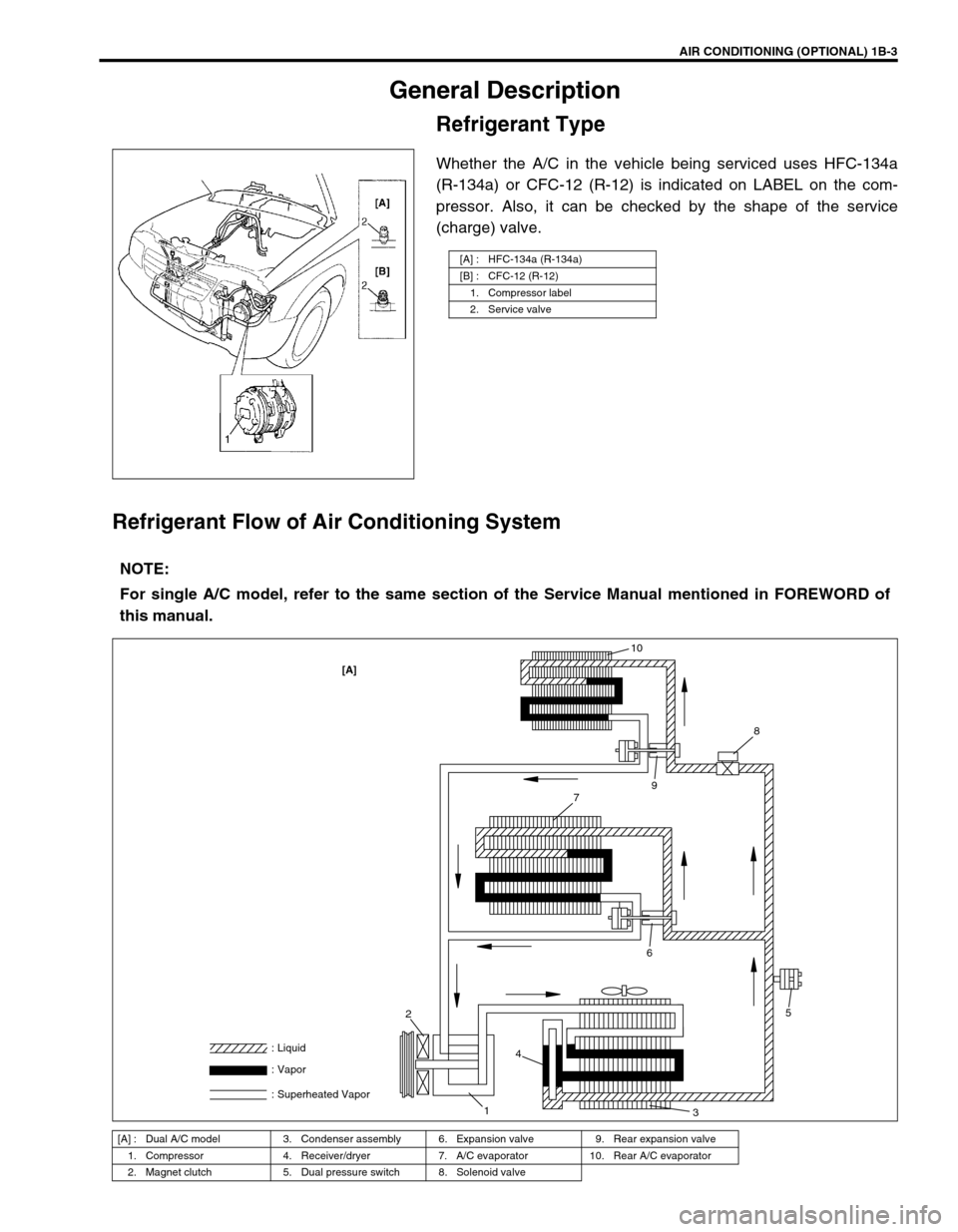
Refrigerant Type
Whether the A/C in the vehicle being serviced uses HFC-134a
(R-134a) or CFC-12 (R-12) is indicated on LABEL on the com-
pressor. Also, it can be checked by the shape of the service
(charge) valve.
Refrigerant Flow of Air Conditioning System
[A] : HFC-134a (R-134a)
[B] : CFC-12 (R-12)
1. Compressor label
2. Service valve
NOTE:
For single A/C model, refer to the same section of the Service Manual mentioned in FOREWORD of
this manual.
[A] : Dual A/C model 3. Condenser assembly 6. Expansion valve 9. Rear expansion valve
1. Compressor 4. Receiver/dryer 7. A/C evaporator 10. Rear A/C evaporator
2. Magnet clutch 5. Dual pressure switch 8. Solenoid valve
[A]10
8
9
5
7
6
3
2
14 : Liquid
: Vapor
: Superheated Vapor
Page 34 of 656
AIR CONDITIONING (OPTIONAL) 1B-9
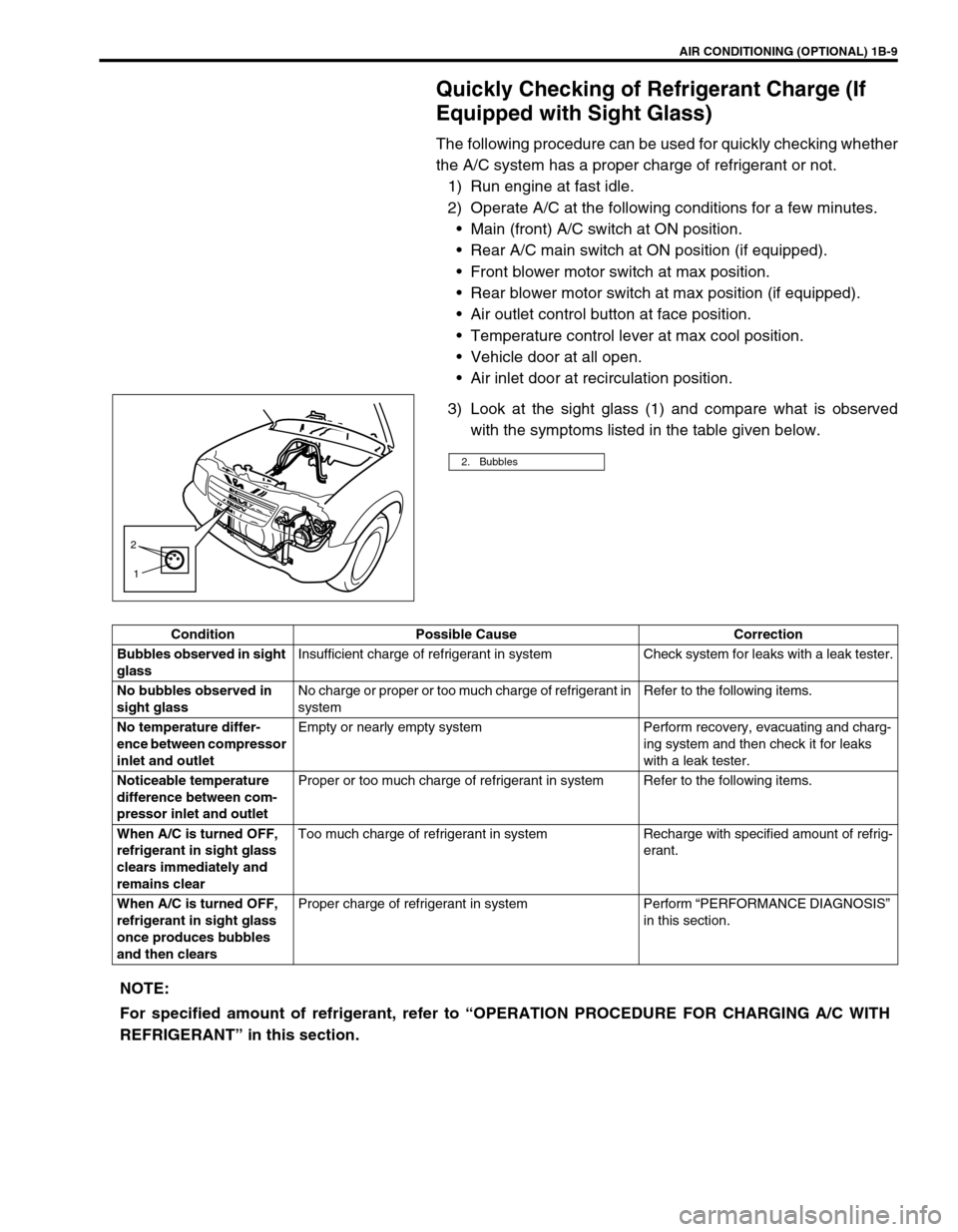
Quickly Checking of Refrigerant Charge (If
Equipped with Sight Glass)
The following procedure can be used for quickly checking whether
the A/C system has a proper charge of refrigerant or not.
1) Run engine at fast idle.
2) Operate A/C at the following conditions for a few minutes.
Main (front) A/C switch at ON position.
Rear A/C main switch at ON position (if equipped).
Front blower motor switch at max position.
Rear blower motor switch at max position (if equipped).
Air outlet control button at face position.
Temperature control lever at max cool position.
Vehicle door at all open.
Air inlet door at recirculation position.
3) Look at the sight glass (1) and compare what is observed
with the symptoms listed in the table given below.
2. Bubbles
2
1
Condition Possible Cause Correction
Bubbles observed in sight
glassInsufficient charge of refrigerant in system Check system for leaks with a leak tester.
No bubbles observed in
sight glassNo charge or proper or too much charge of refrigerant in
systemRefer to the following items.
No temperature differ-
ence between compressor
inlet and outletEmpty or nearly empty system Perform recovery, evacuating and charg-
ing system and then check it for leaks
with a leak tester.
Noticeable temperature
difference between com-
pressor inlet and outletProper or too much charge of refrigerant in system Refer to the following items.
When A/C is turned OFF,
refrigerant in sight glass
clears immediately and
remains clearToo much charge of refrigerant in system Recharge with specified amount of refrig-
erant.
When A/C is turned OFF,
refrigerant in sight glass
once produces bubbles
and then clearsProper charge of refrigerant in system Perform “PERFORMANCE DIAGNOSIS”
in this section.
NOTE:
For specified amount of refrigerant, refer to “OPERATION PROCEDURE FOR CHARGING A/C WITH
REFRIGERANT” in this section.
Page 37 of 656
1B-12 AIR CONDITIONING (OPTIONAL)
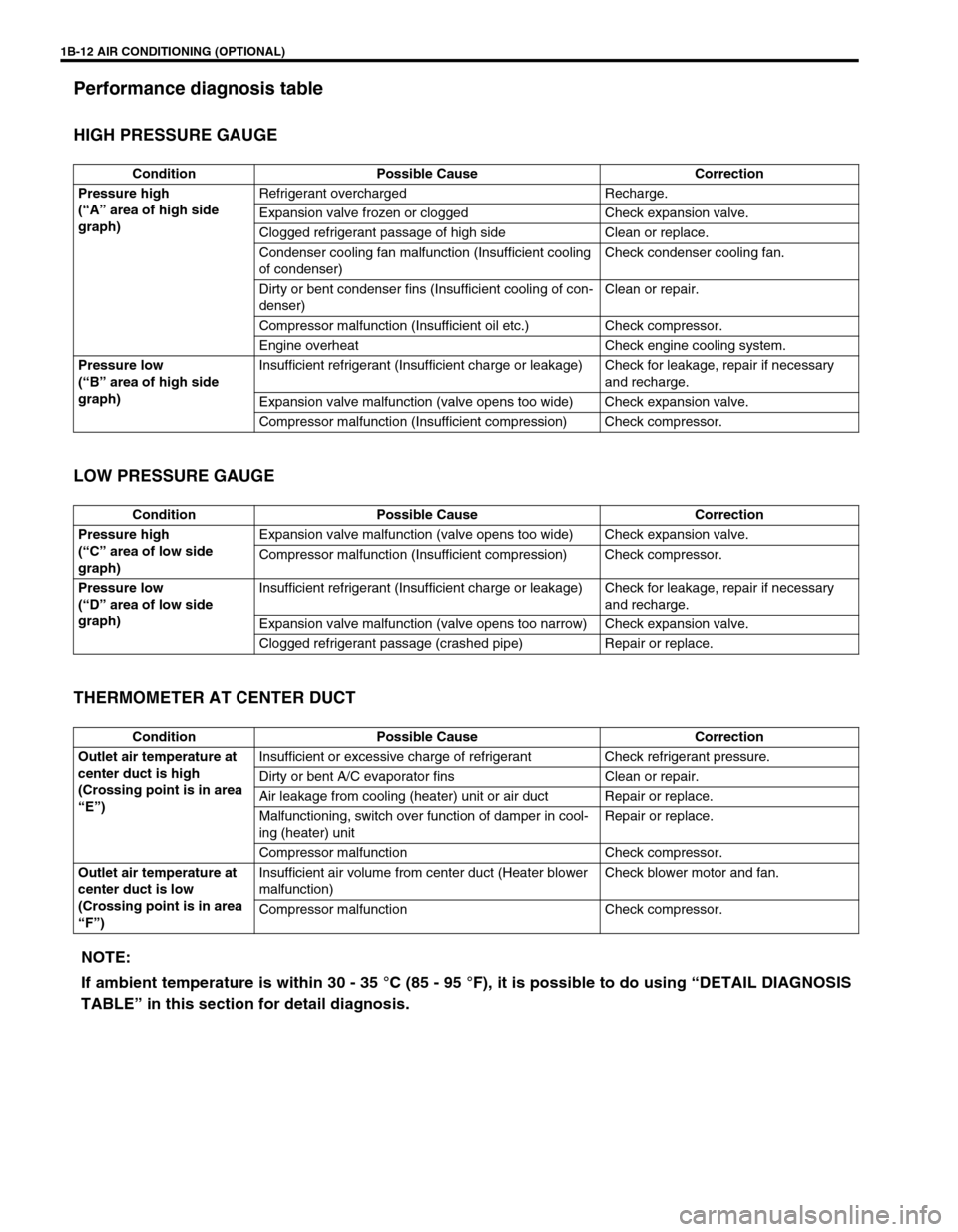
Performance diagnosis table
HIGH PRESSURE GAUGE
LOW PRESSURE GAUGE
THERMOMETER AT CENTER DUCT
Condition Possible Cause Correction
Pressure high
(“A” area of high side
graph)Refrigerant overcharged Recharge.
Expansion valve frozen or clogged Check expansion valve.
Clogged refrigerant passage of high side Clean or replace.
Condenser cooling fan malfunction (Insufficient cooling
of condenser)Check condenser cooling fan.
Dirty or bent condenser fins (Insufficient cooling of con-
denser)Clean or repair.
Compressor malfunction (Insufficient oil etc.) Check compressor.
Engine overheat Check engine cooling system.
Pressure low
(“B” area of high side
graph)Insufficient refrigerant (Insufficient charge or leakage) Check for leakage, repair if necessary
and recharge.
Expansion valve malfunction (valve opens too wide) Check expansion valve.
Compressor malfunction (Insufficient compression) Check compressor.
Condition Possible Cause Correction
Pressure high
(“C” area of low side
graph)Expansion valve malfunction (valve opens too wide) Check expansion valve.
Compressor malfunction (Insufficient compression) Check compressor.
Pressure low
(“D” area of low side
graph)Insufficient refrigerant (Insufficient charge or leakage) Check for leakage, repair if necessary
and recharge.
Expansion valve malfunction (valve opens too narrow) Check expansion valve.
Clogged refrigerant passage (crashed pipe) Repair or replace.
Condition Possible Cause Correction
Outlet air temperature at
center duct is high
(Crossing point is in area
“E”)Insufficient or excessive charge of refrigerant Check refrigerant pressure.
Dirty or bent A/C evaporator fins Clean or repair.
Air leakage from cooling (heater) unit or air duct Repair or replace.
Malfunctioning, switch over function of damper in cool-
ing (heater) unitRepair or replace.
Compressor malfunction Check compressor.
Outlet air temperature at
center duct is low
(Crossing point is in area
“F”)Insufficient air volume from center duct (Heater blower
malfunction)Check blower motor and fan.
Compressor malfunction Check compressor.
NOTE:
If ambient temperature is within 30 - 35 °C (85 - 95 °F), it is possible to do using “DETAIL DIAGNOSIS
TABLE” in this section for detail diagnosis.
Page 40 of 656
AIR CONDITIONING (OPTIONAL) 1B-15
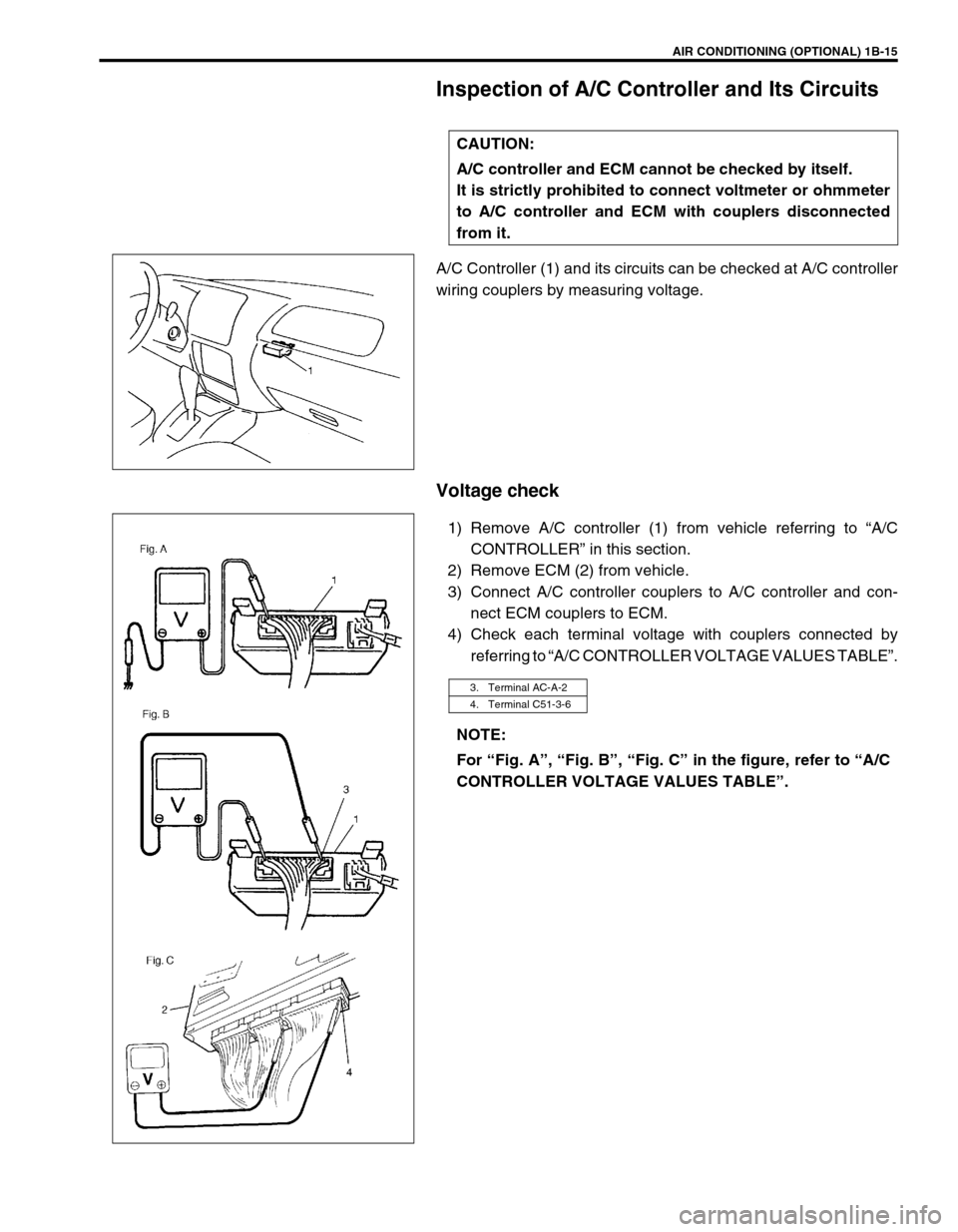
Inspection of A/C Controller and Its Circuits
A/C Controller (1) and its circuits can be checked at A/C controller
wiring couplers by measuring voltage.
Voltage check
1) Remove A/C controller (1) from vehicle referring to “A/C
CONTROLLER” in this section.
2) Remove ECM (2) from vehicle.
3) Connect A/C controller couplers to A/C controller and con-
nect ECM couplers to ECM.
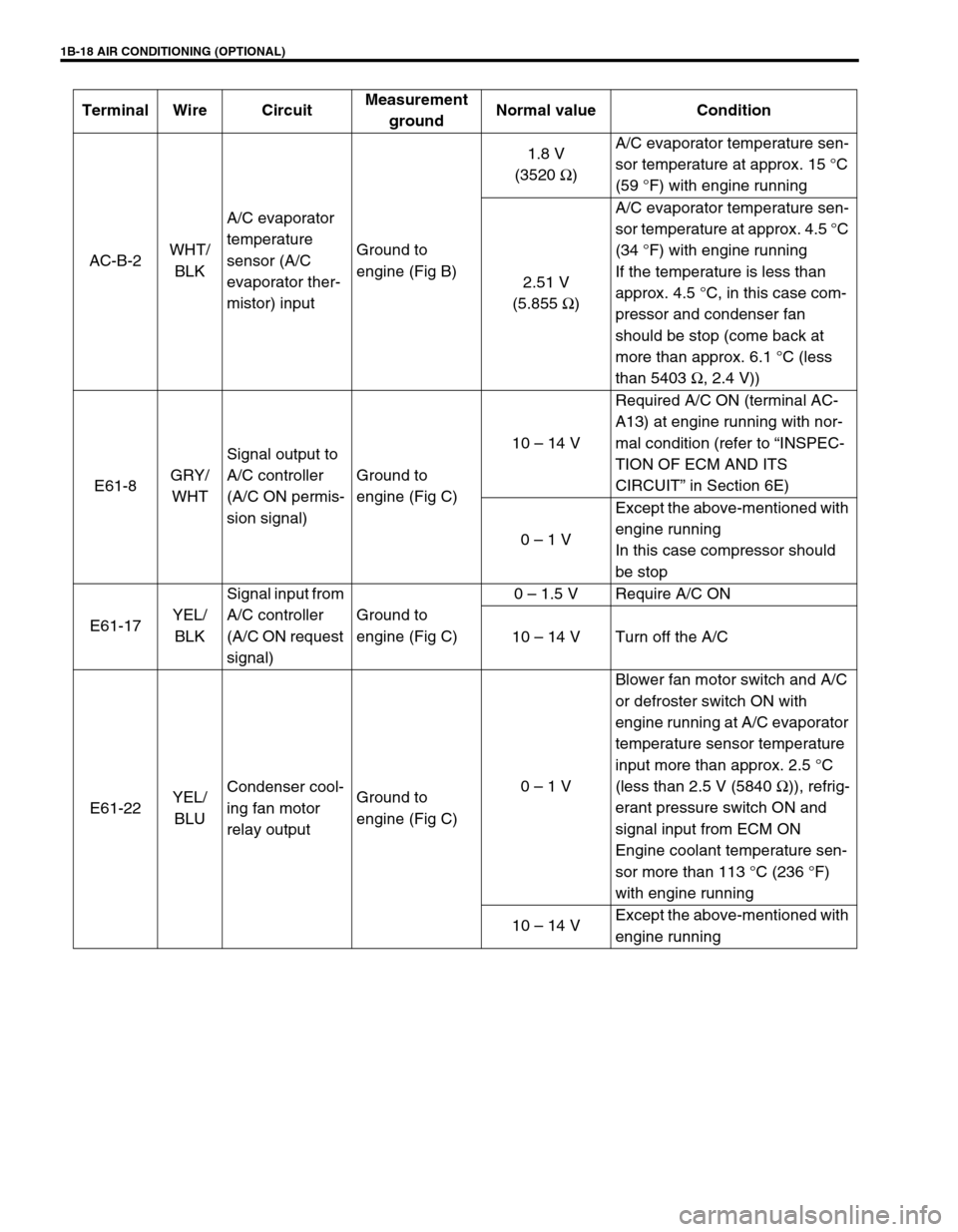
4) Check each terminal voltage with couplers connected by
referring to “A/C CONTROLLER VOLTAGE VALUES TABLE”. CAUTION:
A/C controller and ECM cannot be checked by itself.
It is strictly prohibited to connect voltmeter or ohmmeter
to A/C controller and ECM with couplers disconnected
from it.
3. Terminal AC-A-2
4. Terminal C51-3-6
NOTE:
For “Fig. A”, “Fig. B”, “Fig. C” in the figure, refer to “A/C
CONTROLLER VOLTAGE VALUES TABLE”.
Page 43 of 656
1B-18 AIR CONDITIONING (OPTIONAL)
Terminal Wire CircuitMeasurement
groundNormal value Condition
AC-B-2WHT/
BLKA/C evaporator
temperature
sensor (A/C
evaporator ther-
mistor) inputGround to
engine (Fig B)1.8 V
(3520 Ω)A/C evaporator temperature sen-
sor temperature at approx. 15 °C
(59 °F) with engine running
2.51 V
(5.855 Ω)A/C evaporator temperature sen-
sor temperature at approx. 4.5 °C
(34 °F) with engine running
If the temperature is less than
approx. 4.5 °C, in this case com-
pressor and condenser fan
should be stop (come back at
more than approx. 6.1 °C (less
than 5403 Ω, 2.4 V))
E61-8GRY/
WHTSignal output to
A/C controller
(A/C ON permis-
sion signal)Ground to
engine (Fig C)10 – 14 VRequired A/C ON (terminal AC-
A13) at engine running with nor-
mal condition (refer to “INSPEC-
TION OF ECM AND ITS
CIRCUIT” in Section 6E)
0 – 1 VExcept the above-mentioned with
engine running
In this case compressor should
be stop
E61-17YEL/
BLKSignal input from
A/C controller
(A/C ON request
signal)Ground to
engine (Fig C)0 – 1.5 V Require A/C ON
10 – 14 V Turn off the A/C
E61-22YEL/
BLUCondenser cool-
ing fan motor
relay outputGround to
engine (Fig C)0 – 1 VBlower fan motor switch and A/C
or defroster switch ON with
engine running at A/C evaporator
temperature sensor temperature
input more than approx. 2.5 °C
(less than 2.5 V (5840 Ω)), refrig-
erant pressure switch ON and
signal input from ECM ON
Engine coolant temperature sen-
sor more than 113 °C (236 °F)
with engine running
10 – 14 VExcept the above-mentioned with
engine running
Page 50 of 656
AIR CONDITIONING (OPTIONAL) 1B-25
On-Vehicle Service
Precaution
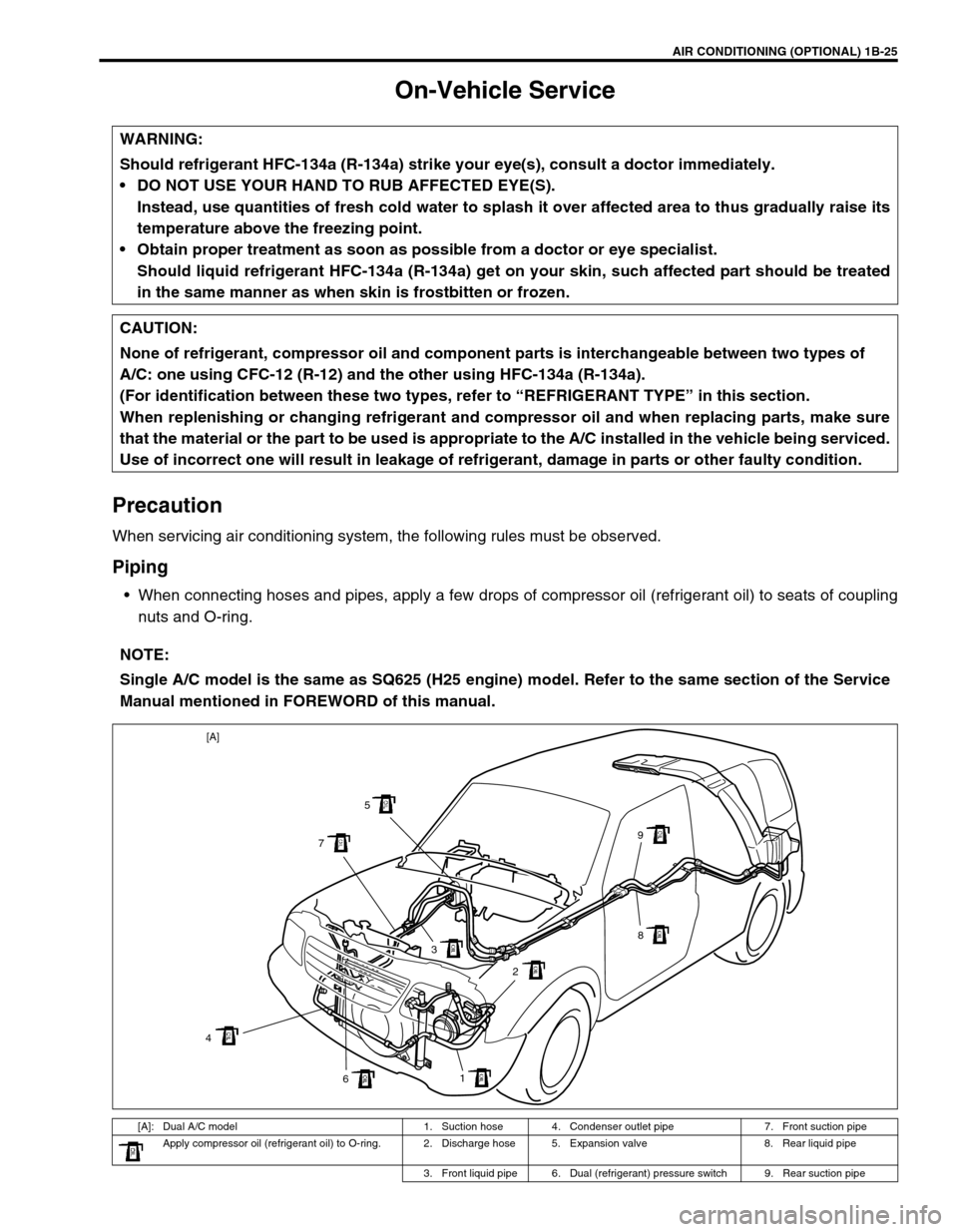
When servicing air conditioning system, the following rules must be observed.
Piping
When connecting hoses and pipes, apply a few drops of compressor oil (refrigerant oil) to seats of coupling
nuts and O-ring. WARNING:
Should refrigerant HFC-134a (R-134a) strike your eye(s), consult a doctor immediately.
DO NOT USE YOUR HAND TO RUB AFFECTED EYE(S).
Instead, use quantities of fresh cold water to splash it over affected area to thus gradually raise its
temperature above the freezing point.
Obtain proper treatment as soon as possible from a doctor or eye specialist.
Should liquid refrigerant HFC-134a (R-134a) get on your skin, such affected part should be treated
in the same manner as when skin is frostbitten or frozen.
CAUTION:
None of refrigerant, compressor oil and component parts is interchangeable between two types of
A/C: one using CFC-12 (R-12) and the other using HFC-134a (R-134a).
(For identification between these two types, refer to “REFRIGERANT TYPE” in this section.
When replenishing or changing refrigerant and compressor oil and when replacing parts, make sure
that the material or the part to be used is appropriate to the A/C installed in the vehicle being serviced.
Use of incorrect one will result in leakage of refrigerant, damage in parts or other faulty condition.
NOTE:
Single A/C model is the same as SQ625 (H25 engine) model. Refer to the same section of the Service
Manual mentioned in FOREWORD of this manual.
[A]: Dual A/C model 1. Suction hose 4. Condenser outlet pipe 7. Front suction pipe
Apply compressor oil (refrigerant oil) to O-ring. 2. Discharge hose 5. Expansion valve 8. Rear liquid pipe
3. Front liquid pipe 6. Dual (refrigerant) pressure switch 9. Rear suction pipe
1
6 43 75
9
8
2 [A]